Queen Liliuokalani’s gift to the leprosy patients, 1891.

GIFT OF ALOHA TO THE LEPROSY PATIENTS AT KALIHI.

We each all are going without a companion at our side, and no child before us or at our back, it is just our lone bodies going naked to the Colony of Kalawao, and there is no way out of it for us for there is the law of our beloved land upon our shoulders.

These red silk kerchiefs which you see on our necks, and your sums of money in our hands this day, it is a memorial for us during the days of our lives in this dejected world, until the dust of that unfamiliar land is spread upon our bodies, and this decaying body returns to the earth, and the spirit returns to God.

Therefore, may your majesty take our great thanks for you. And that is when the Queen replied:

I take your thanks with me, and you will go and you will see my children, those are your seniors living upon that great flat lands, and perhaps we will all be there, but we do not know.

This was the touching statement, and the close to the conversation with the Queen.

Here are the names of the patients taken and their place of residence.

Miss Helina Kaiwaokalani Maikai, Miss Kaehuokalani, Miss M. Kalama [? Miss M. Kalaina], they are from Honolulu; Napoliona Keawe (m), from Manoa, Oahu; Miss Mapo (f), Kahaku (m), from Waialua, Oahu; Ah Ping from Hanalei, Kauai; Henry Keku, Akoi, from Wailuku; Alualu (f), Ulunui (f) from Waikapu; Maraea Kaluna from Olowalu; Liwai Haalelea from Kukuihaele, Hawaii.

These are the patients left at the receiving station of Kalihi:

W. K. Makakoa, G. K. Kepoikai, from Waiehu, Maui; Josiah Kaina from Lihue, Kauai; William Kalani Kalua from Puako, Waimea, Hawaii.

These are the patients who have not been examined by the Doctors:

Keopuhiwa from Hana; Keoahu (f), and Huliwaa (f), and Lutiana Keliikaapuni (f), from Kaupo, Maui; and Joe, a Portuguese boy from Honolulu.

On the 17th of July, Mrs. Kaikioewa Ulukou gave gifts once again to the patients at Kalihi.

Aloha one and all.

WILLIE KALIKOKALANI.

Kalihi Hospital, July 20, 1891.

[Might anyone know how/if Liwai Haalelea and Levi Haalelea (d. 1864) are related?]

(Leo o ka Lahui, 7/29/1891, p. 2)

HE MAKANA ALOHA I NA MA'I LEPERA MA KALIHI.

Ka Leo o ka Lahui, Buke II, Helu 247, Aoao 2. Iulai 29, 1891.

Luau at Kaumakapili Church put on by Princess Liliuokalani, 1887.

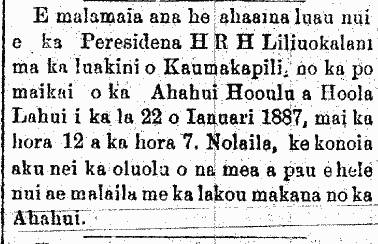
There will be a grand luau put on by the President, H. R. H. Liliuokalani, at Kaumakapili Church, for the benefit of the Hooulu and Hoola Lahui Society [Ahahui Hooulu a Hoola Lahui] on the 22nd of January 1887, from 12 to 7 o’clock. Therefore, the kindness of all is requested to come there with their donations for the Ahahui.

(Ko Hawaii Pae Aina, 1/15/1887, p. 4)

E malamaia ana he ahaaina luau...

Ko Hawaii Pae Aina, Buke X, Helu 3, Aoao 4. Ianuari 15, 1887.

Names of the stevedores who participate in Queen Liliuokalani’s funeral, 1917.

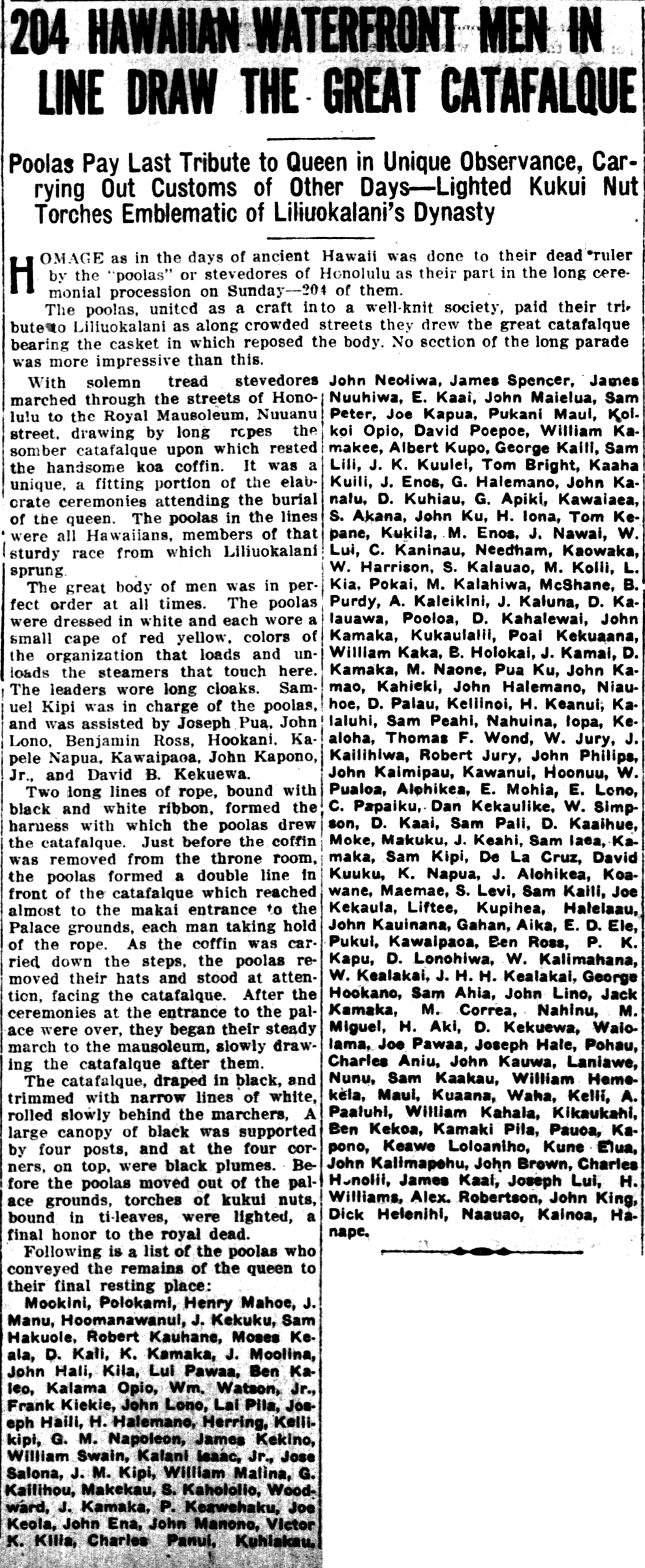
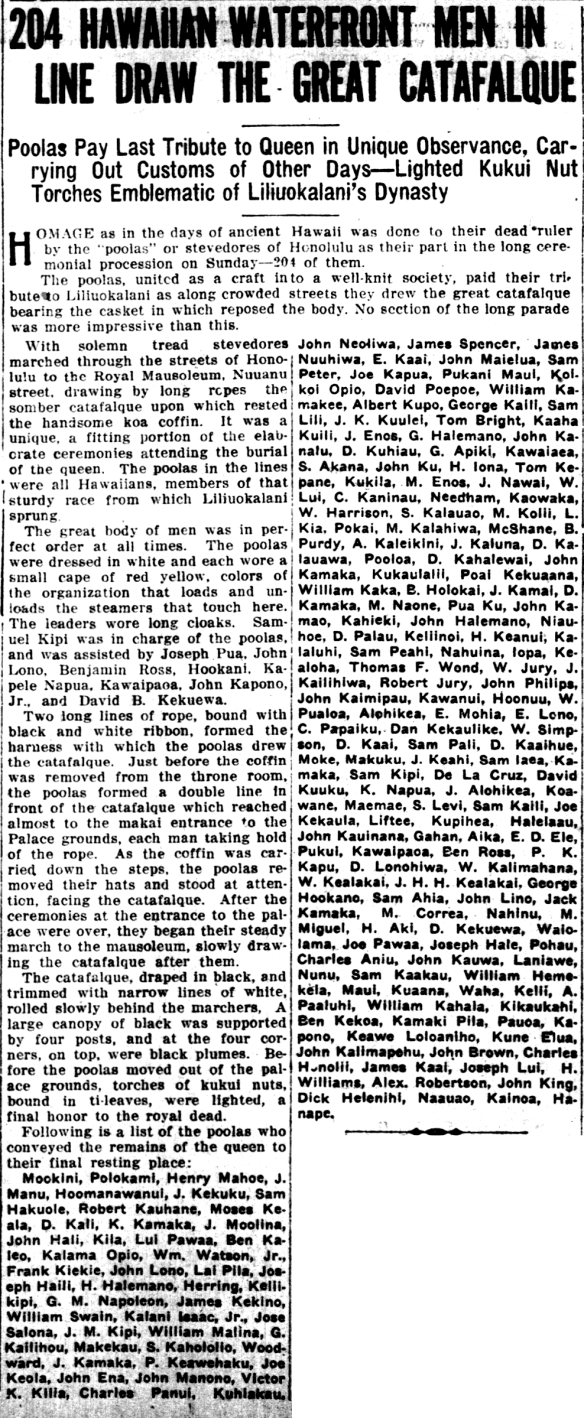
204 HAWAIIAN WATERFRONT MEN IN LINE DRAW THE GREAT CATAFALQUE

Poolas Pay Last Tribute to Queen in Unique Observance, Carrying Out Customs of Other Days—Lighted Kukui Nut Torches Emblematic of Liliuokalani’s Dynasty

HOMAGE as in the days of ancient Hawaii was done to their dead ruler by the “poolas” or stevedores of Honolulu as their part in the long ceremonial procession on Sunday—204 of them.

The poolas, untied as a craft into a well-knit society, paid their tribute to Liliuokalani as along crowded streets they drew the great catafalque bearing the casket in which reposed the body. No section of the long parade was more impressive than this.

With solemn tread stevedores marched through the streets of Honolulu to the Royal Mausoleum, Nuuanu street, drawing by long ropes the somber catafalque upon which rested the handsome koa coffin. It was a unique, fitting portion of the elaborate ceremonies attending the burial of the queen. The poolas in the lines were all Hawaiians, members of that sturdy race from which Liliuokalani sprung.

The great body of men was in perfect order at all times. The poolas were dressed in white and each wore a small cape of red yellow, colors of the organization that loads and unloads the steamers that touch here. The leaders wore long cloaks. Samuel Kipi was in charge of the poolas, and was assisted by Joseph Pua, John Lono, Benjamin Ross, Hookani, Kapele Napua, Kawaipaoa, John Kapono, Jr., and David B. Kekuewa.

Two long lines of ropes, bound with black and white ribbon, formed the harness with which the poolas drew the catafalque. Just before the coffin was removed from the throne room, the poolas formed a double line in front of the catafalque which reached almost to the makai entrance to the Palace grounds, each man taking hold of the rope. as the coffin was carried down the steps, the poolas removed their hats and stood at attention, facing the catafalque. After the ceremonies at the entrance to the palace were over, they began their steady march to the mausoleum, slowly drawing the catafalque after them.

The catafalque, draped in black, and trimmed with narrow lines of white, rolled slowly behind the marchers. A large canopy of black was supported by four posts, and at the four corners, on top, were black plumes. Before the poolas moved out of the palace grounds, torches of kukui nuts, bound in ti-leaves, were lighted, a final honor to the royal dead.

Following is a list of the poolas who conveyed the remains of the queen to their final resting place:

Mookini, Polokami, Henry Mahoe, J. Manu, Hoomanawanui, J. Kekuku, Sam Hakuole, Robert Kauhane, Moses Keala, D. Kali, K. Kamaka, J. Moolina, John Hali, Kila, Lui Pawaa, Ben Kaleo, Kalama Opio, William Watson, Jr., Frank Kiekie, John Lono, Lai Pila, Joseph Haili, H. Halemano, Herring, Keliikipi, G. M. Napoleon, James Kekino, William Swain, Kalani Isaac, Jr., Jose Salona, J. M. Kipi, William Malina, G. Kailihou, Makekau, S. Kahololio, Woodward, J. Kamaka, P. Keawehaku, Joe Keola, John Ena, John Manono, Victor K. Kilia, Charles Panui, Kuhiakau, John Neoliwa, James Spencer, James Nuuhiwa, E. Kaai, John Maielua, Sam Peter, Joe Kapua, Pukani Maui, Koikoi Opio, David Poepoe, William Kamakee, Albert Kupo, George Kaili, Sam Lili, J. K. Kuulei, Tom Bright, Kaaha Kuili, J. Enos, G. Halemano, John Kanalu, D. Kuhiau, G. Apiki, Kawaiaea, S. Akana, John Ku, H. Iona, Tom Kepane, Kukila, M. Enos, J. Nawai, W. Lui, C. Kaninau, Needham, Kaowaka, W. Harrison, S. Kalauao, M. Koili, L. Kia, Pokai, M. Kalahiwa, McShane, B. Purdy, A. Kaleikini, J. Kaluna, D. Kalauawa, Pooloa, D. Kahalewai, John Kamaka, Kukaulaili, Poai Kekuaana, William Kaka, B. Holokai, J. Kamai, D. Kamaka, M. Naone, Pua Ku, John Kamao, Kahieki, John Halemano, Niauhoe, D. Palau, Keliinoi, H. Keanui, Kalaluhi, Sam Peahi, Nahuina, Iopa, Kealoha, Thomas F. Wond, W. Jury, J. Kailihiwa, Robert Jury, John Philips, John Kaimipau, Kawanui, Hoonuu, W. Pualoa, Alohikea, E. Mohia, E. Lono, C. Papaiku, Dan Kekaulike, W. Simpson, D. Kaai, Sam Pali, D. Kaaihue, Moke, Makuku, J. Keahi, Sam Iaea, Kamaka, Sam Kipi, De La Cruz, David Kuuku, K. Napua, J. Alohikea, Koawane, Maemae, S. Levi, Sam Kaili, Joe Kekaula, Liftee, Kupihea, Halelaau, John Kauinana, Kahan, Aika, E. D. Ele, Pukui, Kawaipaoa, Ben Ross, P. K. Kapu, D. Lonohiwa, W. Kalimahana, W. Kealakai, J. H. H. Kealakai, George Hookano, Sam Ahia, John Lino, Jack Kamaka, M. Correa, Nahinu, M. Miguel, H. Aki, D. Kekuewa, Waiolama, Joe Pawaa, Joseph Hale, Pohau, Charles Aniu, John Kauwa, Laniawe, Nunu, Sam Kaakau, William Hemekela, Maui, Kuaana, Waha, Kelli, A. Paaluhi, William Kahala, Kikaukahi, Ben Kekoa, Kamaki Pila, Pauoa, Kapono, Keawe Loloaniho, Kune Elua, John Kalimapehu, John Brown, Charles Honolii, James Kaai, Joseph Lui, H. Williams, Alex. Robertson, John King, Dick Helenihi, Naauao, Kainoa, Hanape.

(Honolulu Star-Bulletin, 11/19/1917, p. 7)
204 HAWAIIAN WATERFRONT MEN IN LINE DRAW THE GREAT CATAFALQUE

Honolulu Star-Bulletin, Volume XXV, Number 7988, Page 7. November 19, 1917.

Birthday gifts for Princess Liliuokalani, 1886.

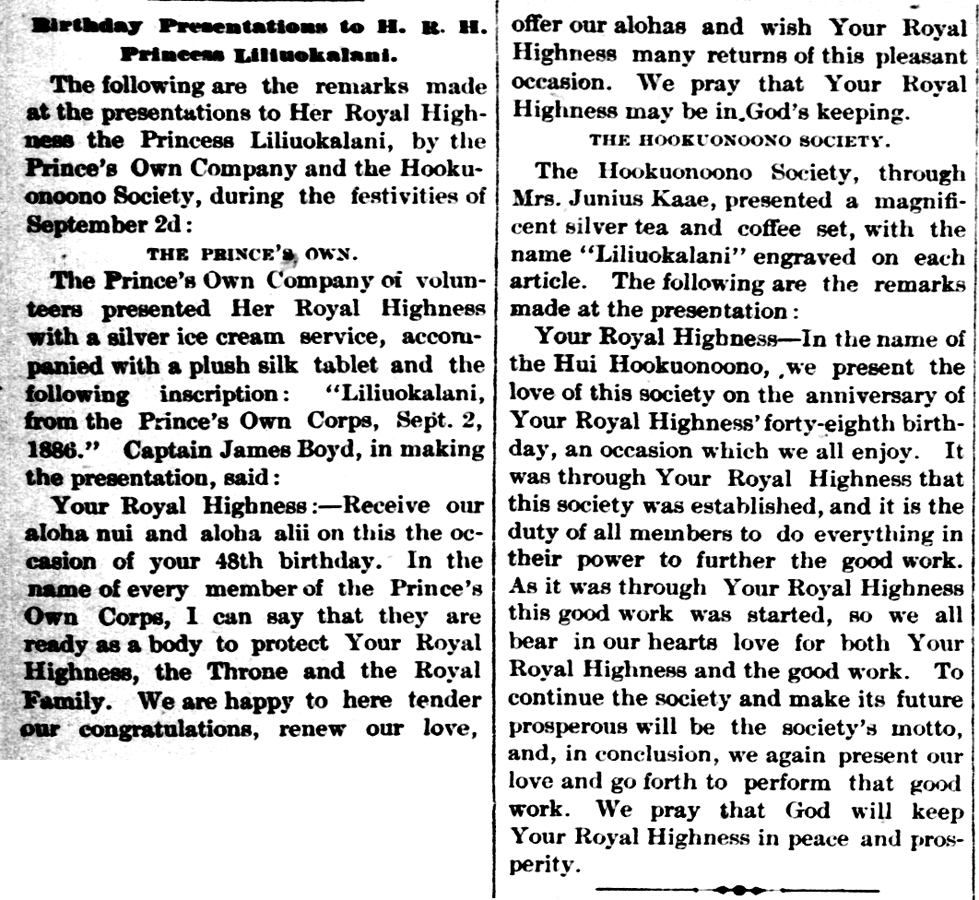
Birthday Presentations to H. R. H. Princess Liliuokalani.

The following are the remarks made at the presentation to Her Royal Highness the Princess Liliuokalani, by the Prince’s Own Company and the Hookuonoono Society, during the festivities of September 2d:

THE PRINCE’S OWN.

The Prince’s Own Company of volunteers presented Her Royal Highness with a silver ice cream service, accompanied with a plush silk tablet and the following inscription: “Liliuokalani, from the Prince’s Own Corps, Sept. 2, 1886.” Captain James Boyd, in making the presentation, said:

Your Royal Highness:—Receive our aloha nui and aloha alii on this the occasion of your 48th birthday. In the name of every member of the Prince’s Own Corps, I can say that they are ready as a body to protect Your Royal Highness, the Throne and the Royal Family. We are happy to here tender our congratulations, renew our love, offer our alohas and wish Your Royal Highness many returns of this pleasant occasion. We pray that Your Royal Highness may be in God’s keeping.

THE HOOKUONOONO SOCIETY.

The Hookuonoono Society, through Mrs. Junius Kaae, presented a magnificent silver tea and coffee set, with the name “Liliuokalani” engraved on each article. The following are the remarks made at the presentation:

Your Royal Highness—In the name of the Hui Hookuonoono, we present the love of this society on the anniversary of Your Royal Highness’ forty-eighth birthday, an occasion which we all enjoy. It was through Your Royal Highness that this society was established, and it is the duty of all members to do everything in their power to further the good work. As it was through Your Royal Highness this good work was started, so we all bear in our hearts love for both Your Royal Highness and the good work. To continue the society and make its future prosperous will be the society’s motto, and, in conclusion, we again present our love and go forth to perform that good work. We pray that God will keep Your Royal Highness in peace and prosperity.

(Pacific Commercial Advertiser, 9/4/1886, p. 2)

Birthday Presentations to H. R. H. Princess Liliuokalani.

The Pacific Commercial Advertiser, Volume V. Number 212, Page 2. September 4, 1886.

A mele for the pāʻū of the Queen, 1893.

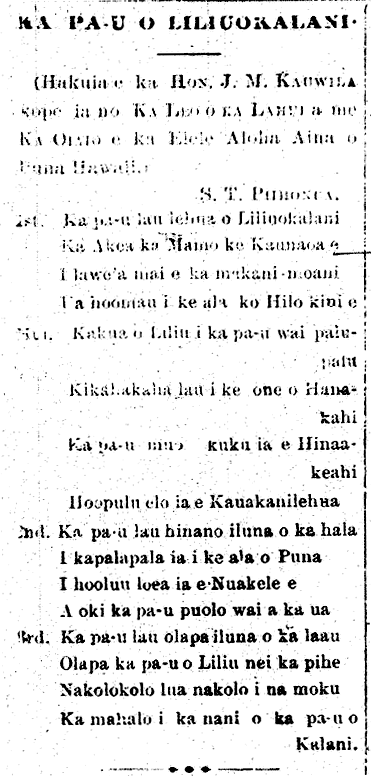
THE PA-U OF LILIUOKALANI

(Composed by the Hon. J. M. Kauwila, and copied for Ka Leo o ka Lahui and Ka Oiaio by the Aloha Aina Representative of Puna, Hawaii.)

S. T. Piihonua.

1st.  Ka pa-u lau lehua o Liliuokalani
Ka Akea [? Akoa] ka Mamo ke Kaunaoa e
I lawe’a mai e ka makani moani
Ua hoomau i ke ala ko Hilo kini e

Hui.  Kakua o Liliu i ka pa-u wai palupalu
Kikahakaha lau i ke one o Hanakahi
Ka pa-u muo kuku ia e Hinaakeahi
Hoopulu elo ia e Kauakanilehua

2nd.  Ka pa-u lau hinano iluna o ka hala
I kapalapala ia e ke ala o Puna
I hoolulu loea ia e Nuakele e
A oki ka pa-u puolo wai a ka ua

3rd.  Ka pa-u lau olapa iluna o ka laau
Olapa ka pa-u o Liliu nei ka pihe
Nakolokolo lua nakolo i na moku
Ka mahalo i ka nani o ka pa-u o Kalani.

(Leo o ka Lahui, 5/8/1893, p. 3)

KA PA-U O LILIUOKALANI

Ka Leo o ka Lahui, Buke II, Helu 700, Aoao 3. Mei 8, 1893.

Foreign birds set free by the Honorable Lilia Kamakaeha, 1870.

[Found under: “NU HOU KULOKO: Oahu.”]

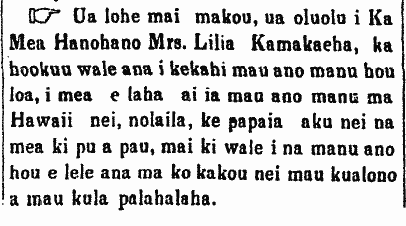
We hear that the Honorable Mrs. Lilia Kamakaeha was pleased at the releasing of some new kinds of birds so that they spread here in Hawaii nei. Therefore, all hunters are prohibited from shooting these new birds flying in our mountainsides and plains.

(Kuokoa, 10/1/1870, p. 2)

Ua lohe mai makou...

Ka Nupepa Kuokoa, Buke IX, Helu 40, Aoao 2. Okatoba 1, 1870.

“Ka Leialii o Hawaii,” another paper to keep your eyes out for! 1892 / Today.

KA LEIALII O HAWAII.

On Monday last another Hawaiian daily was issued, named as above, meaning in English “The Crown of Hawaii.” It flies for its motto of love of Sovereign, Country and People. It is evidently a Tory of the rankest kind, from its motto, and from royal patronage displayed in its columns, and the names of royalists on its stock subscription. We have had on intimation, ever since the election of February last, that something of the kind was to be inaugurated in defense of sovereignty; and the causes that produced the sand-bag scare, has succeeded in giving birth to a full fledged Tory fledgling. We congratulate the Queen, in having her admirers start a paper in her interest, though evidently scared out of them.

[I do not know of any extant copies of this paper. Has anyone seen or heard of it?]

(Leo o ka Lahui, 4/19/1892, p. 4)

KA LEIALII O HAWAII.

Ka Leo o ka Lahui, Buke II, Helu 435, Aoao 4. Aperila 19, 1892.

The Hawaiian Flag, an unwavering tree, 1893.

THE HAWAIIAN FLAG AT A GOVERNMENT OFFICE.

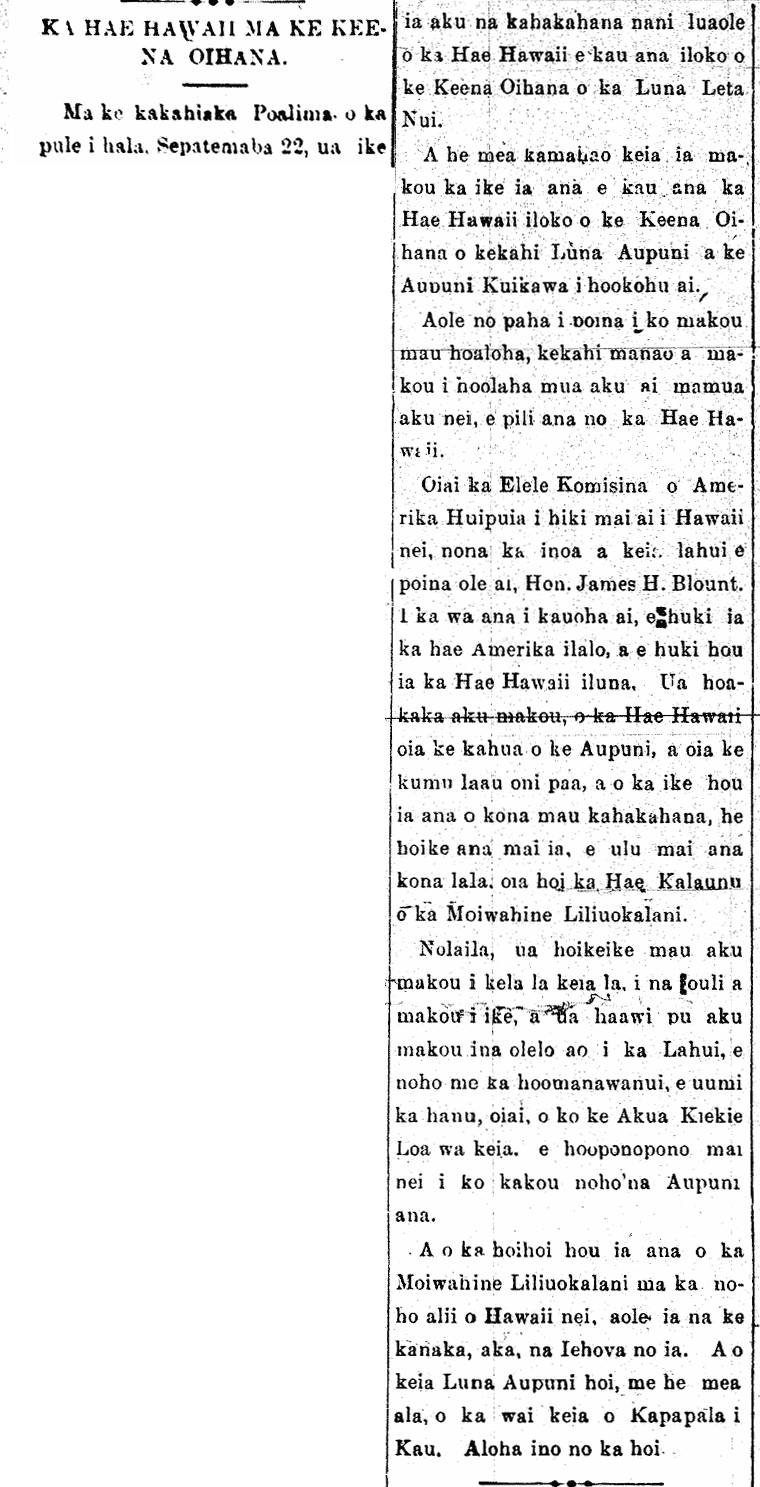
In the morning of Friday last week, September 22, the stripes of the Hawaiian Flag, second in beauty to no other, was seen in the Business Office of the Postmaster General [Luna Leta Nui].

And this is something astonishing for us to see that the Hawaiian Flag is placed in the Office of one of the Heads of Government appointed by the Provisional Government [Aupuni Kuikawa].

Our friends will perhaps not have forgotten the thoughts we published earlier pertaining to the Hawaiian Flag.

The Commissioner of the United States came to Hawaii, whose name will never be forgotten by this people, Hon. James H. Blount, When he ordered that the American flag be taken down and the Hawaiian Flag be raised once again. We made it clear that the Hawaiian Flag was the foundation of this Nation, and it is the unwavering tree; and seeing its stripes once more shows us that its branches are growing, that being the Royal Standard of Queen Liliuokalani.

Therefore we report to you each and everyday all the signs that we see, and we also give advice to the Lahui, to live with patience, to hold your breath, for it is Almighty God’s time now to make right our Nation’s leadership.

The reestablishing of Queen Liliuokalani to the throne of Hawaii nei, that is not something for man to do, but it is for Jehovah. And as for this Government Head, it is as if he is trying to cover up their wrongdoings.¹ How sad.

¹See Olelo Noeau, p. 313, no. 2859, for more on “Uhiuhi lau mamane ka wai o Kapapala.”

(Leo o ka Lahui, 9/25/1893, p. 3)

KA HAE HAWAII MA KE KEENA OIHANA.

Ka Leo o ka Lahui, Buke II, Helu 776, Aoao 3. Sepatemaba 25, 1893.

The current situation, 1893.

A VOICE OF ALOHA,

From the Queen, thus: O My beloved people, return to your homes, and keep the peace of the land. The voice of the alii has mana, and her command is in force. This is mana by which war will not be started; and the people will abide by her command.

The Overthrow of the Government.

This was an act that was planned in advance, and it is an act to gain glory. It’s foundation was laid by the group of missionaries and group of sugar planters, and on Jan. 17, 1893. Weapons were taken up, and the Government Building [Hale Aupuni] was seized by those treasonous ones.

The Annexation Committee.

There are five members of that Committee; They left, fled, and reached Washington; and they returned separately all with nothing to show and much embarrassment. [a hoi liiilii mai ana me na alaala pakahi ma ka a-i, he mai nui ka hilahila.]

The Deceitful Laws.

This Administration ended some parts of their bayonet constitution [kumukanawai elau-pu] of 1887, and enforced oppressive, limiting [?? paikole], and burdensome laws; these were laws not made by the Lahui, but by a group of just 17 people.

Bloodshed of Hawaiians.

There have been two Hawaiians whose blood has flowed unto the earth; they were shot with guns of the evil ones; However, they survived with their precious lives. It is God who spares Hawaii. This bloodshed of Hawaii’s own will become seeds from which will grow equal rights for the Lahui and the land. Rise together O Hawaii—and listen to the Gospel of Christ.

(Leo o ka Lahui, 10/13/1893, p. 2)

HE LEO ALOHA,

Ka Leo o ka Lahui, Buke II, Helu 790, Aoao 2. Okatoba 13, 1893.

Joseph Emerson interrupts meeting at the Kapuukolo Church, 1893.

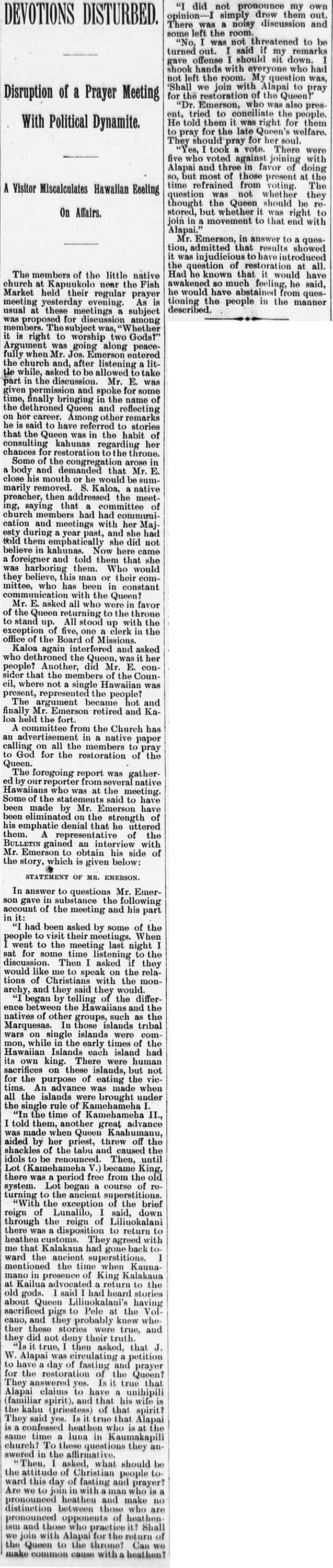
DEVOTIONS DISTURBED.

Disruption of a Prayer Meeting With Political Dynamite.

A Visitor Miscalculates Hawaiian Feeling On Affairs.

The members of the little native church at Kapuukolo near the Fish Market held their regular prayer meeting yesterday evening. As is usual at these meetings a subject was proposed for discussion among members. The subject was, “Whether it is right to worship two Gods?” Argument was going along peacefully when Mr. Jos. Emerson entered the church and, after listening a little while, asked to be allowed to take part in the discussion. Mr. E. was given permission and spoke for some time, finally bringing in the name of the dethroned Queen and reflecting on her career. Among other remarks he is said to have referred to stories that the Queen was in the habit of consulting kahunas regarding her chances for restoration to the throne.

 Some of the congregation arose in a body and demanded that Mr. E. close his mouth or he would be summarily removed. S. Kaloa, a native preacher, then addressed the meeting, saying that a committee of church members had had communication and meetings with her Majesty during a year past, and she had told them emphatically she did not believe in kahunas. Now here came a foreigner and told them that she was harboring them. Who would they believe, this man or their committee, who has been in constant communication with the Queen?

Mr. E. asked all who were in favor of the Queen returning to the throne to stand up. All stood up with the exception of five, one a clerk in the office of the Board of Missions.

Kaloa again interfered and asked who dethroned the Queen, was it her people? Another, did Mr. E. consider that the members of the Council, where not a single Hawaiian was present, represented the people?

The argument became hot and finally Mr. Emerson retired and Kaloa held the fort.

A committee from the Church has an advertisement in a native paper calling on all the members to pray to God for the restoration of the Queen.

The foregoing report was gathered by our reporter from several native Hawaiians who was at the meeting. Some of the statements said to have been made by Mr. Emerson have been eliminated on the strength of his emphatic denial that he uttered them. A representative of the Bulletin gained an interview with Mr. Emerson to obtain his side of the story, which is given below:

STATEMENT OF MR. EMERSON.

In answer to questions Mr. Emerson gave in substance the following account of the meeting and his part in it:

 “I had been asked by some of the people to visit their meetings. When I went to the meeting last night I sat for some time listening to the discussion. Then I asked if they would like me to speak on the relations of Christianity with the monarchy, and they said they would.

“I began by telling of the difference between the Hawaiians and the natives of other groups, such as the Marquesas. In those islands tribal wars on single islands were common, while in the early times of the Hawaiian Islands each island had its own king. There were human sacrifices on these islands, but not for the purpose of eating the victims. An advance was made when all the islands were brought under the single rule of Kamehameha I.

“In the time of Kamehameha II., I told them, another great advance was made when Queen Kaahumanu, aided by her priest, threw off the shackles of the tabu and caused the idols to be renounced. Then, until Lot (Kamehameha V.) became King, there was a period free from the old system. Lot began a course of returning to the ancient superstitions.

“With the exception of the brief reign of Lunalilo, I said, down through the reign of Liliuokalani there was a disposition to return to heathen customs. They agreed with me that Kalakaua had gone back toward the ancient superstitions. I mentioned the time when Kaunamano in the presence of King Kalakaua at Kailua advocated a return to the old gods. I said I had heard stories about Queen Liliuokalani’s having sacrificed pigs to Pele at the Volcano, and they probably knew whether these stories were true, and they did not deny their truth.

“Is it true, I then asked, that J. W. Alapai was circulating a petition to have a day of fasting and prayer for the restoration of the Queen? They answered yes. Is it true that Alapai claims to have a unihipili (familiar spirit), and that his wife is the kahu (priestess) of that spirit? They said yes. Is it tre that Alapai is a confessed heathen who is at the same time a luna in Kaumakapili church? To these questions they answered in the affirmative.

“Then, I asked, what should be the attitude of Christian people toward this day of fasting and prayer? Are we to join in with a man who is a pronounced heathen and make no distinction between those who are pronounced opponents of heathenism and those who practice it? Shall we join with Alapai for the return of the Queen to the throne? Can we make common cause with a heathen?

“I did not pronounce my own opinion—I simply drew them out. There was a noisy discussion and some left the room.

“No, I was not threatened to be turned out. I said if my remarks gave offense I should sit down. I shook hands with everyone who had not left the room. My question was, ‘Shall we join with Alapai to pray for the restoration of the Queen?’

“Dr. Emerson, who was also present, tried to conciliate the people. He told them it was right for them to pray for the late Queen’s welfare. They should pray for her soul.

“Yes, I took a vote. There were five who voted against joining with Alapai and three in favor of doing so, but most of those present at the time refrained from voting. The question was not whether they thought the Queen should be restored, but whether it was right to join in a movement to that end with Alapai.”

Mr. Emerson, in answer to a question, admitted that results showed it was injudicious to have introduced the question of restoration at all. Had he known that it would have awakened so much feeling, he said, he would have abstained from questioning the people in the manner described.

[This article was translated in Leo o ka Lahui, 2/9/1893, p. 2. It is interesting that there is a note appended to the end of the translated article that they did not have time to translate Emerson’s response.]

(Daily Bulletin, 2/7/1893, p. 3)

DEVOTIONS DISTURBED.

The Daily Bulletin, Volume V, Number 644, Page 3. February 7, 1893.