The great protest of July 2, 1894.

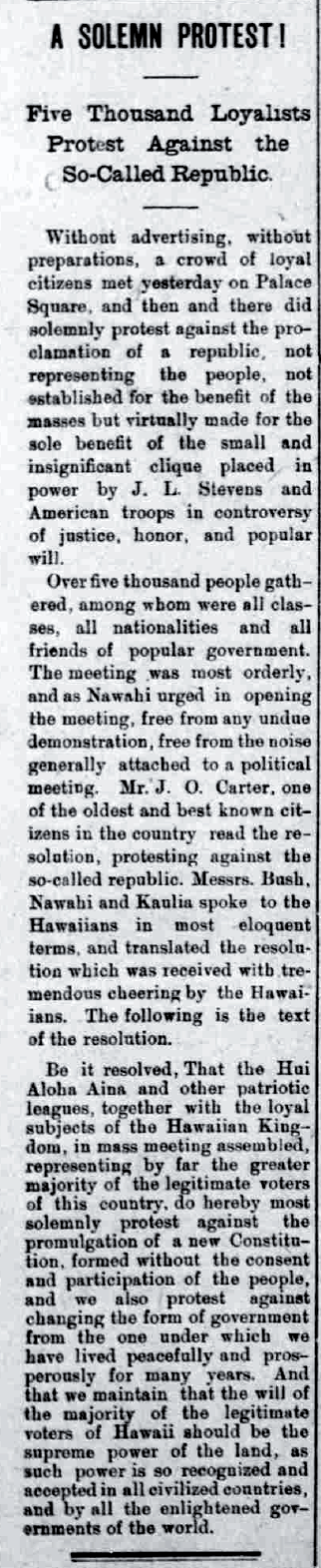
A SOLEMN PROTEST!

Five Thousand Loyalist Protest Against the So-Called Republic.

Without advertising, without preparations, a crowd of loyal citizens met yesterday on Palace Square, and then there did solemnly protest against the proclamation of a republic, not representing the people, not established for the benefit of the masses but virtually made for the sole benefit of the small and insignificant clique placed in power by J. L. Stevens and American troops in controversy of justice, honor, and popular will.

Over five thousand people gathered, among whom were all classes, all nationalities and all friends of popular government. The meeting was most orderly, and as Nawahi urged in opening the meeting, free from any undue demonstration, free from noise generally attached to a political meeting. Mr. J. O. Carter, one of the oldest and best known citizens in the country read the resolution, protesting against the so-called republic. Messrs. Bush, Nawahi and Kaulia spoke to the Hawaiians in most eloquent terns, and translated the resolution which was received with tremendous cheering by the Hawaiians. The following is the text of the resolution.

Be it resolved. That the Hui Aloha Aina and other patriotic leagues, together with the loyal subjects of the Hawaiian Kingdom, in mass meeting assembled, representing by far the greater majority of the legitimate voters of this country, do hereby most solemnly protest against the promulgation of a new Constitution, formed without the consent and participation of the people, and we also protest against changing the form of government from the one under which we have lived peacefully and prosperously for many years. And that we maintain that the will of the majority of the legitimate voters of Hawaii should be the supreme power of the land, as such power is so recognized and accepted in all civilized countries, and by all the enlightened governments of the world.

(Hawaii Holomua, 7/3/1894, p. 2)
A SOLEMN PROTEST!

Hawaii Holomua, Volume III, Number 154, Page 2. July 3, 1894.

The call to protest in English, 1894.

A SOLEMN PROTEST.

The People of Hawaii protest against the New Constitution and Mr. Dole’s Republic.

This afternoon at five o’clock the loyal citizens of Hawaii will meet on Palace Square, and enter a solemn and earnest protest against the infamous outrage, which it is proposed to perpetuate on Wednesday—the proclaiming of a republic of filibusters, the proclamation of a constitution framed by aliens and for the sole benefit of certain classes.

The temporary power invested in the provisional government was obtained through a most contemptible conspiracy, and through underhanded tricks. The revolt of January 1893 was not the outcome of a spontaneous outburst of the popular will. It was the most contemptible act on record in history. The hired brigand John L. Stevens used his brief authority to further this scheme. The country which he represented disavowed his actions and thought that the honor of the United States was saved by dismissing him, and in six lines in a message to congress rebuking him.

The world thinks differently, and there are no reasons to believe hat President Cleveland will allow himself, and his administration to be covered with infamy by leaving an admitted wrong unrepaired.

In this, the fin de siecle, the bloody ravage of war and revolution is out of fashion and arbitration has taken the place of force. But, it is necessary to show to the world that the Hawaiian People are not participating in the revolutionary movement of the oath-breaking ex-Judge, who now maskerades as a president of a republic. The People of Hawaii believe in self-government and, by the Heavens they will have it. The people shall rule. The will of the people shall be the force which makes the government.

When, this afternoon, Hawaiians and foreigners be the Anglo-Saxons, Portuguese or Chinese, stand sholder to shoulder and listen to J. O. Carter, Hawaii’s best citizen, reading the protest of Hawaii against the usurpers the loyal men they can rest assured that their protest will be heard and echoed all over the civilized world, and that the unrelenting and solid opposition to the junta, now calling themselves a republic, will be supported and admired by every power that knows the existence of these fair isles. Let therefore every man, woman and child of every race, nationality and birth be present on Palace Square, and by their presence testify to the true desire of the people of Hawaii, and quietly, orderly and peacefully prove to the world that the new government is unpopular, detested, and created against the will of the Hawaiian nation.

(Hawaii Holomua, 7/2/1894, p. 2)

A SOLEMN PROTEST.

Hawaii Holomua, Volume III, Number 153, Page 2. July 2, 1894.

“American Queen”? 1917.

QUEEN LILIUOKALANI.

Clarifications by a Newspaper Writer about Her.

(Translated)

To “Ke Ola o Hawaii,”

Appearing in the British newspaper, The Outlook, of the other week, there were a number of awe-inspiring lines about our Queen, Liliuokalani, titled: “An American Queen.” This is how it went:

Americans sometimes forget that within one of the Territories of the United States there lives a real ex-Queen who owes the loss of her crown to the activities of American missionaries.

This Queen is, of course, Liliuokalani, of Hawaii, dethroned in the revolution of 1893. She is now a frail old lady of nearly seventy-nine years, and few but her immediate household and closest friends ever have the opportunity of meeting and talking with her.

It is interesting to record that because of one of the tragedies of the present war this aged Queen has permitted for the first time an American flag to fly over her home. The news of this incident comes to us in a letter from a correspondent in Hawaii. This correspondent writes:

It was my privilege a few days ago to attend what will possibly be the last public reception she will ever give to members of the Hawaiian Senate—some of her own race, and some sons of the missionaries who were mainly responsible for her overthrow. Although they belonged to a body absolutely democratic in form and elected by vote of the people as citizens of the United States, it was most interesting and somewhat touching to note the loyalty and love shown the aged ex-Queen: almost, one could imagine, as if she were still their reigning sovereign. Continue reading

The Queen visits Hilo, 1914.

QUEEN LILIUOKALANI

Queen Liliuokalani arrived here in Hilo in the afternoon of this past Sunday, and she is an honored guest of Mrs. Aima Nawahi these days. The Royal one of Hawaii is in good health. She will return to Honolulu the following Friday.

This Thursday, at 10 a. m. until 12 noon, our Queen graciously has granted loving audience with all those who go to see her at the home of Mrs. Aima Nawahi. The members of all the Hawaiian Associations of Hilo nei also want to see their beloved Queen. This audience is open to all the people here in Hilo. Continue reading

On Aloha Aina, 1893.

“Breathes there a man with soul so dead,
Who never to himself hath said,
This is my own my native land.”
(Scott.)

Many of those who support honestly the present state of affairs, have done so in the full hope and belief, that thereby the flag of their country—the Stars and Stripes—will float over the land in perpetuity. Not a single Hawaiian, however, even those few whose signatures to annexation petitions (not 200 in number and mostly convicts.) have been bought or forced by necessity from them, desires to see any foreign flag replace his own. Continue reading

Liliuokalani’s horse riding association, 1892.

[Found under: “NU HOU KULOKO.”]

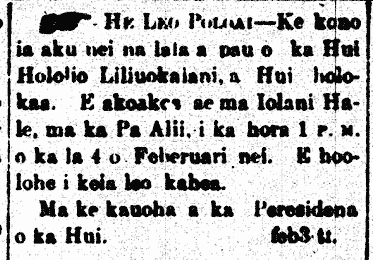
A Summons—All the members of the Liliuokalani Horse Riding Association and Carriage Riding Association are invited. To gather at Iolani Palace, on the Palace Grounds, at 1 p. m. on the 4th of February. Heed this call.

By the orders of the President of the Association.

(Leo o ka Lahui, 2/3/1892, p. 3)

He Leo Poloai

Ka Leo o ka Lahui, Buke II, Helu 382, Aoao 3. Feberuari 3, 1892.


Washington Place, 1895.

The Residence of Wasinetona Hale.

We are putting before you the picture of Washington Place on Beritania Street, Honolulu, not because it was the storage for guns and weapons for Liliuokalani, but because it is a very old building constructed in Honolulu nei. The foundation of this house was began with coral blocks by the one called Isaac Adams, for the mother of Governor Dominis, while her husband, Dominis, was sailing as captain aboard a ship from Honolulu to…

WASINETONA HALE

…China, trading with places of the North and then returning to Honolulu. And being that Mrs. Dominis, who accompanied her husband, fancied living here in Honolulu, and building a home here to live in, and forever more leaving her own home in the state of Massachusetts, her husband agreed to her request. It was perhaps 1842 when the foundation was laid, but it was not completed until the beginning of 1846. And on August 5, 1846, Captain Dominis left again on a ship under his leadership, but after he left Honolulu for China, there was no word that his ship landed on any dry land until this day.

Continue reading

More on Kamehameha III 100th birthday memorial, 1914.

CENTENARY OF KAMEHAMEHA III IS MARKED WITH IMPRESSIVE SERVICE

Handsome Tablet Is Unveiled Accompanied by Sacred Chant of Loved King

The unveiling of a handsome tablet of Hawaiian lava granite, to the accompaniment of sacred chants composed a century ago, marked the 100th anniversary of the birth of Kauikeaouli, the third of the Kamehamehas, which yesterday afternoon was observed at old Kawaiahao church by the Daughters of Hawaii. It was a fitting memorial to that ruler who, known to his subjects as the beneficent king, gave to the inhabitants of these islands their first written constitution, and, to make the observance further complete, the tablet will be taken to Keauhou, Kona, where it will mark the birthplace of ka moi lokomaikai.

The historical structure of Kawaiahao, around which is woven innumerable tales dear to the heart of the kamaaina, was occupied by more than 2600 persons, the majority of whom were Hawaiian. The memorial tablet occupied the center of the platform, hidden from view by the royal standard of Liliuokalani and High Chiefess Elizabeth Kekaaniau Pratt, both lineal descendants of the Hawaiian King who was the founder of the Kamehameha dynasty. Feathered cloaks of almost priceless value draped the chairs in which they sat.

The strange, yet beautiful, setting doubtless was a perfect replica of a court scene in the days of the old regime when the Kamehameha held sway. The costuming of the participants was perfect, and there was presented a spectacle in which was brought out many ancient and rare relics which today are treasured by Honolulu families and which are seldom seen other than in private homes, where they are held almost sacred.

Attired in feather cloaks and helmets, High Chief Fred Kahapula Beckley and High Chief Albert Kalaninoanoa Hoapili, the spear and kahili bearers respectively, occupied places just back of the queen and High Chiefess Pratt, representing the figures which are seen on the royal Hawaiian coat-of-arms. Both are lineal descendants of chiefs of the court of Kamehameha I, High Chief Beckley being a descendant of Kameeiamoku, and High Chief Hoapili a descendant of Kamanawa, the royal kahili bearer. Boys from the Kamehameha school, to the number of 16, acted as court attendants and kahili bearers, and occupied places on either side of the court representatives. They were attired in feather capes and other accessories adopted by the Hawaiian warriors of other days. Above this gathering was suspended the royal standard of Kalakaua, as well as other Hawaiian flags, their colors blending in perfect harmony with the vivid green of the palms and ferns with which the nave was banked.

Continue reading

Public invitation to celebration of Centenary of Kauikeaouli, 1914.

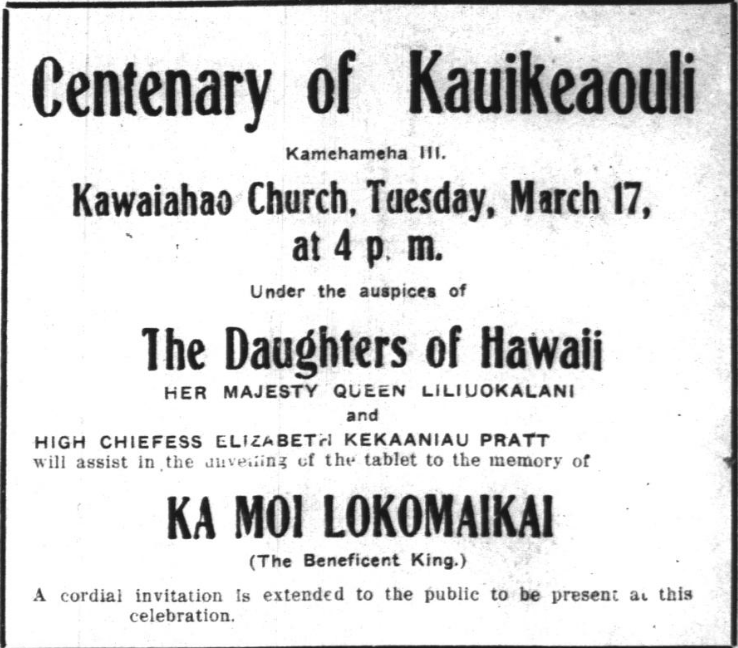
Centenary of Kauikeaouli

Kamehameha III.

Kawaiahao Church, Tuesday, March 17,

at 4 p. m.

Under the auspices of

The Daughters of Hawaii

HER MAJESTY QUEEN LILIUOKALANI

and

HIGH CHIEFESS ELIZABETH KEKAANIAU PRATT

will assist in the unveiling of the tablet to the memory of

KA MOI LOKOMAIKAI

(The Beneficent King.)

A cordial invitation is extended to the public to be present at this celebration.

(Star Bulletin, 3/11/1914, p. 8)

Centenary of Kauikeaouli

Honolulu Star-Bulletin, Volume XXI, Number 6840, Page 8. March 11, 1914.

Kauikeaouli’s 100th birthday at Kawaiahao Church, 1914.

TRIBUTE PAID TO MEMORY OF KING

Hawaiians Celebrate Centenary of Kamehameha III with Impressive Ceremony—Queen Liliuokalani Unveils Tablet to Mark Birthplace of Beloved Monarch

(From Wednesday Advertiser.)

The centenary of Kauikeaouli, Kamehameha III, was celebrated yesterday at Kawaiahao Church under the auspices of the Daughters of Hawaii. This old church, that has witnessed so many of the royal ceremonials of the Hawaiian people, was taxed to the utmost of its seating capacity. More than twenty-six hundred persons viewed the unveilling of the memorial tablet which had been prepared by the Daughters of Hawaii to mark the birthplace of “The Generous King” at Keauhou, in Kai-malino, Hawaii.

The tablet was hidden from view by the Royal Standard of Liliuokalani and a Hawaiian flag, both the property of and loaned by Hawaii’s venerable ex-queen for the sacred ceremonial.

The Queen and High Chiefess Elizabeth Kekaaniau Pratt, both of whom are lineal descendants of Keawe, the ancient king of Hawaii, and founder of the Kamehameha dynasty, were seated on either side of the memorial stone in the nave of the church. The palace chairs in which they sat were draped with ancient Hawaiian feather capes of priceless value.

Oldtime Dignitaries Attend.

Back of the Queen and High Chiefess Pratt were High Chiefs Beckley and Hoapili, clad in the ceremonial feather cloaks and helmets of the Royal Courtiers. High Chief Fred Kahapula Beckley, the spear-bearer, is a direct descendant through his father’s side from Kameeiamoku. High Chief Albert Kalaninoanoa Hoapili, the kahili bearer, is a lineal descendant of Kamanawa, the royal kahili bearer. These two therefore, in yesterday’s ceremony represented the spear-bearer and kahili bearer who are shown on the Hawaiian coat of arms and are descendants of the two chief court alii of Kamehameha I.

On either side of the royal court representatives were the kahili bearers in ordinary, sixteen young men from the Kamehameha School for Boys, robed in feather capes and the costumes of the warrior of old, representative of the court attendants.

The chancel and pulpit were tastefully decorated with beautiful ferns and palms while above was the Royal Standard of Kalakaua and the Hawaiian flags, both now the property of and loaned by the Kapiolani Estate.

Continue reading