Two mele for Liliu and her garden, Uluhaimalama, 1894.

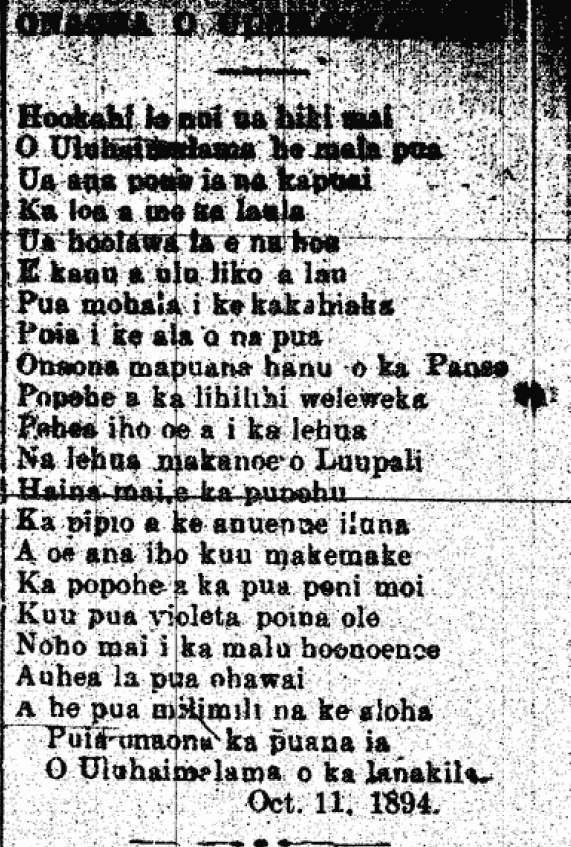
ONAONA O ULUHAIMALAMA.

Hookahi la nui ua hiki mai
O Uluhaimalama he mala pua
Ua ana pono ia na kapuai
Ka loa a me ka laula
Ua hoolawa ia e na hoa
E kanu a ulu liko a lau
Pua mohala i ke kakahiaka
Puia i ke ala o na pua
Onaona mapuana hanu o ka Panse
Popohe a ka lihilihi weleweka
Pehea iho oe a i ka lehua
Na lehua makanoe o Luupali
Haina mai e ka punohu
Ka pipio a ke anuenue iluna
A oe ana iho kuu makemake
Ka popohe a ka pua poni moi
Kuu pua violeta poina ole
Noho mai i ka malu hoonoenoe
Auhea la pua ohawai
A he pua milimili na ke aloha
Puia onaona ka puana ia
O Uluhaimalama o ka lanakila.

Oct. 11, 1894.

(Leo o ka Lahui, 10/16/1894, p. 2)

ONAONA O ULUHAIMALAMA.

Ka Leo o ka Lahui, Buke II, Helu 1050, Aoao 2. Okatoba 16, 1894.

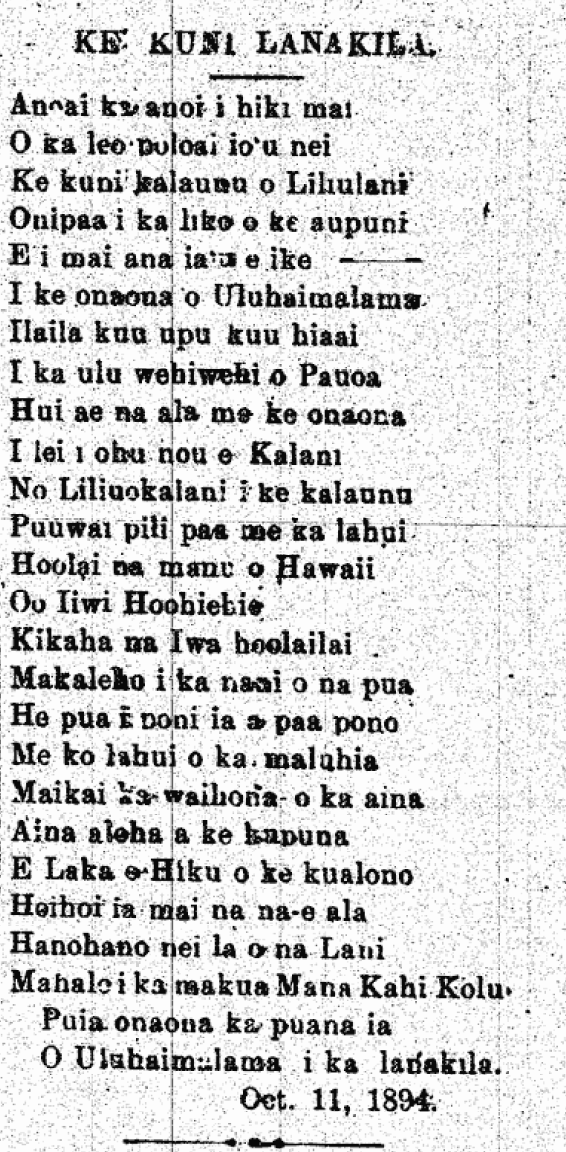
KE KUNI LANAKILA.

Anoai ka anoi i hiki mai
O ka leo poloai io’u nei
Ke kuni kalaunu o Liliulani
Onipaa i ka liko o ke aupuni
E i mai ana ia’u e ike
I ke onaona o Uluhaimalama
Ilaila kuu upu kuu hiaai
I ka ulu wehiwehi o Pauoa
Hui ae na ala me ke onaona
I lei i ohu nou e Kalani
No Liliuokalani i ke kalaunu
Puuwai pili paa me ka lahui
Hoolai na manu o Hawaii
Oo Iiwi Hoohiehie
Kikaha na Iwa hoolailai
Makaleho i ka nani o na pua
He pua i poni ia a paa pono
Me ko lahui o ka maluhia
Maikai ka waihona o ka aina
Aina aloha a ke kupuna
E Laka e Hiku o ke kualono
Hoihoi ia mai na na-e ala
Hanohano nei la o na Lani
Mahalo i ka makua Mana Kahi Kolu
Puia onaona ka puana ia
O Uluhaimalama i ka lanakila

Oct. 11, 1894.

(Leo o ka Lahui, 10/16/1894, p. 2)

KE KUNI LANAKILA.

Ka Leo o ka Lahui, Buke II, Helu 1050, Aoao 2. Okatoba 16, 1894.

A twist on “Hawaii Ponoi,” 1894.

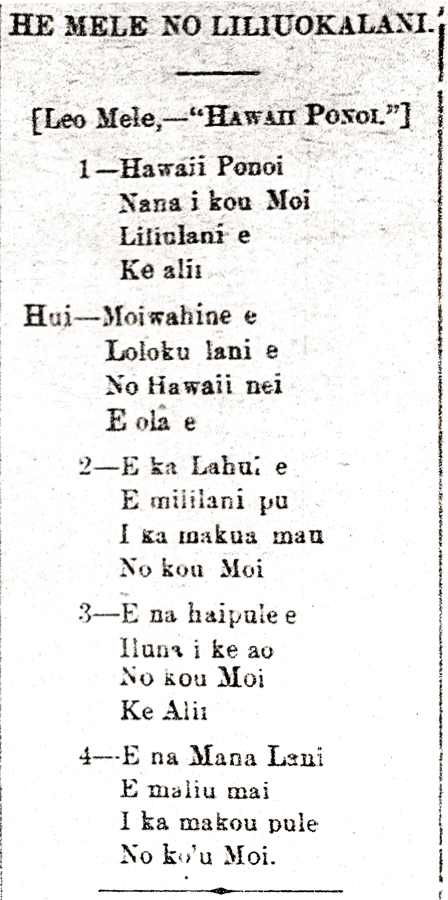
HE MELE NO LILIUOKALANI.

[Leo Mele,—”Hawaii Ponoi.”]

1—Hawaii Ponoi
Nana i kou Moi
Liliuokalani e
Ke alii

Hui—Moiwahine e
Loloku lani e
No Hawaii nei
E ola e

2—E ka Lahui e
E mililani pu
I ka makua mau
No kou Moi

3—E na haipule e
Iluna i ke ao
No kou Moi
Ke alii

4—E na Mana Lani
E maliu mai
I ka makou pule
No ko’u Moi.

A MELE FOR LILIUOKALANI.

[Tune,—”Hawaii Ponoi.”]

1—Hawaii’s Own
Look to your Sovereign
Liliuokalani
The alii

Chorus—Queen
Lolokulani
For Hawaii nei
Prevail

2—O Nation
Let us give praise
To the eternal father
For your Sovereign

3—O Pious ones
[Lift your voices] toward the clouds
For your Sovereign
The Alii

4—O Heavenly Powers
Do pay heed
To our prayer
For my Sovereign.

[The issue in which this mele appears cannot be found online. There in fact are many, many issues of Hawaii Holomua that are still not available anywhere online!]

(Hawaii Holomua Puka Pule, 6/23/1894, p. 3)

HE MELE NO LILIUOKALANI.

Hawaii Holomua (Puka Pule). Buke I, Helu 25, Aoao 3. Iune 23, 1894.

The first Kamehameha Day out in the country, 1872.

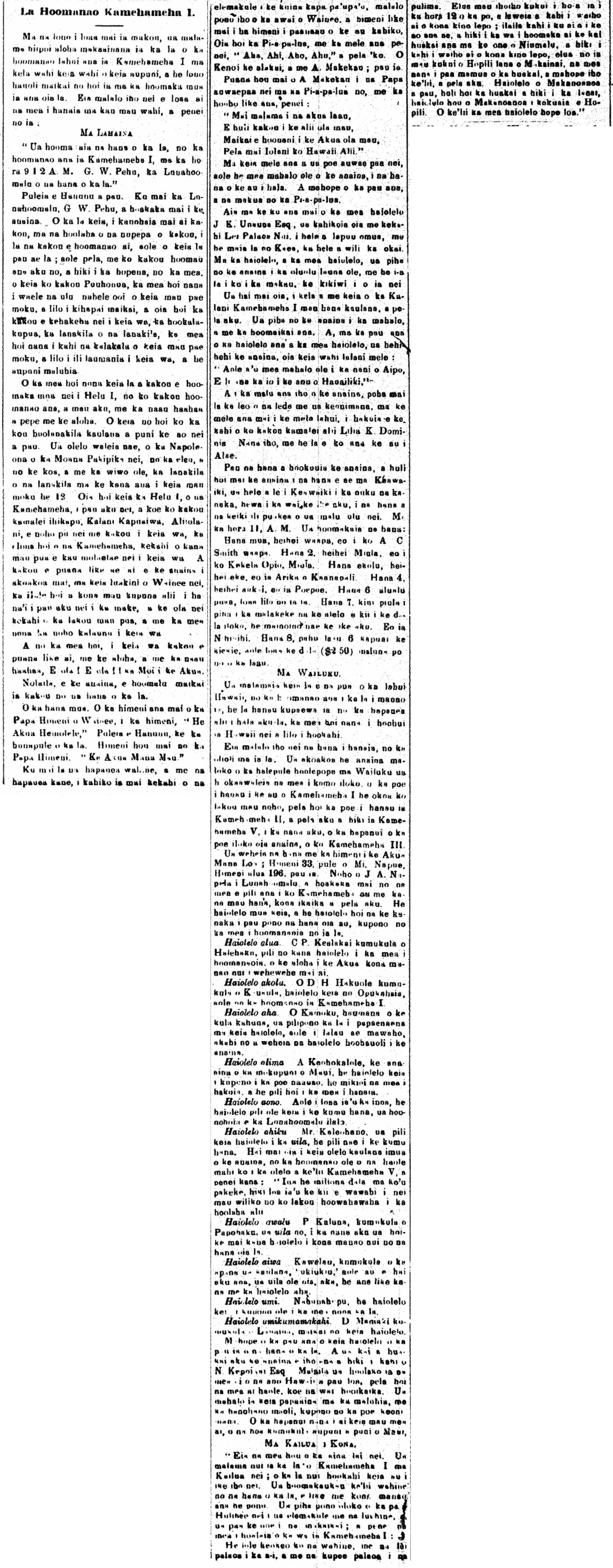
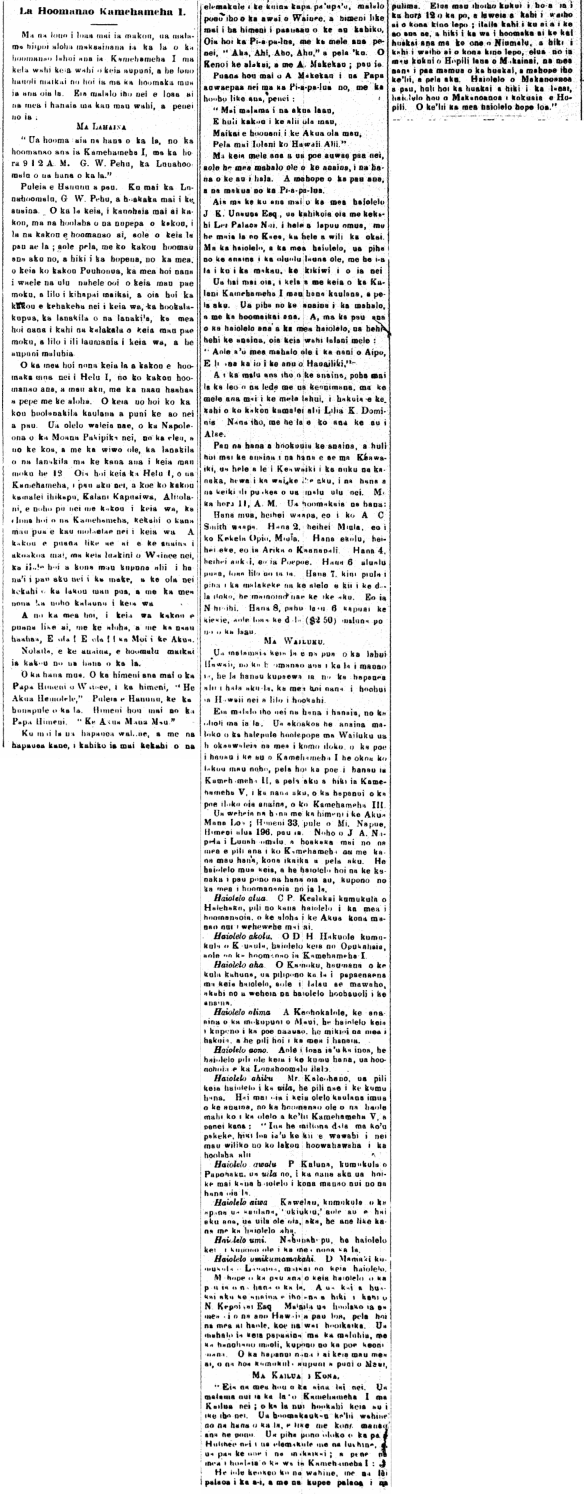
Day Commemorating Kamehameha I.

According to the news we received, the day the nation remembers Kamehameha I was preciously observed in different places of the nation, and this is good news for the very beginning of this day. Here below you will find what took place in various places, and here it is:

In Lahaina

“The activities of the day for the commemoration of Kamehameha I began at 9:12 A. M. with G. W. Pehu as the Chairman of the day’s events.”

A prayer was given by Hanunu. Chairman G. W. Pehu stood and explained to the crowd. This is the day that we were told in the announcements in our newspapers that this day is one that we are to commemorate, but not just on this day and that’s it; no, we are to continue this until the end, for he is the pillar of our world, the one who cleared away the thorny wilderness of this archipelago and made it into a fine garden, and it for him which we have pride: the wondrous one, the victor of victors, the one who shorn off the roughness  of these islands and smoothed it out making it a peaceful nation.

The one for whom we are starting off with this very first day, for whom we are celebrating for all times, with humble hearts, modesty, and aloha. He is our famed conqueror across the whole world. He is called the Napoleon of the Pacific Ocean, for his dexterity and his bravery and fearlessness; the victor of victors in battle for these 12 islands. He is the 1st of the Kamehamehas, who has gone, leaving our sacred offspring, King Kapuaiwa, Aliiolani, now living amongst us, the fifth of the Kamehamehas, one of his blossoms now appears clearly before us. And we proclaim together O Crowd gathered here at the church of Wainee, the House made by his royal ancestors who are passed on, while some of their descendants live on, along with the one who occupies the throne today.

For we now say in unison with aloha and humble hearts, May He Live! May the King Live in God!!

Therefore O People, let us keep the activities of the day well under control.

The first event. The singing of the Choir of Wainee, the hymn, “He Akua Hemolele.” There was a prayer by Hanunu, the pastor of the day. The Choir sang once more, “Ke Akua Mana Mau.”

The old ladies stood, along with the old men; some of the old men were right below the pulpit of Wainee, decked out in  layers of pa’upa’u kapa, and sang memorized songs of old. Like the Second Alphabet [Pi-a-pa-lua], sung like this: “Aha, Ahi, Aho, Ahu,” and so forth. Kenoi was the leader along with A. Makekau; this came to an end.

A. Makekau called out once more to this group of oldsters, with the Pi-a-pa-lua, exhorting in this manner:

“Don’t care after wooden idols,
Let us turn to the ever-living ruler,
It is good to glorify the ever-living God,
This, according to Iolani, the King of Hawaii.”

With this singing of the old ones, there was not a single one there who did not feel gratitude for the work done in times past. And after this was done, the makua then sang the Pi-a-pa-lua.

When the speaker, J. K. Unauna, stood, he was wearing a Large Whale Ivory Lei [Palaoa], which curved at the front like a banana of Kaea whose blossom containers [okai] are twisted. By the speech, of the speaker, the audience was immensely pleased, like a fish caught on the hook, weaving this way and that.

He spoke of the different famous feats of the Chief Kamehameha I. The audience was filled with thanks and appreciation. And, at the end of the speech of the speaker, the audience stomped their feet, like these lines of mele:

“I have nothing but praise for the beauty of Aipo,
Shuddering at the cold of Hauailiki”

[“Aole a’u mea mahalo ole i ka nani o Aipo,
E li ana ka io i ke anu o Hauailiki.”]

And when the audience calmed down, the voices of the men and women burst forth, singing the national anthem [mele lahui] composed by one of our chiefly children, Lilia K. Dominis. To witness this, it was as if the current was drawing to Alae [e ko ana ke au i Alae].

The program was over, and the audience was released, and the went to the other festivities at Keawaiki, which was teeming with people; there were so many people seen at the activities of the white ones of Lahaina nei. At the hour of 11 A. M., the games began:

First event, boat race, won by the boat of A. C. Smith. Event 2, Mule race, won by Castle Jr.’s mule. Event three, sack race, won by Arika of Kaanapali. Event 4, swimming race, won by Poepoe. Event 6, pig chase [alualu puaa], which was won by him. Event 7, tin can filled with molasses and you try to get the dollar inside using your tongue; it was miserable to watch. Won by [?Nahioihi]. Event 8, a wooden pole of 6 feet tall; the money ($2.50) atop the pole was not gotten.

[This article continues with scenes from Wailuku and Kailua, Kona. Look for the continuation at a later date. The image online is very hard to read. I can’t wait for the day when all the newspapers are rescanned clearly!]

(Au Okoa, 6/20/1872, p. 3)
La Hoomanao Kamehameha I.

Ke Au Okoa, Buke VIII, Helu 10, Aoao 3. Iune 20, 1872.

As it was then it is now. 1893 / 2013.

HE LEI NO KA POE ALOHA AINA.

Kaulana na pua a Hawaii
Kupaa mahope o ka Aina
Hiki mai ka Elele a ka lokoino
Palapala anunu me ka pakaha
Pane mai Hawaii Nui a Keawe
Kokua na Hono a Piilani
Kakoo mai Kauai o Mao
Pau pu me ke one o Kakuhihewa
Aole e kau kuu pulima
Maluna o ka pepa a ka Enemi
Aole makou e minamina
I ka puu kala a ke Aupuni
Ua ola makou i ka pohaku
I ka ai kamahao a ka Aina
Hoohui Aina kuai hewa
I ka pono Kiwila a o ke kanaka
Mahope makou o Liliulani
A kau hou ia i ke Kalaunu
Haina ia mai ana ka puana
No ka poe i Aloha i ka Aina.

A LEI FOR THE PATRIOTS.

Famous are the blossoms of Hawaii
Who stand steadfast behind the Land
When the evil-hearted Messengers arrives
With their documents of greed and plunder
Great Hawaii of the Chief Kakuhihewa answers
The Bays of the Chief Piilani assists
Kauai of the Chief Manokalanipo gives support
Along with the sands of the Chief Kakuhihewa
I will not affix my signature
Upon the paper of the Enemy¹
We will not feel longing
For the sums of money from the Government
We live on the rocks
On the amazing food of the Land
[Annexing and selling wrongfully
The Civil rights of the people]
We stand behind Liliulani
Her Crown shall be placed back upon her
Let the refrain be told
Of the people who Love the Land.

Miss Kekoaohiwaikalani,
Puahaulani Hale,
Honolulu, Feb. 10, 1893.

As a result of the many requests we received to reprint the mele of the Patriots, we are fulfilling your desire; and this is a totally accurate copy of this Mele gotten from the Lady who composed this mele.

[This mele was indeed printed many times in the Hawaiian-Language Newspapers, attesting to its importance. It is just as important today, 120 years since, if not more so!]

¹It appears that the bracketed lines were misplaced and should follow here. …or perhaps not, as it appears in basically this same form three years later: Aloha Aina, Buke III, Helu 24, Aoao 4. Iune 13, 1896. “E Nana Mai i ke Mele.”

(Leo o ka Lahui, 5/16/1893, p. 3)

HE LEI NO KA POE ALOHA AINA.

Ka Leo o ka Lahui, Buke II, Helu 706, Aoao 3. Mei 16, 1893.

Fund raiser for the building of St. Augustine in Waikiki, 1901.

FAIR AND LUAU.

A fair and grand luau was held by the Catholic brethren in the armory [hale paikau] outside, this Saturday afternoon. There were many people who showed up to this fair, and we hear that they made a lot of money through the items sold and the luau. Amongst the dignitaries who appeared at the fair was Queen Liliuokalani. The Royal Hawaiian Band [bana aupuni] was there, entertaining the visitors that came, and with the coming of night there was held a dance in the armory. All the proceeds from this fair will be given to the church of St. Augustine being built outside of Waikiki.

(Aloha Aina, 7/20/1901, p. 5)

AHA FEA ME LUAU.

Ke Aloha Aina, Buke VII, Helu 29, Aoao 5. Iulai 20, 1901.

Keahu Kealiiaukai, an awesome biography, 1941.

Recalling the Days of Kamehameha V.

KEAHU KEALIIAUKAI

Keahu Kealiiaukai is one of the last Hawaiians left who is not proficient in English. He is a Hawaiian famous for his knowledge of plants, and he is 82 years old. He lives in Lahaina, Maui, the capital of Hawaii in days of yore. Kealiiaukai is now living with his daughter, Mrs. Juliette Pali.

When Kealiiaukai was born in Kaupo, Maui, on the road going to the crater of Haleakala, in the year 1859, this was the fifth year of Kamehameha IV’s reign over Hawaii nei. Kealiiaukai was 4 when that monarch died. He does not recall this.

Remembering the King.

However, Kealiiaukai does in fact remember Kamehameha V, or King Kapuaiwa, his given name; and the last of the Kamehamehas. Kapuaiwa went to Lahaina numerous times, where he was welcomed warmly by his makaainana.

In Kealiiaukai’s eighty and two years of life, he witnessed the passing of the monarchs of his homeland, closing with the overturning of the nation under Queen Liliuokalani’s protection, in 1893. Then the establishing of the provisional government and the Republic of Hawaii, and the joining of the Islands to the United States and the formation of this Territory of America, 40 years ago.

A Religious Man

Kealiiaukai is an important man in Lahaina for the kamaaina there. His wife left this world eight years ago, but she did not however leave behind children. Kealiiaukai is still strong and active. He participates often in works of this Father in Heaven. He spent his life being a member of the Faith of the Latter Day.

Perhaps he is the last medicine man living and practicing from before the times when there was licensing of those in that profession. During his time, it is said that Kealiiaukai practiced healing with plants amongst his own people and healed them due to his expertise in the use of plants growing in the forests of Hawaii, for all types of illnesses.

(Hoku o Hawaii, 3/5/1941, p. 1)

Hoomanao Ina La O Kamehameha V

Hoku o Hawaii, Volume XXXV, Number 45, Page 1. Malaki 5, 1941.

More on the death of Keanu, 1902.

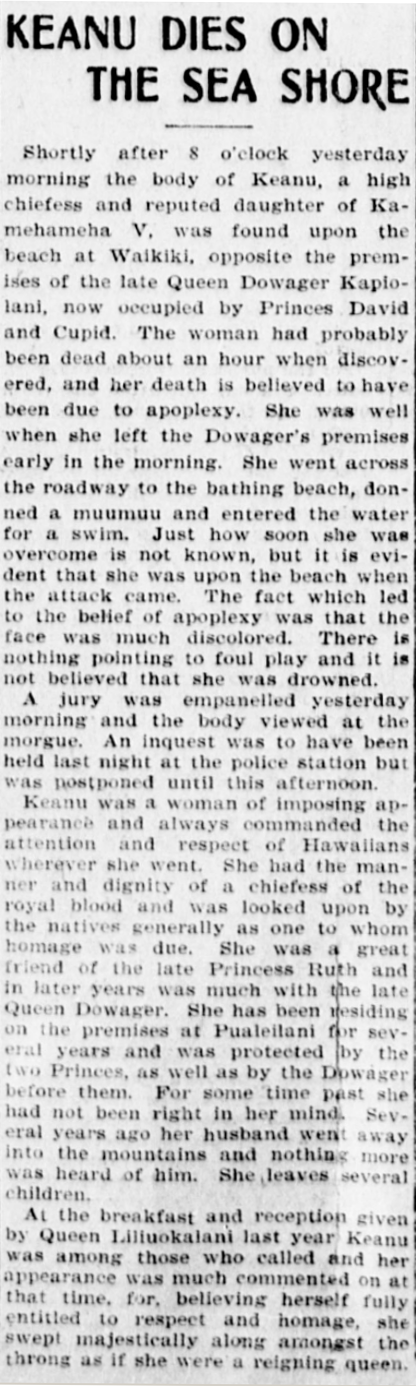
KEANU DIES ON THE SEA SHORE

Shortly after 8 o’clock yesterday morning the body of Keanu, a high chiefess and reputed daughter of Kamehameha V, was found upon the beach at Waikiki, opposite the premises of the late Queen Dowager Kapiolani, now occupied by Princes David and Cupid. The woman had probably been dead about an hour when discovered, and her death is believed to have been due to apoplexy. She was well when she left the Dowager’s premises early in the morning. She wen across the roadway to the bathing beach, donned a muumuu and entered the water for a swim. Just how soon she was overcome is not known, but it is evident that she was upon the beach when the attack came. The fact which led to the belief of apoplexy was that the face was much discolored. There is nothing pointing to foul play and it is not believed that she was drowned.

A jury was empanelled yesterday morning and the body viewed at the morgue. An inquest was to have been held last night at the police station but was postponed until this afternoon.

Keanu was a woman of imposing appearance and always commanded the attention and respect of Hawaiians wherever she went. She had the manner and dignity of a chiefess of the royal blood and was looked upon by the natives generally as one to whom homage was due. She was a great friend of the late Princess Ruth and in later years was much with the late Queen Dowager. She has been residing on the premises at Pualeilani for several years and was protected by the two Princes, as well as by the Dowager before them. For some time past she had not been right in her mind. Several years ago her husband went away into the mountains and nothing more was heard of him. She leaves several children.

At the breakfast and reception given by Queen Liliuokalani last year Keanu was among those who called and her appearance was much commented on at that time, for, believing herself fully entitled to respect and homage, she swept majestically along amongst the throng as if she were a reigning queen.

(Hawaiian Gazette, 7/1/1902, p. 4)

KEANU DIES ON SEA SHORE

Hawaiian Gazette, Volume XXXVII, Number 50, Page 4. July 1, 1902.

Ninipo Hoonipo Song in Australia, 1927.

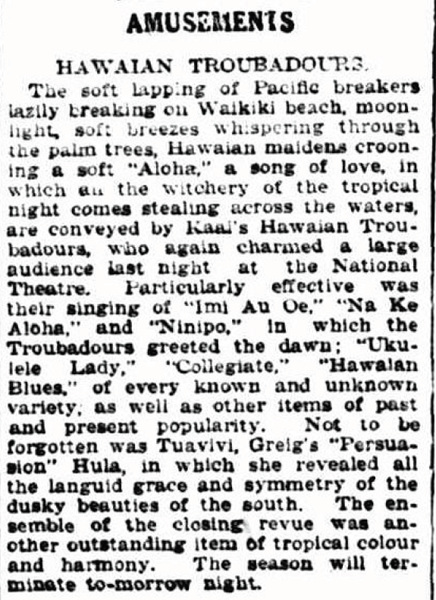
AMUSEMENTS

THE HAWAIIAN TROUBADOURS. The soft lapping of Pacific breakers lazily breaking on Waikiki beach, moon light, soft breezes whispering through the palm trees, Hawaian maidens crooning a soft “Aloha,” a song of love, in which all the witchery of the tropical night comes stealing across the waters, are conveyed by Kaai’s Hawaian Troubadours, who again charmed a large audience last night at the National Theatre. Particularly effective was their singing of “Imi Au Oe,”¹ “Na Ke Aloha,” and “Ninipo,” In which the Troubadours greeted the dawn; “Ukulele Lady,” “Collegiate,” “Hawaian Blues.” of every known and unknown variety; as well as other items of past and present popularity. Not to be forgotten was Tuavivi, Greig’s “Persuasion” Hula, in which she revealed all the languid grace and symmetry of the dusky beauties of the south. The ensemble of the closing revue was another outstanding item of tropical colour and harmony. The season will terminate to-morrow night.

[Earlier, i posted Liliuokalani’s “Ninipo Hoonipo Song”, and strangely enough, i ran across this reference to it being sung all the way in Australia in 1928!]

¹”Imi Au Ia Oe”

(Examiner, 4/22/1927, p. 6)

AMUSEMENTS.

The Examiner, Volume LXXXV, Number 95, Page 6. April 22, 1927.

“Kaai’s Hawaiians” on TROVE, 1928.

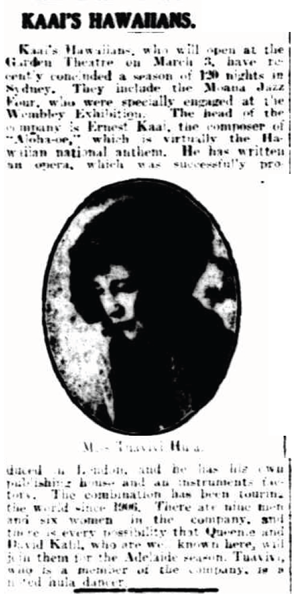
KAAI’S HAWAIIANS.

Kaaiʻs Hawaiians, who will open at the Garden Theatre on March 3, have recently concluded a season of 120 nights in Sydney. They include the Moana Jazz Four, who were specially engaged at the Wembley Exhibition. The head of the company is Ernest Kaai, the composer of   “Aloha oe,” which is virtally the Hawaiiian national anthem. He has written and opera, which was successfully pro…

Miss Tuavivi Greig

…duced in London, and he has his own publishing house and an intsruments factory. The combination has been touring the world since 1906. There are nine men   and six women in the company, and there is every possibility that Queenie and   David Kaili, who are we know here, will join them for the Adelaide season. Tuavivi,   who is a member of the company, is a noted hula dancer.

[This comes from an Adelaide, South Australia newspaper, found on the National Library of Australia webside, TROVE. It seems unclear newspaper images is not something limited to Hawaii nei. However, at least the text on that site is correctable.]

(Advertiser, 2/23/1923, p. 11)

KAAI'S HAWAIIANS.

The Advertiser, Volume LXX, Number 21645, Page 11. February 23, 1928.

Ninipo Hoonipo Song, a follow up, 1999.

There was a question by MA Kaiulani Milham about a translation of an earlier post about the mele “Ninipo Hoonipo Song,” by Queen Liliuokalani. There is a very nice book of many of the Queen’s songs put out by Hui Hanai in 1999, “The Queen’s Songbook.” The lyrics are in there along with the music, a translation, and a short writeup!