Hawaiians abroad and the Hawaiian-Language Newspapers, 1867.

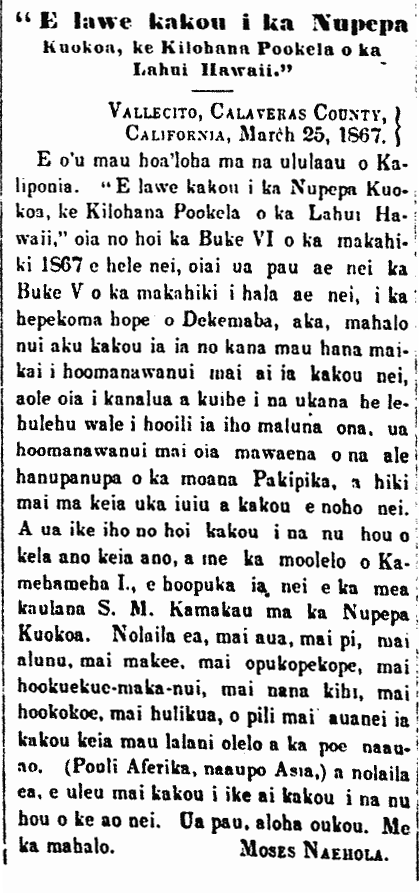
“Let’s subscribe to the Newspaper

Kuokoa, the Greatest Prize of the
Hawaiian Nation.”

VALLECITO, CALAVERAS COUNTY,

CALIFORNIA, March 25, 1867.

O My friends of the forests of California, “Let’s subscribe to the Newspaper Kuokoa, the Greatest Prize of the Hawaiian Nation,” that is the ongoing Volume VI of the year 1867, being that Volume V of this past year, is over, with the last week of December; we are grateful for its patient work done for us; it was not uncertain or hesitant of all the parcels sent upon it, but it persevered upon the surging billows of the Pacific Ocean until reaching this towering lands upon which we live. And thus we see the news of this sort and that, and the history of Kamehameha I., that is being published by the famed S. M. Kamakau in the Kuokoa. Therefore, don’t hold back, don’t scrimp, don’t be greedy, don’t be covetous, don’t surly, don’t scowl, don’t look to the side, don’t look away, don’t turn you back; lest these lines by the enlightened by applied to us. (Dark Africa, ignorant Asia), and so, let’s act quickly so that we can see the news of the world. I am done, aloha to you all. With thanks.

MOSES NAEHOLA.

[For more on the serial by S. M. Kamakau, see: Ruling Chiefs of Hawaii, Tales and Traditions of the People of Old, Ka Po’e Kahiko: The People of Old, The Works of the People of Old, Ke Kumu Aupuni, and Ke Aupuni Mō‘ī.

As for Moses Naehola, does anyone know if this is the same person as Moses Nahora, who is also living in California during the same period?

One more thing… This article has an awesome listing of negative attributes (which by no means are adequately translated here). ]

(Kuokoa, 6/1/1867, p. 4)

"E lawe kakou i ka Nupepa...

Ka Nupepa Kuokoa, Buke VI, Helu 22, Aoao 4. Iune 1, 1867.

A small window into Koolauloa and Koolaupoko—150 years ago, 1862.

Rice and Gold.

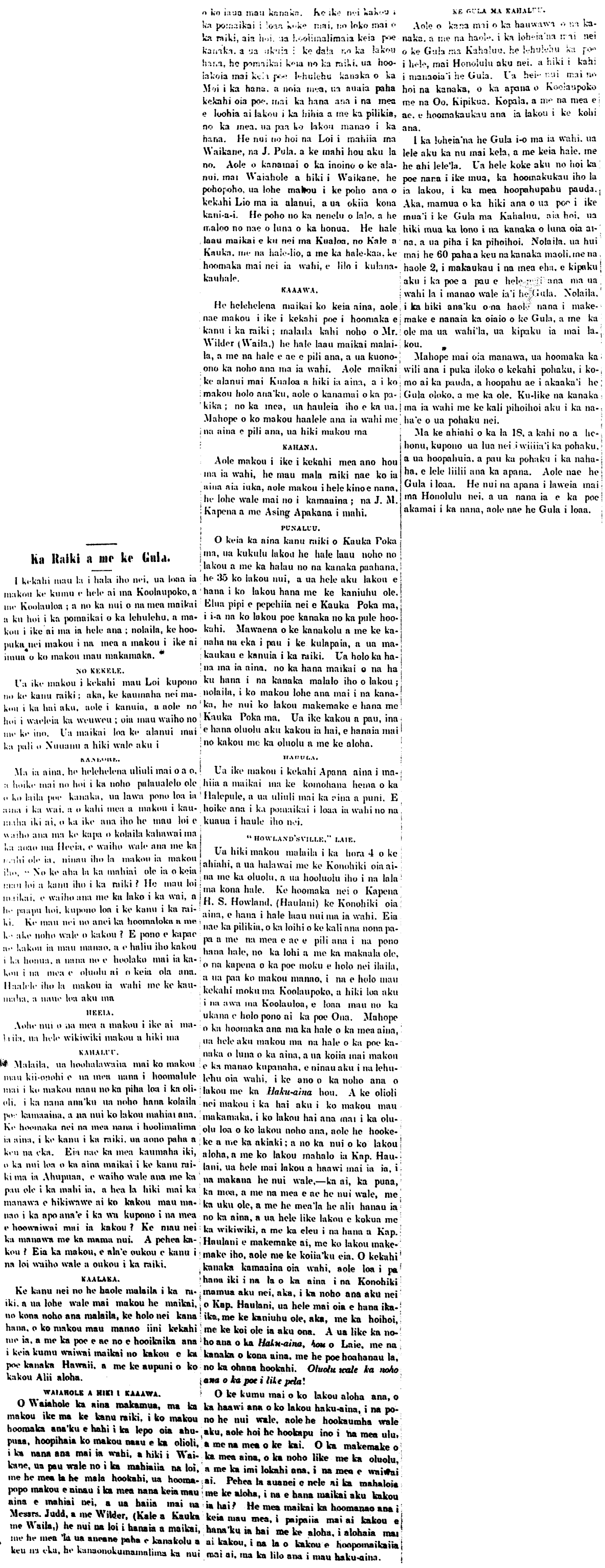
Some days ago, we had reason to travel about Koolaupoko and Koolauloa, and because of the many wonderful and beneficial things for the people we witnessed in our travels, we are publishing what we saw before us.

PERTAINING TO KEKELE.

We saw some Loi perfect for growing rice; however, we are sad to state that they were fallow and it was not weeded, they were just left wild. Fine is the road from the pali of Nuuanu until

KANEOHE

In this land, it is green from one side to the other, which attests to the non-lazy lifestyle of the people there; the land has ample water, but one thing which saddened us a bit was the seeing of some loi that were left fallow next to the river there on the Heeia side, which caused us to ponder, “Why are these loi not farmed, and planted with rice? They are fine loi supplied and full of water, very good for rice growing. Does our lack of faith and our desire to while away our time still persist? We must discard those feelings, and heed the land, and it will supply us with items that will make this life pleasant. We left that place feeling sad, and travelled on to

HEEIA.

There is not much we saw there, and we went on quickly to

KAHALUU.

There, our eyes were shown things that eased our hearts because of our great joy, when we saw that the kamaaina there did work, and that they did much farming. The one who is leasing the land has started to plant rice; there are perhaps six or more acres. But the somewhat sad thing is the majority of the land suitable for rice cultivation in that Ahupuaa, are just left there without being all farmed; when will it be that if the time is right, we will quickly make up our minds to grasp opportunities to make ourselves rich? Time keeps going quickly. And what of us? Here is what we say, to wake up and to plant your unused loi with rice.

KAALAEA

A haole there is planting rice, and we hear that it is going well; because he resides there, the work is progressing, and our hopes go with him and those others that are working at this valuable endeavor for us Hawaiians and the nation of our beloved Alii.

WAIAHOLE TO KAAAWA.

Waiahole is the first place, in our knowledge, that planted rice; when we began to walk upon the soil of that ahupuaa, our hearts were filled with joy at the sights of that place, and reaching Waikane, all the loi were being farmed, as if it was just one huge farm; we thought to ask who was it that was farming the area, and we were told Messrs. Judd and Wilder (Kale of Kauka and Waila) [Kale of Kauka must be Charles Hastings Judd, the son of Kauka (Gerrit Parmele Judd); so many loi were finely built, and it seemed like almost thirty or more acres; they had thirty-five workers. We see the immediate benefits of growing rice, being that these men were hired, and got paid for their labor, and all this is because of rice; many subjects of the King were provided with jobs, and as a result, perhaps some of those people were prevented from acts which would have caused them to suffer difficulties and problems, because their minds are taken up by work. There are many Loi farmed in Waikane, by J. Fuller (J. Pula), and they are being reworked. The road from Waiahole to Waikane is horrible; it is swampy, and we hear that a horse sunk on this street and its throat was cut. The lower part is boggy, but it is dry on the surface of the earth. There is a fine wooden house standing in Kualoa belonging to Charles Hastings Judd, along with a horse shed, and a carriage house; that place is beginning to become a town.

KAAWA.

This land has a fine appearance, but we did not see a single person who started to grow rice; that is where Mr. Wilder (Waila) resides with a nice wooden house there, with other connected buildings, and life there is luxurious. The road from Kualoa until this land is not good, and in our travels, it was terribly slippery because rain had fallen upon it. After leaving that land and the adjoining lands, we arrived at

KAHANA.

We saw nothing new there, but they did have some rice fields which were located in the uplands; we did not go to see it for ourselves, we just heard of them from the kamaaina; J. M. Kapena and Asing Apakana are the ones doing the farming.

PUNALUU.

This is the rice growing lands of Dr. [Seth] Ford (Kauka Poka) them; they built a wooden house for themselves and a halau for the workers who number 35, and they work without any complaints. Dr. Ford them slaughter two cows as meat for their men for a week. The area that was plowed up is between thirty and forty acres and it is ready to be planted with rice. The work there progresses due to the good treatment by the bosses to their workers; they are anxious to work for Dr. Ford. We all know that if we treat others well, we will be treated well and with aloha.

HAUULA.

We saw some well-farmed land to the southwest of the Church, and the land all about is green. This shows the benefits of the recent showers.

“HOWLAND’SVILLE,” LAIE.

We arrived there at 4 in the evening, and met pleasantly with the Konohiki of that land, and rested our limbs at his house. Captain H. S. Howland (Haulani), the Konohiki of that land is starting to build a wooden house there. Here however is the problem, that being the long wait for the lumber and the other house building materials, because of the delay and the inattentiveness of the captains of the ships that travel there; we believe that if there was a ship that went regularly to Koolaupoko and landed at the harbor of Koolauloa, the materials needed for the Owners [of land] would always be there. After making a start at the home of the landowner, we went to the houses of those living on the land, and we were urged on by an astonishing idea, to question the people of that area about their life under their new landlord. And we are happy to report to our friends, their answer was that their life was very pleasant, without any admonishments or reproach; and because of their great aloha and appreciation for Capt. Howland, they went and gave him many gifts—taro, pig, chicken, and many other things, without pay; it was as if he was a native-born alii; also, they all went quickly to assist him, with things that Capt. Howland needed, on their own accord, without being coerced by him. One kamaaina of that area did not touch work in the least when the land was under the previous Konohiki, but with Capt. Howland, he came to work industriously without complaint, but enthusiastically, without being forced to. The new Land owner of Laie lives together with the people of his land, like brothers of the same family. How pleasant is the life of people like that!

The reason for their love is because their landlord gives them many things, and does not just burden them, or put a restriction on plants or things from the sea. The one who owns the land just wants to live together in peace, and to search for together things that will benefit them all. How could there be no appreciation and love if we treat others well? It is good to remember this, to remind us to treat others with aloha, so that we are loved, when the day comes where we will be blessed to become land owners.

GOLD IN KAHALUU.

There was so much commotion amongst the Hawaiians and haole at the news that there was Gold in Kahaluu; there were many people who came from Honolulu to the place where Gold was thought to be. Many Hawaiians from Koolaupoko came with Oo, Pickaxes, Shovels and other things, preparing them to dig.

When it was heard that there was real Gold on that land, the news flew from house to house like firebrand. Those who first spotted it went immediately, making ready with dynamite powder. However, before those people who first witnessed the Gold reached Kahaluu, the news reached the people of that land, and they were roused. Therefore, about 60 kanaka maoli and 2 haole got together with weapons to expel all those who came to that area thought to have Gold. So when the haole came that wanted to ascertain the truth or falsehood of the Gold of that place, they were sent away.

Following that time, a hole was bored into a rock to place dynamite and explode to see if there was Gold within it or not. People stood together there waiting in anticipation for the rock to break.

In the evening of the 18th, the hole dug in the rock was finally deep enough, and it was blasted, and the rock was shattered, the tiny pieces flew. There was however no Gold found. Many pieces were taken to Honolulu, and were looked at by experts, but there was no Gold found.

[Under all the disparaging comments and the obvious push for rice cultivation, you can glean some historical information of what the windward side of Oahu looked like a 150 years ago. There are followup articles in the papers speaking of how the true gold of Hawaii is found through farming the land…

For more information on the history of rice in Hawaii, see: RICE IN HAWAII: A GUIDE TO HISTORICAL RESOURCES, compiled and annotated by Karol Haraguchi.]

(Kuokoa, 2/22/1862, p. 2)
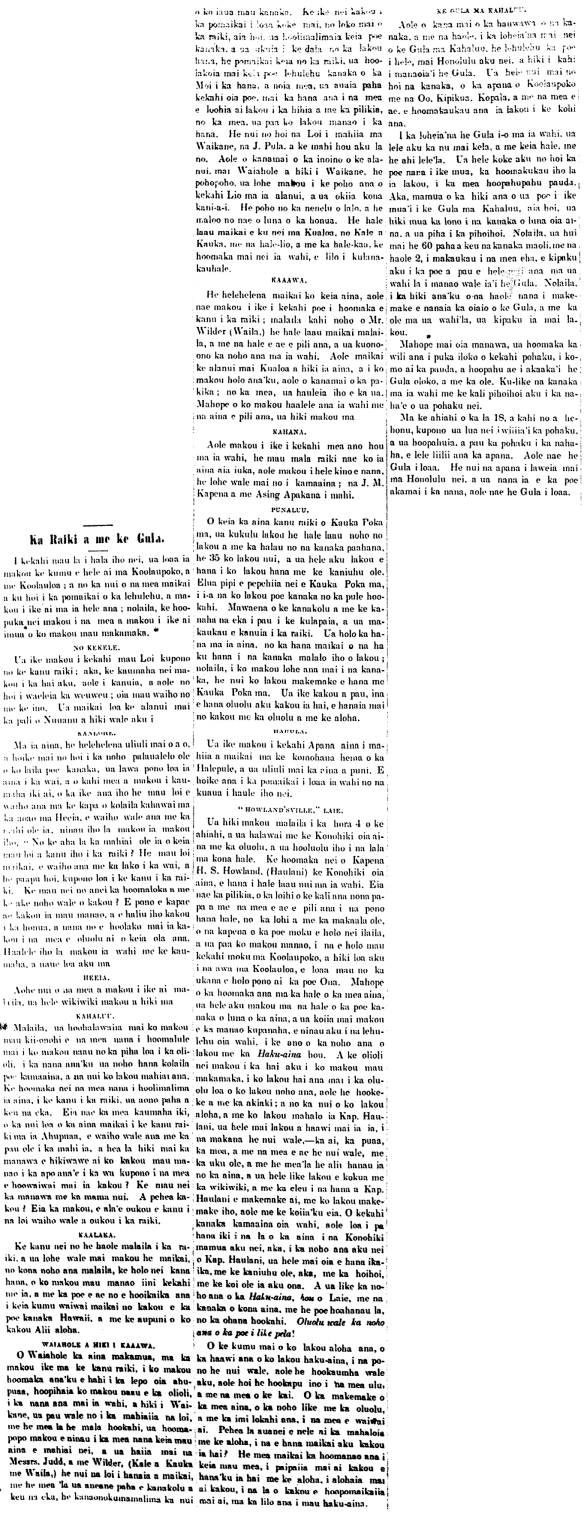
Ka Raiki a me ke Gula.

Ka Nupepa Kuokoa, Buke I, Helu 13, Aoao 2. Feberuari 22, 1862.

J. K. Mokumaia and Keoni Paakaula, 1927.

One of the reasons i posted the return of the ahuula article is because it reminded me of another post just put up—Moanalua, then and now. 1922.

In the image of the Palace Guards from the day of the return of the feather cape, you can see J. K. Mokumaia in the middle of the front row, and John Paakaula, far right on the back row.

I am wondering if this is the same Keoni Paakaula, the kumu hula of Moanalua. He would in theory be 107 years old in this picture.

[It is always important to look up name variants when you are searching for people (and even places). Biblical names in Hawaiian also appear in English, like “Keoni” and “John”. Also, Biblical names are sometimes abbreviated, like “Jas.” for “James”… It would be very helpful if there was a list of names and their variants up online.]

Another image of the return of Kamehameha III’s ahuula, 1927.

The guards of the Palace, when the Ahuula was returned to the Palace on this past Monday. Starting from the left, on the bottom row: E. K. Kaihe, John Hicky [John Hickey], J. K. Mokumaia, D. Hoke, and M. K. Reuter. The row in the back, from the left: S. K. Levi, Joseph Kawai, and John Paakaula.

(Kuokoa, 12/1/1927, p. 4)

Na kiai keia o ka Halealii...

Ka Nupepa Kuokoa, Buke LXVI, Helu 53, Aoao 4. Dekemaba 1, 1927.

Images of the return of Kamehameha III’s ahuula, 1927.

This is a picture showing scenes of the Feather cape of Kamehameha. The picture on the top is the return of the ahuula from the archives to within the Palace. The picture below is the ahuula draped upon the throne.

(Kuokoa, 12/1/1927, p. 1)

He kii keia e hoikeike ana...

Ka Nupepa Kuokoa, Buke LXVI, Helu 53, Aoao 1. Dekemaba 1, 1927.

Kamehameha III’s Feather Cape returned to Hawaii, 1927.

THE FEATHER-CAPE OF KAMEHAMEHA IS RETURNED

Ceremony in Respect to the Ahuula is Carried Out in the Crown Room of the Palace Last Monday

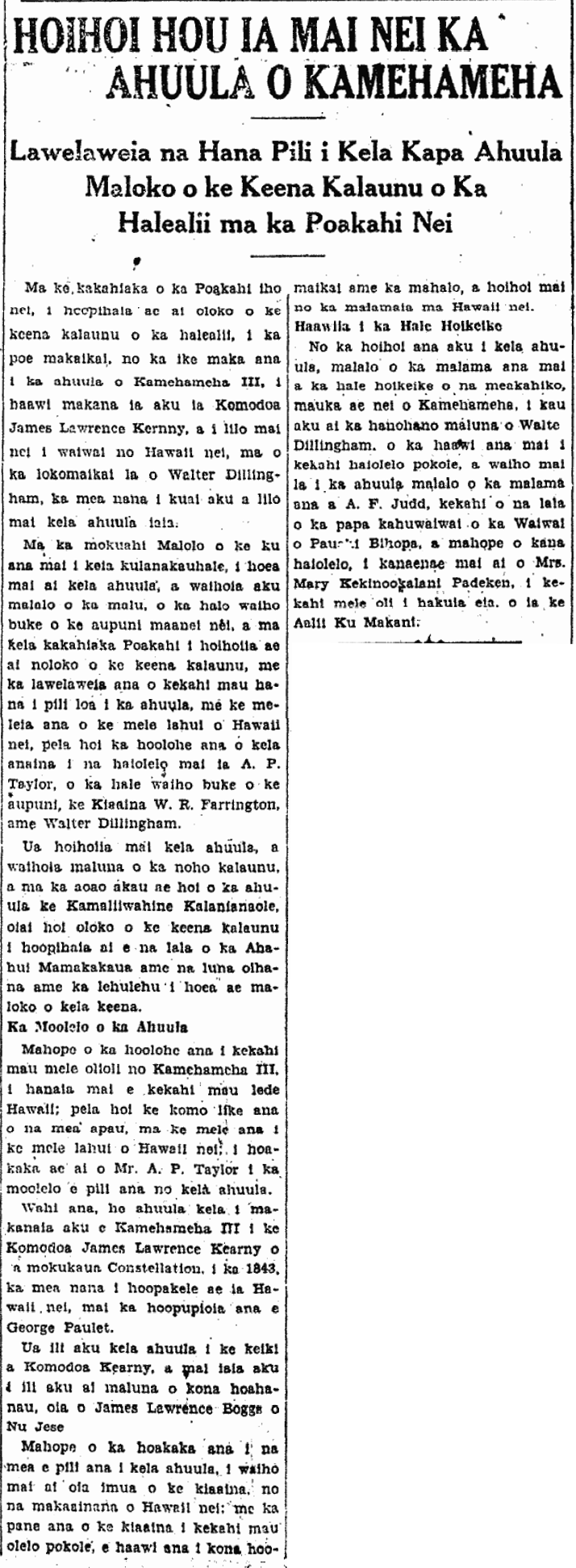
In the morning of last Monday, the throne room of the palace was filled with visitors to see the ahuula of Kamehameha III gifted to Commodore James Lawrence Kernny, and now becoming a treasure for Hawaii nei, through the generosity of Walter Dillingham, the one who purchased the ahuula.

The ahuula arrived aboard the steamer Malolo which arrived in town, and was entrusted to the safekeeping of the national archives, and on that Monday was returned to the throne room with ceremony befitting the ahuula, along with the singing of patriotic songs of Hawaii nei, as well as the hearing by the crowd of speeches given by A. P. Taylor of the national arvhives, Governor W. R. Farrington, and Walter Dillingham.

The ahuula was returned and draped upon the throne, and to the right was the Princess Kalanianaole, while the throne room was filled with members of the Mamakakaua Association and heads of businesses and the multitudes there in that room.

The Story of the Ahuula

After hearing some songs for Kamehameha III, composed by some Hawaiian ladies, the crowd entered while singing the anthem of Hawaii. And Mr. A. P. Taylor explained the history of the ahuula.

According to him, this was an ahuula gifted to Commodore James Lawrence Kearny of the warship Constellation, by Kamehameha III, in the year 1843. He was the one who saved Hawaii from the subjugation by George Paulet.

The ahuula was inherited by the child of Commodore Kearny, and from there to his cousin, James Lawrence Boggs of New Jersey.

After the explanation of its story, the ahuula was presented before the governor for the makaainana of Hawaii nei, whereupon the governor spoke a bit, while giving his thanks and appreciation for it being returned here to be cared for in Hawaii nei.

Given to the Museum

The honor was given to Walter Dillingham for his return of the ahuula for stewardship by the museum up above Kamehameha, and he gave a short speech and placed the ahuula under the care of A. F. Judd, one of the members of the board of the Trust of Pauahi Bishop. After his speech, Mrs. Mary Kekinookalani Padeken presented a chant composed by her, “Aalii Ku Makani.”

[If this sounds familiar, I am reposting it from the old Facebook site. Posts on FB are not easily searched, and so periodically I am thinking of doing reposts of those articles…]

(Kuokoa, 12/1/1927, p. 1)

HOIHOI HOU IA MAI NEI KA AHUULA O KAMEHAMEHA

Ka Nupepa Kuokoa, Buke LXVI, Helu 53, Aoao 1. Dekemaba 1, 1927.

Vital Statistics, 1912.

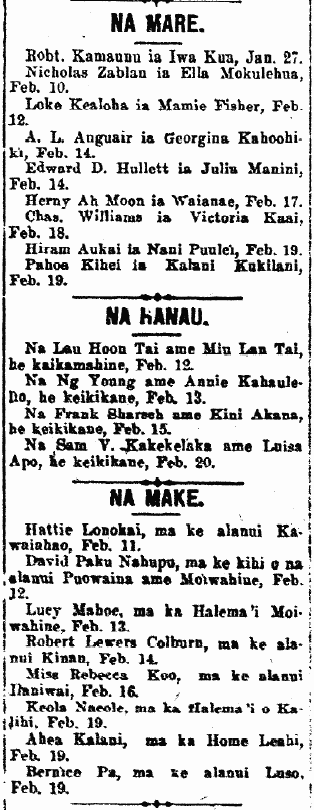
MARRIAGES.

Robert Kamaunu to Iwa Kua, Jan. 27.
Nicholas Zablan to Ella Mokulehua, Feb. 10.
Loke Kealoha to Mamie Fisher, Feb. 12.
A. L. Auguair to Georgina Kahoohiki, Feb. 14.
Edward D. Hullet to Julia Manini, Feb. 14.
Herny [Henry?]  Ah Moon to Waianae, Feb. 17.
Charles Williams to Victoria Kaai, Feb. 18.
Hiram Aukai to Nani Puulei, Feb. 19.
Pahoa Kihei to Kalani Kukilani, Feb. 19.

BIRTHS.

To Lau Hoon Tai and Miu Lan Tai, a daughter, Feb. 12.
To Ng Young and Annie Kahaulelio, a son, Feb. 13.
To Frank Sharech and Kini Akana, a son, Feb. 15.
To Sam V. Kakekelaka and Luisa Apo, a son, Feb. 20.

DEATHS.

Hattie Lonokai, on Kawaiahao Street, Feb. 11.
David Paku Nahupu, on the corner of Punchbowl and Queen Streets, Feb. 12.
Lucy Mahoe, at Queen’s Hospital, Feb. 13.
Robert Lewers Colburn, on Kinau Street, Feb. 14.
Miss Rebecca Koo, on Ilaniwai Street, Feb. 16.
Keola Naeole, at Kalihi Hospital, Feb. 19.
Ahea Kalani, at Leahi Home, Feb. 19.
Bernice Pa, on Luso Street, Feb. 19.

(Kuokoa, 2/23/1912, p. 8)

NA MARE / NA HANAU / NA MAKE.

Ka Nupepa Kuokoa, Buke XLVIII, Helu 8, Aoao 8. Feberuari 23, 1912.

Hawaiian returns home from Pacific Northwest, 1859.

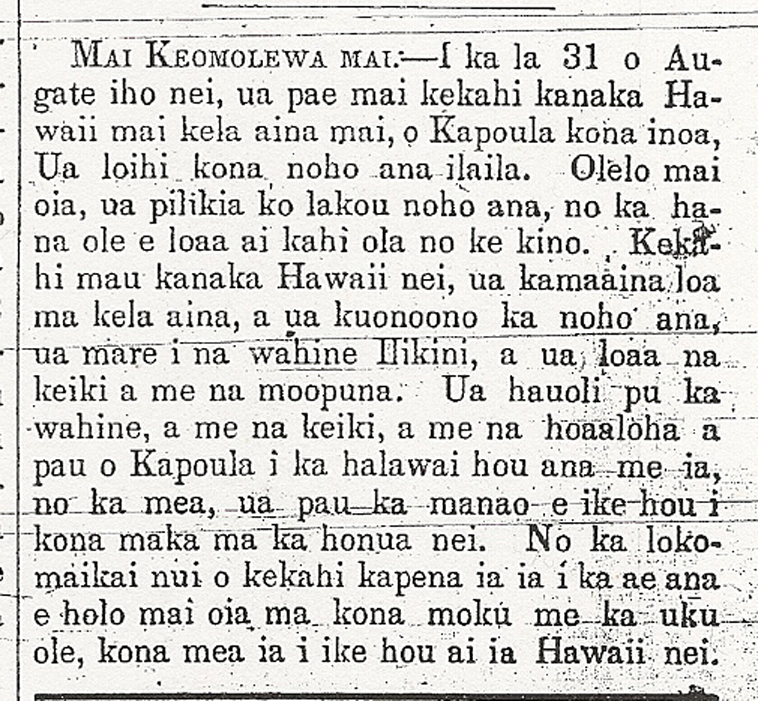
From Keomolewa [Columbia River? Vancouver?]:—On this past 31st of August, a Hawaiian arrived from that land, his name being Kapoula. He lived there for a long time. He stated that their lives were difficult, because they did not have jobs to make a living. Some Hawaiians are long-time residents there, are well off, married Indian women, and had children and grandchildren. The wife, children, and friends of Kapoula are also thrilled at seeing him again, for they thought they’d never see his face again on this earth. It is because of the generosity of a certain captain who allowed him to ride his ship without paying, that he could see Hawaii once again.

[Keomolewa also seen as “Keamolewa”]

(Hoku Loa, 9/1859, p. 12)

Mai Keomolewa mai...

Ka Hoku Loa, Buke I, Helu 3, Aoao 12. Sepatemaba, 1859.

Description of Moku o Lo‘e (Coconut Island) and a lesson on sustainable living. 1859.

FEAST AT MOKUOLOE.

O Hoku Loa:

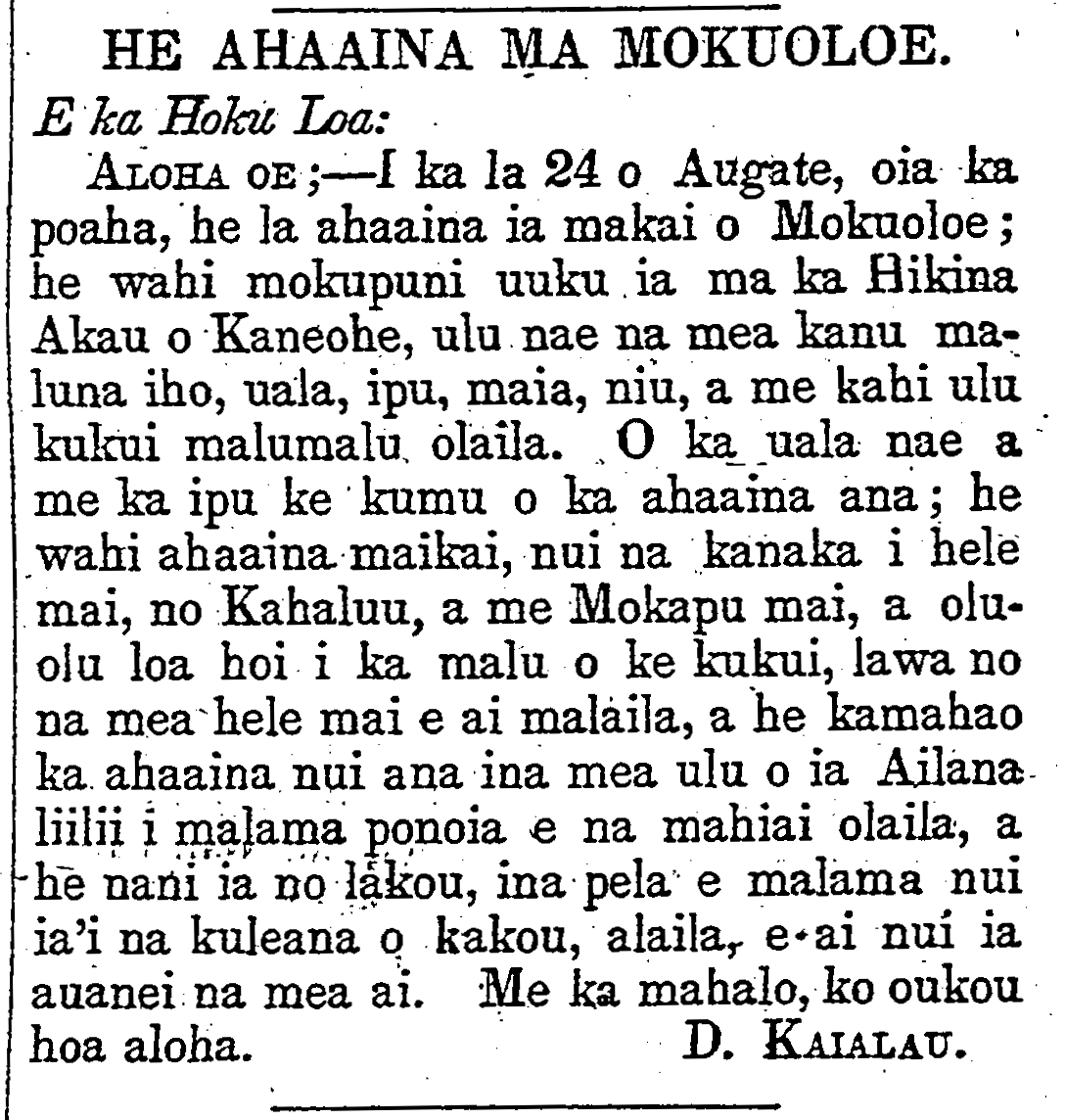
Aloha oe:—The 24th of August, which was a Thursday, was a day of party at the shore of Mokuoloe; it is a small island to the Northeast of Kaneohe, and yet plants grow upon it: sweet potato, gourd, banana, coconut, and its shady kukui grove. The focus of the feast was the sweet potato and gourd; it was a fine party, with many people who came from Kahaluu, and Mokapu, and it was very pleasant in the shade of the kukui, with enough food for all that came; the great spread of produce well-cared for by the farmers of this tiny Island was astonishing, and it would be a good thing if all our own lands were taken care of in the same way, then we’d in time be feasting off of the fruits. With mahalo, your friend.

D. Kaialau.

[For more on Moku o Lo’e, see the recent publication: Moku o Lo’e: A History of Coconut Island.

The images for Hoku Loa will hopefully be put up online soon!]

(Hoku Loa, 9/1859, p. 9)

HE AHAAINA MA MOKUOLOE.

Ka Hoku Loa, Buke I, Helu 3, Aoao 9. Sepatemaba, 1859.

“Kaua i ka Nani o Hilo”. 1892.

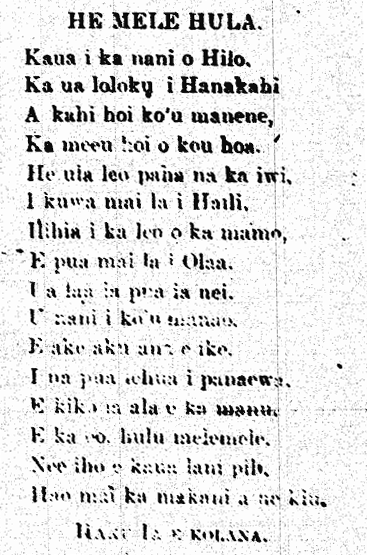
A MELE FOR HULA.

Kaua i ka nani o Hilo
Ka ua loloku i Hanakahi
A kahi hoi ko’u manene,
Ka meeu hoi o kou hoa.
He ula leo paha na ka iwi,
I kuwa mai la i Haili,
Ilihia i ka leo o ka mamo,
E pua mai la i Olaa.
Ua laa ia pua ia nei,
U nani i ko’u manao,
E ake aku ana e ike.
I na pua lehua i panaewa,
E kiko ia ala e ka manu
E ka oo, hulu melemele.
Nee iho e kaua lani pili,
Hao mai ka makani a he kiu.

Composed by Kolana.

[Here is another version of “Kaua i ka Nani o Hilo”, and here it is attributed to Kolana.]

(Leo o ka Lahui, 7/18/1892)

HE MELE HULA.

Ka Leo o ka Lahui, Buke II, Helu 501, Aoao 2. Iulai 18, 1892.