Marriage information found outside of the Vital Statistics column, 1898.

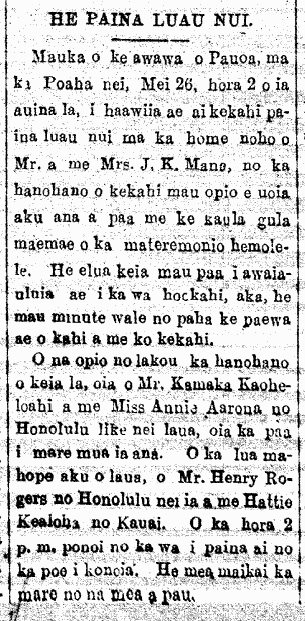
A LARGE LUAU.

Up in the valley of Pauoa, on this past Thursday, May 26, at 2 in the afternoon, a great party was given at the residence of Mr. and Mrs. J. K. Mano, to celebrate the binding tightly with the gold cord of holy matrimony, some youths. There were two secure unions that happened at the same time, but there were perhaps just a few minutes separating one from the other.

The youths to whom belonged the honor of the day were Mr. Kamaka Kaoheloahi and Miss Annie Aarona, both of Honolulu; they were the couple married first. The second following them were Mr. Henry Rogers of Honolulu and Hattie Kealoha of Kauai. It was 2 p. m. exactly when those invited began to dine. Marriage is a good thing for all people.

(Aloha Aina, 5/28/1898, p. 5)

HE PAINA LUAU NUI.

Ke Aloha Aina, Buke IV, Helu 22, Aoao 5. Mei 28, 1898.

Kamehameha III, Kauikeaouli’s birthday, a little late. 1907.

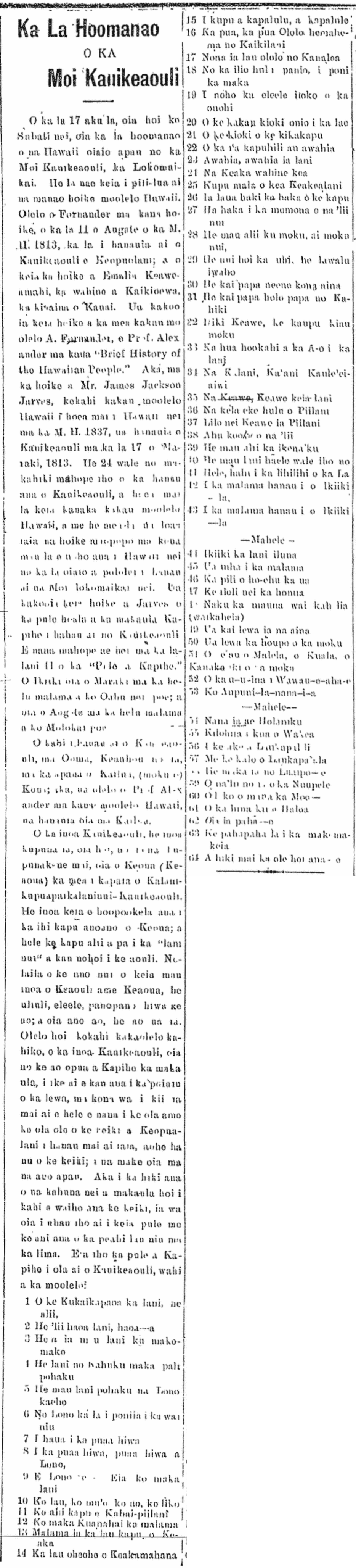
Day of Remembrance

of the

King Kauikeaouli

This past 17th, Sunday, was the day of remembrance for all true Hawaiians, of the King Kauikeaouli, the Benevolent one. There are two different historical accounts of this day. Fornander states in his account that Kauikeaouli was born of Keopuolani on 11 August 1813, and that this information was from Emalia Keaweamahi, the wahine of Kaikioewa, the governor of Kauai. This date of A. Fornander is supported by Prof. Alexander in his “Brief History of the Hawaiian People.” However, in the account of Mr. James Jackson Jarves, a scholar of Hawaiian history who arrived here in Hawaii nei in 1837, Kauikeaouli was born on 17 March 1813. This historian arrived here but 24 years after the birth of Kauikeaouli, and it would seem that he obtained clear information about the true birth date of the Benevolent King, while he was living here. This statement by Jarves is supported by the reviving prayer that Kapihe offered for Kauikeaouli. Look below at line 11 [42?] in the “Pule a Kapihe.” Ikiiki is the month of March according to the reckoning of Oahu people, and according to Molokai people it is August.

Kauikeaouli was born at Ooma, Keauhou, in Kailua, in the moku of Kona. However, Prof. Alexander, in his history of Hawaii, says Kauikeaouli was born in Kailua.

The name Kauikeaouli is a name from his ancestors, that being the name of his grandfather, Keoua (Keaoua), the one called Kalanikupuapaikalaninui Kauikeaouli. This name puts on high the sacred kapu of Keoua–his chiefly kapu extends above and touches the great heavens, and rests upon the dark clouds. So therefore, the importance of the names Keaouli and Keaoua, is the dark, black, thick, esteemed cloud. This cloud is a rain cloud. A Orator of the old times said that the name Kauikeaouli is the bank of clouds that Kapihe, the prophet, saw spread high in the heavens when he was called to go to see if the child that Keopualani gave birth to was alive or not alive. He was not breathing and was totally lifeless. However, when this kahuna and prophet arrived to where the child was placed, he offered this prayer while waving a coconut frond in his hand. This is the prayer by which Kapihe made Kauikeaouli live, according to the story:

1 O ke Kukaikapaoa ka lani, ae alii,

2 He ‘lii haoa lani, haoa—a

3 He a ia m u lani ku makomako

4 He lani no Kahuku maka pali pohaku

5 He mau lani pohaku na Lono kaeho

6 No Lono ka la i poniia i ka wai niu

7 I haua i ka puaa hiwa

8 I ka puaa hiwa, puaa hiwa a Lono,

9 E Lono—e. Eia ko maka lani

10 Ko lau, ko mu’o, ko ao, ko liko

11 Ko alii kapu e Kahai-piilani

12 Ko maka Kuanahai ka malama

13 Malama ia ka lau kapu o Keaka

14 Ka lau oheohe o Keakamahana

15 I kupu a kapalulu, a kapalule

16 Ka pua, ka pua Ololo hemahema no Kaikilani

17 Nona ia lau ololo no Kanaloa

18 No ka ilio hulu panio, i poni ka maka

19 I noho ka eleele iloko o ka onohi

20 O ke kakau kioki onio i ka lae

21 O ke kioki o ke kikakapu

22 O ka i’a kapuhili au awahia

23 Awahia, awahia ia lani

24 Na Keaka wahine kea

25 Kupu mala o kea Keakealani

26 Ia laua haki ka haka o ke kapu

27 He haka i ka momona o na ‘lii nui

28 He mau alii ku moku, ai moku nui,

29 He nui hoi ka uhi, ka lawalu iwaho

30 He kai papa neenekona aina

31 He kai papa holo papa no Kahiki

32 I iki Keawe, ke kaupu kiau moku

33 Ka hua hookahi a ka A-o i ka lani

34 Na Kalani Ka’ani Kauleleiaiwi

35 Na Keawe, Keawe keia lani

36 Na kela eke hulu o Piilani

37 Lilo nei Keawe ia Piilani

38 Ahu kooka o na ‘lii

39 He mau alii ka ikena ‘ku

40 He mau lani haele wale iho no

41 Hele, hahi i ka lihilihi o ka La

42 I ka malama hanau i o Ikiiki—la

43 I ka malama hanau i o Ikiiki—la

—Mahele—

44 Ikiiki ka lani iluna

45 Ua uiha i ka malama

46 Ka pili o ho-ehu ka ua

47 Ke iloli nei ka honua

48 Naku ka mauna wai kali lia (waikaheia)

49 Ua kai lewa ia na aina

50 Ua lewa ka houpo o ka moku

51 O e au o Malela, o Kuala, o Kanaka ki o a moku

52 O ka u-u-ina i Wawau-e-aha-o

53 Ko Aupuni-la-nana-i-a

—Mahele—

54 Nana ia ae Holaniku

55 Kilohiia i kua o Wakea

56 I ke ake a Laukapalili

57 Me ke kalo o Laukapalala

58 He maka ia no Luaipo—e

59 O na ‘lii no ia o ka Nuupele

60 O I ko o maua ka Moo—

61 O ka hina kai o Haloa

62 Oia ia paha—e

63 Ke pahapaha la i ka makemakeia

64 A hiki mai ka ole hoi ana—e

[Amazingly, this is the only issue of this entire year that seems to have survived! If this newspaper could be reshot nicely, we could get a clear/clearer reading of this important mele!

And I put up the mele as is (although the image is not clear in some areas, so there are some questionable lines), so that words and phrases will be searchable on this blog or on google right now, instead of having to wait for some time in the future…]

(Kuokoa Home Rula, 3/22/1907, p. 4)
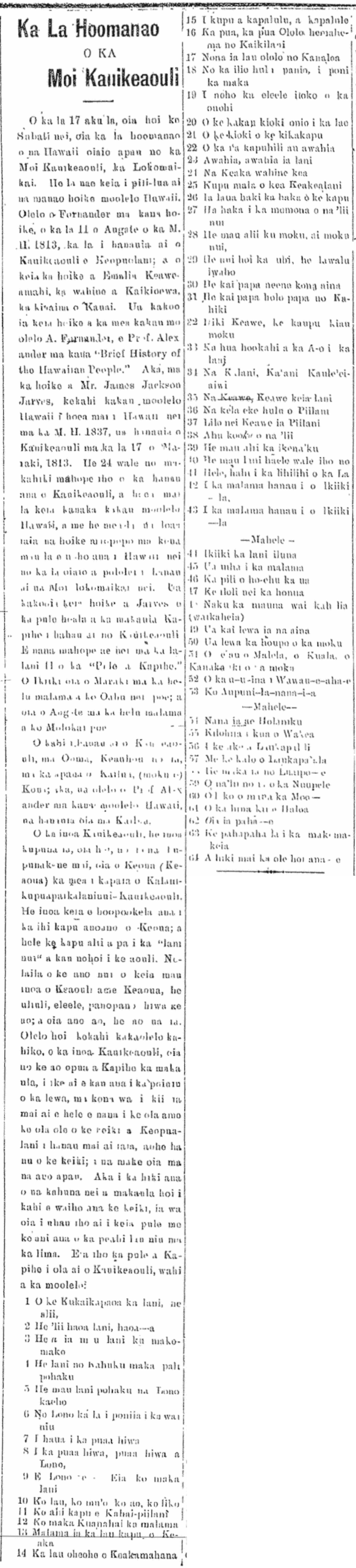
Ka La Hoomanao O KA Moi Kauikeaouli

Kuokoa Home Rula, Buke V, Helu 12, Aoao 4. Maraki 22, 1907.

Vital Statistics. 1862.

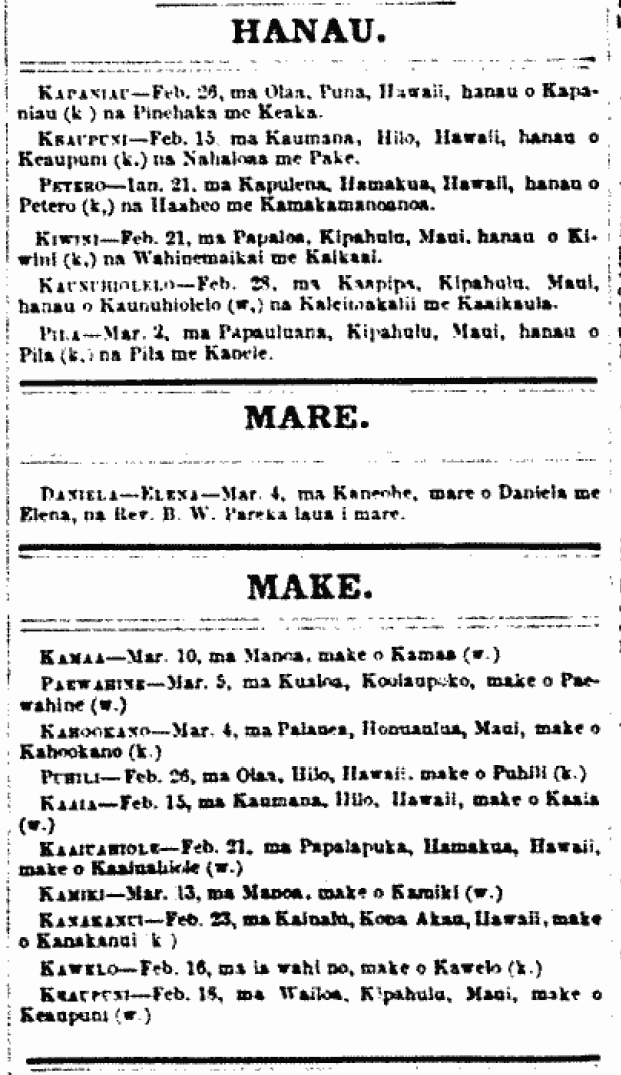
BIRTHS.

Kapaniau—Feb. 26, at Olaa, Puna, Hawaii, Kapaniau (m) was born to Pinehaka and Keaka.
Keaupuni—Feb. 15, at Kaumana, Hilo, Hawaii, Keaupuni (m) was born to Nahaloaa and Pake.
Petero—Jan. 21, at Kapulena, Hamakua, Hawaii, Petero (m) was born to Haaheo and Kamakamanoanoa.
Kiwini—Feb. 21, at Papaloa, Kipahulu, Maui, Kiwini (m) was born to Wahinemaikai and Kaikaai.
Kaunuhiolelo—Feb. 28, at Kaapipa, Kipahulu, Maui, Kaunuhiolelo (f) was born to Kaleimakalii and Kaaikaula.
Pila—Mar. 2, at Papauluana, Kipahulu, Maui, Pila (m) was born to Pila and Kanele.

MARRIAGES.

Daniela—Elena—Mar. 4, at Kaneohe, Daniela married Elena; the two were wed by Rev. B. W. Parker.

DEATHS.

Kamaa—Mar. 10, at Manoa, Kamaa (f) died.
Paewahine—Mar. 5, at Kualoa, Koolaupoko, Paewahine (f) died.
Kahookano—Mar. 4, at Palanea, Honuaulua [Honuaula], Maui, Kahookano (m) died.
Puhili—Feb. 26, at Olaa, Hilo, Hawaii, Puhili (m) died.
Kaaia—Feb. 15, at Kaumana, Hilo, Hawaii, Kaaia (f) died.
Kaaiuahiole—Feb. 21, at Papalapuka, Hamakua, Hawaii, Kaaiuahiole (f) died.
Kamiki—Mar. 13, at Manoa, Kamiki (f) died.
Kanakanui—Feb. 23, at Kainalu, North Kona, Hawaii, Kanakanui (m) died.
Kawelo—Feb. 16, from the same place, Kawelo (m) died.
Keaupuni—Feb. 18, at Wailoa, Kipahulu, Maui, Keaupuni (f) died.

[Notice how this vital statistics column is not the same as the one appearing in the earlier post of Hoku o ka Pakipika which comes out at the same time…]

(Kuokoa, 3/15/1862, p. 3)

HANAU. / MARE. / MAKE.

Ka Nupepa Kuokoa, Buke I, Helu 16, Aoao 3. Maraki 15, 1862.

Vital Statistics. 1862.

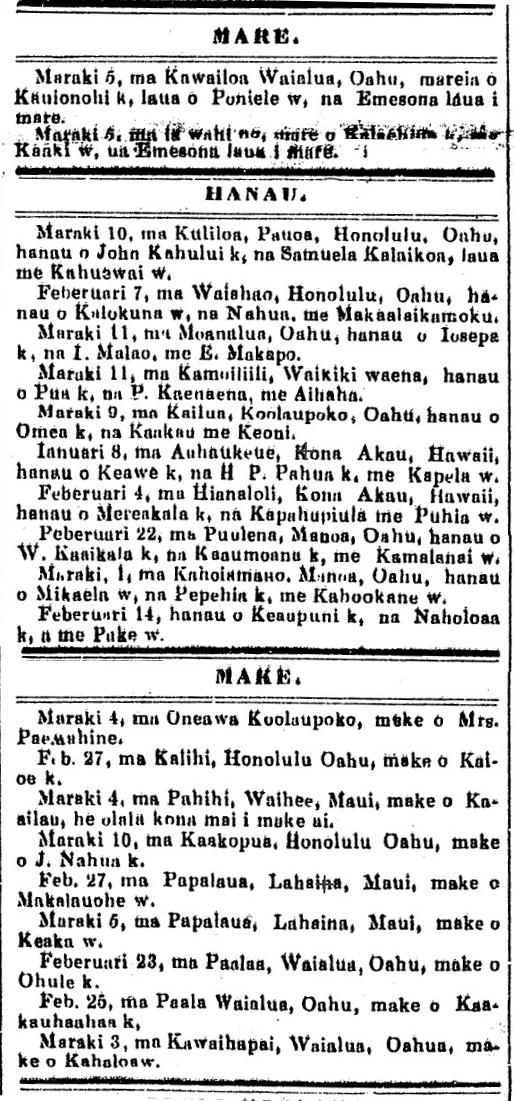
MARRIAGES.

March 5, at Kawailoa, Waialua, Oahu, married was Kauionohi (m) and Poniele (f); Emerson married them.
March 5, at the same place, married was Kalaehina (m) and Kaaki (f), Emerson married them.

BIRTHS.

March 10, at Kuliloa, Pauoa, Honolulu, Oahu, John Kahului (m) was born to Samuela Kalaikoa and Kahuawai (f).
February 7, at Waiahao [mostly known today as Kawaiahao], Honolulu, Oahu, Kalokuna (f) was born to Nahua and Makaalaikamoku.
March 11, at Kamoiliili [mostly known today as Moiliili], Waikiki Waena, born was Pua (m) to P. Kaenaena, and Aihaha.
March 9, at Kailua, Koolaupoko, Oahu, born was Omea (m), to Kaakau and Keoni.
January 8, at Auhaukeue, North Kona, Hawaii, born was Keawe (m) to H. P. Pahua (m) and Kapela (f).
February 4, at Hianaloli, North Kona, Hawaii, born was Mereakala (m) to Kapahupiula and Puhia (f).
February 22, at Puulena, Manoa, Oahu, born was W. Kaaikala (m), to Kaaumona (m) and Kamalanai (f).
March 1, at Kahoiamano, Manoa, Oahu, born was Mikaela (f), to Pepehia (m) and Kahookane (f).
February 14, born was Keaupuni (m) to Naholoaa (m) and Pake (f).

DEATHS.

March 4, at Oneawa, Koolaupoko, Mrs. Paewahine died.
Feb. 27, at Kalihi, Honolulu, Oahu, Kaioe (m) died.
March 4, at Pahihi, Waihee, Maui, Kaailau died of olala [wasting away?].
March 10, at Kaakopua, Honolulu, Oahu, J. Nahua (m) died.
Feb. 27, at Papalaua, Lahaina, Maui, Makalauohe (f) died.
March 5, at Papalaua, Lahaina, Maui, Keaka (f) died.
February 23, at Paalaa, Waialua, Oahu, Ohule (m) died.
Feb. 25, at Paalaa, Waialua, Oahu, Kaakauhaahaa (m) died.
March 3, at Kawaihapai, Waialua, Oahu, Kahaloa (f) died.

[Some newspapers ran vital statistics columns, while others did not. Also the above is an example of a vital statistics column appearing in one paper at the same time another paper prints their own column. They are not the same. See the following post of the Kuokoa column.

Also, there are other articles in this issue giving vital statistics information:

p. 1—”He kanikau no Apuiki,” gives information on Apuiki who died in January, like the parents are Kaiho and Keaka, and elder sibling (of same sex) was named Keliihelela…

p. 1—”He wahi moolelo no J. Kaihupaa,” gives a nicely detailed biography of J. Kaihupaa, who dies on 2/26/1862. He was intimately involved in the royal court. Kamehameha IV took care of much of the funeral. The article is written by J. W. Iaukea (father of Curtis Piehu Iaukea)…

p. 3—”OLELO HOOLAHA, (by Mrs. Napapai),” is a personal announcement speaking of Kahinahina of Honolulu who just died, who is the true child of Kapau who also died, who was a member of the King’s Hulumanu. She claims all lands of Kaaihinahina, which are listed…

p. 3—”OLELO HOOLAHA, (by JNO. E. BARNARD),” is an official announcement saying that Kamaha asked to be the executor of the estate of Maau of Honolulu who died…

And on and on…]

(Hoku o ka Pakipika, 3/13/1862, p. 3)

MARE. / HANAU. / MAKE.

Ka Hoku o ka Pakipika, Buke I, Helu 16, Aoao 3. Maraki 13, 1862.

More about snow on Molokai, 1912.

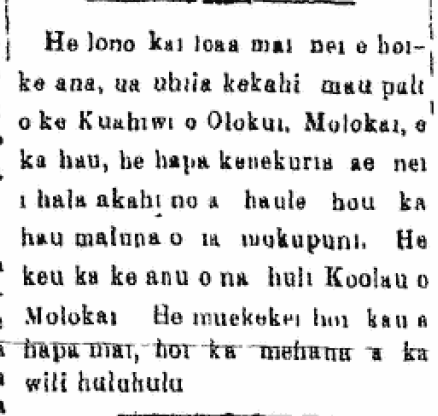
We received word saying that some precipices of the Olokui Mountain, Molokai is covered with snow; it was half a century ago when snow first fell on that island. The Koolau side of Molokai is tremendously cold. [He muekekei hoi a kau hapa mai, hoi ka mehana a ka wili huluhulu. ??]

[Although the previous article says Emma Nakuina thought there never was snow on Molokai before, this here seems to say that snow was recorded on Molokai some time before this!

And does anyone have clarity on the last sentence of the article?]

(Kuokoa Home Rula, 3/15/1912, p. 1)

He lono kai loaa mai nei...

Kuokoa Home Rula, Buke X, Helu 11, Aoao 1. Maraki 15, 1912.

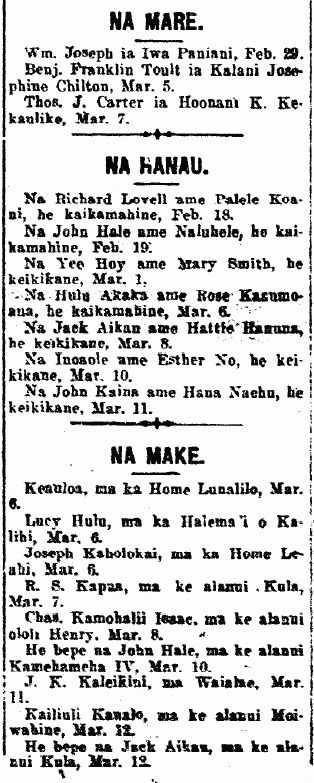
Vital Statistics. 1912.

MARRIAGES.

William Joseph to Iwa Paniani, Feb. 29.
Benjamin Franklin Toult to Kalani Josephine Chilton, Mar. 5.
Thomas J. Carter to Hoonani K. Kekaulike, Mar. 7.

BIRTHS.

To Richard Lovell and Palele Koani, a daughter, Feb. 18.
To John Hale and Naluhele, a daughter, Feb. 19.
To Yee Hoy and Mary Smith, a son, Mar. 1
To Hulu Akaka and Rose Kaaumoana, a daughter, Mar. 6.
To Jack Aikau and Hattie Hanuna, a son, Mar. 8.
To Nameless and Esther No, a son, Mar. 10.
To John Kaina and Hana Naehu, a son, Mar. 11.

DEATHS.

Keauloa, at Lunalilo Home, Mar. 6.
Lucy Hulu, at the Kalihi Hospital, Mar. 6.
Joseph Kaholokai, at Leahi Home, Mar. 6.
R. S. Kapua, on School Street, Mar. 7.
Charles Kamohalii Isaac, on Henry Lane, Mar. 8.
A baby of John Hale, on Kamehameha IV Road, Mar. 10.
J. K. Kaleikini, in Waialae, Mar. 11.
Kailiuli Kanalo, on Queen Street, Mar. 12.
A baby of Jack Aikau, on School Street, Mar. 12.

(Kuokoa, 3/15/1912, p. 8)

NA MARE. / NA HANAU. / NA MAKE.

Ka Nupepa Kuokoa, Buke XLVIII, Helu 11, Aoao 8. Maraki 15, 1912.

If you think we’ve been having strange weather lately… Snow on Molokai? 1912.

SNOW FELL ON MOLOKAI.

THE FIRST TIME THIS REMARKABLE THING WAS WITNESSED.

On her way home from Molokai, Mrs. Emma Nakuina brought proof of snow [hau sano] falling on Molokai, and you can clearly see the whitening of the mountain tops behind Pukoo with snow. In the history of the inhabitation of Molokai, there has never been seen this amazing thing on that island from the beginning, and this is the first time that snow has been seen falling on Molokai. According to Mrs. Nakuina.

H. D. Bowen stated that snow fell in great quantities on the mountain behind Pukoo, so that you could see clearly the patches of snow in many places on the ridges as well as down in the valleys.

You can see the snow all the way from the harbor of Pukoo and the shore, according to Mr. Bowen. He has some land next to [illegible because of fold] and while he was there, he saw the snow.

I believe this is the first time that man remembers that snow fell on Molokai, said Mrs. Nakuina.

So it is perhaps because of the cold we’ve had these past days that snow fell on Molokai. According to the scientists, the time is coming where the tropic zone will become arctic, and will be covered in snow. Could this be the beginning of this?

[See the article from which this was translated [?] and more in The Hawaiian Star, 3/11/1912, pp. 1 & 5.]

(Aloha Aina, 3/16/1912, p. 1)

HAULE KA HAU SANO MA MOLOKAI.

Ke Aloha Aina, Buke XI, Helu 11, Aoao 1. Maraki 16, 1912.

You never know who you will find… 1923.

APPRECIATION

MY BELOVED HUSBAND HAS LEFT ME

To you, Mr. Editor of the Hoku o Hawaii.

Much aloha between us:

Please be so kind as to insert this bundle of sadness shown above in an open space of our newspaper, Ka Hoku o Hawaii, and it will be you who flashes all over the land so that the family and friends of my beloved husband who has left me will see.

That being on the 23rd of Oct., this past month, while I was relaxing at our home, a car arrived from Waiohinu revealing to me this:

“The two of us have come; the train of Punalulu [Punaluu] has gone off the tracks.” That is my husband was on the train, as he works as the stoker. At that moment, I thought that it might be my husband, and I left immediately to the ocean-side of the mill to ask the people of the mill who got injured, but  I first got to where Mrs. Kawaha was doing the wash, and I asked her if she heard the news, and she said she did not.

I told her that I heard the train toppled, and at that moment I saw the sheriff, Moses Kawaha and the doctor.

I called to the sheriff, asking who from the train got injured, but he didn’t respond, then I asked the doctor who was hurt, and his answer to me was Willie, the man from house number 2. Right then my hopes were gone; I returned to our home and everyone else had heard and the house was full of friends. His body was returned here, and I thought maybe he was still breathing, but it was not so, his body was cold and he had gone earlier; he had many injuries.

The reason for the accident is not known; how horrifying to think about.

Puna of the fragrant bowers of pandanus [Puna paia aala i ka hala] is where he was born. He is a true grandchild of Maunakea and Lilia; he grandmother is Puna.

I was joined with my loving husband, William K. Kumukahi in the pure covenant of marriage in the month of March 16, 922 in Kona, Kealia, by reverend John Keala. I think about the places were were together, alas; my husband who has gone afar. We were brought here by the parents [?], Ben Kamoku, to come and be the assistant blacksmith for the mill, and he ended up doing various work. He was kind to me and to all others; my children were important to him.

Alas, I am without my provider [makua], beloved are all the places we were together; he just left this morning to go to work but he has gone forever. His own mother came from Opihikaa [Opihikao?], Puna, but she did not see how he looked; his Kuku [grandparent] and Cousins and Aunty, they saw what he looked like. And his funeral procession went on to the cemetery at Kauahao [Kauahaao?], Waiohinu.

It is there that he lies alone. With the friends and family go my great thanks, those who stayed up with me that night till day, and also the lei, the bouquets of flowers from the friends, and to the family is my endless appreciation.

All of us in sadness:

Mrs. Mary Kumukahi

Miss Alice Kumukahi

Samuel Kumukahi

Mrs. Kawaa Lohiau

Mr. L. K. Lohiau

[I found this article by chance. Genealogy and family stories abound in the Hawaiian-Language Newspapers. Hopefully the names and important information will be inputted faithfully so that if you look up your kupuna, you will find them every time they appear!]

(Hoku o Hawaii, 11/15/1923, p. 3)

HOALOHALOHA

Ka Hoku o Hawaii, Buke XVII, Helu 25, Aoao 3. Novemaba 15, 1923.

True Hawaiian? 1893.

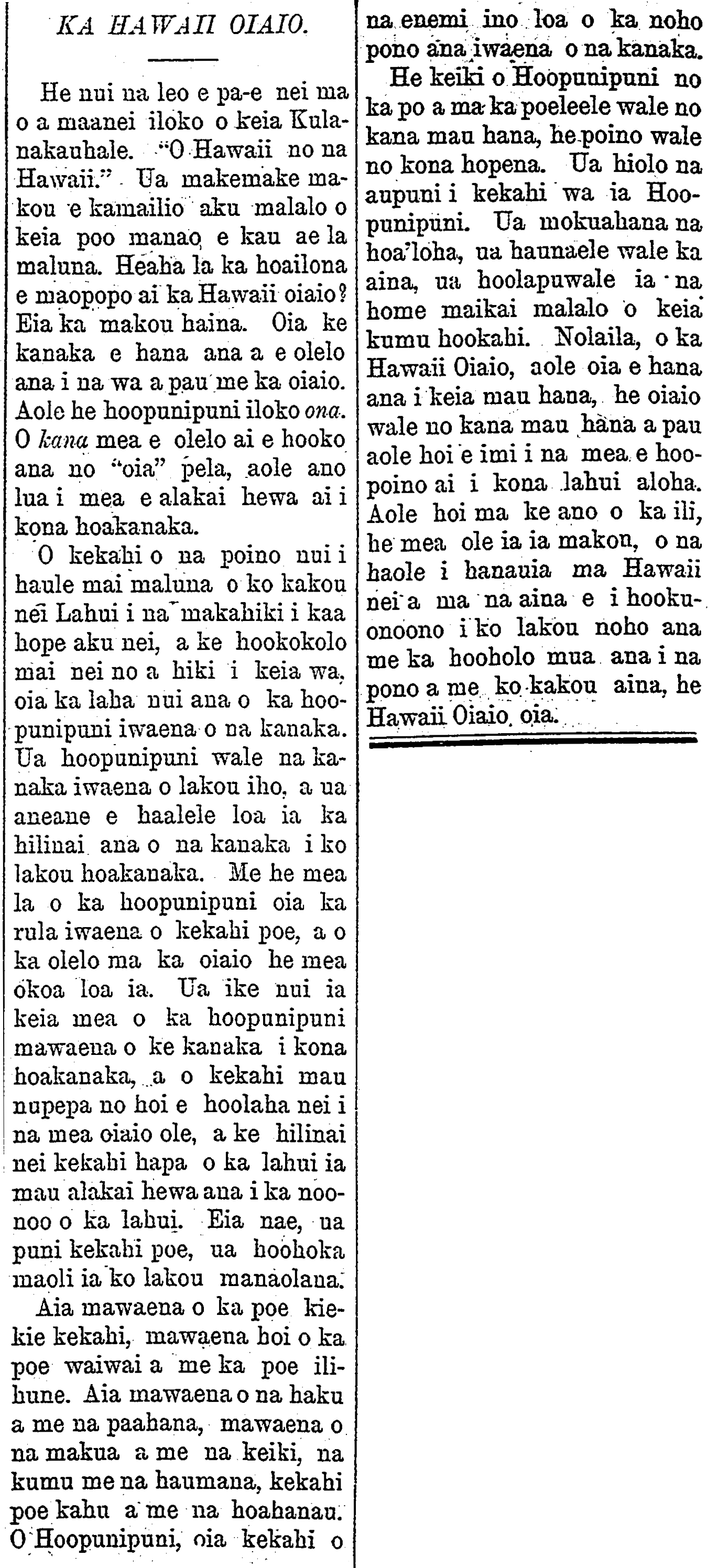
True Hawaiian.

There are many voices ringing out here and there in this Town. “Hawaii for Hawaiians.” We wish to discuss the topic above. What in the world are the signs that distinguish a true Hawaiian? This is our answer. It is a person who acts and speaks at all times in truth. He has no falsehood within him. What he says, he follows through on, and does not speak to mislead his fellow man.

One of the great misfortune which fell upon our Lahui these past years, and creeps on to the present, is the rampant promulgation of lies amongst the people. People tell falsehoods amongst themselves, and it is almost to the point where people have lost faith their fellow man. It is as if lying is the norm with some people, and telling the truth is something terribly odd. This telling of falsehoods is often seen among people to his fellow man, and some newspapers are spreading things that are not true; and a part of the lahui believes this misleading of the minds of the lahui. And still some people were taken by it, and their hopes dashed.

Amongst the prominent people, amongst the rich and the poor. Amongst the bosses and the laborers, amongst the parents and the children, the instructors and students, some pastors and church members. Falsehood is the most vile enemy of righteous living amongst people.

Falsehood is the spawn of night, and it only works in darkness, and misfortune is its outcome. During some ages, nations have fallen to Falsehood. Friends have been torn apart, the land grew tumultuous, and good homes became retched, all because of this one reason. Therefore, the True Hawaiian does not act in such a manner, he only acts truthfully, and he does not seek to cause harm his own beloved lahui. It is not skin color, that means nothing to us; those haole born in Hawaii nei  and elsewhere who prosper while moving well-being and our land forward, he is a True Hawaiian.

[Notice that this editorial came out soon after the overthrow, and was in response to the many articles anticipating the return of the crown.

There were many types of Hawaiian-Language Newspaper owners and editors as well, and it is important to understand the slant of a paper when reading its articles. It is important also to remember that a newspaper might not always have the same goals and objectives throughout its existence, especially if its leadership changes. J. U. Kawainui was editor and J. K. Iosepa was assistant editor of the Daily Kuokoa when this article appeared.

This is one of those papers that are not available online yet (images or text). Also, they are not available at the usual places on microfilm. Hopefully they will be made available soon!]

(Nupepa Puka La Kuokoa me Ko Hawaii Paeaina i Huiia, 3/9/1893, p. 2)

KA HAWAII OIAIO.

Nupepa Puka La Kuokoa me Ko Hawaii Paeaina i Huiia, Buke I, Helu 28, Aoao 2. Maraki 9, 1893.

More from Kalaupapa, 1912.

A REMEMBRANCE OF THE ONE WHO HAS GONE.

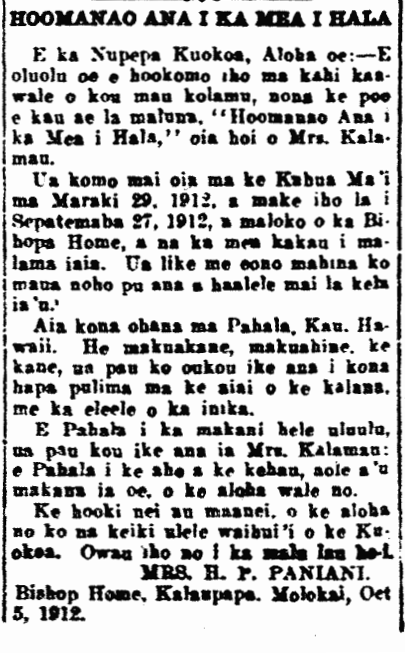
O Nupepa Kuokoa, Aloha oe:—Please be so kind as to include in an empty space of your columns the article with the title above, “A Remembrance of the One Who Has Gone,” that being Mrs. Kalamau.

She came to the leprosy settlement on March 29, 1912, and died on September 27, 1912 in Bishop Home, and it was your writer who took care of her. We lived together for about six months when she left me.

Her family is in Pahala, Kau, Hawaii. Her father, mother, and husband, you will no longer see her hand on white stationery with the black of ink.

O Pahala in the blustery winds, you shall no longer see Mrs. Kalamau; O Pahala in the soft blowing Kehau, i have no gift for you, only aloha.

I end here; my aloha to the type setting boys of the Kuokoa. Me, in the shade of the hoi [ho’i?] leaves.

Mrs. H. P. Paniani.

Bishop Home, Kalaupapa, Molokai, Oct. 5, 1912.

(Kuokoa, 10/18/1912, p. 7)

HOOMANAO ANA I KA MEA I HALA

Ka Nupepa Kuokoa, Buke XLVIII, Helu 42, Aoao 7. Okatoba 18, 1912.