Harper’s New Monthly Magazine and Kekuanaoa, 1871.

Here is the short piece described in the last post:

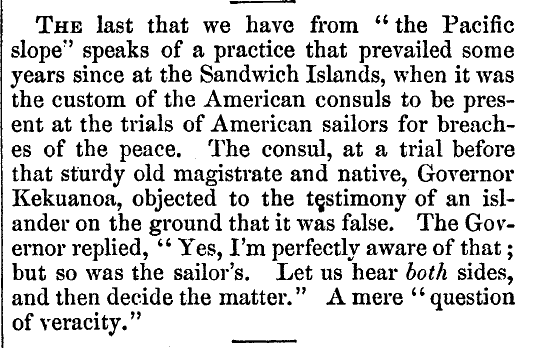
The last that we have from “the Pacific slope” speaks of a practice that prevailed some years since at the Sandwich Islands, when it was the custom of the American consuls to be present at the trials of American sailors for breaches of the peace. The consul, at a trial before the sturdy old magistrate and native Governor Kekuanoa [Kekuanaoa], objected to the testimony of an islander on the grounds that it was false. The Governor replied, “Yes, I’m perfectly aware of that; but so was the sailor’s. Let us hear both sides, and then decide the matter.” A mere “question of veracity.”

(Harper’s New Monthly, 4/1871, p. 797)

The last that we have from...

Harper’s New Monthly Magazine, Volume 42, Issue 251, Page 797. April 1871.

In praise of Mataio Kekuanaoa, 1871.

The different Father of Chiefs.

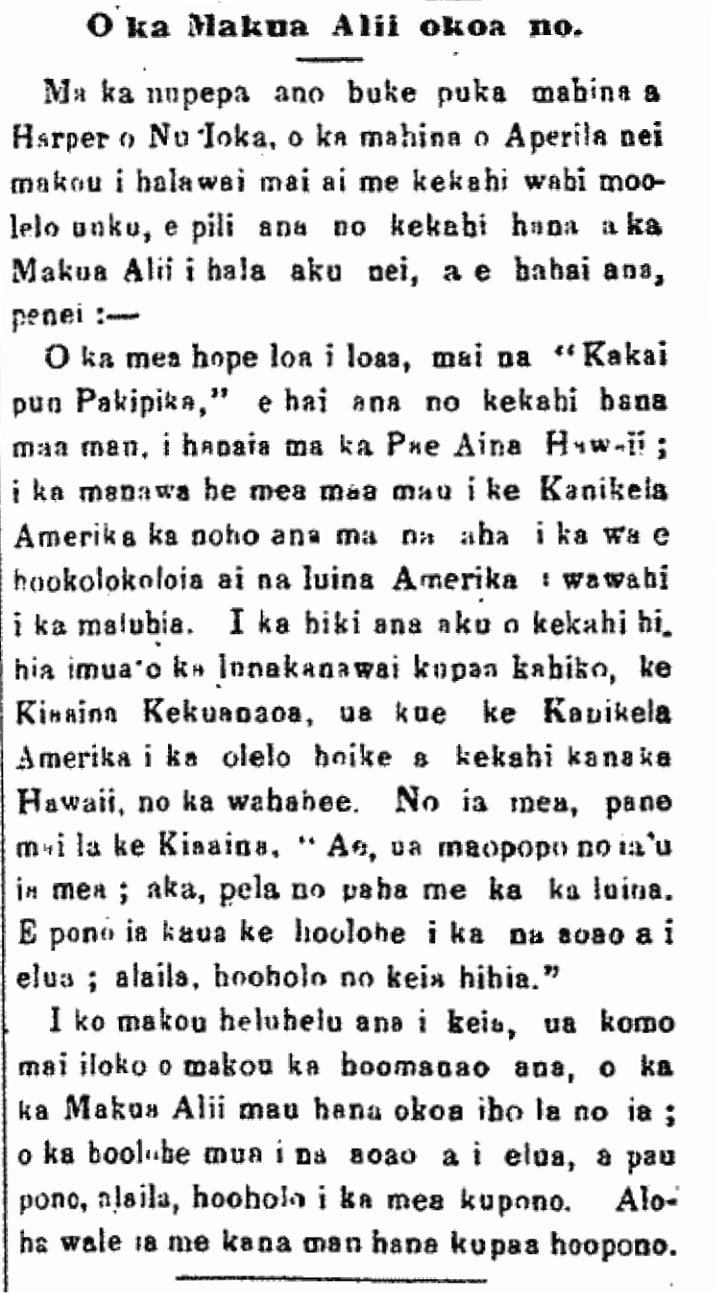
In the monthly magazine, Harper’s of New York, we came across in the April edition, a short story about something done by the Alii Father [Makua Alii] who has passed, and it reports:—

The latest received from the “Pacific String of Hills” speaks of a regular practice carried out in the Hawaiian Islands; during the times when it was a regular thing for the American Consul to sit at court when an American sailor was on trial for disturbing the peace. When a case came before the traditional judge, the Governor Kekuanaoa, the American Consul objected to the testimony of a Hawaiian on the grounds of perjury. At which the Governor replied, “Yes, I am aware of this; but the same may be true of the sailor. The two of us must hear both sides and then rule on this matter.”

When we read this, we recalled that is the different way the Father of Chiefs did things; he listened to both sides first, and when that was finished, he would decide what was proper. Aloha to him and his deeds of steadfast righteousness.

(Au Okoa, 4/13/1871, p. 1)

O ka Makua Alii okoa no.

Ke Au Okoa, Buke VI, Helu 52, Aoao 1. Aperila 13, 1871.

Bound years of the Kuokoa for sale, 1865.

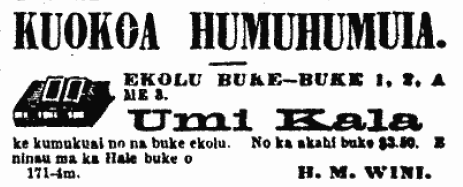
BOUND KUOKOA.

THREE BOOKS—VOLUMES 1, 2 AND 3.

Ten Dollars

is the price for the three books. For one book is $3.50. Inquire at the Book store of H. M. WHITNEY [H. M. WINI].

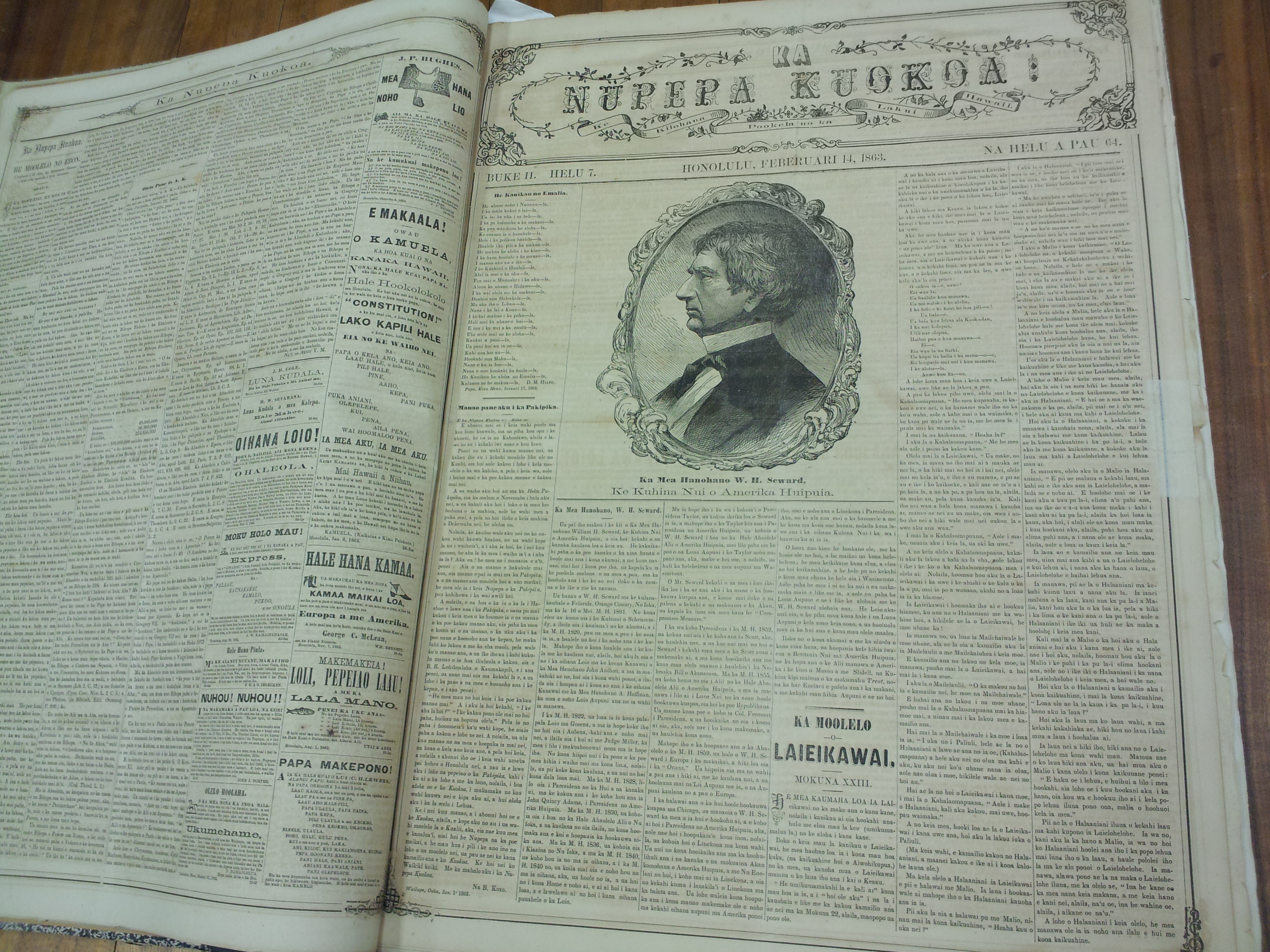
[For a fee, you could take your year of newspapers to be bound at the end of the year, or they would be sold bound like these Kuokoa. Thanks the this binding, we are left with many full sets of newspapers! However, when they microfilmed the bound newspapers years ago, many were so tightly sewn that the bound side of the pages are illegible because they fall in a shadow. Hopefully funding can be found to have these newspapers unbound by an expert so the pages can be photographed clearly!]

(Kuokoa, 3/16/1865, p. 3)

KUOKOA HUMUHUMUIA.

Ka Nupepa Kuokoa, Buke IV, Helu 11, Aoao 3. Maraki 16, 1865.

Hawaii’s Story by Hawaii’s Queen, in the Hawaiian Language, 1898.

WE WILL SATISFY.

Because we are constantly asked by our readers to print the story which our Queen wrote in Washington and that was just published in Boston, therefore, we are spreading the news to our readership that we will translate and print the story in the columns of the newspapers the daily and weekly Ke Aloha Aina, on the first week of this coming month for the benefit of our readers. Therefore, do take up Ke Aloha Aina so that you can see the one story written by Queen Liliuokalani and published in foreign lands, with statements full of sentiment and aloha dealing with Her overthrow. Aloha for Her.

(Aloha Aina, 3/19/1898, p. 5)

E HOOKO AKU ANA MAKOU.

Ke Aloha Aina, Buke IV, Helu 12, Aoao 5. Maraki 19, 1898.

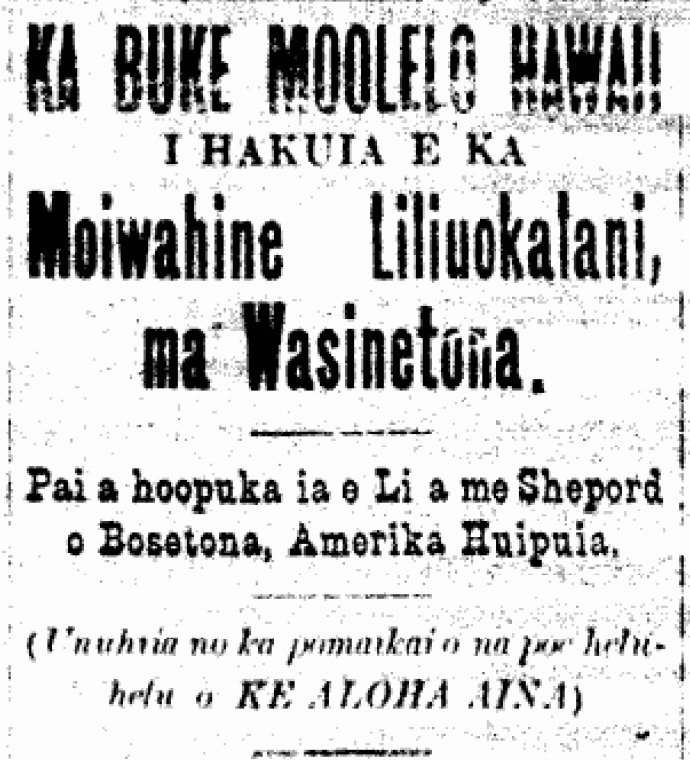
Here, by the way, is what the heading of that running column looked like:

HAWAIIAN HISTORY

WRITTEN BY

Queen Liliuokalani,

in Washington.

Published by Lee and Shepard

of Boston, United States of America.

(Translated for the benefit of the

readers of KE ALOHA AINA)

(Aloha Aina, 4/2/1898, p. 6)

KA BUKE MOOLELO HAWAII

Ke Aloha Aina, Buke IV, Helu 14, Aoao 6. Aperila 2, 1898.

On Liliuokalani’s composition of “Mele Lahui Hawaii,” 1898.

“In the early years of the reign of Kamehameha V, he brought to my notice the fact that the Hawaiian people had no national air. Each nation, he said, but ours had its expression of patriotism and love of country in its own music; but we were using for the purpose on state occasions the time-honored British anthem, “God save the Queen.” This he desired me to supplant by one of my own composition. In one week’s time I notified the king that I had completed my task. The Princess Victoria had been the leader of the choir of the Kawaiahao church; but upon her death, May 29, 1866, I assumed the leadership. It was in this building and by that choir that I first introduced the “Hawaiian National Anthem.” The king was present for the purpose of criticising my new composition of both words and music, and was liberal in his commendations to me on my success. He admired not only the beauty of the music, but spoke enthusiastically of the appropriate words, so well adapted to the air and to the purpose of which they were written.”

(from Hawaii’s Story by Hawaii’s Queen, pp. 31–32.)

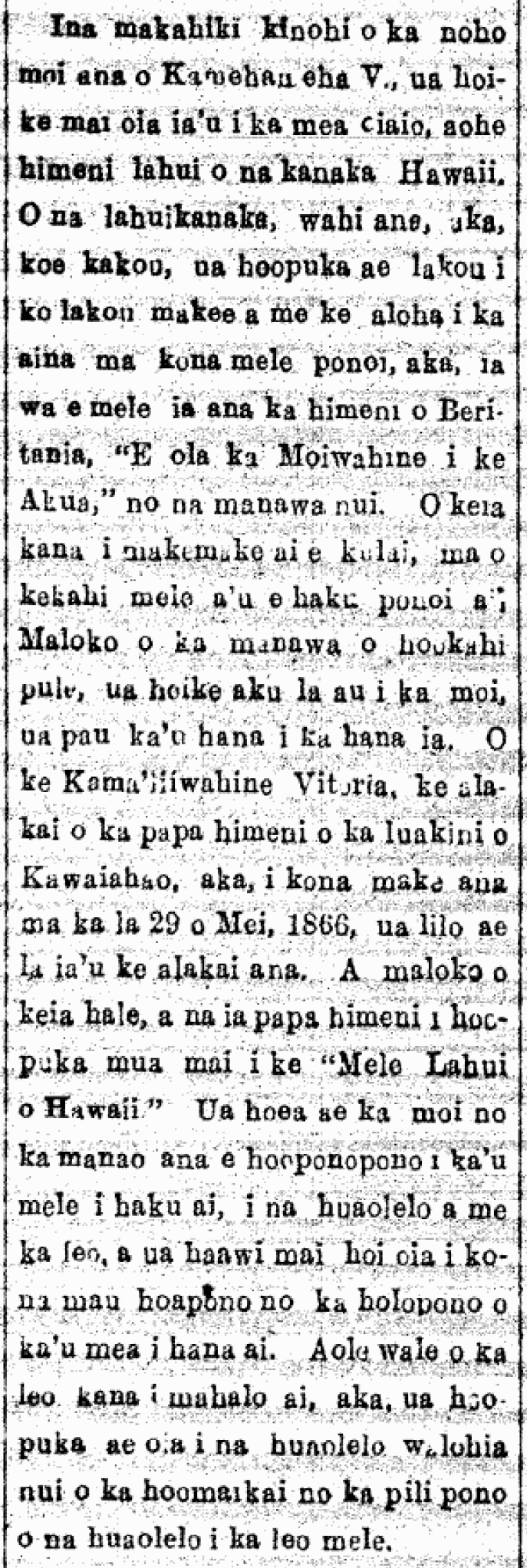
“Ina makahiki kinohi o ka noho moi ana o Kamehameha V., ua hoike mai oia ia’u i ka mea oiaio, aohe himeni lahui o na kanaka Hawaii. O na lahuikanaka, wahi ana, aka, koe kakou, ua hoopuka ae lakou i ko lakou makee a me ke aloha i ka aina ma kona mele ponoi, aka, ia wa e mele ia ana ka himeni o Beritania, “E ola ka Moiwahine i ke Akua,” no na manawa nui. O keia kana i makemake ai e kulai, ma o kekahi mele a’u e haku ponoi ai. Maloko o ka manawa o hookahi pule, ua hoike aku la au i ka moi, ua pau ka’u hana i ka hana ia. O ke Kama’liiwahine Vitoria, ke alakai o ka papa himeni o ka luakini o Kawaiahao, aka, i kona make ana ma ka la 29 o Mei, 1866, ua lilo ae la ia’u ke alakai ana. A maloko o keia hale, a na ia papa himeni i hoopuka mua mai i ke “Mele Lahui o Hawaii.” Ua hoea ae ka moi no ka manao ana e hooponopono i ka’u mele i haku ai, i na huaolelo a me ka leo, a ua haawi mai hoi oia i kona mau hoapono no ka holopono o ka’u mea i hana ai. Aole wale o ka leo kana i mahalo ai, aka, ua hoopuka ae oia i na huaolelo walohia nui o ka hoomaikai no ka pili pono o na huaolelo i ka leo mele.”

(Aloha Aina, 5/14/1898, p. 7)

KA BUKE MOOLELO HAWAII I HAKUIA E KA Moiwahine Liliuokalani...

Ke Aloha Aina, Buke IV, Helu 20, Aoao 7. Mei 14, 1898.

Hawaiian National Anthem, 1866.

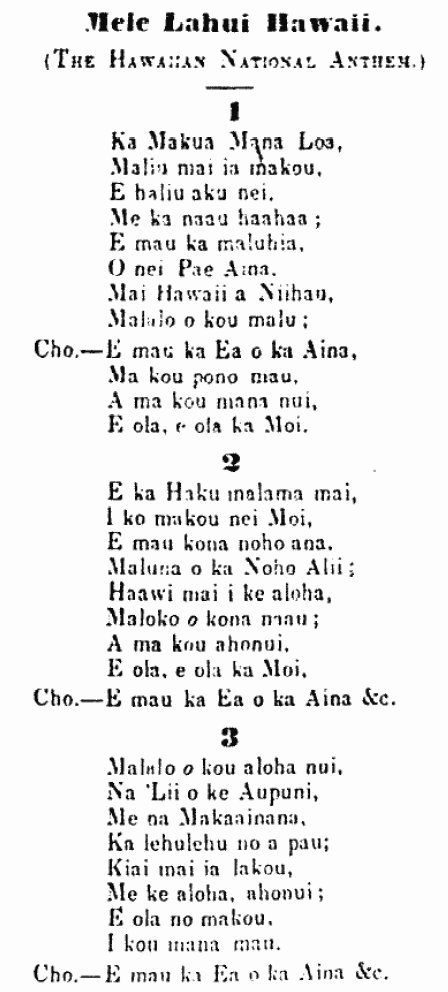
Mele Lahui Hawaii.
(The Hawaiian National Anthem.)

1

Ka Makua Mana Loa,
Maliu mai ia makou,
E haliu aku nei,
Me ka naau haahaa;
E mau ka maluhia,
O nei Pae Aina,
Mai Hawaii a Niihau,
Malalo o kou malu.

Cho.—E mau ka Ea o ka Aina,
Ma kou pono mau,
A ma kou mana nui,
E ola, e ola ka Moi.

2

E ka Haku malama mai,
I ko makou nei Moi,
E mau kona noho ana,
Maluna o ka Noho Alii;
Haawi mai i ke aloha,
Maloko o kona naau;
A ma kou ahonui,
E ola, e ola ka Moi.

Cho.—E mau ka Ea o ka Aina, &c.

3

Malalo o kou aloha nui,
Na ‘Lii o ke Aupuni,
Me na Makaainana,
Ka lehulehu no a pau;
Kiai mai ia lakou,
Me ke aloha, ahonui;
E ola no makou,
I kou mana mau.

Cho.—E mau ka Ea o ka Aina, &c.

The Hawaiian National Anthem.

1

Almighty Father,
Heed us,
Who turn to you,
With humble hearts;
Let there forever be peace,
In these Islands,
From Hawaii to Niihau,
Under your protection;

Cho.—Let the Sovereignty of this Land be for always,
By your never ending righteousness,
And by your great power,
Long live, long live the King.

2

O Lord, protect,
Our King,
Let his rule continue,
Upon the Throne;
Bestow him aloha,
Within his heart;
And by your grace
Long live, long live the King.

Cho.—Let the Sovereignty of this Land be for always, &c.

3

Under your great love,
Are the Alii of the Nation,
And the Makaainana,
All the people;
Do watch over them,
With aloha and magnanimity,
Let us live,
By your eternal power.

Cho.—Let the Sovereignty of this Land be for always, &c.

(Kuokoa, 11/24/1866, p. 2)

Mele Lahui Hawaii.

Ka Nupepa Kuokoa, Buke V, Helu 47, Aoao 2. Novemaba 24, 1866.

Unclear online newspaper images, 2012.

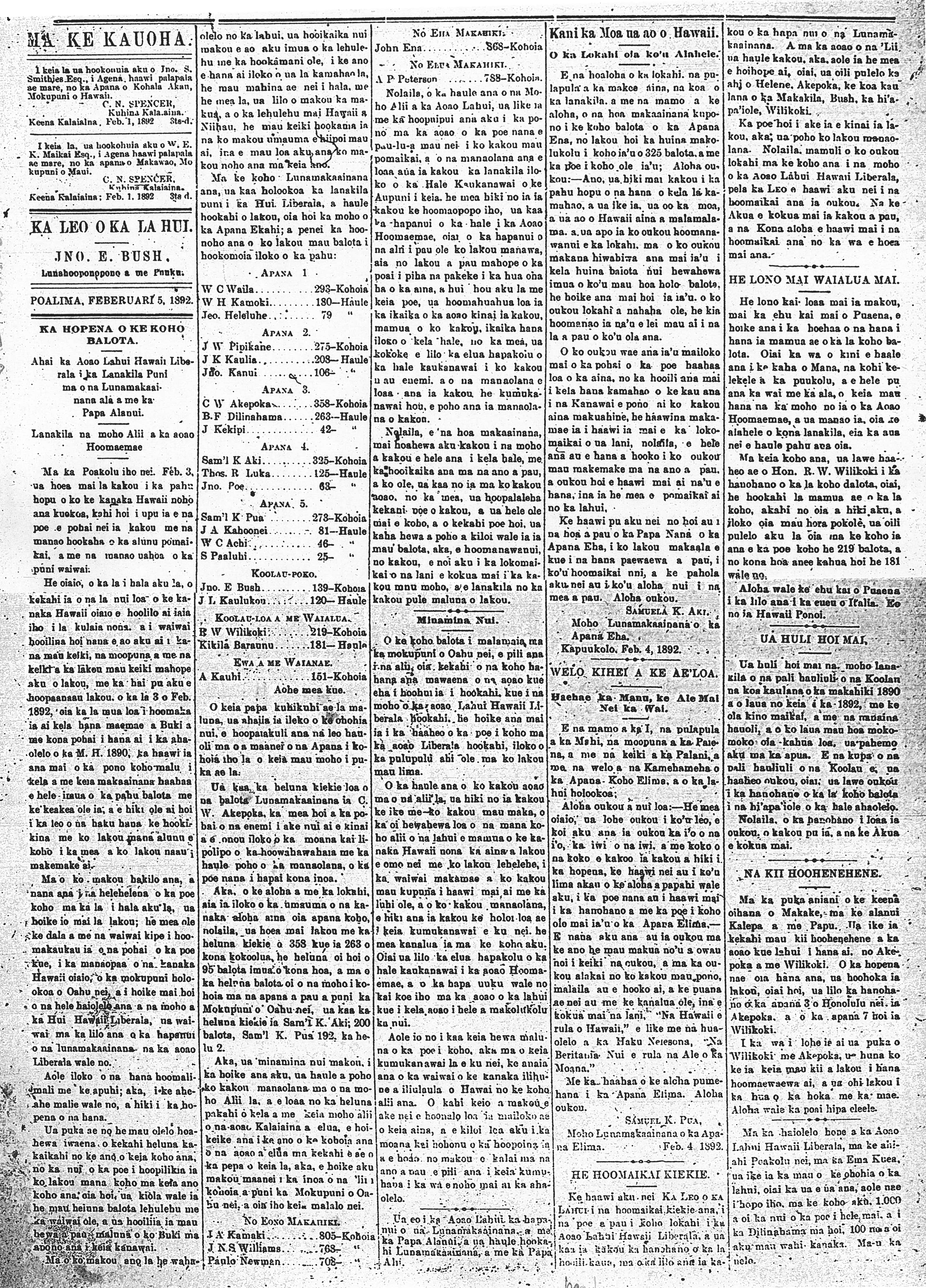
I have been saying that much of the online images of the newspapers done by ulukau are unclear because they were taken from bad microfilms. This is often the case. However, I was just shown a page of Ka Leo o ka Lahui that someone has volunteered to manually type. The online image they received is the same image that is online. It is somewhat legible, but the bottom is totally unclear and would have resulted in strings of @s. I went to the microfilms, and they are actually legible. Here is how this one page compares.

Here is the image of the PDF online.

Here below is an image taken from the microfilm today [to see an enlarged image, click on the image twice]:

Leo o ka Lahui, 2/5/1892, p. 2

Ka Leo o ka Lahui, Buke II, Helu 383, Aoao 2. Feberuari 5, 1892.

For those of you typing pages from this newspaper, you might try looking at the microfilms if you have access to them!

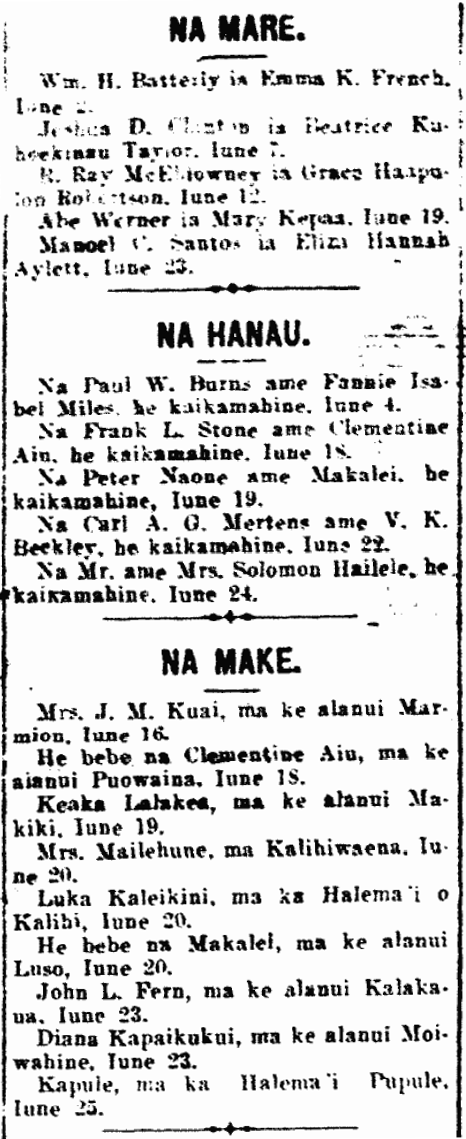
Vital Statistics, 1912.

MARRIAGES.

William H. Batterly to Emma K. French, June 2.
Joshua D. Clanton to Beatrice Kuhoekinau [Kuheekinau?] Taylor, June 7.
R. Ray McEldowney to Grace Haapulou Robertson, June 12.
Abe Werner to Mary Kepaa, June 19.
Manuel C. Santos to Eliza [Elizabeth] Hannah Aylett, June 23.

BIRTHS.

To Paul W. Burns and Fannie Isabel Miles, a daughter, June 4.
To Frank L. Stone and Clementine Aiu, a daughter, June 18.
To Peter Naone and Makalei, a daughter, June 19.
To Carl A. G. Mertens and V. K. Beckley, a daughter, June 22.
To Mr. and Mrs. Solomon Hailele, a daughter, June 24.

DEATHS.

Mrs. J. M. Kuai, on Marmion Street, June 16.
A baby of Clementine Aiu, on Punchbowl Street, June 18.
Keaka lalakea, on Makiki Avenue, June 19.
Mrs. Mailehune, at Kalihiwaena, June 20.
Luka Kaleikini, at the Kalihi Hospital, June 20.
A baby of Makalei, on Luso Street, June 20.
John L. Fern, on Kalakaua Avenue, June 23.
Diana Kapaikukui, on Queen Street, June 23.
Kapule, at the Insane Asylum, June 25.

[Figuring out what the names were under Marriages was particularly difficult and needed to be checked against various sources. It would be a smart thing to photograph the newspapers using today’s technology so that they are as clear as possible, before they crumble apart…]

(Kuokoa, 6/28/1912,  p. 8)

MARE. / HANAU. / MAKE.

Ka Nupepa Kuokoa, Buke XLVIII, Helu 26, Aoao 8. Iune 28, 1912.

Law banning the killing of imported birds, 1870.

HE KANAWAI

E HOOLOLI ANA I KA PAUKU 3 A ME KA PAUKU 7, A E HOOPAU ANA I KA PAUKU 5, O KA MOKUNA LXXXV O KE KANAWAI HOOPAI KARAIMA.

E hooholoia e ka Moi a me ka Hale Ahaolelo o ko Hawaii Pae Aina i akoakoa iloko o ka Ahaolelo Kaukanawai o ke Aupuni:

PAUKU 1. E hoololiia a ma keia ke hoololiia nei ka Pauku 3, o ka Mokuna LXXXV o ke Kanawai Hoopai Karaima, a penei e heluheluia ai:

“PAUKU 3. Ina e pepehi a hoomake paha kekahi kanaka ma ke ki ana i ka pu, ma ke kipukaahele a ma kekahi ano e ae paha, i kekahi manu i laweia mai mai na aina e mai i mea e laha ai kona ano manu ma keia Pae Aina, a i kekahi puka ana o ia ano manu mai na aina e mai i hookuu wale ia maloko o keia Aupuni, a ina hoi e lawe wale i na hua, a i na punana paha o ia mau ano manu, alaila, e hoopaiia oia, ke ku ka hewa ma ka hookolokoloia ana imua o kekahi Lunakanawai Hoomalu a Apana paha, aole emi malalo iho o na dala he umi, aole hoi e oi mamua o na dala he iwakalua no kela hewa keia hewa, a ina aole i hookaaia, alaila e noho oia ma ka Hale Paahao a kaa ia dala hoopai.”

PAUKU 2. E hoololiia ka Pauku 7, o ia Mokuna a ma keia, ua hoololiia, a penei ka heluhelu ana:

“PAUKU 7. Aole no e kipu, aole e pepehi ma kekahi ano e ae, kekahi mea i na holoholona holo wale i laweia mai, mai na aina e mai, a o kekahi puka ana mai o ia holoholona, iloko o na makahiki he umi mahope o ia lawe ana mai, malalo o ka hoopai aole e oi aku mamua o ke kanalima dala no ka hana ana pela.”

PAUKU 3. Ma keia e hoopauia ka Pauku 5 o ia Mokuna i oleloia.

PAUKU 4. E lilo keia i Kanawai i kona la e hooholoia ai.

Aponoia i keia la 8 o Iulai, M. H. 1870.

KAMEHAMEHA R.

(Au Okoa, 8/4/1870, p. 4)
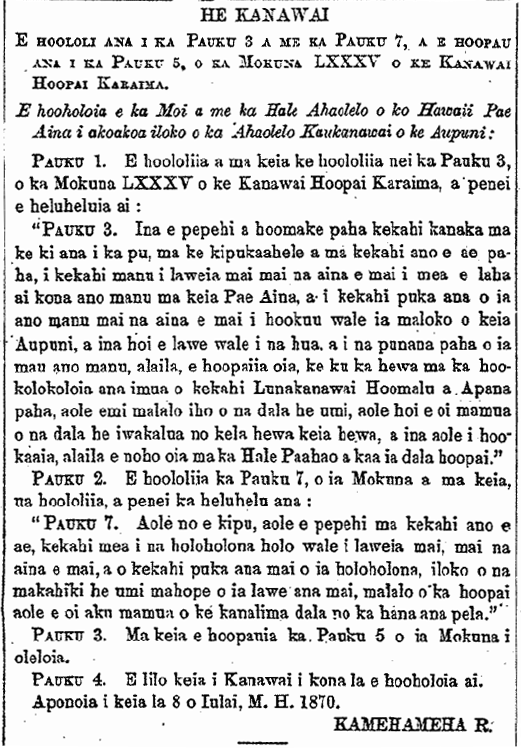
HE KANAWAI, E HOOLOLI ANA I KA PAUKU 3 A ME KA PAUKU 7...

Ke Au Okoa, Buke VI, Helu 16, Aoao 4. Augate 4, 1870.

AN ACT

TO AMEND SECTION 3 and 7 AND REPEAL SECTION 5 OF CHAPTER LXXXV OF THE PENAL CODE.

Be it Enacted by the King and the Legislative Assembly of the Hawaiian Islands, in the Legislature of the Kingdom assembled:

SECTION 1. That Section 3 of Chapter LXXXV of the Penal Code, be and hereby is amended to read as follows:

Section 3. Any person who shall shoot, snare or otherwise destroy any bird, brought from a foreign country for the purpose of propagating its species within this Kingdom, or any of the progeny of such imported bird; or who shall disturb the eggs and nests of such birds, shall, on conviction, before any Police or District Justice, be fined not less than ten dollars, nor more than twenty dollars, for each offense, and in default of payment, be imprisoned until such fine is paid.

SECTION 2. That Section 7 of the said Chapter be, and hereby is amended to read as follows:

“SECTION 7. No person shall shoot or otherwise destroy any animals ‘Feræ Naturæ,’ which shall have been introduced into this Kingdom, within ten years, nor the progeny of such animals, under a penalty of not more than fifty dollars for each offense.”

SECTION 3. That Section 5 of said Chapter, is hereby repealed.

SECTION 4. This Act shall take effect and become a law from and after the date of its passage.

Approved this 8th day of July, A. D. 1870.

KAMEHAMEHA R.

(Hawaiian Gazette, 7/27/1870, p. 4)
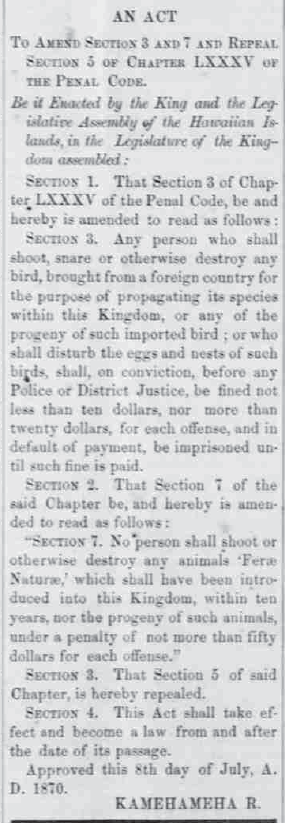
AN ACT, TO AMEND SECTION 3 and 7 AND REPEAL SECTION 5...

Hawaiian Gazette, Volume VI, Number 28, Page 4. July 27, 1870.