Another reason why we need to take new images of the newspapers, 2012.

Yesterday, I was looking for an article that was cited in something I was reading. The citation was for an article on the planting of kalo and the selling of poi and was to be found in Aloha Aina, 5/27/1916.

I of course immediately went online—not there. Then I went to the microfilms—not there. My first instinct was that the citation was wrong. However, there would have been an issue published on that date…

So as a last resort, I went back to the originals. Come to find out, there are in just that year, seven issues that are extant that are not available online or on microfilm…

I am not sure why there isn’t a bigger push to reshoot all of the newspapers so that every word on every page is legible, and so that every page that is still in existence is made easily available online. Sure, the economy is not the best, but if we want to understand the present, and to make better decisions to shape the future, we need to understand the past; not the past as told by those from the outside looking in, but by those living it.

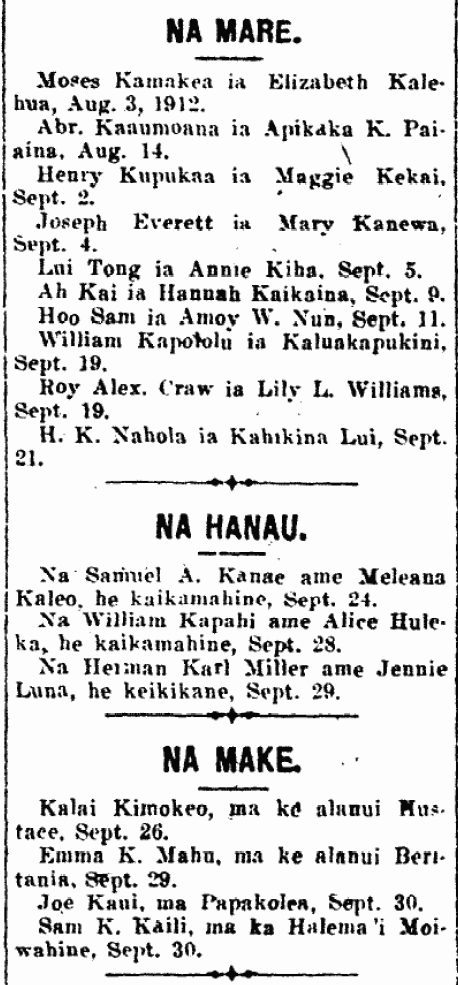
Vital Statistics, 1912.

MARRIAGES.

Moses Kamakea to Elizabeth Kalehua, Aug. 3, 1912.
Abraham Kaaumoana to Apikaka K. Paiaina, Aug. 14.
Henry Kupukaa to Maggie Kekai, Sept. 2.
Joseph Everett to Mary Kanewa, Sept. 4.
Lui Tong to Annie Kiha, Sept. 5.
Ah Kai to Hannah Kaikaina, Sept. 9.
Hoo Sam to Amoy W. Nun [Nuu ?], Sept. 11.
William Kapololu to Kaluakapukini, Sept. 19.
Roy Alexander Craw to Lily L. Williams, Sept. 19.
H. K. Nahola to Kahikina Lui, Sept. 21.

BIRTHS.

To Samuel A. Kanae and Meleana Kaleo, a daughter, Sept. 24.
To William Kapahi and Alice Huleka, a daughter, Sept. 28.
To Herman Karl Miller and Jennie Luna, a son, Sept. 29.

DEATHS.

Kalai Kimokeo, on Hustace Street, Sept. 26.
Emma K. Mahu, on Beritania Street, Sept. 29.
Joe Kaui, in Papakolea, Sept. 30.
Sam K. Kaili, at Queen’s Hospital, Sept. 30.

(Kuokoa, 10/4/1912, p. 8)

NA MARE. / NA HANAU. / NA MAKE.

Ka Nupepa Kuokoa, Buke XLVIII, Helu 40, Aoao 8. Okatoba 4, 1912.

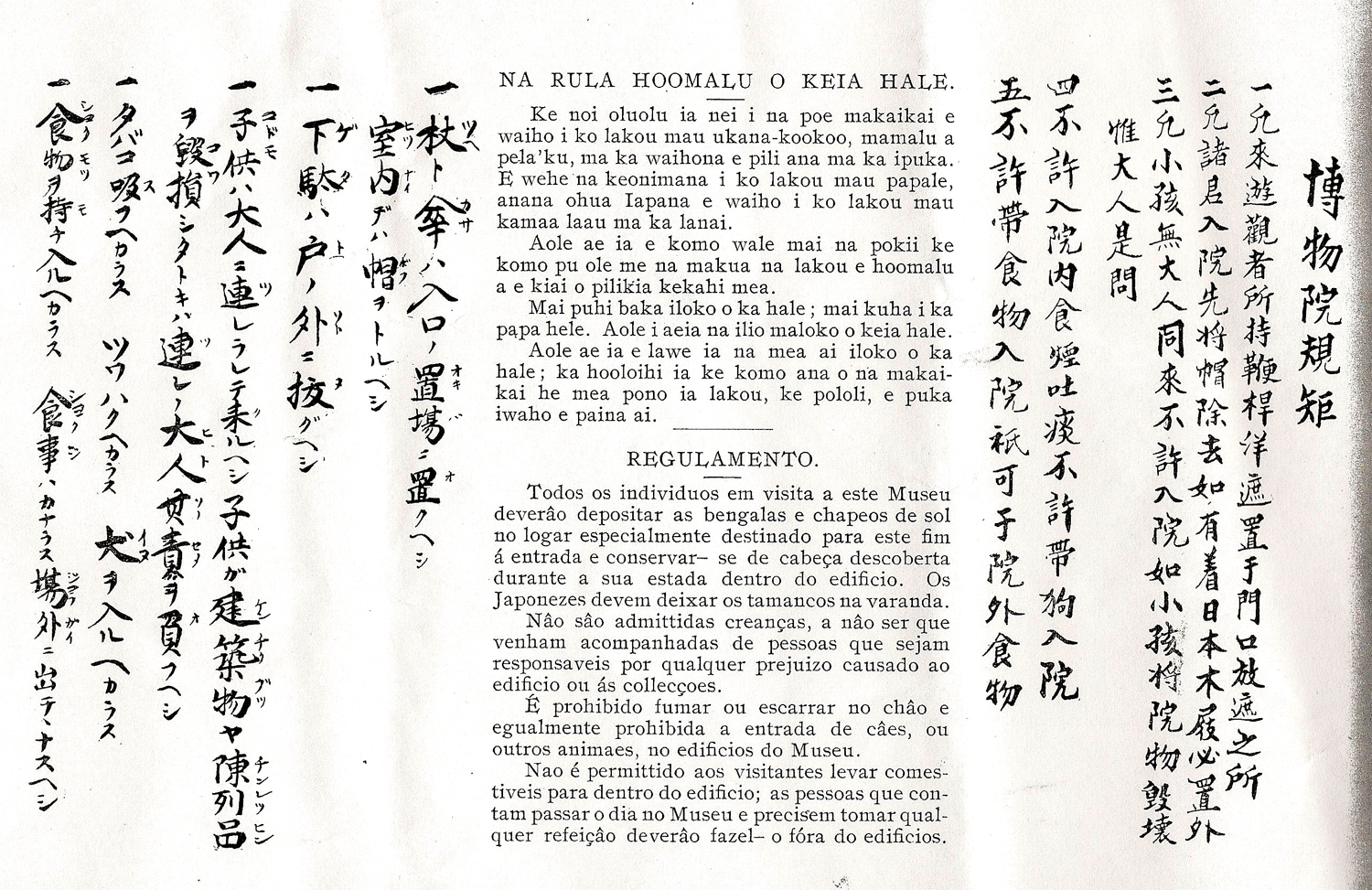
Bernice Pauahi Bishop Museum rules for patrons, 1903.

THE RULES OF ORDER OF THIS ESTABLISHMENT.

We kindly request of the visitors to leave their bags, canes, umbrellas, and so forth at the place to leave them by the entrance. Gentlemen are to remove their hats, and the Japanese guests are to leave their “wooden shoes” on the lanai.

Children are not allowed to enter unsupervised by adults who are to keep them in control and to watch them lest something gets damaged.

Do not smoke withing the building; do not spit on the floors. Dogs are not permitted in the building.

The bringing in of food into the building is not allowed; if here for an extended period, they must, if hungry, go outside to eat.

[This came from “A Handbook for Visitors to the Bernice Pauahi Bishop Museum of Polynesian Ethnography and Natural History” Honolulu 1903. I just came across this today and thought it was interesting.

In Japanese, the only big difference seems to be that it says if a child damages the building or one of the exhibits, then the accompanying adult must take responsibility. And those “wooden shoes” must have been troublesome, because it appears to be talked about in all four other languages as well!]

(“A Handbook for Visitors to the Bernice Pauahi Bishop Museum of Polynesian Ethnography and Natural History” Honolulu 1903.)

"A Handbook for Visitors to the Bernice Pauahi Bishop Museum of Polynesian Ethnography and Natural History" Honolulu 1903. Prepared by William T. Brigham, Director of the Museum.

“A Handbook for Visitors to the Bernice Pauahi Bishop Museum of Polynesian Ethnography and Natural History” Honolulu 1903. Prepared by William T. Brigham, Director of the Museum.

Interpretation of an interesting song from across the shore, 1901.

COMPOSED FOR THE USURPERS OF LAND.

The poem below is taken by us from the newspaper, “Commoner,” of William J. Bryan, the Presidential candidate of the Democrats who lost in the last Presidential race of the United States.

Ina oe e ike ana he kapakai nani
I kaili lima nui ole ia mamua,
E waiho ana ma ke alahele o na hana kalepa
Me na kanaka e noho hemahema ana
I makaukau ole no ka hakaka
O, e komo aku oe a lawe ae no kona nani
O, e oluolu oe e ku iho a lawe ae no kona nani
E hoomaopopo ia aole no ke aloha i ke dala
E hoe aku oe ia oe iho no uka o ka aina
Me ka Baibala iloko o kou lima
E pule aku oe me ka powa pu aku iaia no kona nani
Ina oia e uwa mai, e kipu aku iaia no kona nani,
Ae, he oi loa aku ma kela wahi mamao
E olelo ae hoi kakou, ilalo o Kina
Kahi a na Karistiano e pakaha la i no poe pekana no kona nani
E puhi ahi aku oe, a e kipu aku no hoi
E hoopiha i kau eke me ka waiwai pakaha
Aka, e hoomaopopo iho oe e hana wale ana no oe no kona nani
I kou wa e pakaha ai i na Pake Buda no ko lakou mau waiwai
E lawe ana i na pohaku makamae mai ko lakou mau onohi maka laau
A i kou wa e hoonohonoho ai i na kumukuai
E haawi ae i wahi leo pule
No kou hoike ana aku e hana ana oe no ko lakou pono
A e hoomoakaka aku i ke ano o kou hahao ana iloko o kou pakeke.

[Mahalo to Chronicling America for putting up the original to this mele. See it here: “For His Good” in The Commoner, 3/1/1901, p. 8.]

(Aloha Aina, 4/27/1901, p. 2)

HAKUIA NO NA POE PAKAHA AINA.

Ke Aloha Aina, Buke VII, Helu 17, Aoao 2. Aperila 27, 1901.

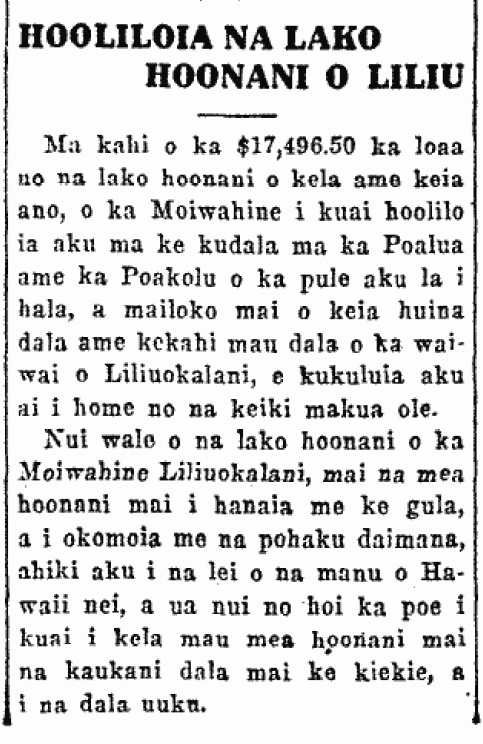
Queen Liliuokalani’s jewelry auctioned off, 1924.

JEWELRY OF LILIU LIQUIDATED

Approximately $17,496.50 was made from the jewelry of this and that sort, of the Queen’s that was auctioned off on Tuesday and Wednesday of last week, and through this sum along with some of the estate of Liliuokalani, a home for orphaned children will be built.

Queen Liliuokalani had a great deal of adornments, from those made of gold and inlaid with diamonds, to lei made with the feathers of Hawaiian birds; there were many who bought them, for as high as thousands of dollars to just a few dollars.

[All of this jewelry apparently went for a steal…]

(Kuokoa, 4/3/1924, p. 1)

HOOLILOIA NA LAKO HOONANI O LILIU

Ka Nupepa Kuokoa, Buke LXIII, Helu 14, Aoao 1. Aperila 3, 1924.

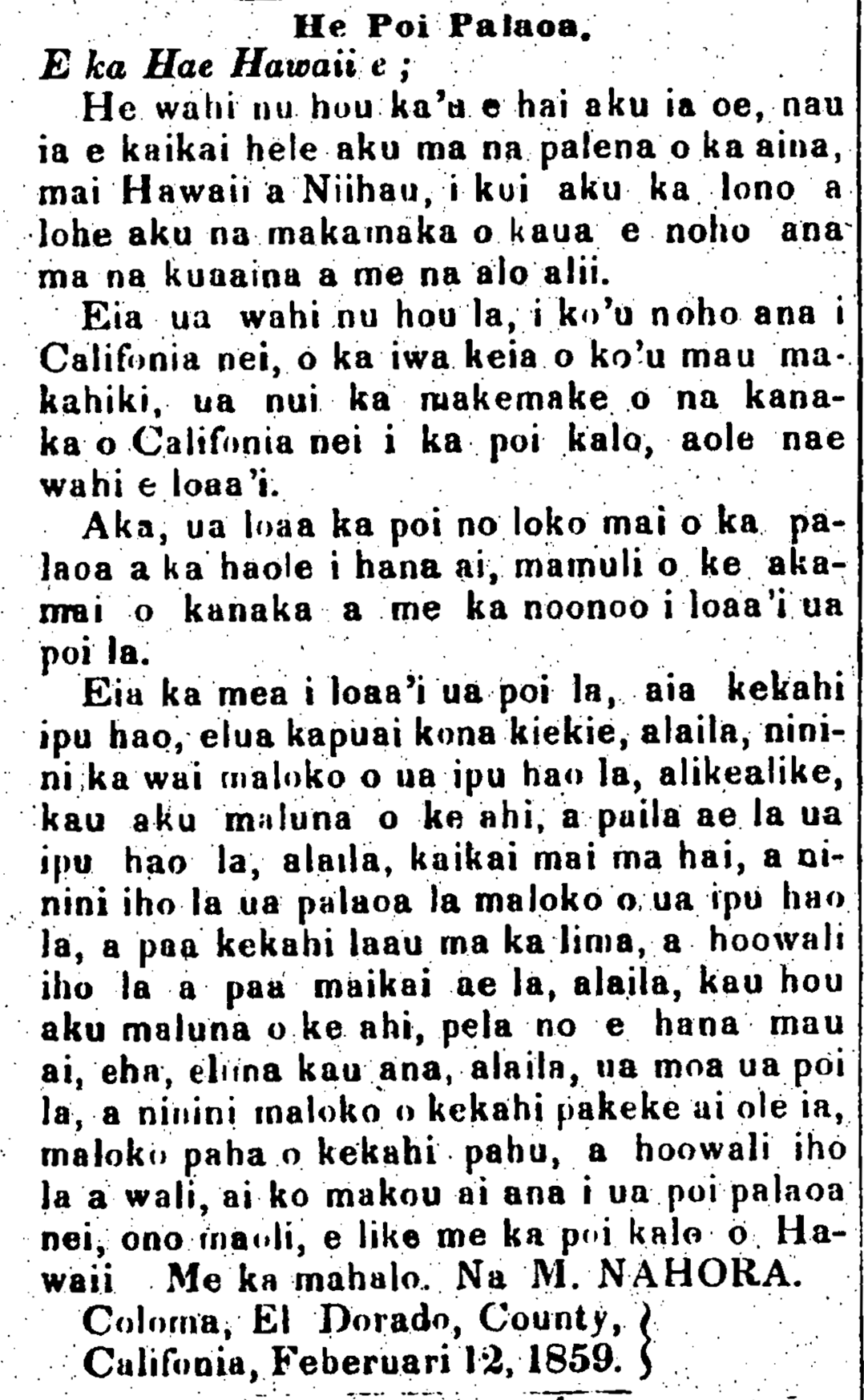
Early report on poi palaoa in California, 1859.

Poi Palaoa.

O Hae Hawaii;

I have some news to report and it will be for you to carry it around to the borders of the land from Hawaii to Niihau, so that the news is heard by our friends living in the countryside [kuaaina] and in the royal court [alo alii].

Here is the news: this is my ninth year of living here in California, and the Hawaiians in California desire poi greatly, but have no way to get it.

But we get poi from the flour that is made by the haole, and through the ingenuity of the Hawaiians who by thinking came up with that poi.

This is how you acquire the poi; get a pot that is two feet high and pour water into it half way and place on top the fire; when it boils, carry it aside and pour in flour into the pot; hold a stick in one hand and stir until firm then put back on the fire; keep doing this, and put back on the fire four or five times at which point the poi is cooked; pour into a bucket or in a barrel perhaps, and mix until smooth; when we eat poi palaoa it is truly delicious like taro poi of Hawaii. With appreciation, By M. NAHORA.

Coloma, El Dorado County,

California, February 12, 1859.

(Hae Hawaii, 3/16/1859, p. 199)

He Poi Palaoa.

Ka Hae Hawaii, Buke 3, Helu 50, Aoao 199. Maraki 16, 1859.

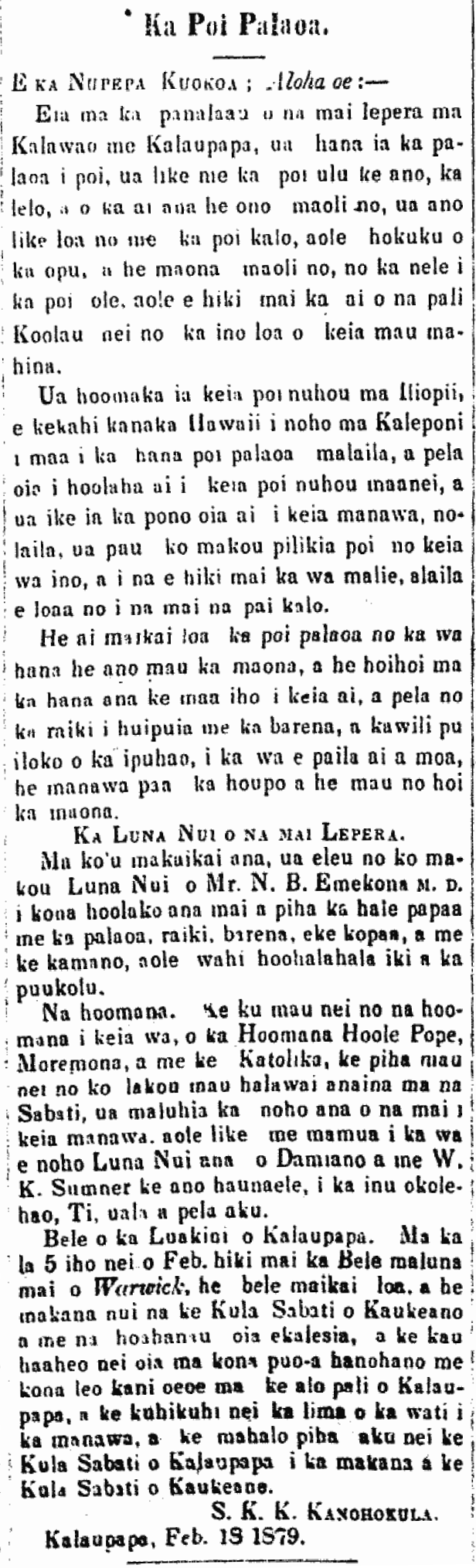
Poi made from wheat flour in Kalawao and Kalaupapa, 1879.

Poi Palaoa.

O Kuokoa Newspaper; Aloha oe:—

Here in the colony of the leprosy patients in Kalawao and Kalaupapa, flour is used to make poi [poi palaoa]; it is similar to poi made of breadfruit [poi ulu] in the yellow color, and it is truly delicious; it is a lot like taro poi [poi kalo]: your stomach doesn’t get sore, and you become full indeed; we have no poi because the taro won’t arrive to these Koolau cliffs because of the terrible weather during these months.

This new poi began at Iliopii, by a Hawaiian who lived in California who was used to making it there, and that is how he spread this new poi here; and the benefits of this poi is now known, and therefore, our poi problems are over during this stormy period, and should calm weather return, the patients will get their paʻi ʻai¹ [pai kalo].

Poi palaoa is very appropriate when working because you stay full, and it is fun to make when you get used to it, and so too with rice mixed with crackers and stirred up in a pot; when it boils and is cooked, it is time for to fill the stomach, and you will be always full.

The Superintendent of the Leprosy Patients.

In my observations, our Superintendent, Mr. N. B. Emerson [Emekona], M. D. is quick with filling the storehouse [hale papaa] with flour [palaoa], rice [raiki], crackers [barena], bags of sugar [eke kopaa], and salmon [kamano]; there is nothing to complain of Kapuukolu.²

Worship. Worship always happens now: Protestants [Hoole Pope], Mormons [Moremona], and Catholics [Katolika]; their meetings on Sundays are always full; life of the patients is peaceful now, not like before when Damien [Damiano] and when W. K. Sumner were Superintendent; there were uprisings from drinking okolehao and other alcoholic drinks made of ti, sweet potato [uala], and so forth.

Bell of the Church of Kalaupapa. On the 5th of Feb., the Bell arrived on the Warwick; a very fine bell which was a gift from the Sunday School of Kaukeano and the brethren of that church; and now it hangs proudly in its honored steeple with its ringing voice in the cliff faces of Kalaupapa, and it points out the movement of the hands of the clock, and the Sunday School of Kalaupapa fully appreciates the gift of the Sunday School of Kaukeano.

S. K. K. Kanohokula.

Kalaupapa, Feb. 18, 1879.

¹Although i tend not to use ʻokina and kahakō, i marked “pai ai” here for added clarity.

²Kapuukolu is a place on Kauai, figuratively used to represent abundance of good food.

(Kuokoa, 3/15/1879, p. 2)
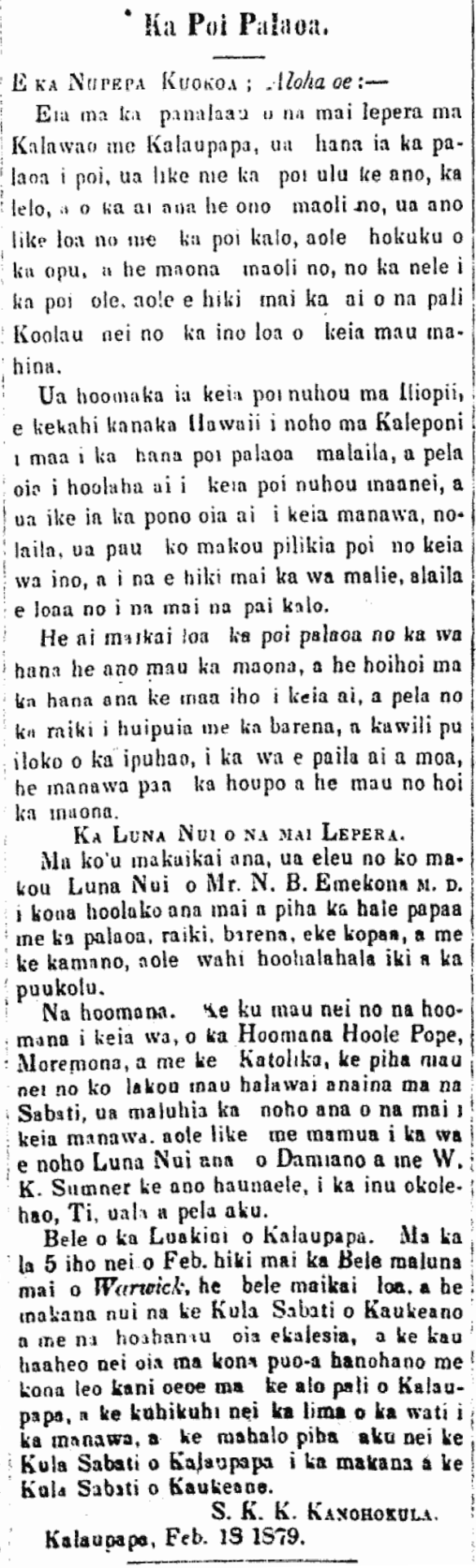
Ka Poi Palaoa.

Ka Nupepa Kuokoa, Buke XVIII, Helu 11, Aoao 2. Maraki 15, 1879.

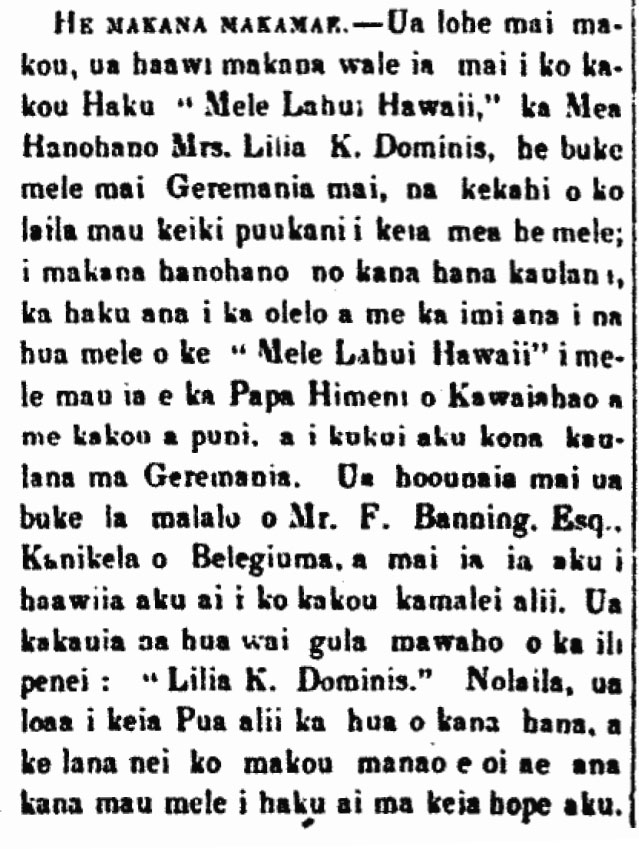
A music book gifted to the Honorable Lilia K. Dominis, 1868.

[Found under: “LOCAL NEWS: Oahu”]

A Precious Gift.—We have heard that our Composer of “Mele Lahui Hawaii,” the Honorable Mrs. Lilia K. Dominis, was gifted a music book from Germany, by one of their singers; it was presented with honor for her famous accomplishment: the composition of the lyrics and the searching for the music of “Mele Lahui Hawaii,” which is sung all the time by the choir of Kawaiahao and by all of us everywhere and its fame has been heard of in Germany. The book was sent by way of Mr. F. Banning, Esq., Consul of Belgium, to our precious alii. Printed in gold lettering on the cover was: “Lilia K. Dominis.” This young alii has thus received the fruits of her labors, and we hope that there will be more of her compositions here after.

[Anyone know what this book is and where it is located today?]

(Kuokoa, 3/28/1868, p. 2)

He Makana Makamae.

Ka Nupepa Kuokoa, Buke VII, Helu 13, Aoao 2. Maraki 28, 1868.

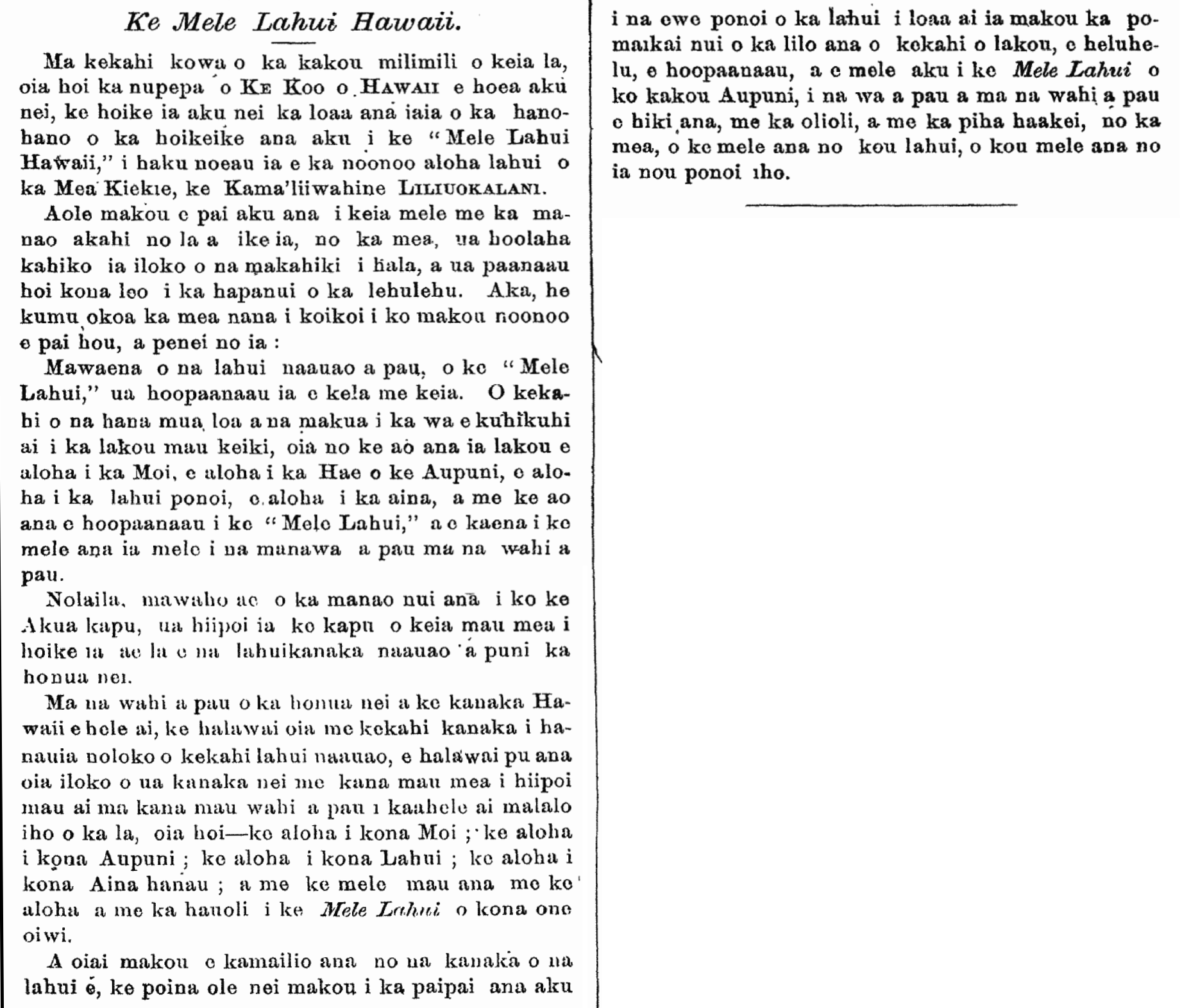
More on the National Anthem, 1883.

Hawaiian National Anthem.

In an open space in our beloved one of this day, that being the newspaper “Ke Koo o Hawaii,” that is coming to you, it is being shown that we have the honor of putting before you the Hawaiian National Anthem [“Mele Lahui Hawaii”] which was skillfully composed with feelings of aloha for her people by Her Highness, Princess Liliuokalani.

We are not printing this mele thinking that this is the first time it will be seen, for it was printed a long ago in years past, and its melody is memorized by most. However, there is a different reason we thought it was important to reprint it, and that being:

Amongst all enlightened people, the “National Anthem” is memorized by everyone. One of the first duties of a parent when instructing their children is to teach them to love their Monarch, to love the Flag of their Nation, to love their own people [lahui], to love their land, and to memorize their National Anthem and to be proud to sing this mele at all times and at all places.

Therefore, besides respecting God’s laws, the sacredness of those things mentioned above are cherished by enlightened nations all over the world.

In all places on this earth travelled by Hawaiians, whenever he meets up with someone born in an enlightened nation, he meets also within that person [e halawai pu ana oia iloko o ua kanaka nei ?] with what he constantly cherishes in all places travelled by him under the sun, that being—love for his King; love for his Nation; love for his People, love for his Land of birth; and the singing always with love and joy of the National Anthem of his homeland.

And while we speak of those of other nations, we do not forget to encourage our own natives of this lahui who we have the great fortune to have some of them read, memorize, and sing the National Anthem of our Nation, at all times and at all places they go, with joy and filled of pride, because singing for your lahui is singing for your very own self.

(Koo o Hawaii, 8/15/1883, p. 5)

Ke Mele Lahui Hawaii.

Ke Koo o Hawaii, Buke 1, Helu 1, Aoao 5. Augate 15, 1883.

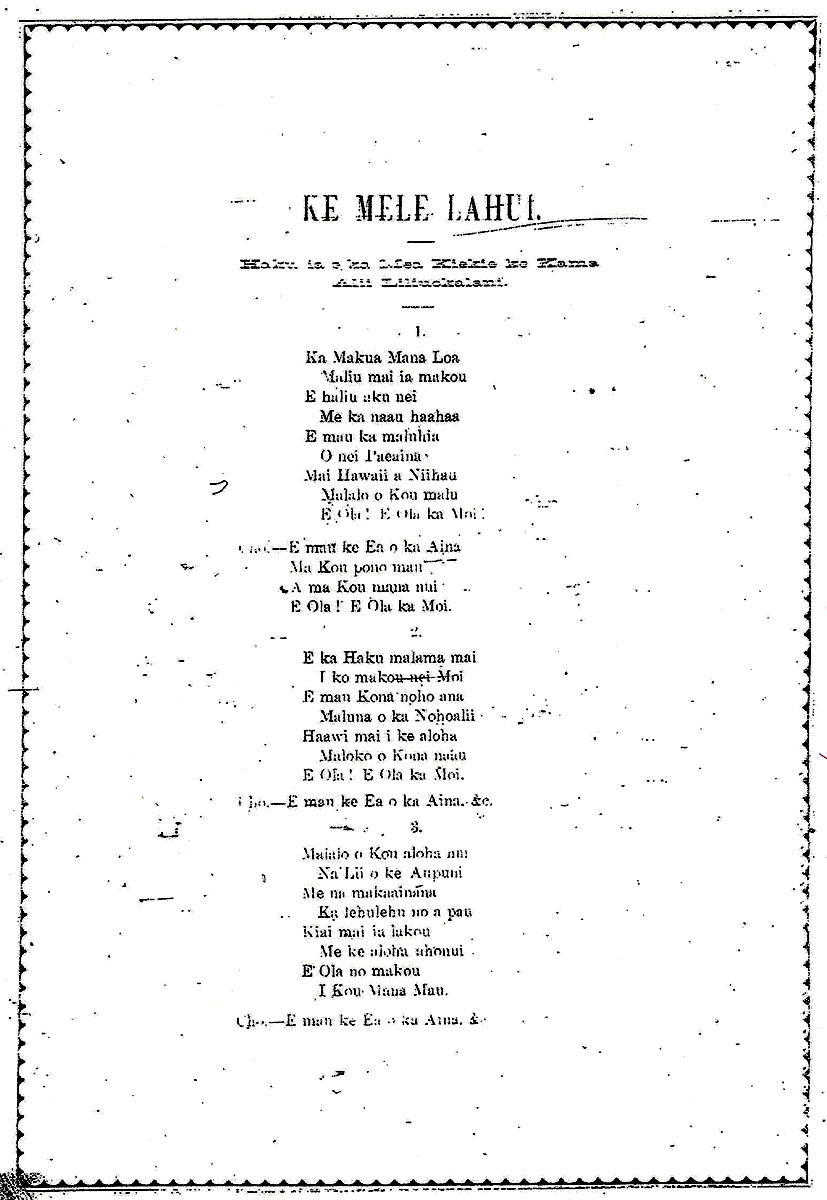
National Anthem, 1883.

KE MELE LAHUI.

Composed by Her Highness
Princess Liliuokalani.

1.

Ka Makua Mana Loa
Maliu mai ia makou
E Haliu aku nei
Me ka naau haahaa
E mau ka maluhia
O nei Paeaina
Mai Hawaii a Niihau
Malalo o Kou malu
E Ola! E Ola ka Moi!

Cho.—E mau ke Ea o ka Aina
Ma Kou pono mau
A ma Kou mana nui
E Ola! E Ola ka Moi.

2.

E ka Haku malama mai
I ko makou nei Moi
E mau Kona noho ana
Maluna o ka Nohoalii
Haawi mai i ke aloha
Maloko o Kona naau
[A ma Kou ahonui]
E Ola! E Ola ka Moi.

Cho.—E mau ke Ea o ka Aina, &c.

3.

Malalo o Kou aloha nui
Na’Lii o ke Aupuni
Me na makaainana
Ka lehulehu no a pau
Kiai mai ia lakou
Me ke aloha ahonui
E Ola no makou
I Kou Mana Mau.

Cho.—E mau ke Ea o ka Aina, &c.

(Koo o Hawaii, 8/15/1883, p. 11)

KE MELE LAHUI.

Ke Koo o Hawaii, Buke 1, Helu 1, Aoao 11. Augate 15, 1883.