Honey Bees introduced, 1857.

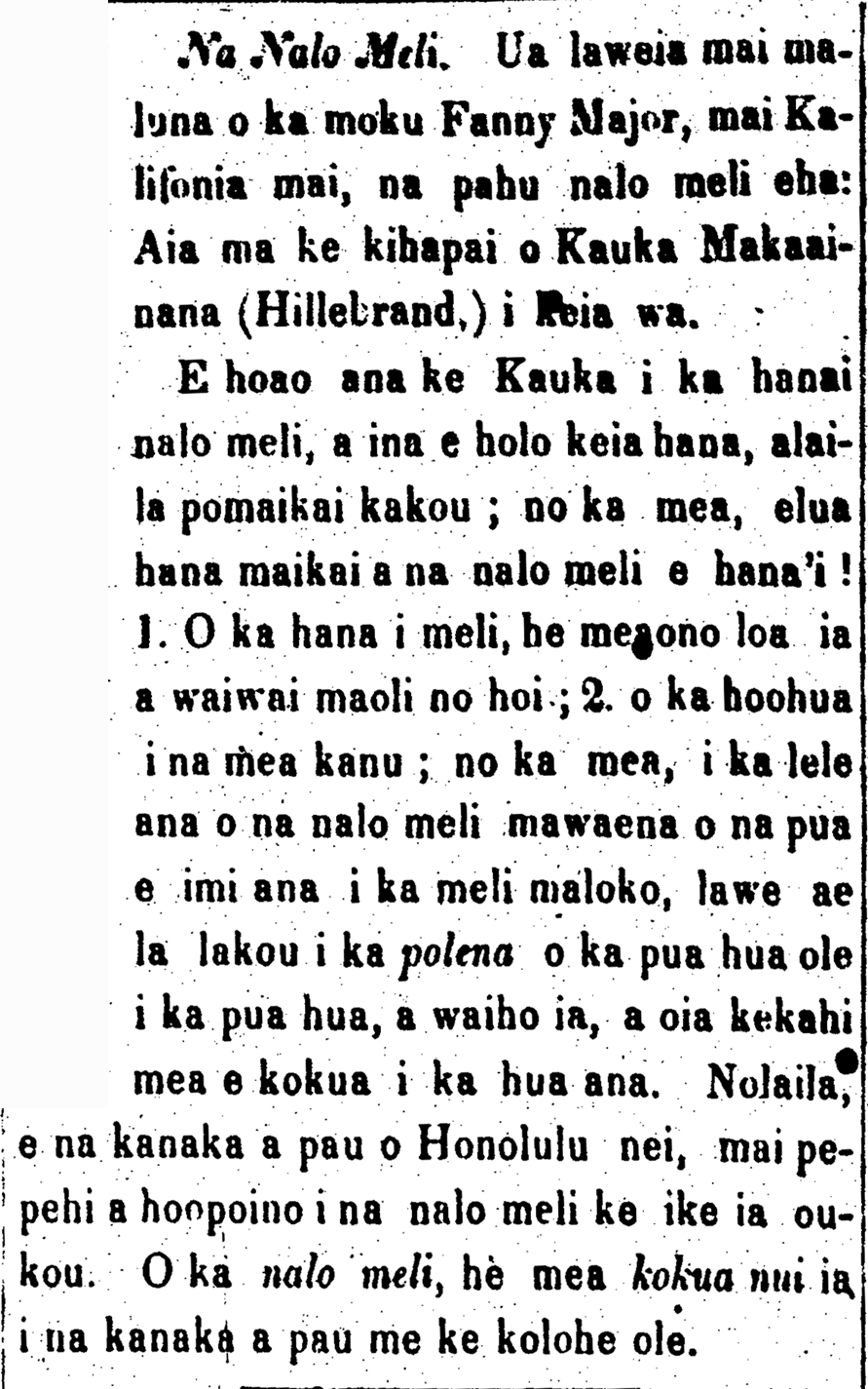
Honey Bees [nalo meli]. Brought upon the ship Fanny Major from California were four boxes of bees. Currently they are in the garden of Dr. Hillebrand [Kauka Makaainana].

The doctor will attempt raising the bees, and should this progress, we will be blessed, because there are two good things done by bees. 1. They make honey, which is very delicious and valuable. 2. They make plants fruit, because when bees fly to flowers in search of the nectar within, it takes with them pollen from non-fruiting flowers to fruiting flowers and deposit it, and that is what helps fruiting. Therefore, all you people of Honolulu nei, do not kill or abuse the bees when you see them. Bees are a great help to all, without any harm.

[According to Senior Scientist and Cultural Advisor at The Nature Conservancy of Hawai’i, Sam Ohu Gon III, “In the big picture, in our modern agricultural world, honeybees are vital, but we should never forget our little-known native bees…”]

(Hae Hawaii, 11/18/1857, p. 134)
Na Nalo Meli.

Ka Hae Hawaii, Buke 2, Ano Hou.----Helu 34, Aoao 134. Novemaba 18, 1857.
May Day Queen, 1941.

Became Queen

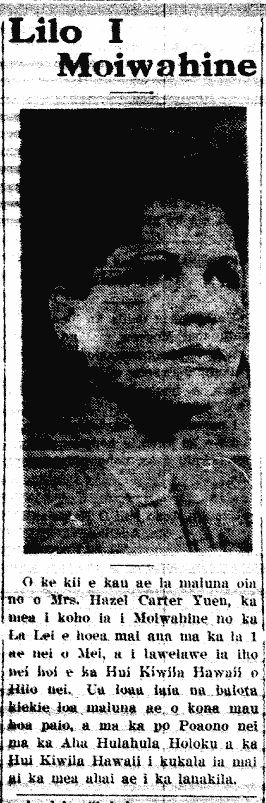
The picture above is of Mrs. Hazel Carter Yuen, the one chosen as Queen for the upcoming Lei Day, the 1st of May, held by the Hawaiian Civic Association [Hui Kiwila Hawaii] of Hilo. She received the most ballots from amongst her running mates, and on the night of this past Saturday at the Holoku Ball of the Hawaiian Civic Association the one who took the win was announced.

(Hoku o Hawaii, 4/9/1941, p. 1)

Lilo i Moiwahine

Ka Hoku o Hawaii, Buke XXXV, Helu 50, Aoao 1. Aperila 9, 1941.

Entrance exams for Kamehameha Schools, 1941.

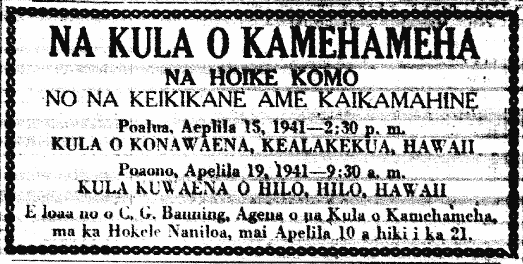
KAMEHAMEHA SCHOOLS

ENTRANCE EXAMS

FOR BOYS AND GIRLS

Tuesday, April 15, 1941—2:30 p. m.

KONAWAENA SCHOOL, KEALAKEKUA, HAWAII.

Saturday, April 19, 1941—9:30 a. m.

HILO INTERMEDIATE SCHOOL, HILO, HAWAII

C. G. Banning, Agent for the Kamehameha Schools will be available at the Naniloa Hotel from April 10 until the 21st.

(Hoku o Hawaii, 4/9/1941, p. 2)

NA KULA O KAMEHAMEHA

Ka Hoku o Hawaii, Buke XXXV, Helu 50, Aoao 2. Aperila 9, 1941.

Lunalilo’s Crypt overgrown by weeds? 1894.

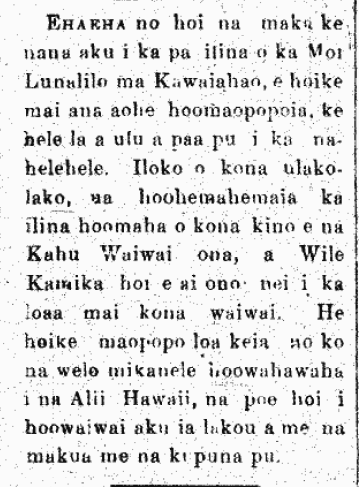
It is painful to see the cemetery of King Lunalilo at Kawaiahao, showing that it is not remembered, for it is overgrown by weeds. In its wealth, the crypt where his body is laid to rest was left to waste by his Trustees, along with Wile Kamika [William Owen Smith] who feasts off of his pay from the trust. This is proof of the missionary descendents’ [welo mikanele] contempt for the Alii of Hawaii, the people who made them wealthy and also their parents and grandparents.

(Makaainana, 3/19/1894, p. 4)

Ehaeha no hoi na maka...

Ka Makaainana, Buke I----Ano Hou, Helu 12, Aoao 4. Maraki 19, 1894.

Renovation of Kawaiahao Cemetery, 1867.

[Found under: “LOCAL NEWS”]

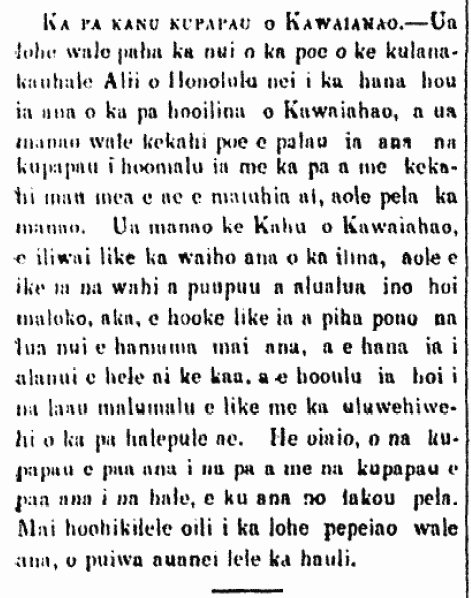
Graveyard of Kawaiahao.—Most of the people of the Capital City of Honolulu have perhaps heard that the cemetery of Kawaiahao is being renovated, and some people have imagined that the bodies laid there to rest, along with the yard and other things at peace there will be plowed up, but this is not the case. The Kahu of Kawaiahao wants to flatten out the graveyard so that there are no humps or holes, to flatten out and fill in the depressions that lay open, and also to make a road for carts to travel on, and to grow shade trees like the greenery of other church yards. It is the truth, the bodies that lay in the yard and the bodies in the crypts will remain as is. Don’t get worked up over what you hear, lest you be shocked.

(Kuokoa, 4/27/1867, p. 3)

Ka pa kanu kupapau o Kawaiahao...

Ka Nupepa Kuokoa, Buke VI, helu 17, Aoao 3. Aperila 27, 1867.

Vital Statistics, 1912.

MARRIAGES.

Lui Hoana Koo to Josephine Marianna Ku, Feb. 29.
Joseph Haole Kealakai to Anna Kaluawai, Feb. 29.
Fred Colburn to Helen Dutro, Mar. 2.

BIRTHS.

To Harry Lee Kwai and Hattie Alapai, a daughter, Feb. 27.
To Nameless and Helen Kamaka, a daughter, Feb. 27.
To Mr. and Mrs. John Ke, a son, Feb. 27.
To Joaquin G. de Silva, a son, Feb. 28.
To Hilo and Hannah Frye, a daughter, Feb. 29.
To Hale and Helen Kanoho, a daughter, Mar. 1.
To Mr. and Mrs. Sol Burke, a daughter, Mar. 5.

DEATHS.

Alexander McCandless, at Queen’s Hospital, Feb. 25
K. M. Koahou, at Makala Boat House [?], Feb. 27.
George N. Shaw, on Ilaniwai Street, Feb. 28.
A baby of William Kuekue, on Queen Street, Feb. 29.
A baby of Charles Kahawai, on Halekauwila Street, Feb. 29.
Pekelo Kinikini, on Dowsett Lane, Feb. 29.
Henry M. Kaeo, on 2nd Avenue, Mar. 3.
Julia Hilo, a the Children’s Hospital, Mar. 4.
Hattie Keala, on Manoa Street, Mar. 5.
Keauloa, at Lunalilo Home, Mar. 6.

(Kuokoa, 3/8/1912, p. 8)

NA MARE / NA HANAU / NA MAKE

Ka Nupepa Kuokoa, Buke XLVIII, Helu 10, Aoao 8. Maraki 8, 1912.

Artifacts from the 1895 Counter-Revolutionary War, 1912.

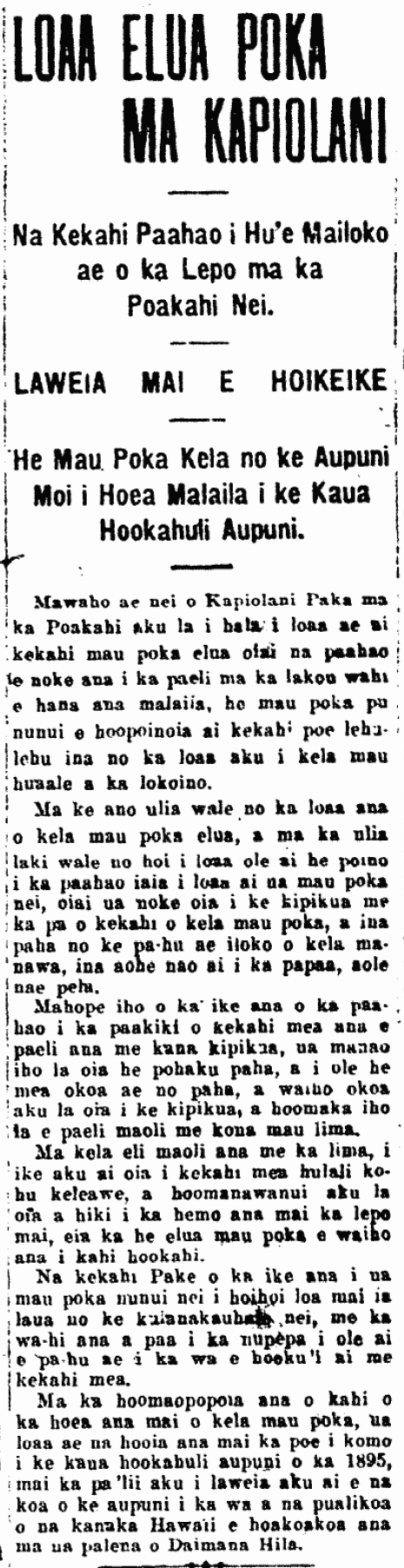
TWO ARTILLERY SHELLS FOUND AT KAPIOLANI

A Prisoner Found it While Digging up Dirt This Past Monday.

IT WAS BROUGHT TO SHOW

They were ammunition of the Monarchial Government Which Got There in the Revolutionary War.

Outside of Kapiolani Park last Monday, two artillery shells were found when the prisoners were in the middle of digging in the area where they are working; they are huge artillery that would have injured many if they had received those evil pills.

It was only by chance that the two shells were found, and it was lucky that the prisoner did not suffer injury when he came upon the shells as he hit one of them while digging with his pick; if it had blown up at that time, it would have been disaster, but that did not happen.

After the inmate perceived this solid thing that he was digging with his pick, he figured it was probably a rock or something, and put down his pick and began to dig with his hands.

While digging with his hands, he spotted something shiny like metal, and he kept at it until out from the dirt amazingly came two artillery shells from the same place.

A Chinese man who saw these two huge shells brought them here in town after wrapping them in newspapers so that they would not explode when knocking against something.

When it was understood where these shells appeared, there was confirmation from those who participated in the Civil War of 1895 that they were taken from the palace grounds by the soldiers of the government while the Hawaiian troops were gathering at the outskirts of Diamond Head.

(Kuokoa, 3/8/1912, p. 1)

LOAA ELUA POKA MA KAPIOLANI

Ka Nupepa Kuokoa, Buke XLVIII, Helu 10, Aoao 1. Maraki 8, 1912.

More “Alika”! 1893.

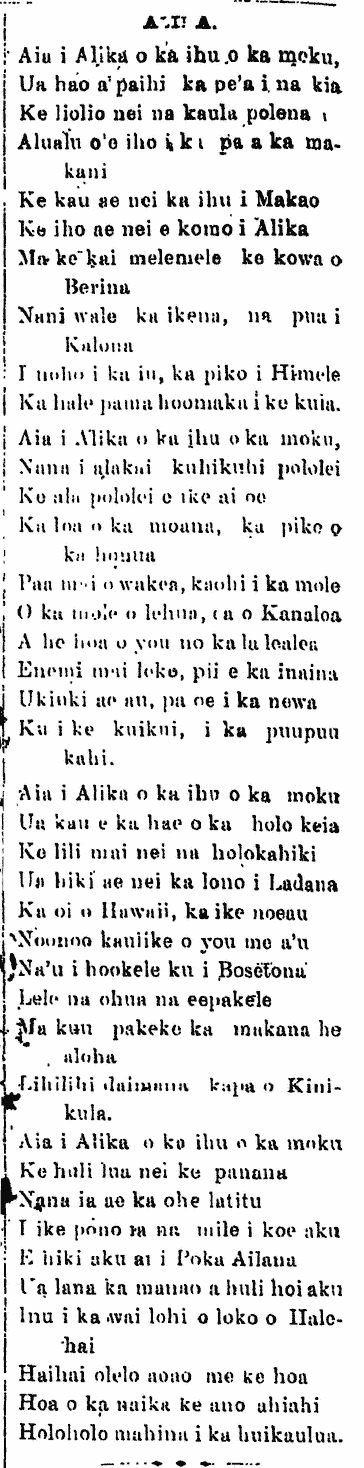
ALIKA.

Aia i Alika o ka ihu o ka moku,

Ua hao a paihi ka pe’a i na kia

Ke liolio nei na kaula polena

Alualu ole iho i ka pa a ka makani

Ke kau ae nei ka ihu i Makao

Ke iho ae nei e komo i Alika

Ma ke kai melemele ke kowa o Berina

Nani wale ka ikena, na pua i Kalona

I noho i ka iu, ka piko i Himele

Ka hale pama hoomaka i ke kuia.

Aia i Alika o ka ihu o ka moku,

Nana i alakai kuhikuhi pololei

Ke ala pololei e ike ai oe

Ka loa o ka moana, ka piko o ka honua

Paa mai [?] o wakea, kaohi i ka mole

O ka mole o lehua, oa [?] o Kanaloa

A he hoa o you no ka la lealea

Enemi mai loko, pii e ka inaina

Ukiuki ae au, pa oe i ka newa

Ku i ke kuikui, i ka puupuu kahi.

Aia i Alika o ka ihu o ka moku,

Ua kau e ka hae o ka holo keia

Ke lili mai nei na holokahiki

Ua hiki ae nei ka lono i Ladana

Ka oi o Hawaii, ka ike noeau

Noonoo kaulike o you me a’u

Na’u i hookele ku i Bosetona

Lele na ohua na eepakele [eepakeke]

Ma kuu pakeke ka makana he aloha

Lihilihi daimana kapa o Kinikula.

Aia i Alika o ka ihu o ka moku,

Ke huli lua nei ke panana

Nana ia ae ka ohe latitu

I ike pono ia na mile i koe aku

E hiki aku ai i Poka Ailana

Ua lana ka manao a huli hoi aku

Inu i ka wai lohi o loko o Halehai

Haihai olelo aoao me ke hoa

Hoa o ka naika ke ano ahiahi

Holoholo mahina i ka huikaulua.

[It is interesting how this might be divided into 4 stanzas of 10 lines, each beginning with “Aia i Alika o ka ihu o ka moku”. I wonder if it was sung differently than today. The Hawaiian-Language Newspapers are filled with mele: those we are familiar with today (often full of variations), as well at those that have been lost (temporarily) over time!]

(Lei Momi, 7/1/1893, p. 4)

ALIKA

Ka Lei Momi, Buke I, Helu 9, Aoao 4. Iulai 1, 1893.

“Alika” variant, 1898.

ALIKA SONG.

1st

Ma ke kai Melemele

Ke kowa a o Berina

O ka hale lau Pama

A o make i ke kula.

Hui: Aia i Alika

E ka ihu o ka moku

Ua hao a paihi

Na pe’a i ka makani

Ke liuliu nei

Na kaula likini

Alualu ole iho

Ka pe’a i ka makani.

2nd

A oi kau aku

Ka newa i ko piko

Kaa e ka huila

Niniu i ka makani.

[Here is a variant of a mele still popular to this day! I wonder if it was sung to the same tune as we hear it sung now…]

(Loea Kalaiaina, 1/31/1898, p. 1)

ALIKA SONG

Ka Loea Kalaiaina, Buke II, Helu 5, Aoao 1. Ianuari 31, 1898.

More donations for the anti-annexation petitions committee, 1898.

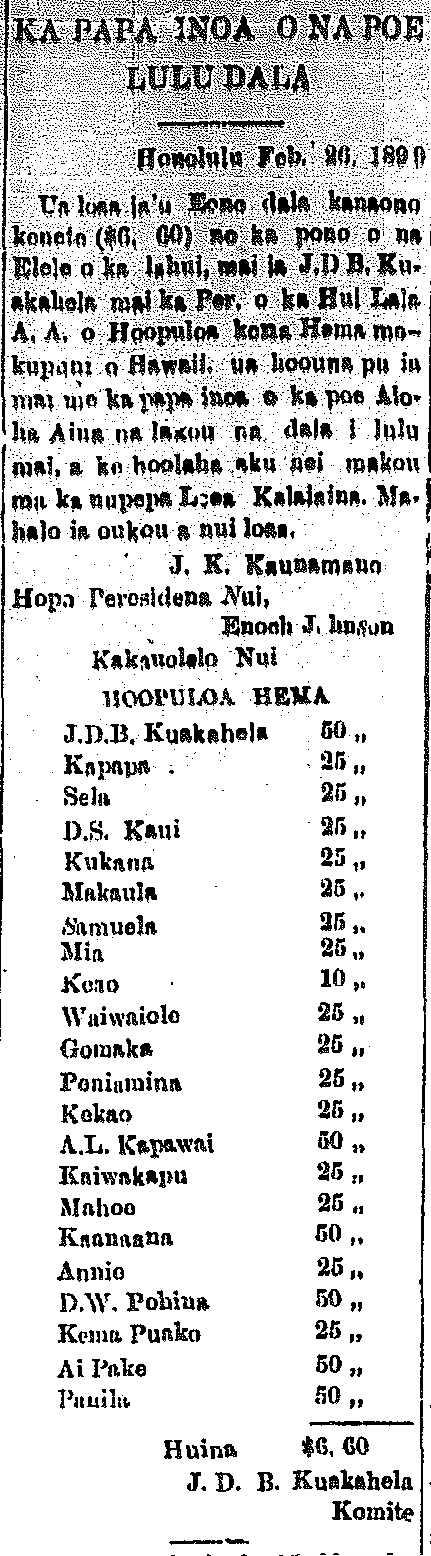
LIST OF DONORS

Honolulu, Feb. 26, 1898.

I have Six dollars and sixty cents ($6.60) for the well-being of the Representatives of the nation, from J. D. B. Kuakahela from the Pres. of the Members of the Patriotic League of Hoopuloa, South Kona, Island of Hawaii; it was sent along with a list of names of the Patriots who donated the money, and we are publishing it in the newspaper Loea Kalaiaina. Thank you very much to you all.

J. K. Kaunamano

Vice President,

Enoch Johnson

Head Secretary.

SOUTH HOOPULOA

J. D. B. Kuakahela, 50 ”

Kapapa, 25 ”

Sela, 25 ”

D. S. Kaui, 25 ”

Kukana, 25 ”

Makaula, 25 ”

Samuela, 25 ”

Mia, 25 ”

Keao, 10 ”

Waiwaiole, 25 ”

Gomaka, 25 ”

Peniamina, 25 ”

Kekao, 25 ”

A. L. Kapawai, 50 ”

Kaiwakapu, 25 ”

Mahoe, 25 ”

Kaanaana, 50 ”

Annie, 25 ”

D. W. Pohina, 50 ”

Kema Puako, 25 ”

Ai Pake, 50 ”

Pauila, 50 ”

Total, $6.60

J. D. B. Kuakahela

Committee.

(Loea Kalaiaina, 3/21/1898, p. 3)

KA PAPA INOA O NA POE LULU DALA

Ka Loea Kalaiaina, Buke II, Helu 12, Aoao 3. Maraki 21, 1898.