Pueo found in Kalihi, 1902.

SCARCE NATIVE OWLS ARE FOUND IN KALIHI VALLEY

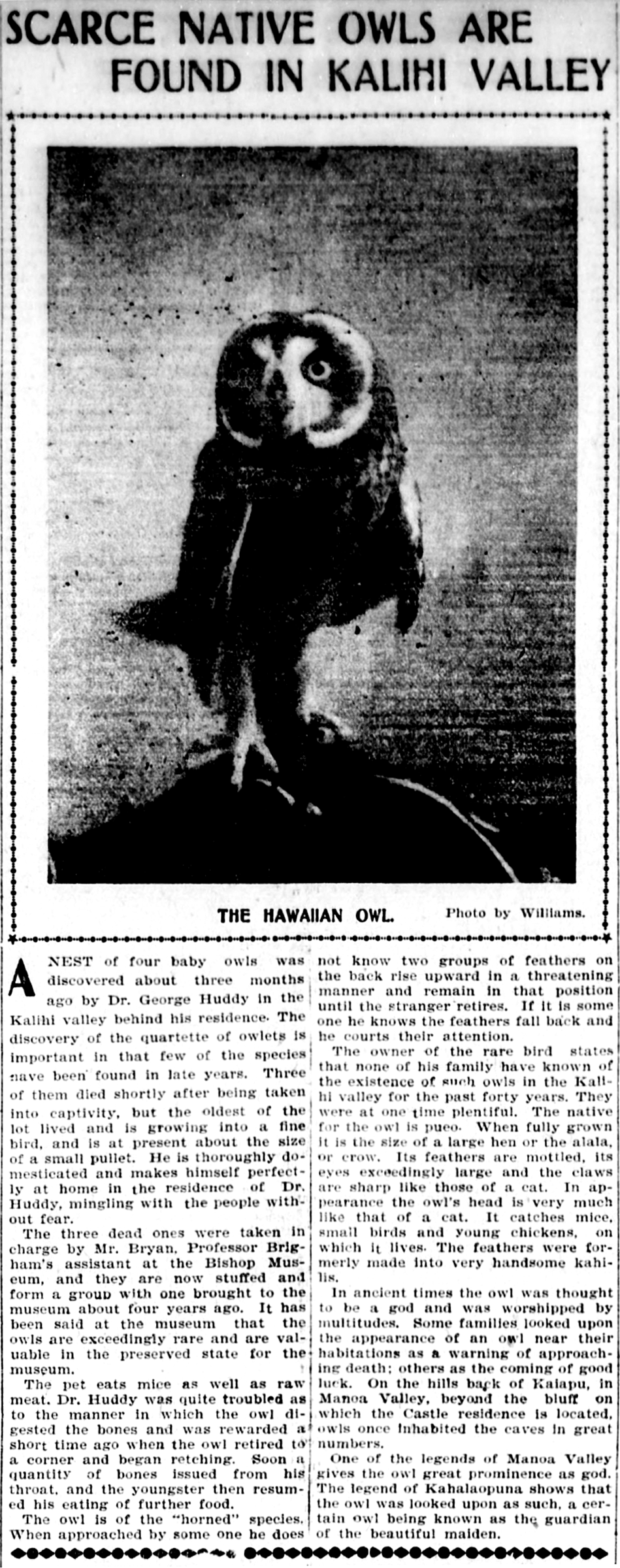
THE HAWAIIAN OWL.  Photo by Williams.

A NEST of four baby owls was discovered about three months ago by Dr. George Huddy in the Kalihi valley behind his residence. The discovery of the quartette of owlets is important in that few of the species have been found in late years. Three of them died shortly after being taken into captivity, but the oldest of the lot lived and is growing into a fine bird, and is at present about the size of a small pullet. He is thoroughly domesticated and makes himself perfectly at home in the residence of Dr. Huddy, mingling with the people without fear.

The three dead ones were taken in charge by Mr. Bryan, Professor Brigham’s assistant at the Bishop Museum, and they are now stuffed and form a group with one brought to the museum about four years ago. It has been said at the museum that the owls are exceedingly rare and are valuable in the preserved state for the museum.

The pet eats mice as well as raw meat. Dr. Huddy was quite troubled as to the manner in which the owl digested the bones and was rewarded a short time ago when the owl retired to a corner and began retching. Soon a quantity of bones issued from his throat, and the youngster then resumed his eating of further food.

The owl is of the “horned” species. When approached by some one he does not know two groups of feathers on the back rise upward in a threatening manner and remain in that position until the stranger retires. If it is some one he knows the feathers fall back and he courts their attention.

The owner of the rare bird states that none of his family have known of the existence of such owls in the Kalihi valley for the past forty years. They were at one time plentiful. The native for the owl is pueo. When fully grown it is the size of a large hen or the alala, or crow. Its feathers are mottled, its eyes exceedingly large and the claws are sharp like those of a cat. In appearance the owl’s head is very much like that of a cat. It catches mice, small birds and young chickens, on which it lives. The feathers were formerly made into very handsome kahilis.

In ancient times the owl was thought to be a god and was worshipped by multitudes. Some families looked upon the appearance of an owl near their habitation as a warning of approaching death; others as the coming of good luck. On the hills back of Kalapu, in Manoa Valley, beyond the bluff on which the Castle residence is located, owls once inhabited the caves in great numbers.

One of the legends of Manoa Valley gives the owl great prominence as god. The legend of Kahalaopuna shows that the owl was looked upon as such, a certain owl being known as the guardian of the beautiful maiden.

[Does anyone know of kahili made with pueo feathers?]

(Hawaiian Gazette, 2/11/1902, p. 5)
SCARCE NATIVE OWLS ARE FOUND IN KALIHI VALLEY

Hawaiian Gazette, Volume XXXVII, Number 12, Page 5. February 11, 1902.
 

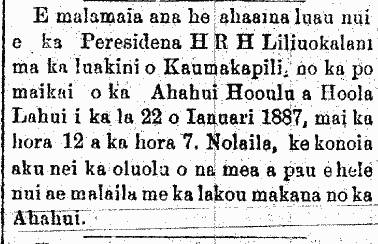
Luau at Kaumakapili Church put on by Princess Liliuokalani, 1887.

There will be a grand luau put on by the President, H. R. H. Liliuokalani, at Kaumakapili Church, for the benefit of the Hooulu and Hoola Lahui Society [Ahahui Hooulu a Hoola Lahui] on the 22nd of January 1887, from 12 to 7 o’clock. Therefore, the kindness of all is requested to come there with their donations for the Ahahui.

(Ko Hawaii Pae Aina, 1/15/1887, p. 4)

E malamaia ana he ahaaina luau...

Ko Hawaii Pae Aina, Buke X, Helu 3, Aoao 4. Ianuari 15, 1887.

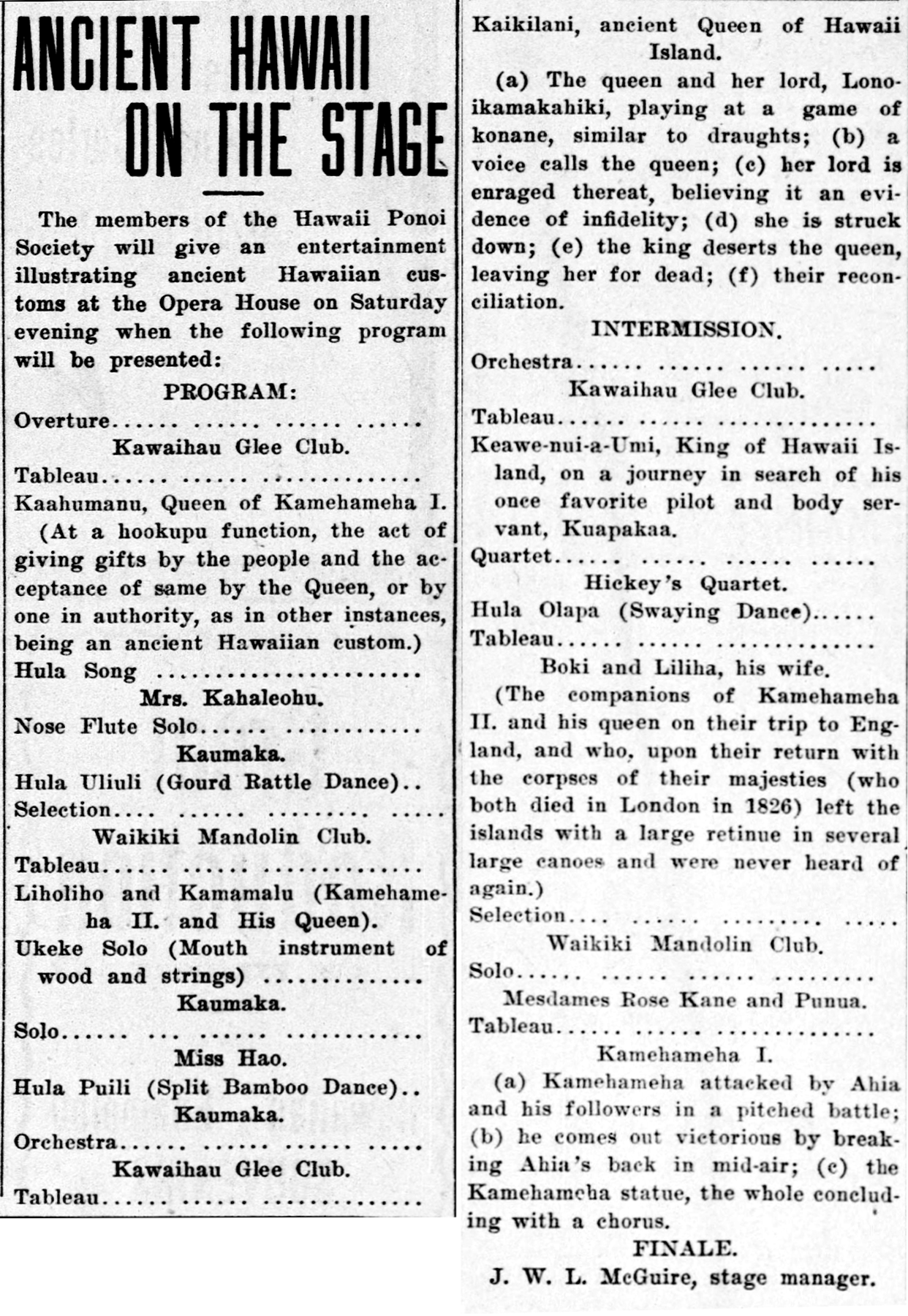
Hawaii Ponoi Society performance, 1907.

ANCIENT HAWAII ON STAGE

The members of the Hawaii Ponoi Society will give an entertainment illustrating ancient Hawaiian customs at the Opera House on Saturday evening when the following program will be presented:

PROGRAM:

Overture

Kawaihau Glee Club

Tableau

Kaahumanu, Queen of Kamehameha I.

(At a hookupu function, the act of giving gifts by the people and the acceptance of same by the Queen, or by one in authority, as in other instances, being an ancient Hawaiian custom.)

Mrs. Kahaleohu.

Nose Flute Solo

Kaumaka.

Hula Uliuli (Gourd Rattle Dance)

Selection

Waikiki Mandolin Club.

Tableau

Liholiho and Kamamalu (Kamehameha II. and His Queen).

Ukeke Solo (Mouth instrument of wood and strings)

Kaumaka.

Solo

Miss Hao.

Hula Puili (Split Bamboo Dance)

Kaumaka.

Orchestra

Kawaihau Glee Club.

Tableau

Kaikilani, ancient Queen of Hawaii Island.

(a) The queen and her lord, Lonoikamakahiki, playing at a game of konane, similar to draughts; (b) a voice calls the queen; (c) her lord is enraged thereat, believing it an evidence of infidelity; (d) she is struck down; (e) the king deserts the queen, leaving her for dead; (f) their reconciliation.

INTERMISSION.

Orcestra

Kawaihau Glee Club.

Tableau

Keawe-nui-a-Umi, King of Hawaii Island, on a journey in search of his once favorite pilot and body servant, Kuapakaa.

Quartet

Hickey’s Quartet.

Hula Olapa (Swaying Dance)

Tableau

Boki and Liliha, his wife.

(The companions of Kamehameha II. and his queen on their trip to England, and who, upon their return with the corpses of their majesties (who both died in London in 1826) left the islands with a large retinue in several large canoes and were never heard of again.)

Waikiki Mandolin Club.

Solo

Mesdames Rose Kane and Punua.

Tableau

Kamehameha I.

(a) Kamehameha attacked by Ahia and his followers in a pitched battle; (b) he comes out victorious by breaking Ahia’s back in mid-air; (c) the Kamehameha statue, the whole concluding with a chorus.

FINALE.

J. W. L. McGuire, stage manager.

(Pacific Commercial Advertiser, 3/15/1907, p. 6)

ANCIENT HAWAII ON THE STAGE

The Pacific Commercial Advertiser, Volume XLV, Number 7675, Page 6. March 15, 1907.

Grand performance on Maui by the Hawaiian Woman’s Club, 1922.

“A Night in Hawaii” Will Prove a Beautiful Picture

Pageants wherein the characters will be clad in the costumes of the old days in Hawaii, tableaux, meles, singing of Hawaiian songs and melodies, instrumental music by Hawaiian musicians and just an interspersal of hula dancing by little folk to show really graceful and beautiful was the old dancing at its best, these go to make up the program which will be offered at the Territorial Building in Kahului, Saturday in “A Night in Hawaii” as arranged by and for the benefit of the Hawaiian Woman’s Club. The program, which is printed below gives promise of the best entertainment of its king that has been offered on this island.

Almost daily rehearsals have been held of late, especial attention having been given to the drilling of the children’s chorus in their songs and their parts, so much attention was not necessary of the older ones most of whom have participated in affairs of this kind before, but groups have worked here, and other groups there, and finally all of the groups have been brought together and welded into one great company for the coming performance.

Following the rendition of the program there will be a dance.

The Hawaiian Woman’s Club which is conducting the entertainment is a benevolent association of the Hawaiian women of Maui working in the interest of Hawaiians who may be in need of assistance such as the club can give. Something of its activities have been told previously, what it has done of the Kula Sanitarium when first organized, for the education of some of the young Hawaiians and in other directions. One of its latest good works was a generous contribution for a chapel for the home for non-leprous children of lepers at Kalihi, Oahu. In many directions it reaches out to do good and all profits of the entertainment will go in the carrying out of such purposes.

The program for Saturday night follows:

 I. OPENING CHORUS ….. “Eleile”

II. TABLEAU ….. Hawaiian Royalty

1. Queen Liliuokalani—”Makalapua” ….. Mrs. J. W. Kalua

2. Princess Kaiulani—”He Inoa No Kaiulani” ….. Mrs. H. H. Holt

3. Queen Emma—””Na Hala o Naui” ….. Mrs. George Hardy

Hula—Ida Long

4. Princess Pauahi Bishop—”Pauahi Lani” (Blest Type of Womanhood) ….. Mrs. C. C. Conradt

5. Queen Kaahumanu—”Kaahumanu” ….. Mrs. D. Kapohakimohewa

a. Kahili Bearers—Alice Allen, Elizabeth Wailehua.

6. King Kamehameha I.—”He Inoa No Kamehameha” ….. Mr. C. F. N. Rose

a. Attendants—Walter Garcia, Edward Wilson.

b. Hookupu bearers—David Kaumeheiwa, Kaiwi Moikeha.

III. HAWAIIAN MELES — ….. Kumanaiwa

1. A Mele to Kamehameha.

2. Ili.

3. Ukeke.

4. Uliuli.

IV. SONGS—

1. “Pua Mohala”

2. “Old Plantation”

Messrs. Charles Waiwaiole, John Waiwaiole, Kama Apo, George Kauwenaole

3. “No Moku o Hawaii”

Mrs. J. Waiwaiole, Mrs. Huakini Enos, Kama Apo, J. H. Waiwaiole

4. “Kuu Iini”

Mrs. A. Garcia

5. “Maid of Honolulu”

R. Plunkett, N. Opiopio, F. Robinson, J. Brown

V TABLEAU—

1. “Koni Au I Ka Wai”

Elizabeth Wailehua and Chorus

2. “Pulupe Nei Ili I Ke Anu”

Alice Allen and Chorus

3. Hula Olapa

a. Entrance Dance

b. “Emma Lani”

c. “Nani Wale I ka Mahina”

d. “Maia Lau Kapalili”

4. “Na Lei o Hawaii”

Hawaii—Alice Kia

Maui—Blanche Garcia

Oahu—Edna Alo

Kauai—Mary Kaumeheiwa

Molokai—Sophie Waiwaiole

Lanai—Jackie Rosario

Kahoolawe—Florence Kaumeheiwa

Niihau—Dollie Wilson

Molokai—Lei Dunn

5. “Sweet Lei Lehua”

Blanche Garcia and Chorus

6. “Palolo”

Hula by Paddy Bal

7. “Moani Keala”

Sophie Waiwaiole and Chorus

8. “Hawaii Ponoi”

9. “Star Spangled Banner”

“Hawaii”—Lei Dunn

“Uncle Sam”—Paddy Bal

(Maui News, 6/9/1922, p. 5)

"A Night in Hawaii" Will Prove a Beautiful Picture

Semi-Weekly Maui News, 22nd Year, Number 1173, Page 5.June 9, 1922.

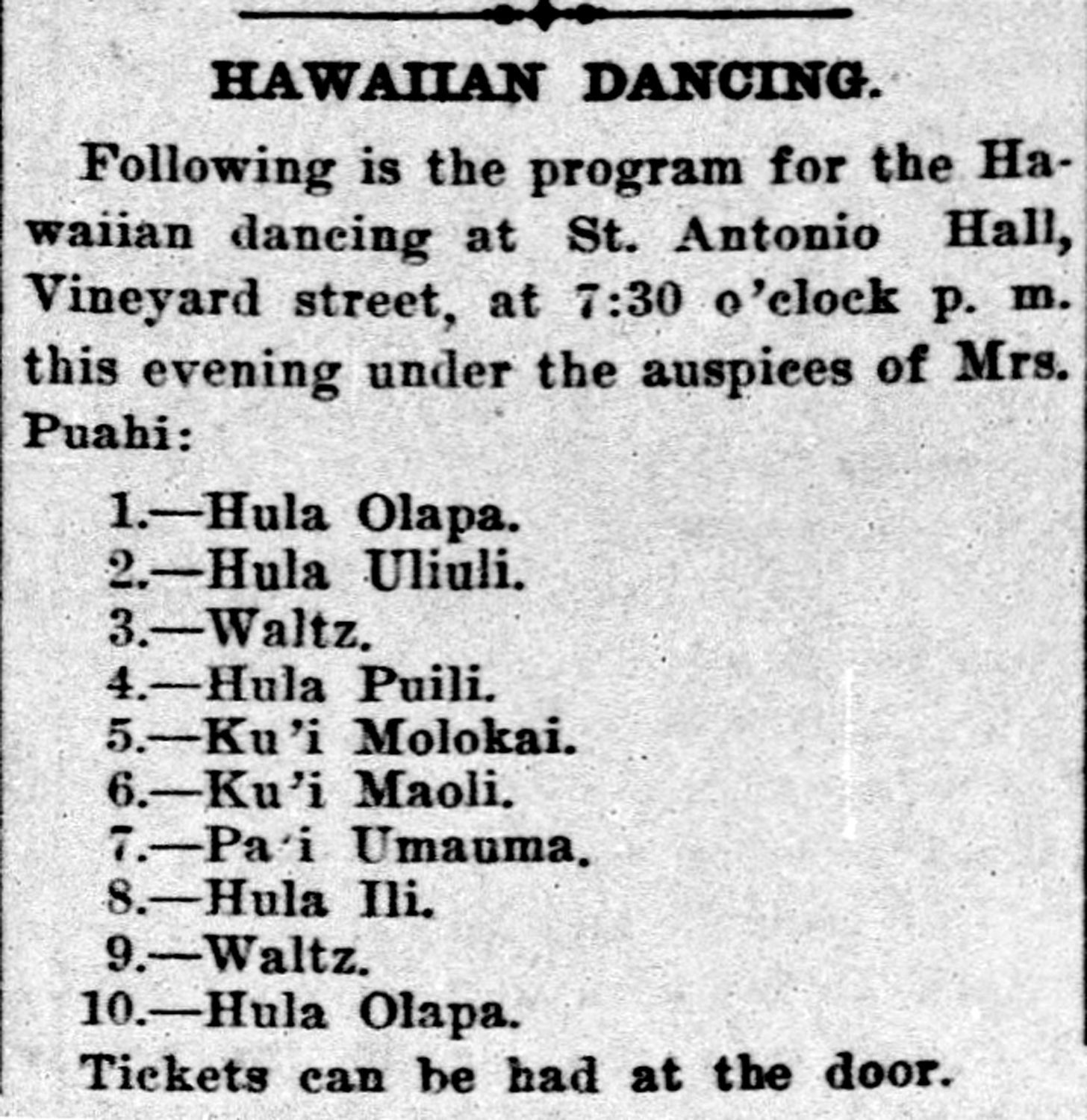
Hula at St. Antonio Hall, by Kainana Puahi 1907.

HAWAIIAN DANCING.

Following is the program for the Hawaiian dancing at St. Antonio Hall, Vineyard street, at 7:30 o’clock p. m. this evening under the auspices of Mrs. Puahi:

1.—Hula Olapa.

2.—Hula Ulili.

3.—Waltz.

4.—Hula Puili.

5.—Ku’i Molokai.

6.—Ku’i Maoli.

7.—Pa’i Umauma.

8.—Hula Ili.

9.—Waltz.

10.—Hula Olapa.

Tickets can be had at the door.

(Pacific Commercial Advertiser, 2/22/1907, p. 5)

HAWAIIAN DANCING.

The Pacific Commercial Advertiser, Volume XLV, Number 7657, Page 5. February 22, 1907.

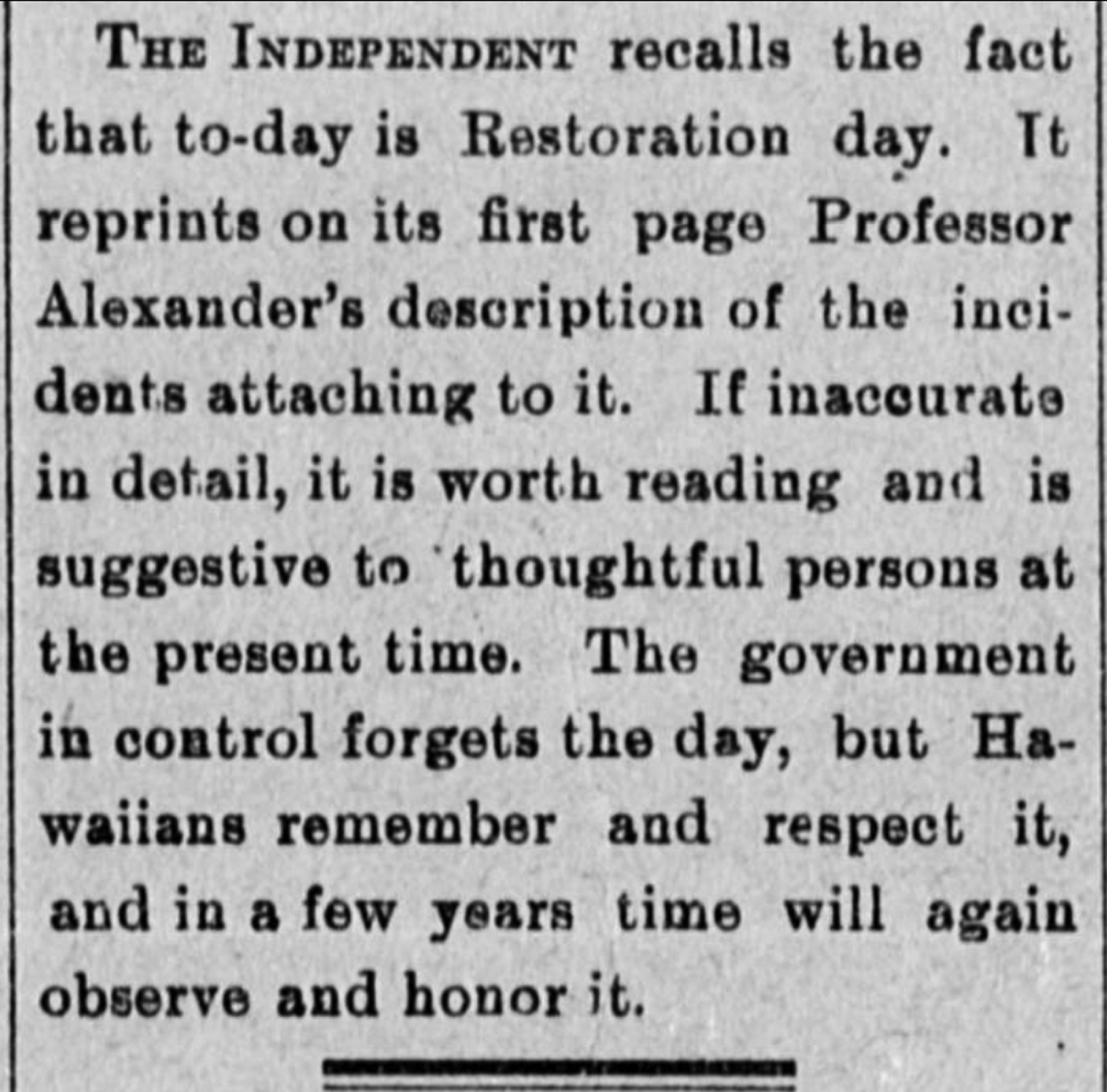
La Hoihoi Ea, 1896.

[Found under: “TOPICS OF THE DAY.”]

The Independent recalls the fact that to-day is Restoration day. It reprints on its first page Professor Alexander’s description of the incidents attaching to it. If inaccurate in detail, it is worth reading and is suggestive to thoughtful persons at the present time. The government in control forgets the day, but Hawaiians remember and respect it, and in a few years time will again observe and honor it.

(Independent, 7/31/1896, p. 2)

The Independent recalls...

The Independent, Volume III, Number 340, Page 2. July 31, 1896.

Remember Restoration Day! 1896.

It would not be wrong of us to commemorate our La Hoihoi Ea, that being this coming Friday, the 53rd year from when George Paulet [Lo Keoki] trespassed upon Hawaii nei on February 25, 1843, and we were blessed once more by Admiral Thomas on that day the very same year. If we do indeed celebrate it, we should do it with decorum and peace.

(Makaainana, 7/27/1896, p. 4)

E hewa ole no ia kakou...

Ka Makaainana, Buke VI—-Ano Hou, Helu 4, Aoao 4. Iulai 27, 1896.


Hula common nuisances? 1859.

[Found under: “HAWAIIAN LEGISLATURE. ADJOURNED SESSION 1858: House of Representatives: Dec. 29, Twenty-First Day.”]

REPORTS OF COMMITTEES.

Mr. Sheldon from the select committee on the subject of hulas, presented a draft of a bill for their suppression, as follows:

“An act to suppress the Hawaiian Hulas.

Be it enacted, &c:

Sec. 1. That the Hawaiian hulas mentioned in this section are common nuisances. Whoever shall publicly perform the following hulas, viz: Kuolo, Pahu, Puniu, Paipu, Paiumauma, Kakalaau, Kihelei, Pele, Ulili, Kii, Kilo, Kake, Pela, Alaapapa, Pana, Ami, Pahua, Olapa, and hulas of like nature, whether performed by an individual or by an assembly, shall, on conviction thereof, be punished as guilty of a common nuisance. Provided, however, that this act shall not be regarded as prohibiting any Court of the Kingdom from applying the law of common nuisance to any dances or hulas not specified in this section, if they be proved nuisances.

Sec. 2. This act shall take effect at the expiration of three months from the date of its publication in the Polynesian and Hae Hawaii newspapers.”

Ordered for Friday next.

[The members of the House there that day were: S. P. Kalama, S. Lainaholo, James I. Dowsett, J. H. Kaakua, J. W. Austin, Paul F. Manini, M. Kapihe, J. S. Low, Ioane Richardson, C. K. Kakani, D. Nuuhiwa, J. H. Kaauwaepaa, R. S. Hollister, E. P. Kamaipelekane, J. E. Chamberlain, Z. P. Kaumaea, M. Kenui, J. W. B. Kiolea, J. W. Kupakee, J. Kahai, J. M. Kalanipoo, D. H. Hitchcock, and H. L. Sheldon.

The committee itself was made up of H. L. Sheldon, James I. Dowsett, and S. P. Kalama.]

(Polynesian, 1/1/1859, p. 2)

REPORTS OF COMMITTEES.

The Polynesian, Volume XV, Number 35, Page 2. January 1, 1859.


Ioane Ukeke at the Orpheum, 1902.

AT THE

Orpheum

A FIRST CLASS ENTERTAINMENT

BY THE

Palama Dramatic Co.

FOR

ONE NIGHT ONLY

Grand production of a series of interesting incidents in HAWAIIAN DANCING, adapted for the stage by H. C. Ulukou, manager.

Saturday, December 27.

The following Hawaiian dances will be given: Alaapapa, Pahu, Uliuli, Puili, Ili, Kui, Ohelo, Paiumauma.

And Dandy Ioane, the Dude with his Hula Girls.

Box plan will be open at the Orpheum on Tuesday, when tickets can be had.

[That Orpheum seems like it was the place to be back then!]

(Pacific Commercial Advertiser, 12/24/1902, p. 10)

AT THE Orpheum

The Pacific Commercial Advertiser, Volume XXXV, Number 6359, Page 10. December 24, 1902.