Joseph Kapaeau Aea passes on, 1911.

JOSEPH AEA PASSES AWAY

Joseph Aea, agent of Her Majesty Liliuokalani, died last evening about ten o’clock at his home in Pauoa. He had been associated with the queen’s family for many years. He leaves a widow and two sons. One of them is the protege of Queen Liliuokalani and is also the stenographer and assistant clerk in the city clerk’s office.

Joseph Aea was for many years connected with the old Royal Hawaiian band. He was the solo viol player and was an excellent musician. He became attached to the household of Queen Liliuokalani, and attended Liliuokalani when she was one of the official guests at the jubilee of Queen Victoria in London. He also attended the queen when she visited Washington in 1903. His wife was also one of the queen’s closest personal attendants, and has been particularly attentive to her since the overthrow of the monarchy.

In 1907, upon the death of Hon. J. O. Carter, Liliuokalani appointed Mr. Aea as her business agent, but the Liliuokalani Trust, formed about two years ago, transferred this important office to Col. C. P. Iaukea, who is one of the trustees under the Liliuokalani Trust.

Aea was a delegate to the Democratic territorial convention in 1900, and was nominated for the legislature by the Home Rulers in 1902, and again in 1904, by the Democrats.

(Hawaiian Star, 1/26/1911, p. 7)

HawaiianStar_1_26_1911_7.png

Hawaiian Star, Volume XVIII, Number 5866, Page 7. January 26, 1911.

O uluwehiwehi mau ka lehua o Hilo!

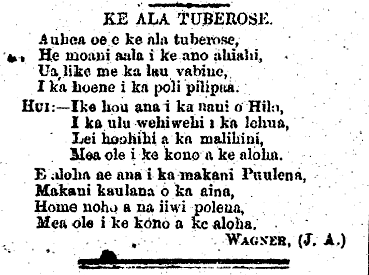
KE ALA TUBEROSE

Auhea oe e ke ala tuberose,
He moani aala i ke ano ahiahi,
Ua like me ka lau vabine,
I ka hoene i ka poli pilipaa.

Hui:—Ike hou ana i ka nani o Hilo,
I ka ulu wehiwehi i ka lehua,
Lei hoohihi a ka malihini,
Mea ole i ke kono a ke aloha.

E aloha ae ana i ka makani Puulena,
Makani kaulana o ka aina,
Home noho a na iiwi polena,
Mea ole i ke kono a ke aloha.

Wagner, (J. A.)

[This is a song credited to Joseph Kapaeau Aea that will be performed at the Kamehameha Song Contest this Friday night! There is a translation here to this mele and the others to be sung that night as well!! May the verdant lehua of Hilo live forever!!!

Does anyone know who the Wagner referred to is?]

(Nupepa Elele, 10/2/1886, p. 1)

NupepaElele_10_2_1886_1

Ka Nupepa Elele, Buke VIII, Helu 14, Aoao 1. Okatoba 2, 1886.

Francis Sinclair dies, 1916.

OWNER OF NIIHAU DIES IN ENGLAND

Francis Sinclair [? Gay], owner with his brother of the Island of Niihau, planter, rancher, author and poet, died on July 22, inst. in the Isle of Jersey, England, at the age of eighty-three. He was well-known in Hawaii to kamaainas of two and three decades ago.

 He was for many years a resident of Hawaii, coming here in 1863 with his brother, from New Zealand, in a small vessel which they had purchased and with which they cruised in the South Seas for some considerable time.

After residing in the Islands a short time Francis Sinclair and his brother purchased the Island of Niihau, northwest of Kauai. Ownership of the island is still held in the Sinclair family, which has quite a number of members in the Islands and particularly in Kauai.

During later years Mr. Sinclair resided in London, England, devoting his time to literary work. Among his works are “Ballads and Poems From the Pacific,” “Under Western Skies” and “From the Four Winds,” in addition to which he published a number of other short stories and poems, mostly dealing with the Pacific and Hawaii.

He is survived by a widow, a sister, one daughter, and many other relatives, both here and abroad. Three of his daughters married men who became prominent in the life and industries of the Islands—Mrs. Knudsen, mother of former Senator Eric A. Knudsen, mother of former Senator Eric A. Knudsen of Kauai, and the elder Mrs. Gay, and Mrs. Robinson.

(Hawaiian Gazette, 9/8/1916, p. 3)

HawaiianGazatte_9_8_1916_3.png

The Hawaiian Gazette, Volume IX, Number 74, Page 3. September 8, 1916.

Alakai o Hawaii prints mele without any accreditation, 1930.

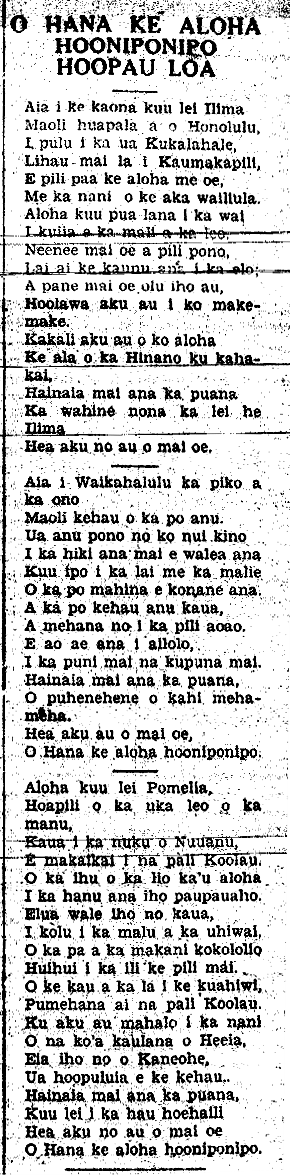
O HANA KE ALOHA HOONIPONIPO HOOPAU LOA

Aia i ke kaona kuu lei Ilima
Maoli huapala a o Honolulu,
I pulu i ka ua Kukalahale,
Lihau mai la i Kaumakapili,
E pili paa ke aloha me oe,
Me ka nani o ke aka wailiula.
Aloha kuu pua lana i ka wai
I kuiia e ka mali a ka leo,
Neenee mai oe a pili pono,
Lai ai ke kaunu ana i ka elo;
A pane mai oe olu iho au,
Hoolawa aku au i ko makemake.
Kakali aku au o ko aloha
Ke ala o ka Hinano ku kahakai,
Hainaia mai ana ka puana
Ka wahine nona ka lei he Ilima
Hea aku no au o mai oe.

———

Aia i Waikahalulu ka piko a ka ono
Maoli kehau o ka po anu
Ua anu pono no ko nui kino
I ka hiki ana mai e walea ana
Kuu ipo i ka lai me ka malie
O ka po mahina e konane ana
A ka po kehau anu kaua
A mehana no i ka pili aoao.
E ao ae ana i ailolo,
I ka puni mai na kupuna mai
Hainaia mai ana ka puana,
O puhenehene o kahi mehameha.
Hea aku au o mai oe,
O Hana ke aloha hooniponipo.

———

Aloha kuu lei Pomelia,
Hoapili o ka uka leo o ka manu,
Kaua i ka nuku o Nuuanu,
E makaikai i na pali Koolau
O ka ihu o ka lio ka’u aloha
I ka hanu ana iho paupauaho
Elua wale iho no kaua,
I kolu i ka malu a ka uhiwai
O ka pa a ka makani kokololio
Huihui i ka ili ke pili mai
O ke kau a ka la i ke kuahiwi,
Pumehana ai na pali Koolau
Ku aku au mahalo i ka nani
O na ko’a kaulana o Heeia.
Eia iho no o Kaneohe,
Ua hoopuluia e ke kehau
Hainaia mai ana ka puana,
Kuu lei i ka hau hoehaili
Hea aku no au o mai oe
O Hana ke aloha hooniponipo.

[Perhaps this printing of the three mele without any credit given is what caused the letter to the Editor from Mrs. Kaholopololei in the previous post.]

(Alakai o Hawaii 3/13/1930, p. 4)

AlakaioHawaii_3_13_1930_4.png

Ke Alakai o Hawaii, Buke 2, Helu 45, Aoao 4. Maraki 13, 1930.

Mele ownership, 1930.

LET THE TAKING OF OTHER PEOPLE’S MELE BE PUT TO AN END.

Mr. Jonah Kumalae,

Editor of Ke Alakai o Hawaii,

Aloha oe:—

I am Mrs. Kaholopololei, and I am resending to you a copy of these mele, with an explanation for the second time.

That is, do disseminate in the precious KE ALAKAI O HAWAII so that the people who love hula and who take the mele of others and bequeath it to whom they want will know.

Instruct them to stop this taking, for still living today is the one to whom the mele belong.

I and some women members of the Ahahui o na wahine Poola of the town of Honolulu, during the term when Mrs. Apoki Kauhini served as President, and Mrs. Holi Kealohahooniponipo Thornton was secretary of that Association.

Kanekoa was her husband, and Holi Thornton the other’s husband. Continue reading

John Wise on Hawaiian Homes and more, 1921.

The Question about the Work Ethic of Hawaiians.

Your writer [John Wise], continues to defend the Hawaiian lahui from being attacked by that question above.

The Hawaiians have perhaps become much talked about amongst those who do not know them and who are not familiar with their accomplishments of today and of the past. And maybe mostly these days for the land being given to us. Your writer frequently clashes with all kinds of other people who protest the giving of land to Hawaiians, because of the ridiculous idea that they don’t know how to work or that they are lazy.

In these attacks, we can see, O Lahui, that they are carried with criticisms and that it is would be a waste to confirm their misbeliefs. But so that the Hawaiians may answer these questions, your writer wants to be made known for all times the sound justification for our side. The readers of past issues of the Kuokoa have seen the responses given by the Commissioner in Washington, and they have seen also the other justifications given, in the newspaper.

The ultimate representation of the skill of a people is their supplying themselves with food and the things necessary for their livelihood. There perhaps is no better response than that. This lahui was living by  themselves for centuries, supplying themselves with everything, and received no assistance from the outside.

But there are things made by this lahui, things that attest to their fine craftsmanship, that will serve as a measure of their skills. Those that see Hawaiian canoes and their manufacture and how they can get Hawaiians through great gales, remaining solid in the dangers of the pounding of waves; how they could make beautiful canoes by using stone adzes; the distance they were taken from mountain to the sea; the patience of the canoe makers. All of these things will show, without being contradicted, that just by seeing the quality of the canoes can one see that this is a lahui that knows how to work. We see the canoes of today being made by people from other lands, and the canoes made by Hawaiians are far more well made and beautiful.

The beauty of things crafted by a people are undeniable proof of the work ethic of that people. Where will you find things more beautiful, O Hawaiians, if you travel all over the world, than the ahuula that are preserved at the Museum of Kamehameha School. Where is the lahui that lives on today, or perhaps has disappeared, that can make these outstanding works, with a beauty second to none, with fine craftsmanship, and patience; with a true sense of work ethic. Snaring birds is a great task all in itself, the inserting [kuku ana] of the feathers is a big job. One mamo feather cloak was said to have been started during the time of Umi and completed during the time of Kamehameha. For this ahu, the entire ahu were done with mamo feathers. And by our counting back, we see that ten generations of ancient kings passed on before the completion of this ahu; showing that it took from about 250 to 300 years of work. Where is there a great work that was completed by a people taking hundreds of years to construct? We perhaps can think of huge things, but as for something of this nature which required the knowledge and patience of men, there is no equal. Continue reading

Anna Lai Hipp transforms Hilo parks, 1937.

Hilo Parks Are Improved Under Woman’s Direction

What a woman park superintendent can do in three weeks is shown by the improvements in local parks accomplished by Mrs. Anna Lai Hipp, member of the park commission for four years, who has been substituting as park superintendent during the past three weeks during the vacation leave of the superintendent, Manuel Tavares. Mrs. Lai Hipp’s duties as acting superintendent end today.

An inspection tour of all the local parks Friday showed definite improvement during the three weeks’ period under Mrs. Lai Hipp.

And the best part of it all is that Mrs. Lai Hipp brought about the improvements with the same group of men who are always kept at work in the parks and with the same amount of money allotted for the work.

Perhaps the best piece of improvement work done by Mrs. Lai Hipp was Reeds bay park where in one day she had the men haul large rocks from Keaukaha which were placed on the boundary lines of the park area. Due to bad weather these stones had not been painted white, but when painted, they will be an added attraction on the park grounds as well as being practical.

“The park commission wants to protect the grass in this park, especially near the Yacht club. Many motorists have built roads on the grass by continually going over it,” Mrs. Lai Hipp said.

Plants in Bloom

At Liliuokalani park the tall weeds and bushes which had almost obstructed the view of the Japanese house from the main road were hauled away. Care has been given the azalea plants and now over 50 plants are in bloom.

On Coconut island scores of full-grown coconut palms have been planted in the places where trees were scarce. The planting was done entirely under Mrs. Lai Hipp’s supervision.

Mooheau park, parts of which were an eyesore, had been Mrs. Lai Hipp’s worry for sometime. Large stumps of trees at the Puna end of the park, which had rotted at the roots, were dug up by wedges and sledge hammers and the holes filled with dirt. Grass will be planted there are a nice lawn will be the result. Large stacks of pipes, rubbish and odds and ends clotted up the entire Puna end toward the beach, and these were hauled away. California grass, “honohono” grass and rubbish were hauled away by the truckloads.

The lovely palm trees lining Kamehameha Ave. in the Shinmachi district in front of the Royal theater were kept in good shape and old leaves trimmed under Mrs. Lai Hipp’s direction. The trees in the Puna end of this small park belong to the Hawaii Consolidated Railway and the Hilo Iron Works and should be taken care of by them, Mrs. Lai Hipp said.

Another piece of good work done by Mrs. Lai Hipp is at Rainbow Falls park where two trees which were too close to the Hilo Memorial hospital nurses’ cottage were cut down and truckloads of grass were taken away. Weeds had covered the lovely stone walks in the park and Mrs. Lai Hipp saw to it that they were pulled out.

For the past three weeks Mrs. Lai Hipp has visited and superintended the work in all the local parks at least twice a day. Hedges have been trimmed, grass pulled out, rubbish hauled away and new tree planted—all during the short space of three weeks along with the routine work the park workers do in lawnmowing the grass and picking up rubbish.

(Hoku o Hawaii, 3/24/1937, p. 1)

HokuoHawaii_3_24_1937_1.png

Ka Hoku o Hawaii, Volume XXXI, Number 48, Aoao 1. Maraki 24, 1937.

Sweet Hilo mele by “Pilialoha,” 1914.

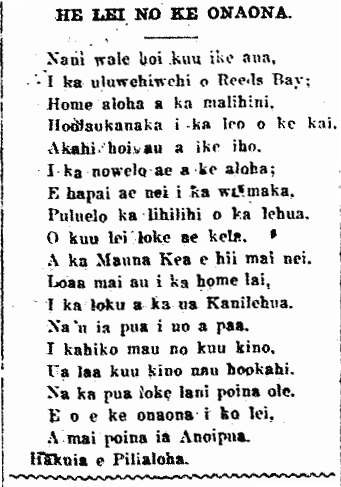
HE LEI NO KE ONAONA.

Nani wale hoi kuu ike ana,
I ka uluwehiwehi o Reeds Bay;
Home aloha a ka malihini,
Hoolaukanaka i ka leo o ke kai.
Akahi hoi au a ike iho,
I ka nowelo ae a ke aloha;
E hapai ae nei i ka waimaka,
Puluelo ka lihilihi o ka lehua.
O kuu lei loke ae kela,
A ka Mauna Kea e hii mai nei,
Loaa mai au i ka home lai,
I ka loku a ka ua Kanilehua.
Na’u ia pua i uo a paa,
I kahiko mau no kuu kino,
Ua laa kuu kino nau hookahi,
Na ka pua loke lani poina ole.
E o e ke onaona i ko lei,
A mai poina ia Anoipua.

Hakuia e Pilialoha.

(Kuokoa, 5/15/1914, p. 2)

Kuokoa_5_15_1914_2

Ka Nupepa Kuokoa, Buke LII, Helu 20, Aoao 2. Mei 15, 1914.

The meeting of Kalaniopuu and Cook, 1867.

[Found under: “KA MOOLELO O KAMEHAMEHA I.”]

The Era of Kalaniopuu, 1779. Pertaining to the Death of Captain Cook, that is Lono.

On the 24th of January, Kalaniopuu and his warriors returned from Maui and landed at Awili in Kaawaloa, and stayed at Hanamua at Keaweaheulu’s place, but they were also on Maui at war with Kahekili.

Kalaniopuu saw the many women were at the ocean on the ship to prostitute themselves [hookamakama], so Kalaniopuu forbade women from going down to the ship. And the haole saw that the women were not coming to the ship, so the haole went into the uplands of Napoopoo and at Kahauloa, and on this side of Kaawaloa to solicit prostitution, and the women received a great amount of foreign rubbish [opala]. Continue reading

Kamehameha School for Boys’ 24th annual song contest, 1945.

[Found under: “News From Boys, Girls Kamehameha School”]

BOY’S SONG CONTEST

Kamehameha School for Boys will present its 24 annual song contest on March 4 at the school auditorium with the eighth and ninth graders competing in the junior division at the tenth, eleventh and twelfth grade boys in the senior division.

The eighth graders have as their choice song “Beautiful Kahana” and the ninth graders choice is “Ka Anoi.” The juniors have selected “Wai Lana” and the tenth grade boys a medley of “Kuu Lei Pikake,” “Lei Awapuhi” and “Roselani.” A medley of “Na Lei O Hawaii” and “Aloha Oe” is the seniors choice. Continue reading