Unknown's avatar

About nupepa

Just another place that posts random articles from the Hawaiian Newspapers! It would be awesome if this should become a space where open discussions happen on all topics written about in those papers!! And please note that these are definitely not polished translations, but are just drafts!!! [This blog is not affiliated with any organization and receives no funding. Statements made here should in now way be seen as a reflection on other organizations or people. All errors in interpretation are my own.]

If Mine was my swift horse… 1893.

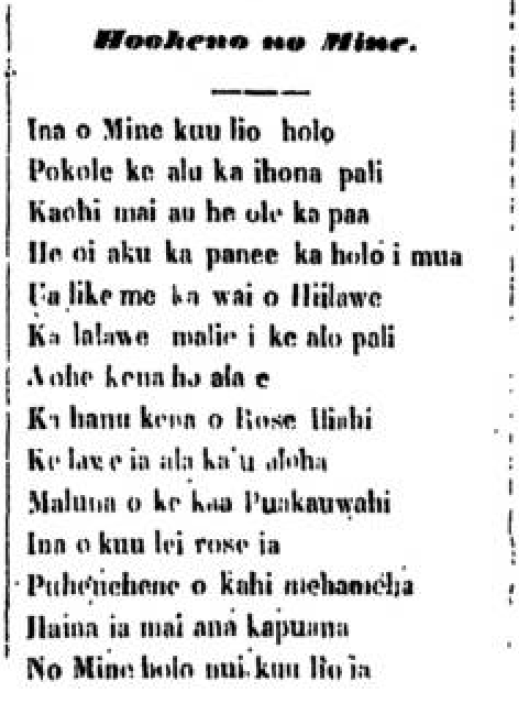
Hooheno no Mine.

Ina o Mine kuu lio holo
Pokole ke alu ka ihona pali
Kaohi mai au he ole ka paa
He oi aku ka panee ka holo i mua
Ua like me ka wai o Hiilawe
Ka lalawe malie i ke alo pali
Aohe kena he ala e
Ka hanu kena o Rose Iliahi
Ke lawe ia ala ka’u aloha
Maluna o ke kaa Puakauwahi
Ina o kuu lei rose ia
Puhenehene o kahi mehameha
Haina ia mai ana kapuana
No Mine holo nui kuu lio ia

[The line in Lena Machado’s “Holo Waapa” about Mine the fast-running horse was perhaps inspired by this mele. Does anyone know if there was a racehorse by this name?]

(Lei Momi, 7/26/1893, p. 3)

LeiMomi_7_26_1893_3

Ka Lei Momi, Buke I, Helu 29, Aoao 3. Iulai 26, 1893.


William Kamaalea Hussey, political advertisement, 1922.

MUCH APPRECIATION.

O Ladies and gentlemen, my citizen lords of the Fifth District of the Island of Oahu nei; Aloha to you all.

With a heart of true aloha, I extend my great appreciation to you, my beloved lahui, the native offspring of Hawaii, my beloved land, for your presenting upon me the magnificent supreme lei of 3426 votes of your aloha, along with your trust in me, and with that aloha, I have become a representative and a servant for you all, and for the people from Hawaii to Niihau.

Therefore, my dear citizen lords, I humbly ask that you look for, search for, and think about work that I should do in this coming legislative session; your voice and your command is what I will carry out for the equal rights of the people and for the people. As for all of your orders to me, I can speak with you at all times that you want me.

Long live the Hawaiian Lahui and the Aina.

Your humble servant.

WILLIAM KAMAALEA HUSSEY,

Honolulu, Nov. 11, A. D. 1922.

(Kuokoa, 11/16/1922, p. 7)

HE HOOMAIKAI NUI.

The Hawaiian National Museum, 1876.

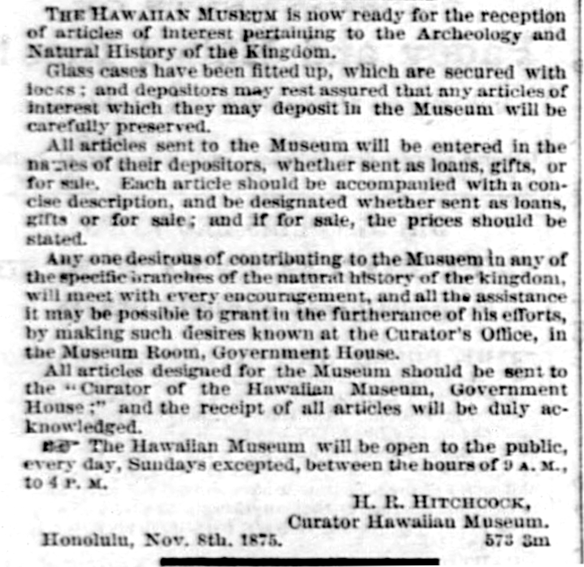
The Hawaiian Museum is now ready for the reception of articles of interest pertaining to the Archeology and Natural History of the Kingdom.

Glass cases have been fitted up, which are secured with locks: and depositors may rest assured that any articles of interest which they may deposit in the Museum will be carefully preserved.

All articles sent to the Museum will be entered in the names of their depositors, whether sent as loans, gifts, or for sale. Each article should be accompanied with a concise description, and be designated whether sent as loans, gifts or for sale; and if for sale, the prices should be stated.

Any one desirous of contributing to the Museum in any of the specific branches of the natural history of the kingdom, will meet with every encouragement, and all the assistance it may be possible to grant in the furtherance of his efforts, by making such desires known at the Curator’s Office, in the Museum Room, Government House.

All articles designed for the Museum should be sent to the “Curator of the Hawaiian Museum, Government House;” and the receipt of all articles will be duly acknowledged.

The Hawaiian Museum will be open to the public, every day, Sundays excepted, between the hours of 9 A. M., to 4 P. M.

H. R. Hitchcock,

Curator Hawaiian Museum.

Honolulu, Nov. 8th, 1875.

(Hawaiian Gazette, 3/8/1876, p. 2)

HawaiianGazette_3_8_1876_2.png

The Hawaiian Gazette, Volume XII, Number 10, Page 2. March 8, 1876.

J. E. Chamberlain, collector for the Hawaiian National Museum, 1876.

Curios for the Government Museum.

The Morning Star brought up for the Hawaiian Government the following curios, corals, &c. Two sets Gilbert Island armor complete with helmets; also shark teeth sword and spear, mats and native dresses; eel basket; common fish basket; umbrella coral, three feet six inches in diameter, perfect, from Apian by Mr. Randolph.

From Marshall Island: Spears, Male fringe petticoats and woman’s mat dress; carved figure-head; model of canoe fully rigged; paddles; red coral; black coral; platter coral, bone adzes from Strong’s Island. Continue reading

Unfortunately, some of Chamberlain’s mangrove seems to have survived, 1876.

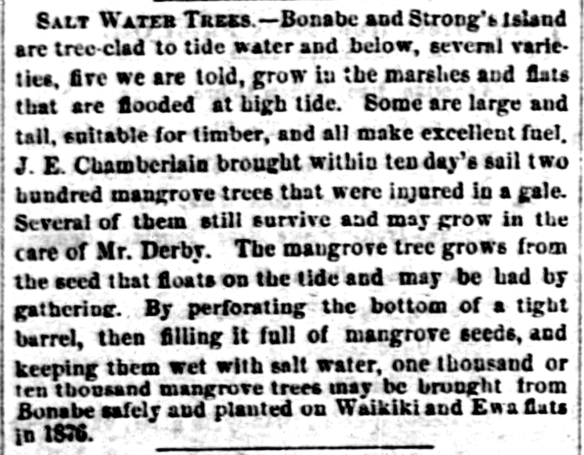
Salt Water Trees.—Bonabe and Strong’s Island are tree-clad to tide water and below, several varieties, five we are told, grow in the marshes and flats that are flooded at high tide. Some are large and tall, suitable for timber, and all make excellent fuel. J. E. Chamberlain brought within ten day’s sail two hundred mangrove trees that were injured in a gale. Several of them still survive and may grow in the care of Mr. Derby. The mangrove tree grows from the seed that floats on the tide and may be had by gathering. By perforating the bottom of a tight barrel, then filling it full of mangrove seeds, and keeping them wet with salt water, one thousand or then thousand mangrove trees may be brought from Bonabe safely and planted on Waikiki and Ewa flats in 1876.

(Hawaiian Gazette, 3/22/1876, p. 2)

HawaiianGazette_3_22_1876_2.png

The Hawaiian Gazette, Volume XII, Number 12, Page 2. March 22, 1876.

Mangrove for Hawaii? 1876.

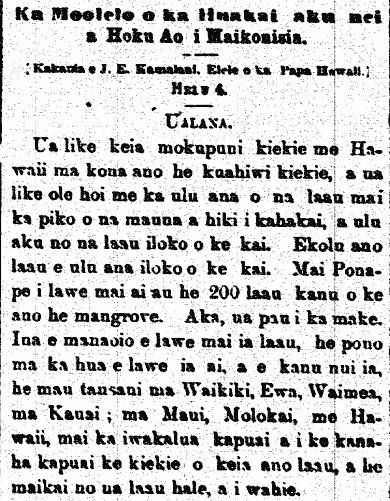
[Found under: “Ka Moolelo o ka Huakai aku nei a Hoku Ao i Maikonisia.”]

Ualana.

This high island is similar to Hawaii being that it is a high mountain, but it is different in that there are trees that grow from the mountain peaks all the way to the ocean, and there are trees that grow in the ocean. There are three kinds of trees growing in the ocean. I brought from Ponape 200 mangrove plants. But they all died. If we really want to bring in that plant, it should be brought in by seed, and planted extensively; thousands in Waikiki, Ewa, Waimea on Kauai, on Maui, Molokai, and Hawaii; this tree reaches from twenty to forty feet high, and is good as lumber for house building and for firewood.

[This appears in a description of travels of the Morning Star to Micronesia, written by Jeremiah E. Chamberlain, the representative of the Board of Hawaiian Missions.]

(Lahui Hawaii, 4/6/1876, p. 2)

LahuiHawaii_4_6_1876_2.png

Ka Lahui Hawaii, Buke II, Helu 15, Aoao 2. Aperila 6, 1876.

Historian J. D. B. Kuakahela dies at sea, 1899.

DIED AT SEA.

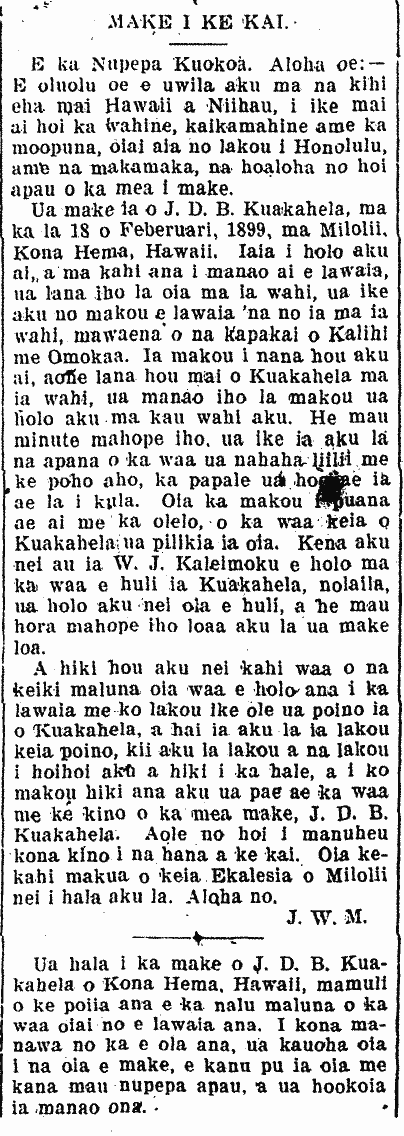
O Kuokoa Newspaper. Aloha oe:—Please flash across the four corners of Hawaii to Niihau, so that the wife, children and grandchildren see, being that they are in Honolulu, and also all of the friends and fellows of the one who died.

J. D. B. Kuakahela died on the 18th of February 1899 at Milolii, South Kona, Hawaii. When he went and was in the area where he wanted to fish, he was floating; we saw him fishing in that area, between the coast of Kalihi and Omokaa. When we looked once more, Kuakahela was no longer floating in that area, and we thought he sailed to some other place. Some minutes later, pieces of the canoe were seen broken into small bits, his fishing line container [poho aho], and his hat floated upon the shore. That is when we said, that is the canoe of Kuakahela; he is in trouble. I instructed W. J. Kaleimoku to go by canoe to search for Kuakahela, so he went to go look, and a number of hours later, he was found dead.

And thereafter a canoe arrived, and the boys aboard that waa were going fishing without knowing that Kuakahela met with disaster; they were told of the calamity and they went to bring him to the house, and when we got there, the waa with the body of the deceased, J. D. B. Kuakahela aboard, landed. His body was not bruised by the action of the ocean. He was one of the elders of this Church of Miloliii who passed on. Aloha no.

J. W. M.

—–

J. D. B. Kuakahela of South Kona, Hawaii, has died because a wave crashed onto his canoe while he was fishing. While he was living, he instructed that at his death, that he is to be buried with all of his newspapers, and this wish of his was carried out.

[That last comment is awesome. I bet I would have liked this man!]

(Kuokoa, 2/24/1899, p. 2)
Kuokoa_2_24_1899_2

Ka Nupepa Kuokoa, Buke XXXVIII, Helu 8, Aoao 2. Feberuari 24, 1899.

Question on Puea Cemetery, 2016.

One of our readers posted a question:

Guy L. Campbell says:

I am searching for information on Puea Cemetery’s undertaker services in 1953. My brother is buried there and there is no grave marker to locate the site. Does anyone know if there was a document of burial plot division and location with names?

[Might any of you out there be able to help?]

Chorus at Kamehameha, 1889.

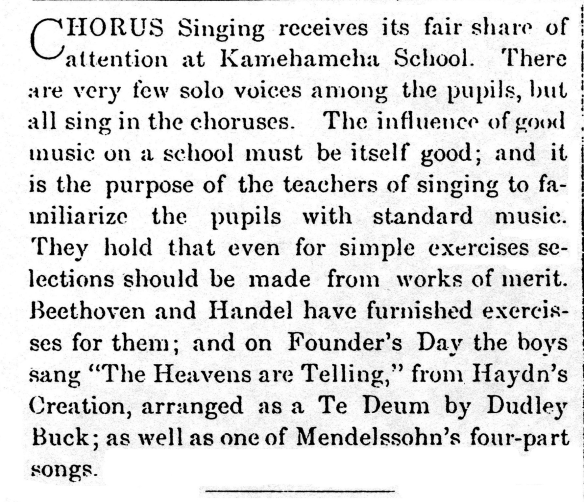
Chorus Singing receives its fair share of attention at Kamehameha School. There are very few solo voices among the pupils, but all sing in the choruses. The influence of good music on a school must be itself good; and it is the purpose of the teachers of singing to familiarize the pupils with standard music. They hold that even for simple exercises selections should be made from works of merit. Beethoven and Handel have furnished exercises for them; and on Founder’s Day the boys sand “The Heavens are Telling,” from Hayden’s Creation, arranged as a Te Deum by Dudley Buck; as well as one of Mendelssohn’s four-part songs.

(Handicraft, 1/1883, p. 3)

Handicraft_1_1889_3.png

Handicraft, Volume 1, Number 1, Page 3. January 1889.

American sailors are taught Hawaiian history, 1925.

PLAYS ABOUT KING KAUIKEAOULI.

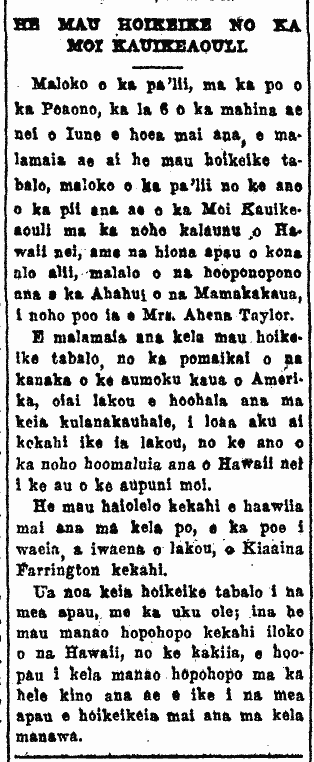
In the grounds of the palace on the night of Saturday, the 6th of this coming June, there will be pageants put on in the palace grounds pertaining to the rise of King Kauikeaouli  to the throne of Hawaii nei along with the appearance of his entire royal court; this will be arranged by the Mamakakaua Society headed by Mrs. Ahuena Taylor.

The pageant will be held for the benefit of the men of the fleet of American warships while they are spending time in this town, so that they obtain some knowledge of the nature of the governing of Hawaii nei i the time of the kingdom.

There will also be speeches presented that night by selected people, and amongst them is Governor Farrington.

This performance will be open to all, without charge; and if there are concerns amongst the Hawaiians that they will be charged, put an end to your worries by going down and witness everything that will be shown at that time.

(Kuokoa, 5/28/1925, p. 2)

Kuokoa_5_28_1925_2

Ka Nupepa Kuokoa, Buke LXIV, Helu 22, Aoao 2. Mei 28, 1925.