Unknown's avatar

About nupepa

Just another place that posts random articles from the Hawaiian Newspapers! It would be awesome if this should become a space where open discussions happen on all topics written about in those papers!! And please note that these are definitely not polished translations, but are just drafts!!! [This blog is not affiliated with any organization and receives no funding. Statements made here should in now way be seen as a reflection on other organizations or people. All errors in interpretation are my own.]

Kanikau for Kamehameha IV, 1864.

ROUND—(4 Parts.)

1

Auwe! Auwe!

2

Aloha ino no,
Ka Moi Iolani,

3

Ua hala aku nei,
I ke ala hoi ole mai,

4

Auwe! Auwe!

ROUND of 4 parts.

1

Alas! Alas!

2

How sad for
The King Iolani,

3

He has passed,
On the path of no return,

4

Auwe! Auwe!

[This kanikau for Kamehameha IV shows that even as far back as 1864, dirges took all sorts of forms!]

(Kuokoa, 1/23/1864, p. 1)

ROUND--[4 Parts)

Ka Nupepa Kuokoa, Buke III, Helu 4, Aoao 1. Ianuari 23, 1864.

Pineapple at the expo in Seattle, 1909.

HAWAIIAN PINEAPPLE IS HIGHLY DESIRED AT THE EXPOSITION.

There is much desire for hala kahiki from Hawaii at the exposition being held in Seattle, because on the ship that just left Honolulu for San Francisco, five-hundred boxes of pineapple is being sent to be sold at the show grounds.

One hundred pineapples are being sold on the average each day, but it is believed that not everyone visiting has tasted the pineapple from Hawaii; and if they receive those added boxes of pineapple, it will supply the visitors for a good amount of time.

This great taking to of the pineapples from Hawaii at Seattle has become something for the pineapple planters to rejoice about, because they feel that that is the one place where people from all over the world can see the quality and the affordability of the pineapples of Hawaii which is foremost above the pineapples of other places.

From now on, the pineapple planters will prepare for orders, and they are able to supply large amounts of pineapples that will be desired.

(Kuokoa, 6/25/1909, p. 5)

MAKEMAKE NUIIA KA HALA HAWAII MA KAHI HOIKEIKE.

Ka Nupepa Kuokoa, Buke XLVI, Helu 26, Aoao 5. Iune 25, 1909.

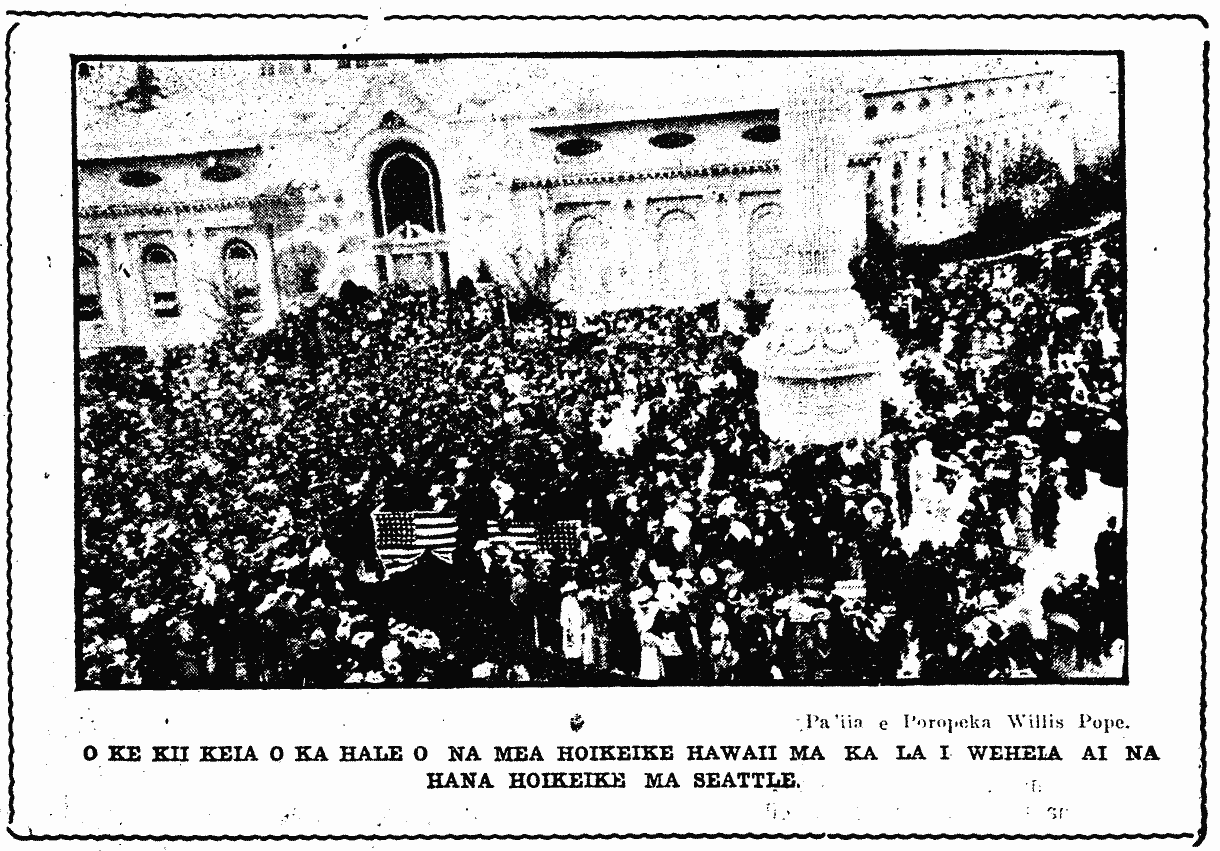
More on the Alaska-Yukon-Pacific Expo, 1909.

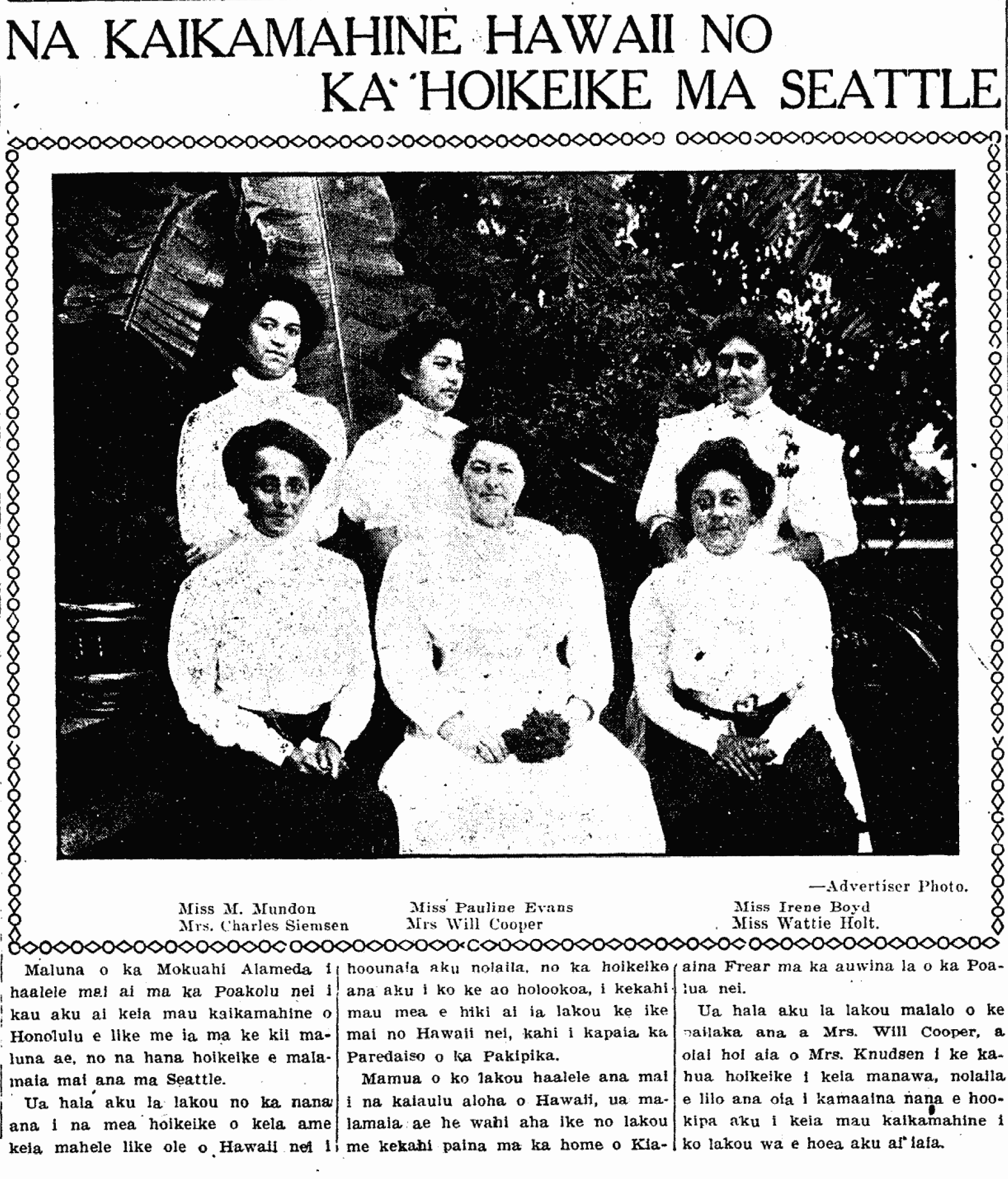
THE HAWAIIAN GIRLS HEADED TO THE EXPOSITION IN SEATTLE

—Advertiser Photo.

Miss M. Mondon  Miss Pauline Evans  Miss Irene Boyd

Mrs. Charles Siemsen  Mrs. Will Cooper  Miss Wattie Holt

It was aboard the steamship Almeda which left on Wednesday that these girls of Honolulu, as shown above in the picture, to go to the exposition being held in Seattle.

They went to go  view the various displays of Hawaii nei sent there to show the world some things from Hawaii nei, the place called the Paradise of the Pacific.

Before their leaving of the beloved community of Hawaii nei, there was held an audience with them along with a party at the residence of Governor Frear on the afternoon of this Tuesday.

They left under the care of Mrs. Will Cooper, and being that Mrs. Knudsen is already at the exposition ground, she will be the kamaaina there who will welcome these girls when they get there.

[See how much clearer the digital image available on Chronicling America is of the same picture in the Pacific Commercial Advertiser from the front page of 5/26/1909. Hopefully someday soon we will be able to rescan all of the Hawaiian-Language Newspapers to get the clearest images of not only the pictures, but of the text, so everything is clearly legible!]

(Kuokoa, 5/28/1909, p. 1)

NA KAIKAMAHINE HAWAII NO KA HOIKEIKE MA SEATTLE

Ka Nupepa Kuokoa, Buke XLVI, Helu 22, Aoao 1. Mei 28, 1909.

Brother Dutton on Molokai, 1911.

25 Years on Molokai.

Last Saturday, the friends of Bro. J. R. Dutton celebrated the twenty-fifth anniversary of his living at the sanatorium at Molokai, where he chose to be amongst the patients, and to teach them of the kingdom of heaven and the righteousness of the spirit.

Bro. Dutton was invited to come to Hawaii as a result of his desire to minister on Molokai amongst the people afflicted with leprosy; and it is true, from the moment he stepped upon the soil of Kalawao, until living there for 25 years, there was not a single moment he spent away, but he remained there at Kalawao at the Baldwin Boys’ Home at all times, as if he made this his home.

In his many years living there, there was only a single time he showed signs of grief, when he climbed into the hills many years ago, his eyes looked out to the wide ocean, and he returned immediately to the Baldwin Home to his room. He then began to write. However, it is unknown what happened that day, except through conjecture.

Bro. Dutton was a soldier engaged in a fierce battle between the north and the south; and he saw the dead bodies of his comrades in battle. He visited the graves of his many friends, and he remains a member of the soldiers of the Republic.

(Kuokoa, 8/4/1911, p. 5)

PIHA KA 25 MAKAHIKI MA MOLOKAI.

Ka Nupepa Kuokoa, Buke XLVII, Helu 31, Aoao 5. Augate 4, 1911.

“Just like being at home!” Hawaiian Pine cannery, 1918.

Wanted are Men and Women Workers

Nice Place to Work

Cafeteria with Hot Snacks–Clothes Lockers for the Women–Dispensary–White Aprons, White Hats, Rubber Gloves, Provided at No Cost.

Good Wages

Just like Being at Home

Hawaiian Pineapple Cannery, Iwilei

(Kuokoa, 7/26/1918, p. 7)

Makemakeia i Poe Kanaka...

Ka Nupepa Kuokoa, Buke LVI, Helu 30, Aoao 7. Iulai 26, 1918.

The dwindling numbers of the Hawaiian hawk, 1889.

THE IO BIRD.

When Captain Cook came upon the island of Kauai and his two ships docked in Waimea, the kamaaina showed him a number of large birds. Captain Cook’s journals say that he saw a Pueo, an Aukuu, and an Io.

These days, we see indeed the Owl [Pueo] and Heron [Aukuu], but who sees the Hawk [Io]? The Io is skilled at snatching chickens and small birds.

If some kamaaina is able to find and catch an Io, V. Knudsen of Waiawa, Mana, is always prepared to pay $10 for it; and for a pair, $15; and for three, $20.

If the bird is live, be careful with the feathers and do not harm them and have them fall off; and so too if it is dead. Also be careful lest it rots, and put a few drops of kerosene in its beak to ward off rotting.

(Kuokoa, 3/30/1889, p. 2)

KA MANU IO.

Ka Nupepa Kuokoa, Buke XXVIII, Helu 12, Aoao 3. Maraki 30, 1889.

One of the biggest early influences on Hawaiian music in Japan starts here, 1909.

DR. K. HAIDA [Katsugorō Haida] is the President of the Japanese Charity Hospital of Honolulu. He was elected by the Japanese Medical Association to this important position in October, 1908, but did not take charge of the hospital affairs until December 19, 1908, when he succeeded Dr. Oyama.

Dr. Haida is a graduate of the Cooper Medical College and is a man of great perseverance. While he is not connected with any agricultural work, he has had plantation life, having been employed at the Paia Sugar Company on Maui. He is one of the promoters of a new Japanese bank to be started by the local Japanese. Dr. Haida believes in the integrity of the United States and on that account he has had his sons take out American citizen papers.

[See also this article on Yukihiko Haida returning to Hawaii in 1933 from Japan to study Hawaiian music.

And also see this article put up by the Nihon Ukulele Association on Yukihiko (Harry) Haida.]

(Evening Bulletin, 3/25/1909, p. 44)

DR. K. HAIDA...

Evening Bulletin Industrial Edition, 1909, p. 44.

I hewa no ia oe la, i kou awihi maka ana mai! 1911.

FAULTED FOR WINKING.

Because the Hawaiian musicians who are in Denver continuously wink at the haole women who frequently dine in the hotel which hired the boys to sing regularly, and most of the women are smitten and are truly entranced by some of the boys, therefore there have been many a complaint to the police about them, to the point where the hotel was ordered to immediately stop contracting those musicians.

When the women and their companions arrive at the hotel, the musicians are always singing songs about women, and therefore some of the women are delighted at this, and the boys are constantly winking.

As they are always seen doing this, there has been numerous complaints to the police department demanding that the hotel throw out the band; the hotel agreed, but only after their contract to sing and play music there was over.

The kinds of songs were not complained about, nor how they sang; only one thing was the cause of the complaints, that being the constant winking of the boys to the women, for by doing this, there have been singers who have married girls of high-class families.

[…pii e ke kai i kumu pali!]

(Kuokoa, 2/17/1911, p. 6)

HOOHALAHALAIA NO KA AWIHI MAKA.

Ka Nupepa Kuokoa, Buke XLVII, Helu 7, Aoao 6. Feberuari 17, 1911.

Storied places of Kiholo and Luahine Wai, 1923.

THE PLEASURES OF TIME

Luahine Wai

It is a big pool close to Kiholo and Laemano. It is a famed bathing spot for the alii of old. Its waters are numbing, and it is said that one cannot swim its circumference because it is cold like ice water.

It is said that within this pond is a hole where you enter into a hidden cave where the bones of the old chiefs are laid. It is said that Kamehameha’s bones are there as well. As for the truth of it all, it is not certain, until some living person enters this hidden cave; then there will be a witness to verify what is in this cave.

This pond is about 5 fathoms deep at its deepest, which is at its center, where it is very cold. And if you dive to the bottom, you will soon feel your body grow cold, and you won’t be able to stay there long. You will shoot up and swim for the edge.

A person that dives down to that deep area will turn red, like the red of coral [? puko’a] Continue reading