Unknown's avatar

About nupepa

Just another place that posts random articles from the Hawaiian Newspapers! It would be awesome if this should become a space where open discussions happen on all topics written about in those papers!! And please note that these are definitely not polished translations, but are just drafts!!! [This blog is not affiliated with any organization and receives no funding. Statements made here should in now way be seen as a reflection on other organizations or people. All errors in interpretation are my own.]

Kamehameha boys off to war, 1917.

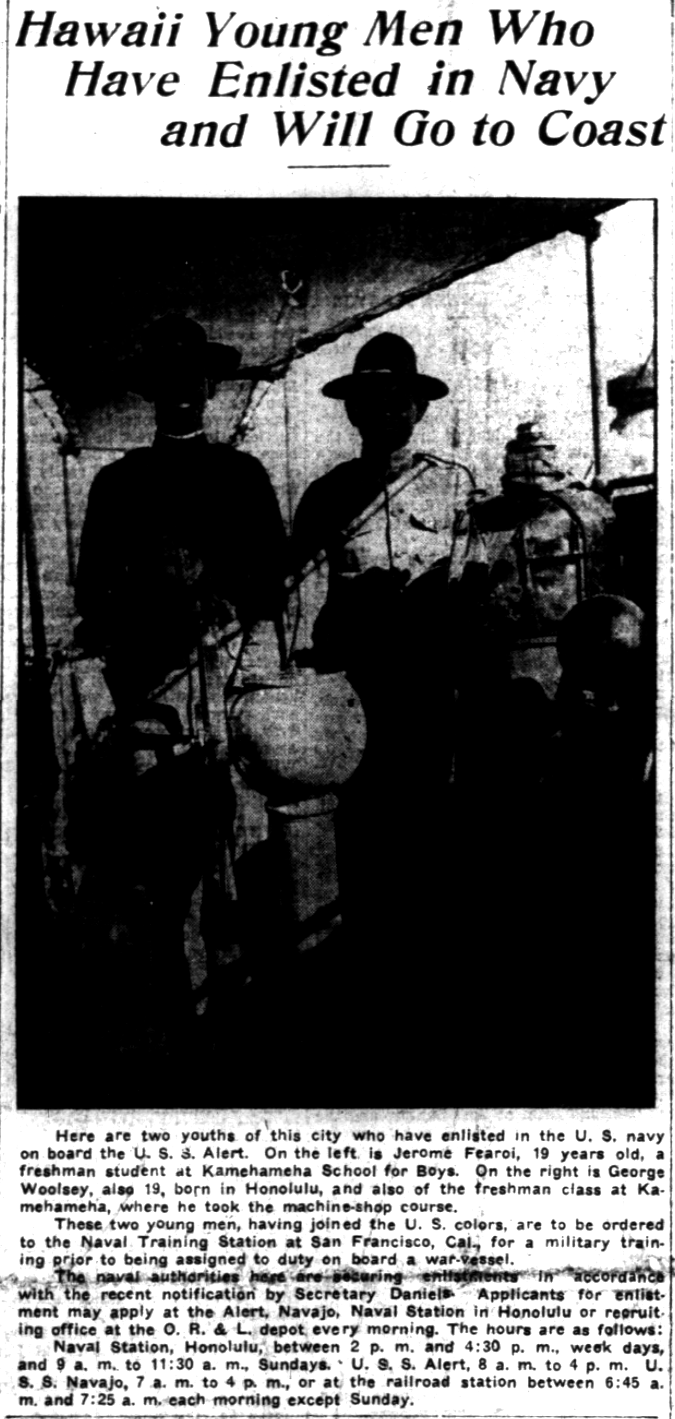
Hawaii Young Men Who Have Enlisted in Navy and Will Go to Coast

Here are two youths of this city who have enlisted in the U. S. navy on board the U. S. S. Alert. On the left is Jerome Fearoi, 19 years old, a freshman student at Kamehameha School for Boys. On the right is George Woolsey, also 19, born in Honolulu, and also of the freshman class at Kamehameha, where he took the machine-shop course.

These two young men, having joined the U. S. colors, are to be ordered to the Naval Training Station at San Francisco, Cal., for a military training prior to being assigned to duty on board a war vessel.

The naval authorities here are securing enlistments in accordance with the recent notification by Secretary Daniels. Applicants for enlistment may apply at the Alert, Navajo, Naval Station in Honolulu or recruiting office at the O. R. & L. depot every morning. The hours are as follows:

Naval Station, Honolulu, between 2 p. m. and 4:30 p. m., week days, and 9 a. m. to 11:30 a. m., Sundays. U. S. S. Alert, 8 a. m. to 4 p. m. U. S. S. Navajo, 7 a. m. to 4 p. m., or at the railroad station between 6:45 a. m. and 7:25 a. m. each morning except Sunday.

(Honolulu Star-Bulletin, 4/17/1917, p. 9)

Hawaii Young Men Who Have Enlisted in Navy and Will Go to Coast

Honolulu Star-Bulletin, Volume XXIV, Number 7803, p. 9. April 17, 1917.


A day to remember, 1924.

THE “DAY TO PLACE FLOWERS” WAS OBSERVED HERE IN HONOLULU

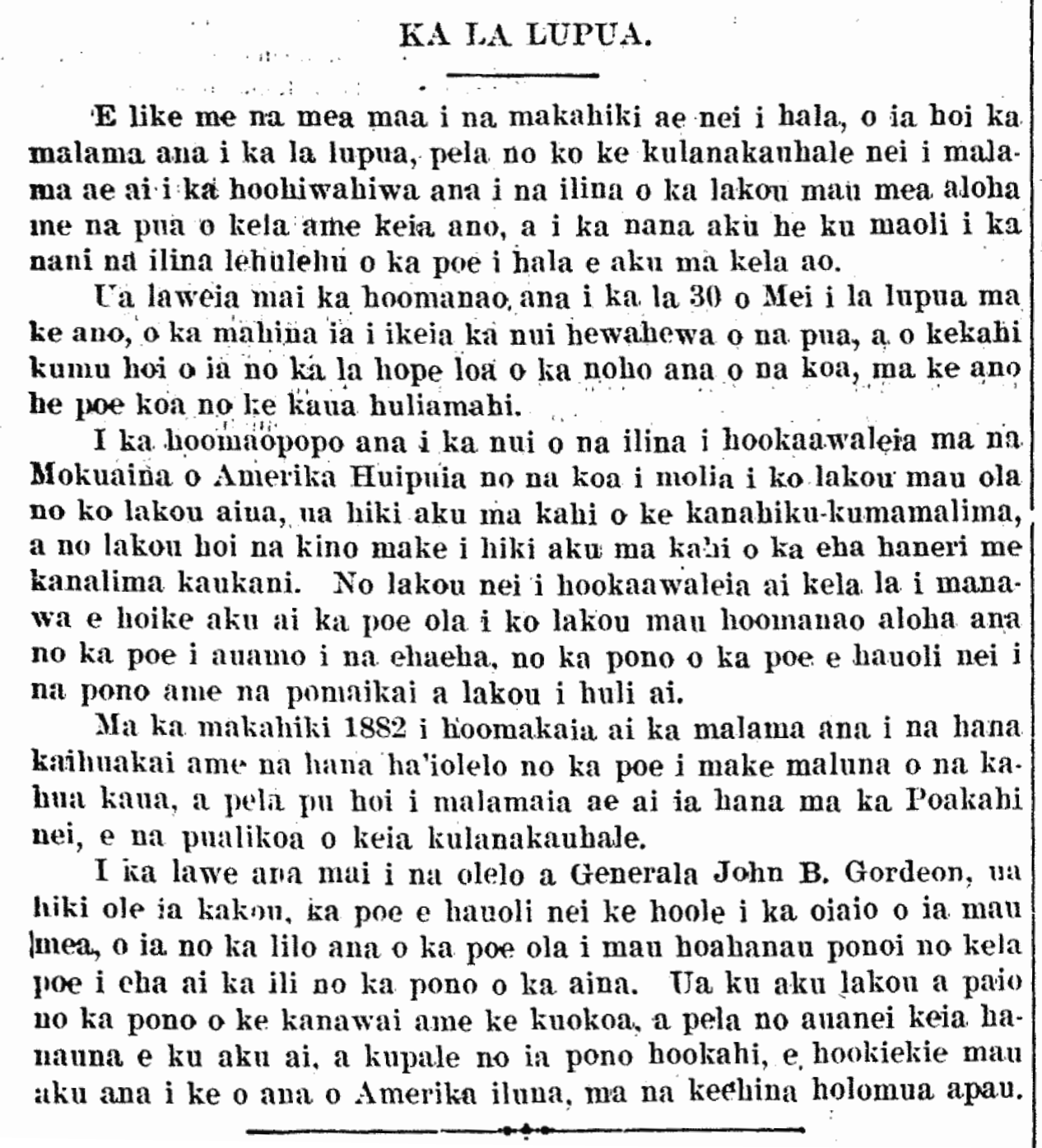
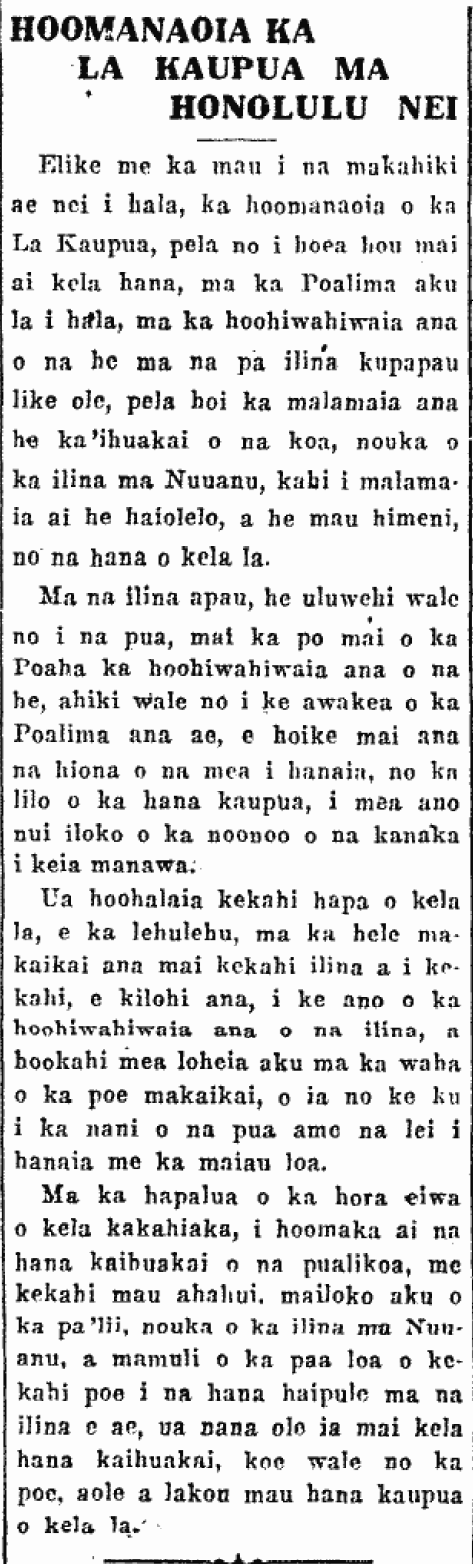
Just as in years past where Decoration Day [La Kaupua] was observed, so too has it come again on this past Friday, as the graves in the different cemeteries were decorated, and also a parade of soldiers was held upland of the cemetery of Nuuanu, where speeches were given as well as songs, for the observances on that day.

All of the cemeteries were decorated with flowers; from Thursday night the graves were being decorated until noon of the following Friday, showing that the observation of Decoration Day is given much thought to by the people these days.

A majority of the day was spent by the people going around from graveyard to graveyard looking at the adornments of the graves, and one thing heard amongst the people making their rounds was that the flowers and lei done with great care were beautiful.

At nine thirty in the morning, the parade of the soldiers and some organizations began from within the palace grounds up to the cemetery in Nuuanu, and being that some people were occupied with prayers at other cemeteries, this parade was not given any thought to, except by those who were not participating in decorating flowers on that day.

[Memorial Day (Decoration Day), which was held on the 30th of May and is now held on the last Monday of May, can be found in the Hawaiian-Language Newspapers as La Kaupua (“day to place flowers”) or La Lupua (“day to strew flowers”).]

(Kuokoa, 6/5/1924, p. 1)

HOOMANAOIA KA LA KAUPUA MA HONOLULU NEI

Ka Nupepa Kuokoa, Buke LXIII, Helu 23, Aoao 1. Iune 5, 1924.

Peleioholani’s home is destroyed by fire, 1901.

ANCIENT RELICS

WERE DESTROYED

Valuable Feather Cloak In Peleioholani’s Fire Claim.

BELONGED TO KEEAUMOKU

THE CLAIMANT’S ANCESTOR

While Husband and Wife Were Shut Out By Quarantine the Flames Swept Away Their Home.

Claims of native Hawaiians were resumed before the Fire Claims Commission yesterday morning. Two of these were called this morning, one of which is of more than ordinary interest.

S. L. Peleioholani presents a claim for $2000 and it appears to be a perfectly straight one. The claimant is a lineal descendant of high chiefs and among his household possessions were heirlooms of great value. Indeed, it is scarcely practicable to measure their value in money, the articles having both historical and ethnological—it might be added without joking, ornithological—interest.

Of the last-named class was a feather cloak, the only one existing of its class except the famous garment of Kamehameha treasured in the British Museum. This cloak descended to Peleioholani from his great-great-grandfather, Keeaumoku, a high chief whose name is given to one of the streets of Honolulu. Evidence was presented before the Commission showing that the claimant refused $500 from Mrs. Marry Ailau, the well-known dealer and connoisseur in Hawaiian relics, several years ago. Yes, and when she sent a relative to further sound the owner on his selling figure an offer of $700 for the cloak was declined by him.

Peleioholani had also a few calabashes of high value, besides other ancient objects of native art.

Why did not Mr. Peleoholani or his wife rescue all this archaeological wealth from the advancing flames? It is an easy question and its answer is not mysterious. The husband was working at his trade of a carpenter on the Castle house, while his wife was away from home on some errand, when the rigid quarantine came down suddenly as a Pali cloud. In consequence the couple could not gain access to their home and the tempest of flame came and swept it away.

Peleioholani lost sundry articles of latter day manufacture and utility, which went to make up his claim. An item was sixty fathoms of inch and a half rope at $47, this being the price he paid for it at an auction sale. He explained that he used the hawser in connection with building and house-moving operations. Scion of a noble house as he is, Peleioholani gave the Commissioners the impression of an honorable man.

[See what was said in an article from one of the Hawaiian-Language Newspapers here.]

(Evening Bulletin, 10/15/1901, p. 1)

ANCIENT RELICS WERE DESTROYED

Evening Bulletin, Volume XI, Number 1968, Page 1. October 15, 1901.

Keelikolani’s house and valuables destroyed by fire, 1873.

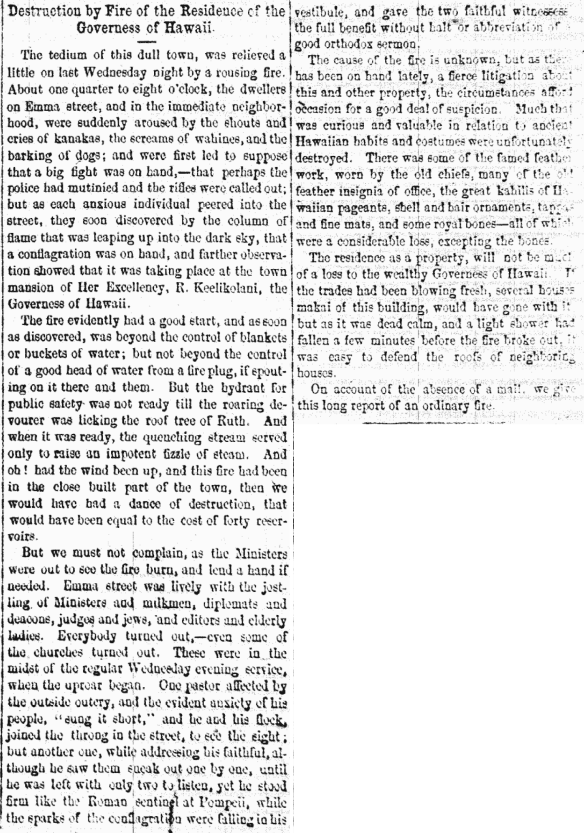
Destruction by Fire of the Residence of the Governess of Hawaii.

The tedium of this dull town, was relieved a little on last Wednesday night by a rousing fire. About one quarter to eight o’clock, the dwellers on Emma street, and in the immediate neighborhood, were suddenly aroused by the shouts and cries of kanakas, the screams of wahines, and the barking of dogs; and were first led to suppose that a big fight was on hand,—that perhaps the police had mutinied and the rifles were called out; but as each anxious individual peered into the street, they soon discovered by the column of flame that was leaping up into the dark sky, that a conflagration was on hand, and farther observation showed that it was taking place at the town mansion of Her Excellency, R. Keelikolani, the Governess of Hawaii.

The fire evidently had a good start, and as soon as discovered, was beyond the control of blankets or buckets of water; but not beyond the control of a good head of water from a fire plug, if spouting on it there and then. But the hydrant for public safety was not ready till the roaring devourer was licking the roof tree of Ruth. And when it was ready, the quenching stream served only to raise an impotent fizzle of stream. And oh! had the wind been up, and this fire had been in the close built part of the town, then we would have had a dance of destruction, that would have been equal to the cost of forty reservoirs.

But we must not complain, as the Ministers were out to see the fire burn, and lend a hand if needed. Emma street was lively with the jostling of Ministers and milkmen, diplomats and deacons, judges and jews, and editors and elderly ladies. Everybody turned out,—even some of the churches turned out. These were in the midst of the regular Wednesday evening service, when the uproar began. One pastor affected by the outside outcry, and the evident anxiety of his people, “sung it short,” and he and his flock, joined the throng in the street, to see the sight; but another one, while addressing his faithful, although he saw them speak out one by one, until he was left with only two to listen, yet he stood firm like the Roman sentinel at Pompeii, while the sparks of the conflagration were falling in his vestibule, and gave the two faithful witnesses the full benefit without halt or abbreviation of good orthodox sermon.

The cause of the fire is unknown, but as there had been on hand lately, a fierce litigation about this and other property, the circumstances afford occasion for a good deal of suspicion. Much that was curious and valuable in relation to ancient Hawaiian habits and costumes were unfortunately destroyed. There was some of the famed featherwork, worn by the old chiefs, many of the old feather insignia of office, the great kahilis of Hawaiian pageants, shell and hair ornaments, tappas and fine mats, and some royal bones—all of which were a considerable loss, excepting the bones.

The residence as a property, will not be much of a loss to the wealthy Governess of Hawaii. If the trades had been blowing fresh, several houses makai of this building, would have gone with it but as it was dead calm, and a light shower had fallen a few minutes before the fire broke out, it was easy to defend the roofs of neighboring houses.

On account of the absence of mail, we give this long report of an ordinary fire.

(Hoku o Hawaii, 1o/17/1873, p. 3)
Destruction by Fire of the Residence of the Governess of Hawaii.

Nuhou, Volume II, Number 24, Page 3. October 17, 1873.

Hilo feather lei maker Ida Akau, 1901.

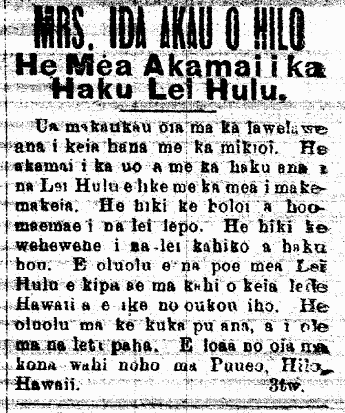
MRS. IDA AKAU OF HILO

A Person Skilled at Making Lei Hulu.

She is proficient at this work with fine workmanship. She is skilled at tying feathers [uo] and putting feather lei together [haku] as per one’s desires. She can clean soiled lei. She can undo old lei and remake them. Those who have Lei Hulu, pleace come and visit the place of this Hawaiian lady to see for yourselves.  Consultation by visit or by correspondence is welcomed. She can be found at her residence in Puueo, Hilo, Hawaii.

(Aloha Aina, 11/9/1901, p. 3)

MRS. IDA AKAU O HILO

Ke Aloha Aina, Buke VII, Helu 45, Aoao 3. Novemaba 9, 1901.

Kaumualii’s mahiole fetches a mere $120 at auction, 1873.

[Found under: “NU HOU KULOKO.”]

Antiquities of Hawaii nei.—At 10 o’clock in the morning of this past Saturday, Mar. 8, the valuables of old Hawaii which were advertised earlier were auctioned off by E. P. Adams. The house was filled with all sorts of people, and some objects went for high bids. The feather mahiole of Kaumualii went for the price of $120. This headdress went for a very low price; it is believed that never again will there be available a mahiole of that kind. The care given to all of the objects by the mother who has passed [Mrs. Whitney] was very good.

(Kuokoa, 3/22/1873, p. 3)

Na mea kahiko o Hawaii nei...

Ka Nupepa Kuokoa, Buke XII, Helu 12, Aoao 3. Maraki 22, 1873.

On Kaumualii and Kaahumanu, 1880.

[From: “Ka Moolelo o Kaahumanu”]

Kaahumanu was one of them who made a circuit of Maui, Oahu, and Kauai with Liholiho. When Kaahumanu arrived on Kauai, she took Kaumualii, the alii of Kauai, as a kane [husband] for herself. When Liholiho returned to Oahu, it was with Haakulou, the woman of Kaumualii; because Liholiho took Haakulou as a wahine [wife] for himself, along with his other wahine.

Kaahumanu lived on Kauai along with Kaumualii in the year 1822. Perhaps in the month of August.

Kaahumanu wanted to seek out Nihoa. It was the very first time that Nihoa was found, that tiny island to the North-West of Niihau. Continue reading

The beginnings of Punahou School, 1841.

SCHOOLHOUSE FOR THE MISSIONARIES, AT KA PUNAHOU.

The rooms are explained by the numbers,

1, a library; 2, 3, 4, 5, for the teachers; 6, kitchen; 7, 8, 9, 10, for the students; 11, 12, for Mi. Mika [?] the woman helper; 13, 14, 15, 16, 17, for the students; 18, cafeteria; 19, school room; 20, room for entertaining guests; 21, 22, 23, 24, 25 for the students. A, E, wide areas to play.

This will not be completed quickly at this time; the places with solid lines are being constructed, and the areas surrounded by dashes are left to complete at a later date. The most tiny rooms are solitary rooms.

[Earlier, i posted a diagram of the layout of the Chiefs’ Children’s School. Here from about the same time is the school for missionary children at Kapunahou, the precursor to today’s Punahou School.

The school began instruction on July 11, 1842, with 5 boarders and 12 day schoolers.]

(Nonanona, 11/23/1841, p. 44)

KA HALE KULA NO NA MISIONARI, AIA MA KA PUNAHOU.

Ka Nonanona, Buke 1, Pepa 11, Aoao 44. Novemaba 23, 1841.

The name of Kaumualii’s mahiole, 1906.

[Excerpt from: “He Moolelo no Kamehameha I. Ka Na’i Aupuni Hawaii.” by Hooulumahiehie.]

After these words of Kamehameha’s were over, he then took his mahiole, Koki, from a basket and placed it upon the head of Kaumualii. Kamehameha removed his royal malo and so too did Kaumualii remove his malo, and they exchanged them with each other.

[This account is from the meeting of Kamehameha and Kaumualii. It is just a tiny excerpt of the kind of awesome information available in the story of Kamehameha I translated by Kamaoli Kuwada, Emalani Case, and Beau Bassett, slated to come out from Kamehameha Publishing. I can’t wait.

I was informed that this priceless feathered object from the past is indeed being cared for amongst the many other antiquities at the Bernice Pauahi Bishop Museum.]

(Na’i Aupuni, 9/14/1906, p. 1)

HE MOOLELO NO KAMEHAMEHA I.

Ka Na’i Aupuni, Buke II, Helu 88, Aoao 1. Sepatemaba 14, 1906.

Kaumualii’s Mahiole, 1873.

It is the Feather Helmet of Kaumualii!—During the days of this past week, displayed in the window of Whitney’s Bookstore the regalia of the Ancient Kings of Hawaii nei. The Mahiole is Kaumualii’s, the last King of Kauai. Mrs. Whitney [Wini] the elder who just passed was the one who was taking care of the mahiole, and it is one of the things remaining today of the beautiful works of the people of old. We praise the fine upkeep by the beloved missionary mother who passed, for on display, it seemed as if it was made yesterday; the feathers appeared new. On the sides of the mahiole were red feathers taken from the Iiwi polena, and feathers of the maha Oo are on top of the mahiole from this side to that of the crest. This should definitely be kept in the Hawaiian Museum. We believe that it is 60 years old.

[It is interesting to note what is not said in a similar article in English.]

(Au Okoa, 2/27/1873, p. 3)

O ka Mahiole ka o Kaumualii!

Ke Au Okoa, Buke VIII, Helu 46, Aoao 3. Feberuari 27, 1873.