Unknown's avatar

About nupepa

Just another place that posts random articles from the Hawaiian Newspapers! It would be awesome if this should become a space where open discussions happen on all topics written about in those papers!! And please note that these are definitely not polished translations, but are just drafts!!! [This blog is not affiliated with any organization and receives no funding. Statements made here should in now way be seen as a reflection on other organizations or people. All errors in interpretation are my own.]

Olelo Noeau, 1922.

PROVERBS.

In order for us to hold on to all of the olelo noeau and all of the ingenious deeds of the Hawaiian people, we very much want everyone to assist the Bishop Museum in their collecting and explaining of wise and witty sayings known amongst this race.

So that this endeavor will move forward, whenever an ancient olelo noeau comes to mind, or perhaps a riddle, do write it down and send it to the museum; and if not to there, send it directly to the Kuokoa with clarification of its hidden meaning or deep wit.

Here are some olelo noeau sent from the museum to this newspaper:

He ala iki ko kahuna.

Aohe pau o ka ike i kau halau.

Aohe hookahi halau i a’oia ai.

He maia ke kanaka, a ka la e hua mai ai, hua.

O-u i ka maka o ka wauke o i opiopio.

Aohe ipukai pau i ka iole.

Aohe malama pau i ka iole.

Aole e nalo na iwi o ke alii kolohe. E nalo na iwi o ke alii maikai. Oluna, olalo, okai, ouka, o ka hao pae, ko ke alii.

Ua mau ke ea o ka aina i ka pono.

E hele ka elemakule, ka luahine, ame ke keiki a moe i ke ala.

Ola na iwi o kaua.

Hiamoe loa ke kane, nana wale ka wahine.

Mai noho a hele kikaha aku.

Ua hala i Kauai, i Kalalau.

Aohe pilo uku.

I ke alo iho la no ka ulu a o ka hala no ia.

He ohu ke aloha, aohe kuahiwi kau ole.

Ono kahi ao luau me ke aloha pu kekahi.

Pa mai, pa mai ka makani o Hilo: waiho ka ipu iki, homai ka ipu nui.

Ka i ke pohuehue, ha’i ka nalu.

Monia, monia, alealea i ke kumu pihapiha: Lawea mai!

O kau ola ia, e Ku ame Hina; O ko’u ola ho’i ia. I ka olua pulapula i keia ao. Amana, ua noa.

Pua ka neneleau momona ka wana.

Pala ka hala, momona ka uhu.

[And presumably from the responses came the publication we all know today as “‘Ōlelo No‘eau: Hawaiian Proverbs and Poetical Sayings”. Some of the examples above are included with different phrasing, while others appear not to have been included. If you don’t have a copy of this publication, it is a must have!]

(Kuokoa, 9/14/1922, p. 5)

NA OLELO NIEAU.

Ka Nupepa Kuokoa, Buke LXI, Helu 37, Aoao 5. Sepatemaba 14, 1922.

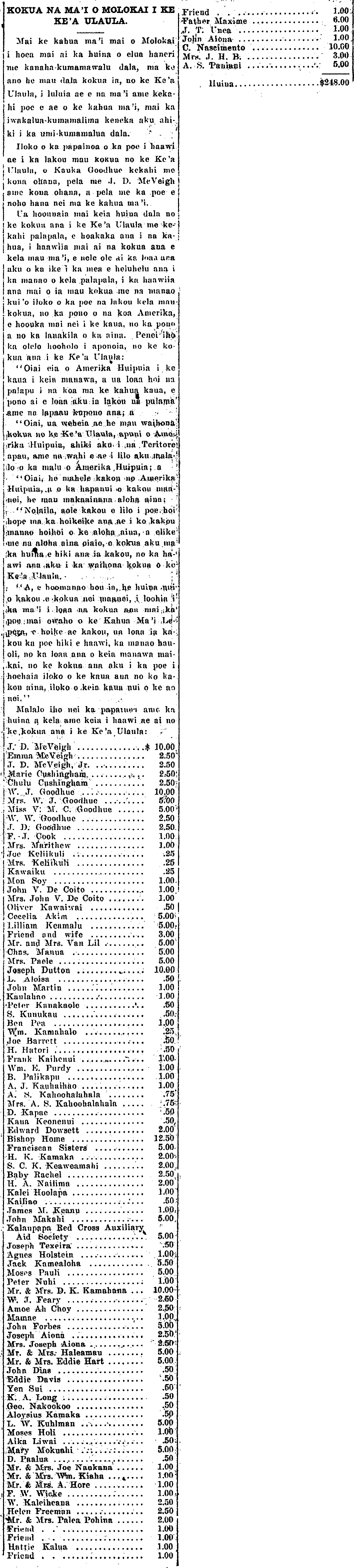
Donations to the Red Cross by the patients and residents of the leprosy colony, 1918.

THE PATIENTS OF MOLOKAI ASSIST THE RED CROSS.

There arrived from the leprosy colony of Molokai, a total of two-hundred and forty-eight dollars, in the form of a donation for the Red Cross [Ke’a Ulaula], given by the patients and some others of the colony, from twenty-five cents to twelve dollars.

In the list of the donors to the Red Cross is Dr. Goodhue and his family, along with J. D. McVeigh and his family, and also those who reside there while working in the leprosy colony.

This sum of money to assist the Red Cross was sent along with a document explaining the reasons that this assistance was given by the patients, so that someone reading it would not be left without knowing that the assistance is given by them sincerely for the benefit of the American soldiers fighting the war for the good and the victory of the land. Here below is the agreed upon resolutions for the assistance of the Red Cross.

“Whereas, the United States of America is now at war, and soldiers are being injured on the battlefield, they should receive care and proper medicine; and

“Whereas, there have been established a number of collections for the Red Cross set up all around the United States, and every Territory, and the other areas under the protection of the United States; and

“Whereas, we are a part of the United States of America, and the majority of us here are patriotic citizens;

“Therefore, we will not fall back from showing our patriotic spirit, and with true patriotism, we give what we can for the donation to the Red Cross.

“And, let it once again be remembered that there are a great number of us being helped here stricken by disease who receive assistance from those outside of the Leprosy Colony; let us show that there are those of us here who can give and that we are happy for this fine opportunity to assist those injured fighting for our land, in this great war of the world.”

Here below is the list of names and the donations that each gave to assist the Red Cross:

J. D. McVeigh ….. $10.00
Emma McVeigh ….. 2.50
J. D. McVeigh, Jr. ….. 2.50
Marie Cushingham ….. 2.50
Chulu Cushingham ….. 2.50
W. J. Goodhue ….. 10.00
Mrs. W. J. Goodhue ….. 5.00
Miss V. M. C. Goodhue ….. 5.00
W. W. Goodhue ….. 2.50
J. D. Goodhue ….. 2.50
F. J. Cook ….. 1.00
Mrs. Marithew ….. 1.00
Joe Keliikuli ….. .25
Mrs. Keliikuli ….. .25
Kawaiku ….. .25
Mon Soy ….. 1.00
John V. De Coito ….. 1.00
Mrs. John V. De Coito ….. 1.00
Oliver Kawaiwai ….. .50
Cecelia Akim ….. 5.00
Lilian Keamalu ….. 5.00
Friend and wife ….. 3.00
Mr. and Mrs. Van Lil ….. 5.00
Charles Manua ….. 5.00
Mrs. Paele ….. 5.00
Joseph Dutton ….. 10.00
L. Aloisa ….. .50
John Martin ….. 1.00
Kaulahao ….. 1.00
Peter Kanakaole ….. .50
S. Kunukau ….. .50
Ben Pea ….. 1.00
William Kamahalo ….. .25
Joe Barrett ….. .50
H. Hatori ….. .50
Frank Kaihenui ….. 1.00
William E. Purdy ….. 1.00
B. Palikapu ….. 1.00
Al. J. Kauhaihao ….. 1.00
A. S. Kahoohalahala ….. .75
Mrs. A. S. Kahoohalahala ….. .75
D. Kapae ….. .50
Kaua Keonenui ….. .50
Edward Dowsett ….. 2.00
Bishop Home ….. 12.50
Franciscan Sisters ….. 5.00
H. K. Kamaka ….. 2.00
S. C. K. Keaweamahi ….. 2.00
Baby Rachel ….. 2.50
H. A. Nailima ….. 2.00
Kalei Hoolapa ….. 1.00
Kailiao ….. .50
James m. Keanu ….. 1.00
John Makahi ….. 5.00
Kalaupapa Red Cross Auxiliary Aid Society ….. 5.00
Joseph Texeira ….. .50
Agnes Holstein ….. 1.00
Jack Kamealoha ….. 5.50
Moses Pauli ….. 5.00
Peter Nuhi ….. 1.00
Mr. & Mrs. D. K. Kamahana ….. 10.00
W. J. Feary ….. 2.50
Amoe Ah Choy ….. 2.50
Mamae ….. 1.00
John Forbes ….. 5.00
Joseph Aiona ….. 2.50
Mrs. Joseph Aiona ….. 2.50
Mr. & Mrs. Haleamau ….. 5.00
Mr. & Mrs. Eddie Hart ….. 5.00
John Dias ….. .50
Eddie Davis ….. .50
Yen Sui ….. .50
K. A. Long ….. .50
George Nakookoo ….. .50
Aloysius Kamaka ….. .50
L. W. Kuhlman ….. 5.00
Moses Holi ….. 1.00
Aika Liwai ….. .50
Mary Mokuahi ….. 5.00
D. Paalua ….. .50
Mr. & Mrs. Joe Naukana ….. 1.00
Mr. & Mrs. William Kiaha ….. 1.00
Mr. & Mrs. A. Hore ….. 1.00
F. W. Wicke ….. 1.00
W. Kaleiheana ….. 2.50
Helen Freeman ….. 2.50
Mr. & Mrs. Palea Pohina ….. 2.00
Friend ….. 1.00
Friend ….. 1.00
Hattie Kalua ….. 1.00
Friend ….. 1.00
Friend ….. 1.00
Father Maxime ….. 6.00
J. T. Unea ….. 1.00
John Aiona ….. 1.00
C. Nascimento ….. 10.00
Mrs. J. H. B. ….. 3.00
A. S. Paniani ….. 5.00
Total ….. $248.00

[The patients of the leprosy colony might have often been forsaken by those on the outside, but it seems throughout history that those forced to live there did not forsake those on the outside.]

(Kuokoa, 2/1/1918, p. 2)

KOKUA NA MA'I O MOLOKAI I KE KE'A ULAULA.

Ka Nupepa Kuokoa, Buke LVI, Helu 5, Aoao 2. Feberuari 1, 1918.

Those afflicted with leprosy forsaken by the church? 1873.

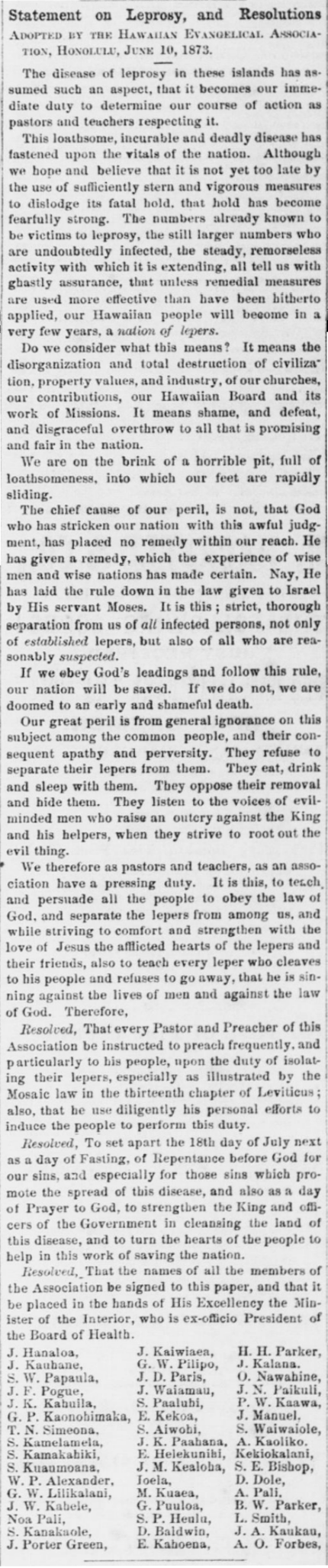
Statement on Leprosy, and Resolutions

Adopted by the Hawaiian Evangelical Association, Honolulu, June 10, 1873.

The disease of leprosy in these islands has assumed such an aspect, that it becomes our immediate duty to determine our course of action as pastors and teachers respecting it.

This loathsome, incurable and deadly disease has fastened upon the vitals of the nation. Although we hope and believe that it is not yet too late by the use of sufficiently stern and vigorous measures to dislodge its fatal hold, that hold has become fearfully strong. The numbers already known to be victims to leprosy, the still larger numbers who are undoubtedly infected, the steady, remorseless activity with which it is extending, all tell us with ghastly assurance, that unless remedial measures are used more effective than have been hitherto applied, our Hawaiian people will become in a very few years, a nation of lepers.

Do we consider what this means? It means the disorganization and total destruction of civilization, property values, and industry, of our churches, our contributions, our Hawaiian Board and its work of Missions. It means shame, and defeat, and disgraceful overthrow to all that is promising and fair in the nation.

We are on the brink of a horrible pit, full of loathsomeness, into which our feet are rapidly sliding.

The chief cause of our peril, is not, that God who has stricken our nation with this awful judgment, has placed no remedy within our reach. He has given a remedy, which the experience of wise men and wise nations has made certain. Nay, He has laid the rule down in the law given to Israel by His servant Moses. It is this; strict, thorough separation from us of all infected persons, not only of established lepers, but also of all who are reasonably suspected.

If we obey God’s leadings and follow this rule, our nation will be saved. If we do not, we are doomed to an early and shameful death.

Our great peril is from general ignorance on this subject among the common people, and their consequent apathy and perversity. They refuse to separate their lepers from them. They eat, drink and sleep with them. They oppose their removal and hide them. They listen to the voices of evil-minded men who raise an outcry against the King and his helpers, when they strive to root out the evil thing.

We therefore as pastors and teachers, as an association have a pressing duty. It is this, to teach and persuade all the people to obey the law of God, and separate the lepers from among us, and while striving to comfort and strengthen with the love of Jesus the afflicted hearts of the lepers and their friends, also to teach every leper who cleaves to his people and refuses to go away, that he is sinning against the lives of men and against the law of God. Therefore,

Resolved, That every Pastor and Preacher of this Association be instructed to preach frequently, and particularly to his people, upon the duty of isolating their lepers, especially as illustrated by the Mosaic law in the thirteenth chapter of Leviticus; also, that he use diligently his personal efforts to induce the people to perform this duty.

Resolved, To set apart the 18th day of July next as a day of Fasting, of Repentance before God for our sins, and especially for those sins which promote the spread of this disease, and also as a day of Prayer to God, to strengthen the King and officers of the Government in cleansing the land of this disease, and to turn the hearts of the people to help in this work of saving the nation.

Resolved, That the names of all the members of the Association be signed to this paper, and that it be placed in the hands of His Excellency the Minister of the Interior, who is ex-officio President of the Board of Health.

J. Hanaloa,  J. Kaiwiaea, H. H. Parker,
J. Kauhane,  G. W. Pilipo,  J. Kalana,
S. W. Papaula,  J. D. Paris,  O. Nawahine,
J. F. Pogue,  J. Waiamau,  J. N. Paikuli,
J. K. Kahuila,  S. Paaluhi,  P. W. Kaawa,
G. P. Kaonohimaka,  E. Kekoa,  J. Manuel,
T. N. Simeona,  S. Aiwohi,  S. Waiwaiole,
S. Kamelamela,  J. K. Paahana,  A. Kaoliko,
S. Kamakahiki,  E. Helekunihi,  Kekiokalani,
S. Kuaumoana,  J. M. Kealoha,  S. E. Bishop,
W. P. Alexander,  Ioela,  D. Dole,
G. W. Lilikalani,  M. Kuaea,  A. Pali,
J. W. Kahele,  G. Puuloa,  B. W. Parker,
Noa Pali,  S. P. Heulu,  L. Smith,
S. Kanakaole,  D. Baldwin,  J. A. Kaukau,
J. Porter Green,  E. Kahoena,  A. O. Forbes.

[How have things changed today? How have things remained the same? Find the Hawaiian-Language version printed in the Kuokoa, 6/18/1873, p. 3, here.]

(Pacific Commercial Advertiser, 6/14/1873, p. 3)
Statement on Leprosy, and Resolutions

The Pacific Commercial Advertiser, Volume XVII, Number 50, Page 3. June 14, 1873.

Queen Kapiolani, Mele, Maunakea, and a new site to check out, 1878/2013.

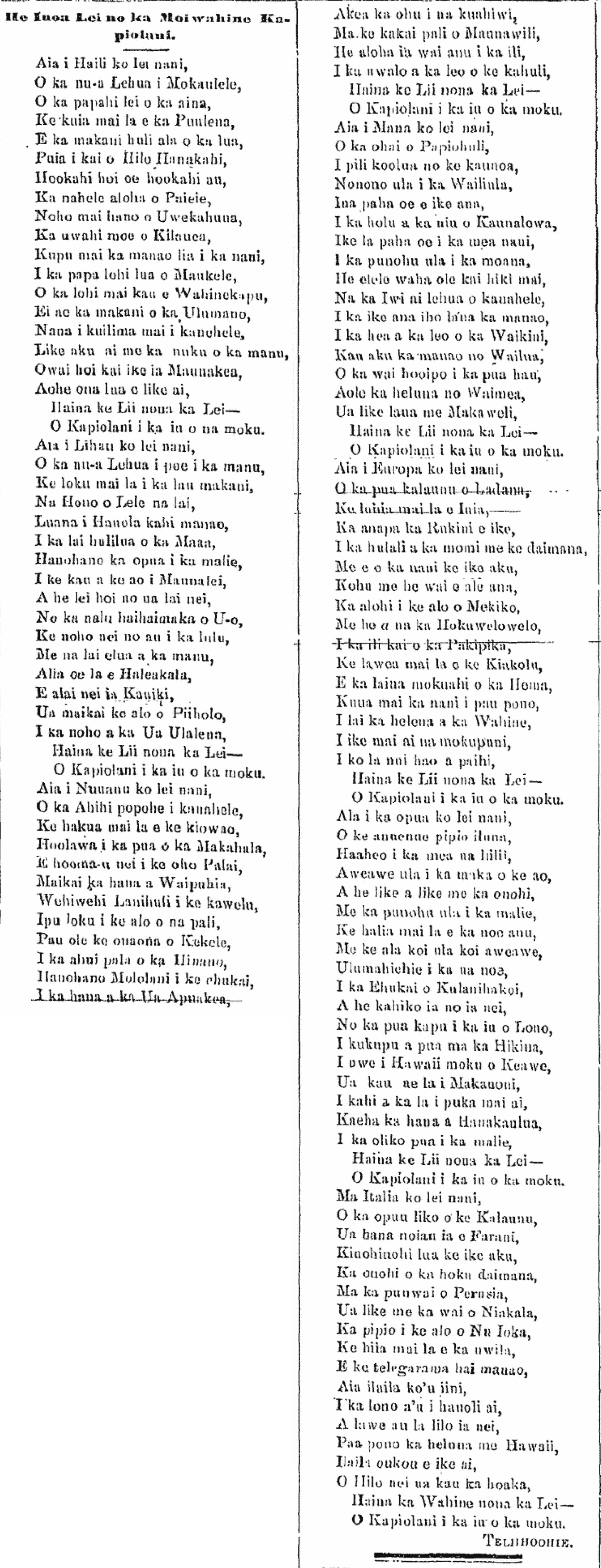
He Inoa Lei no ka Moiwahine Kapiolani.

Aia i Haili ko lei nani,
O ka nu-a Lehua i Mokaulele,
O ka papahi lei o ka aina,
Ke kuia mai la e ka Puulena,
E ka makani huli ala o ka lua,
Puia i kai o Hilo Hanakahi,
Hookahi hoi oe hookahi au,
Ka nahele aloha o Paieie,
Noho mai hano o Uwekahuna,
Ka uwahi moe o Kilauea,
Kupu mai ka manao lia i ka nani,
I ka papa lohi lua o Maukele,
O ka lohi mai kau e Wahinekapu,
Ei ae ka makani o ka Ulumano,
Nana i kuilima mai i kanehele,
Like aku ai me ka nuku o ka manu,
Owai hoi kai ike ia Maunakea,
Aohe ona lua e like ai,
Haina ke Lii nona ka Lei—
O Kapiolani i ka iu o na moku.

Aia i Lihau ko lei nani,
O ka nu-a Lehua i poe i ka manu,
Ke loku mai la i ka lau makani,
Na hono o Lele na lai,
Luana i Hauola kahi manao,
I ka lai hulilua o ka Maaa,
Hanohano ka opua i ka malie,
I ke kau a ke ao i Maunalei,
A he lei hoi no ua lai nei,
No ka nalu haihaimaka o U-o
Ke noho nei no au i ka lulu,
Me na lai elua a ka manu,
Alia oe la e Haleakala,
E alai nei ia Kauiki,
Ua maikai ke alo o Piiholo,
I ka noho a ka Ua Ulalena,
Haina ke Lii nona ka Lei—
O Kapiolani i ka iu o ka moku.

Aia i Nuuanu ko lei nani,
O ka Ahihi popohe i kanahele,
Ke hakua mai la e ke kiowao,
Hoolawa i ka pua o ka Makahala,
E hooma-u nei i ke oho Palai,
Maikai ka hana a Waipuhia,
Wehiwehi Lanihuli i ke kawelu,
Ipu loku i ke alo o na pali,
Pau ole ke onaona o Kekele,
I ka ahui pola o ka Hinano,
Hanohano Mololani i ke ehukai,
I ka hana a ka Ua Apuakea,
Akea ka ohu i na kuahiwi,
Ma ke kakai pali o Maunawili,
He aloha ia wai anu i ka ili,
I ka uwalo a ka leo o ke kahuli,
Haina ke Lii nona ka Lei—
O Kapiolani i ka iu o ka moku.

Aia i Mana ko lei nani,
O ka ohai o Papiohuli,
I pili koolua no ke kaunoa,
Nonono ula i ka Wailiula,
Ina paha oe e ike ana,
I ka holu a ka ulu o Kaunalewa,
Ike la paha oe i ka mea nani,
I ka punohu ula i ka moana,
He elele waha ole kai hiki mai,
Na ka Iwi ai lehua o kanahele,
I ka ike ana iho lana ka manao,
I ka hea a ka leo o ka Waikini,
Kau aku ka manao no Wailua,
O ka wai hooipo i ka pua hau,
Aole ka heluna no Waimea,
Ua like laua me Makaweli,
Haina ke Lii nona ka Lei—
O Kapiolani i ka iu o ka moku.

Aia i Europa ko lei nani,
O ka pua kalaunu o Ladana,
Ke luhia mai la e Inia,
Ka anapa ka Rukini e ike,
I ka hulali a ka momi me ke daimana,
Me e o ka nani ke ike aku,
Kohu me he wai e ale ana,
Ka alohi i ke alo o Mekiko,
Me he a na ka Hokuwelowelo,
I ka ili kai o ka Pakipika,
Ke lawea mai la e ke Kiakolu,
E ka laina mokuahi o ka Hema,
Kuua mai ka nai i pau pono,
I lai ka helena a ka Wahine,
I ike mai ai na mokupuni,
I ko la nui hao a paihi,
Haina ke Lii nona ka Lei—
O Kapiolani i ka iu o ka moku.

Ala i ka opua ko lei nani,
O ke anuenue pipio iluna,
Haaheo i ka mea na liilii,
Aweawe ula i ka maka o ke ao,
A he like a like me ka onohi,
Me ka punohu ula i ka malie,
Ke halia mai la e ka noe anu,
Me ke ala koi ula koi aweawe,
Ulumahiehie i ka ua noe,
I ka Ehukai o Kulanihakoi,
A he kahiko ia no ia nei,
No ka pua kapu i ka iu o Lono,
I kukupu a pua ma ka Hikina,
I uwe i Hawaii moku o Keawe,
Ua kau ae la i Makanoni,
I kahi a ka la i puka mai ai,
Kaeha ka hana a Hanakaulua,
I ka oliko pua i ka malie,
Haina ke Lii nona ka Lei—
O Kapiolani i ka iu o ka moku.

Ma Italia ko lei nani,
O ka opuu liko o ke Kalaunu,
Ua hana noiau ia e Farani,
Kinohinohi lua ke ike aku,
Ka onohi o ka hoku daimana,
Ma ka puuwai o Perusia,
Ua like me ka wai o Niakala,
Ka pipio i ke alo o Nu Ioka,
Ke hiia mai la e ka uwila,
E ke telegarama hai manao,
Aia ilaila ko’u iini,
I ka lono a’u i hauoli ai,
A lawe au la lilo ia nei,
Paa pono ka helua me Hawaii,
Ilaila oukou e ike ai,
O Hilo nei ua kau ka hoaka,
Haina ka Wahine nona ka Lei—
O Kapiolani i ka iu o ka moku.

Teliihoohie.

[I was reminded of this set of lei chants for Queen Kapiolani by a post on a relatively new site with information about Hawaii past and present. Check out the recent post on Maunakea and much more by Nanea Armstrong Wassel, right here:

http://instagram.com/naneaarmstrongwassel

This mele is also printed in the very next issue of Ko Hawaii Pae Aina, 10/12/1878, p. 4, with some variation.]

(Ko Hawaii Pae Aina, 10/5/1878, p. 4)

He Inoa Lei no ka Moiwahine Kapiolani.

Ko Hawaii Pae Aina, Buke I, Helu 40, Aoao 4. Okatoba 5, 1878.

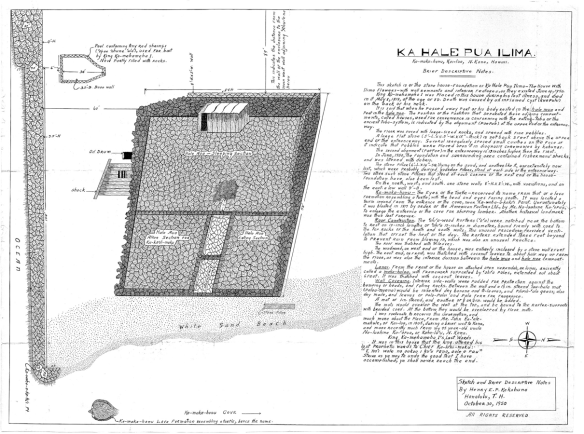
More maps! Check out the awesome detailed work of Henry E. P. Kekahuna, 1900s.

Henry Enoka Palenapa Kekahuna, 1881-1969

Bernice Pauahi Bishop Museum

Henry Kekahuna

Henry E.P. Kekahuna was a valued contributor to Bishop Museum’s records of traditional Hawaiian culture over the many years he assisted anthropologist Kenneth P. Emory. He made detailed records of numerous archaeological sites on Hawai‘i Island for the Museum and the National Park Service, and helped gather local lore from older Hawaiians. (Read on…)

More maps from the University of Hawaii at Manoa Library, 1540–1994.

Restored Maps from the Flood of 2004.

This is a collection of just a few of the many maps which were damaged by the flooding of Hamilton Library back in 2004 and which were subsequently cleaned and restored. They feature maps of the world including some of Hawaii nei.

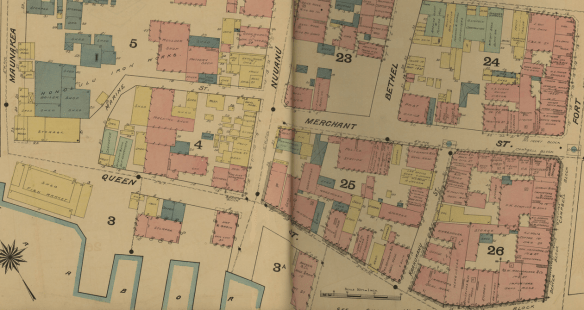
Maps, courtesy of the University of Hawaii at Manoa Library, 1891–1906.

Dakin Fire Insurance Maps

Here are more helpful digital images put up by the University of Hawaii at Manoa Library System! They are fire insurance maps done at the turn of the century, and give you a better picture of what the streets of Honolulu looked like back then.

[It would be ideal if these maps could be unbound so that clearer images of the entire area could be made, not unlike the bound newspapers that i keep talking about…]

New blog from the folks who bring the Hawaii newspapers to Chronicling America, 2013.

HDNP

I just came across this new (as of summer 2013) blog from the Hawaii Digital Newspaper Project. They are the ones who take care of the Hawaii newspapers on Chronicling America. On the blog are posts about the progress of the project itself, as well as random articles from the English-language newspapers. I am looking forward to see what they find in the future about the past!

The Ninth Independence Day, 1852.

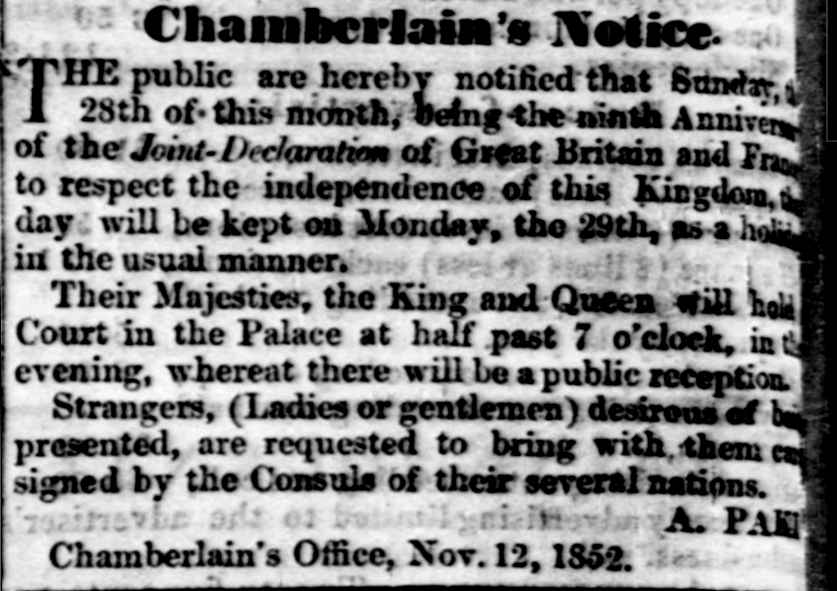
Chamberlain’s Notice.

The public are hereby notified that Sunday, the 28th of this month, being the ninth Anniversary of the Joint-Declaration of Great Britain and France to respect the independence of this Kingdom, the day will be kept on Monday, the 29th, as a holiday in the usual manner.

Their Majesties, the King and Queen will hold Court in the Palace at half past 7 o’clock, in the evening, whereat there will be a public reception.

Strangers, (Ladies or gentlemen) desirous of being presented, are requested to bring with them cards signed by the Consuls of their several nations.

A. PAKI

Chamberlain’s Office, Nov. 12, 1852.

[The 9th anniversary of La Kuokoa was celebrated under the reign of King Kamehameha III, Kauikeaouli and Queen Kapakuhaili.]

(Polynesian, 11/20/1852, p. 110)

Chamberlain's Notice.

The Polynesian, Volume 9, Number 28, Page 110. November 20, 1852.

La Kuokoa information and more… 1700–1999.

For those of you interested, i came across this British Newspaper Archive site. It is unfortunately not free access. But if you want to know what their newspapers were saying about Haalilio and Richards and Paulet and Charlton as it all was going down (or other events that occurred between 1700–1999), it might be worth paying the subscription. Here for example there seem to be some four-thousand articles in the 1840s found using the search term “Sandwich Islands”:

http://www.britishnewspaperarchive.co.uk/search/results/1840-01-01/1849-12-31?basicsearch=sandwich%20islands&exactsearch=false&page=0

And for the same period, there are five hits for “Haalilio”:

http://www.britishnewspaperarchive.co.uk/search/results/1840-01-01/1849-12-31?basicsearch=haalilio&exactsearch=false

[Being that it is a pay for view site, i don’t believe that i would be able to repost articles found there even if i spent the money for a subscription myself…]