Unknown's avatar

About nupepa

Just another place that posts random articles from the Hawaiian Newspapers! It would be awesome if this should become a space where open discussions happen on all topics written about in those papers!! And please note that these are definitely not polished translations, but are just drafts!!! [This blog is not affiliated with any organization and receives no funding. Statements made here should in now way be seen as a reflection on other organizations or people. All errors in interpretation are my own.]

Vital Statistics, 1912.

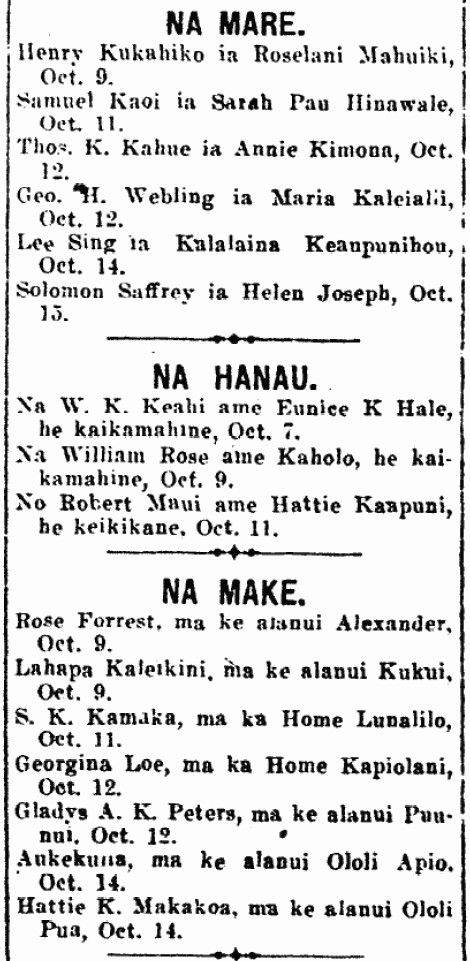
MARRIAGES.

Henry Kukahiko to Roselani Mahuiki, Oct. 9.
Samuel Kaoi to Sarah Pau Hinawale, Oct. 11.
Thomas K. Kahue to Annie Kimona, Oct. 12.
George H. Webling to Maria Kaleialii, Oct. 12.
Lee Sing to Kalalaina Keaupunihou, Oct. 14.
Solomon Saffrey to Helen Joseph, Oct. 15.

BIRTHS.

To W. K. Keahi and Eunice K. Hale, a daughter, Oct. 7.
To William Rose and Kaholo, a daughter, Oct. 9.
To Robert Maui and Hattie Kaapuni, a son, Oct. 11.

DEATHS.

Rose Forrest, on Alexander Street, Oct. 9.
Lahapa Kaleikini, on Kukui Street, Oct. 9.
S. K. Kamaka, at Lunalilo Home, Oct. 11.
Georgina Loe, at Kapiolani Home, Oct. 12.
Gladys A. K. Peters, on Puunui Street, Oct. 12.
Aukekuna [Aukekulia ?], on Apio Lane, Oct. 14.
Hattie K. Makakoa, on Pua Lane, Oct. 14.

(Kuokoa, Oct. 18, 1912, p. 8)

NA MARE. / NA HANAU. / NA MAKE.

Ka Nupepa Kuokoa, Buke XLVIII, Helu 42, Aoao 8. Okatoba 18, 1912.

Mele by Ninito Sumner and Manaiula Sumner for Victoria Kaahumanu, 1862.

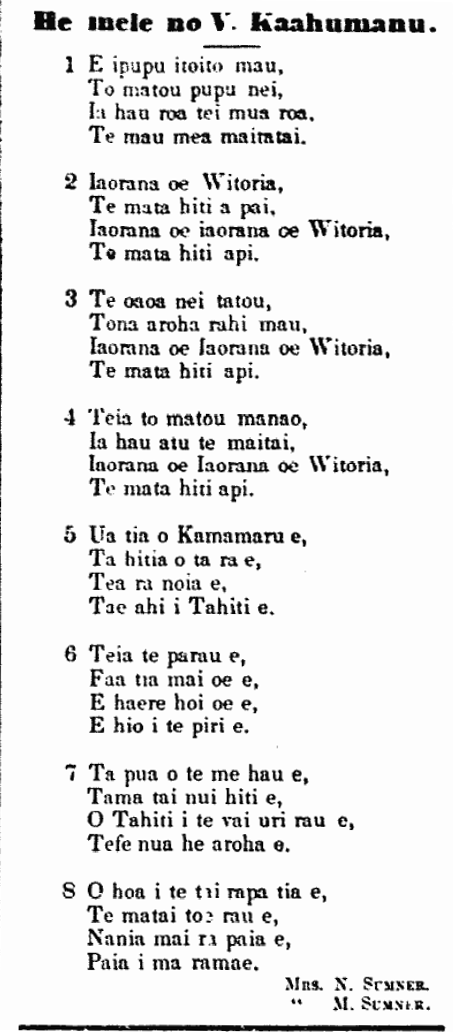
A mele for V. Kaahumanu.

1. E ipupu itoito mau,
To matou pupu nei,
Ia hau roa tei mua roa,
Te mau mea maitatai.

2. Iaorana oe Witoria,
Te mata hiti a pai,
Iaorana oe iaorana oe Witoria,
Te mata hiti api.

3. Te oaoa nei tatou,
Tona aroha rahi mau,
Iaorana oe Iaorana oe Witoria,
Te mata hiti api.

4. Teia to matou  manao,
Ia hau atu te maitai,
Iaorana oe Iaorana oe Witoria,
Te mata hiti api.

5. Ua tia o Kamamaru e,
Ta hitia o ta ra e,
Tea ra noia e,
Tae ahi i Tahiti e.

6. Teia te parau e,
Faa tia mai oe e,
E haere hoi oe e,
E hio i te piri e.

7. Ta pua o te me hau e,
Tama tai nui hiti e,
O Tahiti i te vai uri rau e,
Tefe nua he aroha e.

8. O hoa i te tai rapa tia e,
Te matai toe rau e,
Nania mai ra paia e,
Paia i ma ramae.

Mrs. N. Sumner.

” M. Sumner.

[Can anyone supply a translation for this mele?]

(Kuokoa, 1/25/1862, p. 3)

He mele no V. Kaahumanu.

Ka Nupepa Kuokoa, Buke I, Helu 9, Aoao 3. Ianuari 25, 1862.

Hugo Kawelo, sent to Glasgow to study, returns, 1886.

HAWAIIAN YOUTH RETURNS.

On the ship that brought the Portuguese laborers, Mr. Hugo Kawelo, one of the youths sent to Scotland [Sekotia] to seek education by working [unclear word] in an iron works factory. Because of sickness, he returned, but when he arrived back, he was the epitome of a robust and vigorous man. It was as if the air of the open ocean brought him back to health. He wishes to return to complete his education in the iron [unclear word] industry, should his health be good.

[Hugo Kawelo is one of the select Hawaiians sent abroad by Kalakaua to study and to bring back this knowledge to move Hawaii forward. For more on this program, see for instance: Agnes Quigg’s “Kalakaua’s Hawaiian Studies Abroad Program” from the Hawaiian Journal of History.

Here is one another example of a badly imaged newspaper. I guessed the meaning of some of the passage.

One of our readers, Lynda Fitzgerald, asked who can be contacted to get the original Hawaiian-Language Newspapers reshot clearly. I don’t have a specific name, but the more people that know how important this is, the more likely it will be done. So talk to your friends and coworkers and heads of boards and kumu hula and civic club officers and the aunty down the street. Why do you think seeing all of this information clearly is important…]

(Nupepa Elele, 3/6/1886, p. 2)

HAWAII OPIO UA HOI MAI.

Ka Nupepa Elele, Buke VII, Helu 36, Aoao 2. Maraki 6, 1886.

Princess Kaiulani born, 1875.

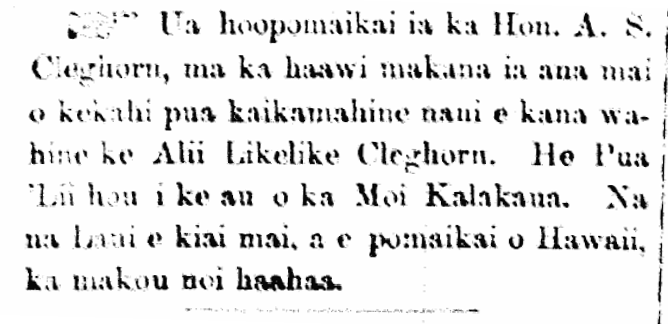
The Hon. A. S. Cleghorn was blessed with being gifted with a beautiful baby girl by his wife, the Alii Likelike Cleghorn. This is a new Royal Offspring in the era of King Kalakaua. That the Heavens watch over and bless Hawaii is our humble plea.

(Lahui Hawaii, 10/23/1875, p. 3)

Ua hoopomaikai ia ka Hon. A. S. Cleghorn...

Ka Lahui Hawaii, Buke I, helu 43, Aoao 3. Okatoba 23, 1875.

I hope people are getting a clearer picture of all that is available in the Hawaiian-Language Newspapers, 2012.

It has been a year already since the first post was put up on this blog. I hope that you have learned something new and maybe your appreciation of the Hawaiian-Language Newspapers has grown.

Hopefully by now you can see how important all of the information in their pages are—information that oftentimes are not available anywhere else. And therefore i take this opportunity once again to say that the newspapers deserve to be reshot clearly so that we don’t have to guess at what was being said!

Always important to look at sources. 1893 / 2012.

HAWAII ESCAPES FROM JAPAN.

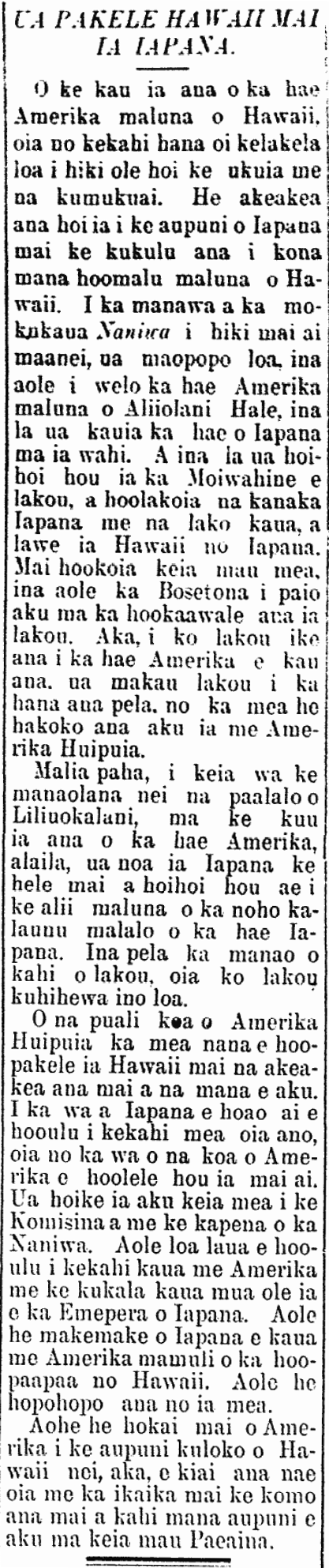
The raising of the American flag over Hawaii is one of the greatest things done that cannot be repaid. It blocks the nation of Japan from establishing its rule over Hawaii. When the warship Naniwa arrived here, it was clear that if the American flag was not waving over Aliiolani Hale, then the Japanese flag would have been put in its place. And then they would have returned the Queen and the Japanese would have been supplied with weapons and took Hawaii for Japan. It all would have happened if the Boston did not hold them off. But when they saw the American flag raised, they were afraid to do this, for it would be fighting with the United States of America.

Perhaps now Liliuokalani’s attendants are hoping that by the taking down of the American flag, the Japanese will be free to come and return the alii to the throne under the Japanese flag. Should that be the thought of some of them, they are gravely mistaken.

The American troops will save Hawaii from the interference by the other powers. When Japan tries to foment something of that sort, that will be when the soldiers of America will be deployed again. This has been announced to the Commissioner and the captain of the Naniwa. They will not start a war with America without it being proclaimed in advance by the Emperor of Japan. Japan has no desire to war against America because of the dispute over Hawaii. There is nothing to fear.

America will not interfere in the local government of Hawaii nei, however it will guard Hawaii with force against the entering of other national powers into this Archipelago.

[It is always important to look at what newspaper an article comes from. Also, long-running newspapers (and people for that matter) don’t necessarily keep their same ideologies throughout their entire life…]

(Kuokoa, 4/8/1893, p. 2)

UA PAKELE HAWAII MAI IA IAPANA.

Ka Nupepa Kuokoa, Buke XXXII, Helu 14, Aoao 2. Aperila 8, 1893.

Deer of Kamehameha V., 1867.

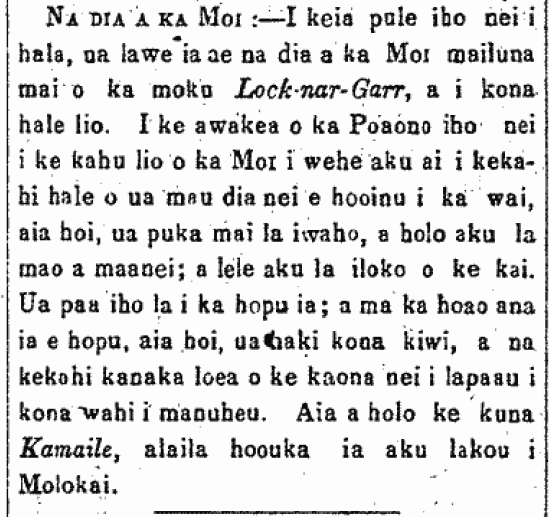
The King’s Deer:—This last week, the King’s deer were taken aboard the ship Lock-nar-Garr [Lochnagar ?] to his stables. At midday on this past Saturday, when the King’s stableman opened a stall where the deer were kept to give them water, come to find out, they got out and ran here and there and jumped into the ocean. They were caught; but while they were being caught, its antler was broken, and someone skilled from town tended to its injury. When the schooner Kamaile sails, they will be taken to Molokai.

(Au Okoa, 12/26/1867, p. 2)

Na dia a ka Moi...

Ke Au Okoa, Buke III, Helu 36, Aoao 2. Dekemaba 26, 1867.

Board of Health and leprosy, 1906.

A HAWAIIAN WOMAN HIDDEN AWAY.

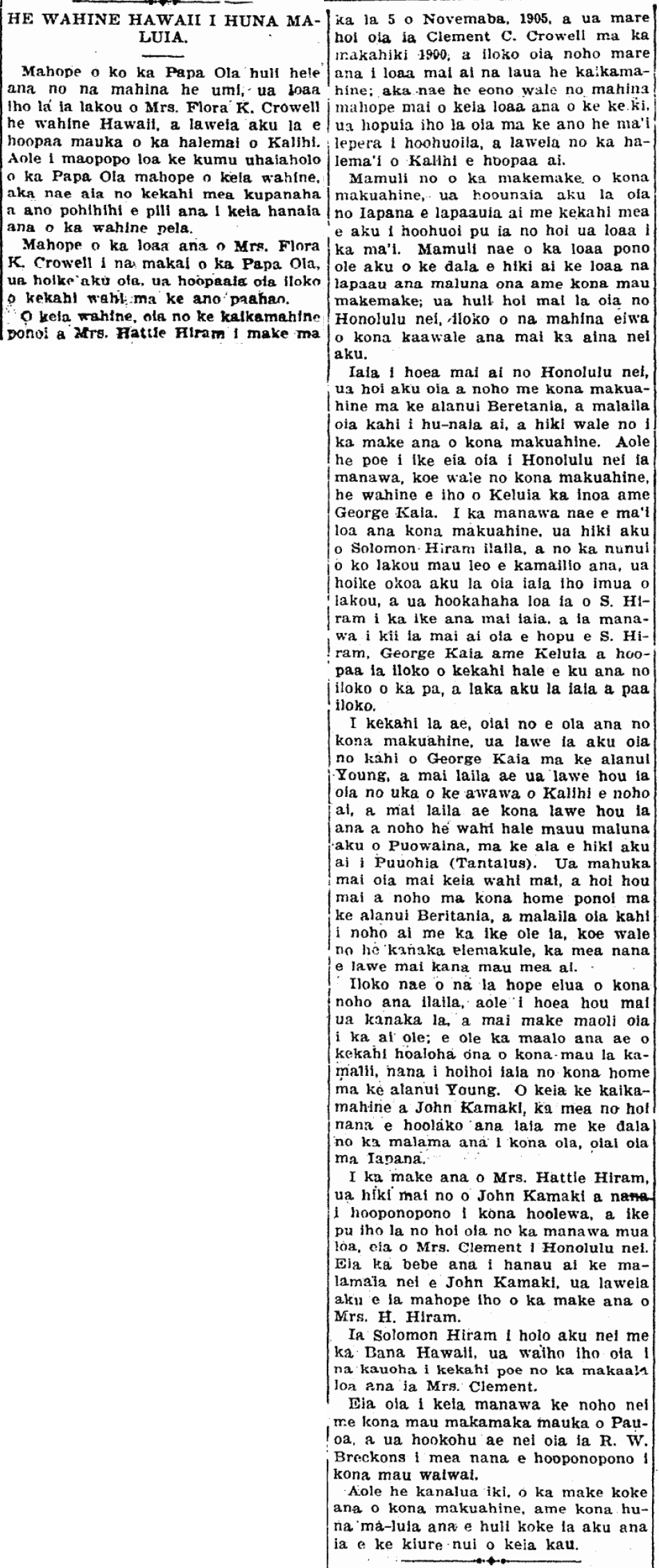
After the Board of Health [Papa Ola] searched for ten months, they found Mrs. Flora K. Crowell, a Hawaiian woman, and she was taken and detained mauka of the Kalihi Hospital. It is not clear why the Board of Health chased after that woman, but there is something astonishing and unclear about what was done to this woman.

After Mrs. Flora K. Crowell was found by the officers of the Board of Health, she said she was locked away like a prisoner.

This wahine is the birth daughter of Mrs. Hattie Hiram who died on the 5th of November 1905, and she married Clement C. Crowell in the year 1900, and by this marriage the two of them had a daughter; but just six months after they had the girl, she [Flora Crowell] was suspected of having leprosy and taken away to be held at the Kalihi Hospital.

According to the wishes of her mother [Hattie Hiram], she was sent to Japan to be treated along with others who were suspected of having the illness. Being that she did not have the funds to be treated and per her wishes, she came back to Honolulu nei after nine months of being away from here.

When she arrived in Honolulu, she went to live with her mother on Beritania Street, and she was hidden there until the death of her mother. There was no one who knew she was here in Honolulu at the time, except her mother along with another woman named Keluia and George Kaia. However, when her mother was extremely ill, Solomon Hiram came, and because they were speaking so loudly, he showed himself before them; S. Hiram was shocked at seeing her; and it was then that she was subdued by S. Hiram along with George Kaia and Keluia and detained in a building on the grounds, and she was locked inside.

A few days later, while her mother was still alive, she [Flora Crowell] was taken to the place of George Kaia on Young Street, and from there she was then taken to the uplands of Kalihi Valley to live, and from there she was taken to a grass house atop Puowaina, on the road that goes up to Puuohia (Tantalus). She escaped from this place and returned to live at her own home on Beritania Street, and it was there she lived unbeknownst to others, all except an old man who brought her food.

But during her last two days there, that man did not come back, and she almost starved for lack of food; it was only because of the passing by of one of her friends from her youth, that she was brought to that friend’s home on Young Street. This was the daughter of John Kamaki, the one who gave Flora Crowell money to care for herself while in Japan.

At the death of Mrs. Hattie Hiram, John Kamaki came and took care of her funeral, and saw for the first time that here was Mrs. Clement in Honolulu nei. Her baby was being cared for by John Kamaki, who took her after the death of Mrs. H. Hiram.

When Solomon Hiram just left with the Royal Hawaiian Band [Bana Hawaii], he left instructions for some people to keep good watch over Mrs. Clement.

She is now living with her friends mauka of Pauoa, and she has chosen R. W. Breckons as the executor of her estate.

There is no doubt, the quick death of her mother and her being hidden away, will be investigated immediately by the grand jury of this session.

(Kuokoa, 11/2/1906, p. 8)

HE WAHINE HAWAII I HUNA MA-LUIA.

Ka Nupepa Kuokoa, Buke XLV, Helu 44, Aoao 8. Novemaba 2, 1906.

I scream, you scream? 1867.

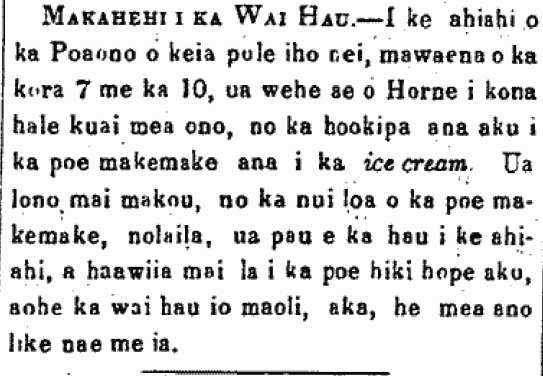
Amazement at the Wai Hau.—On the evening of this past Saturday, between the hours of 7 and 10, Horne [Horn] opened up his sweets shop to welcome those who wanted ice cream. We hear that because of the great number of people interested, all the ice cream was gone that evening and those that came after were given something that was not actually ice cream, but something similar.

[Here’s an advertisement for this shop much later in Thrum’s Annual for 1886, but we see that the establishment was opened in 1863!]

(Au Okoa, 9/26/1867, p. 2)

Makahehi i ka Wai Hau.

Ke Au Okoa, Buke III, Helu 23, Aoao 2. Sepatemaba 26, 1867.