Unknown's avatar

About nupepa

Just another place that posts random articles from the Hawaiian Newspapers! It would be awesome if this should become a space where open discussions happen on all topics written about in those papers!! And please note that these are definitely not polished translations, but are just drafts!!! [This blog is not affiliated with any organization and receives no funding. Statements made here should in now way be seen as a reflection on other organizations or people. All errors in interpretation are my own.]

Unknown newspaper begins, 1872.

[Found under: “Local News: Oahu.”]

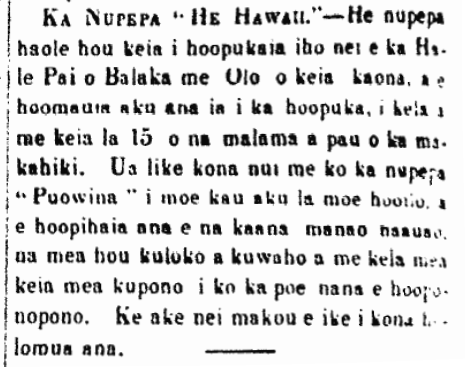
The Newspaper “He Hawaii.” [The Hawaiian]—This is a new haole newspaper just published by the Printers of Black and Auld of this town, and it will continue to be published on the 15th of every month throughout the year. It is the same size as “Puowina” [Punchbowl], which rests the eternal rest; and it will be full of intelligent offerings, foreign and domestic news, and other matter found fit by the editors. We hope to see it progress.

[Although there are extant copies of “Punchbowl” held by the Hawaiian Historical Society, it seems that there are no surviving copies of “The Hawaiian”.]

(Kuokoa, 1/27/1872, p. 2)

Ka Nupepa "He Hawaii."

Ka Nupepa Kuokoa, Buke XI, Helu 4, Aoao 2. Ianuari 27, 1872.

Royal Order of Kamehameha: the early days, 1903.

The Secret Society of the True Natives.

On the 11th of this month, on the day of Ka Na’i Aupuni [Kamehameha Day], a number of native youths established a secret society called “Kamehameha Order”. There are many respected Hawaiians who joined this association, and Prince Kalanianaole is the head of this group.

It is stated that this association will be spread across this Archipelago, and native Hawaiians will be allowed to join, should they be fitting.

One of their major functions will be trying to search out and to care for things from times of old, and the designating of the storied places [wahi pana] all over these islands.

Currently, there is a Historical Society [Ahahui Moolelo o ke Au Kahiko]¹, and they have a lot, but the oiwi Hawaii themselves must do something so that the famed ones of times past will live on, and also to foster things that will let the name of Hawaii live on in perpetuity.

¹The roster of active members of the Hawaiian Historical Society of 1903 read:

“Ables, L. C.; Achi, W. C.; Alexander, S. T.; Alexander, W. D.; Allen, S. C.; Allen, W. F.; Baldwin, H. P.; Banning, B. R.; Beckwith, Rev. E. G.; Beckwith, Miss Martha; Bertram, Bro. G.; Bishop, Rev. S. E.; Bolte, C.; Bowen, W. A.; Boyd, J. H.; Brown, Cecil; Brown, C. A.; Bryan, Wm. A.; Carter, A. W.; Carter, G. R.; Carter, Mrs. H. A. P.; Carter, J. O.; Cartwright, Bruce; Castle, G. P.; Castle, J. B.; Castle, W. R.; Catton, R.; Cooke, A. F.; Cooke, C. M.; Cooke, Jos. P.; Cunha, E. S.; Damon, F. W.; Damon, S. M.; Day, Dr. F. R.; Dayton, D.; Desha, G. L.; Dickey, C. H.; Dickey, L. A.; Dillingham, B. F.; *Dimond, W. W.; Dole, E. P.; Dole, Hon. S. B.; Dowsett, J. M.; Emerson, J. S.; Emerson, Mrs. J. S.; Emerson, Dr. N. B.; Emerson, Rev. O. P.; Emmeluth, J.; Fisher, J. H.; Frear, Hon. W. F.; Giffard, W. M.; Goodale, W. W.; Graham, W. M.; Haalelea, Mrs. A. A.; Hackfeld, J. F.; Hall, W. W.; Hartwell, A. S.; Hatch, F. M.; Henriques, E.; Herrick, C. F.; Hobron, T. W.; Ho Fon; Humphreys, A. S.; Hustace, C.; Irwin, W. G.; Jones, P. C.; Judd, Albert F.; Lewers, Robert; Logan, D.; Lowrey, F. J.; Lucas, George; Lyle, James; Lyons, C. J.; Mclanahan, E. B.; McGonagle, Chas.; McIntyre, H. E.; Mackintosh, Rev. A.; Magoon, J. A.; May, Thos.; Mott-Smith, E. A.; Nakuina, M. K.; Nolte, H. J.; Parke, W. C.; Peacock, W. C.; Pearson, Arthur W.; Pond, Percy M.; Potter, Geo. C.; Rhodes, C. L.; Robinson, M. P.; Rodgers, Dr. C. T.; *Ropert, Rev. F. G., Bishop of Panopolis; Rowell, W. E.; Schaefer, F. A.; Schmidt, H. W.; Searle, J. C.; Sedgwick, T. F.; Smith, G. W.; Smith, Henry; Smith, Walter G.; Smith, W. O.; Stokes, John; Swanzy, F. M.; Timmons, L. D.; Towse, Ed.; Thrum, T. G.; Thurston, L. A.; von Holt, H.; Walker, T. R.; Wall, W. E.; Waterhouse, H.; Weaver, P. L.; Westervelt, Rev. W. D.; Whiting, W. A.; Whitney, Dr. J. M.; Wichman, H. F.; Wilcox, A. S.; Wilcox, C.; Wilcox, G. N.; Williams, H. H.; Wilson, W. F.; Wodehouse, E. H.; Wood, Dr. C. B.; Wood, Edgar; Wundenberg, F.
*Deceased.

(Kuokoa, 6/26/1903, p. 1)
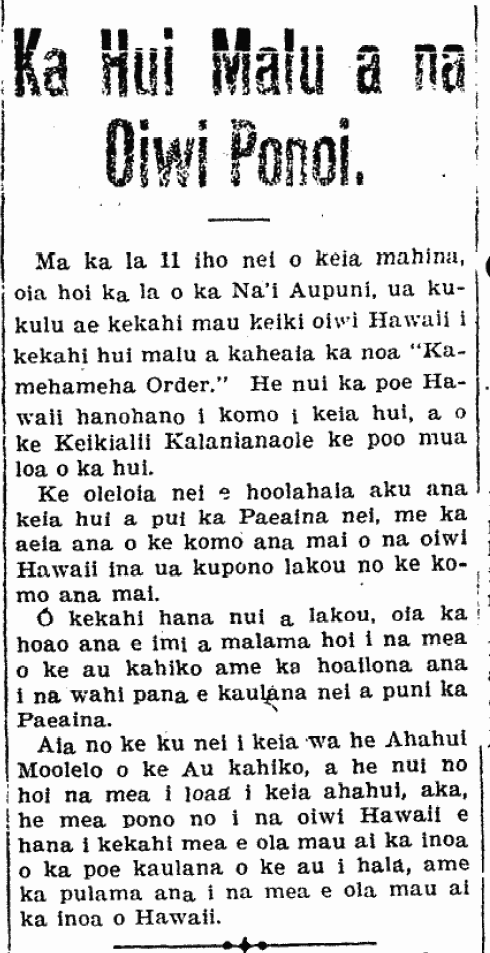
Ka Hui Malu o na Oiwi Ponoi.

Ka Nupepa Kuokoa, Buke XLI, Helu 26, Aoao 1. Iune 26, 1903.

Display of power by the American battleship, 1893.

THE PARADING

OF THE
American Battleship Soldiers.

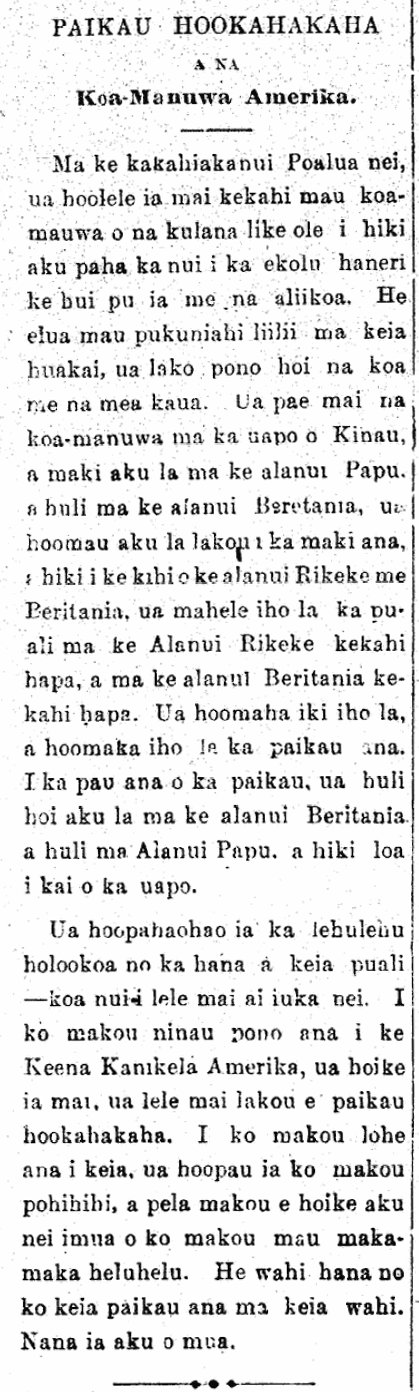
In the early morning of this Tuesday, some of the soldiers of all ranks from the warship were sent ashore, perhaps numbering three hundred when combined with the officers. There were two small cannons in this parade, and the soldiers were armed with weapons. The soldiers from the battleship landed at Kinau Wharf [uapo o Kinau], and marched on Fort Street and turned on Beritania where they continued marching until Richards and Beritania; the troops divided: some travelled on Richards Street and some on Beritania Street. They rested for a while, and then proceeded to drill. After drilling, they went back on Beritania Street and turned on Fort, until reaching the wharf.

Everyone was left puzzled by this action of the great number of the troops who came to shore. When we asked the Office of the American Consul directly, we were told that they landed to parade. When we heard this, our confusion was cleared, and so we report to our reader friends. The drilling here is part of their job. Let’s see what happens in the future.

(Leo o ka Lahui, 10/25/1893, p. 3)

PAIKAU HOOKAHAKAHA

Ka Leo o ka Lahui, Buke II, Helu 798, Aoao 3. Okatoba 25, 1893.

Japanese swarming like bees, 1893.

THE STEAMER MIIKE MARU AND THE JAPANESE LABORERS.

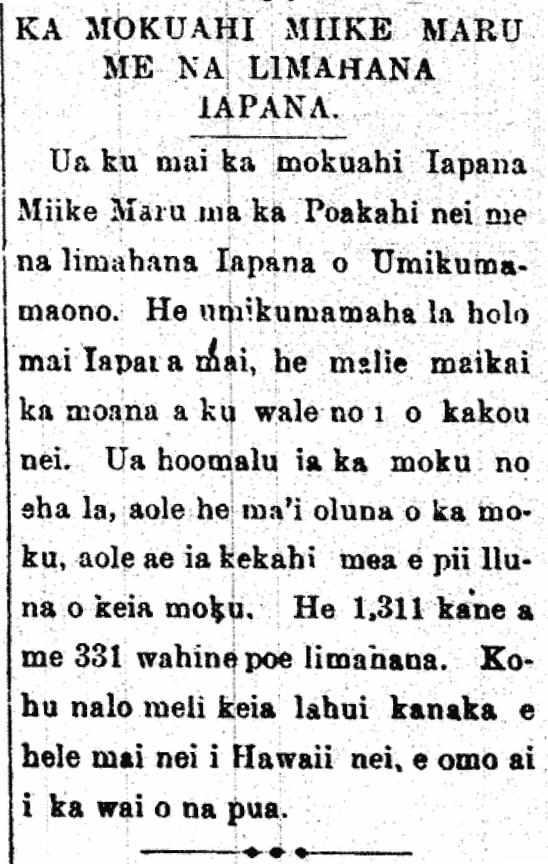
The Japanese Steamship Miike Maru docked this Monday with the Sixteenth [group of] Japanese laborers. It travelled fourteen days from Japan, and it was smooth sailing until arriving amongst us. The ship was quarantined for four days, and there were no sick aboard the ship and no one was allowed aboard. There are 1,311 men and 331 women laborers. These people are like honey bees coming to Hawaii, sucking from the nectar of the flowers.

(Leo o ka Lahui, 10/25/1893, p. 2)

KA MOKUAHI MIIKE MARU ME NA LIMAHANA IAPANA.

Ka Leo o ka Lahui, Buke II, Helu 798, Aoao 2. Okatoba 25, 1893.

Workings of the Provisional Government, 1893.

INDEPENDENCE DAY OF THE PORTUGUESE.

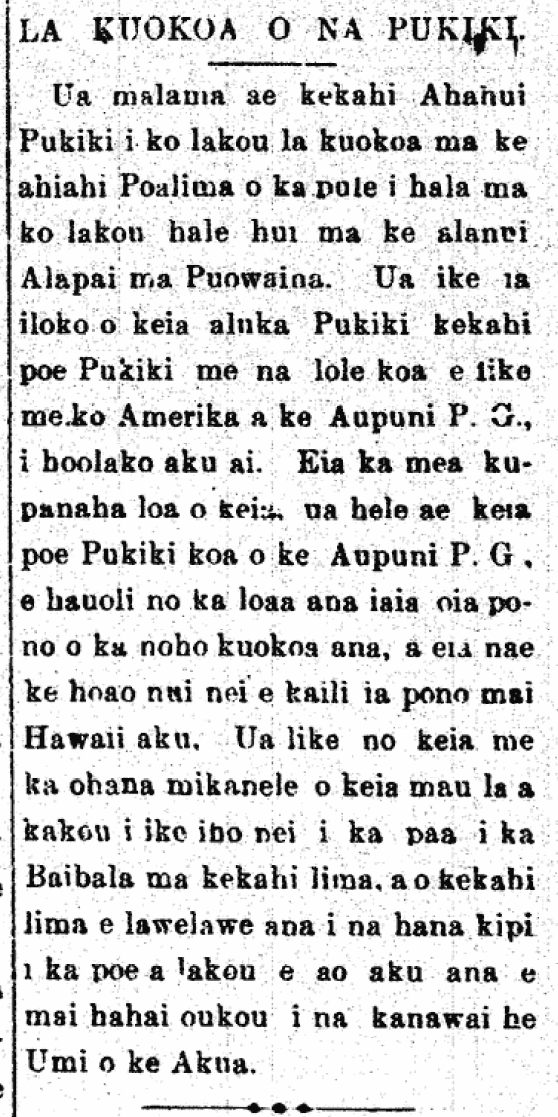
An Association of the Portuguese honored their independence day on the evening of Friday last week, in their club house on the streets of Alapai and Punchbowl [Puowaina]. Amongst this group of Portuguese were seen some with soldier uniforms like that of the Americans that were supplied by the P. G. This is the astonishing thing about this: these Portuguese soldiers of the Government of the P. G. went to celebrate their independence, and yet they are insistently trying to wrench that right from Hawaii. This is like the missionary family of these days who we’ve seen holding the Bible in one hand while with the other hand, carrying out treachery to the people to whom they taught not to break the Ten laws of God.

(Leo o ka Lahui, 12/4/1893, p. 2)

LA KUOKOA O NA PUKIKI.

Ka Leo o ka Lahui, Buke II, Helu 826, Aoao 2. Dekemaba 4, 1893.

And more on the Maori, 1920.

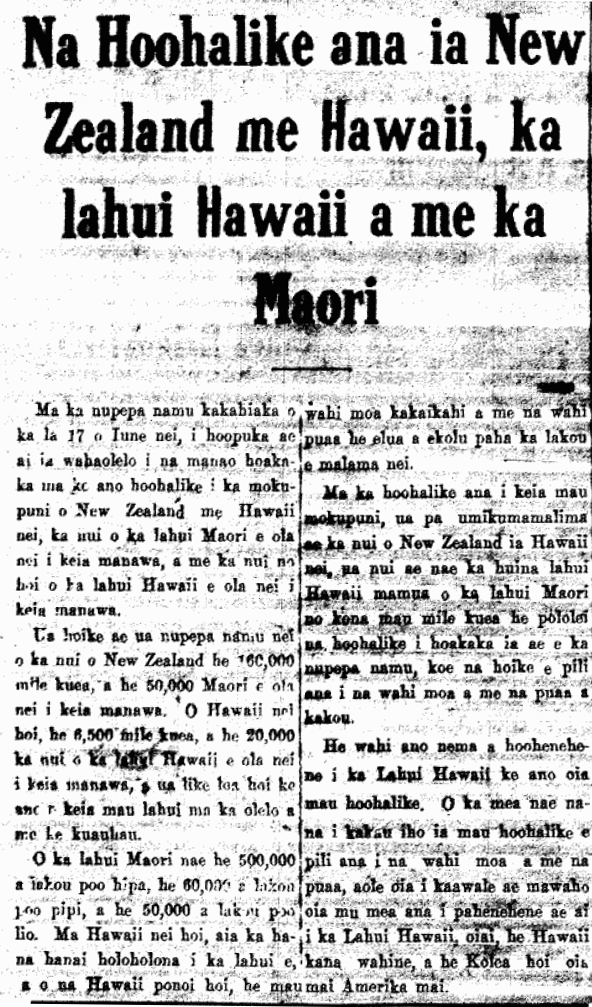
Comparison of New Zealand and Hawaii, the Hawaiian People and the Maori.

In the English morning newspaper [Pacific Commercial Advertiser] of the 17th of June, that mouthpiece published a clarification between the island of New Zealand and Hawaii, the population of the Maori lahui living today and that of the Hawaiian lahui.

That English paper said the area of New Zealand is 160,000 square miles, and that there are 50,00 Maori living today. As for Hawaii, it is 6,500 square miles, and there are 20,000 of its lahui living currently; and these two people are very much alike in language and genealogy.

However, the Maori have 500,000 heads of sheep, 60,000 heads of cattle, and 50,000 heads of horses. In Hawaii nei, the job of raising livestock is left to the other ethnicities, and the Hawaiians themselves, they raise a few chickens and a couple or three pigs.

In comparing these islands, New Zealand is fifteen times as big as Hawaii nei, but the total Hawaiians are more than the Maori per square miles; the comparisons put forth by the English paper are correct, all but what was said about our few chickens and pigs.

That comparison criticizes  and ridicules the Hawaiian people. But the one who wrote these comparisons pertaining to the chickens and pigs is not far from these things of which he mocks the Hawaiian people about, for his wife is a Hawaiian, and he is a Kolea bird¹ from America.

¹The kolea is the migrating plover, that is used to symbolize people who come to Hawaii, and like these birds, feed off of the riches only to leave after getting fat.

[I will have to check on who the writer was. Too bad the Advertiser is not online!]

(Aloha Aina, 7/4/1920, p. 4)

Na Hoohalike ana ia New Zealand me Hawaii, ka lahui Hawaii a me ka Maori

Ke Aloha Aina, Buke XXXX, Helu 43, Aoao 4. July 3, 1920.

More on Maori visit, 1920.

[Found under: “On The Other Islands”]

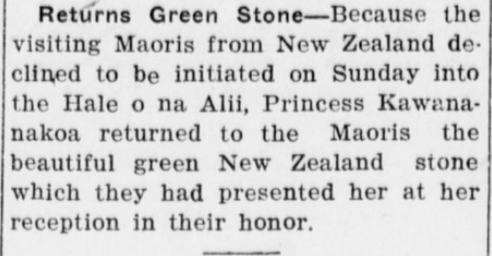
Returns Green Stone—Because the visiting Maoris from New Zealand declined to be initiated on Sunday into the Hale o na Alii, Princess Kawananakoa returned to the Maoris the beautiful green New Zealand stone which they had presented her at her reception in their honor.

(Maui News, 7/2/1920, p. 6)

Returns Green Stone

The Maui News. 21st Year, Number 1059, Page 6. July 2, 1920.

Maori visit Hawaii, 1920.

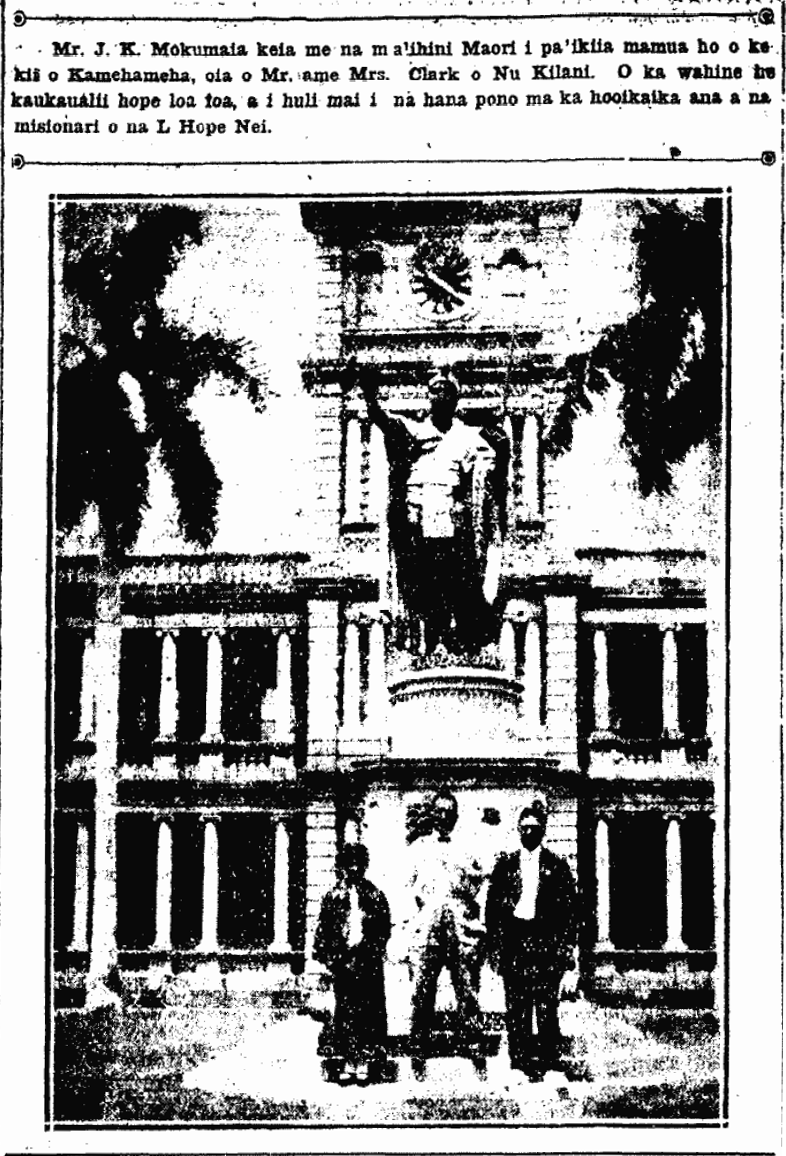
This is Mr. J. K. Mokumaia with the Maori malihini, photographed before the statue of Kamehameha; they are Mr. and Mrs. Clark of New Zealand. The woman is the last kaukau alii [kaukaualii hope loa ??], and they came to do good works by strengthening the missionaries of the Latter Day.

[The text is pretty clear, but during the last decades of the newspapers, you will notice more and more typos, as you can see here.

If the newspapers were reshot clearly, the image would no doubt be much more crisp.]

(Kuokoa, 7/9/1920, p. 3)

Mr. J. K. Mokumaia keia...

Ka Nupepa Kuokoa, Buke LVIII, Helu 28, Aoao 3. Iulai 9, 1920.

Another mountain-climbing mele for Emalani, 1871.

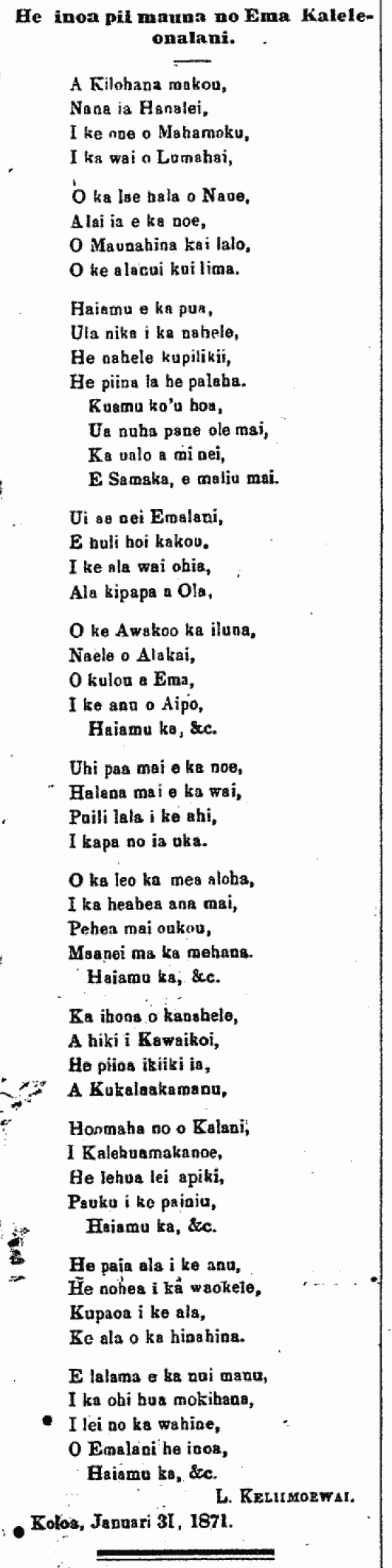
A mountain-climbing name song for Ema Kaleleonalani.

A Kilohana makou,
Nana ia Hanalei,
I ke one o Mahamoku,
I ka wai o Lumahai,

O ka lae hala o Naue,
Alai ia e ka noe,
O Maunahina kai lalo,
O ke alanui kui lima.

Haiamu e ka pua,
Ula nika i ka nahele,
He nahele kupilikii,
He piina la he palaha.
Kuamu ko’u hoa,
Ua nuha pane ole mai,
Ka ualo a mi nei,
E Samaka, e maliu mai.

Ui ae nei Emalani,
E huli hoi kakou,
O ke ala wai ohia,
Ala kipapa a Ola,

O ke Awakoo ka iluna,
Naele o Alakai,
O kulou a Ema,
I ke anu o Aipo,
Haiamu ka, &c.

Uhi paa mai e ka noe,
Halana mai e ka wai,
Puili lala i ke ahi,
I kapa no ia uka.

O ka leo ka mea aloha,
I ka heahea ana mai,
Pehea mai oukou,
Maanei ma ka mehana.
Haiamu ka, &c.

Ka ihona o kanahele,
A hiki i Kawaikoi,
He piina ikiiki ia,
A kukalaakamanu,

Hoomaha no o Kalani,
I Kalehuamakanoe,
He lehua lei apiki,
Pauku i ke painiu,
Haiamu ka, &c.

He paia ala i ke anu,
He nohea i ka waokele,
Kupaoa i ke ala,
Ke ala o ka hinahina.

E lalama e ka nui manu,
I ka ohi hua mokihana,
I lei no ka wahine,
O Emalani he inoa,
Haiamu ka, &c.

L. Keliimoewai.

Koloa, Januari 31, 1871.

[This is another mele honoring Queen Emma and her famous travels through Kauai. It seems the eight lines starting “Haiamu e ka pua” is repeated like a chorus after every two verses.

This seems to be a more “complete” version of the one printed in “He Lei no Emalani,” pp. 90–91.]

(Au Okoa, 2/9/1871, p. 1)

He inoa pii mauna no Ema Kaleleonalani.

Ke Au Okoa, Buke VI, Helu 43, Aoao 1. Feberuari 9, 1871.