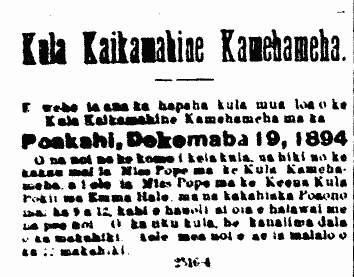
Hawaiian-Language advertisement for Kamehameha School for Girls, 1894.

Kamehameha Girls’ School

The first fourth of the Kamehameha Girls’ School will open on

Monday, December 19, 1894

For applications to enroll in this school, you can write to Miss Pope at Kamehameha School, or to Miss Pope in the Kindergarten Room at Emma Hale, on Saturday mornings from 9 to 12, where she will be happy to meet with the applicants. The tuition is fifty dollars  a year. No applicant below 12 years old will be accepted.

[As you can see, this was barely legible!

Hopefully new and clear images of these newspapers will be taken soon, before they fall apart. After they fall apart, it will be too late. Does anyone know of an organization/organizations that would appreciate the value of the information held in each fragile page, that would consider funding the re-shooting of the newspapers?]

(Kuokoa, 11/17/1894, p. 1)

Kula Kaikamahine Kamehameha.

Ka Nupepa Kuokoa, Buke XXXIII, Helu 46, Aoao 1. Novemaba 17, 1894.

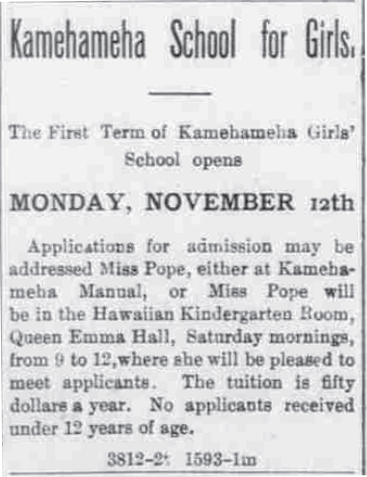
Kamehameha School for Girls advertisement, 1894.

Kamehameha School for Girls.

The First Term of Kamehameha Girls’ School opens

MONDAY, NOVEMBER 12th

Applications for admission may be addressed Miss Pope, either at Kamehameha Manual, or Miss Pope will be in the Hawaiian Kindergarten Room, Queen Emma Hall, Saturday mornings, from 9 to 12, where she will be pleased to meet applicants. The tuition is fifty dollars a year. No applicants received under 12 years of age.

[How things have changed!]

(Hawaiian Gazette, 10/23/1894, p. 6)

Kamehameha School for Girls.

The Hawaiian Gazette, Volume XXIX, Number 84, Page 6. October 23, 1894.

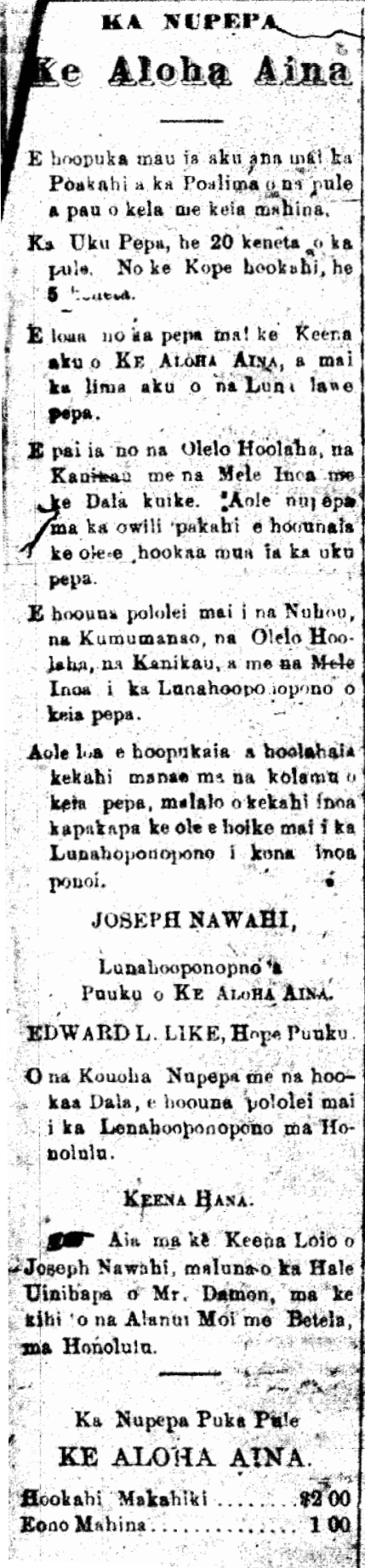
M. E. Silva’s Funeral Home, 1912.

NEW UNDERTAKING COMPANY.

On April 14th, Manuel Feli [Felip?] Aguan passed.

Mr. Loo [Lee?] Chong left this life on the 21st of April.

Mrs. Kanehailua left for the eternal world on the 3rd of November at Hamakua, Hawaii.

Therefore, bring in your donations of ten cents for the members of your Organizations who left this life, to my Business Office on Chaplain Lane, right behind Queen Emma Hall, between Nuuanu Avenue and Fort Street.

M. E. SILVA.

[This is the undertaking establishment of M. E. Silva mentioned in the previous post. See more on the interesting story of Manuel Enos Silva in “Men of Hawaii” (1917).

(Aloha Aina, 5/16/1912, p. 3)

HUI HOOLEWA HOU

Ke Aloha Aina, Buke XVI, Helu 20, Aoao 3. Mei 18, 1912.

Hawaiian Pine Advertisement, 1919.

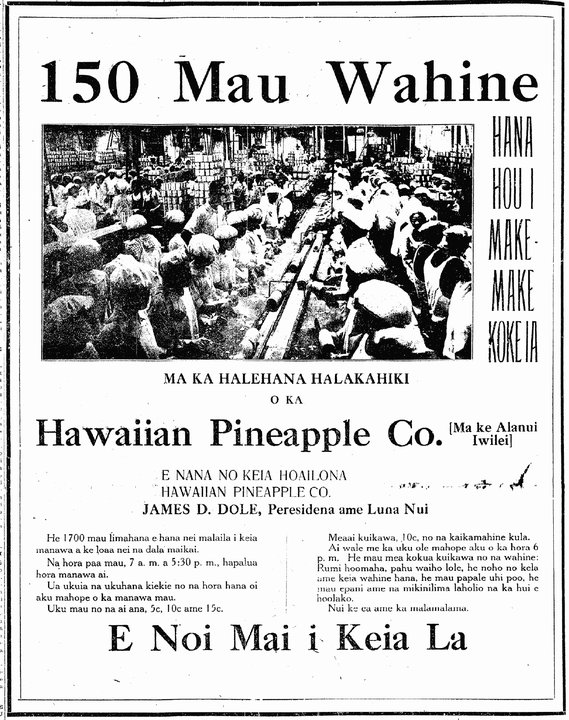
150 Women

NEW POSITIONS WANTED FILLED SOON

AT THE PINEAPPLE PLANT

OF

Hawaiian Pineapple Co. [On Iwilei Street]

LOOK FOR THIS SIGN

HAWAIIAN PINEAPPLE CO.

JAMES D. DOLE, President and Foreman

1700 workers are working there currently and are receiving good pay.

The set hours are 7 a. m. to 5:30 p. m. with half an hour food break.

High overtime pay is paid for work done over the regular hours.

Regular costs for food, 5¢, 10¢ and 15¢.

Snacks, 10¢ for school girls.

Food for free after 6 p. m. Special amenities for the women: Break room, lockers, seats for each working woman, head coverings, apron and rubber gloves supplied by the company.

There is much air and light.

Inquire Today

(Kuokoa, 7/18/1919, p. 2)

150 Mau Wahine

Ka Nupepa Kuokoa, Buke LVII, Helu 29, Aoao 2. Iulai 18, 1919.

Gravestone advertisement, 1882.

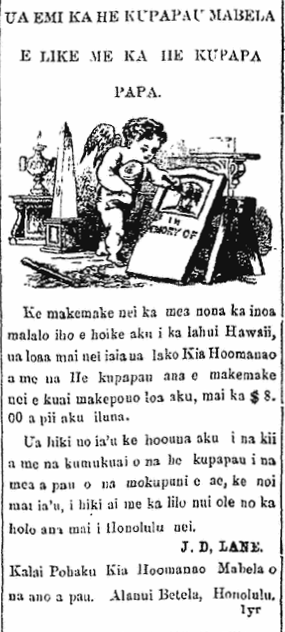
MARBLE HEADSTONES AT LOW COST

LIKE SLATE [PAPA?] HEADSTONES.

The person whose name appears at the bottom wishes to announce to the Hawaiian people that he has acquired material for Monuments and Tombstones which he wants to sell for a good price, from $8.00 up.

I can send images and prices of the tombstones to people on the other islands, should they ask me, so that it can be done without the large expense of travelling to Honolulu.

J. D. LANE.

Engraver of Marble Monuments of all types. Bethel Street, Honolulu.

(Ko Hawaii Pae Aina, 5/6/1882, p. 2)

UA EMI KA HE KUPAPAU MABELA

Ko Hawaii Pae Aina, Buke V, Helu 18, Aoao 2. Mei 6, 1882.

Two interesting testimonials appearing in the same issue, 1892.

VERIFICATION OF THE TRUTH.

Honolulu, April 4, 1892.

I hereby attest, I am the one whose name appears below; in order to verify the miraculous works of Mr. Marcus W. Lowell, and so that the public knows, he treated my wife in 1886 after she contracted the disease known as the sickness that separates families [ma’i hookaawale ohana]; he treated her and she got much better than with the doctors who treated her. She suffered for ten years from this sickness, and within a month, Mr. Lowell saved her because of his aloha he had for my wife during that time.

To attest to this, I place my name here.

John Kahikina Kelekona.

(Leo o ka Lahui, 4/8/1892, p. 2)

HE HOIKE AKU I KA OIAIO.

Ka Leo o ka Lahui, Buke II, Helu 428, Aoao 2. Aperila 8, 1892.

CURE FOR CANCER.

Honolulu, March 24, 1892.

I, George Campton, carpenter, have been a resident of these Islands for the last 14 years. In the last year 1891 I suffered from cancer in the leg, and through the advice of a friend I had Mr. Lowell to see it. I suffered the most excruciating pain and has confined to my bed for weeks, when Mr. Lowel saw me and told me he thought he could cure it, and to my utter astonishment, in one month from the time Mr. Lowell first saw it it was cured. It is now nearly three months since and has all the appearance of a complete cure. In three weeks from the time Mr. Lowell first saw me I was able to go about my dusiness. Any one desiring further information can call on me at 36 King St.

(Leo o ka Lahui, 4/8/1892, p. 4)

CURE FOR CANCER.

Ka Leo o ka Lahui, Buke II, Helu 428, Aoao 4. Aperila 8, 1892.

Crown Lands and Government Lands, 1896.

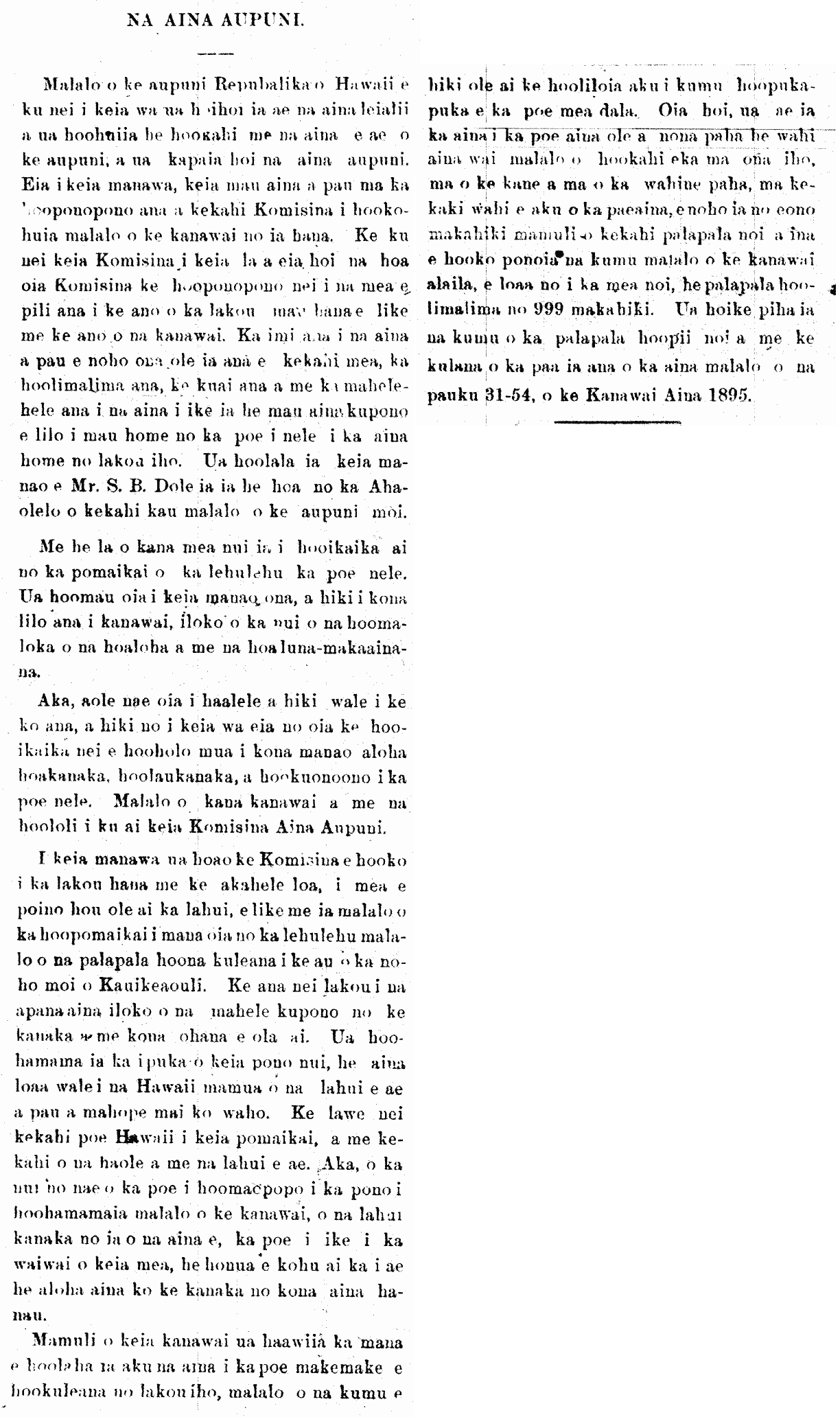
GOVERNMENT LANDS.

Under the Republic of Hawaii that stands now, the crown lands have been returned and added with the other lands of the government, and are referred to as government lands. Currently, the entirety of these lands are under the authority of a Commission appointed for that purpose under the law. The Commission is active today and its members are putting into order matters that pertain to their duties as per the laws. The finding of all lands that are not to be owned by someone, as well as the leasing, selling, and dividing of lands that are recognized as lands fitting to be homes for people without homesteads for themselves. This idea was devised by Mr. S. B. Dole while he was a member of the Legislature for a session under the monarchy.

It seems that this was what he focused on, for the good of those without. He kept at this idea until it became law, amidst much skepticism by friends and fellow representatives.

But he did not relent until he succeeded, and now he is working to move forward his loving idea for his fellow man, to increase, and to make prosperous, the poor people. Under his law and its revisions, this Government Lands Commission was created.

At this time, the Commission is trying to carefully carry out their duties so that the lahui will not once again be hurt like under the benefits intended for the masses with the quiet land titles in the time of Kauikeaouli’s rule. They are surveying parcels from areas suited for a man and his family to live. The doors to this great right is opened and Hawaiians will receive land before all other ethnicities and then thereafter those from the outside. There are some Hawaiians taking advantage of this opportunity, along with some haole and other ethnicities. But the majority of those that know of the good offered up by this law are the people of foreign lands, the ones who know the value of land for which one is able to say that he is patriotic to the land of his birth.

By this law, power is give to advertise land to those who claim land for themselves, under the condition that they cannot use it for profit. The land is available to those without land or those with wetlands of less than an acre under his name, or under the husband or wife in some other area of the archipelago; they will live on the land for six years after the request for land and should they meet the qualifications under the law, the applicant will receive a lease or 999 years. The requirements for the application and stipulations of the lease are shown in full in sections 31–54 of the Land Act of 1895.

[Just as it is today, it was back then. Different newspapers and sources had different stances. It is perhaps not best thing to base your opinions on a single article or the words of a single person. It is important to try and see all that was written and handed down in other ways (for ink and paper is not necessarily the best way that information is passed down), and then decide what you think on the subject…

Oh, and see here for the Land Act of 1895.]

(Oiaio Puka La, 4/3/1896, p. 2)
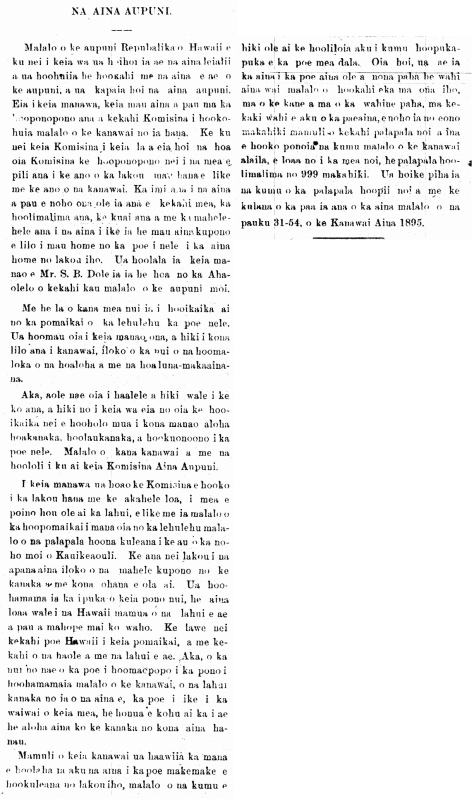
NA AINA AUPUNI.

Ka Oiaio Puka La, Buke I, Helu 67, Aoao 2. Aperila 3, 1896.