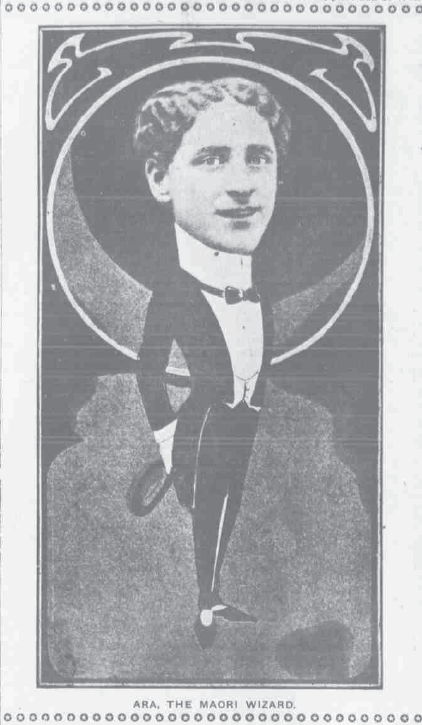
ARA, THE MAORI WIZARD
[Here is an image of Ara, mentioned in the previous post. See the rest of the article here: A Trip Around the World.
Also see more English-language coverage in Chronicling America!]
(Hawaiian Star, 2/10/1912, p. 12)
[Here is an image of Ara, mentioned in the previous post. See the rest of the article here: A Trip Around the World.
Also see more English-language coverage in Chronicling America!]
(Hawaiian Star, 2/10/1912, p. 12)
A New Zealand theater troupe under the leadership of Ara, a man from the Maori people who performs astonishing acts, arrived in Honolulu. After they left their own land, they visited the lands of the South: New Guinea, Fiji, Samoa, the Solomon Islands, and then arrived here. They are taking beautiful shots of Hawaii nei, and when they perform, they have some nice scenes of these islands.
They will also show some pictures of New Zealand, the lifestyle of the Maori, the Hot Volcanic Springs, Palorous Jack [Pelorus Jack], that astonishing piloting fish that guides the way before sailboats when they enter into the harbor of Wellington, and for which a law was made protecting its life, as well as some other lovely pictures of New Zealand. One day in March, they will hold their performance at the Hale Mele Hou [Opera House].
(Aloha Aina, 2/17/1912, p. 1)
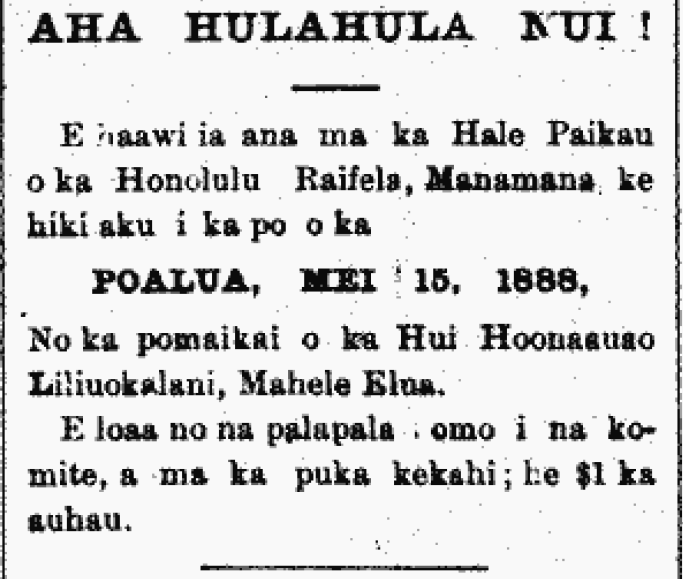
To be held at the Armory of the Honolulu Rifles, Manamana when reaching the night of
TUESDAY, MAY 15, 1888.
For the benefit of the Hui Hoonaauao Liliuokalani, Mahele Elua [The Liliuokalani Educational Society, Division Two].
Tickets of entry may be obtained from the committee, and also at the door; $1 is the cost.
(Makaainana, 5/3/1888, p. 3)
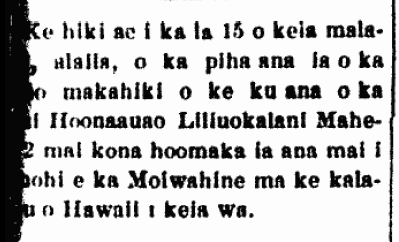
On the 15th of this month, it will be the [???] anniversary of the Hui Hoonaauao Liliuokalani, Mahele 2 [Liliuokalani Educational Society, Division 2] from its inception by the Queen of Hawaii at this time.
[This article in theory states the year that the Liliuokalani Educational Society, Division 2 begins, but that year is not visible. Here is another article which is cut off because of tight binding. It is a sad thing to have to randomly go back and flip through fragile newspaper pages just to find what a word or phrase is. And if a whole bunch of people need to find different things, the papers will deteriorate quickly, and soon, a good image will be impossible because the pages will be dust…]
(Kuokoa, 5/7/1892, p. 3)
The First Division of the Liliuokalani Educational Society will meet at Washington Place, three [?] o’clock Monday afternoon.
[Granted, this is a single sentence, but there is not much known about the Liliuokalani Educational Society, and every little mention is important…
This newspaper is bilingual, Hawaiian and English, and is also called “The National Herald”. The images are not very clear, and the typescript as a result is riddled with “@”s, which indicate that the area is illegible. Hopefully they (and all of the other newspapers) can be re-shot so that there will be legible images—the information they hold is priceless!]
(Ahailono a ka Lahui, February 1, 1890, p. 5)
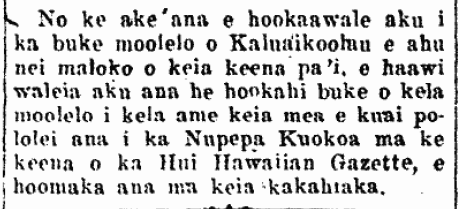
Because of the desire to liquidate the story book of Kaluaikoolau which are stacked up in the publishing office, one of those books will be given away for free to each person who buys the Kuokoa directly from the office of the Hawaiian Gazette Company, beginning this morning.
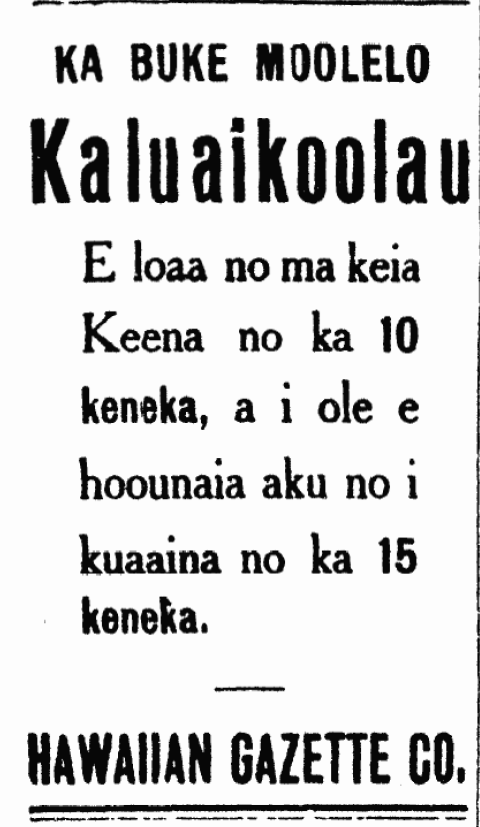
[Up until this time, the books were going for 10 cents each, if you picked them up at the Hawaiian Gazette Co. office, or 15 cents if you wanted them sent to the country. See ad below.]
(Kuokoa, 3/29/1912, p. 8)
Kaluaikoolau
Can be picked up at this Office for 10 cents, or they will be sent to the country for 15 cents.
HAWAIIAN GAZETTE CO.
(Kuokoa, 3/22/1912, p. 6)
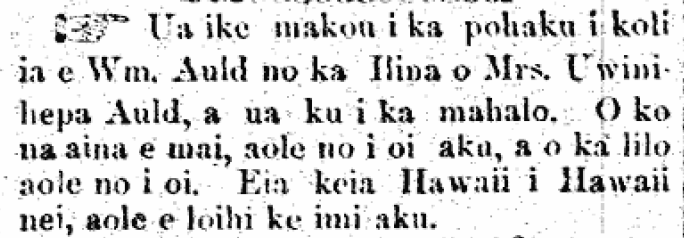
We saw the stone carved by William Auld for the Grave of Mrs. Uwinihepa Auld, and it is admirable. Those imported are not better, and it was not more expensive. This Hawaiian is in Hawaii, and he is not far away if looked for.
[And once again, it astounds me what you can find online… William Auld [older brother of James Auld] apparently was very talented as seen by the tombstone still standing today.]
(Lahui Hawaii, 5/17/1877, p. 3)
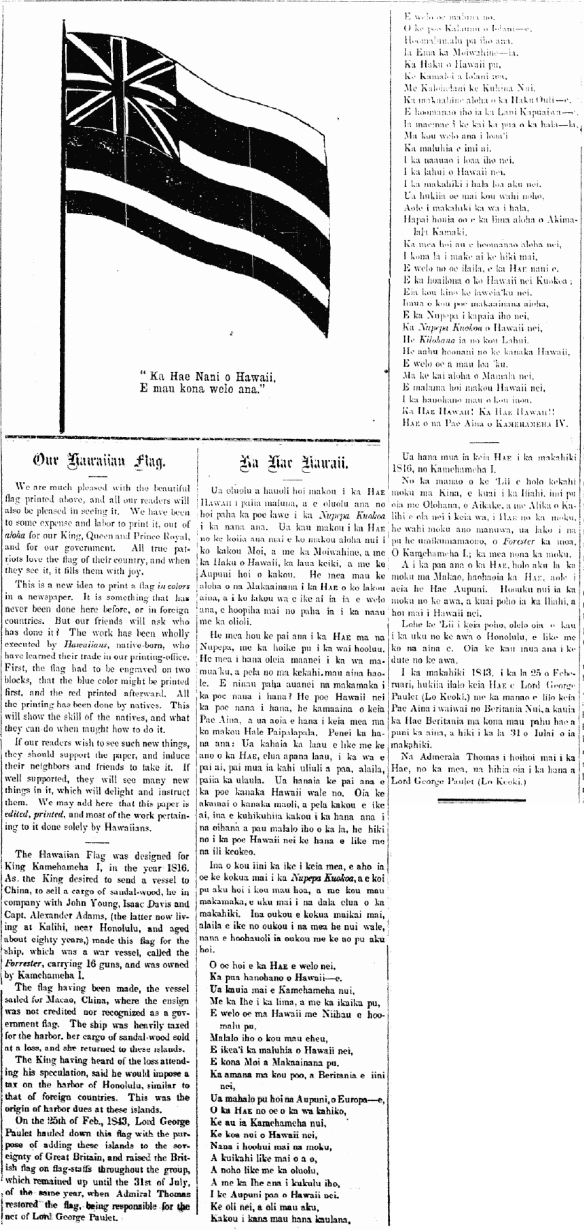
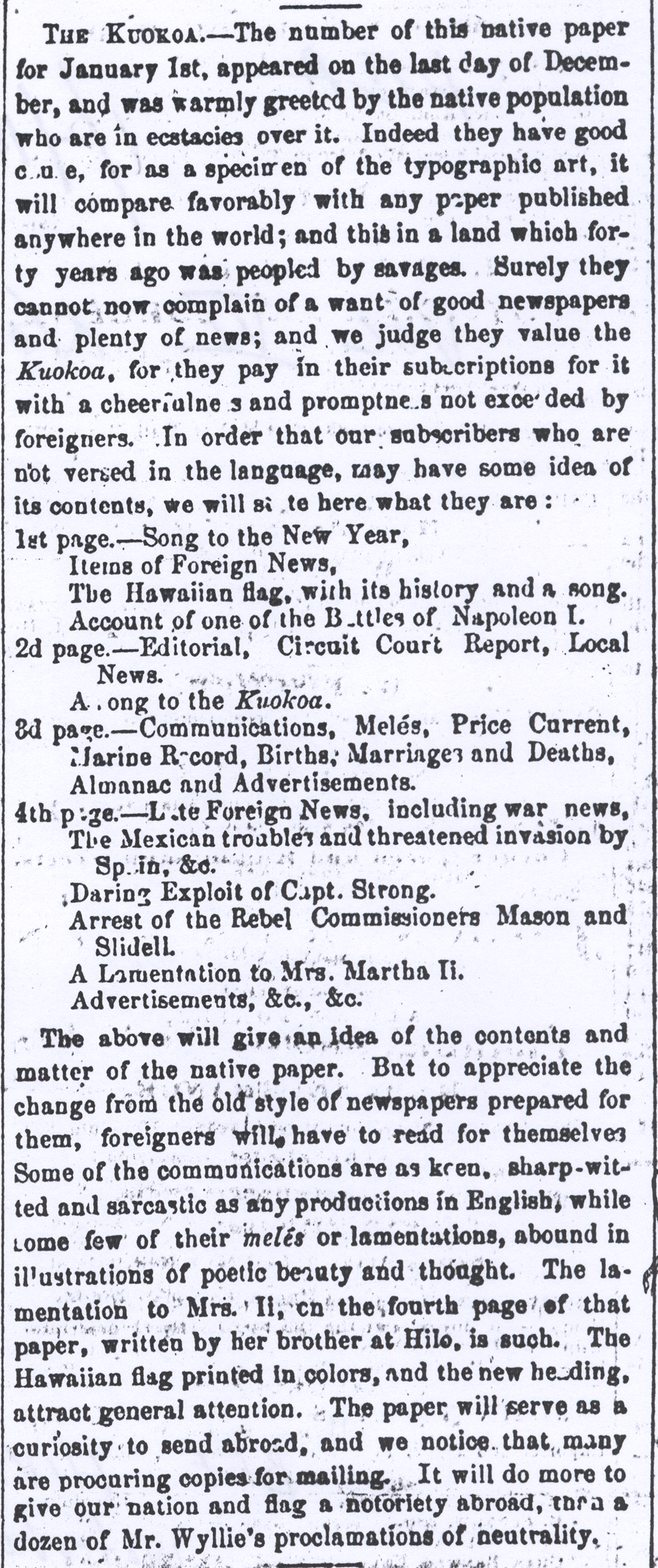
THE KUOKOA.—The number of this native paper for January 1st, appeared on the last day of December, and was warmly greeted by the native population who are in ecstacies over it. Indeed they have good cause, for as a specimen of the typographic art, it will compare favorably with any paper published anywhere in the world; and this in a land which forty years ago was peopled by savages. Surely they cannot now complain of a want of good newspapers and plenty of news; and we judge they value the Kuokoa, for they pay in their subscriptions for it with a cheerfulness and promptness not exceeded by foreigners. In order that our subscribers who are not versed in the language may have some idea of its contents, we will state here what they are:
1st page.—Song to the New Year,
Items of Foreign News,
The Hawaiian flag, with its history and a song.
Account of one of the Battles of Napoleon I.
2d page.—Editorial, Circuit Court Report, Local News.
A song to the Kuokoa.
3d page.—Communications, Meles, Price Current,
Marine Record, Births, Marriages and Deaths,
Almanac and Advertisements.
4th page.—Late Foreign News, including war news,
The Mexican troubles and threatened invasion by Spain, &c.
Daring Exploit of Capt. Strong.
Arrest of the Rebel Commissioners Mason and Slidell.
A Lamentation to Mrs. Martha Ii.
Advertisements, &c., &c.
The above will give an idea of the contents and matter of the native paper. But to appreciate the change from the old style of newspapers prepared for them, foreigners will have to read for themselves. Some of the communications are as keen, sharp-witted and sarcastic as any productions in English, while some few of their meles or lamentations, abound in illustrations of poetic beauty and thought. The lamentation to Mrs. Ii, on the fourth page of that paper, written by her brother at Hilo, is such. The Hawaiian flag printed in colors, and the new heading, attract general attention. The paper will serve as a curiosity to send abroad, and we notice that many are procuring copies for mailing. It will do more to give our nation and flag a notoriety abroad, then a dozen of Mr. Wyllie’s proclamations of neutrality.
[There actually was a replica done of this issue of the Kuokoa by Hoolaupai: Hawaiian Newspaper Resource (which currently either lies dormant or has gone defunct). I heard word that it was going to be reprinted once again a number of months ago, but it seems that did not happen…]
(Pacific Commercial Advertiser, 1/2/1862, p. 2)
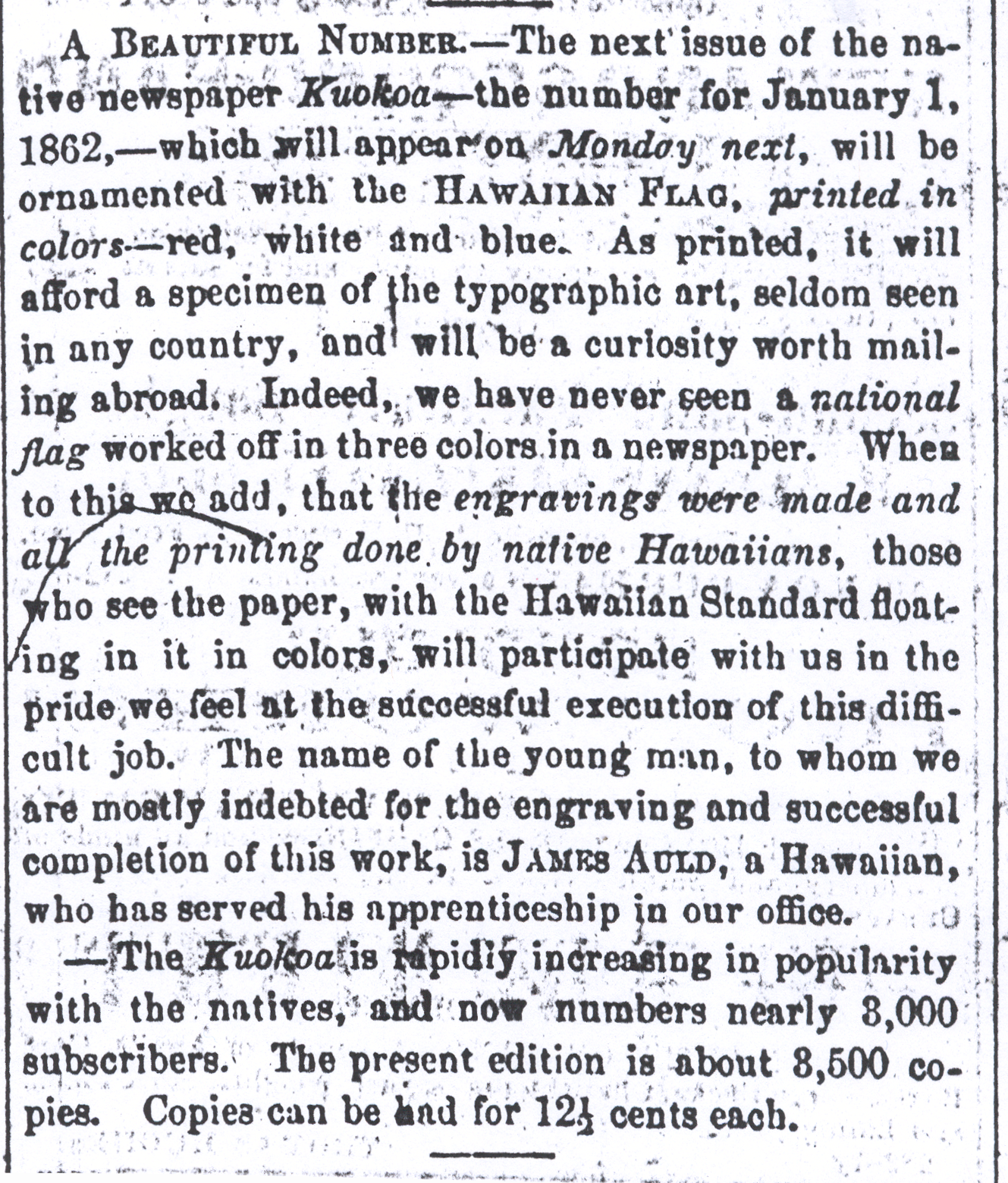
A BEAUTIFUL NUMBER.—The next issue of the native newspaper Kuokoa—the number for January 1, 1862,—which will appear on Monday next, will be ornamented with the HAWAIIAN FLAG, printed in colors—red, white and blue. As printed, it will afford a specimen of the typographic art, seldom seen in any country, and will be a curiosity worth mailing abroad. Indeed, we have never seen a national flag worked off in three colors in a newspaper. When to this we add, that the engravings were made and all the printing done by native Hawaiians, those who see the paper, with the Hawaiian Standard floating in it in colors, will participate with us in the pride we feel at the successful execution of this difficult job. The name of the young man, to whom we are mostly indebted for the engraving and successful completion of this word, is JAMES AULD, a Hawaiian, who has served his apprenticeship in our office.
—The Kuokoa is rapidly increasing in popularity with the natives, and now numbers nearly 3,000 subscribers. The present edition is about 3,500 copies. Copies can be had for 12½ cents each.
[The added information of James Auld here shows that it is important to not only get information from the Hawaiian-Language Newspapers, but the other language papers hold good information as well!]
(Pacific Commercial Advertiser, 12/26/1861, p. 2)
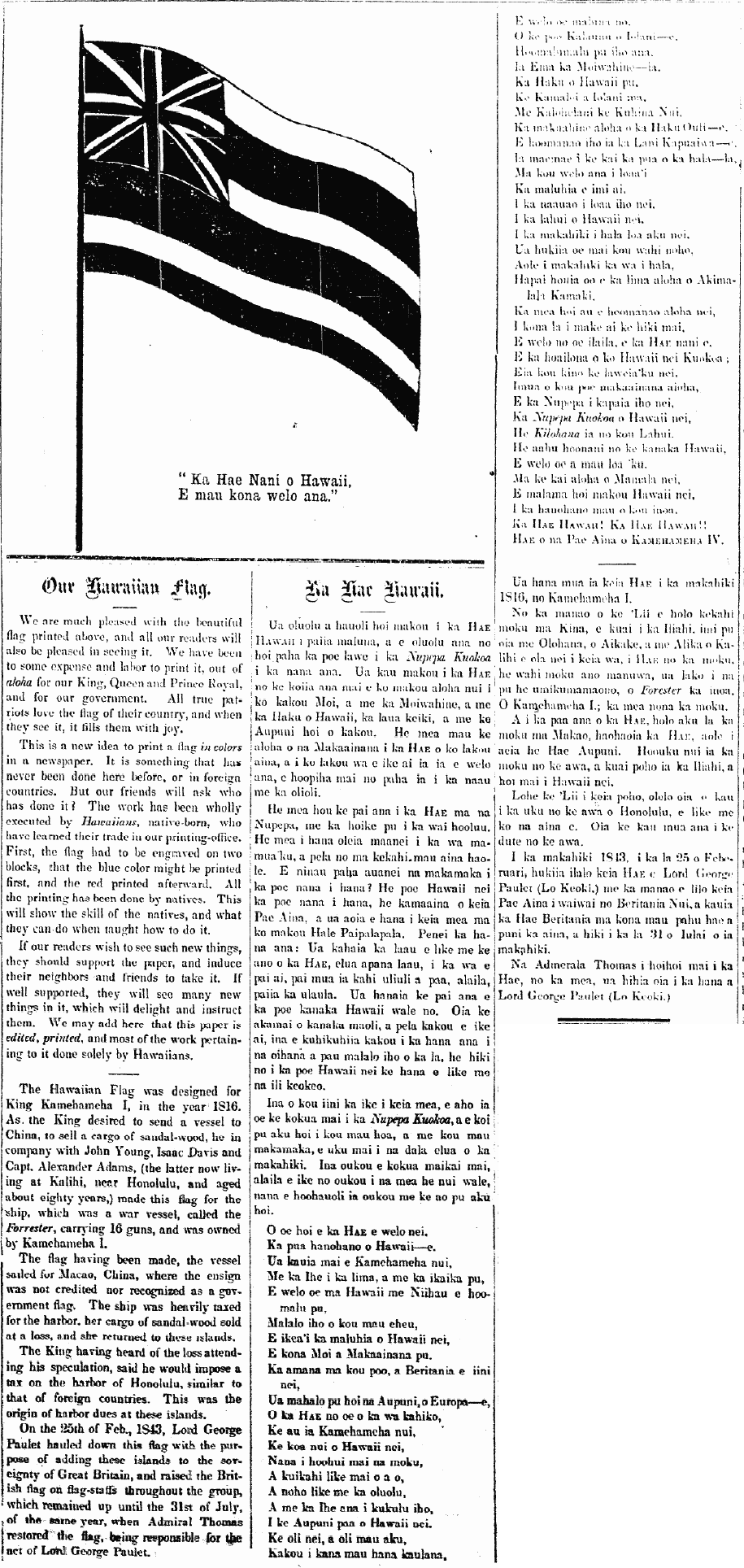
“The Beautiful Flag of Hawaii,
Let it forever wave.”
We are pleased and happy about the Hawaiian Flag printed above, and the people subscribing to Ka Nupepa Kuokoa will be delighted to see it. We display the Flag, urged to do so by our great aloha for our King, Queen, and Ka Haku o Hawaii, their son, as well as for our Nation. The love by the people for their flag of their country is customary, and when they see her fluttering, it fills their hearts with joy.
The printing of the Flag in a Newspaper is something new, along with the displaying of its colors*. This is something not done previously here, as well as in some foreign countries. Perhaps our friends will inquire as to who did this work. Some Hawaiians did the work, people from this Archipelago, and they were taught to do this in our Printing Office. Here is how it was done: Woodblocks were carved in the fashion of the flag using two blocks. When it was printed, first the blue was printed, allowed to set, then the red was printed. This printing was done solely by Hawaiians. Such is the intelligence of the kanaka maoli, and that is how we recognize it. If we are instructed to do any task under the sun, Hawaiians can do the same as the white-skinned people.
If you should want to see this, you should support Ka Nupepa Kuokoa, and urge your acquaintances and friends to pay the two dollars a year. If you would kindly help, you will see many things that will gladden and instruct you.
You, O fluttering Flag,
The proud blossom of Hawaii.
Established by Kamehameha the great,
With Spear in hand, with strength,
Flutter over Hawaii and Niihau, and give protection.
Beneath your wings,
So that the peace of Hawaii be known,
By her King and the people as well.
The cross on your crest that Britain holds dear,
The Nations of Europe also give acclaim,
You are the Flag of old,
The time of Kamehameha the great,
The bravest warrior of Hawaii,
He who joined the islands,
With unity from end to end,
Living as one in contentment,
Along with the Spear upon which he erected,
The steadfast Nation of Hawaii.
We rejoice, and rejoice for all time,
His famed accomplishments,
You wave there above,
The crown of Iolani, the king
While giving shelter,
To Emma, the Queen.
Along with Ka Haku o Hawaii.
The Royal child of Iolani and Emma,
And Kalohelani, the Regent, Victoria Kamamalu.
The loving aunt of the young lord, Prince Albert,
Do remember his His Highness, Lot Kapuaiwa,
Cleansing the fruit of the pandanus in the sea,
Your fluttering has garnered
The peace that allowed us to seek,
The knowledge that has come,
To the Hawaiian populace.
That year long ago.
You were taken from your proper place.
Not a year passed,
You were raised by the loving hands of Admiral Thomas.
The one you fondly recall,
On the day of his death when it approaches,
You will wave there, O beautiful Flag.
O symbol of Hawaii’s Independence ;
Here is your body, being brought.
Before your beloved people,
By the Newspaper called,
Ka Nupepa Kuokoa of Hawaii,
The Excellence of your Nation.
A garment that adorns the Hawaiian People,
Wave forever.
Over the beloved sea of Mamala,
We, Hawaii, will cherish always,
The eternal glory of thy name.
The Hawaiian Flag! The Hawaiian Flag!!
The Flag of the Islands of Kamehameha IV.
This Flag was first designed in the year 1816 for Kamehameha I.
The King, wanting a ship to sail to China to sell Sandalwood, searched along with John Young, Isaac Davis, and Captain Alexander Adams of Kalihi, who is still living, for a Flag for the ship. It was a man-o-war, called the Forrester, carrying sixteen guns. Kamehameha I owned the ship.
When the Flag was completed, the ship sailed to Macao. The Flag was puzzled over, and was not accepted as a National Flag. The ship was charged exorbitantly for harbor fees, the Sandalwood was sold for a loss, and the ship returned to Hawaii.
The King learned of this loss, and he said that a tax should be placed on the harbor of Honolulu like those of foreign lands. That is when duty was first charged for the harbor.
In 1843, the 25th of February, this Flag was taken down by Lord George Paulet [Lo Keoki], with the intent that this Archipelago be taken as a possession of Great Britain. The British flag was raised on flag poles all around the land, until the 31st of July of that year.
It was Admiral Thomas who restored the Flag, for he disputed the actions of Lord George Paulet.
[Notice the English column to the left, which gives a translation of the Hawaiian. It seems this issue of the Kuokoa was sent to home by many a missionary, to show the progress they were making…
*A word of clarification: This is not the first time color appears in a newspaper. For more on this topic, see Hana Hou Magazine, August/September 2011: “Read All About It!” by Ron Williams.
For more flag articles, just click here!]
(Kuokoa, 1/1/1862, p. 1)