Collage of Royal Order of Kamehameha officers, 1918.

THESE ARE THE OFFICERS OF THE AHAHUI KAMEHAMEHA, THE ORGANIZATION HEADED BY PRINCE KALANIANAOLE, AND AS USUAL THIS HAWAIIAN ORGANIZATION HELD A PRAYER SERVICE OF REMEMBRANCE FOR KA NA’I AUPUNI KAMEHAMEHA IN KAWAIAHAO CHURCH THIS PAST SUNDAY, WITH OTHER HAWAIIAN GROUPS IN ATTENDANCE AT THAT GATHERING OF COMMEMORATION. THE NAMES OF THE OFFICERS ARE SEEN BELOW THEIR PICTURES.

William Kawohionalani Cano, Reuben Kinney, Solomon Meheula, William Chung Hoon, Jr., Edward K. Wongham.

Samuel K. Kamaiopili, Samuel Pinao, Benjamin N. Kahalepuna, George H. Miranda, James L. Holt.

Prince J. K. Kalanianaole, John K. Lane, Joseph K. Kanepuu.

(Kuokoa, 6/14/1918, p. 1)

O NA LUNA NUI KEIA...

Ka Nupepa Kuokoa, Buke LVI, Helu 24, Aoao 1. Iune 14, 1918.

More mele from Mary Jane Montano, 1927.

SOME OLD MELE OF HAWAII NEI.

Mr. Solomon Hanohano, Editor of the Kuokoa Newspaper:—Please publish the following mele from times past, when the land was filled with alii.

This is a name song [mele inoa] for the royal one Ahumanu [Kaahumanu], which was inherited by Kaumakaokane II, the mother of Kuakini (John Adams Cummins) during the youth of Kaumaka, and that royal woman [Kaahumanu] then called Kaumakaokane, by the name Papaleaiaina.

This name is the name that Kalaniahumanu [Kaahumanu] called the Royal One, Paiea Kamehameha I, and it is answered to today by the granddaughter of the Hon. J. A. Cummins, that being Matilda Papaleaiaina Walker Constable.

It would be best that these jewels of Hawaii nei be shown, for some of us will live on as teachers for the impertinent questions, as like the one who questioned in the Advertiser newspaper, about my dear brother, the Hon. J. A. Cummins, the “backbone” [iwikuamoo] of the chiefly ones who have passed into the next realm.

Kaumakaokane he inoa,
Hanau a koa he kupuna,
Eia ua aliiwahine nei,
Ke holo mai nei o ka moku,
Me ka hae o kau weloweloula,
Ku’ilua ka pu,
He aloha ia,
Aole i ike ka haole,
Wahi a Kalanikauleleiaiwi,
Iwi ka maka,
Holoholo ka onohi,
Lele ka puuwai i ka makemake,
I ka wai olu o Lanipo-e,
Nau ke ku’i haukeke ka auwae,
I hemahema i ka wa kamalii,
O ko’u wa naaupo no ia,
E laua la e,
Papaleaiaina kuu aloha e—
O kau ka haili aloha i o’u nei,
O ka welelau o kuu lima ka i pa aku,
Pa i ka lihi o Kilauea.

And here is the genealogy of the lei to adorn the neck of Ahia (Mrs. Capt. George Beckley), that being John Adams Cummins.

Liloa is the father who dwelt with Akahiakuleana, born was Umi. Umi, dwelt with Piikea, born was Aihakoko, Kumulaenuiaumi. Kumulaenui, dwelt with Kumunuipawalau, born was Kekapuhelemai; Kekapuhelemai dwelt with Piilani, born was Lonoikauakini.

Lonokauakini, dwelt with Kapukaheiau, born was Lonoikahaupo; Lonoikahaupo, dwelt with Ninauaiwi, born was Kekapalakea. Kekapalakea dwelt with Kelahuna, born was Kowali; Kolwali dwelt with Kaumaokaokane, born was Keaweaua. Keaweaua dwelt with Kaahaiku, born was Keauiaole; Keauiaole dwelt with Liloa, born was Kaumakaokane, Kameeiamoku.

Kaumakaokane (f) dwelt with Thomas Cummins, born was John Adams Cummins.

Kelahuna (f) is a descendant of Kelahunapaikua (m) and Ahia (f) and Kelahunapaikua (m) is a child of Kakuhihewa and Kolimoalani, that being Koaekea (f), the grandchild of Akahinuikameenoa (f), the woman that I placed a kapu upon.

Kelahuna (f) is the younger sister of Kamehaiku, these being female alii of Kau, Hawaii, and Kamehaiku is the woman of Keeaumoku, the father of Kaahumanu who slept with Kalanianoano and begot Kanehoa, the grandfather of Kaleianoano, Hoapili, and so forth, as well as Jesse Hakainai [Makainai ?], and so forth.

Sincerely, this is I

Ako-kuia ka hale lehua o ka manu,
Kauwewe i ka liko o ka ohia,
He uanoe he uaawa no ka mauna,
Uli ka nahele o Ookuauli,
Uli ka nahu hoomau a ka makani,
A makani a lei a lea,
Lea i na kauna ami a ka ua,
Alohi Maukele anapa i ka la e,
Okioki a hoe,
O ke aho no ia a ka ua Polohinalo,
A pikipiki ka lei,
Me he nu’a kapa la,
Popo ka lei a waiho malie,
Nana aku o kuu apana hala iuka o Panaewa,
Mamina ino no kuu kula lehua,
A’u i kawili mua ai,
Ua maka-pa ua eena ka manu,
He ena kai olohia ia no ke kanaka e—

The is the origin of my name from the heavenly one, Kauikeaouli; Kekulani is the name appended to Keoni Ana Opio [John Young, Jr.] when Kauikeaouli died and returned.

E o mai oe i kou inoa e Kekulani,
O ka lani no ka i ku,
I ka papa holu i ka makani,
A o oe no ke o mai e,

MARYJANE AHIA AHUENA KEKULANI MONTANO.

(Kuokoa, 3/31/1927, p. 1)

KEKAHI MELE KAHIKO O HAWAII NEI.

Ka Nupepa Kuokoa, Buke LXVI, Helu 13, Aoao 1. Maraki 31, 1927.

Time to remember and to celebrate, 1861.

Perhaps everyone knows that this newspaper is being printed on the 28th of this month, November, and likewise, all of you probably know what occured on this day, making it a day to remember; that being this.

1. This day, the 28th of November of every year, is a fitting day under the Constitution and Laws of the King, and a fitting day for all Hawaiians to celebrate; for this is the day upon which the great nations of Great Britain and France agreed to the independence of the Archipelago of Hawaii, under the protection of each of their Sovereigns, and that Hawaii join the other great independent nations as per international law.

2. This day, the last Thursday of November, the 28th of this month, is the day decided upon by the American Board of Missionaries, to be a day to honor the Trinity, while giving thanks and appreciation for the blessings He bestowed upon us, and a day to ask Him what we would like to be done by Him from here forth.

Upon these two ideas are the basis of what the newspaper Hoku o ka Pakipika wants to expound upon for all readers, while we feel hesitant about our words lest they be spit back out by those who call themselves perfect; but being that the time has come for the newspaper to speak about this day, it steps forward to speak, for there will be no other opportunity in its first volume where the date of November 28th will appear; and in the following second volume, it will once again speak to you about the 28th of this month. Therefore, it desires to speak and make clear the important reasons this day is set aside, and it will begin with the first stated reason, thus:

1. This day, the 28th of November… is the day upon which the great nations, Great Britain and France agreed to the independence of the Archipelago of Hawaii, under the protection of each of their Sovereigns…

From the very beginning when Hawaiians began living in these islands, and from when the alii first ruled and governed over our Hawaiian lahui until the rule of beloved King Kamehameha III who passed, there were none of this type of holidays celebrated by the Hawaiians; there were no days of celebration of this kind that were held near and far; but other days were commemorated, those being the days of parading of the chiefs, the days to display their grandeur, the days of offerings, and the days that the makahiki were celebrated, perhaps like the Hapi Nuia (the New Year of today; those were the only days similar to what we have now); but the other days, they were not regularly celebrated on the days of the months in the year.

This was so until the death of Harieta Nahienaena, the sister of the King who passed, when a memorial was held, a day to grieve and to reminisce on her passing—no other day was commemorated nor celebrated, until the year 1843, when the 31st of July was celebrated for the return of the sovereignty of the land.

During that time, the Nation of Hawaii was in great turmoil; there was much tumult and disorder caused from the outside, for we were not an independent nation in those days, and did not associate with the other great nations, as with international law.

Therefore, because of the great desire of the deceased King to have an independent nation, during the years of 1840 and 1841, he sent Ministers to go to the great nations, however independence was not obtained. Yet the kindhearted King who passed did not falter, he sent Ministers once again, because of his aloha and his idea to make his rule independent along with us makaainana, and to give us rights under international law.

In the year 1842, he once again sent Ministers, they being George Simpson and William Richards, and sent also from the side of the King was Timoteo Haalilio, to seek this independence; they went, worked, and achieved the right. And this 28th of November is the fruit of their journey, that being the day on which the Rulers of Britain and France,  by the names of their Kings, agreed to validate and to make binding, the independence of the Nation of the Hawaiian Islands; and therefore we celebrate on this day, and rejoice in the obtaining of our rights and our high position as a great nation counted amongst the great nations of the world.

The year that this was approved, it became a day of celebration for us, and there perhaps was no other year as troublesome as this year for the King. There was some difficulties in 1839, but there was just some money taken while the one who took the money promised to return it, and it was returned; however, this year, it was the most problematic, because while the Ministers were away dealing with the rights of the Nation and asking for independence, a warship arrived and took the sovereignty of the land and took control of the nation while rejecting some of the laws and taking and distributing the money in the Treasury; our King, however, carried out his claim to petition the Nation of Britain. The Admiral arrived, but our independence was not clear; and on the 28th of November 1843, the Heads of State approved and affixed their signatures in London, certifying our independence and that it was binding, and that is how we are today.

The King who accomplished this has passed; and the officers who went and fought for this, they have gone on the same journey; and some of our people who were here in past November 28s, they too have gone; and the kingdom has been inherited by our present benevolent King; and to the other alii; and to we makaainana as well; for these blessings were not sought just for them, but for all of us who came after living today, and for those who will come after us, and for all eternity.

Therefore it is good reason for us to rejoice for all of our rights, and to remember our beloved King, the one who first sought out independence for our archipelago so that he would have authority from Hawaii to Kauai, and then kindly give us a place for us to live peacefully under his care, and under his progeny to whom he passes the throne, as we see now. And we must thank our present King and the royal family for their efforts and desire to perpetuate these rights; and we must also thank the great nations for their aloha and for their kindness in agreeing to count us amongst the famed people of the earth.

This is the eighteenth 28th of November celebrated by us in response to this reason of independence, and there are many good activities for us to do. One of them is to hold meetings while selecting speakers to talk about the blessings we received on this day. Because the blessings received as a result of the actions done on this day from the start,  they are so great that we cannot totally fathom it; as a result of these blessings, should we land on the other side of the world, we will see the Flag of our land of birth waving in London; and should we fly in a balloon, it will be fluttering on the shores of California and Spain; and it will be streaming everywhere. There are many reasons we should rejoice and commemorate the 28th of this month with love and joy.

That is not all. You know by the second idea shown above that it is important for us to give thanks to God for the blessings we received these years while humbling ourselves before Him, while asking for his kindness and patience, and quietly beg of Him to watch over us always, and to bless our King and Queen and Ka Haku o Hawaii, and the Royal grandchildren of Kamehameha, and all of the alii; ours, and all of the land, and to give us a treaty.

For this reason, let us participate, go, eat, and drink while celebrating those for whom we should remember on this day.

[Sorry for being a whole week late, and for the particularly rough state which this is in. This definitely needs a finished translation! I hope you all set aside time to celebrate La Kuokoa in your own way!]

(Hoku o ka Pakipika, 11/28/1861, p. 2)

Ke ike mai nei paha na mea a pau...

Ka Hoku o ka Pakipika, Buke I, Helu 10, Aoao 2. Novemaba 28, 1861.

More reaction to Bayonet Constitution, 1887.

CURIOUS HAPPENING OF LAST NIGHT

Here Once More are the Deeds of the Rascals!

Who is Responsible? Who is this Rogue?

A little before 9 last night, there were handwritten bills posted at various places around town. The first found was in front of the residence of Dr. Rodgers [Kauka Lokeke], and other bills were found in other places like the Government Building and the Palace Grounds. The following was found by police lieutenant Kahumoku and officer S. Ku, at the corner of the estate of Haalelea, at the corner of Richards and the Palace, like this:

“Dec. 16th 1886” [1887 ?]

“To you rebel Ministers [Kuhina], it is best for you to return your appointments. We have measured you evil deeds. If these actions continue, then be vigilant every minute of your life lest a coffin be your end.”

(Picture of a Coffin.)

Written atop the coffin is the word, “Minister.”

When the officers in the Armory [Halekoa] got word, some of the soldiers were sent out to search, and this was found posted on the mauka gate of the Palace Grounds:

“To you, O treasonous Ministers, it is best for you to return your appointments. We have had enough of your evil deeds. If this should continue, you all watch out every minute, or you will have a coffin as your eternal home.”

(Picture of a Coffin.)

Written atop the image of the coffin were the words, “In Memory of the Ministers.”

Similar ones were found on the pillars on the grounds of Aliiolani Hale. Perhaps some were posted elsewhere, but it is not known.

[Unfortunately, only two issues have been found of this important newspaper which ran from 1887 to 1888.]

(Makaainana, 12/17/1887, p. 3)

HE PAHAOHAO NO KA PONEI

Ka Makaainana, Buke I, Helu 41, Aoao 3. Dekemaba 17, 1887.

Response to changes happening in the Kingdom, 1888.

COMMON OPINION¹

PREPARING THE MOVEMENT FOR THE GOOD OF HAWAII.

The opinion printed below this heading comes from letters received from our friends. All criticism for those opinions fall upon those who wrote the letters, and not upon us. (Editor)

O Mr. Editor:—I ask for your patience, being that I am a true Hawaiian.

Whereby two-thirds or more of this lahui are of the opinion to form an appropriate Association for the benefit of the Hawaiians and the foreigners.

Whereby the Cabinet of Ministers in power now stands upon sand, where when the rain beats down and the wind blows, it will fall, and that shall be their fate.

Whereby this Cabinet of Missionary Ministers are in government positions without the confidence of two-thirds or more of the people residing here and some who are observing from elsewhere.

Whereas the circle of Missionaries intends to long hold the power in the workings of the Government, while clearly going against the laws of this land.

And Hawaii intends to look after its own good, without fear of the opposition facing it. Whereas all enlightened Hawaiians know that they have this responsibility.

Therefore, they have no desire for the power of the Governmental offices of their beloved land to be put to waste by this circle, and to have them [the ministers] enter Hawaii into a debt that cannot be repaid.

Along with the other heads that they are appointing; and they are the major power, and they are the King. And the negligent laws they pass have power over this tiny lahui.

Whereas I speak with truth in enlightened manner. Whereas the laws not approved by the King, and not signed by him; they have no power to become law over this lahui.

Therefore, time is near for Hawaii to consider, and to discuss what is right, and of the advancement of its efforts, its land, and the King.

O Editor, I shall constantly fill your paper with delicacies, should this topic above receive your kindness.

With Appreciation

S. W. B. K.——

Manoa, Nov. 6, 1888.

[Anybody have an idea who S. W. B. K. from Manoa is?]

¹”Na Manao Laulaha” is a regular column in Ke Alakai o Hawaii.

(Alakai o Hawaii, 11/10/1888, p. 4)

NA MANAO LAULAHA

Ke Alakai o Hawaii, Buke I, Helu 45, Aoao 4. Novemaba 10, 1888.

On taxation and leprosy patients, 1875.

The Leprosy Patients are Taxed!

Mr. Editor; Aloha:—

On the 2nd of this December, the Tax Assessor [Luna Auhau] of this island of Molokai came in person to the colony of Kalawao, the place of the castaways who are afflicted with wounds of an incurable sickness, that being leprosy [mai lepera], which is called he Chinese sickness [mai Pake].

Therefore, the Tax Assessor is acting as per his power under the Law; the taxing of animals, all except the body of man. And as such, I am announcing before all of our fellow people, that this is a major thing, because from the beginning of the enforcement of this law upon people afflicted with leprosy and who are set apart as based on the intent of the edict of the Board of Health; this is the first time this sort of thing has come before the patience, as it has almost been ten years that these people have been living as prisoners in the penitentiary of the law.

Through this, I am announcing clearly to all the people living all over outside of the boundaries of the land of the skeletons. This is astonishing that those dead to the law are being taxed. So if leprosy patients are taxable in this way, then those imprisoned in Kawa [the government prison] should be taxed, for they are better off than those living here in the Colony of Kalawao; those people, there is a given time when they will once again receive their Civil rights, but we here (the leprosy patience), we will not have a time when we are relieved, because the law follows after our steps, and takes from us even the tiniest of rights that we have.

This is the Era of King Kalakaua, and the character of the history of his reign is being prepared; so “Recognize your fellow man, and don’t waste your aloha on dogs.” Aloha no. SILOAMA.¹

Kalawao, Dec. 3, 1875

¹Siloama is probably a pen name; it is the Protestant church in Kalawao.

(Kuokoa, 12/11/1875, p. 4)

Ua Auhauia na mai Lepera!

Ka Nupepa Kuokoa, Buke XIV, Helu 50, Aoao 4. Dekemaba 11, 1875.

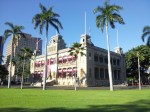
Remembering, 2012.

Passed by yesterday and stopped to remember…

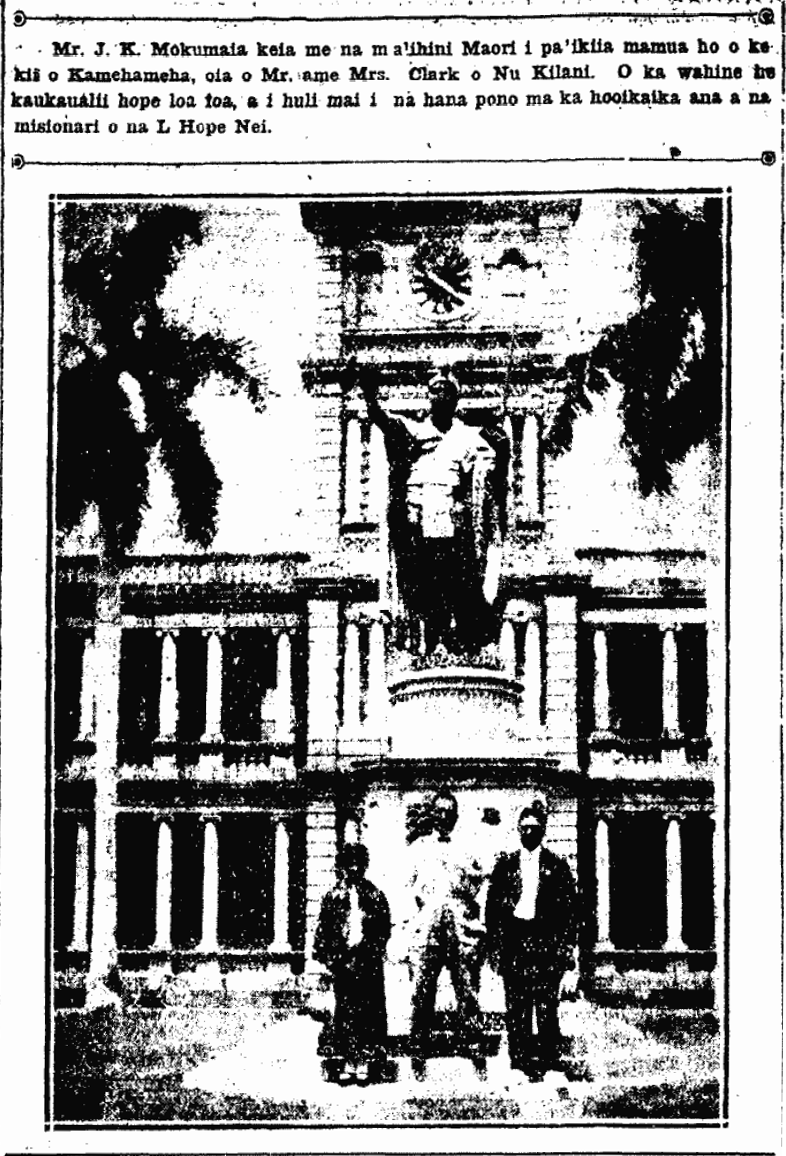
Maori visit Hawaii, 1920.

This is Mr. J. K. Mokumaia with the Maori malihini, photographed before the statue of Kamehameha; they are Mr. and Mrs. Clark of New Zealand. The woman is the last kaukau alii [kaukaualii hope loa ??], and they came to do good works by strengthening the missionaries of the Latter Day.

[The text is pretty clear, but during the last decades of the newspapers, you will notice more and more typos, as you can see here.

If the newspapers were reshot clearly, the image would no doubt be much more crisp.]

(Kuokoa, 7/9/1920, p. 3)

Mr. J. K. Mokumaia keia...

Ka Nupepa Kuokoa, Buke LVIII, Helu 28, Aoao 3. Iulai 9, 1920.

Another mountain-climbing mele for Emalani, 1871.

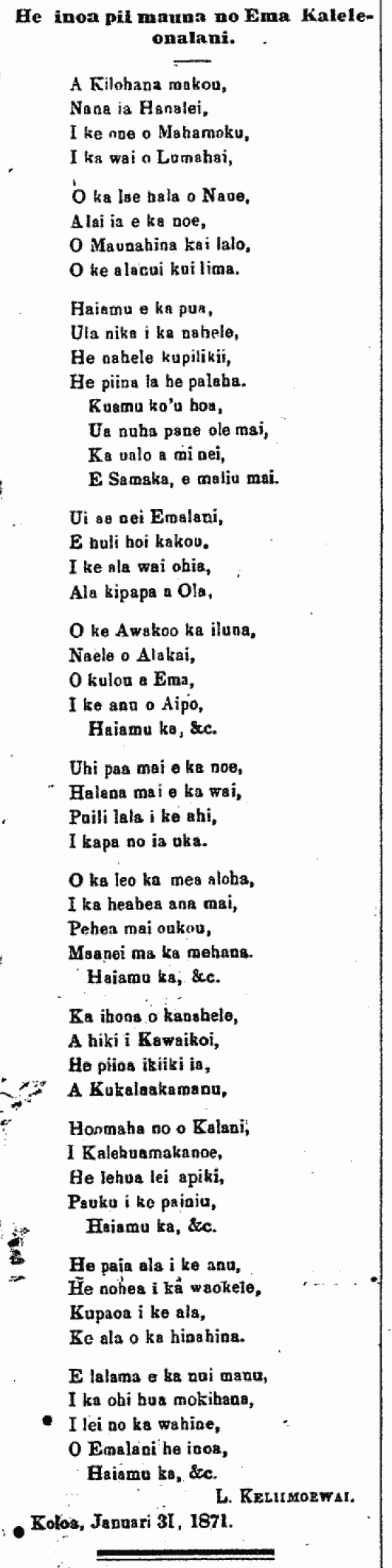
A mountain-climbing name song for Ema Kaleleonalani.

A Kilohana makou,
Nana ia Hanalei,
I ke one o Mahamoku,
I ka wai o Lumahai,

O ka lae hala o Naue,
Alai ia e ka noe,
O Maunahina kai lalo,
O ke alanui kui lima.

Haiamu e ka pua,
Ula nika i ka nahele,
He nahele kupilikii,
He piina la he palaha.
Kuamu ko’u hoa,
Ua nuha pane ole mai,
Ka ualo a mi nei,
E Samaka, e maliu mai.

Ui ae nei Emalani,
E huli hoi kakou,
O ke ala wai ohia,
Ala kipapa a Ola,

O ke Awakoo ka iluna,
Naele o Alakai,
O kulou a Ema,
I ke anu o Aipo,
Haiamu ka, &c.

Uhi paa mai e ka noe,
Halana mai e ka wai,
Puili lala i ke ahi,
I kapa no ia uka.

O ka leo ka mea aloha,
I ka heahea ana mai,
Pehea mai oukou,
Maanei ma ka mehana.
Haiamu ka, &c.

Ka ihona o kanahele,
A hiki i Kawaikoi,
He piina ikiiki ia,
A kukalaakamanu,

Hoomaha no o Kalani,
I Kalehuamakanoe,
He lehua lei apiki,
Pauku i ke painiu,
Haiamu ka, &c.

He paia ala i ke anu,
He nohea i ka waokele,
Kupaoa i ke ala,
Ke ala o ka hinahina.

E lalama e ka nui manu,
I ka ohi hua mokihana,
I lei no ka wahine,
O Emalani he inoa,
Haiamu ka, &c.

L. Keliimoewai.

Koloa, Januari 31, 1871.

[This is another mele honoring Queen Emma and her famous travels through Kauai. It seems the eight lines starting “Haiamu e ka pua” is repeated like a chorus after every two verses.

This seems to be a more “complete” version of the one printed in “He Lei no Emalani,” pp. 90–91.]

(Au Okoa, 2/9/1871, p. 1)

He inoa pii mauna no Ema Kaleleonalani.

Ke Au Okoa, Buke VI, Helu 43, Aoao 1. Feberuari 9, 1871.

Mele by Ninito Sumner and Manaiula Sumner for Victoria Kaahumanu, 1862.

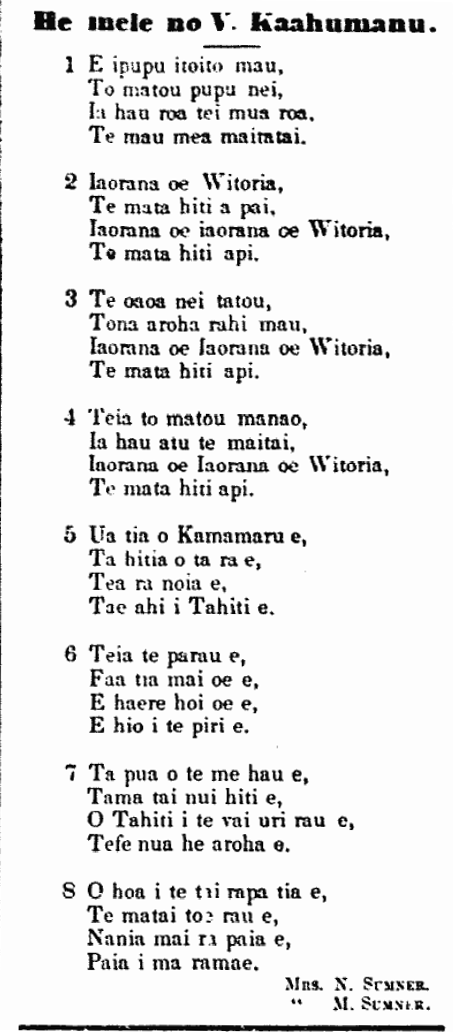
A mele for V. Kaahumanu.

1. E ipupu itoito mau,
To matou pupu nei,
Ia hau roa tei mua roa,
Te mau mea maitatai.

2. Iaorana oe Witoria,
Te mata hiti a pai,
Iaorana oe iaorana oe Witoria,
Te mata hiti api.

3. Te oaoa nei tatou,
Tona aroha rahi mau,
Iaorana oe Iaorana oe Witoria,
Te mata hiti api.

4. Teia to matou  manao,
Ia hau atu te maitai,
Iaorana oe Iaorana oe Witoria,
Te mata hiti api.

5. Ua tia o Kamamaru e,
Ta hitia o ta ra e,
Tea ra noia e,
Tae ahi i Tahiti e.

6. Teia te parau e,
Faa tia mai oe e,
E haere hoi oe e,
E hio i te piri e.

7. Ta pua o te me hau e,
Tama tai nui hiti e,
O Tahiti i te vai uri rau e,
Tefe nua he aroha e.

8. O hoa i te tai rapa tia e,
Te matai toe rau e,
Nania mai ra paia e,
Paia i ma ramae.

Mrs. N. Sumner.

” M. Sumner.

[Can anyone supply a translation for this mele?]

(Kuokoa, 1/25/1862, p. 3)

He mele no V. Kaahumanu.

Ka Nupepa Kuokoa, Buke I, Helu 9, Aoao 3. Ianuari 25, 1862.