Alii of Fatu Hiva, 1867.

[Found under: “LOCAL NEWS: OAHU”]

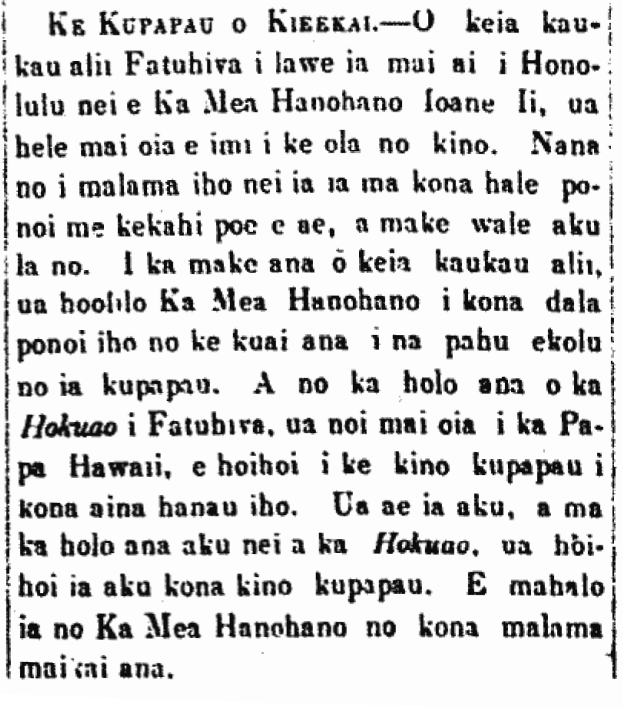
The Body of Kieekai.—This kaukau alii from Fatu Hiva [Fatuhiva] to Honolulu by the Honorable John Papa Ii [Ioane Ii], and he came here in search of health. It was Ii who cared for him at his own home along with some others, and Kieekai died. At the death of this kaukau alii, The Honorable One spent his own money to purchase the three caskets for the body. Being that the Hokuao is on its way to Fatu Hiva, he asked the Hawaiian Board of Missions [Papa Hawaii] to return the body to the land of his birth. It was agreed to, and when the Hokuao left, the body was taken. The Honorable One is appreciated for his fine care.

(Kuokoa, 3/30/1867, p. 2)

Ke Kupapau o Kieekai.

Ka Nupepa Kuokoa, Buke VI, Helu 13, Aoao 2. Maraki 30, 1867.

Honorable Lydia Kamakaeha Paki weds Adjutant General Major J. O. Dominis, 1862.

MARRIED—At the hour of 8 in the evening of Tuesday, the 16th of this month, the Honorable Lydia Kamakaeha Paki married Adjutant General Major J. O. Dominis, at Haleakala, the Residence of the Honorable C. R. Bishop and his Chiefess. The two were married in the Anglican faith.

Present were the King; Her Highness Princess V. K. Kaahumanu; His Highness Prince L. Kamehameha; the Honorable M. Kekuanaoa, the Chiefly Governor of Oahu; Colonel Peter Young Kekuaokalani; there also were the parents of the woman, and the mother of the man, and his cousins.

Rev. Samuel C. Damon was who married them. There was much appreciation for how fine and honorable it was. With the two of them is the aloha of this paper.

[It seems Queen Emma was not present at this wedding. Ka Haku o Hawaii had only passed away a few weeks earlier…]

(Kuokoa, 9/20/1862, p. 3)

MAREIA...

Ka Nupepa Kuokoa, Buke I, Helu 43, Aoao 3. Sepatemaba 20, 1862.

Albert Loomens of Wilcox Rebellion sentenced, 1890.

[Found under: “HAWAII NEWS”]

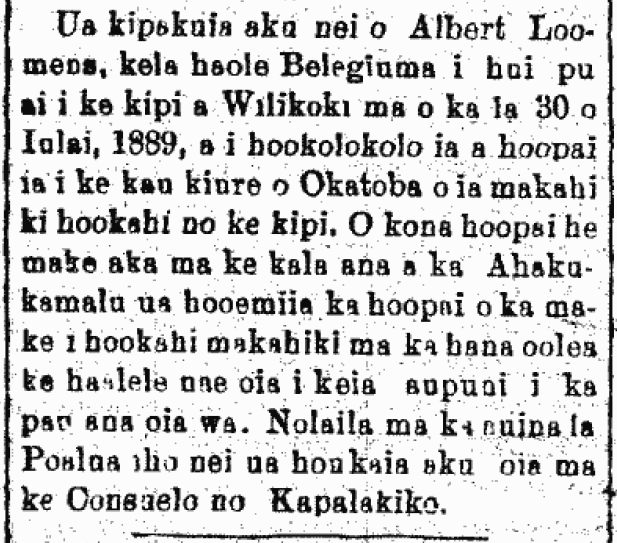
Albert Loomens is being banished, that Belgian who joined the rebellion with Wilcox and party on the 30th of July 1889; and he was tried and sentenced by jury on October of the same year for treason. His sentence was death but this was forgiven by the Privy Council [Ahakukamalu], and the death sentence was reduced to one year of hard labor on the condition that he leave this country at the end of this term. Therefore, on the afternoon of this Tuesday, he was sent aboard the Consuelo for San Francisco.

(Ko Hawaii Pae Aina, 10/18/1890, p. 2)

Ua kipakuia aku nei o Albert Loomens...

Ko Hawaii Pae Aina, Buke XIII, Helu 42, Aoao 2. Okatoba 18, 1890.

Ka Anoi, Mele for Queen Kapiolani, 1883.

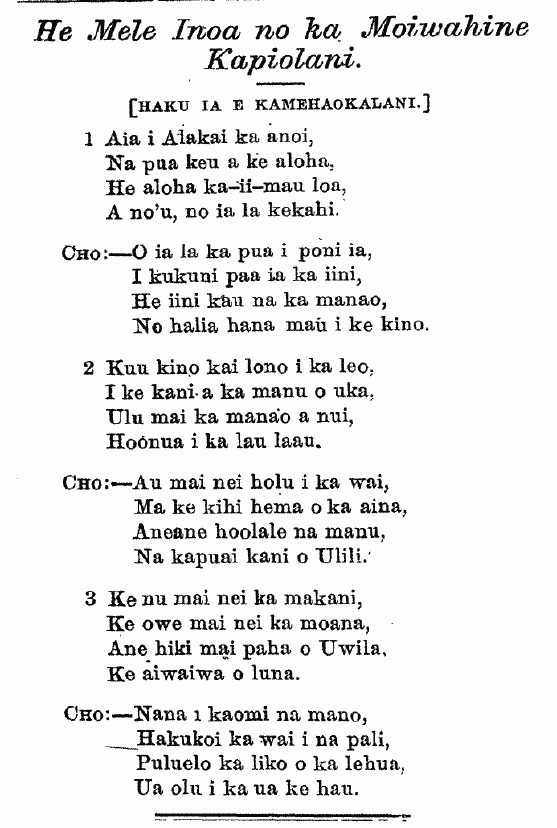
A Name Song for Queen Kapiolani.

[COMPOSED BY KAMEHAOKALANI.]

1 Aia i Alakai ka anoi,
Na pua keu a ke aloha,
He aloha ka–ii–mau loa,
A no’u no ia la kekahi.

Cho:—O ia la ka pua i poni ia,
I kukuni paa ia ka iini,
He iini kau na ka manao,
No halia hana mau i ke kino.

2 Kuu kino kai lono i ka leo,
I ke kani a ka manu o uka,
Ulu mai ka manao a nui,
Hoonua i ka lau laau.

Cho:—Au mai nei holu i ka wai,
Ma ke kihi hema o ka aina,
Aneane hoolale na manu,
Na kapuai kani o Ulili.

3 Ke nu mai nei ka makani,
Ke owe mai nei ka moana,
Ane hiki mai paha o Uwila,
Ke aiwaiwa o luna.

Cho:—Nana i kaomi na manao,
Hakukoi ka wai i ka pali,
Puluelo ka liko o ka lehua,
Ua olu i ka ua ke hau.

(Koo o Hawaii, 8/29/1883, p. 8)

He Mele Inoa no ka Moiwahine Kapiolani.

Ke Koo o Hawaii, Buke 1, Helu 2, Aoao 8. Augate 29, 1883.

Bernice Pauahi Bishop Museum’s Government and Governance Digital Initiative, 2012.

I was at a presentation tonight by DeSoto Brown of the Bishop Museum on some of their treasures held in the Museum’s archives. Of particular interest to you all might be the number of new material that is available online and is word searchable!

Here is the search page for their Government and Governance: A Digital Initiative page.

One of the great many topics of interest is Leprosy.

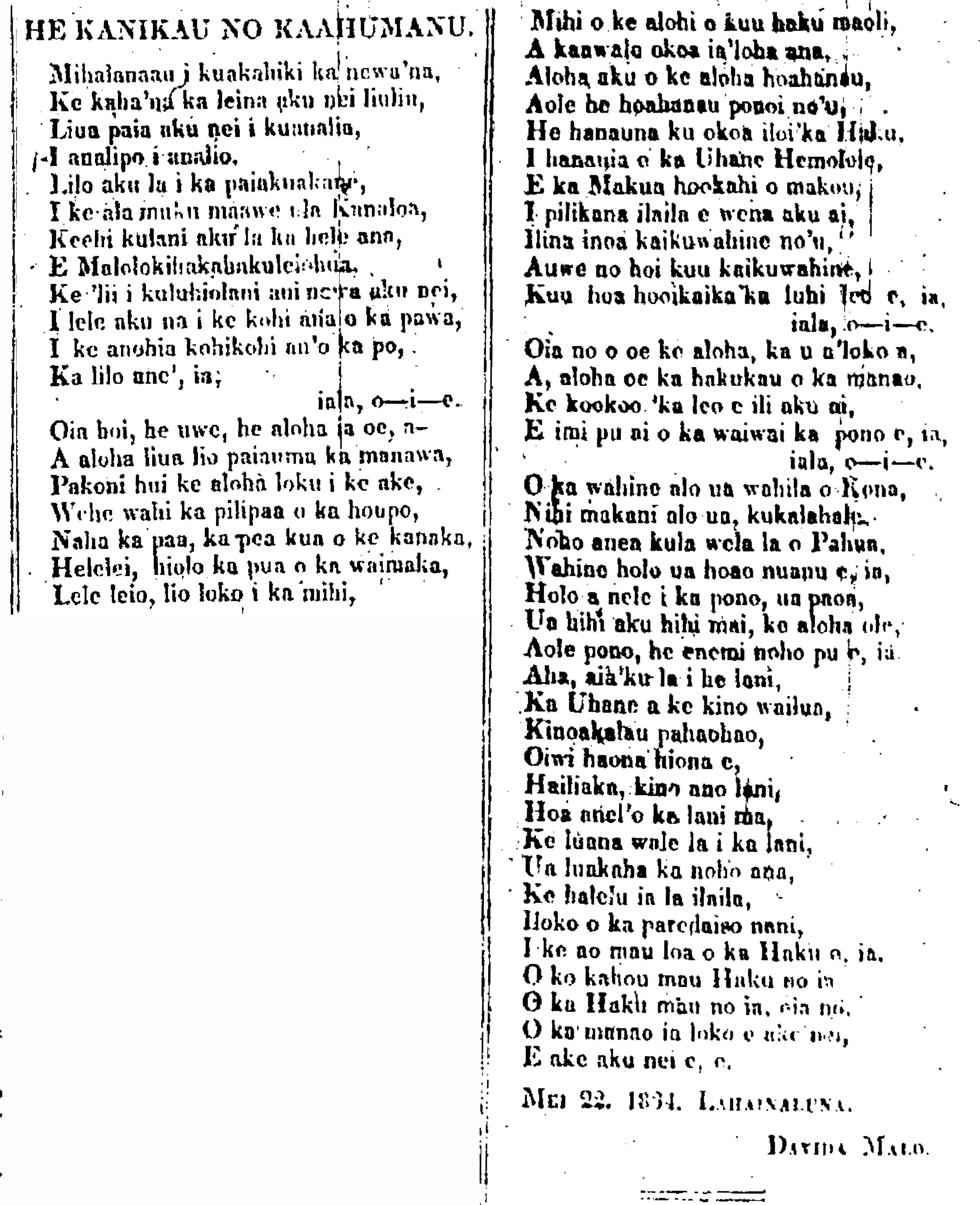
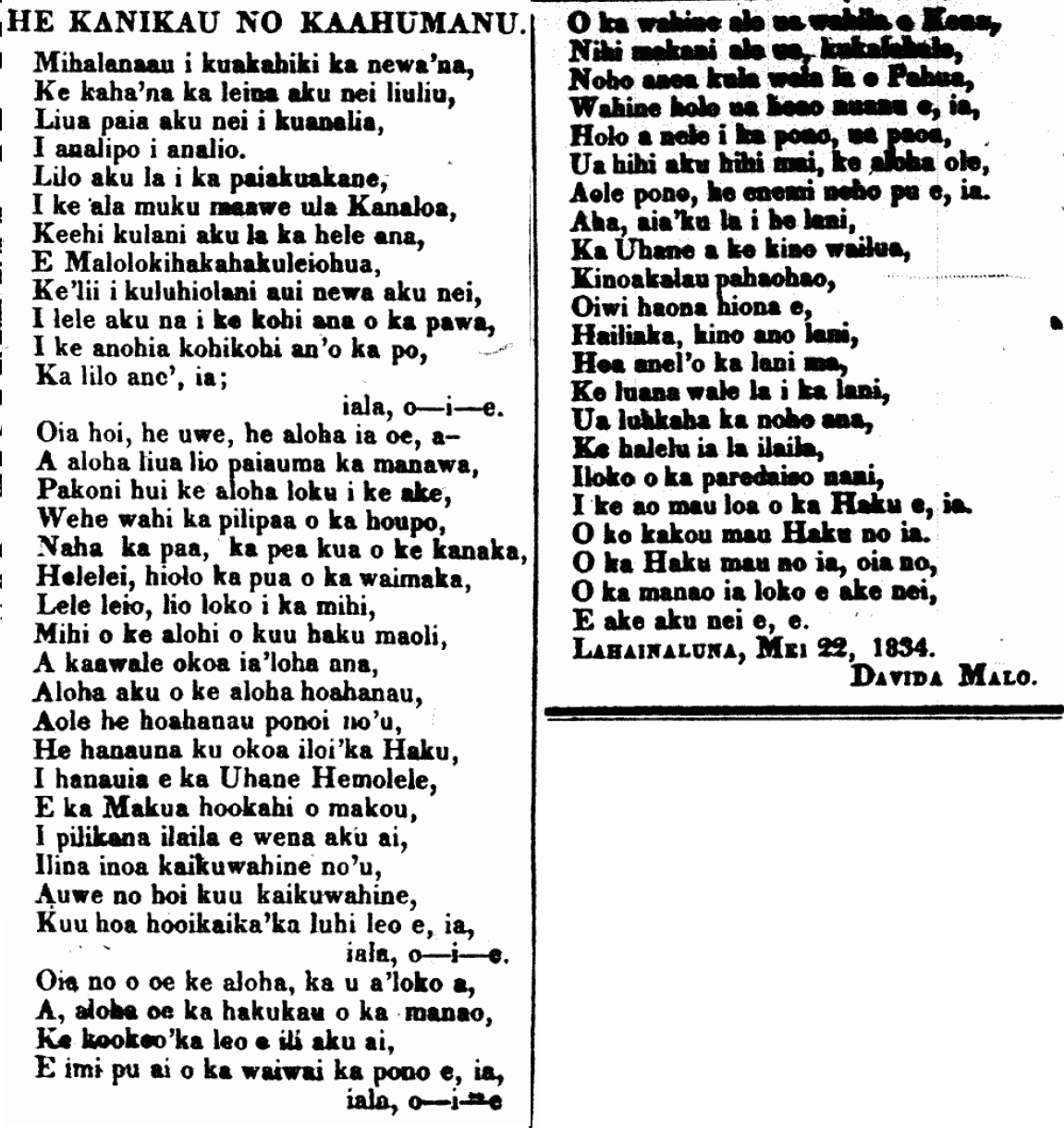
Here is Davida Malo’s kanikau for Kaahumanu as it was first published, 1834/1835.

HE KANIKAU NO KAAHUMANU.

Mihalanaau i kuakahiki ka newa’na,
Ke kaha’na ka leina aku nei liuliu,
Liua paia aku nei i kuanalia,
I analipo i analio.
Lilo aku la i ka paiakuakane,
I ke ala muku maawe ula Kanaloa,
Keehi kulani aku la ka hele ana,
E Malolokihakahakuleiohua.
Ke ‘lii i kuluhiolani aui newa aku nei,
I lele aku na i ke kohi ana o ka pawa,
I ke anohia kohikohi an’o ka po,
Ka lilo ane’, ia,
Oia hoi, he uwe, he aloha ia oe, aiala, o—i—e.
A aloha liua lio paiauma ka manawa,
Pakoni hui ke aloha loku i ke ake,
Wehe wahi ka pilipaa o ka houpo,
Naha ka paa, ka pea kua o ke kanaka,
Helelei, hiolo ka pua o ka waimaka,
Lele leio, lio loko i ka mihi,
Mihi o ke alohi o kuu haku maoli,
A kaawale okoa ia’loha ana,
Aloha aku o ke aloha hoahanau,
Aole he hoahanau ponoi no’u,
He hanauna ku okoa iloi ka Haku,
I hanauia o ka Uhane Hemolele,
E ka Makua hookahi o makou,
I pilikana ilaila e wena aku ai,
Ilina inoa kaikuwahine no’u,
Auwe no hoi kuu kaikuwahine,
Kuu hoa hooikaika ka luhi leo e, ia, iala, o—i—e.
Oia no o oe ke aloha, ka u a’loko a,
A, aloha oe ka hakukau o ka manao,
Ke kookoo ‘ka leo e ili aku ai,
E imi pu ai o ka waiwai ka pono e, ia, iala, o—i—e.
O ka wahine alo ua wahila o Kona,
Nihi makani alo ua, kukalahale.
Noho anea kula wela la o Pahua,
Wahine holo ua hoao nuanu e, ia,
Holo a nele i ka pono, ua paoa,
Ua hihi aku hihi mai, ke aloha ole,
Aole pono, he enemi noho pu e, ia.
Aha, aia’ku la i he lani,
Ka Uhane a ke kino wailua,
Kinoakalau pahaohao,
Oiwi haona hiona e,
Hailiaka, kino ano lani,
Hoa anel’o ka lani ma,
Ke luana wale la i ka lani,
Ua luakaha ka noho ana,
Ke halelu ia la ilaila,
Iloko o ka paredaiso nani,
I ke ao mau loa o ka Haku e, ia.
O ko kahou mau Haku no ia
O ka Haku mau no ia, oia no.
O ka manao ia loko e ake nei,
E ake aku nei e, e.
MEI 22, 1834. LAHAINALUNA.
DAVIDA MALO.

[As mentioned by Kuamoolelo, here is the earliest published appearance of Malo’s famous kanikau for Kaahumanu. Unfortunately the image is not so legible, i had to go back to the original to check it. Hopefully one day soon, some entity will understand how important clear images of the newspapers are, and they will fund this priceless undertaking!!]

(Lama Hawaii, 8/8/1834, p. 3)
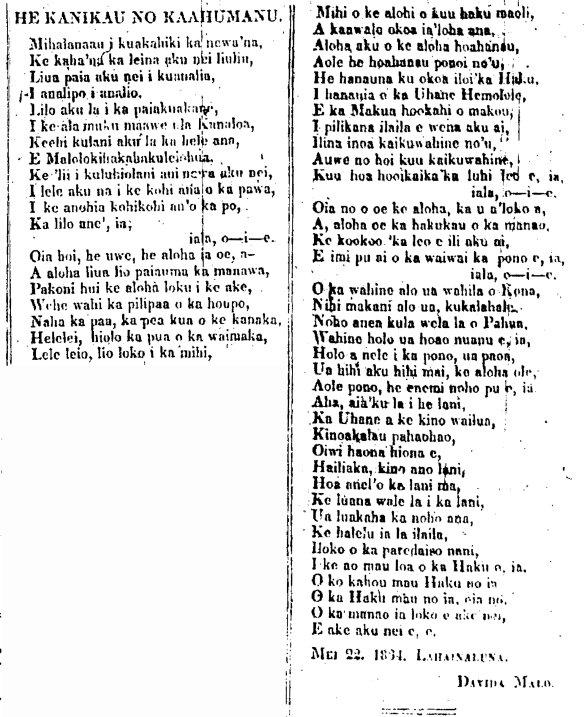
HE KANIKAU NO KAAHUMANU

Ka Lama Hawaii, Makahiki 1, Helu 17, Aoao 3. Augate 8, 1834.


HE KANIKAU NO KAAHUMANU.

Mihalanaau i kuakahiki ka newa’na,
Ke kaha’na ka leina aku nei liuliu,
Liua paia aku nei i kunolia,
I analipo i analio.
Lilo aku la i ka paiakuakane,
I ke ala muku maawe ula Kanaloa,
Keehi kulani aku la ka hele ana,
Ke’lii i kuluhiolani aui newa aku nei,
I lele aku na i ko kohi ana o ka pawa,
I ke anohia kohikohi an’o ka po,
Ka lilo ane’, ia;
iala, o—i—e.
Oia hoi, he uwe, he aloha ia oe, a—
A aloha liua lio paiauma ka manawa,
Pakoni hui ke aloha loku i ke ake,
Wehe wahi ka pilipaa o ka houpo,
Naha ka paa, ka pea kua o ke kanaka,
Helelei, hiolo ka pua o ka waimaka,
Lele leio, he loko i ka mihi,
Mihi a ke alohi o kuu haku maoli,
A kaawale okoa ia’loha ana,
Aloha aku o ke aloha hoahanau,
Aole he hoahanau ponoi no’u,
He hanauna ku okoa ilo’ika Haku,
I haupuia e ka Uhane Hemolele,
E ka Makua hookahi o makou,
I pilikana ilaila e wena aku ai,
Ilina inoa kaiakwahine no’u,
Auwe no hoi kuu kaikuwahine,
Kuu hoa hooikaika’ka luhi leo e, ia,
iala, o—i—e.
Oia no o oe ke aloha, ka u’aloko a,
A, aloha oe ka hakukau o ka manao,
Ke kookoo’ka leo e ili aku ai,
E imi pu ai o ka waiwai ka pono, e ia,
iala, o—i—e.
O ka wahine alo ua wahila o Kona,
Nihi makani alo ua, kukalahale,
Noho anea kula wela la o Pahua,
Wahine holo ua hoao auanu e, ia,
Holo a nele i ka pono, ua paoa,
Ua hihi aku hihi mai, ke aloha ole,
Aole pono, he enemi noho pu e, ia.
Aha, aia’ku la i he lani,
Ka Uhane a ke kino wailua,
Oiwi haona hiona e,
Hailiaka, kino ano lani,
Hea anei’o ka lani ma,
Ke luana wale la i ka lani,
Ua luakaha ka noho ana,
Ke halelu ia la ilaila,
Iloko o ka paredaiso nani,
I ke ao mau loa o ka Haku e, ia.
O ko lakou mau Haku no ia.
O ka Haku mau no ia, oia no,
O ka manao ia loko e ake nei,
E ake aku nei e, e.
LAHAINALUNA, MEI 22, 1834.

DAVIDA MALO.

[This is the second known publication of the kanikau. The image is a clearer, but not totally clear.]

(Kumu Hawaii, 10/28/1835, p. 176)
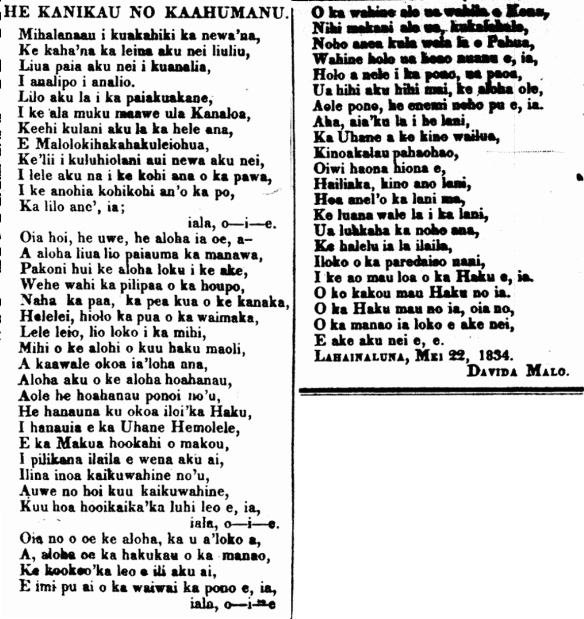
HE KANIKAU NO KAAHUMANU.

Ke Kumu Hawaii, Buke 1, Pepa 22, Aoao 176, Okatoba 28, 1835.
Davida Malo remembered, 1907.

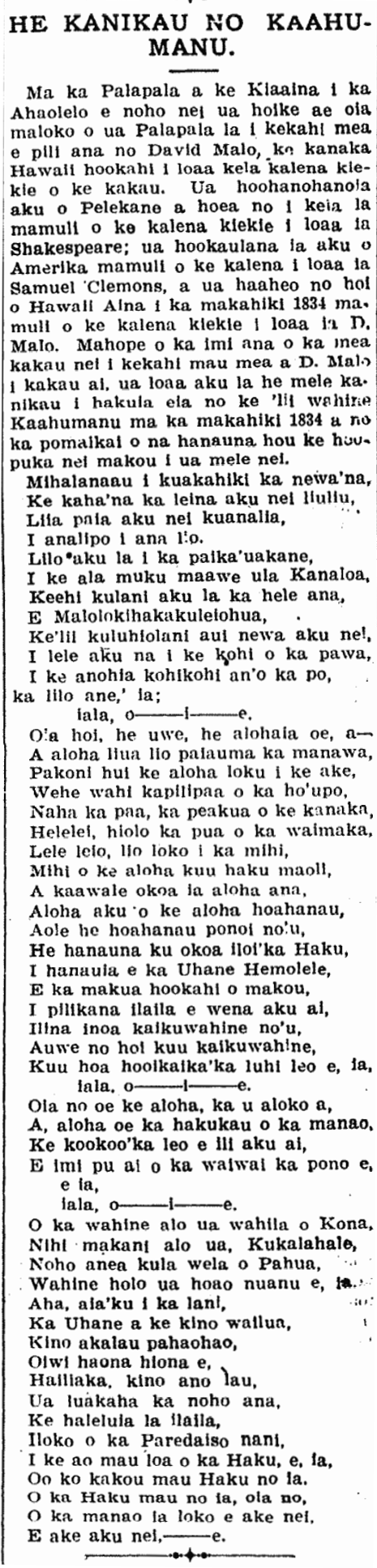
A DIRGE FOR KAAHUMANU.

In the Document by the Governor [George Robert Carter] to the current Legislature, he spoke of in the Document about David Malo, the single Hawaiian who had a excellent talent for writing. Britain is famed to this day for the high talent of Shakespeare; America is made famous because of the talent of Samuel Clemens [Mark Twain], and Hawaii was proud indeed in the year 1834, because of the great talent of D. Malo. After your writer searched for things written by D. Malo, this kanikau was found, composed by him for the queen, Kaahumanu, in 1834; and for the benefit of the new generations, we are reprinting that mele.

Mihalanaau i kuakahiki ka newa’na,
Ke kaha’na ka leina aku nei liuliu,
Liia paia aku nei kuanalia,
I analipo i ana lio,
Lilo aku la i ka paika’uakane,
I ke ala muku maawe ula Kanaloa,
Keehi kulani aku la ka hele ana,
E Malolokihakakuleiohua,
Ke’lii kuluhiolani aui newa aku nei,
I lele aku na i ke kohi o ka pawa,
I ke anohia kohikohi an’o ka po, ka lilo ane,’ ia;
iala, o———i———e,
Oia hoi, he uwe, he alohaia oe, a—
A aloha liua lio paiauma ka manawa,
Pakoni hui ke aloha loku i ke ake,
Wehe wahi kapilipaa o ka ho’upo,
Naha ka paa, ka peakua o ke kanaka,
Helelei, hiolo ka pua o ka waimaka,
Lele leio, lio loko i ka mihi,
Mihi o ke aloha kuu haku maoli,
A kaawale okoa ia aloha ana,
Aloha aku o ke aloha hoahanau,
Aole he hoahanau ponoi no’u,
He hanauna ku okoa iloi’ka Haku,
I hanauia e ka Uhane Hemolele,
E ka makua hookahi o makou,
I pilikana ilaila e wena aku ai,
Ilina inoa kaikuwahine no’u,
Auwe no hoi kuu kaikuwahine,
Kuu hoa hooikaika’ka luhi leo e, ia,
iala, o———i———e.
Oia no oe ke aloha, ka u aloko a,
A, aloha oe ka hakukau o ka manao,
Ke kookoo’ka leo e ili aku ai,
E imi pu ai o ka waiwai ka pono e,
e ia,
iala, o———i———e.
O ka wahine alo ua wahila o Kona,
Nihi makani alo ua, Kukalahale,
Noho anea kula wela o Pahua,
Wahine holo ua hoao nuanu e, ia.
Aha, aia’ku i ka lani,
Ka Uhane a ke kino wailua,
Kina akalau pahaohao,
Oiwi haona hiona e,
Hailiaka, kino ano lau,
Ua luakaha ka noho ana,
Ke haleluia la ilaila,
Iloko o ka Paredaiso nani,
I ke ao mau loa o ka Haku, e, ia,
Oo ko kakou mau Haku no ia,
O ka Haku mau no ia, oia no,
O ka manao ia loko e ake nei,
E ake aku nei,———e.

(Kuokoa, 4/26/1907, p. 5)

HE KANIKAU NO KAAHUMANU.

Ka Nupepa Kuokoa, Buke XLII, Helu 17, Aoao 5. Aperila 26, 1907.

Where did all of these treasures from the Kingdom go? 1922.

THERE ARE MANY OLD THINGS PLACED ON DISPLAY.

There are many old things from the monarchial period saved as memorabilia on display in the window of the business of Hawaiian News Co., which is headed by John H. Soper, the first General of the Hawaiian National Guards [Pualikoa Kiai Lahui Hawaii]; and amongst the old things is the sword of King Kalakaua, memorabilia from the P. G. [Provisional Government; aupuni kuikawa], and many various documents.

There also is a ticket signed by G. E. Smithies of the treasury office, for the receipt of the crown and sword of Kalakaua and many other items within Iolani Palace at the time, and now the Executive Building [Hale Mana Hooko].

Near the sword is a written document, explaining that it was presented to Colonel Soper (that being Soper’s rank at the time) from James W. Robertson, the first chamberlain of the King, by order of Sanford B. Dole, and it was written on the 18th of January, 1893, the day after Queen Liliuokalani was driven from the throne.

There are also proclamations signed by President Dole and the ministers of the P. G. giving authority to John H. Soper, the one who was appointed as marshal of the republic of Hawaii, to proclaim martial law. There are also several documents sent to Marshal Soper from President Dole ordering Soper to circulate the proclamations should the troops of the Provisional Government be waged war upon.

There is also an order giving authority to Marshal Soper to arrest some men here in Honolulu, should they defy the government. In the list of names of those people are: Charles J. McCarthy, former mayor of Hawaii; also C. B. Wilson, marshal of the kingdom under Queen Liliuokalani; Samuel Parker and some other former ministers; along with other important people of the time amongst the Hawaiians.

Also in the window is a portrait painted of President Dole and also of General Soper in full dress, in the role of General of the Republic of Hawaii; and so too with other important people during the time of the overthrow of 1893.

All of the appointment documents of General Soper as a marshal [ilamuku] for the kingdom signed by King Kalakaua from 1884 to 1886, and also the appointment as marshal by President Dole for the republic of Hawaii, and the appointments as colonel and brigadier general for the National Guards, can all be seen in the window.

[Speaking of treasures and swords and auctions… Why is this sword up for auction?]

(Kuokoa, 9/22/1922, p. 1)

LEHULEHU NA MEA KAHIKO I KAUIA NO KA HOIKEIKE ANA.

Ka Nupepa Kuokoa, Buke LXI, Helu 39, Aoao 1. Sepatemaba 28, 1922.

Queen Liliuokalani’s birthday celebrated at Washington Place, 1912.

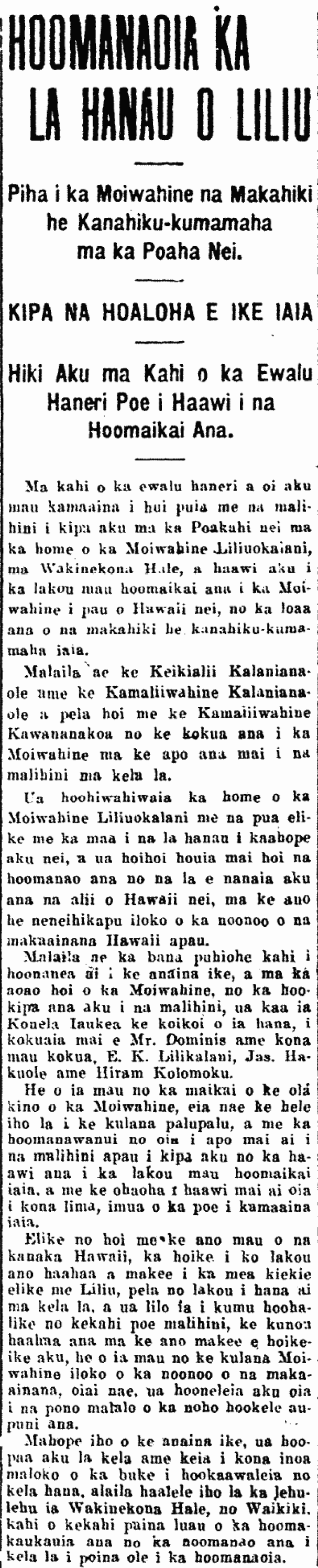
LILIU’S BIRTHDAY CELEBRATED

The Queen Made Seventy-Four This Thursday.

FRIENDS CAME TO SEE HER

Those Who Extended Their Congratulations Were About Eight Hundred.

About eight-hundred or more kamaaina and malihini went on Monday to the home of Queen Liliuokalani, Washington Place [Wakinekona Hale], and gave their congratulations to the former Queen of Hawaii nei, for her reaching seventy-four years in age.

Present was Prince Kalanianaole and Princess Kalanianaole and also Princess Kawananakoa, who were there to assist the Queen in welcoming the visitors on that day.

The Queen’s home was decorated in flowers as was customary on her birthdays in the past and memories were stirred up of days when the alii of Hawaii nei were viewed with majesty in the minds of all Hawaii’s people.

The band was there entertaining the visitors; and from the Queen’s side, to welcome the guests, the responsibility went to Colonel Iaukea, assisted by Mr. Dominis and his aids, E. K. Lilikalani, James Hakuole, and Hiram Kolomoku.

The Queen is still in good health, however she is becoming frail, yet with patience she welcomed all the guests who visited her to extend their congratulations, and delightedly she extended her hand before those with whom she was familiar.

Just as it is with Hawaiians, who show their deference and affection for their royalty, like Liliu; so they did on this day, and this was followed as an example by some of the malihini, who bowed deeply and with affection, showing that the Queen’s position remained the same in the minds of the people even if she is left without her rights in ruling the nation.

Following the audience, each person signed their name in the book set aside for this occasion, and then the crowd left Washington Place for Waikiki where a luau was prepared to celebrate that unforgettable day.

(Kuokoa, 9/6/1912, p. 1)

HOOMANAOIA KA LA HANAU O LILIU

Ka Nupepa Kuokoa, Buke XLVIII, Helu 36, Aoao 1. Sepatemaba 6, 1912.

More on Liliuokalani’s Birthday Celebration, 1912.

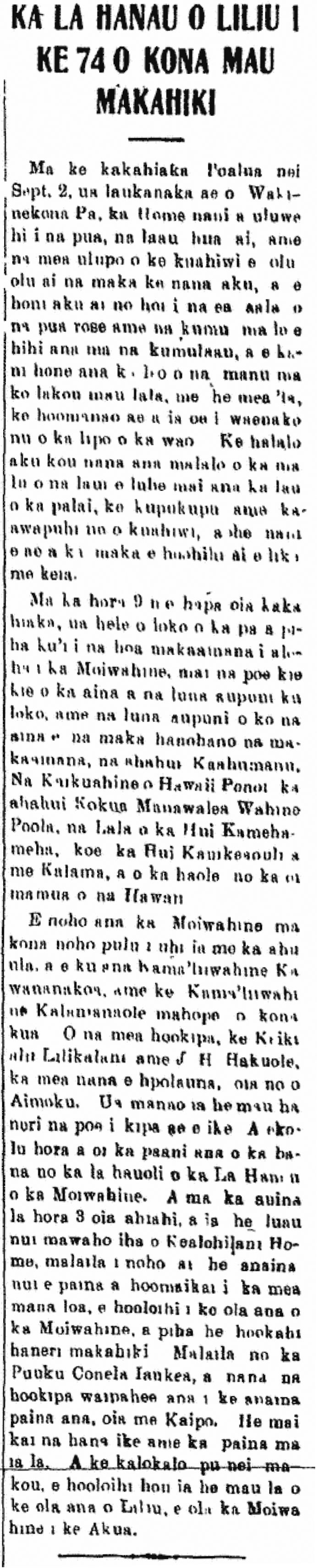
THE BIRTHDAY OF LILIU ON HER 74th YEAR

On this Tuesday morning, Sept. 2, the grounds of Washington Place was filled with people, the lovely Home verdant with flowers and fruit trees along with plants that grow densely in the mountains was wonderful to see; with the scent of rose blossoms and maile crawling on the trees as the birds called out sweetly on its branches—this all made you think that you were in the middle of the forest. Should your gaze fall below the shade of the ti leaves, it was lush with fronds of palai and kupukupu ferns and ginger from the mountains; there is no other beauty to entice the eyes equal to this.

At half past 9 on that morning, the estate was packed with the people who loved the Queen, from the high-ranking ones of the land; and the heads of local and foreign governments; dignitaries; citizens; the Kaahumanu Society [Ahahui Kaahumanu]; the Sisters of Hawaii Ponoi [Na Kaikuahine o Hawaii Ponoi]; the Charitable Association of Stevedore Wives [Ahahui Kokua Manawalea Wahine Poola ?]; the members of the Royal Order of Kamehameha [Hui Kamehameha], except for the Kauikeaouli Society and the Kalama; and the haole outnumbered the Hawaiians.

The Queen sat upon her cotton chair on which was draped a feather cloak [ahuula], and Princess Kawananakoa and Princess Kalanianaole stood behind her. The ones who did the welcoming were Prince Lilikalani and J. H. Hakuole, and the one who did introductions was Aimoku. It is believed that there were several hundreds that came to visit. And the band played for over three hours for this joyous day, the Birthday of the Queen. And in the afternoon at 3 o’clock, there was a great luau outside of Kealohilani Home, and there sat a large group who ate and gave thanks to the almighty, so that the Queen could live longer, reaching a hundred. Present indeed was the steward, Colonel Iaukea, and it was he that graciously welcomed the party guests along with Kaipo. The audience and the party that day went well. And we also pray that Liliu’s life may be increased more days; God save the Queen.

(Kuokoa Home Rula, 9/5/1912, p. 2)

KA LA HANAU O LILIU I KE 74 O KONA MAU MAKAHIKI

Kuokoa Home Rula, Buke X, Helu 36, Aoao 2. Sepatemaba 5, 1912.