Kaulilua… Mele inoa for Kamehameha IV, 1864.

[Excerpt found under: “A DIRGE FOR KING Alexander Kalanikualiholiho, Maka o Iouli, Kunuiakea o Kukailimoku, KAMEHAMEHA IV!”]

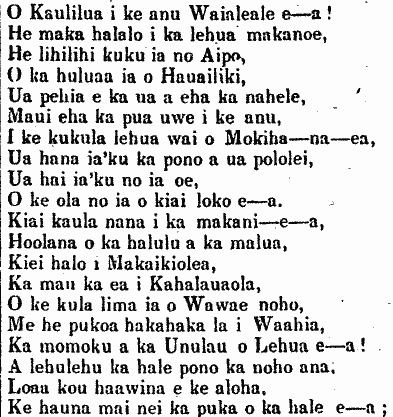
O Kaulilua i ke anu Waialeale e—a!
He maka halalo i ka lehua makanoe,
He lihilihi kuku ia no Aipo,
O ka huluaa ia o Hauailiki,
Ua pehia e ka ua a eha ka nahele,
Maui eha ka pua uwe i ke anu,
I ke kukula lehua wai o Mokiha—na—ea,
Ua hana ia’ku ka pono a ua pololei,
Ua hai ia’ku no ia oe,
O ke ola no ia o kiai loko e—a.
Kiai kaula nana i ka makani—e—a,
Hoolana o ka halulu a ka malua,
Kiei halo i Makaikiolea,
Ka mau ka ea i Kahalauaola,
O ke kula lima ia o Wawae noho,
Me he pukoa hakahaka la i Waahia,
Ka momoku a ka Unulau o Lehua e—a!
A lehulehu ka hale pono ka noho ana,
Loaa kou haawina e ke aloha,
Ke hauna mai nei ka puka o ka hale e—a;

[So many interesting things about this. The first and foremost perhaps is that this appears as part of an unusual kanikau for Alexander Liholiho Kamehameha IV in the form of a conversation between Kamehameha III (K III.) and himself (K IV.). Another is that if you hula, you probably learned this as a mele inoa for Kalakaua and not as one for Kamehameha IV. Does anyone know who it is that is labeled as (M.) in the conversation? Click here for a PDF of the issue with the rest of the piece on page 4.]

(Kuokoa, 1/23/1864, p. 4)

O Kaulilua i ke anu Waialeale e—a!

Ka Nupepa Kuokoa, Buke III, Helu 4, Aoao 4. Ianuari 23, 1864.

Another beautiful name song for Queen Kapiolani, still sung today, 1883.

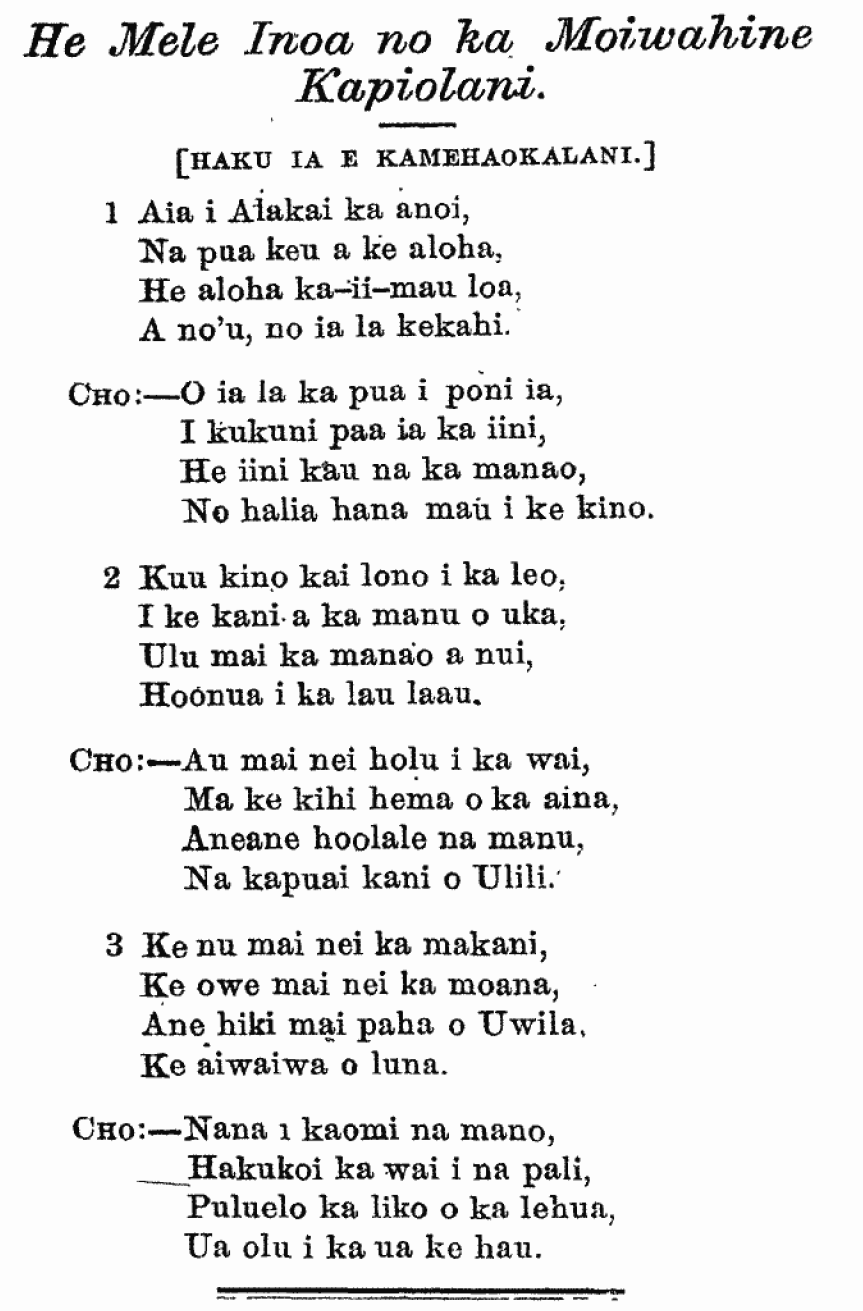
He Mele Inoa no ka Moiwahine Kapiolani.

[HAKU IA E KAMEHAOKALANI.]

1 Aia i Alakai ka anoi,
Na pua keu a ke aloha,
He aloha ka—ii—mau loa,
A no’u, no ia la kekahi.

Cho:—O ia la ka pua i poni ia,
I kukuni paa ia ka iini,
He iini kau na ka manao,
No halia hana mau i ke kino.

2 Kuu kino kai lono i ka leo,
I ke kani a ka manu o uka,
Ulu mai ka manao a nui,
Hoonua i ka lau laau.

Cho:—Au mai nei holu i ka wai,
Ma ke kihi hema o ka aina,
Aneane hoolale na manu,
Na kapuai kani o Ulili.

3 Ke nu mai nei ka makani,
Ke owe mai nei ka moana,
Ane hiki mai paha o Uwila,
Ke aiwaiwa o luna.

Cho:—Nana i kaomi na mano,
Hakukoi ka wai i na pali,
Puluelo ka liko o ka lehua,
Ua olu i ka ua ke hau.

[The mele in the newspapers need to be studied. Here, this one is credited to Kamehaokalani. Later on in 1897, in Edward C. Holstein’s “Ka Buke Mele o na Himeni Hawaii,” it is credited to Kamealoha. This book is available as a reprint from the Bernice Pauahi Bishop Museum.]

(Koo o Hawaii, 8/29/1883, p. 8)

He Mele Inoa no ka Moiwahine Kapiolani.

Ke Koo o Hawaii, Buke 1, Helu 2, Aoao 8. Augate 29, 1883.

The Kings of Hawaii, 1876.

This is from an issue of “The Friend,” which includes a short biography in English of the ruling monarchs of Hawaii nei, written by S. C. Damon. As for this page of illustrations, they say:

The illustrations accompanying this number of the Friend we could wish were better executed. The plate was made in New York, from the best photographs we could procure in Honolulu. The original of Kamehameha 1st was executed in 1817 by a Russian artist, who accompanied Kotzebue in his voyage, and may be seen by referring to the third volume of his voyage. The original of Kamehameha 2d was executed in England in 1824, in the style of the dress of George 4th’s reign. We think those of Kamehameha 3d, 4th and 5th are very good, but not quite so good those of Lunalilo or His Majesty Kalakaua.

[For the biographies, find them here: The Friend, February 1, 1876.

Although it is clunky to maneuver, most of this series of news letters is available from the Mission Houses Museum here: The Friend.]

(Friend, 2/1/1876, pp. 9–13)

[Monarchs]

The Friend, New Series, Volume 25, Number 2, Page unnumbered. February 1, 1876.

Hula and King Kalakaua’s 50th Jubilee, 1886.

THE LUAU FEAST AT THE PALACE GROUNDS.

Nov. 23, 1886.

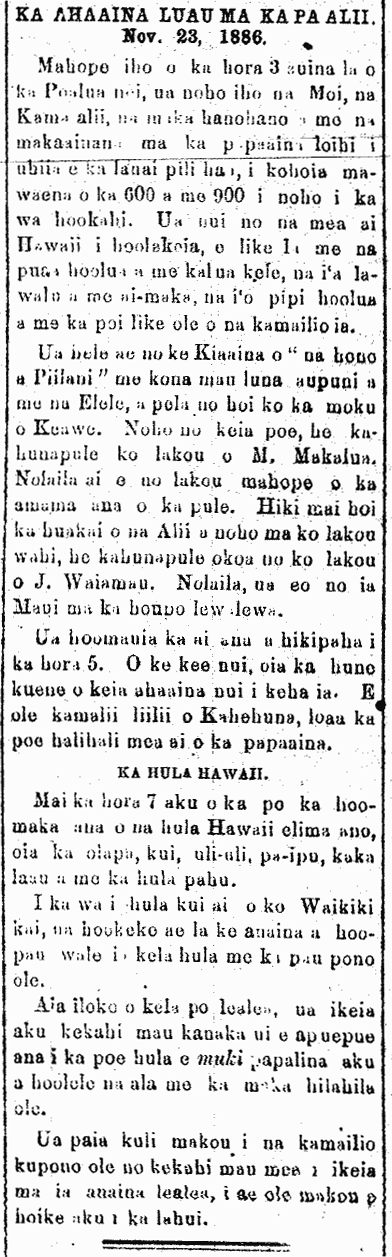
After 3 o’clock in the afternoon of this Tuesday, the King, the Princes and Princesses, the dignitaries, and the makaainana sat at a long table housed by a pavilion with corrugated iron roofing [lanai pili hao], which could sit an estimated 600 to 900 people at a time. There was much Hawaiian foods supplied, like laulau [puaa hoolua] and roasted pork [puaa kalua kele]; fish wrapped in ti leaves and baked [lawalu] and raw [ai-maka]; baked beef [i’o pipi hoolua] and all types of poi spoken of.

The Governor of the “bays of Piilani”¹ as well as his government officials and Delegates, along with those of the island of Keawe.² These people sat along with their pastor, M. Makalua. They began eating after the prayer was over. The entourage of the King and Queen arrived and sat in their area, and they had their own pastor, J. Waiamau. Therefore, Maui was victorious over their hunger [?? Nolaila, ua eo no ia Maui ma ka houpo lewalewa].

The eating continued perhaps until 5 o’clock. A big problem was the dearth of waiters for the grand feast that was boasted about. Thanks to the small children of Kahehuna [School], there were those to serve the food for the feast.

HAWAIIAN HULA.

From 7 o’clock in the night, Hawaiian hula of five types commenced, that being olapa, kui, uli-uli, pa-ipu, kaka laau, and hula pahu.

When those of Waikiki kai danced their hula kui, the audience complained, and that hula was put to an end without ending properly.

During that joyful night, some youths were seen attempting to get the dancers to kiss their cheeks, and to [?? hoolele na ala] without any sign of shame.

We were deafened by all the improper talk of some of the things seen in that partying crowd that we will not agree to tell the nation.

¹The governor of Maui was John Owen Dominis.

²The governor of Hawaii was Virginia Kapooloku Poomaikelani

(Ko Hawaii Pae Aina, 11/27/1886, p. 4)

KA AHAAINA LUAU MA KA PA ALII.

Ko Hawaii Pae Aina, Buke IX, Helu 48, Aoao 4. Novemaba 27, 1886.

More on Kaiulani buttons, 1899.

Kaiulani Souvenirs.

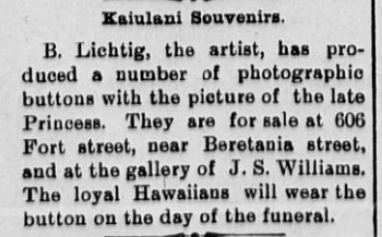
B. Lichtig, the artist, has produced a number of photographic buttons with the picture of the late Princess. They are fro sale at 606 Fort street, near Beretania street, and at the gallery of J. S. Williams. The loyal Hawaiians will wear the button on the day of the funeral.

[How is that for advertising? “The loyal Hawaiians will wear the buttons…”]

(Independent, 3/7/1899, p. 3)

Kaiulani Souvenirs.

The Independent, Volume VIII, Number 1142, Page 3. March 7, 1899.

Mourning of Princess Kaiulani, 1899.

KAIULANI BUTTONS.

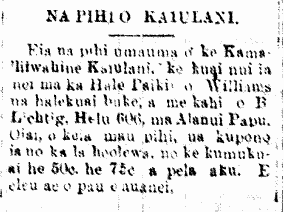
Buttons to be worn on the chest [pihi umauma] of Princess Kaiulani are being widely sold a the Photography Studio of Williams; at bookstores; and at B. Lichtig’s place, Number 606, Fort Street.  Being that these pins are perfect for the day of the funeral, for the price of 50¢, 75¢, and so forth. Be quick lest they sell out first.

[Has anyone seen examples of these?]

(Aloha Aina, puka pule, 3/18/1899, p. 1)

NA PIHI O KAIULANI.

Ke Aloha Aina (puka pule), Buke V, Helu 11, Aoao 1. Maraki 18, 1899.

More on Jane Loeau, 1867.

[Found under: “LOCAL NEWS: Hawaii.”]

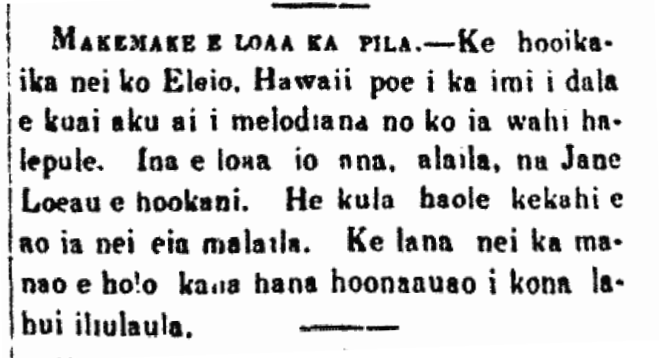
Instrument is sought after.—Eleio, Hawaii is putting effort into raising money to purchase a melodeon [melodiana] for its church house. If they should obtain one, then it will be Jane Loeau who will play it. An English school is also being taught by her there. It is hoped that her education effort for her dark-skinned [iliulaula] race will progress

(Kuokoa, 1/12/1867, p. 2)

Makemake e loaa ka pila.

Ka Nupepa Kuokoa, Buke VI, Helu 2, Aoao 2. Ianuari 12, 1867.

More stories about alalaua, 1873.

Alalauwa

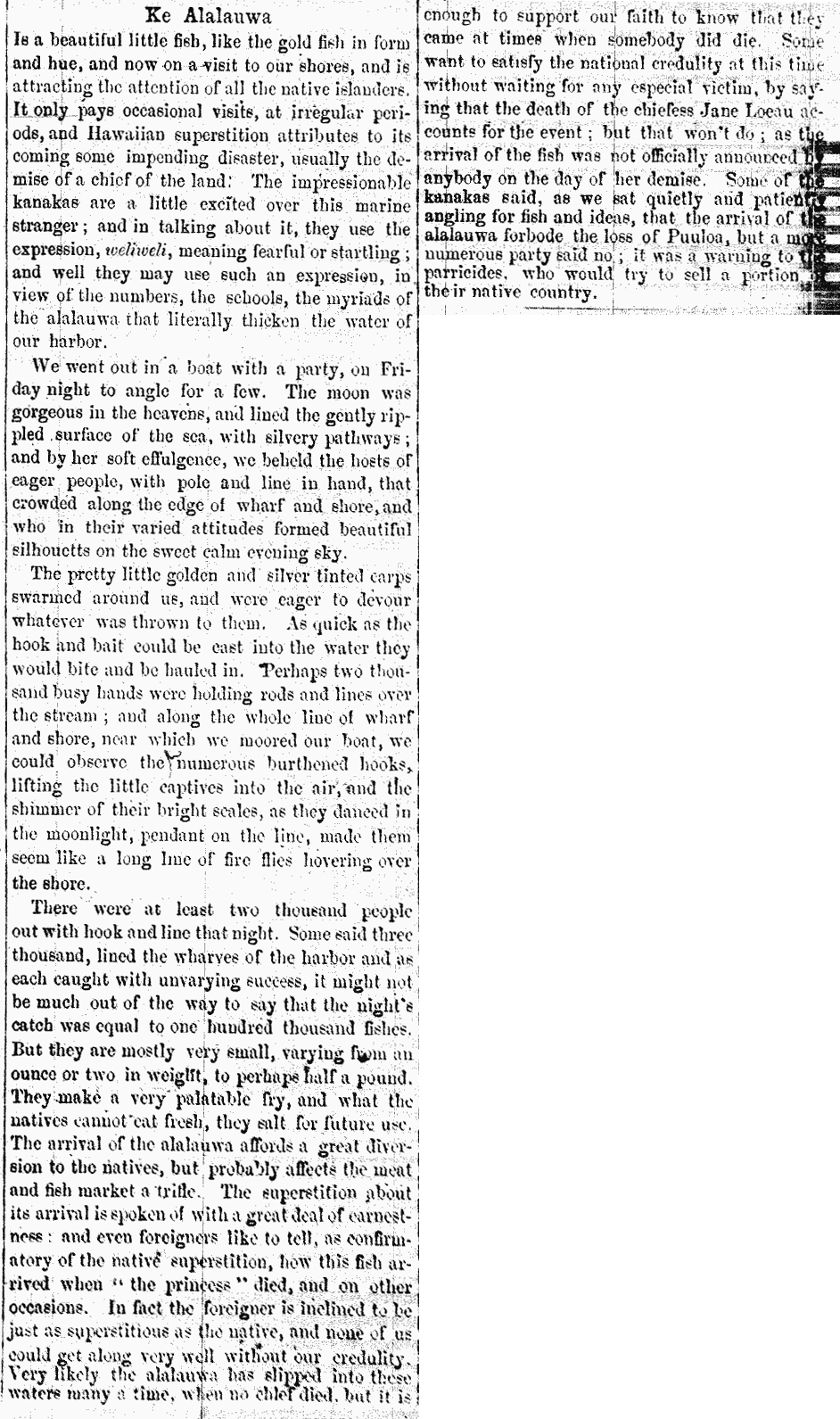
Is a beautiful little fish, like the gold fish in form and hue, and now on a visit to our shores, and is attracting the attention of all the native islanders. It only pays occasional visits, at irregular periods, and Hawaiian superstition disaster, usually the demise of a chief of the land. The impressionable kanakas are a little excited over this marine stranger; and in talking about it, they use the expression, weliweli, meaning fearful or startling; and well they may use such expression, in view of the numbers, the schools, the myriads of the alalauwa that literally thicken the water of our harbor.

We went out in a boat with a party, on Friday night to angle for a few. The moon was gorgeous in the heavens, and lined the gently rippled surface of the sea, with silvery pathways; and by her soft effulgence, we beheld the hosts of eager people, with pole and line in hand, that crowded along the edge of wharf and shore, and who in their varied attitudes formed beautiful silhouetts on the sweet calm evening sky.

The pretty little golden and silver tinted carps swarmed around us, and were eager to devour whatever was thrown to them. As quick as the hook and bait could be cast into the water they would bite and be hauled in. Perhaps two thousand busy hands were holding rods and lines over the stream; and along the whole line of wharf and shore, near which we moored our boat, we could observe the numerous burthened hooks, lifting the little captives into the air, and the shimmer of their bright scales, as they danced in the moonlight, pendant on the line, made them seem like a long line of fire flies hovering over the shore.

There were at least two thousand people out with hook and line that night. Some said three thousand, lined the wharves of the harbor and as each caught with unvarying success, it might not be much out of the way to say that the night’s catch was equal to one hundred thousand fishes. But they are mostly very small, varying from an ounce or two in weight, to perhaps half a pound. They make very palatable fry, and what the natives cannot eat fresh, they salt for future use. The arrival of the alalauwa affords great diversion to the natives, but probably affects the meat and fish market a trifle. The superstition about its arrival is spoken of with a great deal of earnestness: and even foreigners like to tell, as confirmatory of the native superstition, how this fish arrived when “the princess” died, and on other occasions. In fact the foreigner is inclined to be just as superstitious as the native, and none of us could get along very well without our credulity. Very likely the alalauwa has slipped into these waters many a time, when no chief died, but it is enough to support our faith to know that they came at times when somebody did die. Some want to satisfy the national credulity at this time without waiting for any especial victim, by saying that the death of the chiefess Jane Loeau accounts for the event; but that won’t do; as the arrival of the fish was not officially announced by anybody on the day of her demise. Some of the kanakas said, as we sat quietly and patiently angling for fish and ideas, that the arrival of the alalauwa forbode the loss of Puuloa,¹ but a more numerous party said no; it was a warning to the parricides, who would try to sell a portion of their native country.

¹Pearl Harbor

(Nuhou, 8/12/1873, p. 1)

Ke Alalauwa

Nuhou, Volume II, Number 9, Page 1. August 12, 1873.

Queen Kapiolani’s visit to the leprosy colony, 1884.

While the entire report should be read because it is all so telling, I think many will find “Report of Her Majesty Queen Kapiolani’s visit to Molokai, by H. R. H. Princess Liliuokalani, July, 1884.” found in the Appendix to the Report on Leprosy of the President of the Board of Health to the Legislative Assembly of 1886, pp. iii–xvii, very interesting for many reasons.