The current situation, 1893.

A VOICE OF ALOHA,

From the Queen, thus: O My beloved people, return to your homes, and keep the peace of the land. The voice of the alii has mana, and her command is in force. This is mana by which war will not be started; and the people will abide by her command.

The Overthrow of the Government.

This was an act that was planned in advance, and it is an act to gain glory. It’s foundation was laid by the group of missionaries and group of sugar planters, and on Jan. 17, 1893. Weapons were taken up, and the Government Building [Hale Aupuni] was seized by those treasonous ones.

The Annexation Committee.

There are five members of that Committee; They left, fled, and reached Washington; and they returned separately all with nothing to show and much embarrassment. [a hoi liiilii mai ana me na alaala pakahi ma ka a-i, he mai nui ka hilahila.]

The Deceitful Laws.

This Administration ended some parts of their bayonet constitution [kumukanawai elau-pu] of 1887, and enforced oppressive, limiting [?? paikole], and burdensome laws; these were laws not made by the Lahui, but by a group of just 17 people.

Bloodshed of Hawaiians.

There have been two Hawaiians whose blood has flowed unto the earth; they were shot with guns of the evil ones; However, they survived with their precious lives. It is God who spares Hawaii. This bloodshed of Hawaii’s own will become seeds from which will grow equal rights for the Lahui and the land. Rise together O Hawaii—and listen to the Gospel of Christ.

(Leo o ka Lahui, 10/13/1893, p. 2)

HE LEO ALOHA,

Ka Leo o ka Lahui, Buke II, Helu 790, Aoao 2. Okatoba 13, 1893.

Hawaiian Flag Handkerchiefs, 1893.

HAWAIIAN FLAG.

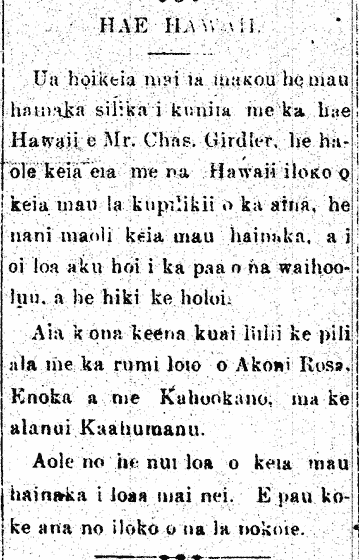
We were shown some silk handkerchiefs printed with the Hawaiian Flag by Mr. Charles Girdler; this is a haole, who is with the Hawaiians in the difficulties of the land these days; these are truly beautiful handkerchiefs, and because they are dyed color fast, they can be washed.

His tiny shop is next to the attorneys’ office of Akoni Rosa, Enoka, and Kahookano, on Kaahumanu Street. They will be gone in a few days.

(Leo o ka Lahui, 7/21/1893, p. 2)

HAE HAWAII.

Ka Leo o ka Lahui, Buke II, Helu 731, Aoao 2. Iulai 21, 1893.

Another beautiful patriotic mele by Eleanor Prendergast, 1893.

KE ALOHA AINA.

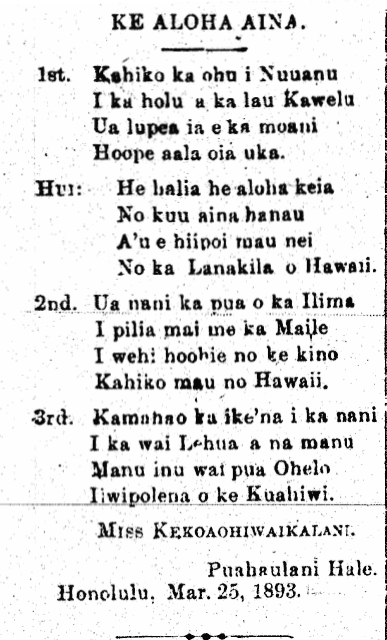
1st. Kahiko ka ohu i Nuuanu
I ka holu a ka lau Kawelu
Ua lupea ia e ka moani
Hoope aala oia uka.

Hui: He halia he aloha keia
No kuu aina hanau
A’u e hiipoi mau nei
No ka Lanakila o Hawaii.

2nd. Ua nani ka pua o ka Ilima
I pilia mai me ka Malie
I wehi hoohie no ke kino
Kahiko mau no Hawaii.

3rd. Kamahao ka ike’na i ka nani
I ka wai Lehua a na manu
Manu inu wai pua Ohelo
Iiwipolena o ke Kuahiwi.

Miss Kekoaohiwaikalani.

Puahaulani Hale.

Honolulu, Mar. 25, 1893.

(Leo o ka Lahui, 4/25/1893, p. 1)

KE ALOHA AINA.

Ka Leo o ka Lahui, Buke II, Helu 691, Aoao 1. Aperila 25, 1893.

Aloha Aina Ribbons! 1893

LIPINE ALOHA AINA.

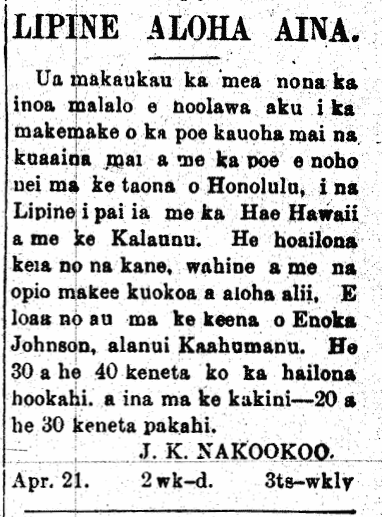
The person whose name appears below is ready to supply the orders of those from the country as well as those in the town of Honolulu for Ribbons printed with the Hawaiian Flag and the Crown. This is an insignia for men, women and children who prize their independence and who have aloha for their alii. I can be found at the office of Enoka Johnson on Kaahumanu Street. Each insignia is 30 or 40 cents each, and by the dozen, it is 20 or 30 cents each.

J. K. NAKOOKOO.

[Might anyone know if there are extant Aloha Aina Ribbons? This is something I want to see!]

(Leo o ka Lahui, 4/25/1893, p. 3)

LIPINE ALOHA AINA.

Ka Leo o ka Lahui, Buke II, Helu 691, Aoao 3. Aperila 25, 1893.

“Peacock Government,” 1894.

THE PEACOCK GOVERNMENT [AUPUNI PIKAKE].

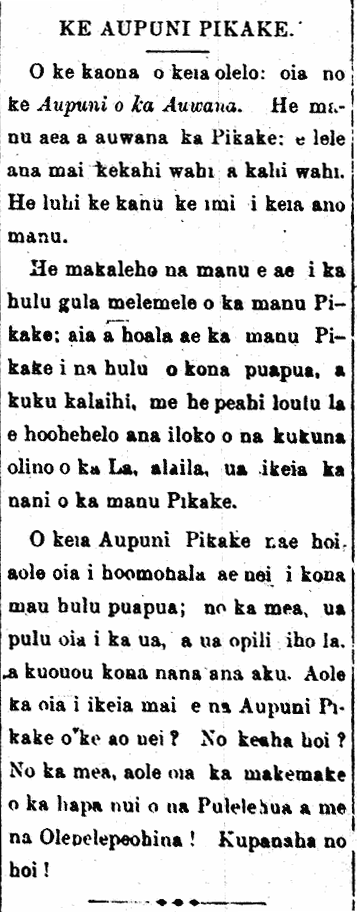
The concealed reference [kaona] of this term: that is a Wandering Government. The Peacock is a bird that is shiftless and a wanderer: it flies from one place to another. A keeper will grow weary looking for this kind of bird.

The other birds are covetous of the golden-yellow feathers of the Peacock; when the Peacock raises its tail feathers and they stand rigid like a loulu fan that shines brightly in the dazzling rays of the Sun, it is then that the beauty of the Peacock is seen.

This Peacock Government however has not spread out its tail feathers, because it is wet and numbed by the rain, and it appears droopy [? kuouou]. It is not recognized by the world’s Peacock Governments. Why is that? Because it is not favored by most of the Butterflies [Pulelehua] and Monarch Butterflies [Olepelepeohina]! How very amazing!

[Who is the Pikake? Who are the Pulelehua and the Olepelepeohina?]

(Leo o ka Lahui, 7/6/1894, p. 2)

KE AUPUNI PIKAKE.

Ka Leo o ka Lahui, Buke II, Helu 977, Aoao 2. Iulai 6, 1894.

A patriotic mele criticizing the Rev. Joseph S. Emerson, 1893.

THE KAPUUKOLO CHURCH SCANDAL.

There is a saintly son of a gun,
Whose name is J. S. Emerson,
Who goes about in pious style,
To ease his anti-monarch bile.
And enters with his devout brother,
Hawaiian’s meeting: tries to smother,
All aloha for their Queen and land,
By fairy tales of witchcraft brand.
And sweetly says: “My christian friends,
“In order now to gain our ends,
“Will you ally yourselves with one,
“Who being but a native son.
“Has dared to infringe the haole’s plan
“And makes himself (deceitful man)
“The priest of God and Baal too?
“Shall such associate with you?
“Perish the thought! No! brethren dear,
“Not though my father’s sons, ’tis clear,
“Have robbed you of your lands and living,
“And taught you not that way to heaven.
“We’ll sweetly sing, in chorus clear
“The haole takes the government here
“Having taken all else, and let your Queen,
“Rely on none who here are seen.
“Associate she with heathens foul,
“Pig, kahunas, chickens, awa bowl!
“Shall such be helped with christian prayer,
“And our God asked for her to care.”
He stayed his speech and called for votes,
The answer from indignant throats,
Came fast and furious on his ears:
“Take out from here your lying sneers.
“Hypocrite! usurper! rebel! beast!
“Such words become your family least,
“Who live on what the royal hand,
“Gave bounteous of Waialua’s land.
“As pay for early prayer and praise,
“Raised by your father in those days,
“When missionaries first came here,
“And taught us a new God to fear.
“Go, hound! unto your wealthy home,
“Reflect on whence your creature comforts come,
“Think if you can what doom will be,
“Ingratitude’s God will bring to thee.
“Hide your grey locks in deepest shame
“Let another take your father’s name,
“Go, and ne’er again pollute,
“This sacred place with your foul boot.”
They went: None blessed their homeward way:
All seemed relieved: Arose the lay,
Of praise to God: and all agree,
To pray for Queen and Hawaii.

[Here is an article with descriptions of what led to this mele.]

(Hawaii Holomua, 2/11/1893, p. 4)

THE KAPUUKOLO CHURCH SCANDAL.

Hawaii Holomua, Buke III, Helu 7, Aoao 4. Feberuari 11, 1893.

Joseph Emerson interrupts meeting at the Kapuukolo Church, 1893.

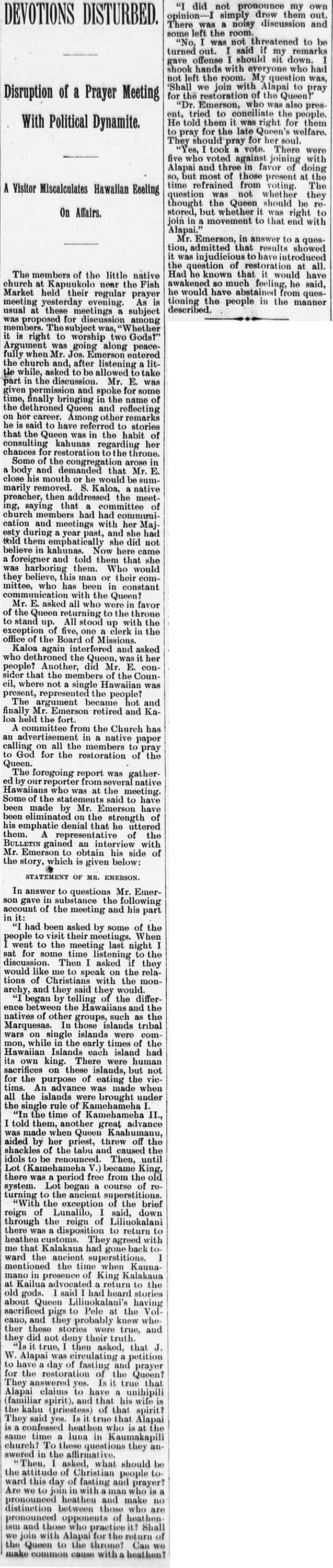
DEVOTIONS DISTURBED.

Disruption of a Prayer Meeting With Political Dynamite.

A Visitor Miscalculates Hawaiian Feeling On Affairs.

The members of the little native church at Kapuukolo near the Fish Market held their regular prayer meeting yesterday evening. As is usual at these meetings a subject was proposed for discussion among members. The subject was, “Whether it is right to worship two Gods?” Argument was going along peacefully when Mr. Jos. Emerson entered the church and, after listening a little while, asked to be allowed to take part in the discussion. Mr. E. was given permission and spoke for some time, finally bringing in the name of the dethroned Queen and reflecting on her career. Among other remarks he is said to have referred to stories that the Queen was in the habit of consulting kahunas regarding her chances for restoration to the throne.

 Some of the congregation arose in a body and demanded that Mr. E. close his mouth or he would be summarily removed. S. Kaloa, a native preacher, then addressed the meeting, saying that a committee of church members had had communication and meetings with her Majesty during a year past, and she had told them emphatically she did not believe in kahunas. Now here came a foreigner and told them that she was harboring them. Who would they believe, this man or their committee, who has been in constant communication with the Queen?

Mr. E. asked all who were in favor of the Queen returning to the throne to stand up. All stood up with the exception of five, one a clerk in the office of the Board of Missions.

Kaloa again interfered and asked who dethroned the Queen, was it her people? Another, did Mr. E. consider that the members of the Council, where not a single Hawaiian was present, represented the people?

The argument became hot and finally Mr. Emerson retired and Kaloa held the fort.

A committee from the Church has an advertisement in a native paper calling on all the members to pray to God for the restoration of the Queen.

The foregoing report was gathered by our reporter from several native Hawaiians who was at the meeting. Some of the statements said to have been made by Mr. Emerson have been eliminated on the strength of his emphatic denial that he uttered them. A representative of the Bulletin gained an interview with Mr. Emerson to obtain his side of the story, which is given below:

STATEMENT OF MR. EMERSON.

In answer to questions Mr. Emerson gave in substance the following account of the meeting and his part in it:

 “I had been asked by some of the people to visit their meetings. When I went to the meeting last night I sat for some time listening to the discussion. Then I asked if they would like me to speak on the relations of Christianity with the monarchy, and they said they would.

“I began by telling of the difference between the Hawaiians and the natives of other groups, such as the Marquesas. In those islands tribal wars on single islands were common, while in the early times of the Hawaiian Islands each island had its own king. There were human sacrifices on these islands, but not for the purpose of eating the victims. An advance was made when all the islands were brought under the single rule of Kamehameha I.

“In the time of Kamehameha II., I told them, another great advance was made when Queen Kaahumanu, aided by her priest, threw off the shackles of the tabu and caused the idols to be renounced. Then, until Lot (Kamehameha V.) became King, there was a period free from the old system. Lot began a course of returning to the ancient superstitions.

“With the exception of the brief reign of Lunalilo, I said, down through the reign of Liliuokalani there was a disposition to return to heathen customs. They agreed with me that Kalakaua had gone back toward the ancient superstitions. I mentioned the time when Kaunamano in the presence of King Kalakaua at Kailua advocated a return to the old gods. I said I had heard stories about Queen Liliuokalani’s having sacrificed pigs to Pele at the Volcano, and they probably knew whether these stories were true, and they did not deny their truth.

“Is it true, I then asked, that J. W. Alapai was circulating a petition to have a day of fasting and prayer for the restoration of the Queen? They answered yes. Is it true that Alapai claims to have a unihipili (familiar spirit), and that his wife is the kahu (priestess) of that spirit? They said yes. Is it tre that Alapai is a confessed heathen who is at the same time a luna in Kaumakapili church? To these questions they answered in the affirmative.

“Then, I asked, what should be the attitude of Christian people toward this day of fasting and prayer? Are we to join in with a man who is a pronounced heathen and make no distinction between those who are pronounced opponents of heathenism and those who practice it? Shall we join with Alapai for the return of the Queen to the throne? Can we make common cause with a heathen?

“I did not pronounce my own opinion—I simply drew them out. There was a noisy discussion and some left the room.

“No, I was not threatened to be turned out. I said if my remarks gave offense I should sit down. I shook hands with everyone who had not left the room. My question was, ‘Shall we join with Alapai to pray for the restoration of the Queen?’

“Dr. Emerson, who was also present, tried to conciliate the people. He told them it was right for them to pray for the late Queen’s welfare. They should pray for her soul.

“Yes, I took a vote. There were five who voted against joining with Alapai and three in favor of doing so, but most of those present at the time refrained from voting. The question was not whether they thought the Queen should be restored, but whether it was right to join in a movement to that end with Alapai.”

Mr. Emerson, in answer to a question, admitted that results showed it was injudicious to have introduced the question of restoration at all. Had he known that it would have awakened so much feeling, he said, he would have abstained from questioning the people in the manner described.

[This article was translated in Leo o ka Lahui, 2/9/1893, p. 2. It is interesting that there is a note appended to the end of the translated article that they did not have time to translate Emerson’s response.]

(Daily Bulletin, 2/7/1893, p. 3)

DEVOTIONS DISTURBED.

The Daily Bulletin, Volume V, Number 644, Page 3. February 7, 1893.
Henry Berger’s 50th birthday, and commentary on eating stones, 1894.

Celebrating Fifty Years

This past Saturday, at 7:30, a joint concert was held with the Hawaiian Republic band and the band of the Philadelphia, on the grounds of the Hawaiian Hotel to commemorate the birthday of the bandmaster of the Government, who is 50 years old. That night was the 4664th time he gave concerts in various locations, and this is his 500th at that place. The Government band went first, and when they were through, then there were singers of haole songs chosen from a non-Hawaiian singing group from the uplands of Leiolono, and then came the boys of the sea [from the Philadelphia]. When that was over, the two groups joined together for the ending, and that was the conclusion of the activities of the night. The band stage was illuminated by electric lights and all sorts of Japanese lanterns under tree branches. Continue reading

On eating stones, 1894.

[Found under: “KELA A ME KEIA.”]

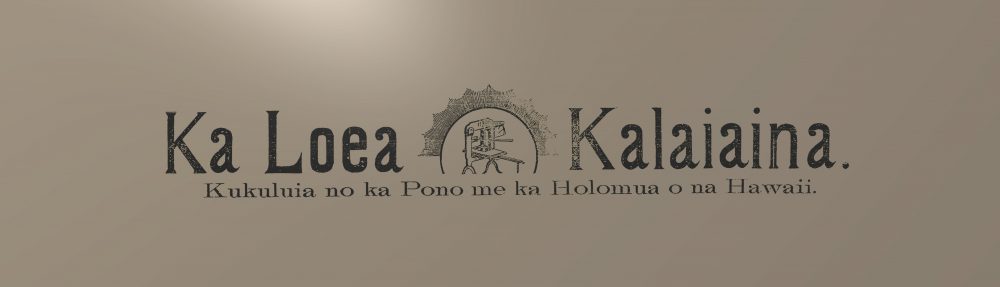
Because of the music of the boys of the Hawaiian band is constantly being of much acclaim, so to them went the jobs of entertaining parties of the haole of ours this past week. The P. G. band was not called for. They live, and do not have to eat stones. The visitors at the Hawaiian Hotel are those who want them the most.

[It was said that when the members of the Royal Hawaiian Band refused to sign an oath of allegiance to the P. G. The bandmaster Henry Berger told them they would end up eating stones… I cannot find a quote from the time. Does anyone know of one?]

(Makaainana, 10/15/1894, p. 8)

Mamuli o ke ohohia...

Ka Makaainana, Buke II—Ano Hou, Helu 16, Aoao 8. Okatoba 15, 1894.

Royal Hawaiian Band and “Kaulana na Pua,” 1893.

NIGHT OF GREAT ENTERTAINMENT.¹

There were many people who arrived at the Night of Entertainment by the Royal Hawaiian Band [Bana Lahui Hawaii], at the Hawaiian Hotel on the evening of this past Tuesday. There were perhaps 5,000 people of all ethnicities who showed up to listen to those beautiful singers of Hawaii. Because of your fine work, O Patriots, therefore the lahui showed its appreciation to you all, with them always filling the audiences of all the performances you give. The singing voices were sweet, and the most acclaimed was your “Mele Ai Pohaku.” The audience went home with happy hearts because of the mele that were played, along with the singing. When will the next performance be? Send in a notice in advance, and we will inform the multitudes and the friends of the occasion.

¹”Ka Po Lea o Halalii.”

(Leo o ka Lahui, 10/12/1893, p. 2)

KA PO LEA O HALALII.

Ka Leo o ka Lahui, Buke II, Helu 789, Aoao 3. Okatoba 12, 1893.