DEATH.
On the 20th of July, Toma Manono died at Waimea, Kauai. Manono was an alii; he was with Kekuaokalani folks when they were fighting at Kuamoo. Continue reading

DEATH.
On the 20th of July, Toma Manono died at Waimea, Kauai. Manono was an alii; he was with Kekuaokalani folks when they were fighting at Kuamoo. Continue reading
THE HEIAU OF KAMAIKO, NEAR NAPOOPOO, WHERE A. GARTLEY AND C. H. COOKE RECENTLY DISCOVERED THE SKULLS OF PRIEST AND THEIR FOLLOWERS SAID TO HAVE BEEN EXECUTED AT THE HEIAU ABOUT THE TIME THE TABUS WERE ABOLISHED.
(PCA, 3/25/1908, p. 1)
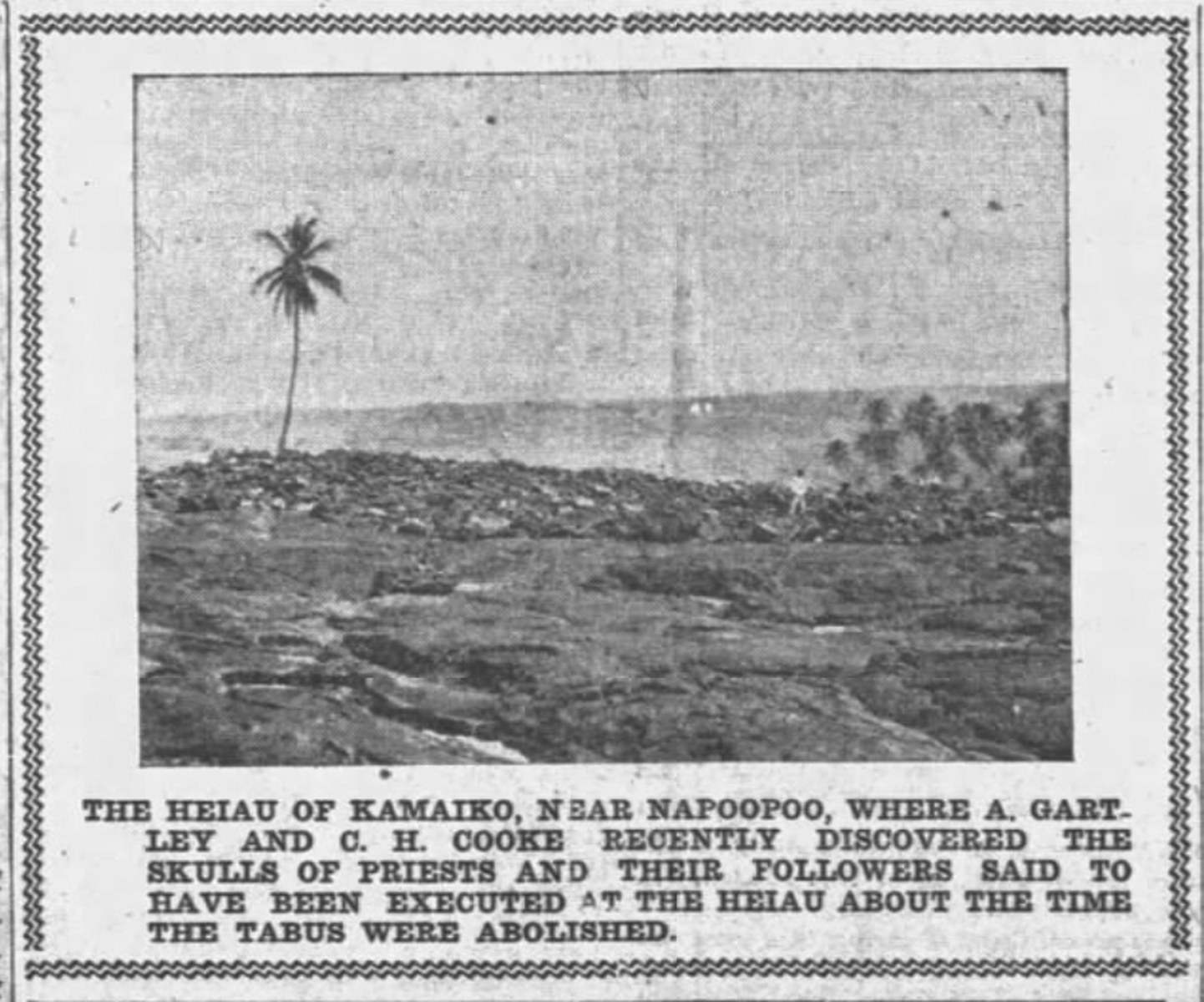
The Pacific Commercial Advertiser, Volume XLVII, Number 7995, Page 1. March 25, 1908.
A. Gartley and C. H. Cooke Find Many Skulls and Skeletons at the Kamaiko Heiau in Kona, All in Good Preservation.
A Gartley and C. H. Cooke made a most interesting discovery in connection with the Kamaiko heiau of the district of Keei, in South Kona, on their recent visit to the Big Island. Continue reading
At Keei, Kona, Found were Many Human Skulls and Bones.
Upon the return of Mr. A. Gartley and C. H. Cook [C. H. Cooke] from their excursion to South Kona, Hawaii, they said that when they went to look at Kamaiko Heiau at Keei, they found many human bones in the heiau.
It is conjectured that the reason there are many human skulls and their bones there is because their lives were sacrificed in this heiau when the kapu system [ka noho ame ka ai kapu ana] was abolished. Continue reading
O Friends, Companions, those who go hand in hand with the Leo, who walk together on the sands of Kakuhihewa moistened by the Kukalahale rains, living from Maunalua to Moanalua. Greetings to you all.
Remember the title above, “I nui ke aho.” This is one of the touching statements said by our Land Conqueror [Na’i Aina], when one of his warriors was pierced by a barbed spear; when he saw this predicament, he grabbed and pulled the spear, and that is when the warrior cried out in pain. But that conqueror of aina responded quickly while shedding tears, “My son, be patient.” Continue reading
The years 1775, 1776, 1777, 1778, and 1778. Kalaniopuu went to war at Kaupo on Maui, with his Alii, his war Officers, and his soldiers. Kalaniopuu first went to war at Kaupo, and he tortured the makaainana of Kaupo by clubbing their foreheads with his war club [newa]. This battle was called Kalaehohoa [“Clubbing-of-the-Forehead”] Continue reading
These passing days, the Board of Trade of Hilo [Papa o ka Hui Kalepa o Hilo] is considering moving the Naha Stone [Na-ha Pohaku] from where it now is placed and putting it by the Library of the Hilo Town, and the Editor of the Hoku o Hawaii [S. L. Desha] was asked to tell of some things pertaining to this Royal Stone, and which were contained in the old history of this land, and that will become something for the Natives of this land to understand things about the history of this Birth Stone of the Alii of the Naha Class.
The Naha Stone spoken of in this story is the great Pohaku that is lies in Piihonua in Hilo Town on the Hilo side of Waianuenue Avenue, and is in front of the first house foundation of Governor Kipi of Hilo, and that place is named after an old Heiau called “Pinao.”
In the history of this Royal Stone, it is said that the Pohaku was brought from the Wailua River on Kauai, and it was brought upon double-hulled canoes, and it was brought by a high Chief of long ago named MAKALIINUIKUAKAWALE (m), and this pohaku was brought as a sign of chiefly births and this Pohaku Alii was placed before the Pinao Heiau. Continue reading
106. A cloak said to have been destroyed in the conflagration caused accidentally in the attempt of the Board of Health to stamp out the bubonic plague in the Chinese quarter of Honolulu. At the time when the claims for losses caused by this great fire were presented to the Commission appointed for the purpose, my assistant, Mr. Allen M. Walcott, obtained from the claimant, Peleioholani, a carpenter by trade, the following particulars: The cloak was called “Eheukani” and was made in the time of Keeaumoku (the father of Kaahumanu) and finished shortly before the battle of Mokuohai (July, 1782) between Kamehameha and Kiwalaó. Keeaumoku’s wife gave it to Peleioholani’s grandmother. Principally mamo* feathers with a small crescent of red iiwi in each upper corner; between the shoulders a round spot of black oo feathers, from which a line of red iiwi led down to a trifle below the middle of the cloak. The cords at the neck were of human hair, an unusual thing. It must be remembered that the design (Fig. 16) as well as the following measurements are from the description given to Mr. Walcott by Peleioholani and are of course only approximate. They are worth recording as differing from any robes described. Length, about 4 feet 9 inches; neck measurment about 2 feet; circumference at bottom about 5 feet 8 inches. It is a matter of tradition that 27,000 birds were captured to furnish the feathers for this cloak. In the left side were seven spear holes that were never patched, and about which were blood stains. Keeaumoku was severely wounded in this battle, and it was rather a fancy with the old chiefs to retain the honorable scars in the ahuula, as in the cloak given by Kamehameha to Vancouver to be taken to England for King George.
[And a note on the note by Brigham. I am not sure the oo instead of mamo feathers comment should be considered true when even the great mamo feather ahuula of Kamehameha Paiea has red iiwi feathers within it…]
(Brigham, William T. Additional Notes on Hawaiian Featherwork. Honolulu: Bishop Museum Press, 1903. pp. 15–16.)
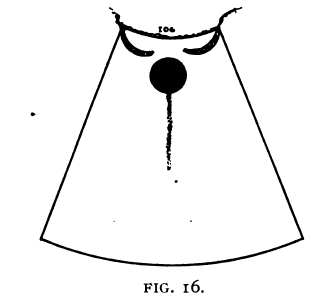
Brigham, William T. Additional Notes on Hawaiian Featherwork. Honolulu: Bishop Museum Press, 1903. p. 17.
At Waiakea Kai, Hilo, an old man just died whose name was Kaa kea, on Thursday last, at 110 years old. It is not exactly known when he was born, however, he stated that he was 30 years old when Kamehameha I died. He joined in the battles of Kamehameha I, and at the last battle in Kona. At the death of the king, he slashed a mark like a moo on his forehead, and he lived with this mark until his death.
(Aloha Aina, 2/14/1898, p. 7)
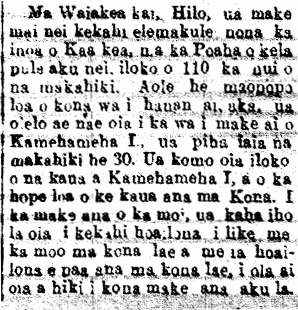
Ke Aloha Aina, Buke IV, Helu 7, Aoao 7. Feberuari 12, 1898.
 nupepa