Fred Malulani Beckley Kahea passing on traditional knowledge, 1922.

[Found under: “Nuhou Kuloko”]

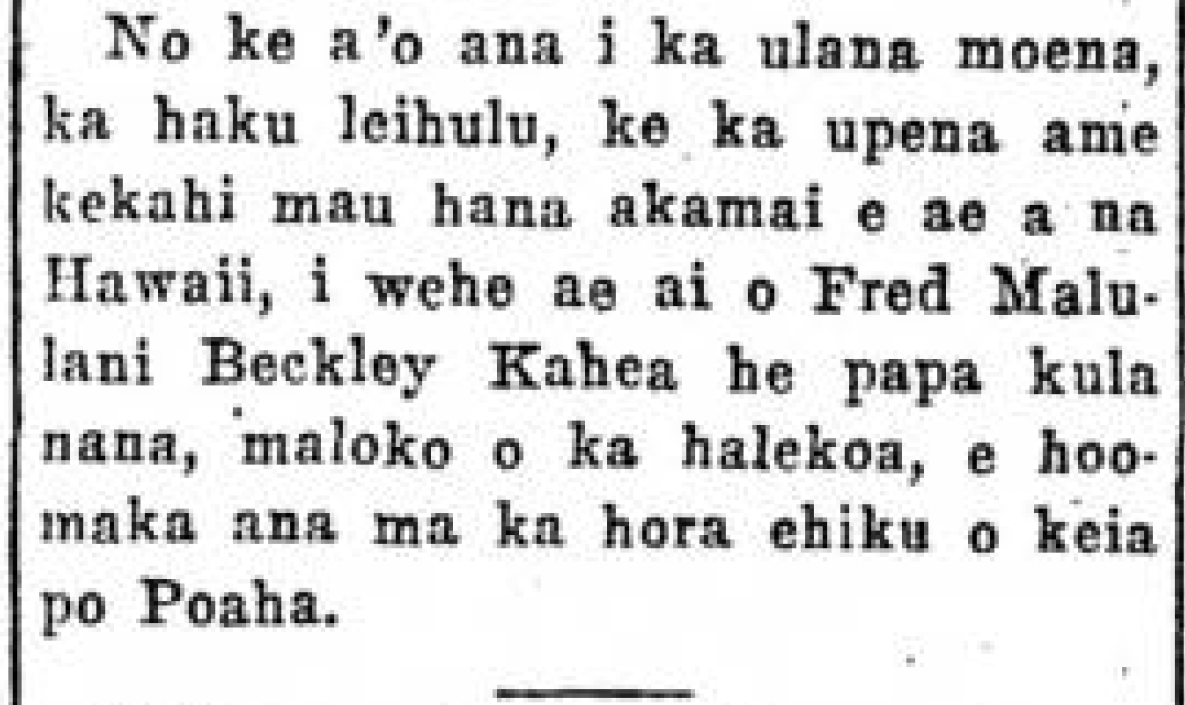
In order to teach mat weaving [ulana moena], feather lei making [haku lei hulu], net tying [ka upena], and other Hawaiian skills, Fred Malulani Beckley Kahea initiated himself a class in the armory, beginning at seven o’clock this Thursday night.

[I was reminded of this article by the recent post by Nanea Armstrong-Wassel about Fred Malulani Beckley Kahea and traditional featherworkers.

F. M. B. Kahea not only taught his class at the armory, but he also was the sharing his knowledge in the construction of kahili when they were made for Governor Farrington in 1928.]

(Kuokoa, 12/7/1922, p. 8)

No ke a'o ana...

Ka Nupepa Kuokoa, Buke LXI, Helu 49, Aoao 8. Dekemaba 7, 1922.

O ko’u aupuni, he aupuni palapala ko’u, 1837.

From the Salem Gazette.

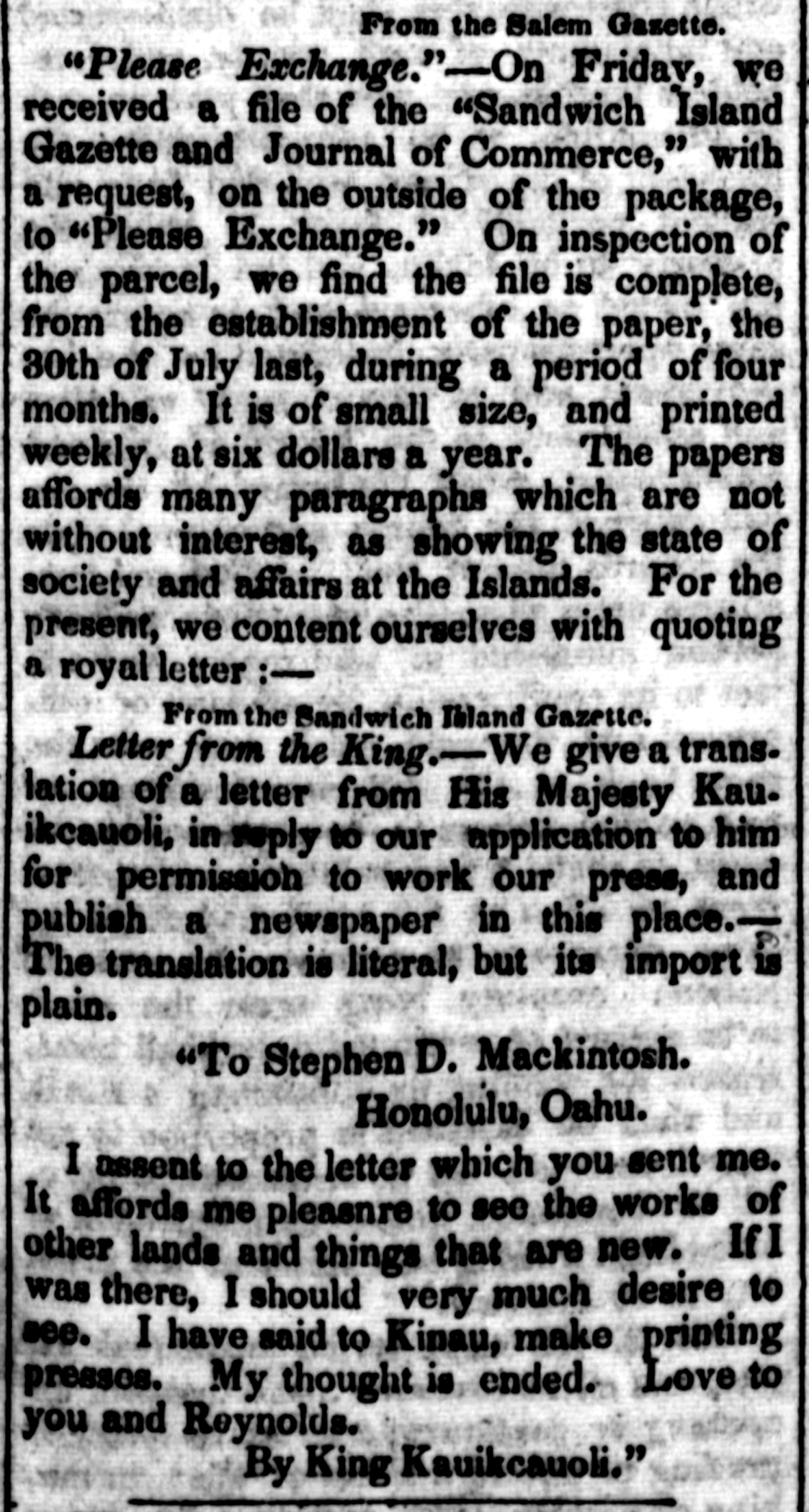
Please Exchange.”—On Friday, we received a file of the “Sandwich Island Gazette and Journal of Commerce,” with a request, on the outside of the package, to “Please Exchange.” On inspection of the parcel, we find the file is complete, from the establishment of the paper, the 30th of July last, during a period of four months. It is of small size, and printed weekly, at six dollars a year. The papers affords many paragraphs which are not without interest, as showing the state of society and affairs at the Islands. For the present, we content ourselves with quoting a royal letter:—

From the Sandwich Island Gazette.

Letter from the King.—We give a translation of a letter from His Majesty Kauikeauoli [Kauikeaouli], in reply to our application to him for permission to work our press, and publish a newspaper in this place.—The translation is literal, but its import is plain.

“To Stephen D. Mackintosh.

Honolulu, Oahu.

I assent to the letter which you sent me. It affords me pleasure to see the works of other lands and things that are new. If I was there, I should very much desire to see. I have said to Kinau, make printing presses. My thought is ended. Love to you and Reynolds.

By King Kauikeauoli.”

[This was a pretty exciting find. Kamehameha III proclaimed that his kingdom would be a kingdom of reading and writing. And indeed it was. Kamehameha III encourages the printing of newspapers, and here he writes, “If I was there…” because it seems he was in Kailua, Hawaii at the time, while the newspaper was to be printed in Honolulu. Unfortunately, The Sandwich Island Gazette and Journal of Commerce which ran from 7/30/1836 to 7/27/1839 is not available online at Chronicling America as of yet.

For more on this first English newspaper in Hawaii nei, see “Hawaii’s first English Newspaper and Its Editor,” by Helen P. Hoyt, appearing in the Annual Report of the Hawaiian Historical Society in 1954.]

(Constantine Republican, 5/31/1837, p. 2)

From the Salem Gazette.

Constantine Republican, Volume I, Number 48, page 2. May 31, 1837.

Belina Elizabeth, Sacred Hearts teacher passes on, 1894.

A Catholic Nun Dies.

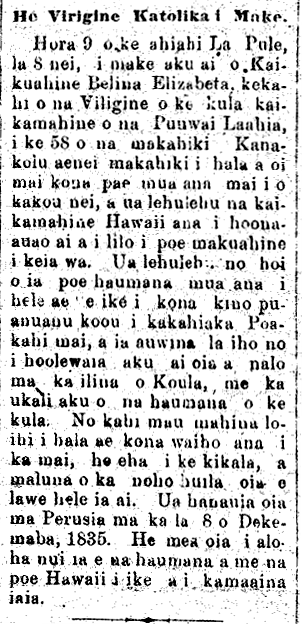
At 9 o’clock in the evening on this past Sunday, the 8th, Sister Belina Elizabeth, one of the Nuns [Viligine] at Sacred Hearts girls’ school, at 58 years old. It was thirty or more years ago that she first landed here amongst us, and there have been numerous Hawaiian girls who were taught by her and who have become mothers today. And many of those early students of hers came to see her cold, clammy [i am sure there is a much better image for “koou”!] remains in the morning of the following Monday, and that evening, her funeral was held, and at the Koula Cemetery she was no more to be seen, accompanied by the students of the school. For many months she was ill with pains in her hip, and she was taken around on a wheelchair [noho huila]. She was born in Persia [Perusia] on the 8th of December, 1835. She was greatly beloved by the students, and by the Hawaiians who knew her and were close to her.

(Makaainana, 4/16/1894, p. 1)

He Virigine Katolika i Make.

Ka Makaainana, Buke I—-Ano Hou, Helu 16, Aoao 1. Aperila 16, 1894.


More news from Kamehameha Schools as reported by the students, 1944.

[Found under: “News From Boys, Girls Kamehameha School”]

By BARRY ONTAI

———

Ilona Momilani, a baby girl was welcomed into the family of Mr. and Mrs. Folinga Faufata on March 10.

The baby’s father, a graduate of Kamehameha with the class of 1935, is now an engineer at a power plant in Pearl Harbor.

The Fafatas reside on Kaunaoa Street in Kapahulu. Barbara, the eldest daughter, attends the Kamehameha kindergarten.

———

The Saturday night activities for the student body on April 22, were calling and movies.

The senior division enjoyed dancing and a social gathering which began at 7:30 o’clock in the common room of Lunalilo hall.

Two color movies were shown to the junior division at the school for boys’ assembly hall.

“A Victory”, a picture filmed for the Junior Police Officers on the K.S.B. campus, featured Samuel Fontaine, brother of David Fontaine, low-eleventh student at K.S.B., and James Noa, a ninth grader at the school for boys.

In the second feature, “Make Way for Victory”, two boys of the Preparatory department, Kealoha Coleman and Kui Lee, had leading roles. There were also dances by the preparatory pupils directed by Mrs. Mary K. Pukui and Mrs. Lei Hapai.

These pictures were filmed in color by George Tahara, a student at the University of Hawaii. He has also made two previous showings to Kamehameha audiences. Continue reading

St. Louis School, 1880.

The New Catholic School.

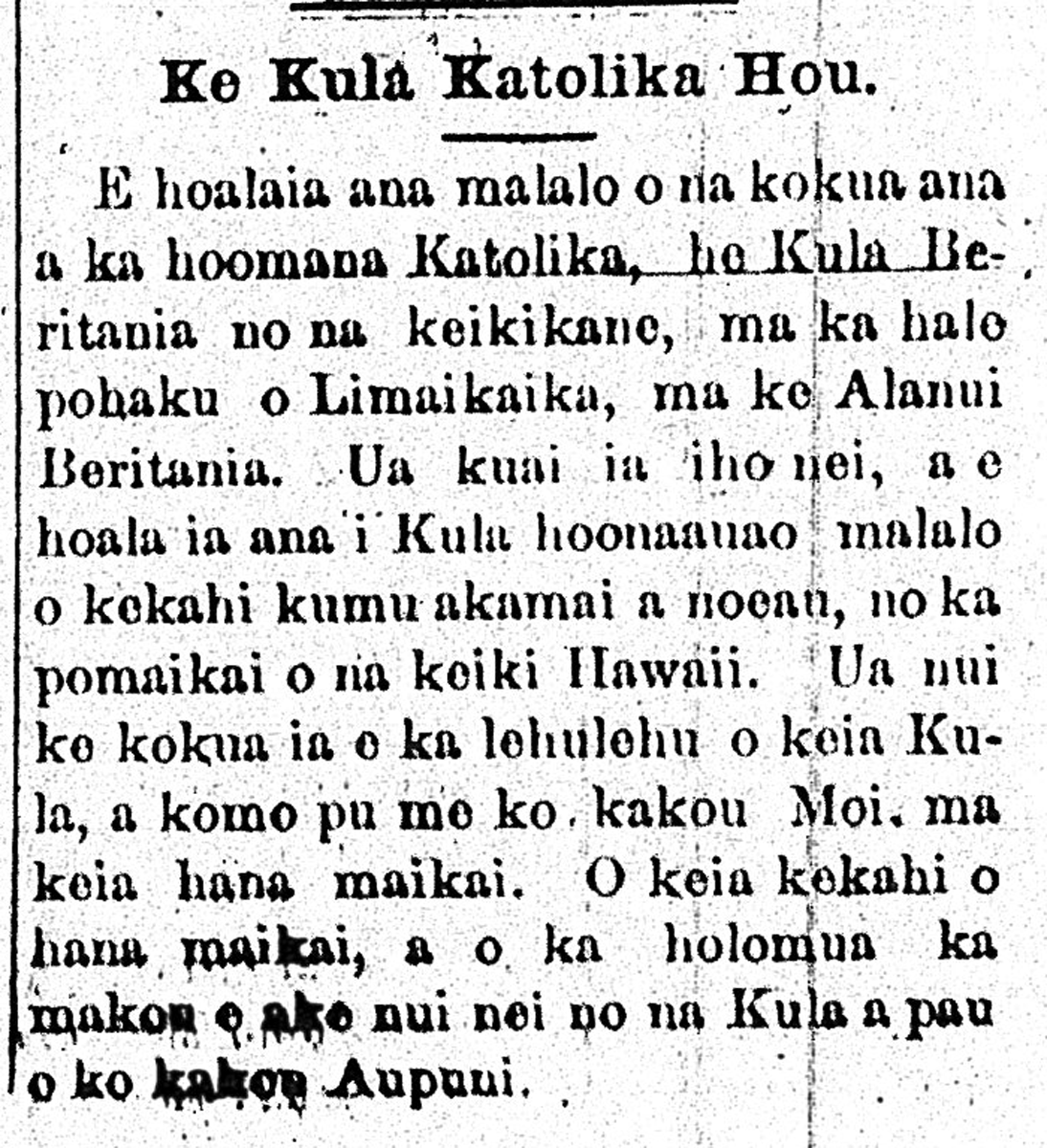
There will be established under the Catholic Faith, an English school for boys, at the stone building of Armstrong [Limaikaika], on Beritania Street. It was recently purchased, and a school of learning will be set up for the benefit of Hawaiian boys. This school is greatly supported by the public, along with our King, at this fine endeavor. This is one of the fine works, and is progress that we greatly desire for all of the Schools of our Nation.

(Elele Poakolu, 9/22/1880, p. 1)

Ke Kula Katolika Hou.

Ka Elele Poakolu, Buke I, Helu 3, Aoao 1. Sepatemaba 22, 1880.

Lucy Kahaina Keohohinaokalani Kekoa turns 50 years old, 1919.

JUBILEE CELEBRATION.

MRS. ANE KEALOHA K. NAMAKELUA.¹

To Solomon Hanohano, Esq., Aloha oe:—Please let me introduce before you and your workers of the press.

Last Sunday, January 5, 1919, Mrs. Lucy Kahaina Keohohinaokalani Kekoa made 50 years old; she is a native mother and kamaaina to the dark cliffs of Koolaupoko, and there she was born from the loins of Mrs. Lilia Kamaka Kailiponi and C. Apela Kailiponi on the 5th of January, 1869, and she is a mother who is well known to Honolulu’s people, and she has many family and friends on the islands. Continue reading

Another Solomon Meheula passes on just three years earlier, 1922.

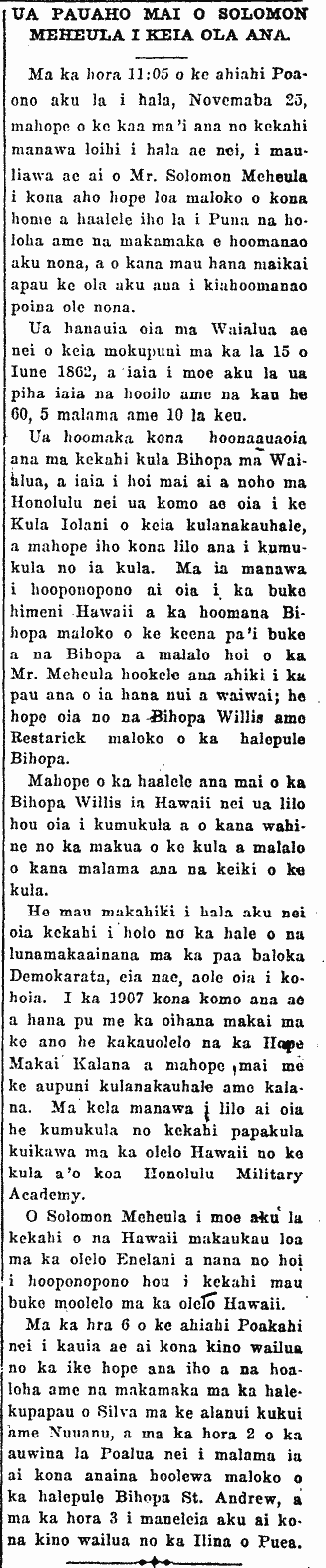
SOLOMON MEHEULA GROWS WEARY OF THIS LIFE.

At 11:05 in the evening of this past Saturday, November 25, after being sick for a long time, Mr. Solomon Meheula gasped his last breath at his home, and he left in Puna his friends and fellows remembering him and all of his fine works that will live on as a monument to him.

He was born over there in Waialua, on this island, on the 15th of June 1862, and now that he sleeps, he spent 60 winters and summers plus 5 months and 10 days.

His education was began at an Episcopal school in Waialua, and when he returned to live in Honolulu nei, he entered the Iolani School of this town, and after he became a teacher for that school. During this time he edited the Episcopal Hymnal in the press of the Episcopal Church, and it was under Mr. Meheula’s guidance that this great and valuable work was completed; he was an assistant to the Bishops Willis and Restarick in the Episcopal Church.

After Bishop Willis left Hawaii nei, he again became a school teacher, and his wife was the matron of the school, and the children of the school were under her care.

A number of years ago, he was one of those who ran for representative under the Democratic party, however, he was not elected. In 1907 he entered and began working at the police department as a secretary under the County Deputy Sheriff and thereafter with the city and county government. At that time, he became a teacher in a special Hawaiian-language class for the military school, the Honolulu Military Academy.

The late Solomon Meheula was one of the Hawaiians who was fluent in English, and he rearranged a number of story books into Hawaiian.

At 6 o’clock in the evening of this Monday, his remains were placed for the last visitation by his fellows and friends at the Silva Mortuary on Kukui Street and Nuuanu Avenue, and at 2 o’clock in the afternoon of this Tuesday, his funeral was held at the Episcopal church, St. Andrew, and at 3 o’clock his remains were carried to the Puea Cemetery.

(Kuokoa, 11/30/1922, p. 1)
UA PAUAHO MAI O SOLOMON MEHEULA I KEIA OLA ANA.

Ka Nupepa Kuokoa, Buke LXI, Helu 48, Aoao 1. Novemaba 30, 1922.

Books to teach Maori English arrive, 1878.

Maori Books.

We return our hearty thanks to a Brother Editor of the New Zealand Press for some nice Maori books forwarded by last mail. They are destined for the instruction of the Maoris in the English language. The Maori title of one of these books is:—He Akoranga i te reo Ingarihi mo te kura Maori, or, “Lessons in the English Language for Maori Schools.” Published at Wellington “by authority” by George Didsbury, Government Printer. Continue reading

Stanford University Hawaii Club, 1905.

LEIS AT STANFORD

AN INTERESTING SOCIETY FORMED AT THE UNIVERSITY AT PALO ALTO—LEIS OF ROSES AND SCORE CARDS OF LAUHALA AT A CARD PARTY OF THOSE WHO HAVE LIVED IN THE ISLANDS.

STANFORD UNIVERSITY, April 13, 1905.—A number of Island people met on the evening of April 7, at the home of Mr. and Mrs. A. D. Larnach, and formed what was named the “Hui Hawaii” which is intended to bring together the Hawaiians about Stanford University in a social way. It was decided to have this a most informal affair and not to choose any regular officer, but simply to have it made known at one meeting who is to entertain at the next one. Anyone who has been in the Islands is to be eligible to membership. Continue reading

English and education, 1903.

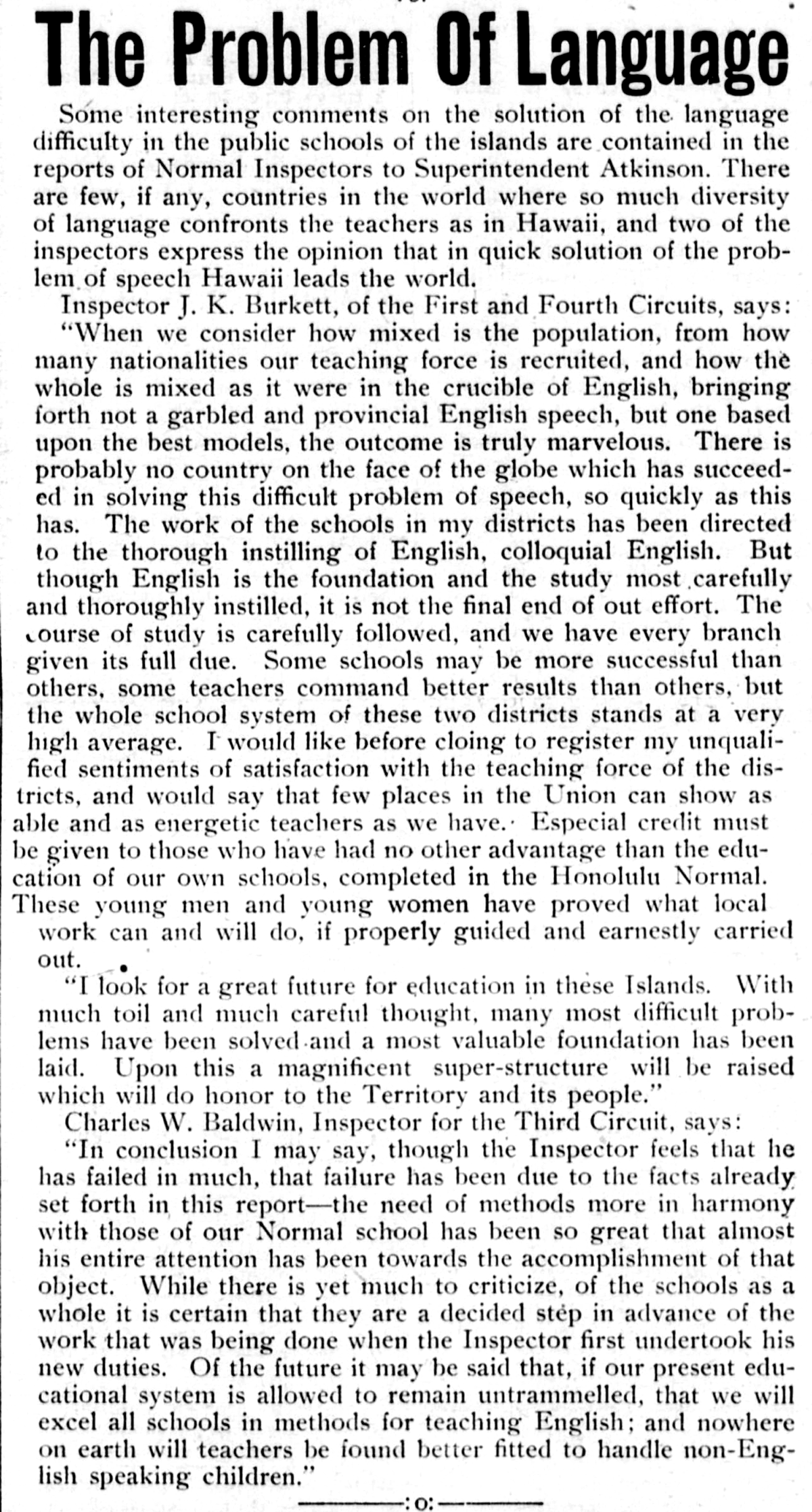
The Problem Of Language

Some interesting comments of the solution of the language difficulty in the public schools of the islands are contained in the reports of Normal Inspectors to Superintendent Atkinson. There are few, if any, countries in the world where so much diversity of language confronts the teachers as in Hawaii, and two of the inspectors express the opinion that in quick solution of the problem of speech Hawaii leads the world.

Inspector J. K. Burkett, of the First and Fourth Circuits, says:

“When we  consider how mixed is the population, from how many nationalities our teaching force is recruited, and how the whole is mixed as it were in the crucible of English, bringing forth not a garbled and provincial English speech, but one based upon  the best models, the outcome is truly marvelous. There is probably no country on the face of the globe which has succeeded in solving this difficult problem of speech, so quickly as this has. The work of the schools in my districts has been directed to the thorough instilling of English, colloquial English. But though English is the foundation and the study most carefully and thoroughly instilled, it is not the final end of our effort. The course of study is carefully followed, and we have every branch given its full due. Some schools may be more successful than others, some teachers command better results than others, but the whole school system of these two districts stands at a very high average. I would like before closing to register my unqualified sentiments of satisfaction with the teaching force of the districts, and would say that few places in the Union can show as able and as energetic teachers as we have. Especial credit must be given to those who have had no other advantage than the education of our own schools, completed in the Honolulu Normal. These young men and young women have proved what local work can and will do, if properly guided and earnestly carried out.

“I look for a great future for education in these Islands. With much toil and much careful thought, many most difficult problems have been solved and a most valuable foundation has been laid. Upon this a magnificent super-structure will be raised which will do honor to the Territory and its people.”

Charles W. Baldwin, Inspector for the Third Circuit says:

“In conclusion I may say, though the Inspector feels that he has failed in much, that failure has been due to the facts already set forth in this report—the need of methods more in harmony with those of our Normal school has been so great that almost his entire attention has been towards the accomplishment of that object. While there is yet much to criticize, of the schools as a whole it is certain that they are a decided step in advance of the work that was being done when the Inspector first undertook his new duties. Of the future it may be said that, if our present educational system is allowed to remain untrammelled, that we will excel all schools in methods for teaching English; and nowhere on earth will teachers be found better fitted to handle non-English speaking children.”

(Hawaiian Star, 3/5/1903, p. 7)

The Problem Of Language

The Hawaiian Star, Volume X, Number 3419, Page 7. March 5, 1903.