The birth of the new princess, Kaiulani, 1875.

On Saturday morning last, the 16th instant, Her Royal Highness the Princess Miriam Likelike, sister to His Majesty the King, and wife of the Hon. A. S. Cleghorn, was safely delivered of a daughter. At four P. M. all the bells of the city rang a merry peal in honor of the infant Princess.

(Pacific Commercial Advertiser, 10/23/1875, p. 2)

On Saturday morning last...

The Pacific Commercial Advertiser, Volume XX, Number 17, Page 2. October 23, 1875.

Piilani, Kaluaikoolau, and Kaleimanu, from the pen of C. B. Hofgaard, 1916.

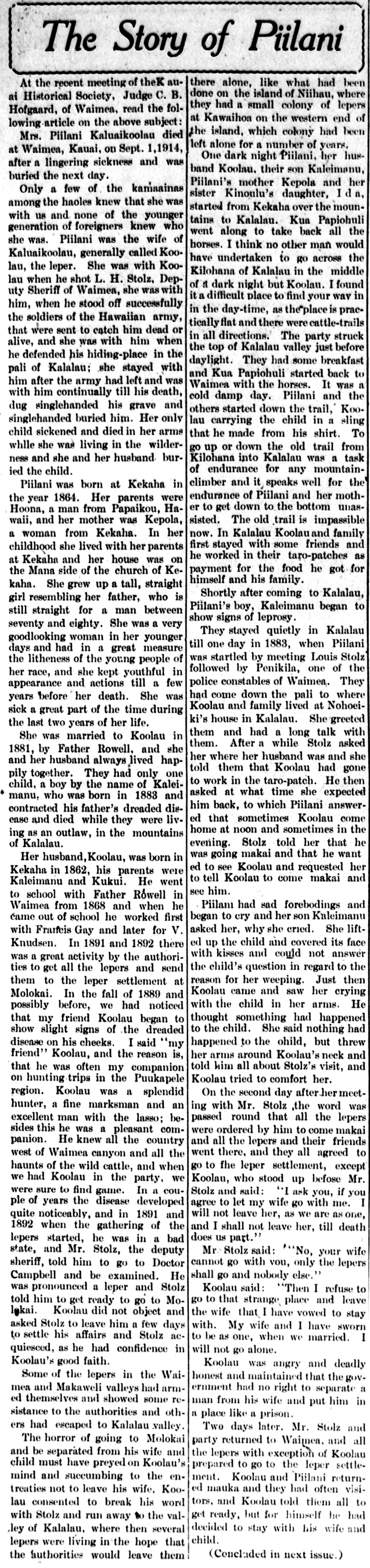
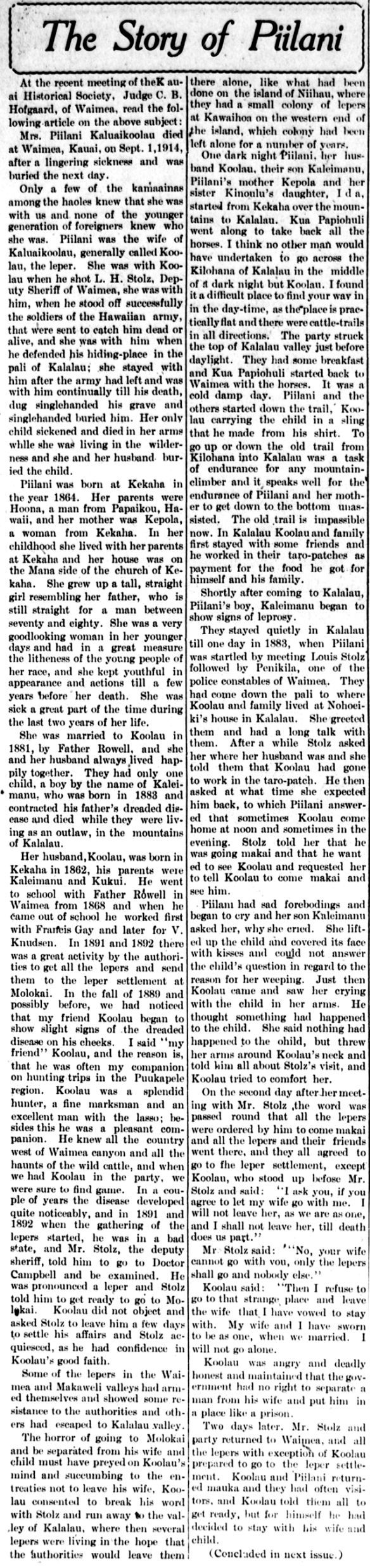
The Story of Piilani

At the recent meeting of the Kauai Historical Society, Judge C. B. Hofgaard, of Waimea, read the following article on the above subject:

Mrs. Piilani Kaluaikoolau died at Waimea, Kauai, on Sept. 1, 1914, after a lingering sickness and was buried the next day.

Only a few of the kamaainas among the haoles knew that she was with us and none of the younger generation of foreigners knew who she was. Piilani was the wife of Kaluaikoolau, generally called Koolau, the leper. She was with Koolau when he shot L. H. Stolz, Deputy Sheriff of Waimea, she was with him, when he stood off successfully the soldiers of the Hawaiian army, that were sent to catch him dead or alive, and she was with him when he defended his hiding-place in the pali of Kalalau; she stayed with him after the army had left and was with him constantly till his death, dug singlehanded his grave and singlehanded buried him. Her only child sickened and died in her arms while she was living in the wilderness and she and her husband buried the child.

Piilani was born at Kekaha in the year 1864. Her parents were Hoona, a man from Papaikou, Hawaii, and her mother was Kepola, a woman from Kekaha. In her childhood, she lived with her parents at Kekaha and her house was on the Mana side of the church of Kekaha. She grew up a tall, straight girl resembling her father, who is still straight for a man between seventy and eighty. She was a very goodlooking woman in her younger days and had in a great measure the litheness of the young people of her race, and she kept youthful in appearance and actions till a few years before her death. She was sick a great part of the time during the last two years of her life.

She was married to Koolau in 1881, by Father Rowell, and she and her husband always lived happily together. They had only one child, a boy by the name of Kaleimanu, who was born in 1883 and contracted his father’s dreaded disease and died while they were living as a outlaw, in the mountains of Kalalau.

Her husband, Koolau, was born in Kekaha in 1862, his parents were Kaleimanu and Kukui. He went to school with Father Rowell in Waimea from 1868 and when he came out of school he worked first with Francis Gay and later for V. Knudsen. In 1891 and 1892 there was a great activity by the authorities to get all the lepers and send them to the leper settlement at Molokai. In the fall of 1889 and possibly before, we had noticed that my friend Koolau began to show signs of the dreaded disease on his cheeks. I said “my friend” Koolau, and the reason is, that he was often my companion on hunting trips in the Puukapele region. Koolau was a splendid hunter, a fine marksman and an excellent man with the lasso; besides this he was a pleasant companion. He knew all the country west of Waimea canyon and all the haunts of the wild cattle, and when we had Koolau in the party, we were sure to find game. In a couple of years the disease developed quite noticeably, and in 1891 and 1892 when the gathering of the lepers started, he was in a bad state, and Mr. Stolz, the deputy sheriff, told him to go to Doctor Campbell and be examined. He was pronounced a leper and Stolz told him to get ready to go to Molokai. Koolau did not object and asked Stolz to leave him a few days to settle his affairs and Stolz acquiesced, as he had confidence in Koolau’s good faith.

Some of the lepers in the Waimea and Makaweli valleys had armed themselves and showed some resistance to the authorities and others had escaped to Kalalau valley.

The horror of going to Molokai and be separated from his wife and child must have preyed on Koolau’s mind and succumbing to the entreaties not to leave his wife, Koolau consented to break his word with Stolz and run away to the valley of Kalalau, where the several lepers were living in the hope that the authorities would leave them there alone, like what had been done on the island of Niihau, where they had a small colony of lepers at Kawaihoa on the western end of the island, which colony had been left alone for a number of years.

One dark night Piilani, her husband Koolau, their son Kaleimanu, Piilani’s mother Kepola and her sister Kinoulu’s daughter, Ida, started from Kekaha over the mountain to Kalalau. Kua Papiohuli went along to take back all the horses. I think no other man would have undertaken to go across the Kilohana of Kalalau in the middle of a dark night but Koolau. I found it a difficult place to find your way in in the day-time, as the place is practically flat and there were cattle-trails in all directions. The party struck the top of Kalalau valley just before daylight. They had some breakfast and Kua Papiohuli started back to Waimea with the horses. It was a cold damp day. Piilani and the others started down the trail, Koolau carrying the child in a sling that he made from his shirt. To go up or down the old trail from Kilohana into Kalalau was a task of endurance for any mountain-climber and it speaks well for the endurance of Piilani and her mother to get down to the bottom unassisted. The old trail is impassible now. In Kalalau Koolau and family first stayed with some friends and he worked in their taro-patches as payment for the food he got for himself and his family.

Shortly after coming to Kalalau, Piilani’s boy, Kaleimanu began to show signs of leprosy.

They stayed quietly in Kalalau till one day in 1883, when Piilani was startled by meeting Louis Stolz followed by Penikila, one of the police constables of Waimea. They had come down the pali to where Koolau and family lived at Nohoeiki’s house in Kalalau. She greeted them and had a long talk with them. After a while Stolz asked her where her husband was and she told them that Koolau had gone to work in the taro-patch. He then asked at what time she expected him back, to which Piilani answered that sometimes Koolau come home at noon and sometimes in the evening. Stolz told her that he was going makai and that he wanted to see Koolau and requested her to tell Koolau to come makai and see him.

Piilani had sad forebodings and began to cry and her son Kaleimanu asked her, why she cried. She lifted up the child and covered its face with kisses and could not answer the child’s question in regard to the reason for her weeping. Just then Koolau came and saw her crying with the child in her arms. He thought something had happened to the child. She said nothing had happened to the child, but threw her arms around Koolau’s neck and told him about Stolz’s visit, and Koolau tried to comfort her.

On the second day after her meeting with Mr. Stolz, the word was passed around that all the lepers were ordered by him to come makai and all the lepers and their friends went there, and they all agreed to go to the leper settlement, except Koolau, who stood up before Mr. Stolz and said: “I ask you, if you agree to let my wife go with me. I will not leave her, as we are as one, and I shall not leave her, till death does us part.”

Mr. Stolz said: “No, your wife cannot go with you, only the lepers shall go and nobody else.”

Koolau said: “Then I refuse to go to that strange place and leave the wife that I have vowed to stay with. My wife and I have sworn to be as one, when we married. I will not go alone.

Koolau was angry and deadly honest and maintained that the government had no right to separate a man from his wife and put him in a place like a prison.

Two days later, Mr. Stolz and party returned to Waimea, and all the lepers with exception of Koolau prepared to go to the leper settlement. Koolau and Piilani returned mauka and they had often visitors, and Koolau told them all to get ready, but for himself, he had decided to stay with his wife and child

(Concluded in next issue.)

[This account as told by C. B. Hofgaard continues in the 12/26/1916 issue and concludes in the 1/2/1917 issue.]

(Garden Island, 12/19/1916, p. 6)
The Story of Piilani

The Garden Island, Volume 12, Number 51, Page 6. December 19, 1916.

Treasures spread across the four corners of the earth? 1906.

Auction Sale

Tourists! Collectors!

Thursday, Feb. 1, 1906,

10 O’CLOCK A. M.,

At my salesroom, 847 Kaahumanu Street, I will sell, under instruction from the Administrators of the Estate of

MARY AILAU

the eminent Hawaiian collector, the following ancient and other relics of

Ancient Chiefs

Pig Platters,

Calabashes,

Cocos (Calabash Nets),

Tapas,

Stone Adzes,

Stone Lamps,

Mike Stones,

Poi Pounders,

49 Fans,

2 Kauila Aumakuas (War Spears),

2 Hula Drums (Ancient),

1 Idol—Kukaili-iki—One of Kamehameha’s War Gods,

1 Ipu Hula (Gourd Drum),

1 Pawehe Calabash,

1 Pawehe Water Bottle,

1 Newa (War Club),

2 Bamboo Cushions,

1 Hinai Opae,

2 Samoan War Clubs,

1 Koko (Ancient),

1 Black Kapa (Burial),

1 Lauhala Hall Mat,

7 Samoan Cocoanut Bowls,

1 Lauhala Bag,

1 Case Stuffed Hawaiian Birds,

1 Aumakua,

1 Kauila Kahili Stick,

1 Kahili Stick (Tortoise) and Ivory (Ancient),

2 Emu Eggs,

1 Carved Coco Bank,

1 Large Show Case,

4 Lei Hulus (Native Birds),

1 Samoan War Club,

1 Moss Album.

JAMES F. MORGAN,

AUCTIONEER.

(Pacific Commercial Advertiser, 1/29/1906, p. 8)

Auction Sale

The Pacific Commercial Advertiser, XLIII, Number 7324, Page 8. January 29, 1906.

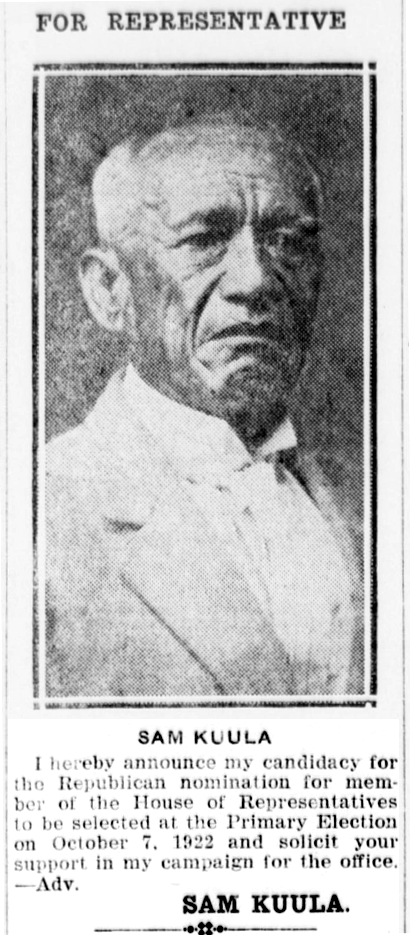
Sam Kuula for Representative, 1922.

FOR REPRESENTATIVE

SAM KUULA

I hereby announce my candidacy for the Republican nomination for member of the House of Representatives to be elected at the Primary Election on October 7, 1922 and solicit your support in my campaign for the office.—Adv.

SAM KUULA.

(Maui News, 9/8/1922, p. 6)

FOR REPRESENTATIVE

Semi-Weekly Maui News, 22nd. Year, Number 1199, Page 6. September 8, 1922.

Anna Berry, daughter of Kentucky congressman, speaks on annexation, 1898.

THE INJUSTICE OF ANNEXATION

As Viewed by an American Woman Miss Anna E Berry of Newport—The Kentucky Congressman’s Daughter Writes Entertainingly of the Native Hawaiians—A Petition to the President.

[Among the ladies who accompanied the congressional party to Hawaii in September was Miss Anna Berry, daughter of Congressman Berry of Kentucky, who has written charmingly of the islands. She brought back many souvenirs of her visit, which are to be seen in her Newport home. The best of all is the Royal Hawaiian standard, the flag which was floating over Queen Liliuokalani when she was deposed. It is to be noted that Miss Berry returned to America with a woman’s sense of the injustice of annexation, from the viewpoint of the native Hawaiian, while the men of the party came back a unit for annexation. The Hawaiian minister to whom Miss Berry refers as a descendant of a Kentucky Governor is Rev. Desha, of Hilo. His grandfather was Governor Desha, of Kentucky, and his father was Isaac B. Desha, who committed a sensational murder at Doggett’s Tavern, a well-known inn of early Kentucky days on the Licking River. The murderer was sentenced to death, and saved by his own father’s pardoning power. The case was one of the most remarkable in American criminal history. He fled to Hawaii where one of his half-native sons is a leading Kanaka minister, and the other is a postal employee.—The Editor of the Kentucky Post.

The recent visit of Senator Morgan and four members of the United States House of Representatives to the Hawaiian Islands aroused among the various peoples of the “Paradise of the Pacific” sentiments and feelings as opposite as the poles. There are indeed various peoples in Hawaii—a very scrapbag of a population—the good with the bad. Here Portuguese and Chinese, Japanese and Germans, Americans and natives jostle one another. Continue reading

More on the 11th of June in Kalaupapa, 1904.

11th of June

Sports at Kalaupapa

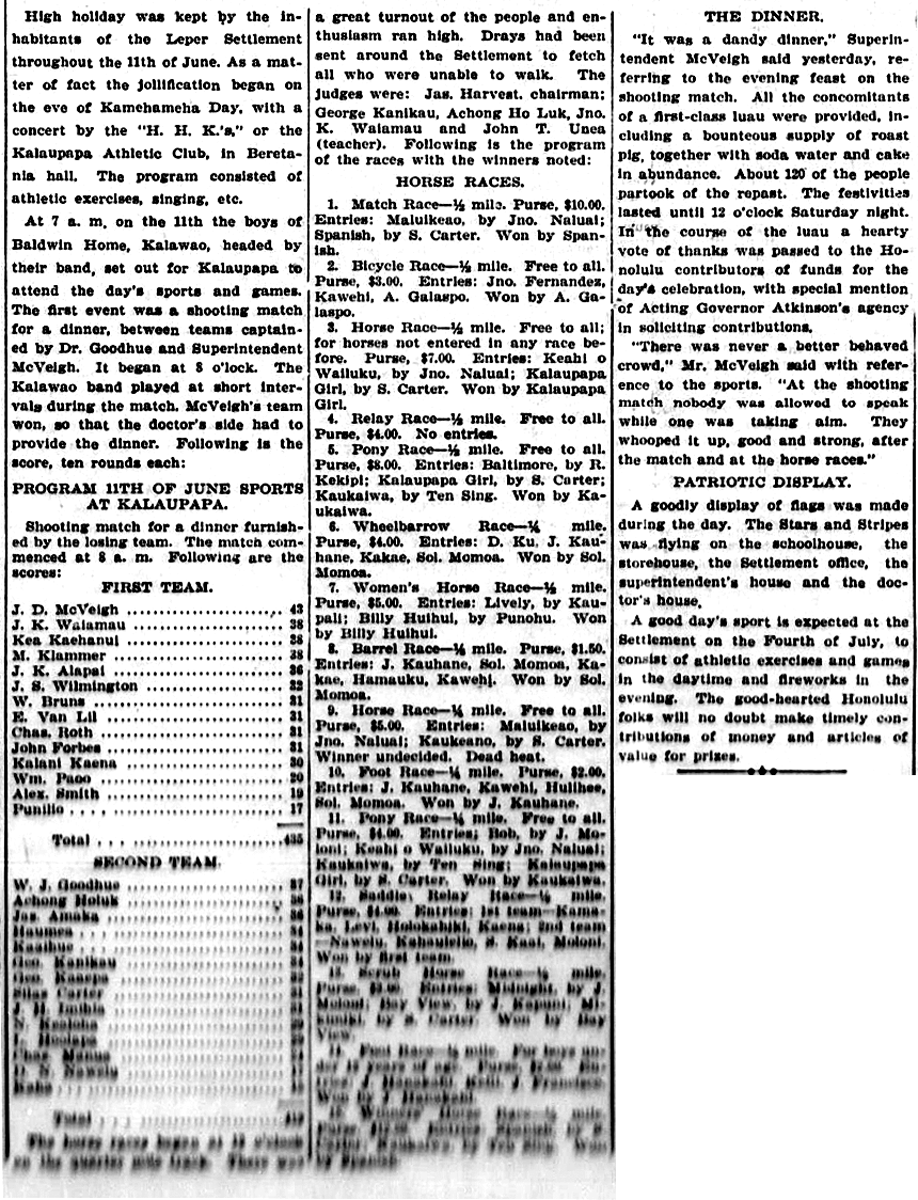
High holiday [Kamehameha Day] was kept by the inhabitants of the Leper Settlement throughout the 11th of June. As a matter of fact the jollification began on the eve of Kamehameha Day, with a concert by the “H. H. K.’s” [Hui Hooikaika Kino] or the Kalaupapa Athletic Club, in Beretania hall. The program consisted of athletic exercises, singing, etc.

At 7 a. m., on the 11th the boys of Baldwin Home, Kalawao, headed by their band, set out for Kalaupapa to attend the day’s sports and games. The first event was a shooting match for a dinner, between teams captained by Dr. Goodhue and Superintendent McVeigh. It began at 8 o’clock. The Kalawao band played at short intervals during the match. McVeigh’s team won, so that the doctor’s side had to provide the dinner. Following is the score, ten rounds each:

PROGRAM 11TH OF JUNE SPORTS AT KALAUPAPA.

Shooting match for a dinner furnished by the losing team. The match commenced at 8 a. m. Following are the scores:

FIRST TEAM.

J. D. McVeigh ….. 43
J. K. Waiamau ….. 38
Kea Kaehanui ….. 38
M. Klammer ….. 38
J. K. Alapai ….. 36
J. S. Wilmington ….. 32
W. Bruns ….. 31
E. Van Lil ….. 31
Chas. Roth ….. 31
John Forbes ….. 31
Kalani Kaena ….. 30
Wm. Paoo ….. 20
Alex. Smith ….. 19
Punilio ….. 17
Total ….. 435

SECOND TEAM.

W. J. Goodhue …. 37
Achong Holuk ….. 36
Jas. Amaka ….. 36
Haumea ….. 34
Kaaihue ….. 34
Geo. Kanikau ….. 34
Geo. Kaaepa ….. 32
Silas Carter ….. 31
J. H. Imihia ….. 31
N. Kealoha ….. 29
I. Hoolapa ….. 29
Chas. Manua ….. 24
D. N. Nawelu ….. 17
Kaha ….. 15
Total ….. 119

The horse races began at 12 o’clock on the quarter mile track. There was a great turnout of the people and enthusiasm ran high. Drays had been sent around the Settlement to fetch all who were unable to walk. The judges were: Jas. Harvest, chairman; George Kanikau, Achong Ho Luk, Jno. K. Waiamau and John T. Unea (teacher). Following is the program of the races with the winners noted:

HORSE RACES.

1. Match Race—½ mile. Purse, $10.00. Entries: Maluikeao, by Jno. Naluai; Spanish, by S. Carter. Won by Spanish.
2. Bicycle Race—½ mile. Free to all. Purse, $3.00. Entries: Jno. Fernandez, Kawehi, A. Galaspo. Won by A. Galespo.
3. Horse Race—½ mile. Free to all; for horses not entered in any race before. Purse, $7.00. Entries: Keahi o Wailuku, by Jno. Naluai; Kalaupapa Girl, by S. Carter. Won by Kalaupapa Girl.
4. Relay Race—½ mile. Free to all. Purse, $4.00. No entries.
5. Pony Race—½ mile. Free to all. Purse, $8.00. Entries: Baltimore, by R. Kekipi; Kalaupapa Girl, by S. Carter; Kaukaiwa, by Ten Sing. Won by Kaukaiwa.
6. Wheelbarrow Race—¼ mile. Purse, $4.00. Entries: D. Ku, J. Kauhane, Kakae, Sol. Momoa. Won by Sol. Momoa.
7. Women’s Horse Race—½ mile. Purse, $5.00. Entries: Lively, by Kaupali; Billy Huihui, by Punohu. Won by Billy Huihui.
8. Barrel Race—¼ mile. Purse, $1.50. Entries: J. Kauhane, Sol. Momoa, Kakae, Hamauku, Kawehi. Won by Sol. Momoa.
9. Horse Race—¼ mile. Free to all. Purse, $5.00. Entries: Maluikeao, by Jno. Naluai; Kaukeano, by S. Carter. Winner undecided. Dead heat.
10. Foot Race—¼ mile. Purse, $2.00. Entries: J. Kauhane, Kawehi, Hulihee, Sol. Momoa. Won by J. Kauhane.
11. Pony Race—¼ mile. Free to all. Purse, $4.00. Entries: Bob, by J. Moloni; Keahi o Wailuku, by Jno. Naluai; Kaukaiwa, by Ten Sing; Kalaupapa Girl, by S. Carter. Won by Kaukaiwa.
12. Saddle Relay Race—½ mile. Purse, $4.00. Entries: 1st team—Kamaka, Levi, Holokahiki, Kaena; 2nd team—Nawelu, Kahaulelio, S. Kaai, Moloni. Won by first team.
13. Scrub Horse Race—½ mile. Purse, $3.00. Entries: Midnight, by J. Moloni; Bay View, by J. Kapuni; Mikimiki, by S. Carter. Won by Bay View.
14. Foot Race—½ mile. For boys under 13 years of age. Purse, $2.00. Entries: J. Hanakahi, Kelii, J. Francisco. Won by J. Hanakahi.
15. Winners’ Horse Race—½ mile. Purse, $12.00. Entries: Spanish, by S. Carter; Kaukaiwa, by Ten Sing. Won by Spanish.

THE DINNER.

“It was a dandy dinner,” Superintendent McVeigh said yesterday, referring to the evening feast on the shooting match. All the concomitants of a first-class luau were provided, including a bounteous supply of roast pig, together with soda water and cake in abundance. About 120 of the people partook of the repast. The festivities lasted until 12 o’clock Saturday night. In the course of the luau a hearty vote of thanks was passed to the Honolulu contributors of funds for the day’s celebration, with special mention of Acting Governor Atkinson’s agency in soliciting contributions.

“There was never a better behaved crowd,” Mr. McVeigh said with reference to the sports. “At the shooting match nobody was allowed to speak while one was taking aim. They whooped it up, good and strong, after the match and at the horse races.”

PATRIOTIC DISPLAY.

A goodly display of flags was made during the day. The Stars and Stripes was flying on the schoolhouse, the storehouse, the Settlement office, the superintendent’s house and the doctor’s house.

A good day’s sport is expected at the Settlement on the Fourth of July, to consist of athletic exercises and games in the daytime and fireworks in the evening. The good-hearted Honolulu folks will no doubt make timely contributions of money and articles of values for prizes.

[This article followed the illustration by John K. Waiamau posted earlier today.]

(Hawaiian Gazette, 6/17/1904, p. 5)

11th of June

Hawaiian Gazette, Volume XXXIX, Number 49, Page 5. June 17,

More on John K. Waiamau and others, 1893.

PERSONAL.

President Dole’s illness has been caused by an ulcerated tooth. He is now on the mend.

John K. Waiamau, the accomplished young architect is going to Chicago at the expense of his employer, C. B. Ripley to study architectural drawing.

Ornithologist Palmer returned on the Pele last evening from Makaweli, where he has been collecting birds for the British Museum.

(Hawaiian Star, 8/18/1893, p. 2)

PERSONAL.

The Hawaiian Star, Volume I, Number 122, Page 2. August 18, 1893.

Primo across the sea, 1912.

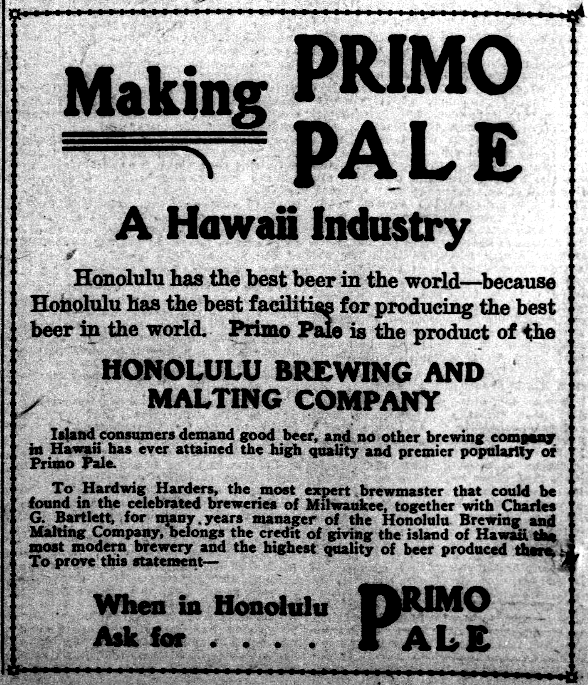
Making PRIMO PALE

A Hawaii Industry

Honolulu has the best beer in the world—because Honolulu has the best facilities for producing the best beer in the world. Primo Pale is the product of the

HONOLULU BREWING AND
MALTING COMPANY

Island consumers demand good beer, and no other brewing company found in the celebrated breweries of Milwaukee, together with Charles G. Bartlett, for many years manager of the Honolulu Brewing and Malting Company, belongs the credit of giving the island of Hawaii this most modern brewery and the highest quality of beer produced there. To prove this statement—

When in Honolulu Aks for… PRIMO PALE

[The issue of the SF Call that this advertisement appears in is the Hawaiian Publicity Edition, sixteen pages of articles and pictures dealing with Hawaii nei.]

(San Francisco Call, 8/14/1912, p. 6)

Making PRIMO PALE

The San Francisco Call, Volume CXII, Number 75, Page 6. August 14, 1912.

Sanford B. Dole, the Congregationalists, and Annexation, 1902.

THE HAWAIIAN SITUATION.

On Monday evening, April 28 last, Governor Dole was the guest of the Congregational Club of Boston. Elsewhere in this issue will be found a sketch made by Dole of the Hawaiian situation. It is characteristic of the man. Having the full support of the Administration behind him he is not afraid to say in public what he has been thinking in private for many long years. Let us see and take up his points one by one.

Point No. 1.—”The monarchy was overthrown and annexation was accomplished for the sake of good government for the islands; that is, for their benefit.”—It is true! Annexation was accomplished, by a handful of Congregationalists because the reciprocity treaty between the United States and Hawaii was in imminent danger of being abrogated. The monarchy was overthrown, so as to save the $40 per ton duty on sugar. It was then as it is now for the Congregationalists:—Money before principle.

Point No. 2:—”We have given you everything we have by being annexed.”—That is, Sanford B. Dole, and his Congregationalist friends have given to the United States that which did not belong to them. With the help of an American cruiser, American marines and an American Minister, they have robbed the native Hawaiians of their country so as to enable a few Congregationalist planters to keep up receiving big dividends from their sugar stocks which would have been materially cut down had a $40 duty been imposed upon each ton of sugar. The Springfield Republican adds the following comment to Point No. 2: “But the second point that they have given us all they have is not at all consistent with his first point that they sought Annexation for the benefit of the Islands, and it shows that they are still trying to work the United States for the benefit of the Hawaiians.” Continue reading