The latest from Kohala, 1879.

News of the Apaapaa Winds.

To My Constant Desire, Ka Nupepa Kuokoa.

Aloha oe:—On this past 11th of Oct., fire engulfed more or less 15 acres of Robert R. Hind’s.

This is the cause. The fire jumped from the property of J. W. Keohokii, Esq., while he and his workers were burning the leaves of the sugarcane.

And it was extinguished because of all of those assisting. The luckiest thing was that the cane was all ready to be milled.

While the smoke was billowing, the Fly Wheels of the two Mills spun, that being Haui Mill [Hawi Mill] and Union Mill,  hoping to quickly take care of that burning cane. Because of the terribly wild winds that day, it was not put out quickly.

On that very day of the fire, a Handwritten Newspaper at Kaiopihi under the editing of Joseph Poepoe was issued.

The name of that paper is “Hoku o ke Kai.” When we examined it, the discussions were outstanding.

On the past 16th of this month, at 6 o’clock in the evening, the sugar plantation people of the district of Kohala, from Niulii to Kaauhuhu, met at the Court House. And this is what happened at that meeting.

The officers were chosen first. J. Wight, President; Dr. Thompson, Vice President; H. B. Montgomery, Secretary; D. S. Kahookano, Hawaiian Secretary; Charles Hapkins [Charles Hopkins], Translator.

After this, Henry Johnson explained the purpose of this meeting.

1. Pertaining to the laborers. 2. Pertaining to the wages of the laborers. 3. The work hours per day. This was left to a committee.

D. R. Vida, Esq., asked that a Committee be selected to  form a constitution, laws, and rules; the motion was passed.

H. Johnson, Esq. put forth the name of this organization, that being “Hui imi pono a hooholomua o ka poe mahiko a Wili o Kohala” [Association seeking rights and progress for the workers of the plantations and Mills of Kohala].

The meeting was adjourned until the 30th of Oct. to hear the report of the Committee.

Yesterday afternoon, Oct. 17, a brick fell between the Boilers of the Mill of R. R. Hind, Esq., but there were no serious injuries.

Those were a few news items from here in the Back areas.

Charlse N. Pulaa.

Honomakua, Kohala, Oct. 18, 1879.

(Kuokoa, 10/25/1879, p. 3)
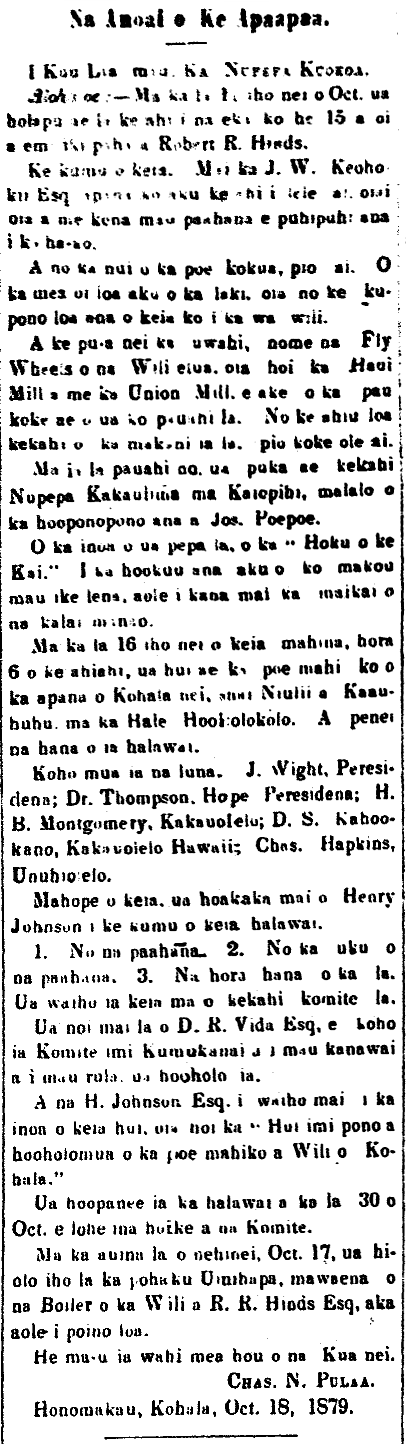
Na Anoai o Ke Apaapaa.

Ka Nupepa Kuokoa, Buke XVIII, Helu 43, Aoao 3. Okatoba 25, 1879.
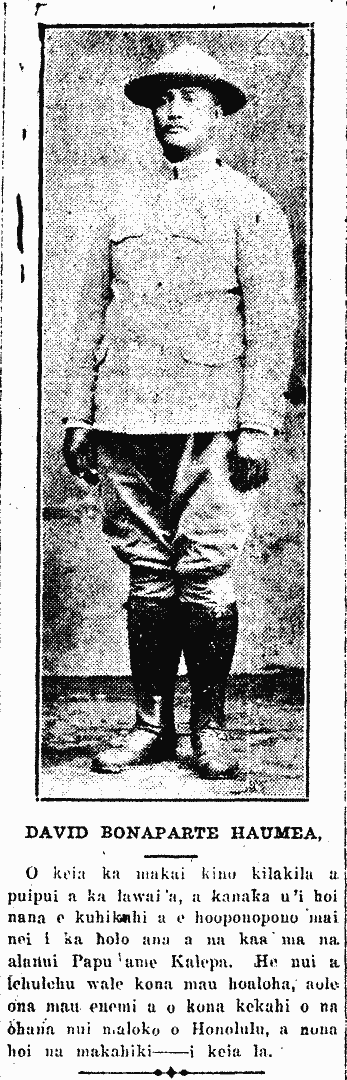
David Bonaparte Haumea, 1922.

DAVID BONAPARTE HAUMEA.

This is the tall and husky officer and fisherman and handsome youth who directs and brings order to traffic at Fort and Merchant streets. He has a great many friends, and no enemies, and he has one of the biggest families in Honolulu, and is ——- years old today.

(Kuokoa, 1/27/1922, p. 6)

DAVID BONAPARTE HAUMEA.

Ka Nupepa Kuokoa, Buke LXI, Helu 4, Aoao 6. Ianuari 27, 1922.

Wailuku and Lahaina get new marketplace, 1880.

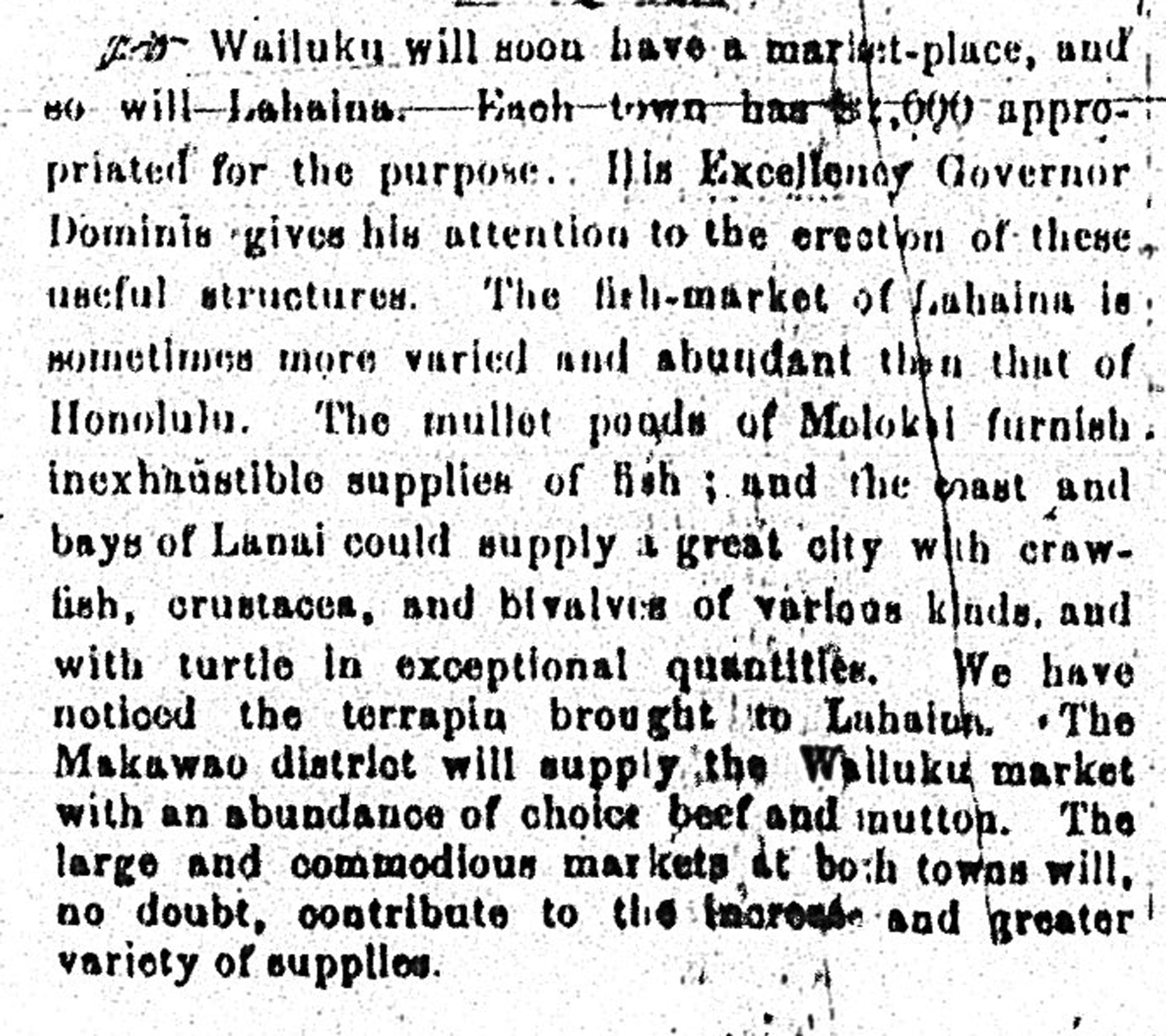
Wailuku will soon have a market-place, and so will Lahaina. Each town has $2,000 appropriated for the purpose. His Excellency Governor Dominis gives his attention to the erection of these useful structures. The fish-market of Lahaina is sometimes more varied and abundant than that of Honolulu. The mullet ponds of Molokai furnish inexhaustible supplies of fish; and the coast and bays of Lanai could supply a great city with crawfish, crustacea, and bivalves of various kinds, and with turtle in exceptional quantities. We have noticed the terrapin brought to Lahaina. The Makawao district will supply the Wailuku market with an abundance of choice beef and mutton. The large and commodious markets at both towns will, no doubt, contribute to the increase and greater variety of supplies.

[Wow, this article has so much varied information: on government spending, fish supply, fish ponds, ranching, &c., &c., &c.]

(Wednesday Express, 9/8/1880, p. 1)

Wailuku will soon have a market-place...

The Wednesday Express, Volume I, Number 1, Page 1. September 8, 1880.

Just because something appears in a newspaper doesn’t necessarily make it true, 1865.

[Found under: “NOTES OF THE WEEK.”]

News from a Far Country.—The following item is clipped from the Weekly London Times:

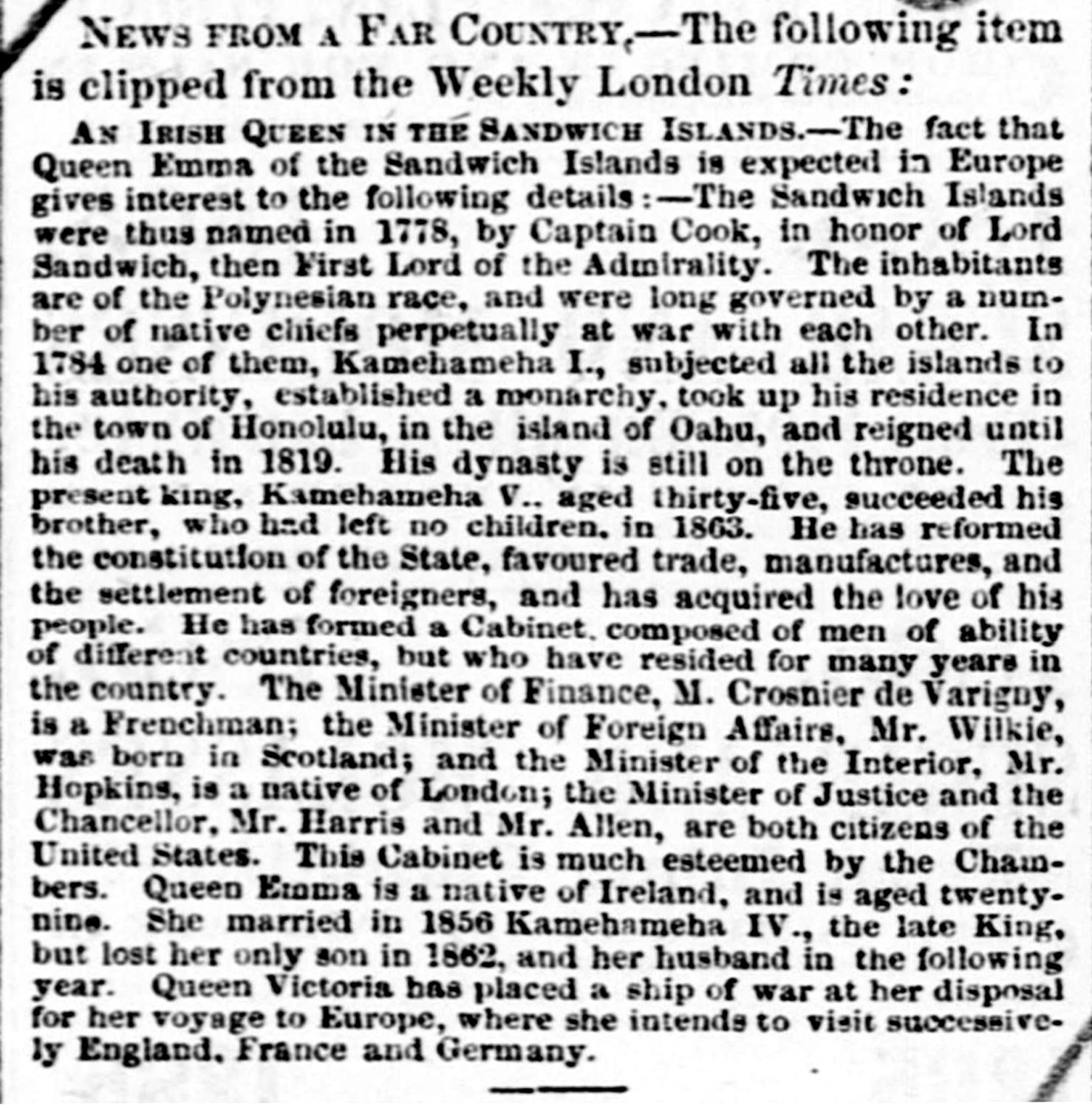
An Irish Queen in the Sandwich Islands.—The fact that Queen Emma of the Sandwich Islands is expected in Europe gives interest to the following details:—The Sandwich Islands were thus named in 1778, by Captain Cook, in honor of Lord Sandwich, then First Lord of the Admirality. The inhabitants are of the Polynesian race, and were long governed by a number of native chiefs perpetually at war with each other. In 1784 one of them, Kamehameha I., subjected all the islands to his authority, established a monarchy, took up his residence in the town of Honolulu, in the island of Oahu, and reigned until his death in 1819. His dynasty is still on the throne. The present King, Kamehameha V., aged thirty-five, succeeded his brother, who had left no children, in 1863. He has reformed the constitution of the State, favoured trade, manufactures, and the settlement of foreigners, and has acquired the love of his people. The Minister of Finance, M. Crosnier de Varigny, is a Frenchman; the Minister of Foreign Affairs, Mr. Wilkie, was born in Scotland; and the Minister of Interior, Mr. Hopkins, is a native of London; the Minister of Justice and the Chancellor, Mr. Harris and Mr. Allen, are both citizens of the United States. This Cabinet is much esteemed by the Chambers. Queen Emma is a native of Ireland, and is aged twenty-nine. She married in 1856 Kamehameha IV., the late King, but lost her only son in 1862, and her husband in the following year. Queen Victoria has placed a ship of war at her disposal for her voyages to Europe, where she intends to visit successively England, France and Germany.

(Pacific Commercial Advertiser, 9/30/1865, p. 2)

News from a Far Country...

The Pacific Commercial Advertiser, Volume X, Number 13, Page 2. September 30, 1865.

The current situation, 1893.

A VOICE OF ALOHA,

From the Queen, thus: O My beloved people, return to your homes, and keep the peace of the land. The voice of the alii has mana, and her command is in force. This is mana by which war will not be started; and the people will abide by her command.

The Overthrow of the Government.

This was an act that was planned in advance, and it is an act to gain glory. It’s foundation was laid by the group of missionaries and group of sugar planters, and on Jan. 17, 1893. Weapons were taken up, and the Government Building [Hale Aupuni] was seized by those treasonous ones.

The Annexation Committee.

There are five members of that Committee; They left, fled, and reached Washington; and they returned separately all with nothing to show and much embarrassment. [a hoi liiilii mai ana me na alaala pakahi ma ka a-i, he mai nui ka hilahila.]

The Deceitful Laws.

This Administration ended some parts of their bayonet constitution [kumukanawai elau-pu] of 1887, and enforced oppressive, limiting [?? paikole], and burdensome laws; these were laws not made by the Lahui, but by a group of just 17 people.

Bloodshed of Hawaiians.

There have been two Hawaiians whose blood has flowed unto the earth; they were shot with guns of the evil ones; However, they survived with their precious lives. It is God who spares Hawaii. This bloodshed of Hawaii’s own will become seeds from which will grow equal rights for the Lahui and the land. Rise together O Hawaii—and listen to the Gospel of Christ.

(Leo o ka Lahui, 10/13/1893, p. 2)

HE LEO ALOHA,

Ka Leo o ka Lahui, Buke II, Helu 790, Aoao 2. Okatoba 13, 1893.

Rufus Anderson arrives, 1863.

[Found under: “NA MEA HOU O HAWAII NEI.”]

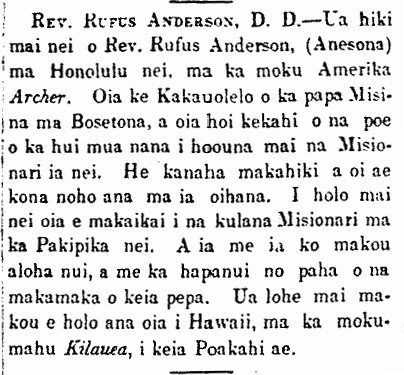
Rev. Rufus Anderson, D. D.—Rev. Rufus Anderson (Anesona) has arrived in Honolulu nei, aboard the American ship, Archer. He is the secretary of the Mission Board in Boston, and he is one of the original members of the board that sent Missionaries here. He served in that occupation for forty years or more. He came to check on the condition of the Missionaries here in the Pacific. With him is our great aloha, along with perhaps the majority of the friends of this paper. We heard that he will be going to Hawaii aboard the steamship Kilauea this coming Monday.

(Kuokoa, 3/7/1863, p. 2)

Rev. Rufus Anderson, D. D.

Ka Nupepa Kuokoa, Buke II, Helu 10, Aoao 2. Maraki 7, 1863.

Lake Waiau atop Mauna Kea is frozen, 1906.

THE FIRST TIME LAKE WAIAU IS SKATED UPON.

When Mr. Eben Low of Waimea, Hawaii, arrived in town, some news about Mauna Kea was heard. According to him, because the ice on the top of Lake Waiau [ka moanawai o Waiau] is frozen solid, it can be walked upon.

The freshwater lake Waiau is a lake atop Mauna Kea, about 15,000 feet above sea level, which is covered with ice, which visitors walked upon. The thickness of the ice was tested by digging, but after digging for two feet, the travellers gave up continuing to dig. Continue reading

Old school mile markers! 1866.

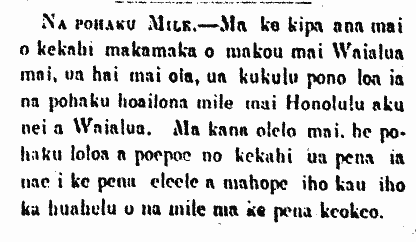
Mile stones.—When one of our friends from Waialua came visiting, he told us, the stone mile markers from Honolulu to Waialua have been set up. From what he said, they are tall and rounded rocks that have been painted black, and afterwards the numerals of the miles will be painted on in white.

(Kuokoa, 11/24/1866, p. 2)

Na Pohaku Mile.

Ka Nupepa Kuokoa, Buke V, Helu 47, Aoao 2. Novemaba 24, 1866.

Warships, 1843.

SIX MEN-OF-WAR

There are six men-of-war [manuwa] docked in Honolulu, on this day, the 4th of August. Three of them are from Britain, and three are from America.

Here are the names of the British ships. (1.) Dublin, a frigate; Rear Admiral R. Thomas is the officer. The ships has 50 cannons.

(2.) Carysfort is a small frigate; its captain is Lord George Paulet; this ship has 26 cannons.

(3.) Hazard is a Sloop; Bell is the captain, and it has 16 cannons.

These are the names of the American ships.

(1.) United States is a frigate; Commodore Jones is the officer. The ship has 52 cannons.

(2.) Constellation is a frigate; Commodore Kearney is the officer; it has 46 cannons.

(3.) Cyane is a Sloop; its captain is C. K. Stribling; it has 20 cannons.

(Nonanona, 8/8/1843, p. 29)

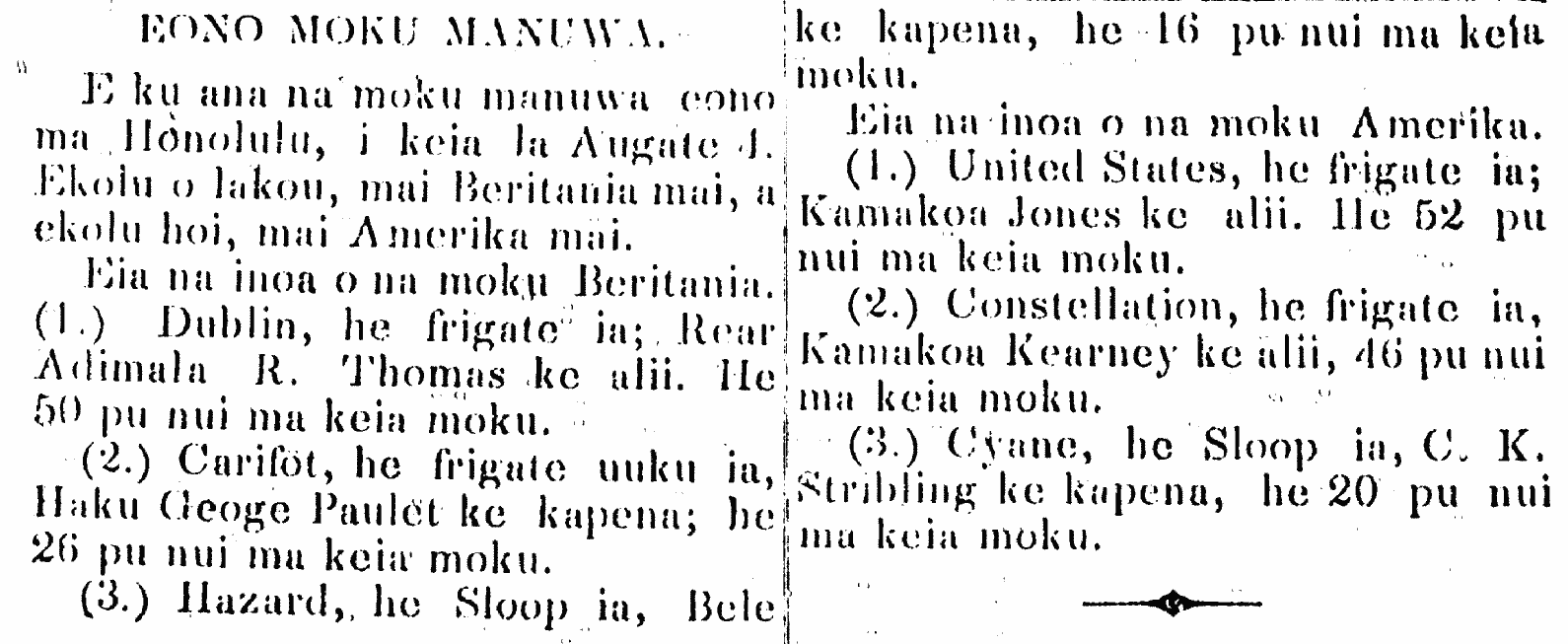
EONO MOKU MANUWA.

Ka Nonanona, Buke 3, Pepa 6, Aoao 29. Augate 8, 1843.