James Kekela reports from Tahiti, 1890.

NEWS FROM THE ISLANDS IN THE SOUTH.

The letter below is by Rev. James Kekela to Dr. C. M. Hyde, and we were given permission to publish it.

Papeete, August 6, 1890.

Rev. C. M. Hyde,

Much aloha to you and your wife, and your children. It has been a long time that we have not associated through letters. All of us Hawaiian Missionaries are in good health here in the Archipelago of Nuuhiwa, except for the wife of S. Kauwealoha, she is somewhat weak and frail; she was like this for the past four months, but she has gotten a little better now; I saw them in Uapou during the first week of this past July.

I am here these days in Papeete to fetch her (my youngest daughter) to bring her back to be a teacher at the French language school in Hivaoa for the Nuuhiwa girls. This daughter of ours has been living in Tahiti for 4 years and she is prepared to teach the French language. She was approved by the teachers and the French government officials here in Tahiti. In the last days of June, I left Puamau and travelled to Nuuhiwa and reached there, where the boat [? kusie] had left for Tahiti, and I went for a bit to Uapou to meet with S. Kauwealoha them for a whole week and returned to Taiohae in Nuuhiwa to wait for the ship from California.

July 29, I left Taiohae and left for Tahiti, on the 2nd of August I reached Papeete after a four days’ trip, and I am living here these days, waiting for a boat to go to Nuuhiwa. I met with the French Protestant [Pelosetane] missionary teachers in Papeete, Mr. Verenie and his wife, the pastor for the kamaaina, and they have a fine church, and they had me give a sermon on the Sabbath. They were very happy to hear about the works of God in the Archipelago of Nuuhiwa and Hawaii and the land of Micronesia [Maikonisia]. As for here in the archipelago of Tahiti, this was the first islands to hear the gospel of Jesus. Continue reading
Alatau Wilder, Boy Scout, 1916.

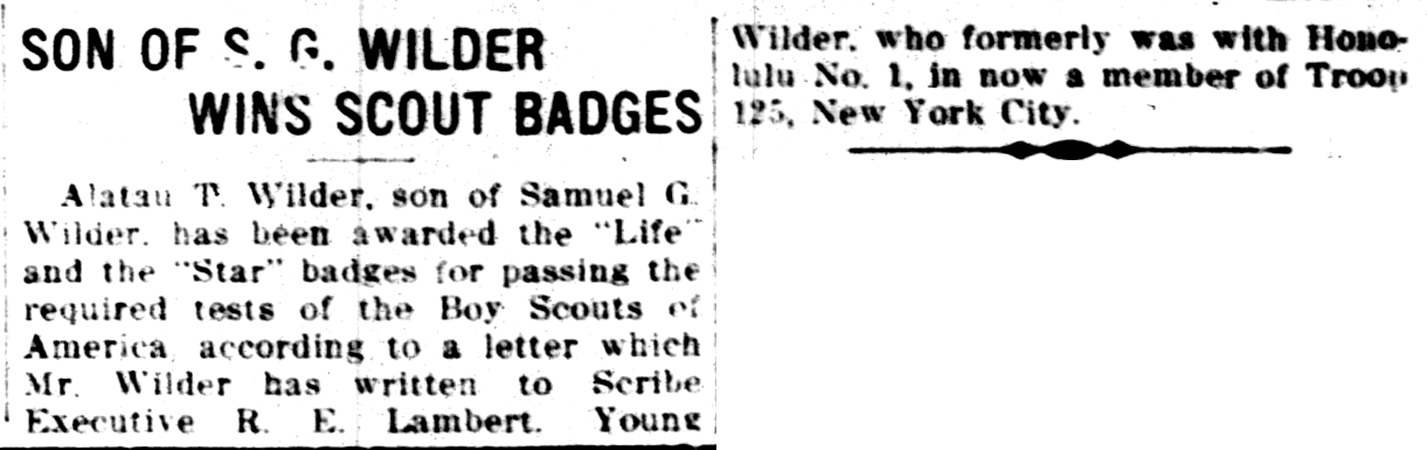
SON OF S. G. WILDER WINS SCOUT BADGES

Alatau T. Wilder, son of Samuel G. Wilder, has been awarded the “Life” and the “Star” badges for passing the required tests of the Boy Scouts of America according to a letter which Mr. Wilder has written to Scribe Executive R. E. Lambert Young. Wilder, who formerly  was with Honolulu No. 1, is now a member of Troop 125, New York City.

(Honolulu Star-Bulletin, 5/16/1916, p. 8)

SON OF S. G. WILDER WINS SCOUT BADGES

Honolulu Star-Bulletin, Volume XXIII, Number 7517, Page 8. May 16, 1916.

Greatest Mariners, 1938 / 2015.

POLYNESIANS AS MARINERS SEEN

Dr. Buck Terms Early Polynesians Greatest Mariners World Has Ever Known

HONOLULU, Nov. 29—Dr. Peter Buck, director of the Bishop Museum, last night termed the early Polynesians the greatest mariners the world has ever known.

Dr. Buck, who will leaves soon for Yale University to lecture on primitive religions, spoke at a dinner in his honor attended by almost 200 persons. He was introduced by Frank Atherton.

He said it was probable that some of the early Polynesians reached the shores of America. He traced the possibility in similarity of certain words, such as that for sweet potato itself was brought into the South Seas from the American continent. Continue reading

The Maori and Hawaiians, 1911.

Hawaiians and Maori Talk to Each Other.

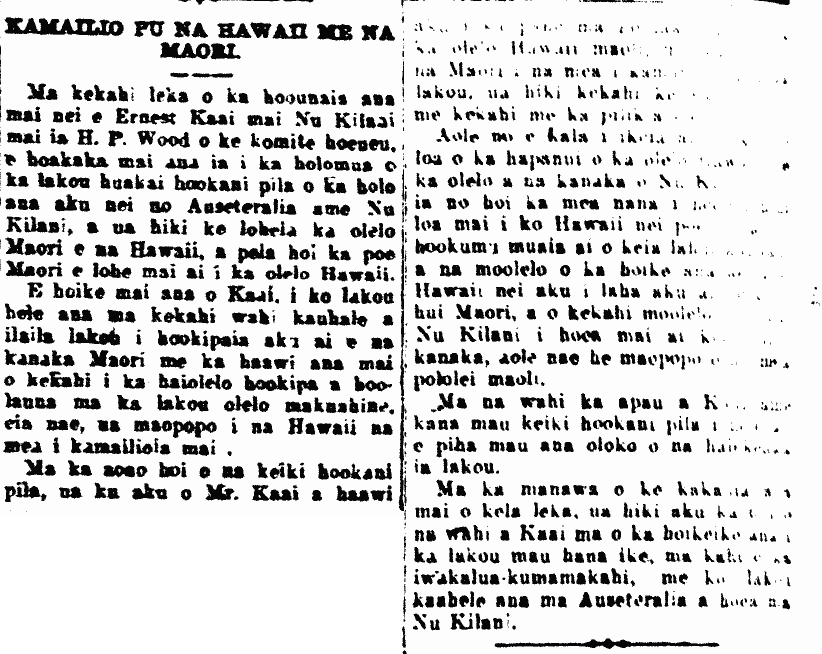
In a letter sent by Ernest Kaai from New Zealand to H. P. Wood of the Hawaiian Promotion Committee [which seems to be a precursor to the visitor’s bureau], he shows the progress of their musical touring of Australia and New Zealand. The Hawaiians could hear the Maori language and the Maori could hear the language of Hawaii.

Kaai said that when they went to some villages, they were hosted by Maori people, where one of them said words of welcome and friendship in their mother tongue. But the Hawaiians understood what was being said.

From the side of the musicians, Mr. Kaai stood and gave [rest of the paragraph unclear].

It was not long ago that [also unclear here, but they seem to be talking about the relationship between Aotearoa and Hawaii].

Everywhere that Kaai and his musical group went, the theaters would be filled with them.

When this letter was written, the number of places that Kaai them performed at was about 21, with them going around Australia and reaching New Zealand[?]

[A great deal of the Hawaiian Language Newspapers are bound into book form, and because they were purposely printed without much empty margins, often the printed portions that fall in the margin area of the books are not legible, especially when scanned. To get a clear image of the entire page, the books will have to be unbound first. That, it seems, takes a great amount of funding.]

(Kuokoa, 6/30/1911, p. 8)

KAMAILIO PU NA HAWAII ME NA MAORI.

Ka Nupepa Kuokoa, Buke XLVII, Helu 26, Aoao 8. Iune 30, 1911.

Hawaiians come to Hawaii for the first time, 1940.

Hawaiian Malihini.

The picture above is a picture of a Hawaiian family who came to Hawaii as malihini to this land. They are Hawaiians by skin, but they are newcomers to the land. This is the first time they are seeing in person the land of their parents and kupuna. Arrived by the Aorangi was Mrs. Antone Pai, who was born in San Francisco, and her children who were born in Portland, Oregon. In the front line is Robert, 3; Sylvia, 6, and Antone Jr., 4. In the middle line is Katherine, 9; Antoinette, 8; and Helena, 11. In the back is Mrs. Pai and her brother, Francis Sylvia, who was born in Seattle.

Hawaiians Visiting Hawaii

Question: When is a Hawaiian called a malihini?

Answer: When they have not seen Hawaii before.

These are two generations of Hawaiians that saw Hawaii for the first time when they arrived in Honolulu last week on the Steamer Aorangi from Vancouver. Neither Mrs. Pai nor her children had seen Hawaii before, nor had her brother, Francis Sylvia, 22, who arrived with this family. All of them were born in America to Hawaiian families.

“It is just so beautiful,” according to Mrs. Pai as her voice choked up.

“You see that everything is green,” said one of her children. Continue reading

Hawaiians on ships attacked by the CSS Alabama, 1882.

Alabama Claims.

VICTIMS OF THE ALABAMA.

Here below are the Hawaiian sailors who have rights to the claims from the money plundered by the ship Alabama from ships in the Arctic Ocean [Kai o Arika].

      Ship—John Howland—Keoni Haulani.

Name.                                          Place of Residence

Hoopii,                                Estate of Pika Kaeo [Peter Kaeo]
Napuu,                                Manamana,
Maele,                                 Makiki,
Hopu,                                  Kikihale,
Paahao,                               Kapalama,
Hanaike,                              Auwaiolimu,
Kauai,                                  Kikihale.

Ship—Covington—Kawikona.

Name.                                          Place of Residence

Leimakani,                          Kaopuaua,
Kalua,                                 Moanalua,
Puhau,                                Halealii [Palace],
Kekahea,                            Halealii [Palace],
Keoni Ohaio,                      Haliimaile,
Kolohai,                              Kepahoni.

Ship—Euphrates—Iupekisi.

Name.                                          Place of Residence

Mahiai,                             Kaumakapili,
Kauhikoa,                         Makiki,
Mana,                               Pelekane,
Mahoe,                             Kikihale,
Waihalulu,                        Kikihale,
Kahanu,                            Kapuukolo,
Kaoni,                               Kaopuaua,
Kamai,                              Waikiki,
Kumoanahulu,                  Waikahalulu.

Ship—Nassau—Nakau.

Name.                                          Place of Residence

Opunui,                               Kaopuaua,
Kaiawe,                               Auwaiolimu,
Kanikaula,                           Honokaupu,
Kanoho,                              Niolopa.

Ship—Milo—Mailo.

Name.                                          Place of Residence

Keaupuni,                          Moanalua,
Namauu,                            Haimoeipo,
Kamaole,                            Pukalale,
Luhilea,                              Kapamoo,
Kimo Kaiwi,                        Kapalama.

Ship—Congress—Konolisa.

Name.                                          Place of Residence

Kekuaihehia,                     Puunui,
Nakaneihele,                     Kaopuaua,
Kekoa,                               Kaopuaua,
Hale liilii,                           Keoneula,
Kamaa,                              Lepekaholo,
Kalanihookahu,                 Kakaako,
Hakuole,                            Pauoa,
Keliilelepa,                        Kaopuaua,
Namakaeha,                      Estate of Pika Kaeo [Peter Kaeo],
Kalulu,                               Halealii [Palace],
Kolona,                              Kaakopua,
Kaunu,                               Aala,
Kahumoku liilii,                  Kikihale,
Kemaha,                             Kaakopua,
Kapuniai,                            Kauluwela,
Kaihe,                                 Kauanonoula.

Ship—Favorite—Fewalaiki.

Name.                                          Place of Residence

David,                                 Kapuukolo,
Maihui,                               Kapuukolo,
Kanoa,                                Kapuukolo,
Kahula,                               Kaopuaua,
Kaai,                                   Kikihale,
Kaapa,                                Kapuukolo,
Kaneihalau,                        Kapauhi,
Mauaa,                               Kaakopua.

Ship—Martha—Maleka.

Name.                                          Place of Residence

Kainaina,                             Kaopuaua,
Pika,                                    Kaumakapili,
Manuhoa,                           Lepekaholo,
Ikaaka,                                Niupaipai,
Kalama,                              Apua,
Ii,                                         Kapuukolo,
Keliaa,                                 Kaopuaua,
Kalawaia,                             Apua,
Honu,                                  Kikihale,
Kekipi,                                 Apua,
Kilauea,                               Kapuukolo,
Pao,                                     Moanalua,
Alapai,                                 Kaopuaua,
Kaawaloa,                           Kapalama,
Aiamanu,                            Apua,
Hoomana,                           Peleula,
Kapela,                                Apua,
Kapou,                                 Honokaupu,
Kealonui,                             Apua,
Kalue,                                  Lepekaholo,
William Thompson, Uilama Kamikana,
Kahunapau Keala,
Kahananui,                         Kaumakapili,
Kaailaau,                            Kapuukolo,
Kumakauila,                       Kapuukolo,
Mahoe,                               Kapuukolo,
Kauhailama,                       Pukalale,
Kaumaka.

Ship—Nile—Naila.

Name.                                          Place of Residence

Naihelua,                          Kepahoni,
Kuakolu,                           Kepahoni,
Kanalu,                             Pauoa,
Kamaka,                           Peleula,
Hoaiki,                              Kapamoo,
Moeino,                            Kepahoni,
Kauhane,                          Kikihale,
Palakiko,                          Palolo,
Kaia,                                Paeaki,
Kaumealani,                    Kaumakapili,
Kalimahelehonua,           Honokaupu,
Kanuha,                           Kikihale,
Pau,                                 Kaopuaua,
Kekahea,                         Halealii [Palace],
Kalua,                              Kapalama.

Ship—Catherine—Kakalina.

Name.                                          Place of Residence

Samuel,                             Kaopuaua,
Piko,                                  Kaopuaua,
Kealoha,                            Niolopa,
Epela Waahia,                   Kawaiahao,
Simona Nuole,                  Kaakopua,
Poaeae,                             Niupaipai,
Keawe,                              Kapuukolo,
Hahololio,                         Kapuukolo,
Kanuha,                            Kikihale,
Peniamina,                        Kapalama.

The names above, are the Hawaiian sailors aboard the ships mentioned above, that were pirated by the Shenandoah in 1865.

Those who received the aforementioned money, should not come again—as for those who did not receive the money, they must come at once to my office in Honolulu.

Should one of these people have died, then relatives or heirs should come.

A. S. Hartwell.

Honolulu, Dec. 1, 1882.

[Does anyone know how to easily do tabs in WordPress?]

Another mele for Kawailani, 1913.

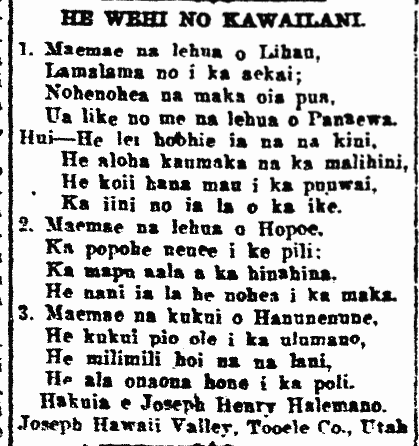
HE WEHI NO KAWAILANI.

1. Maemae na lehua o Lihau,
Lamalama no i ka aekai;
Nohenohea na maka oia pua,
Ua like no me na lehua o Panaewa.

Hui—He lei hoohie ia na na kini,
He aloha kaumaka na ka malihini,
He koii hana mau i ka puuwai,
Ka iini no ia la o ka ike.

2. Maemae na lehua o Hopoe,
Ka popohe nenee i ke pili;
Ka mapu aala a ka hinahina,
He nani ia la he nohea i ka maka.

3. Maemae na kukui o Hanunenune,
He kukui pio ole i ka ulumano,
He milimili hoi na na lani,
He ala onaona hone i ka poli.

Hakuia e Joseph Henry Halemano.
Joseph Hawaii Valley, Tooele Co., Utah.

(Kuokoa, 1/17/1913, p. 6)

HE WEHI NO KAWAILANI.

Ka Nupepa Kuokoa, Buke XLIX, Helu 3, Aoao 6. Ianuari 17, 1913.

One more mele for Kawailani, 1913.

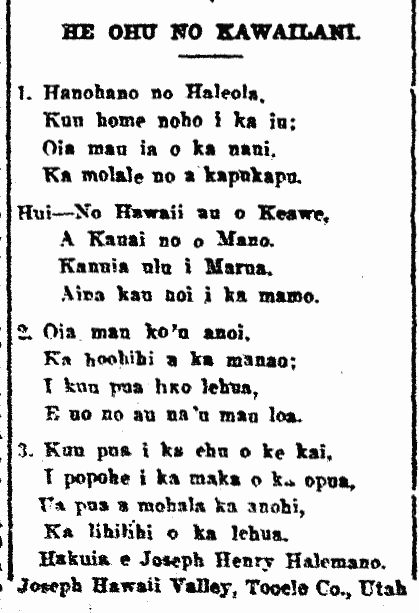
HE OHU NO KAWAILANI.

1. Hanohano no Haleola,
Kuu home noho i ka iu;
Oia mau ia o ka nani,
Ka molale no a kapukapu.

Hui—No Hawaii au o Keawe,
A Kauai no o Mano,
Kanuia ulu i Marna,
Aina kau hoi i ka mamo.

2. Oia mau ko’u anoi,
Ka hoohihi a ka manao;
I kuu pua liko lehua,
E uo no au na’u mau loa.

3. Kuu pua i ka ehu o ke kai,
I popohe i ka maka o ka opua,
Ua pua a mohala ka anohi,
Ka lihilihi o ka lehua.

Hakuia e Joseph Henry Halemano
Joseph Hawaii Valley, Tooele Co., Utah.

(Kuokoa, 1/10/1913, p. 6)

HE OHU NO KAWAILANI.

Ka Nupepa Kuokoa, Buke XLIX, Helu 2, Aoao 6. Ianuari 10, 1913.

Mele for Annie Kawailani Halemano (?) of Iosepa, Utah, 1913.

HE INOA NO KAWAILANI.

1. Wehiwehi no Halemano,
Ohuohu i ka lau lehua,
Hoohie no na kini,
A hoohihi no ilaila.

Hui—One, two, three, four, five,
Na hooheno ana, oni oi ala, piha hauoli.

2. Hanohano Kukaniloko,
Wehiwehi i na pua,
A hoohie no na manu,
A hoohihi no ilaila.

3. Haaheo o Leilehua,
Onaona i ke kupukupu,
Hoohie na ilikea,
A hoohihi no ilaila.

4. Kaulana no o Puaena,
Lamalama i ka ehu kai,
E nanea no na kupa,
A hoohihi no ilaila.

5. Kilakila no Hawaii,
Kaulana puni ka honua,
Hoohie na lehulehu,
A hoohihi no ilaila.

Hakuia e Joseph Henry Halemano.

Joseph Hawaii Valley, Tooele Co., Utah.

[I hardly hear this being sung today, but it is such a fun song!]

(Kuokoa, 1/10/1913, p. 7)

HE INOA NO KAWAILANI.

Ka Nupepa Kuokoa, Buke XLIX, Helu 2, Aoao 7. Ianuari 10, 1913.

Letter from Iosepa, Utah, 1913.

Word From Utah.

Iosepa, Toole County, Dec. 19, 1912.

Solomon Hanohano, Editor of the Kuokoa, Aloha oe:—Because we want to know of the news from our birth lands, we decided to subscribe to the Kuokoa. As the new year is arriving, it would be a means for us to see the news of our home and the progress of the political scene or its regression, as well as the victories or discouragements of our fellow makaainana.

This is an important year for the country, being that the great power of the nation has gong to the Democrats; the important question is this: Will the poor citizens of the land really benefit, or will they once again perhaps drift about like during Cleveland’s presidency, but it will be time that tells.

If those who were elected actually carry out what they promised with their lips to the people, then benefits will indeed result, however if it is like what Isaia said: “This people draweth nigh unto me with their mouth, but their heart is far from me.” Then those words of that old kamaaina of Lahaina will appear: “He says, when oh when will that happen.”¹ Recognized are the wealthy, and ignored are the poor. [Ikeia aku la no na kii maka nunui, nana oleia iho la na wahi kii maka liilii]. Continue reading