22 (122) years from the overthrow, 1915 (2015).

Amazing! Hawaii Has Not Been Americanized?

By our understanding, it has been nearly 22 whole years from when Hawaii was transferred under the administration of various governments until today, through the Kingdom of Queen Liliuokalani being stolen. It is a fact that the American flag did not wave from the flagpoles of Iolani during all of those years, being that during the first two years or perhaps three, the mountains, the ridges, the rivers, and the shores of Hawaii (but not the people of the land) were under the administration of the P. G. (P. I. G. in actuality), and for two or three years after that, under the name of the Republic of Hawaii, and for 16 years until today under the Territory of Hawaii. After the Kingdom of Hawaii was turned into the P. (I.) G. of Hawaii and thereafter, the Republic of Hawaii, and finally to the Territory of Hawaii, there is but only one good thing that we see during these many changes, that is the name HAWAII, and we believe that should the government in Hawaii nei change every year, for a 100 years, Hawaii will live on in its name.

During these years of changing of the political administration of this beloved land of Hawaii nei, America was the only foreign nation that posited itself greatly into Hawaii nei, and because of its support did these changes occur, being that it was Americans who instigated these actions; and during all of these changes, there was but one motivation, that being the annexation of this land to the United States of America. We do not forget the big-talking deceitful words of those people, “Should Hawaii be annexed to America, it will be with shovels that the people of this land will be scooping up silver and gold, and work will be had by all who ask.” These were the benefits that were projected upon the walls of Hawaii nei, but that is not the truth of what is being seen today.  It is not silver and gold that the people of the land are scooping with shovels. It is only in the pockets of the few that silver and gold flows. There are no jobs that “Uncle Sam” is just giving away, unless you have a starched collar, some gloves, and skin like that of an angel, and speak the words of the Cherubim; that is what the people of this land need to get ready so that they can acquire food and other necessities of life. Continue reading
William Nevins Armstrong, 1894.

WHO IS HE?

Mr. W. N. Armstrong

Again.

Mr. W. N. Armstrong has adopted the position of lecture and political teacher in the country and we have no doubt that he feels very proud of the audience that gathers around him in the Club and in the League. We have received a number of communications asking us who this Mr. Armstrong is an although his importance—as viewed by himself—has never dazzled our optics we are able  to furnish a little information about this would be professer in national and political science as far as his connections with the Hawaiian Government is concerned. Continue reading

Missionary descendants, 1894.

Who indeed are the missionaries.

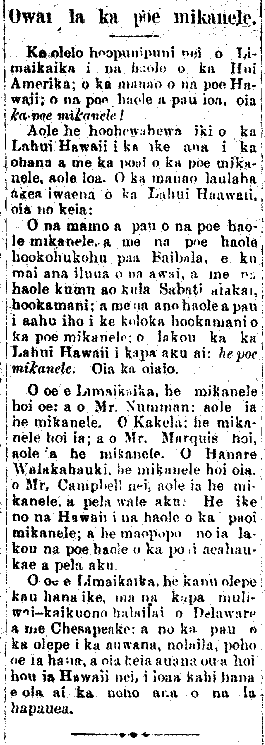
Armstrong is telling lies to the American League [Hui Amerika] about the thoughts of the Hawaiians; that all of the haole are the missionaries!

The Hawaiians are not mistaken in the least as to their recognition of the family and circle of missionaries, not at all. The general thought amongst the Lahui Hawaii is this:

All of the descendants of the haole missionaries and the haole who make as if they are steadfast to the Bible, who stand at the pulpit, and of the hypocritical haole Sunday school leaders; and all of the haole who wear the disguise of the missionary; those are who the Lahui Hawaii call: the missionaries. That is the truth.

You, O Armstrong, you are a missionary; and Mr. Neumann, he is not a missionary. Castle, he is a missionary; and Mr. Marquis though is not a missionary. Henry Waterhouse, he is a missionary; Mr. Campbell is not a missionary, and so forth. The Hawaiians do indeed know who is in the circle of missionaries; and they know who the haole are who are in the circle of vagrants.

As for you, O Armstrong, your trade is growing oysters on the banks of the calm Delaware and Chesapeake River and Bay, and due to the oysters going elsewhere, you took a loss and that is why you wandered back here to Hawaii nei, to find a job to support you in your old age.

[I am not sure who the “Mr. Marquis” referred to here is.]

(Oiaio, 2/16/1894, p. 2)

Owai la ka poe mikanele.

Ka Oiaio, Buke VI, Helu 7, Aoao 2. Feberuari 16, 1894.

Render unto Caesar… 1893.

The Pastor, the Pulpit, and the Church.

[Written for Ka Leo o ka Lahui.]

A pastor is one who travels. He goes far and wide. A pastor is knowledgeable and enlightened; he has spiritual wisdom, and his spirit is filled with aloha and patience; he does not grumble, is not snappy, nor impatient, nor hurtful; he has no contempt for others, when misfortune befalls him. He is truly devout, and prays sincerely for all, leaving none out; it is not right for a pastor to say:—”Ah! He will fall for he disregards the teachings of the pious.” The pastor should not say: “Because of his sins, he is cast out by God from above.”

When Christ was on this earth, he said: Do no harm to those that bring harm to you; love your enemy and pray for those who hurt you.

A Doctor is there for the sick, while a pastor is there to teach the sinners. Continue reading

Republicans and Hawaiians, 1902.

TO JOSEPH KALANA

Mr. Editor: Please give me a column in the fearless spokesmen of the lahui.

I am very regretful should you be a true Hawaiian, being that I always see in our newspapers of the mother tongue you announcing to the far and wide of the Archipelago, “Let Us be Republican.”

Do you not know the one who overthrew the monarchy? Do you not know the “head” of those who overthrew the government? Do you not know the desire of the people you support to obliterate us Hawaiians, and that this is verified from Governor Dole’s very own mouth? Do you not know the great desire of the Republicans to limit our voting power which was corroborated by the Governor in Boston by him saying: “We demand that the whites be supported and the native Hawaiians put down.’ ‘Ke kauoha nei makou e kakooia ka poe keokeo a e kulai a kuaia na kanaka Hawaii ilalo.” Continue reading

Ka Haku o Hawaii and Fire Engine Company 4, 1862.

[Found under: “NA MEA HOU O HAWAII NEI.”]

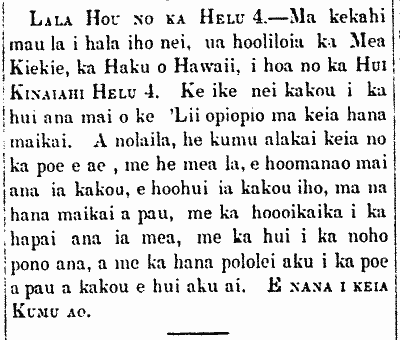
New Member for Number 4.—Recently, His Highness, Ka Haku o Hawaii, became a new member of Engine Company Number 4 [Hui Kinaiahi Helu 4]. We see the young Alii joining in on these fine work. This is an example for others, as if reminding us that we ourselves should join in good endeavors of all sorts, while putting effort into fostering these works, and living properly, and treating well all those with whom we meet. Look to this Example.

(Kuokoa, 1/25/1862, p. 2)

Lala Hou...

Ka Nupepa Kuokoa, Buke I, Helu 9, Aoao 2. Ianuari 25, 1862.

On ice and challenges and such, 1919 / timeless.

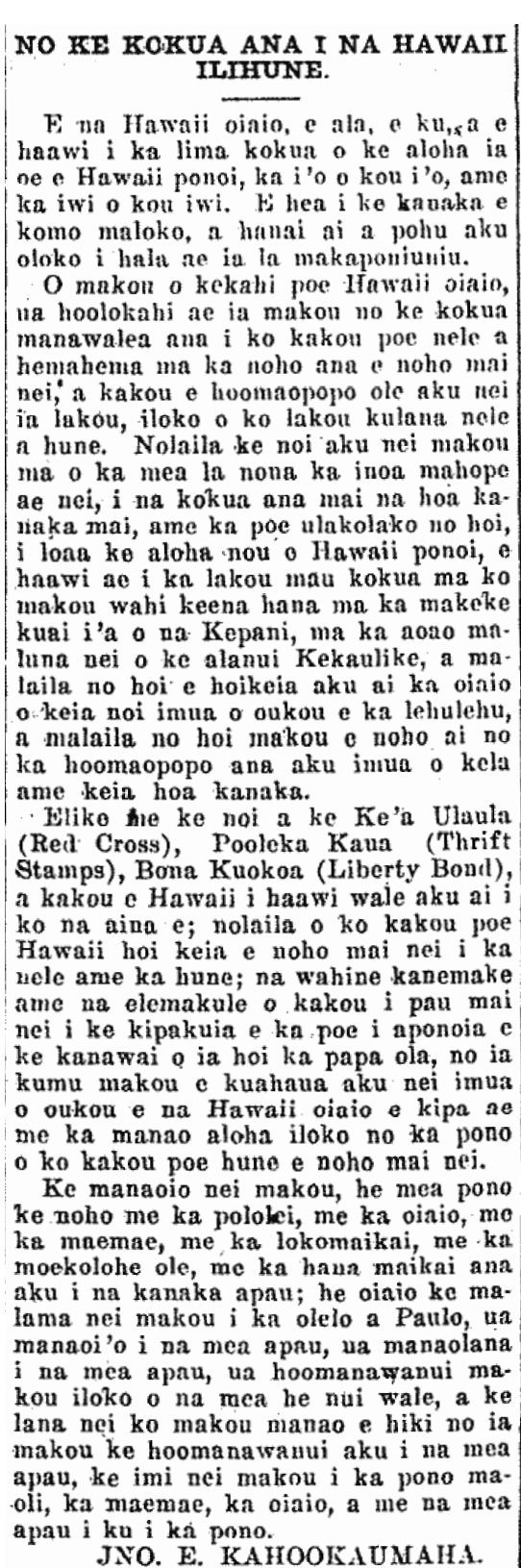
On Assisting Destitute Hawaiians

O True Hawaiians, rise, stand, and give a helping hand of aloha, oh to you, Hawaii’s own, the flesh of your flesh, the bone of your bone. Call out in welcome, feed, and nourish them, so they may make it through the days of hunger.

We are a number of true Hawaiians joining together to freely help our own facing hardship and difficulty in making a living; those who we do not know, in their poor and destitute condition. Therefore we ask by way of the one named later, for assistance from our fellow kanaka and wealthy people who have aloha for you, O Hawaii’s own, to give their donations to our office in the Japanese Fish Market on the upper side of Kekaulike Street, and there will be shown the truth of this plea before you, the people, and it is there that we will stay to make it understood to each and every fellow kanaka.

Just as with the pleas of the Red Cross (Kea Ulaula), Thrift Stamps (Pooleka Kaua), Liberty Bonds (Bona Kuokoa), to which we Hawaiians gave freely to those of foreign lands; this is our own Hawaiian people who are living in poverty, widows, and elderly who were kicked out by those who are responsible under the Law for their care, that being the Board of Health, and for that reason, we announce before you all, O True Hawaiians, come see us with aloha for the good of our own people living in poverty.

We believe in being honest, true, chaste, benevolent, virtuous, and in doing good to all men; indeed, we may say that we follow the admonition of Paul-We believe all things, we hope all things, we have endured many things, and hope to be able to endure all things. If there is anything virtuous, lovely, or of good report or praiseworthy, we seek after these things.¹

JOHN E. KAHOOKAUMAHA.

¹This is the thirteenth article in the Mormon articles of faith.

(Kuokoa, 3/28/1919, p. 2)

NO KE KOKUA ANA I NA HAWAII ILIHUNE.

Ka Nupepa Kuokoa, Buke LVII, Helu 13, Aoao 2. Maraki 28, 1919.

[The Aloha Aina also ran this announcement, but by this time, the typesetting done in this newspaper was not carefully done. There are frequent typesetting errors throughout. This can be seen in the parallel announcement found below.

One striking change however found in the Aloha Aina announcement is the phrase: “ka Papa Make (ka Papa Ola)” replacing “ka papa ola,” where they refer to the Board of Health as “the Board of Death”.]

No ke Kokou ana Ina Hawaii Ilihune

Ke Aloha Aina, Buke XXXIV, Helu 12, Aoao 4. Maraki 28, 1919.

D. L. Conkling, from bicyclist to treasurer, 1909.

BICYCLE RACER IS NOW TERRITORIAL TREASURER

David L. Conkling Is Given Fat Job in Hawaii

[Special Correspondence of the Call]

HONOLULU, July 2.—David Lloyd Conkling, formerly chief clerk of the territory, has been appointed territorial treasurer to succeed A. M. Campbell, whom the senate refused to confirm.

Conkling is a young man who came to Hawaii from San Francisco as a fancy bicycle rider and racer, having been well known on the coast tracks 10 years ago.

After the bicycle craze died out he became purser on one of the inter-island steamers and later was a reporter for the Honolulu papers. He was appointed chief clerk by Governor Carter and received his promotion from Governor Frear.

Conkling’s appointment has been received with general favor.

(San Francisco Call, 7/11/1909, p. 28)

BICYCLE RACER IS NOW TERRITORIAL TREASURER

San Francisco Call, Volume CVI, Number 41, Page 28. July 11, 1909.

Hawaiian Music, an editorial, 1911.

How Hawaiian Music is Being Misconstrued!

Perhaps the thoughts of the Kuokoa may not be the same as those of others about the way Hawaiian music is being sung these days, but because we hold dear listening to the beauty and the sweet sounds along with the joy of the voices, therefore the Kuokoa takes up this matter.

It is not something that we Hawaiians should criticize, that singing is something we are proud of, and something that makes this race famous all around the world, by tourists who visit Hawaii nei and hear us singing our enjoyable and entertaining songs, as well as by singing groups being seen travelling about America.

If we were to turn back in time, to many years past, when the Kawaihau Glee Club and many other groups were famous for singing, we will see when comparing them to those performing today, the differences between them; our admiration will be taken by the singing of the old days, which many groups in some places around Hawaii nei still practice that way of singing Hawaiian songs.

Our Hawaiian mele are composed with their many kaona, and it is by how they are sung, if it is not made clear by the lyrics, that give appreciation and admiration to the listener, from Hawaiians to those that don’t know our language, because it is only through the melody of the song that that listener is entertained.

These days however, our singers are following haole style singing; and when songs that we are used to hearing along with their tunes which fill us with energy and enthrallment are changed, when listening to that it is like ridicule, for we are not used to hearing that kind of melody, and Hawaiian songs are not famous for that style of singing.

Our people, from the men to the women are talented with fine singing voices; it is a talent not widely spread amongst other people of the world, but it is not by the the way some people now are singing, but by singing songs as they were sung in years past.

Perhaps the vibrato and the slow and drawn out of singing matches haole songs of this age, but by changing the way Hawaiian songs are sung in this way, we at the Kuokoa are not mistaken when we say that it is insulting to the listener.

We don’t wish to call this person or that one not a good singers, but should we want our goal to be to preserve this fame through song, there is only one arena for us to stand before the other races, that is through expressing what God has given to every Hawaiian man and woman, without mimicking or emulating what other people are doing; lest what is seen by us as good becomes something that is not good.

We have nothing to say to those who are studying music in books; that will be a great benefit to some, but the good seen in one aspect will not get better by changing another aspect; so it is with our Hawaiian music, by changing how they are sung, it will not make them better.

Each and every Hawaiian is the true witness, and they are the perfect judge to weigh what we now discuss, not to criticize or to assail upon someone with words of persecution, but for our affection of the grandeur and true beauty of Hawaiian mele which each and every one of us all love and cherish.

[On a somewhat related topic about tradition and kuleana and mele, there is a very thought-provoking essay for composers and non-composers alike, by Kainani Kahaunaele, printed in The Value of Hawaii 2: Ancestral Roots, Oceanic Visions, just recently out. In fact, if you haven’t got your copy yet, there are many stories by a wide range of writers in there that we should look at, and perhaps the many moolelo within the collection will then push us into thinking what we ourselves feel the value of Hawaii nei is and where we should be headed and what it is we need to do to get us there.]

(Kuokoa, 9/8/1911, p. 4)

PEHEA E HOOHEPAIA MAI NEI NA HIMENI HAWAII!

Ka Nupepa Kuokoa, Buke XLVII, Helu 36, Aoao 4. Sepatemaba 8, 1911.

Happy Mother’s Day, 1933.

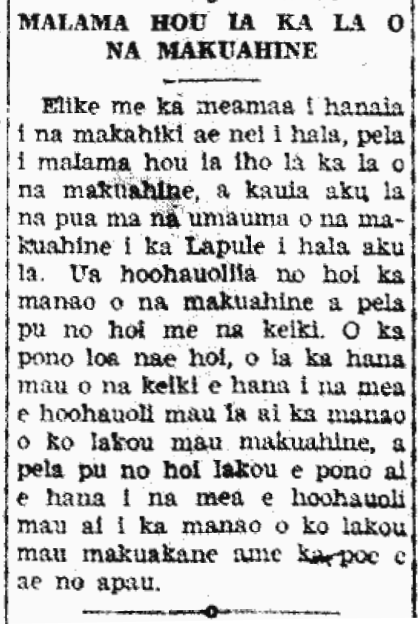
MOTHER’S DAY OBSERVED ONCE MORE.

Just as has been the custom these past years, the day for mothers has been observed, and flowers were placed on the breasts of the mothers on this past Sunday. Gladdened were the mothers as well at the children. What really should be done is that the children should always do what makes their mothers happy, and so too should they always do what makes their fathers happy and everyone else.

(Alakai o Hawaii, 5/25/1933, p. 2)

MALAMA HOU IA KA LA O NA MAKUAHINE

Ke Alakai o Hawaii, Buke 6, Helu 4, Aoao 2. Mei 25, 1933.