Happy Birthday, Aunty! 2016.

DON’T BE INDIFFERENT TO GOOD WORKS.

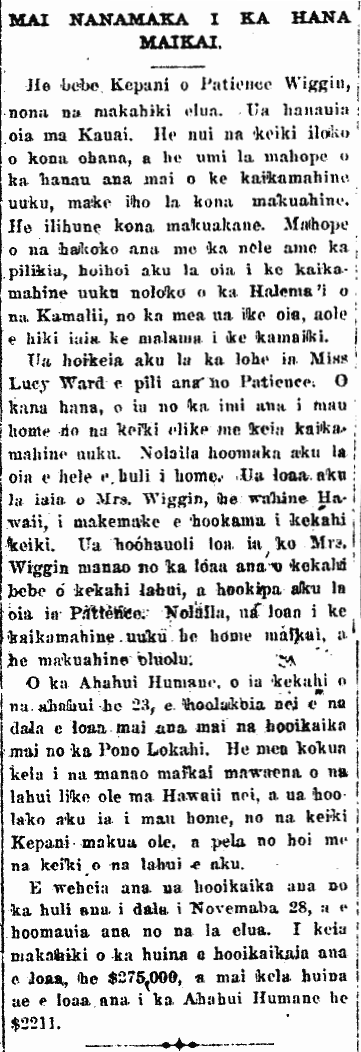
Patience Wiggin is a Japanese baby who is two years old. She was born on Kauai. There are many children in her family, and ten days after the birth of this little girl, her mother passed away. Her father is poor. After fighting with destitution and troubles, he returned the tiny girl to the Children’s Hospital, for he knew he could not care for this child.

The news was told to Miss Lucy Ward about Patience. Her job is to find homes for children like this small girl. So she began to go around searching for a home. She found Mrs. Wiggin, a Hawaiian, who wanted to adopt [hookama] a child. Mrs. Wiggin’s mind was delighted to find a baby of a different ethnicity, and welcomed in Patience. So the young girl gained a fine home and a kind mother.

The Humane Society is one of 23 associations that is provided with funds that are collected for United Welfare [Pono Lokahi] drive. This is something which promotes good will between the different ethnicities of Hawaii nei, and it will provide homes for Japanese orphans and also for children of other races.

Efforts to raise funds will begin on November 28 and continue for two days. This year the goal to be collected is $275,000, and from that sum, the Humane Society will receive $2211.

[For and earlier post, click here. And for even more on Aunty, click here.

If it wasn’t for the young girl in the story, I certainly would not be doing this blog. Hauoli la hanau e Aunty Pat! O KU O KA!!]

(Kuokoa, 11/25/1921, p. 4)
Kuokoa_11_25_1921_4

Ka Nupepa Kuokoa, Buke LIX, Helu 47, Aoao 4. Novemaba 25, 1921.
New Hawaiian shop, “Ka Noeau o Hawaii,” 1896.

“Ka Noeau o Hawaii.”

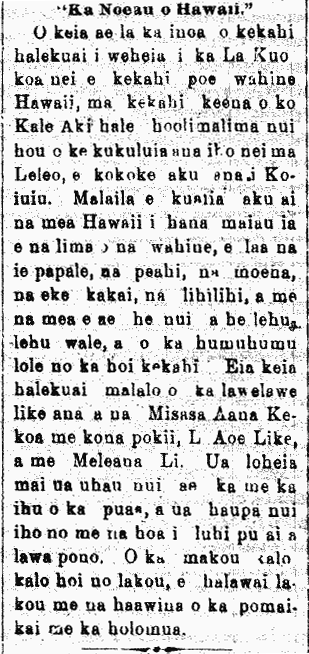
This is the name of a store that opened on this Independence Day [La Kuokoa] by some Hawaiian women in an office of Charles Aki’s [Kale Aki] large new rental space just built at Leleo near Koiuiu. There is sold Hawaiian goods fashioned with skill by the hands of women like ie hats, fans, blankets, purses, lace, and many other things, and also they do tailoring. This shop is under the equal management of Mrs. Aana Kekoa and her sister L. Aoe Like and Meleana Li. We doubt it, but it is said that they did sacrifices with the snout of a pig, and they feasted with those that labored with them until satiated. Our prayer for them is that they meet with good fortune and progress.

(Makaainana, 12/7/1896, p. 2)

"Ka Noeau o Hawaii."

Ka Makaainana, Buke VI—-Ano Hou, Helu 23, Aoao 2. Dekemaba 7, 1896.

Life stages 15. Haumakaʻiole, 16. Palalauhala, and 17. Kāikōkō.1905.

[Found under: “KA MAKUAHINE PALEKA.”]

The famous saying of the Hawaiians said always in prayers of the old kahuna—”Haumakaiole, palalauhala a kaikoko;” it was those words that showed how long lived the ancient Hawaiians were. Because from the actual meaning of the word “haumakaiole,” it is the shriveling of a person’s eyes that is all wrinkly, which is why they are tiny like that of a rat’s, and that is the stage after gray-haired [poohina]; and elderly [elemakule] comes before gray-haired, but elemakule is the general stage for when a person becomes frail [palupalu].

And after an old and frail person passes the stage of “haumakaiole,” then that person enters into the stage “palalauhala,”and the idea behind that it is the very old age of a person if he continue to live, he cannot walk around by himself, should he not perhaps receive assistance; that is when the person lies constantly atop a mat, and sometimes the person is rolled up in a mat. Continue reading

Names for the stages of life, 1909.

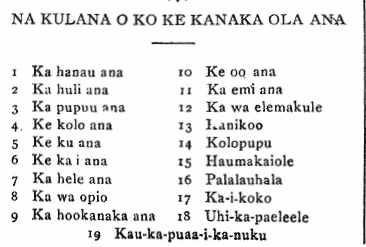
NA KULANA O KO KE KANAKA OLA ANA

1  Ka hanau ana

2  Ka huli ana

3  Ka pupuu ana

4  Ke kolo ana

5  Ke ku ana

6  Ke ka i ana

7  Ka hele ana

8  Ka wa opio

9  Ka hookanaka ana

10  Ke oo ana

11  Ka emi ana

12  Ka wa elemakule

13  Kanikoo

14  Kolopupu

15  Haumakaiole

16  Palalauhala

17  Ka-i-koko

18 Uhi-ka-paeleele

19  Kau-ka-puaa-i-ka-nuku

(Lanakila, 9/23/1909, p. 26)

KE KULANA O KO KE KANAKA OLA ANA

Ka Lanakila, Buke 1, Helu 11, Aoao 26. Sepatemaba 23, 1909.

The importance of mele, 1860.

Pertaining to Mele!

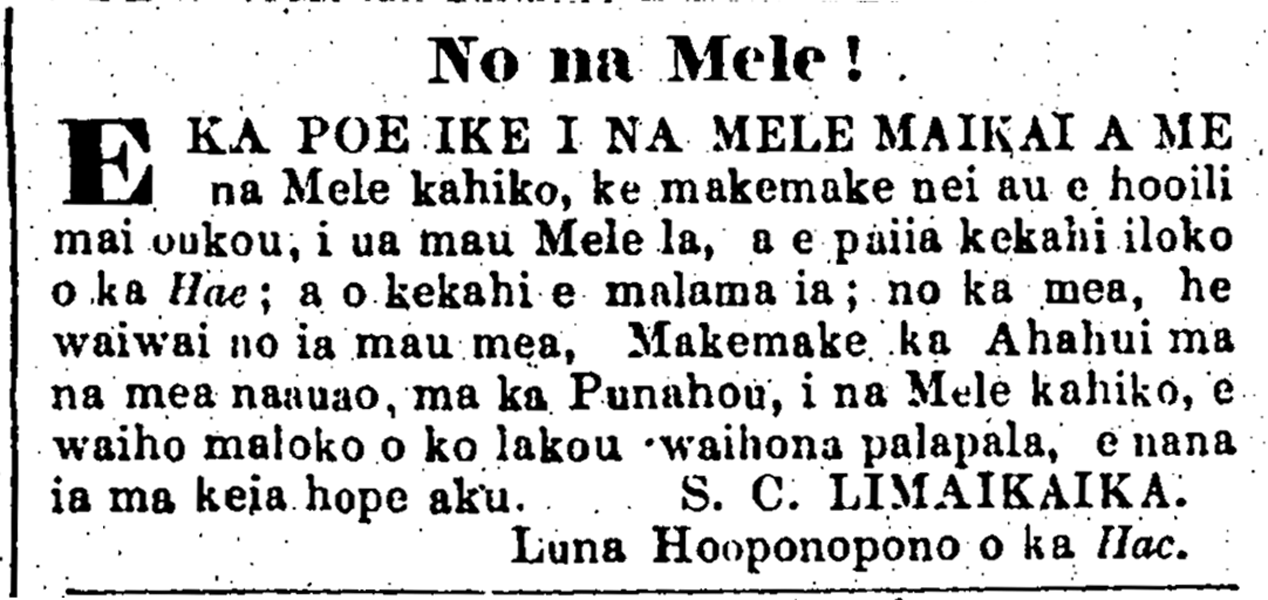
O PEOPLE THAT KNOW FINE MELE AND the old Mele, I want you all to send those Mele in, and some will be published in the Hae [Ka Hae Hawaii]; and some will be kept; for those things are valuable. The Philomathian Society [?? Ahahui ma na mea naauao]  at Punahou is wanting old Mele to put into their archives to be looked at at a later date. S. C. Armstrong [S. C. Limaikaika].

Editor of the Hae.

(Hae Hawaii, 3/21/1860, p. 203)

No na Mele

Ka Hae Hawaii, Buke 4, Ano Hou.—Helu 51, Aoao 203. Maraki 21, 1860.

Traditional place names and the Daughters of Hawaii, 1918.

OLD HAWAIIAN NAMES TO BE PRESERVED.

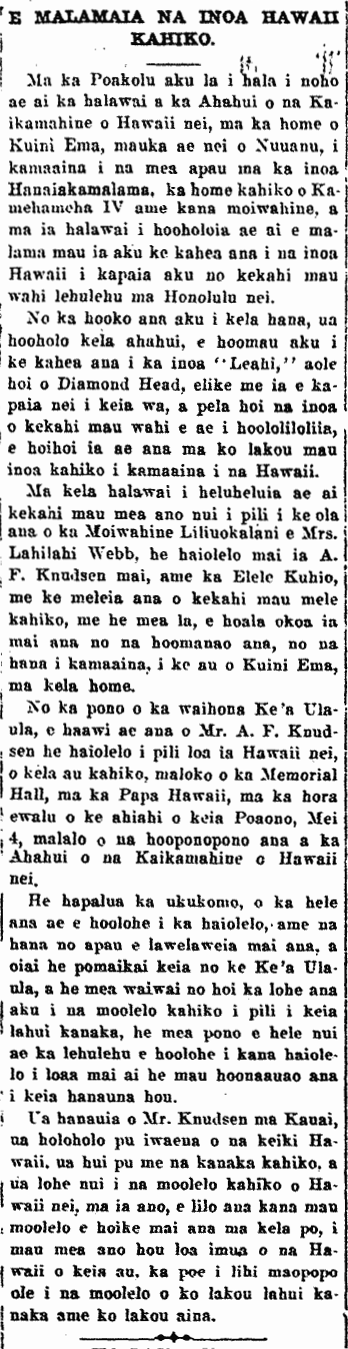
This past Wednesday the Daughters of Hawaii [Ahahui o na Kaikamahine] held a meeting at the home of Queen Emma in the uplands of Nuuanu, known by all by the name Hanaiakamalama, the old home of Kamehameha IV and his queen; and at that meeting it was decided that the calling of many places in Honolulu nei by their Hawaiian names will be preserved forever.

To carry out this endeavor, the organization decided to continue calling the name “Leahi,” and not Diamond Head, as it is being called now, and so too with other names that have been changed; they will be returned to their old names that Hawaiians are familiar with.

At that meeting several things were read pertaining to the life of Queen Liliuokalani  by Mrs. Lahilahi Web, a speech by A. F. Knudsen, and Representative Kuhio, along with the singing of some old mele, just as if they were recreating memories of familiar deeds from the time of Queen Emma in that home.

For the treasury of the Red Cross, Mr. A. F. Knudsen will give a speech specifically pertaining to Hawaii nei of the olden days, at Memorial Hall of the Hawaiian Evangelical Association [Papa Hawaii], at eight o’clock on the evening of this Saturday, May 4, under the direction of the Daughters of Hawaii nei.

The entrance will be half price to go and listen to the speech and for all activities that will be put on, and being that it is a benefit for the Red Cross, and that it is beneficial to listen to this history pertaining to the Hawaiian lahui, all the people should go to hear his speech so that the new generations can get some education.

Mr. Knudsen was born on Kauai and went around amongst the Hawaiian children, and met the old people, and listened to the old stories of Hawaii nei; and because of this, the stories he tells that night will be something totally new for Hawaiians of today, the people who know hardly any of the stories of their lahui and their land.

(Kuokoa, 5/3/1918, p. 4)

E MALAMAIA NA INOA HAWAII KAHIKO.

Ka Nupepa Kuokoa, Buke LVI, Helu 18, Aoao 4. Mei 3, 1918.

Daughters of Hawaii to Put on Historical Play, 1913.

DAUGHTERS OF HAWAII TO GIVE UNIQUE PROGRAM

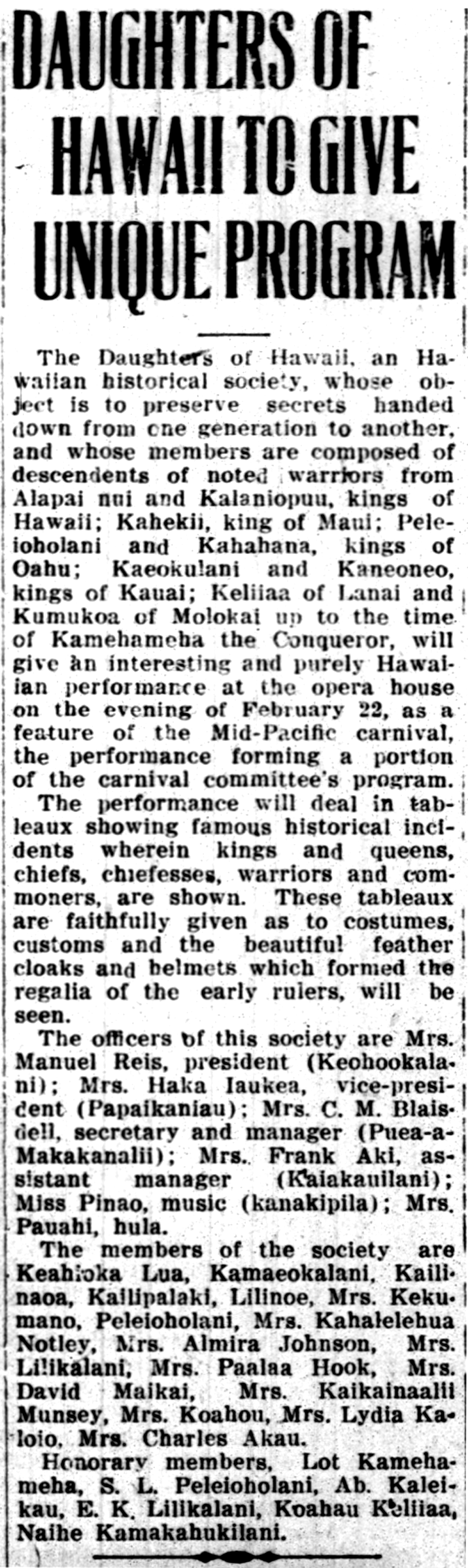
The Daughters of Hawaii, an Hawaiian historical society, whose object is to preserve secrets handed down from one generation to another, and whose members are composed of descendents of noted warriors from Alapai nui and Kalaniopuu, kings of Hawaii; Kahekili, king of Maui; Peleioholani and Kahahana, kings of Oahu; Kaeokulani and Kaneoneo, kings of Kauai; Keliiaa of Lanai and Kumukoa of Molokai up to the time of Kamehameha the Conqueror, will give an interesting and purely Hawaiian performance at the opera house on the evening of February 22, as a feature of the Mid-Pacific carnival, the performance forming a portion of the carnival committee’s program.

The performance will deal in tableaux showing famous historical incidents wherein kings and queens, chiefs, chiefesses, warriors and commoners, are shown. These tableaux are faithfully given as to costumes, customs and the beautiful feather cloaks and helmets which formed the regalia of the early rulers, will be seen.

The officers of this society are Mrs. Manuel Reis, president (Keohookalani); Mrs. Haka Iaukea, vice-president (Papakaniau); Mrs. C. M. Blaisdell, secretary and manager (Puea-a-Makakanalii); Mrs. Frank Aki, assistant manager (Kaiakauilani); Miss Pinao, music (kanikapila); Mrs. Pauahi [? Mrs. Puahi], hula.

The members of the society are Keahioka Lua, Kamaeokalani, Kailinaoa, Kailipalaki, Lilinoe, Mrs. Kekumano, Peleioholani, Mrs. Kahalelehua Notley, Mrs. Almira Johnson, Mrs. Lilikalani, Mrs. Paalaa Hook, Mrs. David Maikai, Mrs. Kaikainaalii Munsey, Mrs. Koahou, Mrs. Lydia Kaloio, Mrs. Charles Akau.

Honorary members, Lot Kamehameha, S. L. Peleioholani, Ab. Kaleikau [Abraham Kaleikau], E. K. Lilikalani, Koahau Keliiaa, Naihe Kamakahukilani.

(Honolulu Star-Bulletin, 2/18/1913, p. 5)

DAUGHTERS OF HAWAII TO GIVE UNIQUE PROGRAM

Honolulu Star-Bulletin, Volume XX, Number 6514, Page 5. February 18, 1913.

Ahahui Mamakakaua forms, 1917.

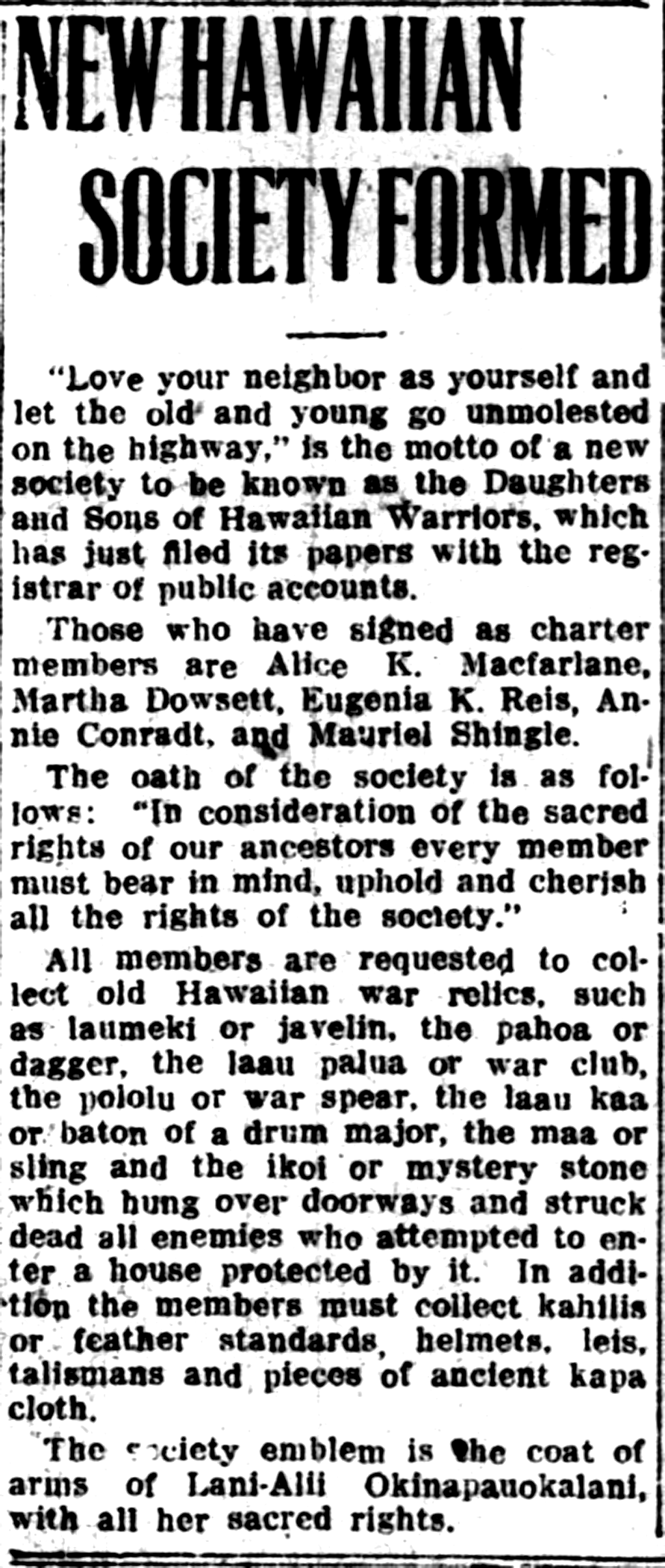
NEW HAWAIIAN SOCIETY FORMED

“Love your neighbor as yourself and let the old and young go unmolested on the highway,” is the motto of a new society to be known as the Daughters and Sons of Hawaiian Warriors, which has just filed its papers with the registrar of public accounts.

Those who have signed as charter members are Alice K. Macfarlane, Martha Dowsett, Eugenia K. Reis, Annie Conradt, and Mauriel Shingle [Muriel Campbell Shingle].

The oath of the society is as follows: “In consideration of the sacred rights of our ancestors every member must bear in mind, uphold and cherish all the rights of the society.”

All members are requested to collect old Hawaiian war relics, such as laumeki or javelin, the pahoa or dagger, the laau palua [laau palau] or war club, the pololu or war spear, the laau kaa or baton of a drum major, the maa or sling and the ikoi or mystery stone which hung over doorways and struck dead all enemies who attempted to enter a house protected by it. In addition the members must collect kahilis or feather standards, helmets, leis, talismans and pieces of ancient kapa cloth.

The society emblem is the coat of arms of Lani-Alii Okinapauokalani, with all her sacred rights.

(Honolulu Star-Bulletin, 10/24/1917, p. 14)

NEW HAWAIIAN SOCIETY FORMED

Honolulu Star-Bulletin, Volume XXV, Number 7966, Page 14. October 24, 1917.

Fred Malulani Beckley Kahea passing on traditional knowledge, 1922.

[Found under: “Nuhou Kuloko”]

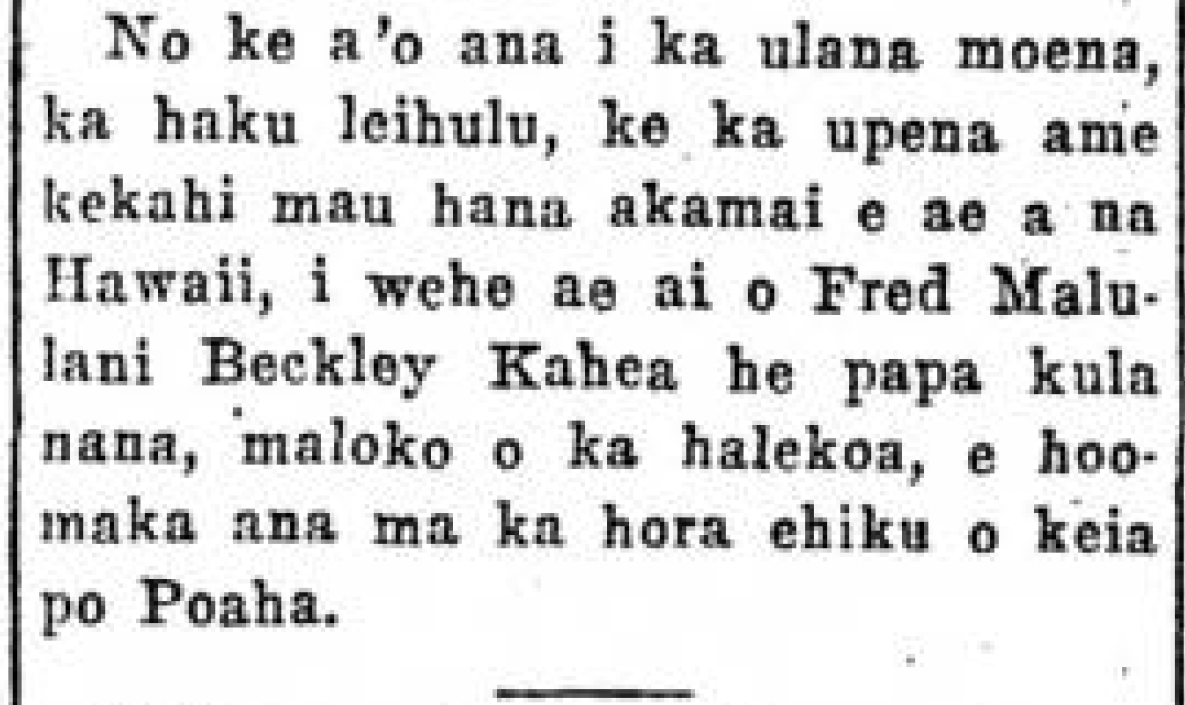
In order to teach mat weaving [ulana moena], feather lei making [haku lei hulu], net tying [ka upena], and other Hawaiian skills, Fred Malulani Beckley Kahea initiated himself a class in the armory, beginning at seven o’clock this Thursday night.

[I was reminded of this article by the recent post by Nanea Armstrong-Wassel about Fred Malulani Beckley Kahea and traditional featherworkers.

F. M. B. Kahea not only taught his class at the armory, but he also was the sharing his knowledge in the construction of kahili when they were made for Governor Farrington in 1928.]

(Kuokoa, 12/7/1922, p. 8)

No ke a'o ana...

Ka Nupepa Kuokoa, Buke LXI, Helu 49, Aoao 8. Dekemaba 7, 1922.

“Kearny cloak” aboard the Malolo, 1927.

[Found under: “Nuhou Kuwaho”]

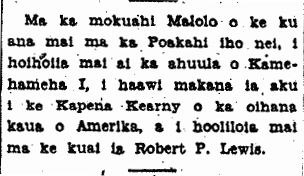
By way of the steamship Malolo which arrived this past Monday, returned was the feather cape of Kamehameha I that was presented to Captain Kearny of the armed forces of America, and which was obtained through purchase by Robert P. Lewis.

(Kuokoa, 11/24/1927, p. 4)

Ma ka mokuahi Malolo...

Ka Nupepa Kuokoa, Buke LXVI, Helu 52, Aoao 4. Novemaba 24, 1927.