Kalaniopuu’s ahuula and mahiole that he placed on Cook, 1779 / 2016.

I just put up the short excerpt the other day describing Kalaniopuu giving James Cook his ahuula and kahili. And now there is this exciting announcement from the Bernice Pauahi Bishop Museum!
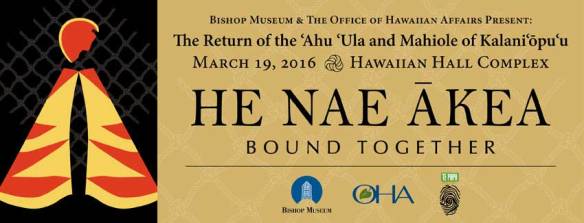
he-nae-akea

[It should be perhaps made clear however that the ahuula at least has made its way back to Hawaii nei two times since 1779, courtesy of the Dominion Museum, the predecessor of Te Papa Tongarewa]. The first time was in 1960:

DOMINION MUSEUM FEATHER CLOAK

Each year the Museum attempts to bring back for the Aloha Week exhibit a fine example of Hawaiian featherwork from abroad. This year the Dominion Museum of Wellington, New Zealand, has generously loaned a large Hawaiian feather cloak, which to the best of our knowledge, was presented to Captain Cook’s expedition in 1779. Aloha Week marks the first return of this cloak to Hawaii.

(Conch Shell: News of the Bishop Museum, October 1960)

The second time was for the “Artificial Curiosities” exhibit at the Bishop Museum which ran from January 18 to August 31, 1978.

Also, check out this previous post on an amazing story about other featherwork given to Cook by Kalaniopuu!

Keahualono, wahi pana of Hawaii Island, 1916.

KE AHU-A-LONO

This is the border between the two Kona districts and Kohala, and the name of this heap of rocks  [ahu pohaku] is called after Lonoikamakahiki-Kapu-a-ka-Lani, one of the high ruling chiefs of Hawaii nei who is famous in genealogical histories of the high ruling chiefs of Hawaii Island of Keawe.

When Lonoikamakahiki went with his troops and camped at this place, the Marshals [Ilamuku] built this mound of rocks and called it by the name “Ke Ahu-a-Lono,” after the name of Lonoikamakahiki, the ruling chief. That is how this pile of rocks is known until today, an unforgettable monument built by the foremost war leaders [pukaua] of Lonoikamakahiki, so that the generations of this time would remember the truly famous deeds of our forefathers who passed on; and of that sacred name Lonoikamakahiki-Kapu-a-ka-Lani. The locals of Puuanahulu are familiar with this ahu pohaku.

(Hoku o Hawaii, 2/17/1916, p. 4)

HokuoHawaii_2_17_1916_4.png

Ka Hoku o Hawaii, Buke 10, Helu 37, Aoao 4. Feberuari 17, 1916.

William Huddy, one lucky man, 1916.

SAVED

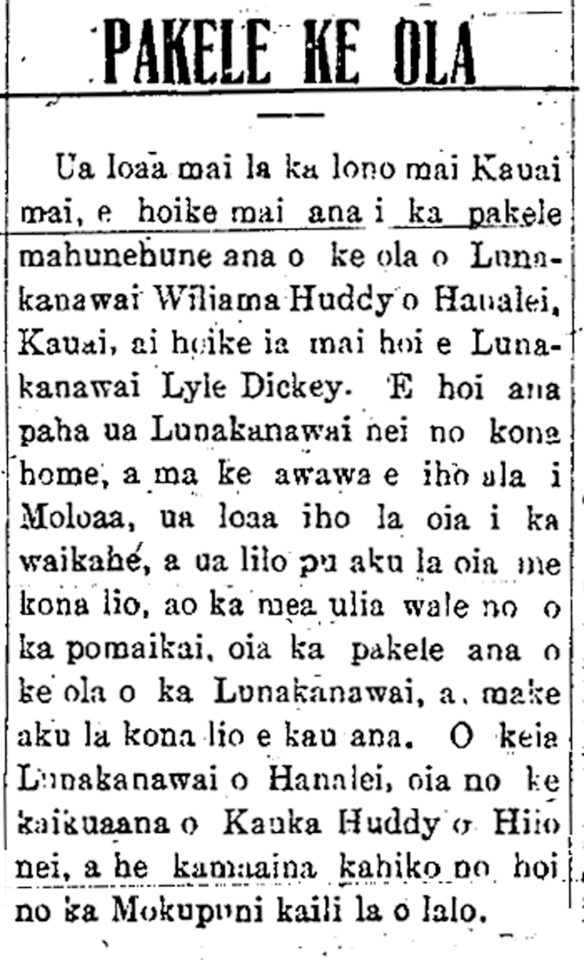
We received news from Kauai telling how the life of Judge William Huddy [Wiliama Huddy] of Hanalei, Kauai was barely saved, as told by Judge Lyle Dickey. Perhaps that Judge was heading home, and in the valley going down into Moloaa, he came up against an overflowing stream, and he and his horse got caught up in it; and only by sheer luck was the life of the Judge saved, but the horse he was on died. This Judge of Hanalei is the older brother of Dr. Huddy of Hilo nei, and a old-timer of the Island in the west that snatches the sun.

(Hoku o Hawaii, 2/17/1916, p. 2)

HokuoHawaii_2_17_1916_2

Ka Hoku o Hawaii, Buke 10, Helu 37, Aoao 2. Feberuari 17, 1916.

79 years ago, Inter-Island Play Day for Women, 1937.

LOCAL GIRLS TO GO TO MOLOKAI

Under the leadership of Eliza K. Osorio and Irene K. Silva, directors of the Hilo Women’s Athletic association, 31 local girls will leave for Molokai this Sunday on the steamer to attend the fifth annual Inter-island Play Day of Women which will be held on Molokai on March 23, 24, and 25. The play festival was held two years in Hilo and a year ago on Maui.

Girls making the trip from Hilo are: Margaret Brown, Harriet Brown, Yok Lan Mehau, Christine Almeida, Pua Ho-a, Betty Watai, Elsie Watai, Mary Cootey, Virginia Asau, Margaret Kimi, [Napua] Harriet Stevens, Continue reading

Hiram Kaaha dies, 1923.

MY BELOVED FATHER, MR. HIRAM KAAHA, HAS PASSED.

MR. HIRAM KAAHA.

Iluna i ke ao,
Kuu home mau,
He malihini au,
Ma keia ao,
He waoakua nei,
He pilikia e,
Ka lani iluna ae,
Kuu home mau.

[Above in the clouds,
Is my home for all times,
I am a stranger,
In this world,
A desert,
A place of troubles,
The heavens above,
Is my home for all times.]

Mr. Solomon Hanohano: Aloha nui kaua:—Please insert this loving bundle of tears in an open space in the Kuokoa so that the fellow workers in the church, family, and friends of my dearly beloved father see that he has left this life.

My beloved papa was born at Kamoiliili, Waikiki Waena, Honolulu, Oahu, on Oct. 18, 1854 from the loins of Kawela (m) and Kahoiwai (f). Continue reading

Ka Leo Hawaii, 1972 / 2016.

A labor of love

When Larry Kimura and his students first arrived at KCCN in Honolulu with a pitch for a new Hawaiian-language radio show, the station manager had one question.

“Do you have an audience?”

It was 1972. Hawaiian was dying out. Most native speakers were kupuna — and there were not many left. It was still technically illegal to speak Hawaiian in schools. Who was going to listen to a program conducted entirely in Hawaiian?

“But he was kind enough to say, ‘All right,’” Kimura, now 69 and an associate professor of Hawaiian language and culture at the University of Hawaii at Hilo, recalled last week. Continue reading at Hawaii Tribune Herald

[Check out this awesome article from the Hawaii Tribune Herald. I wonder who the station manager of KCCN was in 1972!]

George Vancouver arrives once more on February 14, 1793.

[Found under: “He Moolelo Hawaii”]

Vancouver Returns

In the month of February, the 14 day, 1793, Vancouver [Vanekouwa] returned to Hawaii nei, from the northwest of America, and landed at Kawaihae.

The men pleaded for guns and powder from him. Vancouver refused and would not sell those sort things to them. There was great desire of Hawaiians for those things during those days, because it was a time of war, and Kamehameha was conquering the nation then; Oahu and Kauai remained.

And from there, Vancouver landed at Kealakekua, on the 22nd of that month and met with Kamehameha.

At that time, he gifted Kamehameha with two cattle, a bull and a cow. The cattle that Vancouver brought were from Monterey, a land in America.

These animals were greatly appreciated by Hawaiians because they were unusual, and they were called puaa pipi. It is from those pipi that the cattle which roam these days at Waimea and Maunakea and the other forests of Hawaii proliferated.

Kamehameha treated Vancouver kindly; Vancouver was facing hardship without water and took his water barrels into the uplands, and Kamehameha commanded his men to carry the barrels and to fill them with water. Continue reading

Recalling the death of James Cook, 1896.

[Found under: “He Moolelo no ka HOOKUMUIA ANA O HAWAII”]

PERTAINING TO THE DEATH OF LONO.

On the 24th of January 1779, Kalaniopuu returned from Maui; Lono was at Kealakekua in Kona, and Kalaniopuu met with Lono, and Kalaniopuu the chief treated Lono kindly and donned a ahu ula upon Lono, with kahili, and Kalaniopuu did a great many good things for Lono.

And on the 4th of February 1779, Lono leaves Kealakekua and his ship sails directly outside of Kawaihae and Kohala; it is noticed that one of the masts of his ship is rotten, so he returns to Kealakekua to build a new mast for his ship. Continue reading