Multi-day Restoration Day celebration! 1844.

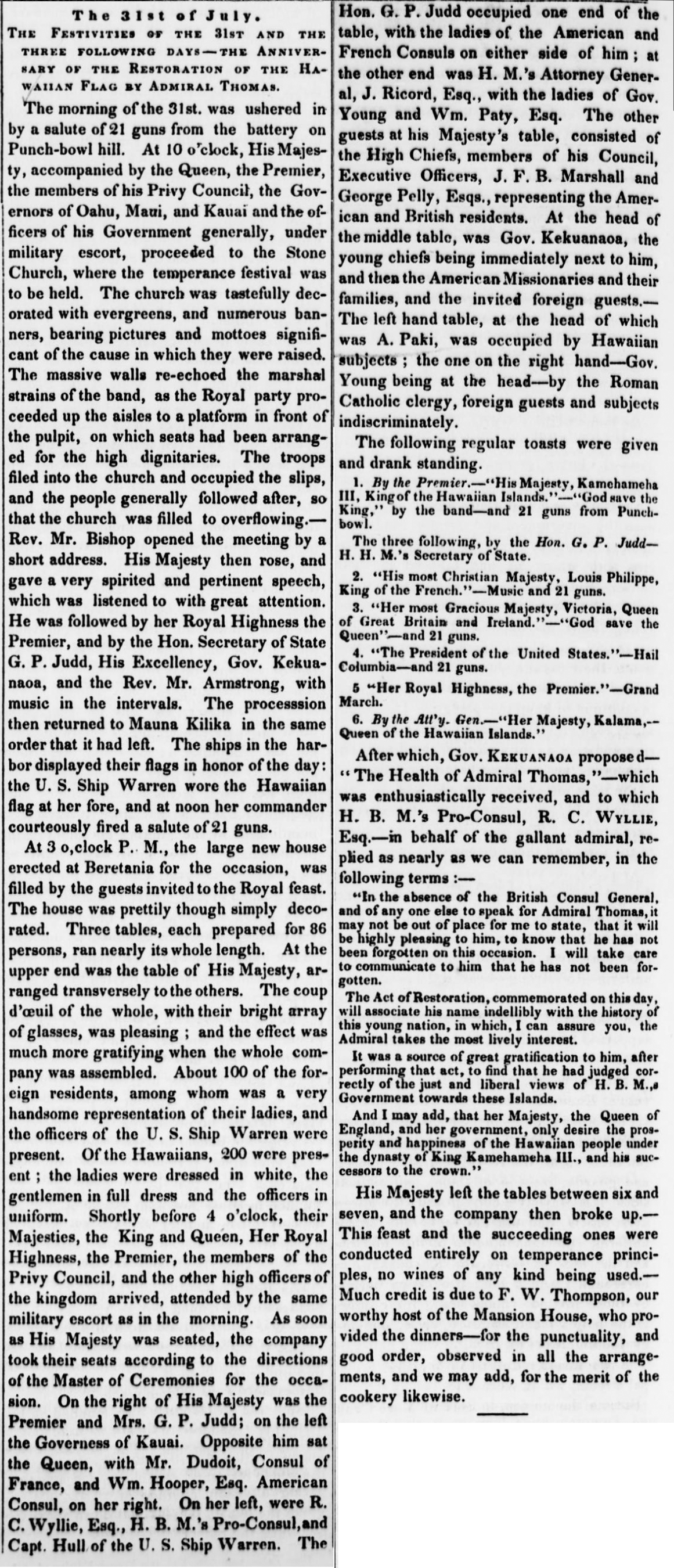
The 31st of July.

The Festivities of the 31st and the three following days—the Anniversary of the Restoration of the Hawaiian Flag by Admiral Thomas.

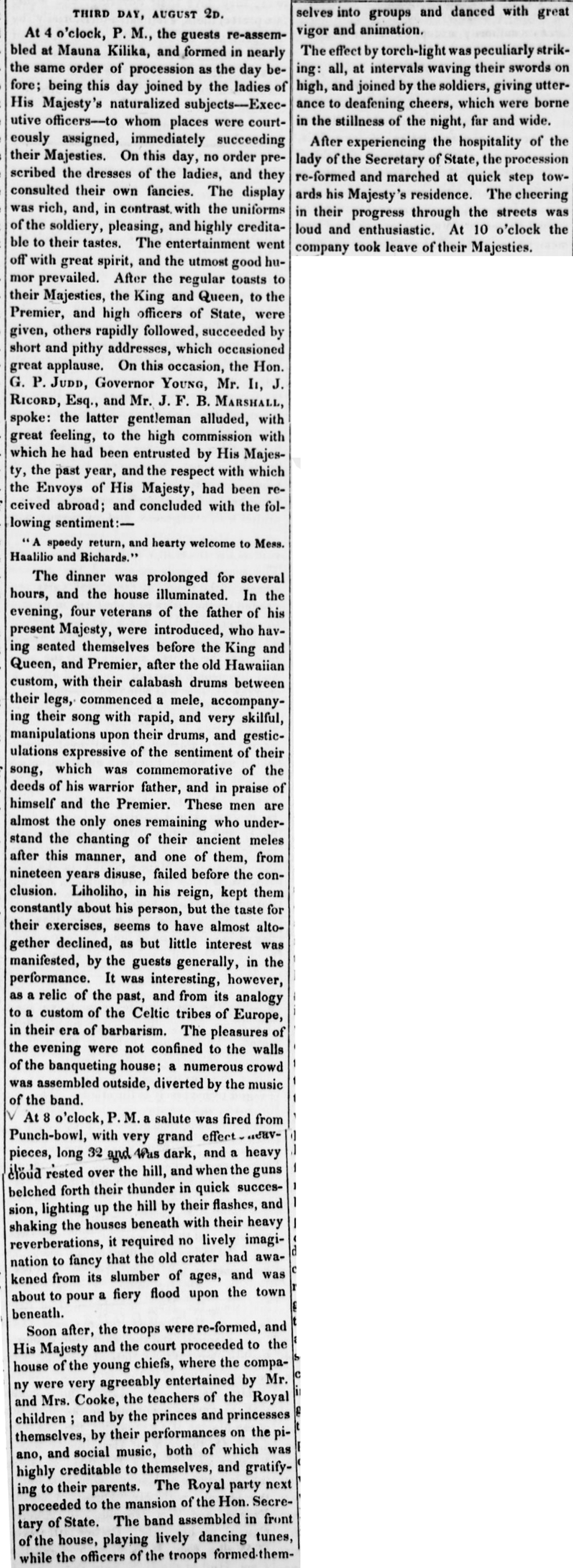
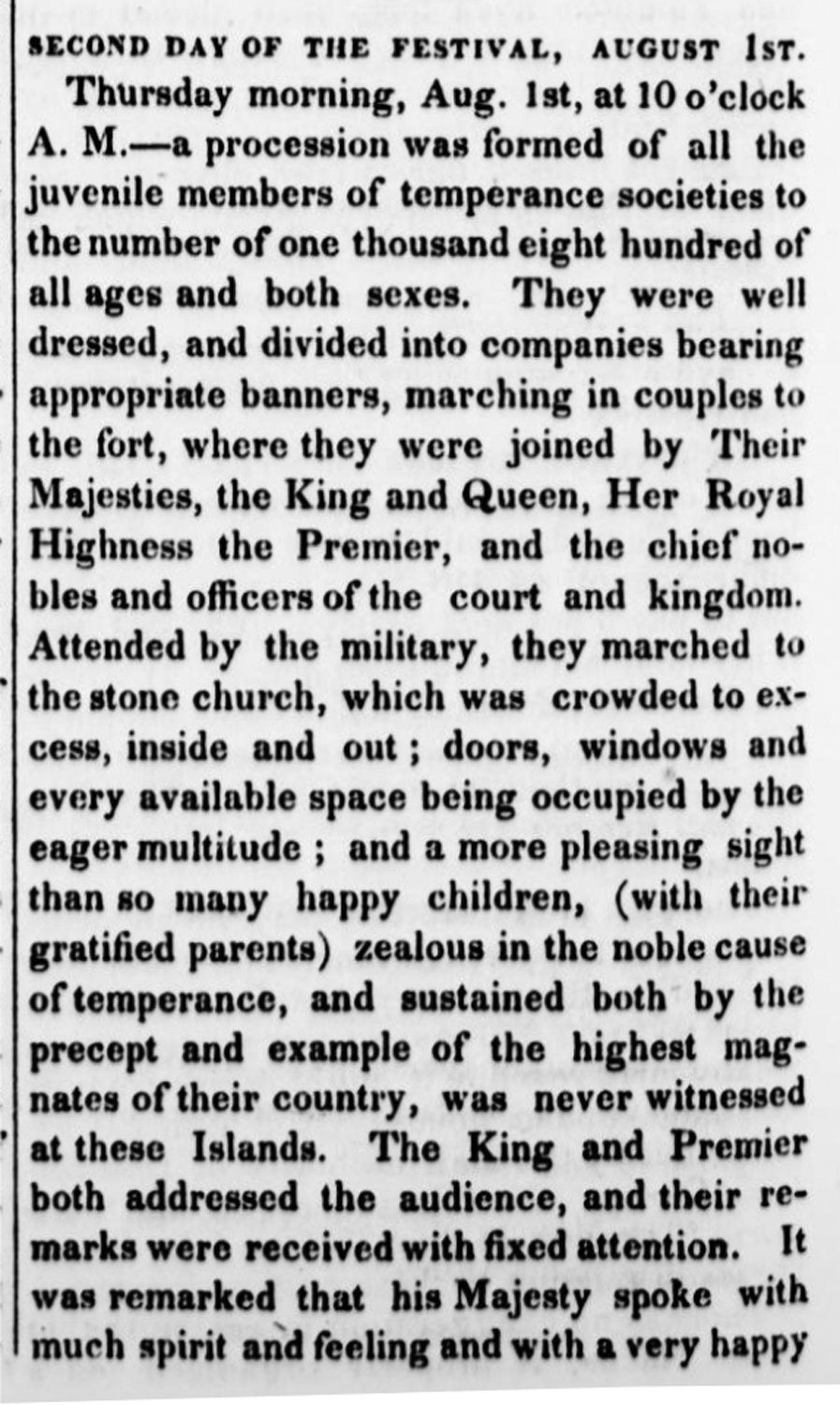
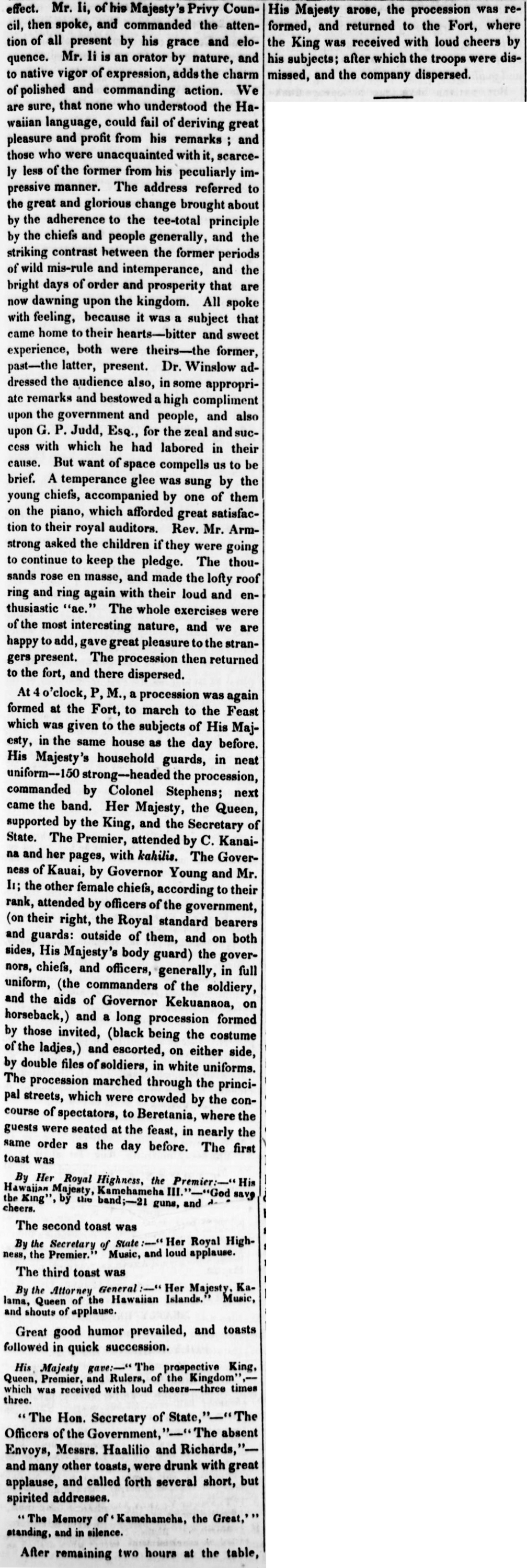
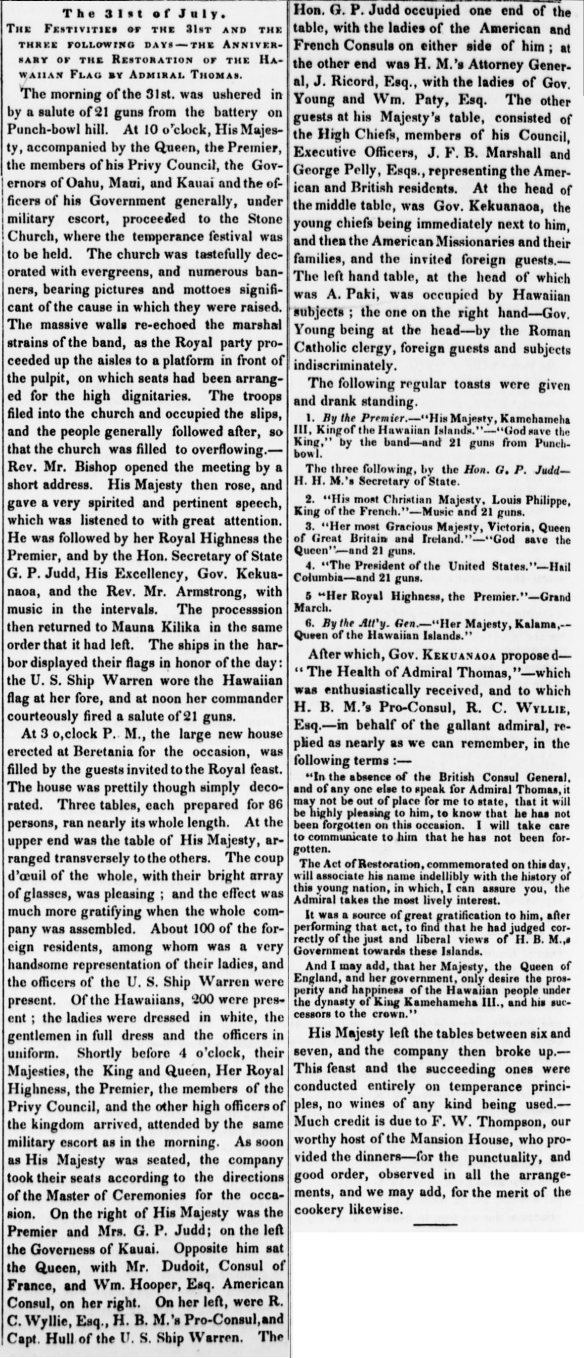
The morning of the 31st, was ushered in by a salute of 21 guns from the battery on Punch-bowl hill. At 10 o’clock, His Majesty, accompanied by the Queen, the Premier, the members of his Privy Council, the Governors of Oahu, Maui, and Kauai and the officers of his Government generally, under military escort, proceeded to the Stone Church [Kawaiahao Church], where the temperance festival was to be held. The church was tastefully decorated with evergreens, and numerous banners, bearing pictures and mottoes significant of the cause in which they were raised. The massive walls re-echoed the marshal strains of the band, as the Royal party proceeded up the aisles to a platform in front of the pulpit, on which seats had been arranged for the high dignitaries. The troops filed into the church and occupied the slips, and the people generally followed after, so that the church was filled to overflowing.—Rev. Mr. Bishop opened the meeting by a short address. His Majesty then rose, and gave a very spirited and pertinent speech, which was listened to with great attention. He was followed by her Royal Highness the Premier, and by the Hon. Secretary of State G. P. Judd, His Excellency, Gov. Kekuanaoa, and the Rev. Mr. Armstrong, with music in the intervals. The procession then returned to Mauna Kilika in the same order that it had left. The ships in the harbor displayed their flags in honor of the day: the U. S. Ship Warren wore the Hawaiian flag at her fore, and at noon her commander courteously fired a salute of 21 guns.

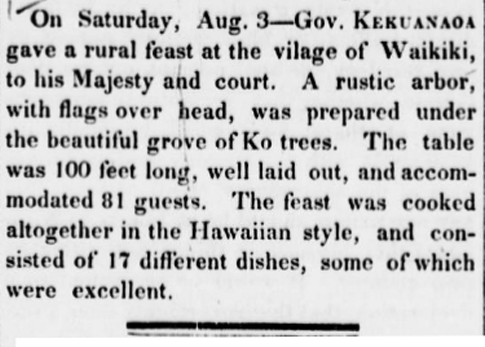
At 3 o’clock P. M., the large new house erected at Beretania for the occasion, was filled by the guests invited to the Royal feast. The house was prettily though simply decorated. Three tables, each prepared for 86 persons, ran nearly its whole length. At the upper end of the table of His Majesty, arranged transversely to the others. The coup d’œuil of the whole, with their bright array of glasses, was pleasing; and the effect was much more gratifying when the whole company was assembled. About 100 of the foreign residents, among whom was a very handsome representation of their ladies, and the officers of the U. S. Ship Warren were present. Of the Hawaiians, 200 were present; the ladies were dressed in white, the gentlemen in full dress and the officers in uniform. Shortly before 4 o’clock, their Majesties, the King and Queen, Her Royal Highness, the Premier, the members of the Privy Council, and the other high officers of the kingdom arrived, attended by the same military escort as in the morning. As soon as His Majesty was seated, the company took their seats according to the directions of the Master of Ceremonies for the occasion. On the right of His Majesty was the Premier and Mrs. G. P. Judd; on the left the Governess of Kauai. Opposite him sat the Queen, with Mr. Dudoit, Consul of France, and William Hooper, Esq. American Consul, on her right. On her left, were R. C. Wyllie, Esq., H. B. M.’s Pro-Consul, and Capt. Hull of the U. S. Ship Warren. The Hon. G. P. Judd occupied one end of the table, with the ladies of the American and French Consuls on either side of him; at the other end was H. M.’s Attorney General, J. Ricord, Esq., with the ladies of Gov. Young and William Paty, Esq. The other guests at his Majesty’s table, consisted of the High Chiefs, members of his Council, Executive Officers, J. F. B. Marshall and George Pelly, Esqs., representing the American and British residents. At the head of the middle table, was Gov. Kekuanaoa, the young chiefs being immediately next to him, and then the American Missionaries and their families, and the invited foreign guest.—The left hand table, at the head of which was A. Paki, was occupied by Hawaiian subjects; the one on the right hand—Gov. Young being at the head—by the Roman Catholic clergy, foreign guests and subjects indiscriminately.

The following regular toasts were given and drank standing.

1. By the Premier.—”His Majesty, Kamehameha III, King of the Hawaiian Islands.”—”God save the King,” by the band—and 21 guns from Punchbowl.

The three following, by the Hon. G. P. Judd—H. H. M.’s Secretary of State.

2. “His most Christian Majesty, Louis Philippe, King of the French.”—Music and 21 guns.

3. “Her most Gracious Majesty, Victoria, Queen of Great Britain and Ireland.”—”God save the Queen”—and 21 guns.

4. “The President of the United States.”—Hail Columbia—and 21 guns.

5. “Her Royal Highness, the Premier.”—Grand March.

6. By the Att’y. Gen.—”Her Majesty, Kalama,—Queen of the Hawaiian Islands.”

After which, Gov. Kekuanaoa proposed—”The Health of Admiral Thomas,”—which was enthusiastically received, and to which H. B. M.’s Pro-Consul, R. C. Wyllie, Esq.—in behalf of the gallant admiral, replied as nearly as we can remember, in the following terms:—

“In the absence of the British Consul General, and of any one else to speak for Admiral Thomas, it may not be out of place for me to state, that i will be pleasing to him, to know that he has not been forgotten on this occasion. I will take care to communicate to him that he has not been forgotten.

The Act of Restoration, commemorated on this day, will associate his name indellibly with the history of this young nation, in which, I can assure you, the Admiral takes the most lively interest.

It was a source of great gratification to him, after performing that act, to find that he had judged correctly of the just and liberal views of H. B. M.’s Government towards these Islands.

And I may add, that her Majesty, the Queen of England, and her government, only desire the prosperity and happiness of the Hawaiian people under the dynasty of King Kamehameha III., and his successors to the crown.”

His Majesty left the tables between six and seven, and the company then broke up.—This feast and the succeeding ones were conducted entirely on temperance principles, no wines of any kind being used.—Much credit is due to F. W. Thompson, our worthy host of the Mansion House, who provided the dinners—for the punctuality, and good order, observed in all the arrangements, and we may add, for the merit of the cookery likewise.

(Polynesian, 8/10/1844, p. 46.)
The 31st of July.

The Polynesian, New Series, Volume 1, Number 12, Page 46. August 10, 1844.

More on Restoration Day, 1843.

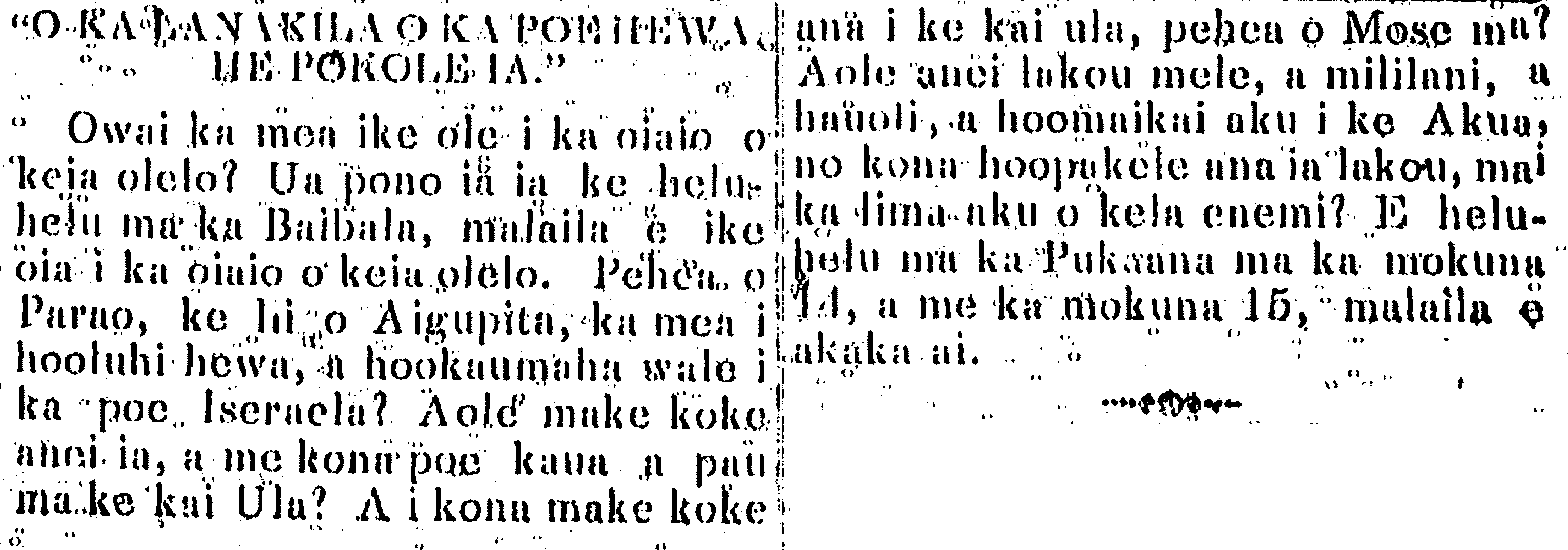
“THE VICTORY OF WRONGDOERS IS BUT FOR A MOMENT.”

Who does not know the truth of this statement? He must read the Bible; it is there that he will see the truth in this statement. What of Pharaoh [Parao], the ruler of Egypt [Aigupita], the one who overburdened and oppressed the Israelites? Did he not die at once, along with all of his warriors in the Red Sea? And with his quick death in the Red Sea, what happened to Moses and his people? Did they not sing, exalt, rejoice, and praise God for his saving them from the hands of their enemy? Read Exodus [Pukaana] chapter 14 and chapter 15, and there it will be clarified.

[Considering this particular outcome, this was quite a boost for Christianity.]

(Nonanona, 8/8/1843, p. 27)

"O KA LANAKILA O KA POE HEWA, HE POKOLE IA."

Ka Nonanona, Buke 3, Pepa 6, Aoao 27. Augate 8, 1843.

Richard Thomas arrives today, 1843.

WARSHIP.

On the 26th of July, the British Warship named Dublin arrived. Read Admiral Thomas is the Captain. He is the commander-in-chief of the British Warships here in the Pacific Ocean.

When he received the document about Capt. Lord George Paulet, by way of the ship Victoria, and he heard clearly that the flag of Britain was raised at this archipelago, he quickly came to restore the kingdom to Kamehameha III. How wonderful indeed is his aloha for the king! and for the people as well.

(Nonanona, 8/8/1843, p. 25)

MOKU MANUWA.

Ka Nonanona, Buke 3, Pepa 6, Aoao 25. Augate 8, 1843.

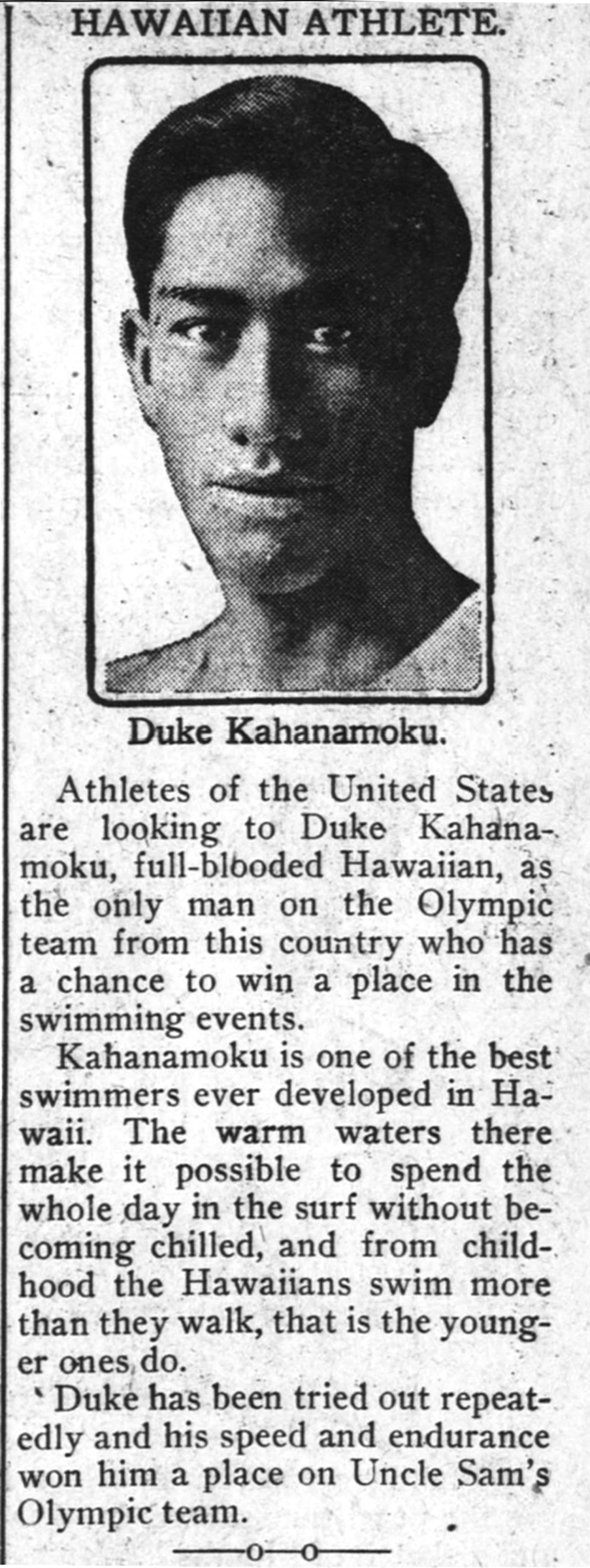
Duke Kahanamoku Off to Hollywood, 1936.

Kahanamoku Asks to Go to the Land of the Haole

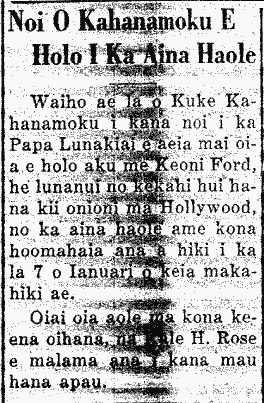
Duke Kahanamoku [Kuke Kahanamoku] submitted his request to the Board of Supervisors [Papa Lunakiai] to allow him to go with John Ford [Keoni Ford], a director [lunanui] of a movie company in Hollywood, to the land of the haole and to take a leave until the 7th of January of next year.

During his leave from his office, Charles H. Rose [Kale H. Rose] will take care of all of his duties.

(Alakai o Hawaii, 11/19/1936, p. 3)

Noi O Kahanamoku E Holo I Ka Aina Haole

Ke Alakai o Hawaii, Buke 9, Helu 33, Aoao 3. Novemaba 19, 1936.

Population change of Kona, Kauai and Niihau, 1835.

POPULATION.

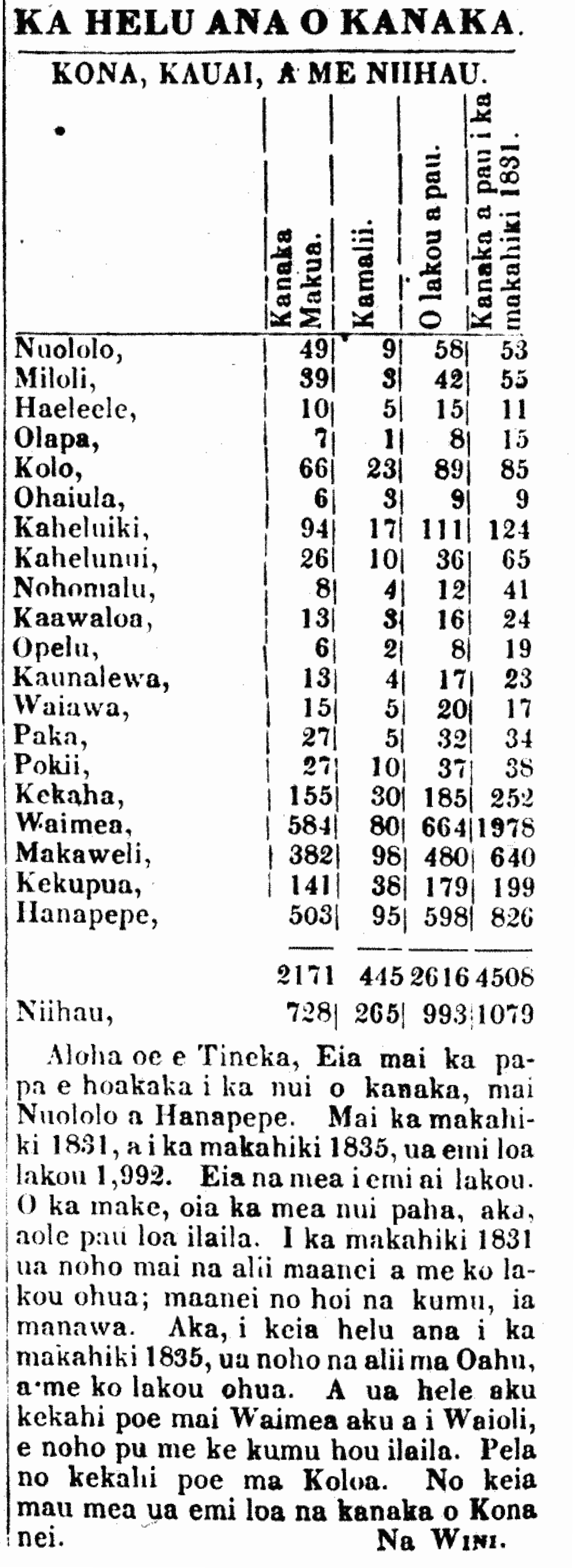
KONA, KAUAI, AND NIIHAU.

Adults Children All together Entire population in 1831
Nuololo 49 9 58 53
Miloli 39 3 42 55
Haeleele 10 5 15 11
Olapa 7 1 8 15
Kolo 66 23 89 85
Ohaiula 6 3 9 9
Kaheluiki 94 17 111 124
Kahelunui 26 10 36 65
Nohomalu 8 4 12 41
Kaawaloa 13 3 16 24
Opelu 6 2 8 19
Kaunalewa 13 4 17 23
Waiawa 15 5 20 17
Paka 27 5 32 34
Pokii 27 10 37 38
Kekaha 155 30 185 252
Waimea 584 80 664 1978
Makaweli 382 98 480 640
Kekupua 141 38 179 199
Hanapepe 503 95 598 826
2171 445 2616 4508
Niihau 728 265 993 1079

Aloha to you, O Tinker [Tineka]. This is a chart showing the number of people from Nualolo to Hanapepe. From 1831 to 1835, there was a great decrease of 1,992. This is the reasons for their decrease. Death is perhaps the biggest cause, but that is not all. In 1831, the alii were living here and their retinue; here as well were the teachers at that time. However, during this census in 1835, the alii were living on Oahu along with their ohua. And some people went from Waimea to Waioli to live with the new teacher there. So too some people from Koloa. For these reasons, the people here in Kona [Kauai] have sharply decreased.  By Whitney [Wini].

(Kumu Hawaii, 12/23/1835, p. 204)

KA HELU ANA O KANAKA.

Ke Kumu Hawaii, Buke 1, Pepa 26, Aoao 204. Detemaba 23, 1835.

Miriam Kekupuohi dies, 1836.

[Found under: “MAKE.”]

Kailua, Hawaii, Feb. 9, 1836.

Died here in Kailua was the chiefess named Miriama Kekupuohi, on the 8th of February. She belonged to the church for eight years, and she was one of the first converts of Kailua nei. She was not known to have any entanglements.

She was very old, perhaps 80 years old. She was a wife of Kalaiopuu,* the chief when Lono [Captain Cook] came, in the first ship to arrive in Kaawaloa.

O Brethren, very true are the words of James 4:14. “Whereas ye know not what shall be on the morrow. For what is your life? It is even a vapour, that appeareth for a little time, and then vanisheth away.”  By DANIELA.

*Kalaiopuu was also known as Kaleiopuu and today is more commonly known as Kalaniopuu.

(Kumu Hawaii, 3/16/1836, p. 24)

Kailua, Hawaii...

Ke Kumu Hawaii, Buke 2, Pepa 6, Aoao 24. Maraki 16, 1836.

Red Cross knitting drive, 1917.

Red Cross Knitting

The increasing number of knitters in the service of the Red Cross necessitates the publication of the following:

KNITTING DIRECTIONS

Because of a difference in knitting needle sizes in the United States—there being three manufacturers’ gauges which, unfortunately, do not correspond, the Pacific Division of the American Red Cross ask that the women follow the printed directions as near as possible, but try out their needles and yarn to see just what measurement a definite number of stitches gives them.

Following are the sizes the articles should be.

SLEEVELESS SWEATERS

Length 25 inches.
Width across chest from 16 to 20 inches, preferably 18 inches.

MUFFLER

11 inches wide.
68 inches long—(3 yards even more acceptable.)

MITTENS, OR LONG WRISTLETS

12 inches long.
Openifig should be 3 inches from top.

SOCKS

Length should be 11 inches from top of leg to division of heel.
Width of leg and of foot—4 inches.
Foot 10½ inches to 12 inches.
(11 and 11½ inches average length.)

SLEEVELESS SWEATER.
Materials required—2½hanks knitting yarn.
No. 5 Needles.

Cast on 96 stitches.
Knit 2, purl 2 for 3 inches.
Knit until it measures 25 inches from the beginning.
Make neck hole as follows:
Knit 35 stitches, bind off 26, knit 35.
Knit 7 ribs on each side (over and back is a rib)
Knit 35 stitches—cast on 26, knit 35.
Knit for 22 inches, knit 2, purl 2 for 3 inches.
Crochet sides together, leaving 9 inches for arm hole.
Crochet edge ½ inch deep round around neck.

(Garden Island, 12/4/1917, p. 4)

Red Cross Knitting

The Garden Island, Volume 13, Number 49, Page 4. December 4, 1917.

Duke donating time to make warm clothing, 1918.

In this picture is seen Duke P. Kahanamoku, the swimming champion of Hawaii nei making warm clothing in his spare time on the shore of Waikiki. The young girl watching him is named Miss Kathryn Jackson of Kalakaua Avenue who heard much of Kahanamoku going to make clothes, and she thus wanted to see it for herself.

(Kuokoa, 4/5/1918, p.1)

Ma keia kii e ikeia ana o Duke P. Kahanamoku...

Ka Nupepa Kuokoa, Buke LVI, Helu 14, Aoao 1. Aperila 5, 1918.

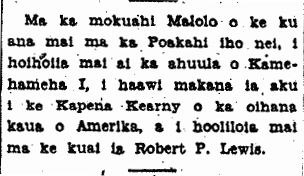
Duke saves lives, 1925.

SENT WAS A MEDAL GIFTED TO KAHANAMOKU.

Because of the brave and fearless rescue carried out by Duke P. Kahanamoku, the famous swimming champion of the world, just recently at Newport, California, in saving the lives of eight people from death, he was sent a gift of a medal to honor him, last Wednesday with a letter from Governor Farrington.

The news of this rescue carried out by Duke P. Kahanamoku arrived in this town, therefore,  some people of Honolulu donated a sum of money to purchase a medal to present to him.

This presentation medal was sent along with a letter from the governor to Lorrin Andrews, living in Los Angeles, as the president of the Hawaiian Club of South California [Kalapu Hawaii ma Kalepooni Hema], and from that club the gift will be given to Mr. Kahanamoku.

[I noticed today’s post by Bishop Museum announcing their upcoming exhibit on this hero, Duke Paoa Kahanamoku!]

(Kuokoa, 8/27/1925, p. 4)

HOOUNAIA HE MEDALA MAKANA IA KAHANAMOKU.

Ka Nupepa Kuokoa, Buke LXIV, Helu 35, Aoao 4. Augate 27, 1925.

Apapane flourishing, 1939.

Hawaiian Birds

We received word from the news released by the Hui Manuihi [?? Audubon Society ??] that there are now at Kilauea many apapane birds, and it is the one bird that is most widespread there.

Just like the work of those who research all sorts of things, there are some who made a move to study the different birds, and not only in other places, but here in Hawaii as well.

The activity of these people on Kilauea was to go into the forests to look at the Hawaiian Birds that are spread out there, and by them travelling the narrow paths in the Bird Park and entering into the Golf course and reaching the Soldier Camp at Kilauea and then arriving at Kilauea Iki; there were more Apapane than all the other birds put together.

With the research of the rangers of Kilauea National Park, they saw there was a large amount of bugs on the trees these days and that is was has caused an increase in the birds, for that is what the birds eat.

The number of kolea decreased and the mynah [piheekelo] birds are less, and it is believed because of the great cold.

Other Hawaiian birds seen at Kilauea these days are the amakihi and the elepaio.

Therefore according to this report shown, Hawaiian birds are indeed numerous, and the apapane is the most abundant.

[What about today? Are things better? Are things worse?]

(Hoku o Hawaii, 1/11/1939, p. 2)

Na Manu Hawaii

Ka Hoku o Hawaii, Volume XXXIII, Number 37, Aoao 2. Ianuari 11, 1939.