Land next to Kapiolani Park on sale, 1896.

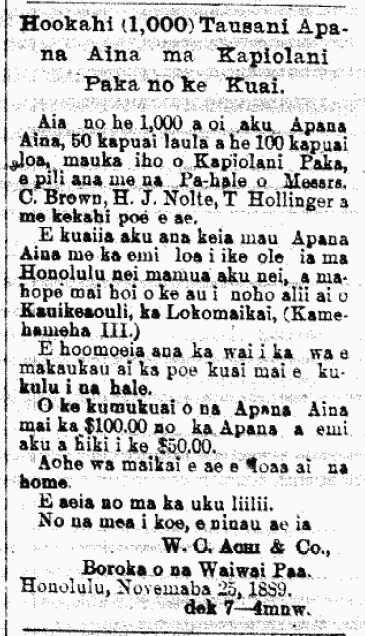
One Thousand (1,000) Land Parcel at Kapiolani Park for Sale.

There are 1,000 plus Parcels of Land, 50 feet wide and 100 feet long, upland of Kapiolani Park, adjacent to the house lots of Messrs. C. Brown, H. J. Nolte, T. Hollinger and some others.

These Parcels will be sold at low prices that have never been seen here in Honolulu before, from the time of the rule of Kauikeaouli, the Kind-hearted (Kamehameha III).

The water will be laid when the buyers are ready to build their houses.

The price of the Lots run from $100.00 per Lot, all the way down to $50.00.

There is no better time to get a home.

Installment pay is acceptable.

For anything else, inquire at

W. C. Achi & Co.

Broker of Real Estate.

Honolulu, November 25, 1889.

(Makaainana, 12/14/1896, p. 2)

Hookahi (1,000) Tausani Apana Aina ma Kapiolani Paka no ke Kuai.

Ka Makaainana, Buke VI----Ano Hou, Helu 24, Aoao 2. Dekemaba 14, 1896.

More on the flag from Iolani Palace, 2011.

After putting up the article from 1918 about the search for the flag from the Palace earlier this week, I went to the Archives just to see.

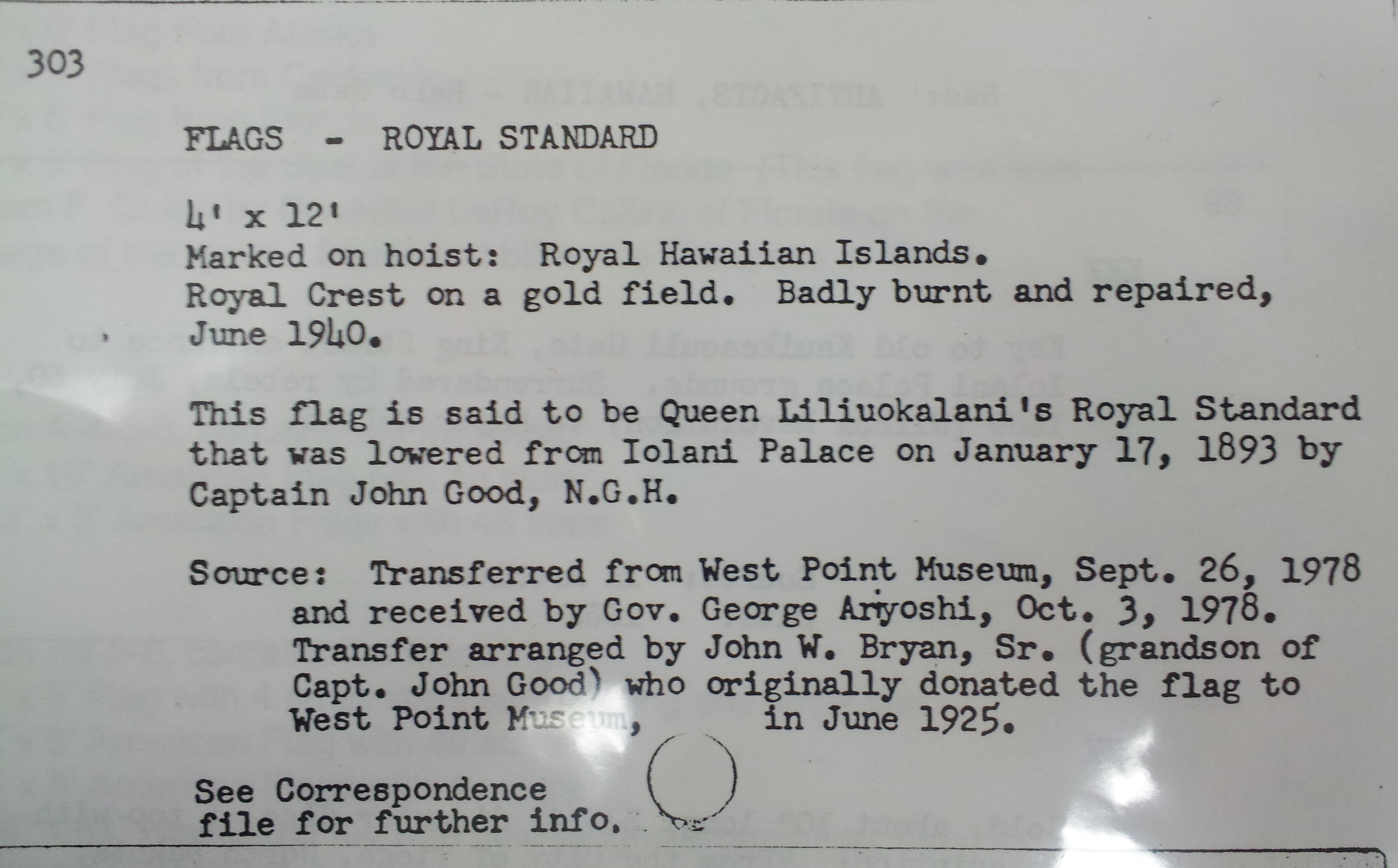
303

FLAGS – ROYAL STANDARD
4′ x 12′
Marked on hoists: Royal Hawaiian Islands.
Royal Crest on a gold field. Badly burnt and repaired,
June 1940.

This flag is said to be Queen Liliuokalani’s Royal Standard that was lowered from Iolani Palace on January 17, 1893 by Captain John Good, N. G. H.

Source: Transferred from West Point Museum, Sept. 26, 1978 and received by Gov. George Ariyoshi, Oct. 3, 1978. Transfer arranged by John W. Bryan, Sr. (grandson of Capt. John Good) who originally donated the flag to West Point Museum, in June 1925.

See Correspondence file for further info.

Hawaii State Archives card catalogue

from Archives, 12/9/2011

Liliuokalani plays the first organ at Kawaiahao Church, 1867.

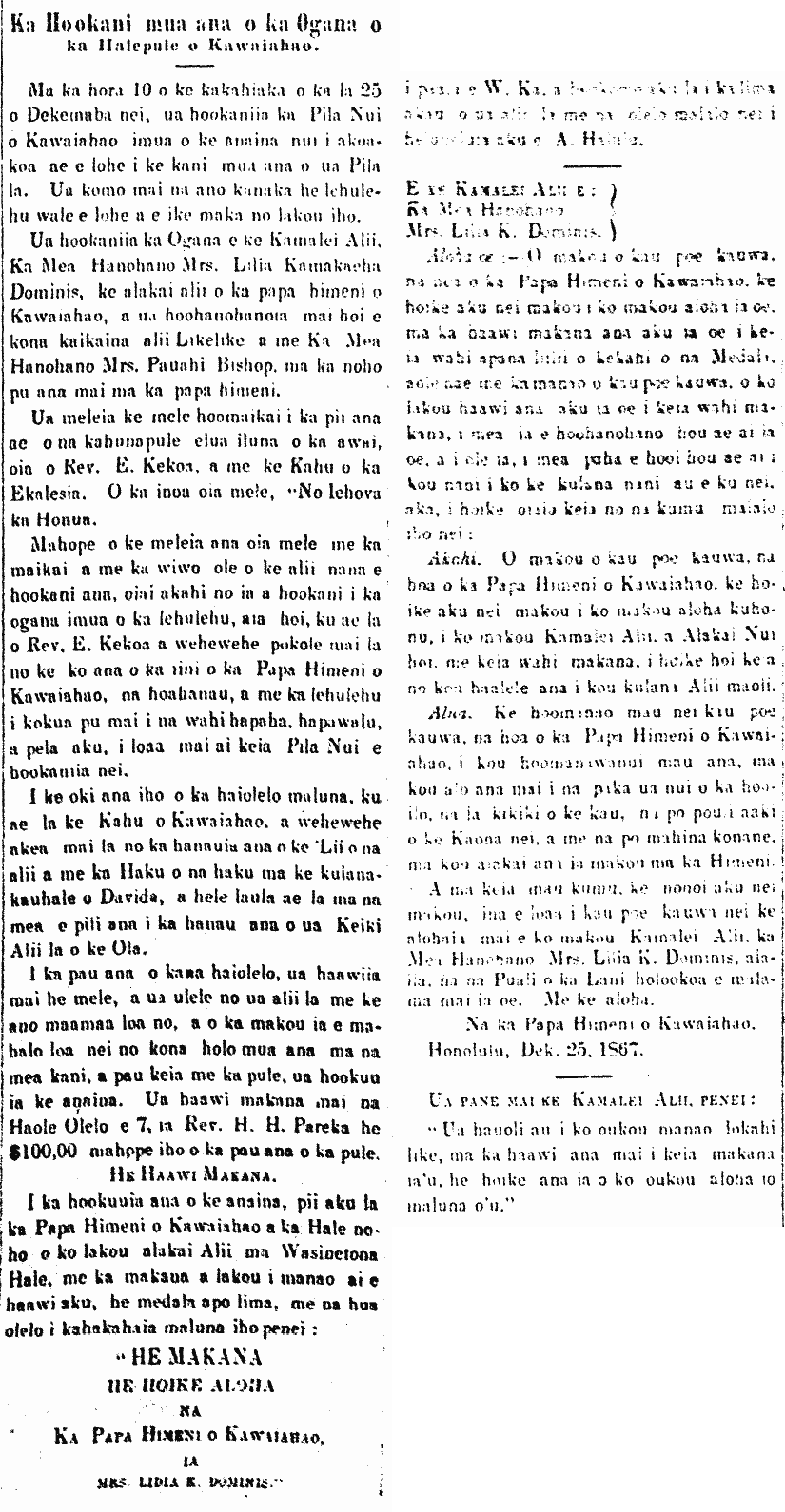
First Playing of the Organ of Kawaiahao Church.

At 10 in the morning of the 25th of December, the great musical instrument of Kawaiahao was played before the great crowd who gathered there to hear it being played for the first time. A great assortment of people came to hear and to see for themselves.

The Organ was played by the Princess, the Honorable Mrs. Lilia Kamakaeha Dominis, the royal leader of the Kawaiahao choir, and she was honored by her royal younger sister, Likelike, as well as the Honorable Mrs. Pauahi Bishop, who sat in the choir.

A song of gratitude was sung while the two pastors walked up to the pulpit, they being the Rev. E. Kekoa and the Kahu of the Church. The name of the hymn was “No Iehova ka Honua.”

After the singing of the hymn, nicely and fearlessly by the royal one who performed it, albeit this was the first time she played the organ before a crowd; then Rev. E. Kekoa stood and explained briefly the fulfilling of the dream of the Kawaiahao Choir, the church members, and the public, who helped with their 25¢ and their 12½¢ so that we could have this Great Instrument which is being played.

At the closing of this speech above, the Kahu of Kawaiahao stood and explained to all the birth of the King of kings, and the Lord of lords in the city of David, and expanded on things related to the birth of that Prince of Life.

At the conclusion of his speech, a hymn was given, and that alii lept into action, like she was very accustomed to it; and we are greatly appreciative for her advancement in musical instruments; and this was followed by a prayer, and then the congregation was released. The 7 foreign language speaking haole [?] gifted to Rev. H. H. Parker, $100.00 after the end of the prayer.

PRESENTING OF A GIFT.

After the congregation was let go, the Kawaiahao Choir went up to the Residence of their royal leader, to Washington Place, with a gift they wanted to present to her, a medal [?] bracelet with words engraved upon it, thusly:

“A GIFT
AN EXPRESSION OF ALOHA
BY
The Kawaiahao Choir
TO
MRS. LIDIA K. DOMINIS.”

which was [….] by W. Ka, and it was placed on the right hand of that royal one with the words below [….] by A. H[…..].

O Princess:
The Honorable
Mrs. Lilia K. Dominis.

Aloha oe:—We are your servants, the members of the Kawaiahao Choir, we show our aloha for you by presenting you with this gift of a small part of a Medal [?]; but it is not with thoughts of your servants, that their giving you this gift is something that should give you more honor, or that perhaps it will increase your already beautiful nature, but as a true expression of the things below:

One. We, your servants, the members of the Kawaiahao Choir, show our deep aloha to our Princess, and our Leader, with this small gift, as a symbol for your leaving your true Alii status [?]

Two. Your servants, the members of the Kawaiahao Choir, constantly think of your everlasting patience as you face the heavy rains of the winter, the scorching sun of the summer, the pitch dark nights of Town, and the bright moonlit nights, as you lead us in our Hymns.

And for these reasons, we ask of you, should your servants have the aloha of our Princess, the Honorable Mrs. Lilia K. Dominis, then let the Army of the wide Heavens watch over you. With aloha.

The Kawaiahao Choir.

Honolulu, Dec. 25, 1867.

—————

The Princess Replied Like This:

“I am joyful at your combined thought in gifting me with this present; it is a symbol of your true love for me.”

(Kuokoa, 12/28/1867, p. 3)
Ka Hookani mua ana o ka Ogana o ka Halepule o Kawaiahao.

Ka Nupepa Kuokoa, Buke VI, Helu 52, Aoao 3. Dekemaba 28, 1867.

Place name list, 1883.

Here is the beginning of a list of place names found in  Saturday Press.

It is introduced like this:

“DICTIONARY OF HAWAIIAN LOCALITIES.

“[The names given below are Hawaiian geographical names—towns, districts, estates, mountains, valleys, bays, rivers, etc., which English readers are likely to come across in historical or newspaper reading. Translations are given when a satisfactory English rendering is possible. This dictionary will be continued as complete as possible.]”

(Saturday Press, 8/11/1883, p. 4)

Boxing matches in Hawaii nei, 1911.

BOXING AT THE ORPHEUM

There will be a boxing match of twelve rounds between George “Slim” Gilmore, the slugger of San Francisco, and Jim Hoao, Honolulu’s Hawaiian boy who is skilled at throwing blows; Dick Sullivan will be the referee.

There will be others boxing as well.

(Kuokoa Home Rula, 12/8/1911, p. 4)

KU'IKU'I PUUPUU MA KA OPIUMA

Kuokoa Home Rula, Buke IX, Helu 49, Aoao 4. Decemaba 8, 1911.

A benefit held for Duke Kahanamoku, 1911.

[Found under “Local News”]

A ball game was held last Sunday, and the profits from that contest was given to Duke Kahanamoku for the expenses of him going to America to compete in a swim meet against America’s famous haole swimmers. $227.60 was raised.

(Aloha Aina, 12/9/1911, p. 4)

Ua malamaia he hookuku kinipopo...

Ke Aloha Aina, Buke XVI, Helu 49, Aoao 4. Dekemaba 9, 1911.

Hawaiian Flag from Iolani Palace, 1918.

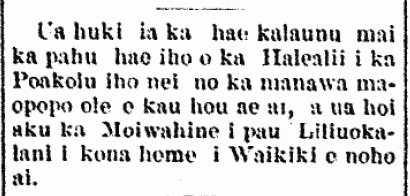
ANYONE KNOW OF THE ROYAL FLAG?

This office [of the Kuokoa] was asked by the caretaker of the museum of antiquities at Kamehameha Schools, if perhaps there was someone who knew the whereabouts of the royal flag of Hawaii nei that was taken down from the flagpole of the palace when the rule of Queen Liliuokalani was snatched away, and being that there is no one here in this office who knows of the flag, therefore it is being asked before the public, and perhaps there is a Hawaiian who knows of the flag, or has heard of where it is kept.

There are many Hawaiian flags, but the one that is greatly desired is the royal flag that was taken down on the 17th of January of the year 1893, which is 25 years ago; and the reason for this great desire to acquire this flag is that it will become something that will remind us of the history of Hawaii and her people.

If there is someone who knows, or who has seen where this royal flag is kept, please inform the head of the museum at Kamehameha Schools, or this office.

(Kuokoa, 8/16/1918, p. 3)

UA IKE ANEI KEKAHI I KA HAE KALAUNU?

Ka Nupepa Kuokoa, Buke LVI, Helu 33, Aoao 3. Augate 16, 1918.

More Gulick in Japan, 1871.

LETTER FROM JAPAN.—Part 3.

Kobe, Japan, July 18, 1871.

The “Alaula:” Aloha oe;

During this past month, that being June, I was caught up meeting with my youngest brother, John Gulick who lived as a missionary in China for seven years. He and his wife arrived on the 1st of June, and left for America and Britain to meet with their cousins, then they will go back to meet with the parents who are with you in Honolulu. Because of all the time I spent with them, my letter to you was not completed until the postal ship for June had already left.

On the persecution of our students.

I spoke to you earlier about the terrifying persecution of the Roman Catholic followers, by the government of Japan, and how the Japanese worship their ruler, the Mikado, as if he were a God. Now I will speak to you about our persecution by the government because of their anger at the name of Christ and the gospel. But this persecution has not fell upon us directly. They fear the haole and the warships, therefore they do not detain us, but persecute our followers. In this fashion:

I was about to hire a certain Japanese to teach me the language of this land on a regular basis. He stayed with me always, and returned home to his wife at nights to sleep. During school hours, he taught me, and when we were apart, he copied the books of the Gospel of Matthew, Mark, and John, which was translated into Japanese by one of the missionaries, but it was not published. This man named Einosuke lived with me for three months, and before this, he was a teacher for a fellow missionary, for one year or more.

This Einosuke had some learning from the word of God and from our teaching. We had hoped that he had become a devout believer. He always held family prayer at his home, and he came to the morning services of my fellow missionary.

In the evening of the 30th of June, this man and his wife were taken by the sheriff who was ordered by the governor of this city, and they were thrown into jail. Taken were the books of Mark and some other books which we left in the hands of this worker of ours. The other missionary and I sought hard for a means to get this follower and friend of freed from these people who were persecuting him. We asked government officials of the reason for our worker being jailed, but we were not told. We asked of the charges against him, but they did not answer in the least. It is clear to us what is his offense, that being his long association with us and his listening to the teachings of the kingdom of Christ. This is a major offense in the minds of the pagan officials, and to scare him and so that the people do not associate with us, this innocent man was taken and thrown in jail with his wife. This is the second week that they have been imprisoned, and it is not known when they will be released. Perhaps we will see their faces again; perhaps we will not see them again until they die. We pray fervently to God to give hope and to strengthen the faith of this man who is persecuted in His name, and to save him from the mouth of the lion.

There was an announcement by the government recently, saying: “Obey dearly the laws pertaining to religion; and if someone speaks to another about Christianity with perhaps the intent to convert them to that religion, they should bring charges immediately before the government officials and make known the name of the person who tried to convert them.” Christ is the stone left behind by the house builders, but he is who shall be made the cornerstone.

O. H. Gulick.

(Alaula, 11/1871, p. 30)

PALAPALA MAI IAPANA MAI.

Ke Alaula, Buke VI, Helu 8, Aoao 30. Novemaba, 1871.

More from Orramel Gulick, 1871.

LETTER FROM JAPAN.—Number [2].

Ke Alaula: Aloha oe:

When the postal ship arrived, I received two issues of Ke Alaula, January’s and February’s. It made my heart happy, receiving these quick-winged messengers who flew above the great waves of the Pacific Ocean and reaching my home here on the shores of Asia. According to the words of Proverbs 25:25, “Like cold water to a weary soul is good news from a distant land.”

About the Japanese Language.

Our great task at hand is learning the language of this land; and we have begun. Some of the short words, the pronunciation is the same as in Hawaiian, but the translation is different. Here are some of those words. Hai aku [Hayaku]; this is the meaning; hurry up. Kani [Kane], a bell, something that sounds. Hookano [Hoka no], a different thing. Hito, a person. Hookano hito, a different person. Dogs are called ino [inu]. Chickens are called tori. Sweet potato is called imo.

The Gospel of John was translated into Japanese by a missionary who came to this land before, and we are learning to read from the first chapter. Chapter 1. “In the beginning was the Word, and the Word was with God, and the Word was God.” Here it is in Japanese: “Hajime ni Michi wa ari, Michi wa Kami to tomo ni ari, Michi wa Kami nari.” When they write it however, they write in strange letters mixed with Chinese characters. The people study reading intensely. Perhaps more than half of the people can read.

About the food.

At this time, the fields are filled with wheat and oil producing fruit, which is a tiny fruit like that of the black mustard. In a month, the wheat will be mature, then rice will be planted. That is the main staple of the people. We have potatoes, sweet potatoes, peas, beans [pine?], and oranges. Their oranges are different, they are not large and sweet like those of Hawaii, they are small and bland.

They also have fruit of cold lands: peaches, pears, and cherries. Bananas, coconuts, guavas, pandanus, figs, and mangoes are not to be found here.

Here is something strange eaten here. Large bamboo, what we call ohe hawai, is found in abundance here. When the new shoots begin to sprout, like a banana sprout, they harvest it to eat. It is boiled in a pot, and this bamboo shoot is good if it is tried.

On Child rearing.

These are a people who love and are compassionate towards their children. The children of the wealthy are well taken care of. When they are little, eight days after birth, the head of the child is shaved smooth. Some leave some hair circling the edge of the child’s head. It is customary to shave the top of the head until they are elderly. When the child begins to walk, they are fitted with sandals. The sandals of the Japanese are just under the feet and are fastened with with straps going up from between the space between the big toes. The sandals used for nice days are made of finely-woven grass. On rainy and muddy days, they wear wooden sandals fastened below the feet with straps. When they enter the house, the sandals are removed.

On beggars.

In large cities, there are poor who beg for money. They are clothed in rags, and when looking at them some of them seem to be suffering from starvation. They beg with soft voices and heads bowed down, “Please may I have a few cents.” These beggars are found in large numbers at places of worship. Seeing their suffering breaks one’s heart. This is something not seen in Hawaii, someone dying of starvation.

On farming.

This is a nation very skilled at farming. The lowlands are full of plants. The places left unfarmed are the cliffs and very dry areas. The land is not plowed, but is only worked with a hoe. Farms are well cared for, and are not left to go wild. They watch vigilantly and clear weeds with their hoe, when they begin to grow. They pay much attention to fertilizing the land to fortify the soil so that much fruit is produced.

Night soil, cow feces, horse feces, and waste vegetation are kept and placed on the farmland to fertilize the soil. In this month of May, the farms as far as the eye can see are green and beautiful. The wheat is long, and the ears of wheat are forming, the yellow flowers are blossomed, the rice sprouts are beginning to be grown, sprinkled out all crowded, to be planted in the rice paddies. Here is something else I’ve seen of rice cultivation. The rice farmer writes a prayer to the God of farmers, this prayer is rolled about a small stick, and the stick is then stuck into the paddy where the rice seeds are spread, and this prayer is left there until the rice grows. This custom by the idol-worshiping Japanese is like what I read in Hawaiian History about the prayers of the fishermen and farmers of the ancient times in our land of Hawaii. How pitiful is the ignorance of those who don’t know of the true God.

On Rivers and Reservoirs.

This nation knows the great value of water, and water is well cared for. Large reservoirs are made in the uplands, and by rivers. These reservoirs were made in times past with much labor. Canals are dug on sides of cliffs where water flows. In rainy periods, the reservoirs are filled to supply water to the rice paddies on dry periods. Some of these reservoirs are acres wide. The land will not lack fruit because of the great water reserved for dry periods.

With aloha, me,

O. H. Gulick.

Kobe, Japan, May 18, 1871.

(Alaula, 7/1871, p. 16)

PALAPALA MAI IAPANA MAI.

Ke Alaula, Buke VI, Helu 4, Aoao 16. Iulai, 1871.