More on the Palace mirrors, 1913.

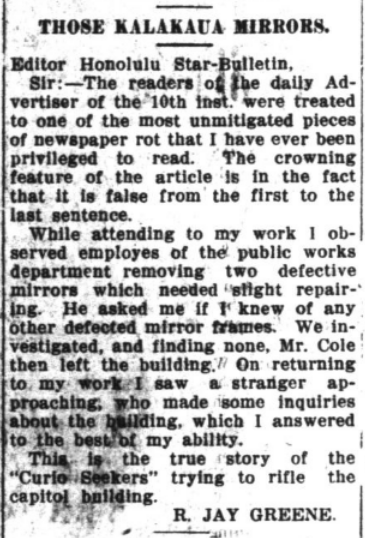
THOSE KALAKAUA MIRRORS.

Editor Honolulu Star-Bulletin,

Sir:—The readers of the daily Advertiser of the 10th inst. were treated to one of the most unmitigated pieces of newspaper rot that I have ever been privileged to read. The crowning feature of the article is in the fact that it is false from the first to the last sentence.

While attending to my work I observed employees of the public works department removing two defective mirrors which needed slight repairing. He asked me if I knew of any other defected mirror frames. We investigated, and finding none, Mr. Cole then left the building. On returning to my work I saw a stranger approaching, who made some inquiries about the building, which I answered to the best of my ability.

This is the true story of the “Curio Seekers” trying to rifle the capitol building.

R. JAY GREENE.

[Here is an interesting response from the “Roland Green” of the previous articles.]

(Honolulu Star-Bulletin, 1/11/1913, p. 4)

THOSE KALAKAUA MIRRORS.

Honolulu Star-Bulletin, Volume XX, Number 6482, Page 4. January 11, 1913.

More English-language Hawaii papers to be searchable online! 2012.

The UH Manoa Library has received $265,018 from the National Endowment for the Humanities (NEH) to digitize and upload the predecessor newspapers of the Honolulu Star-Advertiser on the Chronicling America website.  The publications are:
Pacific Commercial Advertiser (1856-1921)
Honolulu Star-Bulletin (1917-1922)

More on Maori visit, 1920.

[Found under: “On The Other Islands”]

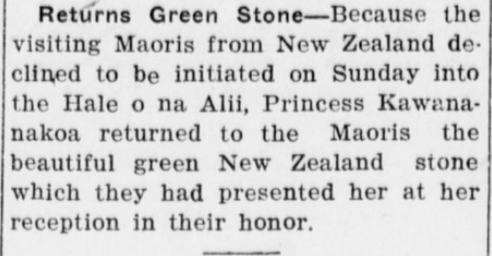
Returns Green Stone—Because the visiting Maoris from New Zealand declined to be initiated on Sunday into the Hale o na Alii, Princess Kawananakoa returned to the Maoris the beautiful green New Zealand stone which they had presented her at her reception in their honor.

(Maui News, 7/2/1920, p. 6)

Returns Green Stone

The Maui News. 21st Year, Number 1059, Page 6. July 2, 1920.

Interpretation of an interesting song from across the shore, 1901.

COMPOSED FOR THE USURPERS OF LAND.

The poem below is taken by us from the newspaper, “Commoner,” of William J. Bryan, the Presidential candidate of the Democrats who lost in the last Presidential race of the United States.

Ina oe e ike ana he kapakai nani
I kaili lima nui ole ia mamua,
E waiho ana ma ke alahele o na hana kalepa
Me na kanaka e noho hemahema ana
I makaukau ole no ka hakaka
O, e komo aku oe a lawe ae no kona nani
O, e oluolu oe e ku iho a lawe ae no kona nani
E hoomaopopo ia aole no ke aloha i ke dala
E hoe aku oe ia oe iho no uka o ka aina
Me ka Baibala iloko o kou lima
E pule aku oe me ka powa pu aku iaia no kona nani
Ina oia e uwa mai, e kipu aku iaia no kona nani,
Ae, he oi loa aku ma kela wahi mamao
E olelo ae hoi kakou, ilalo o Kina
Kahi a na Karistiano e pakaha la i no poe pekana no kona nani
E puhi ahi aku oe, a e kipu aku no hoi
E hoopiha i kau eke me ka waiwai pakaha
Aka, e hoomaopopo iho oe e hana wale ana no oe no kona nani
I kou wa e pakaha ai i na Pake Buda no ko lakou mau waiwai
E lawe ana i na pohaku makamae mai ko lakou mau onohi maka laau
A i kou wa e hoonohonoho ai i na kumukuai
E haawi ae i wahi leo pule
No kou hoike ana aku e hana ana oe no ko lakou pono
A e hoomoakaka aku i ke ano o kou hahao ana iloko o kou pakeke.

[Mahalo to Chronicling America for putting up the original to this mele. See it here: “For His Good” in The Commoner, 3/1/1901, p. 8.]

(Aloha Aina, 4/27/1901, p. 2)

HAKUIA NO NA POE PAKAHA AINA.

Ke Aloha Aina, Buke VII, Helu 17, Aoao 2. Aperila 27, 1901.

Response to Ernest A. Mott-Smith’s Letter in San Francisco Call, 1912.

THE STATE OF LEPROSY IN HAWAII NEI

In the newspaper, the “Call” of San Francisco, of the 14th of August, in a section of that newspaper dealing with Hawaii, is where we saw a very important idea given by Mott-Smith, the secretary of the Territory of Hawaii, describing matters related to Leprosy in Hawaii nei. We understand the thoughts of Mr. Mott-Smith that Leprosy isn’t a contagious disease like what was believed long ago; it is only weakly transmitted. In other words, “Leprosy” is not transmittable from one person to another.

[The article referred to here from the San Francisco Call, “ON GUARD AGAINST DISEASE,” can be found here at Chronicling America.

Also, i could barely read the Aloha Aina article, because the image online is so unclear, as you can see for yourself. There are so many pages like this that need to be shot clearly before it is too late…]

(Aloha Aina, 9/14/1912, p. 1)

KE KULANA MA'I LEPERA MA HAWAII NEI

Ke Aloha Aina, Buke XVII, Helu 37, Aoao 1. Sepatemaba 14, 1912.

English version of David Kanewanui’s Death Announcement, 1902.

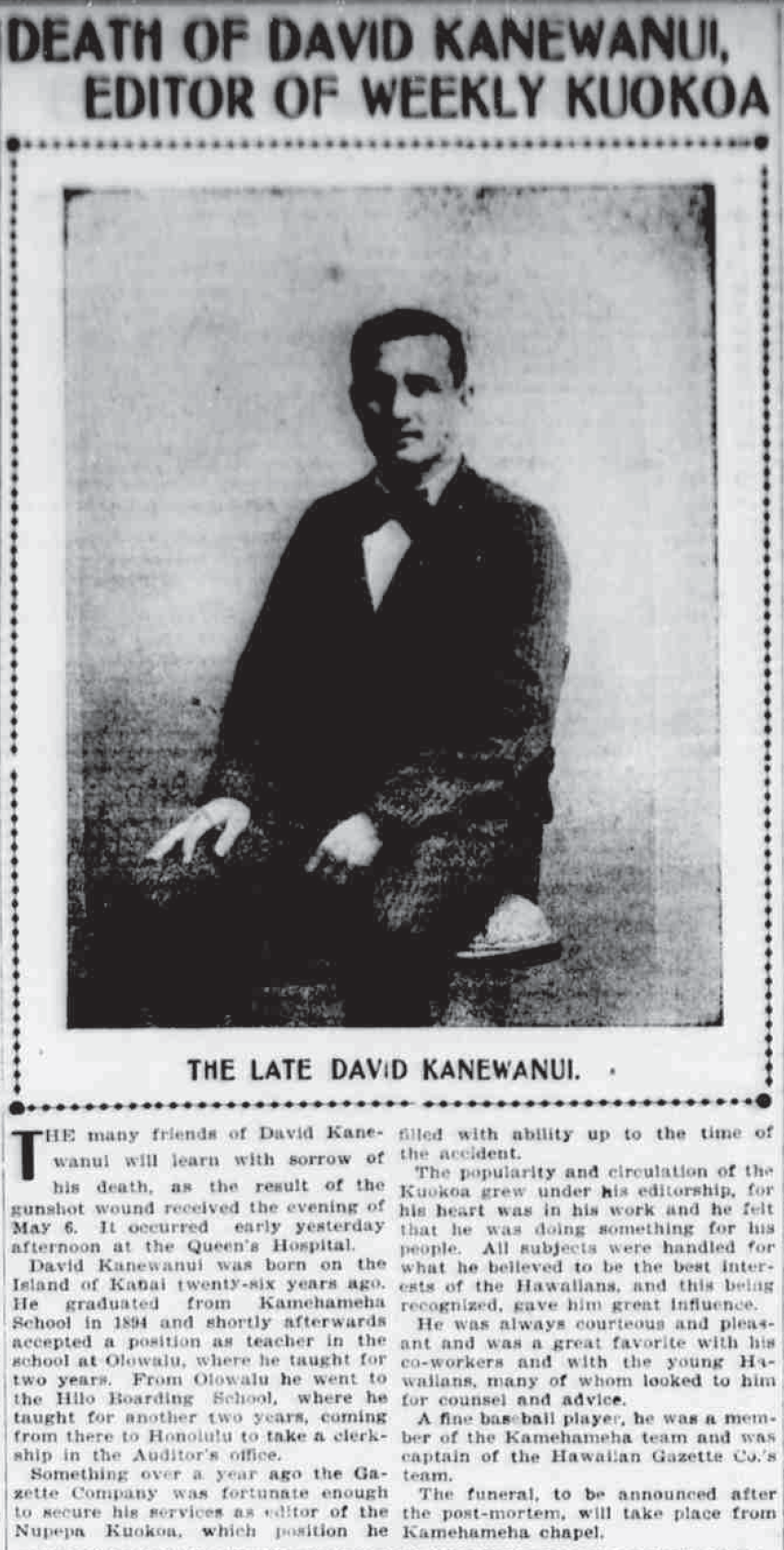
DEATH OF DAVID KANEWANUI, EDITOR OF WEEKLY KUOKOA

THE LATE DAVID KANEWANUI.

THE many friends of David Kanewanui will learn with sorrow of his death, as the result of the gunshot wound received the evening of May 6. It occured early yesterday afternoon at the Queen’s Hospital.

David Kanewanui was born on the Island of Kauai twenty-six years ago. He graduated from Kamehameha School in 1894 and shortly afterwards accepted a position as teacher in the school at Olowalu, where he taught for two years. From Olowalu he went to the Hilo Boarding School, where he taught for another two years, coming from there to Honolulu to take a clerkship in the Auditor’s office.

Something over a year ago the Gazette Company was fortunate enough to secure his services as editor of the Nupepa Kuokoa, which position he filled with ability up to the time of the accident.

The popularity and circulation of the Kuokoa grew under his editorship, for his heart was in his work and he felt that he was doing something for his people. All subjects were handled for what he believed to be the best interests of the Hawaiians, and this being recognized, gave him great influence.

He was always courteous and pleasant and was a great favorite with his co-workers and with the young Hawaiians, many of whom looked to him for counsel and advice.

A fine baseball player, he was a member of the Kamehameha team and was captain of the Hawaiian Gazette Co.’s team.

The funeral, to be announced after the post-mortem, will take place from Kamehameha chapel.

(Hawaiian Gazette, 5/23/1902, p. 5)

DEATH OF DAVID KANEWANUI, EDITOR OF WEEKLY KUOKOA

The Hawaiian Gazette, Volume XXXVII, Number 39, Page 5. May 23, 1902.

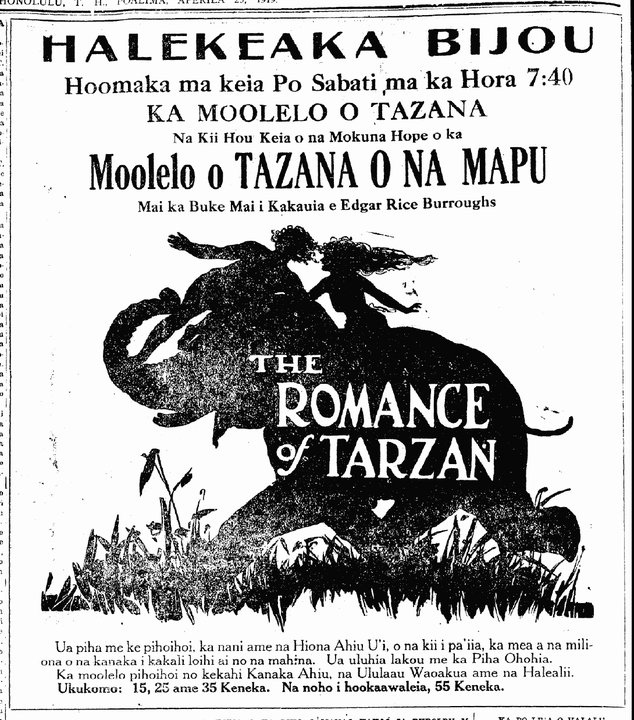
Tarzan ad, 1919.

BIJOU THEATRE

Starting this Sunday Night at 7:40

THE STORY OF TARZAN

These are Pictures From the Last Chapters of the

Story of TARZAN OF THE APES

From the Book by Edgar Rice Burroughs

THE ROMANCE OF TARZAN

Filled with excitement, magnificence, and Wild Beauty; the images taken are what millions of people have been awaiting for months. They are overcome with total fascination.

The thrilling story of a Primitive Man, Jungle Wilds, and Palaces.

Entrance fee: 15, 25, and 35 Cents. Reserved seating: 55 Cents.

[Chronicling America does not have any Honolulu papers up yet for this year, so here is a similar ad printed in The Garden Island, 5/27/1919, p. 3.]

(Kuokoa 4/25/1919, p. 2)

HALEKEAKA BIJOU

Ka Nupepa Kuokoa, Buke LVII, Helu 17, Aoao 2. Aperila 25, 1919.

The new and improved St. Louis College, 1881.

THE COLLEGE
OF SAINT LOUIS
—and the—
COMMERCIAL AND BUSINESS ACADEMY
HONOLULU, OAHU, H. I.

This institution being remote from city allurements, is an acknowledged safeguard for morals—for salubrity of climate, is unrivalled. The buildings are large and commodious, while the grounds afford the pupils opportunities for healthful exercises.

Unremitting attention will be given to the intellectual and moral culture of the pupils. Non-Catholic pupils will be free to attend the religious exercises or not, according as their parents or guardians may desire.

Pupils are received at any time during the year. No reduction will be made from regular charges, except for absence caused by protracted illness.

No leave of absence during the scholastic year, except at the College vacations or by special permission.

Each pupil must on entering obtain one suit of uniform, which with all other necessary clothing, &c., &c., will be furnished at moderate cost by the College; but none of these will be provided by the College unless by special arrangement.

Payments are to be made quarterly, and invariably in advance.

The course of study is Classical, Scientific and Commercial; Latin, Greek, French, Spanish, German and Italian are taught.

Particular attention will be paid to the English Language in all its branches. Literature, Pure and Mixed Mathematics, History, Geography, Chemistry and Natural Philosophy, &c.

TERMS:

For Board, Lodging, Tuition and Washing, per Scholastic Year…$200.00

Entrance fee…10.00

Vacation at College…40.00

Music, vocal and instrumental, Drawing and Modern Languages—extras.

DAY PUPILS—Senior Class…$60.00

Junior Class…40.00

The Scholastic Year consists of two Sessions, each comprising a period of five months. The first session commences on the 20th of August; the second on the 20th of January.

For all further particulars, apply to

REV. W. J. LARKIN, President.

No. 73 Beretania St.

Evening School Department of St. Louis College.

The President has decided to include this branch in the curriculum of the College.

Its object is to afford all classes of the community the means of acquiring a theoretical and practical knowledge of all commercial and business transactions in daily use; and also to give an insight into the workings and applications of the different Trades, which it is so essential to do in these Islands.

The Theoretical Branch will be under the supervision of the President and Professors of the College. The Practical and most important Branch will be specially attended to by volunteers from the various master artizans among us, who have kindly and generously promised their services to this useful and valuable enterprise.

They will, alternately, devote half and hour each evening to the task of imparting knowledge to the students. All the implements necessary to each trade, and to Agriculture, will be furnished by the College.

Each master-artizan, while connected with the College, will be entitled to name one Free-Life-Scholarship to the privileges of this Evening School Department.

TERMS—Each student per week, 50 cts. The Evening School will open at 7 o’clock p. m.

(Elele Poakolu, 2/2/1881, p. 5)

KE KULA NUI O SANA LUI

Ka Elele Poakolu, Buke I, Helu 22, Aoao 5. Feberuari 2, 1881.

[This is an advertisement for the recently moved Saint Louis College, back in 1881. The English is taken from the English advertisement appearing on page 5 of the Hawaiian Gazette, 2/9/1881.

This Hawaiian ad appears in the newspaper Ka Elele Poakolu, which for some reason is not available online as of yet, even if it has been available on microfilm for years…]