The Kawaihau Glee Club, 1904.

[Found under: “SOCIETY”]

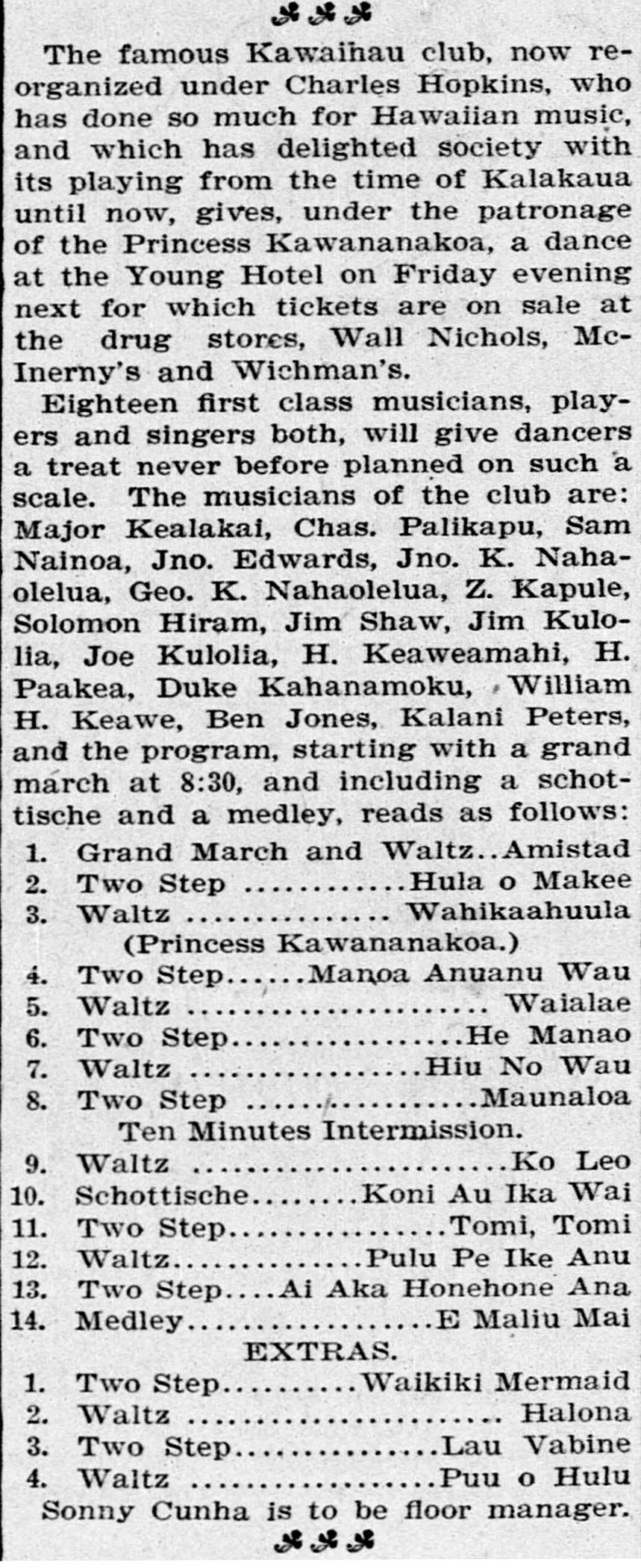
The famous Kawaihau club, now reorganized under Charles Hopkins, who has done so much for Hawaiian music, and which has delighted society with its playing from the time of Kalakaua until now, gives, under the patronage of the Princess Kawananakoa, a dance at the Young Hotel on Friday evening next for which tickets are on sale at the drug stores, Wall Nichols, McInerny’s and Wichman’s.

Eighteen first class musicians, players and singers both, will give dancers a treat never before planned on such a scale. The musicians of the club are: Major Kealakai, Charles Palikapu, Sam Nainoa, John Edwards, John K. Nahaolelua, George K. Nahaolelua, Z. Kapule, Solomon Hiram, Jim Shaw, Jim Kulolia, Joe Kulolia, H. Keaweamahi, H. Paakea, Duke Kahanamoku, William H. Keawe, Ben Jones, Kalani Peters, and the program starting with a grand march at 8:30, and including a schotische and medley, reads as follows:

1.  Grand March and Waltz ….. Amistad
2.  Two Step ….. Hula o Makee
3.  Waltz ….. Wahikaahuula (Princess Kawananakoa)
4.  Two Step ….. Manoa Anuanu Wau
5.  Waltz ….. Waialae
6.  Two Step ….. He Manao
7.  Waltz ….. Hiu No Wau
8.  Two Step ….. Maunaloa

Ten Minutes Intermission.

9.  Waltz ….. Ko Leo
10. Schottische ….. Koni Au Ika Wai
11.  Two Step ….. Tomi, Tomi
12.  Waltz ….. Pulu Pe Ike Anu
13.  Two Step ….. Ai Aka Honehone Ana
14.  Medley ….. E Maliu Mai

EXTRAS.

1.  Two Step ….. Waikiki Mermaid
2.  Waltz ….. Halona
3.  Two Step ….. Lau Vabine
4.  Waltz ….. Puu o Hulu

Sonny Cunha is to be floor manager.

(Pacific Commercial Advertiser, 6/19/1904, p. 6)

The famous Kawaihau club...

Sunday Advertiser, Volume II, Number 77, Page 6. June 19, 1904.

Kalai’s fame spreads to far away Pennsylvania, 1874.

[Found under: “Varieties.”]

King Kalakaua, of the Sandwich Islands, has requested an old woman named Kalai, who sent him a mat into which she had woven a petition praying for the removal of taxes on animals, to weave two mats, one with the American and the other with the English coat-of-arms, to be exhibited at our Centennial Exhibition as specimens of Hawaiian handiwork.

[There is mention of this also in the National Republican (Washington, DC) on 6/19/1874.]

(Juniata Sentinel and Republican, 6/24/1874, p. 1)

King Kalakaua...

Juniata Sentinel and Republican, Volume XXVIII, Number 25, Page 1. June 24, 1874.

The famous Niihau protest mat on display at the Bishop Museum, 1874 / 2015.

[Found under: “NOTES OF THE WEEK.”]

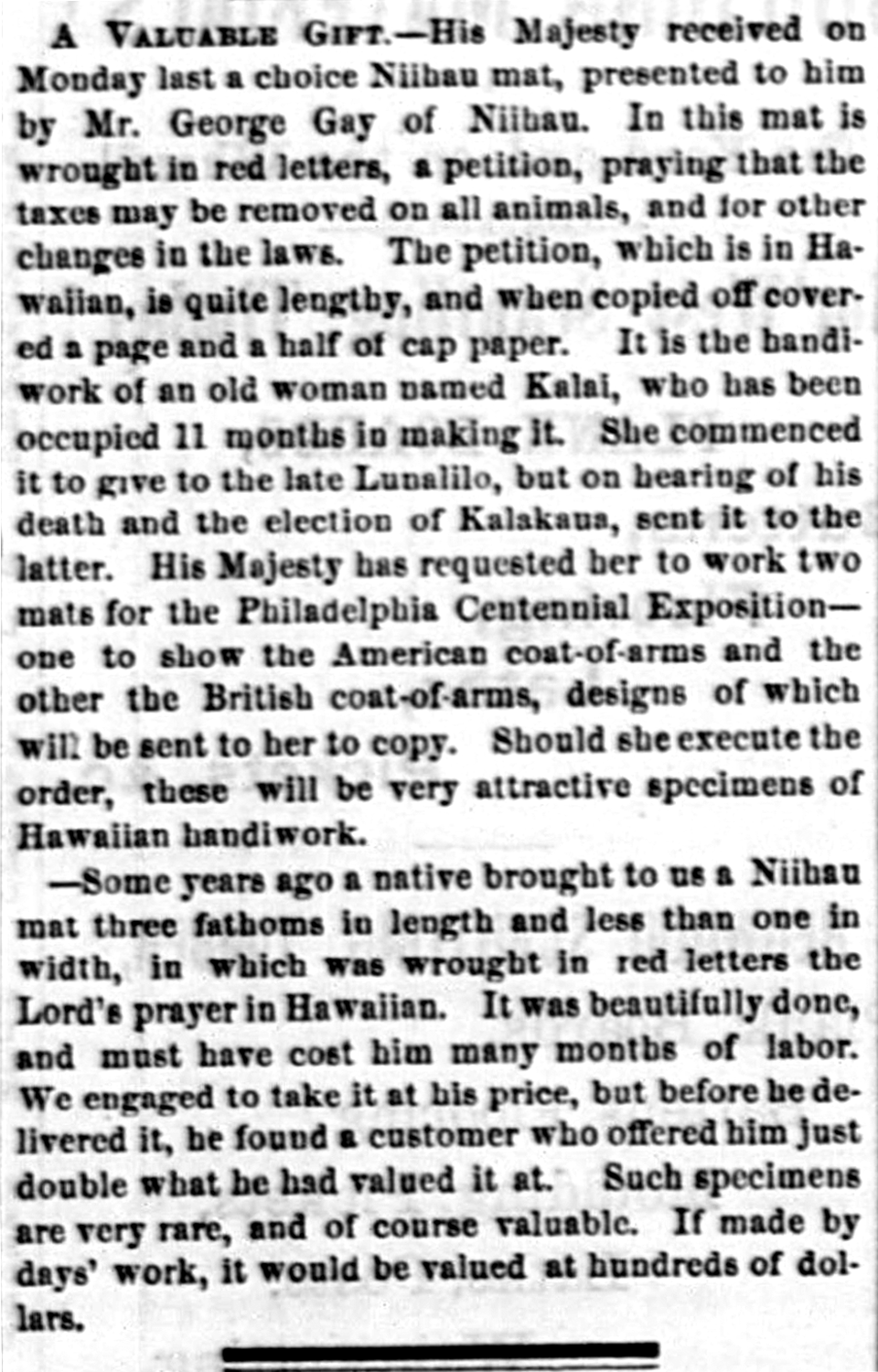
A Valuable Gift.—His Majesty received on Monday last a choice Niihau mat, presented to him by Mr. George Gay of Niihau. In this mat is wrought in red letters, a petition, praying that the taxes may be removed on all animals, and for other changes in the laws. The petition, which is in Hawaiian, is quite lengthy, and when copied off covered a page and a half of cap paper. It is the handiwork of an old woman named Kalai, who has been occupied 11 months in making it. She commenced it to give to the late Lunalilo, but on hearing of his death and the election of Kalakaua, sent it to the latter. His Majesty has requested her to work tow mats for the Philadelphia Centennial Exposition—one to show the American coat-of-arms and the other the British coat-of-arms, designs of which will be sent to her to copy. Should she execute the order, these will be very attractive specimens of Hawaiian handiwork.

—Some years ago a native brought to us a Niihau mat three fathoms in length and less than one in width, in which was wrought in red letters the Lord’s prayer in Hawaiian. It was beautifully done, and must have cost him many months of labor. We engaged to take it at his price, but before he delivered it, he found a customer who offered him just double what he had valued it at. Such specimens are very rare, and of course valuable. If made by days’ work, it would be valued at hundreds of dollars.

[This mat was put on display at the Bishop Museum just yesterday. Go check it out if you are on Oahu nei.]

(Hawaiian Gazette, 4/29/1874, p. 3)

A Valuable Gift.

Hawaiian Gazette, Volume X, Number 17, Page 3. Aprila 29, 1874.

Hooulu Lahui, 1874.

[Found under: “Nu Hou Kuloko.”]

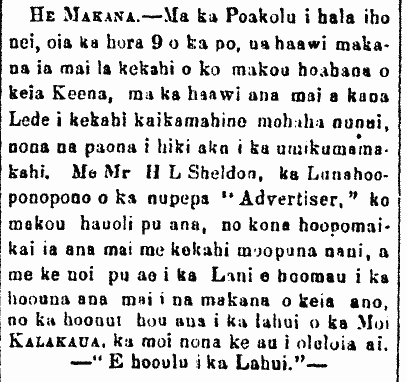
A Gift.—This past Wednesday, at 9 o’clock at night, one of our coworkers at this Office was given a gift, by his Lady giving him a large, well-developed girl, who weighed even eleven pounds. To Mr. H. L. Sheldon, the Editor of the newspaper “Advertiser,” goes our shared joy for his being blessed with a beautiful grandchild, as we ask of the Heavens to continue to send this type of gifts, to once again increase the lahui of King Kalakaua, the king of whose reign is said,

—”E hooulu i ka Lahui.”¹—

¹One of the great goals of King Kalakaua was to Hooulu Lahui, or to increase the Hawaiians.

(Kuokoa, 8/22/1874, p. 2)

He Makana.

Ka Nupepa Kuokoa, Buke XIII, Helu 34, Aoao 2. Augate 22, 1874.

Kekaulike appointed governor of Hawaii Island, 1880.

[Found under: “Ma ke Kauoha.”]

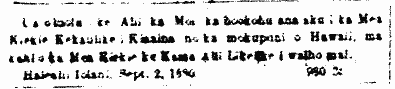
It pleases the Chief, the King, to appoint Her Highness Kekaulike as Governor for the island of Hawaii, in the place left behind by Her Highness, the Princess Likelike.

(Kuokoa, 9/18/1880, p. 2)

Ua oluolu i ke alii...

Ka Nupepa Kuokoa, Buke XIX, Helu 38, Aoao 2. Sepatemaba 18, 1880.


Leleiohoku, the Prince Regent, 1874.

THE FIRST PUBLIC SPEECH

By His Highness

THE ALII WILLIAM PITT LELEIOHOKU,

Before the Citizens at Ewa, Oahu.

[Ewa’s makaainana are surely very proud that they were victorious, hearing the words from His Highness, the Chief, and the Crowned Prince of the Nation, W. P. Leleiohoku, on Saturday, April 25, 1874. Because of the excellence of the content, and that this is the very first of his speeches, and because of the great desire and admiration for it, therefore, we are putting it before the public to admire it for themselves, to see the intelligent expression from the Young Prince. Ed.]

O Citizens:—My naau¹ is filled with joy to see upon your faces this day, a sign telling me that your loving hearts are encouraged by the astute remarks of our King spoken of in his royal address pertaining to one of the foundations of His Kingdom, that being

“The Increase of the Lahui.”

The is an important question which our King puts before you, and not just you, but before all of the citizens of His Kingdom from Hawaii to Kauai; it is a wide, deep, and lingering question. And this is the appropriate time for us to raise this question to consider it, being that the lahui continues to decrease, from the conditions as shown in the dark ages gone by.

As I speak on the subject of this question, let us look to the future, and consider the character of the One who asked this question, that being our current King. He did not simply take up [lawe kamako²] this endeavor, or do it on his own; he carefully considered it, trusting in your patience in helping Him in search out means to rejuvenate this lahui. Continue reading

King Lunalilo passes, 1874.

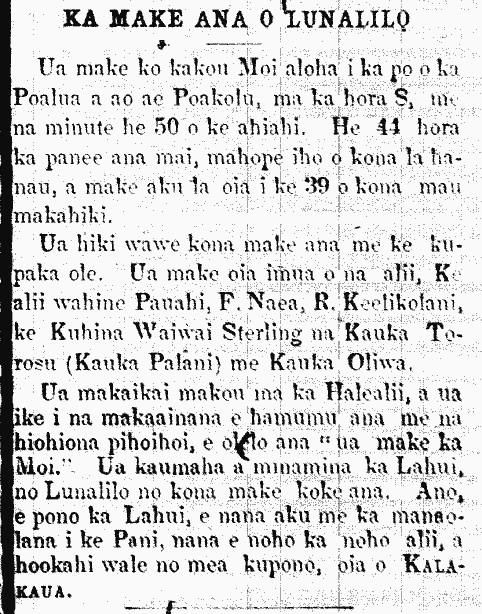
THE DEATH OF LUNALILO

Our beloved King died from the night of Tuesday to the day of Wednesday [February 3, 1874], at 8 o’clock and 50 minutes in the evening. 44 hours went by after his birthday, and he died at 39 years old.

His death was quick without a struggle. He died before the alii, Ke alii Pauahai, F. Naea, R. Keelikolani, the Minister of Finance Sterling, Dr. Trousseau (Kauka Palani), and Dr. Oliver.

We visited the Palace and saw the makaainana murmuring about with worried faces, saying, “The King is dead.” The Lahui are sad and grieve over the quick passing of Lunalilo. The Lahui must at once look with hope to his Replacement, the one who will occupy the throne, and there is but one who is fitting, that is Kalakaua.

(Nuhou Hawaii, 2/10/1874, p. 3)

KA MAKE ANA O LUNALILO.

Ka Nuhou Hawaii, Buke I, Helu 15, Aoao 3. Feberuari 10, 1874.

History of Kawaiahao Church, 1885.

KAWAIAHAO CHURCH

The readers of the Kuokoa will probably not be unable to recognize the features of the building pictured above; it is the church of Kawaiahao. It is an old building and one that is greatly beloved by a portion of our people, this mother church of ours. Its predecessor on these grounds was a church of pili grass; and the stone building was completed in 1842, constructed by the loving hands of the alii and makaainana of times gone by. It was Kekuanaoa and Bingham [Binamu] Sr. who selected the area where it was to be built and supervised its construction, however Bingham returned to America before the completion of this building.

There were many renowned events which were done in Kawaiahao such that it is as if the building was the place to carry out grand and fine deeds of the past, of the nation and the people. It was in this building that a number of the Legislative Sessions of the nation were opened, if this writer is not mistaken. It was in this building that Kamehameha V opened the Constitutional Convention [Ahaolelo Hooponopono Kumukanawai] on the 7th of July, 1864. Continue reading

More on the wax cylinder of Kalakaua, 1891.

A VOICE FROM THE DEAD.

Just before the last call of the reaper whose powerful scythe severed the connections of King Kalakaua with mundane matters, His Majesty was visited by Mr. Louis Glass, agent of the Edison Phonograph Co., and by request spoke into a cylinder of the machine. His Majesty spoke the following, as an experimental trial, having intended, when in better health to speak more at length. The Editor of the Paradise of the Pacific obtained the following carefully prepared translation of His Majesty’s words, the rendition being made by Mr. James I Dowsett, Jr., of Honolulu, at his request:

“Aloha kaua—Aloha kaua. Ke hoi nei no paha makou ma keia hope aku i Hawaii, i Honolulu. A ilaila oe e hai aku ai oe i ka lehulehu i kau mea e lohe ai ianei.”

[Translation.]

“We greet each other—We greet each other. We will very likely hereafter go to Hawaii, to Honolulu. There you will tell my people, what you have heard me say Here.”

(Paradise of the Pacific, 2/1891, p. 2)

A VOICE FROM THE DEAD.

Paradise of the Pacific, Volume IV, Number 2. February 1891.


Report of Kalakaua’s death from the “San Francisco Chronicle,” 1891.

KALAKAUA DEAD

Last Hours of the Hawaiian Monarch.

Solemn Scenes at the Royal Bedside.

The Succession and the Political Situation.

Sketches of the Dead Sovereign and of the Heirs to the Throne.

Kalakaua I., King of the Hawaiian Islands, is dead. He expired at 2:33 o’clock yesterday afternoon in his room at the Palace Hotel, where for three days he had lain unconscious on his bed. Surrounding him at the moment of his death were Col. Macfarlane, the King’s Chamberlain; Col. Hoapili Baker, His Majesty’s Equerry-in-waiting; Hawaiian Consul McKinley, Admiral Brown, U. S. N. Rev. J. Sanders Reed, Rev. F. H. Church and a number of personal friends of the King. Immediately after the death, Admiral Brown notified the Secretary of the Navy of that fact, Mayor Sanderson was also notified, and he called a meeting of the Supervisors for 9 o’clock this morning to consider proper action in the matter. The remains were embalmed and this afternoon they will be removed to the mortuary chapel of Trinity Church, where they will be guarded by a detail of United States soldiers.

At the Deathbed.

The Scenes in the Chamber of the Dying Monarch.

It was a pitiful and most impressive scene. The dying monarch lay gasping upon his bed, his emaciated body heaving convulsively with each of his labored respirations. At the bedside stood two ministers of the Gospel, physicians of the body had given way when they had come to the sad conclusion that Kalakaua was beyond mortal aid. Seated at the head of the bed, clasping the left hand of his King was Col. Baker, Kalakaua’s Aid-de-camp, whose strong frame was bent with sorrow, and who with great difficulty kept back the flood of tears which trembled in his eyes. Bending over from the right side was Col. Macfarlane, Chamberlain of the King. The suspense of the last few days had almost prostrated him, and his face bore traces of weeping. Crouched upon the floor against the wall near the bedside were the King’s valet Kahikina, an Hawaiian youth, and Kalua, a young girl from the Gilbert islands, who had been a most devoted servant to Kalakaua. They formed part of his suite on his arrival here.

Only a light coverlet of rich brown design covered the body of the King. In his struggles to throw off the firm reaper who was gradually pressing more heavily upon him, Kalakaua had thrust his arms out upon the bed. During the forenoon his faithful servant Kalua, in an endeavor to make the King as comfortable as possible, had placed beneath his chin a wide soft scarf of blue silk. There it remained until the death, seeming as it rose and fell upon the bright red undershirt to be symbolical of the wavering between this and the great beyond of the spirit of the stricken King.

Kalakaua was possessed of great vitality, and to the last he resisted the destroyer with a persistence which excited the wonder of the medical men, who knew that the King’s time had come. Though for three days past he had been unconscious and life had apparently been kept in him merely by the stimulants applied internally through natural channels or hypodermically, his constitution seemed determined to keep the spirit with the trembling body. Even after the physicians had relinquished all hope and, knowing that he must die, had ceased to apply stimulants, he continued to struggle on.

During the morning Drs. Woods, Watts, Sanger and Taylor were in attendance.

They consulted and announced that in their opinion the King would not live more than a few hours. He had then been unconscious for nearly forty hours, with the exception of one brief moment in the early morning, when he recognized Admiral Brown and spoke to Colonel Baker saying:

“Well, I am a very sick man.” Continue reading