Maunakea.
E aha ia ana Maunakea,
Kuahiwi alo pu me ke kehau.
Alawa iho oe ia Maunaloa,
Kohu moa uakea i ka malie. Continue reading

E aha ia ana Maunakea,
Kuahiwi alo pu me ke kehau.
Alawa iho oe ia Maunaloa,
Kohu moa uakea i ka malie. Continue reading
Patience Wiggin is a Japanese baby who is two years old. She was born on Kauai. There are many children in her family, and ten days after the birth of this little girl, her mother passed away. Her father is poor. After fighting with destitution and troubles, he returned the tiny girl to the Children’s Hospital, for he knew he could not care for this child.
The news was told to Miss Lucy Ward about Patience. Her job is to find homes for children like this small girl. So she began to go around searching for a home. She found Mrs. Wiggin, a Hawaiian, who wanted to adopt [hookama] a child. Mrs. Wiggin’s mind was delighted to find a baby of a different ethnicity, and welcomed in Patience. So the young girl gained a fine home and a kind mother.
The Humane Society is one of 23 associations that is provided with funds that are collected for United Welfare [Pono Lokahi] drive. This is something which promotes good will between the different ethnicities of Hawaii nei, and it will provide homes for Japanese orphans and also for children of other races.
Efforts to raise funds will begin on November 28 and continue for two days. This year the goal to be collected is $275,000, and from that sum, the Humane Society will receive $2211.
[For and earlier post, click here. And for even more on Aunty, click here.
If it wasn’t for the young girl in the story, I certainly would not be doing this blog. Hauoli la hanau e Aunty Pat! O KU O KA!!]
(Kuokoa, 11/25/1921, p. 4)
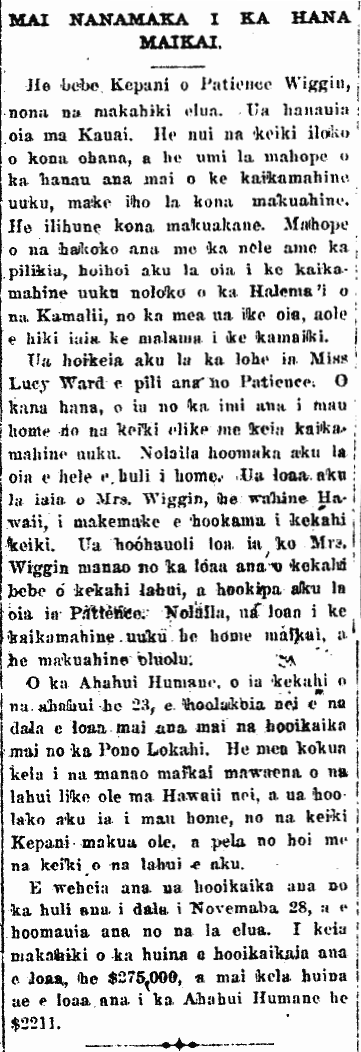
Ka Nupepa Kuokoa, Buke LIX, Helu 47, Aoao 4. Novemaba 25, 1921.
———
Ilona Momilani, a baby girl was welcomed into the family of Mr. and Mrs. Folinga Faufata on March 10.
The baby’s father, a graduate of Kamehameha with the class of 1935, is now an engineer at a power plant in Pearl Harbor.
The Fafatas reside on Kaunaoa Street in Kapahulu. Barbara, the eldest daughter, attends the Kamehameha kindergarten.
———
The Saturday night activities for the student body on April 22, were calling and movies.
The senior division enjoyed dancing and a social gathering which began at 7:30 o’clock in the common room of Lunalilo hall.
Two color movies were shown to the junior division at the school for boys’ assembly hall.
“A Victory”, a picture filmed for the Junior Police Officers on the K.S.B. campus, featured Samuel Fontaine, brother of David Fontaine, low-eleventh student at K.S.B., and James Noa, a ninth grader at the school for boys.
In the second feature, “Make Way for Victory”, two boys of the Preparatory department, Kealoha Coleman and Kui Lee, had leading roles. There were also dances by the preparatory pupils directed by Mrs. Mary K. Pukui and Mrs. Lei Hapai.
These pictures were filmed in color by George Tahara, a student at the University of Hawaii. He has also made two previous showings to Kamehameha audiences. Continue reading
[Found under: “Nuhou Kuloko”]
A Japanese girl of two years old was adopted by Mrs. Mary Wiggin, in the court of the Circuit Court Judge Achi, on this past Monday; her new name that she is being called by her adopted mother is Patience Eimay Kamakauahoaokawenaulaokalani [Namakauahoaokawenaulaokalaniikiikikalaninui] Wiggin.
See much more in Nanea Armstrong Wassel’s Instagram post!
[Hauoli la hanau, e Aunty!]
(Kuokoa, 8/19/1921, p. 4)
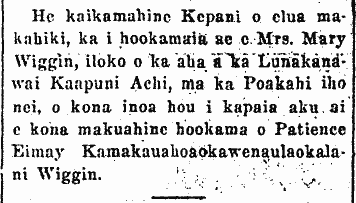
Ka Nupepa Kuokoa, Buke LIX, Helu 33, Aoao 4. Augate 19, 1921.
Hooheno keia no pua Melekule
Lei mae ole ia he koiikoi,
O oe ka ia e kuu aloha
Nowelo malie i ka pili poli
O Maile Laulii o ke kuahiwi
O Maile Kaluhea kuu hoa ia
Mai puni hei oe i ke Tiele
A he pua nani ia a he mae wale
Alawa iho au o ke telepona
Honehone malie i ka iwi-hilo
Hea aku makou o mai oe
O ka pua Melekule kou inoa
Haina ia mai ana ka puana
Ka huila wai o Hanahanapono.
Hoopoo.
[Check out more on this another variant of this mele and its translation by Liliuokalani as well, here on the fascinating and educational Instagram page: http://instagram.com/naneaarmstrongwassel!
Was Hoopoo a pen name for Kalanianaole??]
(Leo o ka Lahui, 11/20/1891, p. 2)
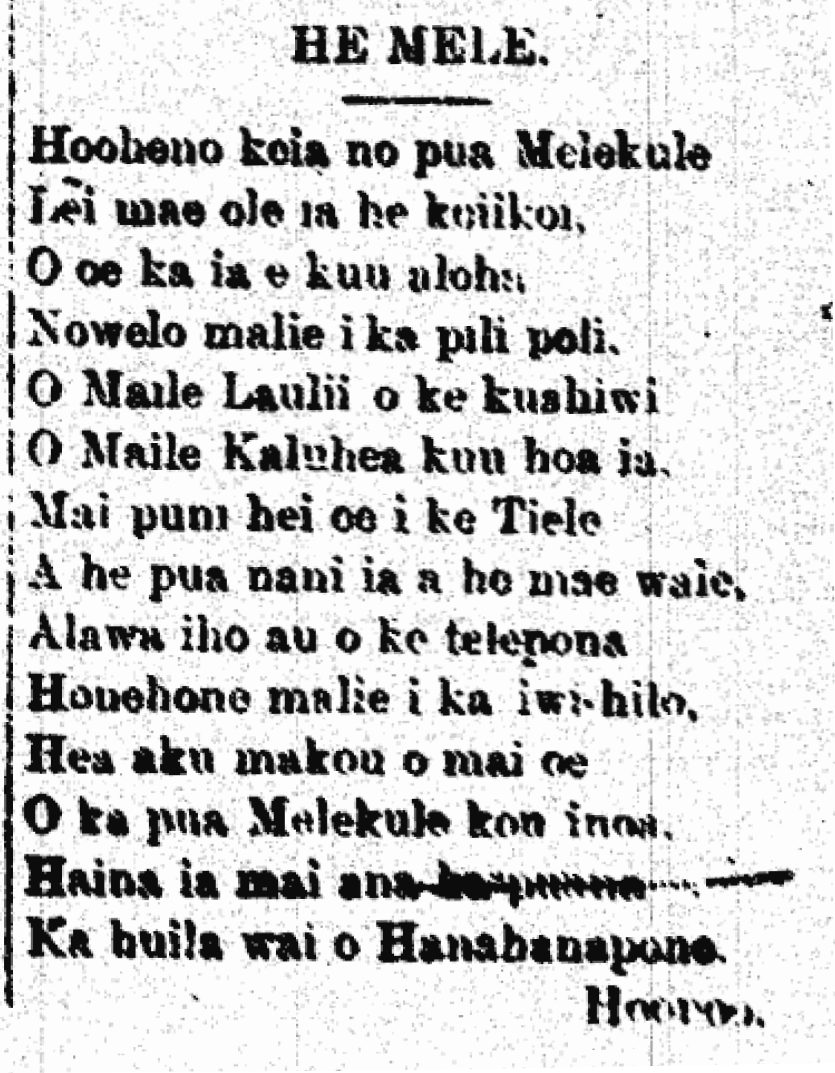
Ka Leo o ka Lahui, Buke II, Helu 320, Aoao 2. Novemaba 20, 1891.
(Written by M. TITCOMB)
Here below is a list of names of some fishes of Hawaii nei that are found in the book of names in the Kamehameha Museum [Hale Hoikeike o Kamehameha].
akaka, akeke, akiki, akilolo, aku; variety, —aku kina’u, akule; also called aku-a (?), akupa, alaihi, alaihi kalaloa or kakaloa or kahaloa, alaihi lakea, alaihi mahu, alaihi maoli, alalana, alalauwa, alamo’o, alea, aleihi, aloalo, alo’ilo’i, alukaluka, ama’ama, pua ama’ama; pua ama; pua kahaha, ama’ama, anae, amo’omo’o, amuka; puakahala, ananalu, a-niho-loa, aoaonui, apahu, api, apoha, apu’upu’u, a’u, a’u kaku; kupala, a’u kuau-lepa, a’u lepe (iheihe; auki), a’u papaohe, aua’a auae, aualaliha, aua’u; ahaaha, auau ki, auki, auku, awa; awa-aua; awa-awa, awalo, awala; awela; awela, aweoweo.
e, e’a, eheula, ehu, enenue, hahalalu, halalua, ha hilu (?), hahili, haie’a, hailipo, halahala, halaloa, hahalua, hanaui; mokumokuhanui, haoma, hapuu, hapuupuu, hauliuli puhi, heahaaha, hihimanu; lupe, hilu, hilu eleele, hilu lauwili, hilu melemele, hilu pano, hilu pilikoa, hilu ula, hilu uli, hinalea, hinalea akilolo, hinalea eleele, hinalea iiwi, hinalea lauwili, hinalea lipoa, hinalea lolo, hinalea luahine, hinalea nukuiwi, hinalea nukuiwi-ula, hinalea nukuiwi-uli, hinalea nukuloa eleele, hinalea nukunuku loa, hinalea mananalo; ananalo, hinana, hi’ukole, hi’u-ula, hoana, hololua, hou huhune.
[This was the beginning of a series of lists of fish names appearing in the Hoku o Hawaii, and running until it seems like August 28, 1940.]
(Hoku o Hawaii, 6/5/1940, p. 2)
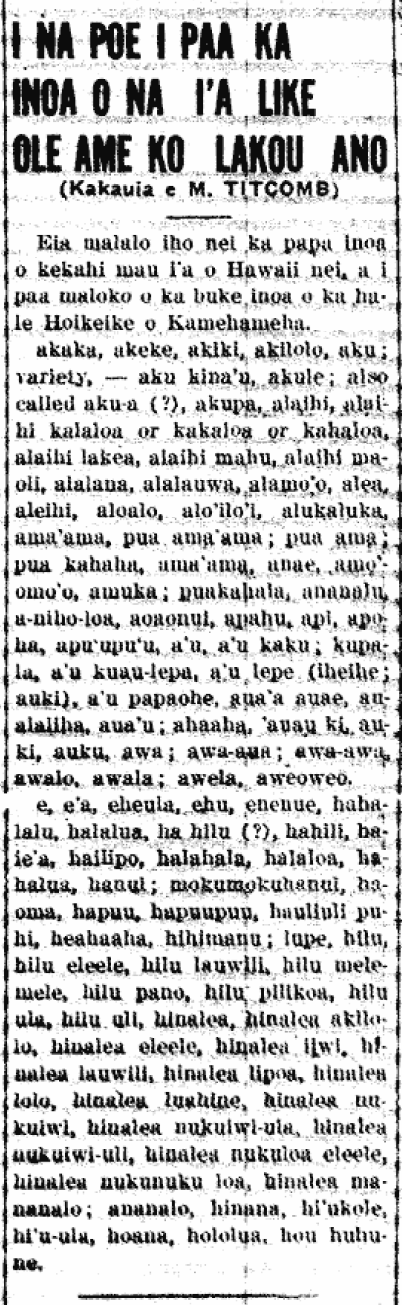
Ka Hoku o Hawaii, Volume XXXV, Number 6, Aoao 3. Iune 5, 1940.
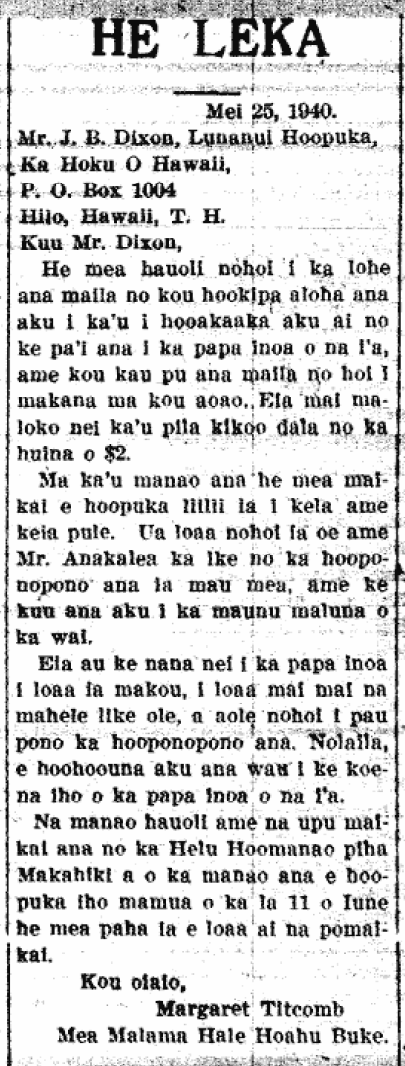
May 25, 1940.
Mr. J. B. Dixon, Circulation Manager,
Ka Hoku O Hawaii,
P. O. Box 1004
Hilo, Hawaii, T. H.
My Dear Mr. Dixon,
I am pleased to hear that you are willing to entertain with aloha my clarification of the publishing of a list of fish names and your running it complimentary on your part. Enclosed is my check for the total of $2.¹
I believe that it would be a fine thing to publish it in portions each week. You and Mr. Anakalea have the ability to edit this kind of thing, and to throw out the bait upon the water.
I am looking at the list of fish names that we have, they are found in various collections, and they are not edited completely. Therefore, I will send the remainder of the list of fish names.
Happy thoughts and good wishes on your Commemorative Anniversary Edition and with hopes that this will be printed before the 11th of June, it will perhaps be something beneficial.
Yours truly,
Margaret Titcomb
Librarian.
[This is no doubt a precursor to the publication Margaret Titcomb did with Mary Kawena Pukui, “Native Use of Fish in Hawaii,” first published in 1952 as Memoir 29 of the Polynesian Society, Wellington, New Zealand. It is currently available in book form from University of Hawaii Press.]
¹It is interesting to note that the cost (prepaid) for a year’s subscription of the Hoku o Hawaii was only $2.00. This is the same cost as a year’s subscription for the Hoku o ka Pakipika and the Nupepa Kuokoa in 1861!
(Hoku o Hawaii, 6/5/1940, p. 2)
Ka Hoku o Hawaii, Volume XXXV, Number 6, Aoao 3. Iune 5, 1940.
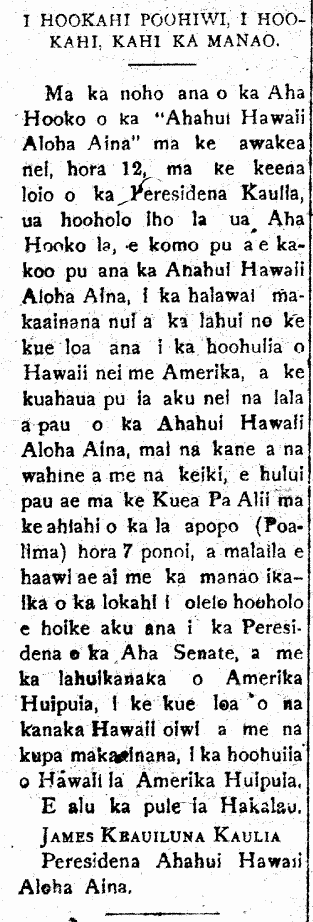
At the meeting of the Executive Committee of the “Ahahui Hawaii Aloha Aina” [Hawaiian Patriotic League] at noon, 12 o’clock, at the attorney’s office of President Kaulia, the said Executive Committee decided that the Patriotic League will join and support the great rally of the makaainana of the lahui to absolutely protest the annexation of Hawaii to America, and it is announced to all of the members of the Hawaiian Patriotic League, from the men, to the women, to the children, to assemble at the Palace Square [Kuea Pa Alii] tomorrow evening (Friday) at exactly 7 o’clock, and there will be presented with insistence and unity, the resolution informing the President of the Senate and the people of the United States, that the native Hawaiians and the long-time makaainana protest the annexation of Hawaii to the United States of America.
Let us combine our prayers to overcome Hakalau. [E alu ka pule ia Hakalau.]²
James Keauiluna Kaulia
President of the Ahahui Hawaii Aloha Aina.
¹Hearkening to the idea of “I hookahi umauma, i hookahi poohiwi, a i hookahi puuwai.” [Let us be of one chest, one shoulder, and of one heart.] Also from earlier that year, see by Samuel K. Kamakaia, “Nai Wale no Oukou A’oe Pau.”
²According to Mary Kawena Pukui’s Olelo Noeau (115): “A sorcerer at Hakalau once created havoc in his own and other neighborhoods. Many attempts to counter-pray him failed until a visiting kahuna suggested that all of the others band together to concentrate on the common enemy. This time they succeeded.”
(Aloha Aina, 10/9/1897, p. 3)
Ke Aloha Aina, Buke III, Helu 41, Aoao 3. Okatoba 9, 1897.
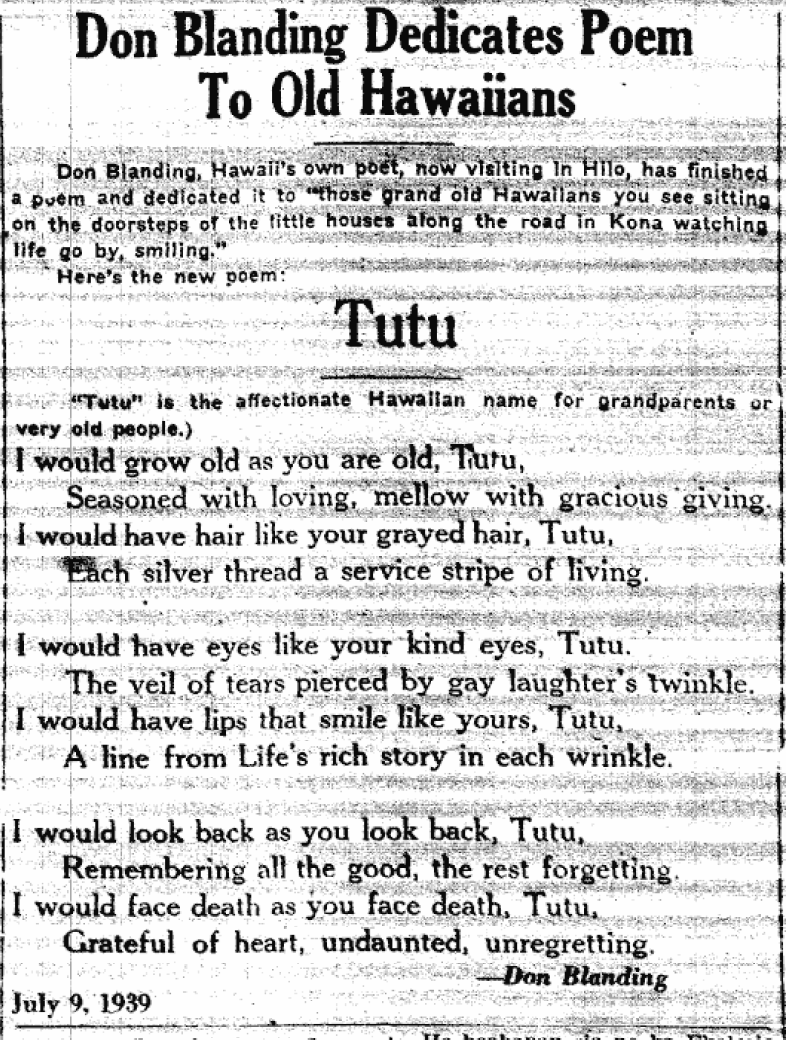
Don Blanding, Hawaii’s own poet, now visiting in Hilo, has finished a poem and dedicated it to “those grand old Hawaiians you see sitting on the doorsteps of the little houses along the road in Kona watching life go by, smiling.”
Here’s the new poem:
“Tutu” is the affectionate Hawaiian name for grandparents or very old people.)
I would grow old as you are old, Tutu,
Seasoned with loving, mellow with gracious giving,
I would have hair like your grayed hair, Tutu,
Each silver thread a service stripe of living.
I would have eyes like your kind eyes, Tutu,
The veil of tears pierced by gay laughter’s twinkle,
I would have lips that smile like yours, Tutu,
A line from Life’s rich story in each wrinkle.
I would look back as you look back, Tutu,
Remembering all the good, the rest forgetting,
I would face death as you face death, Tutu,
Grateful of heart, undaunted, unregretting.
—Don Blanding
July 9, 1939
(Hoku o Hawaii, 7/12/1939, p. 6)
Ka Hoku o Hawaii, Volume XXXIV, Number 11, Aoao 6. July 12, 1939.
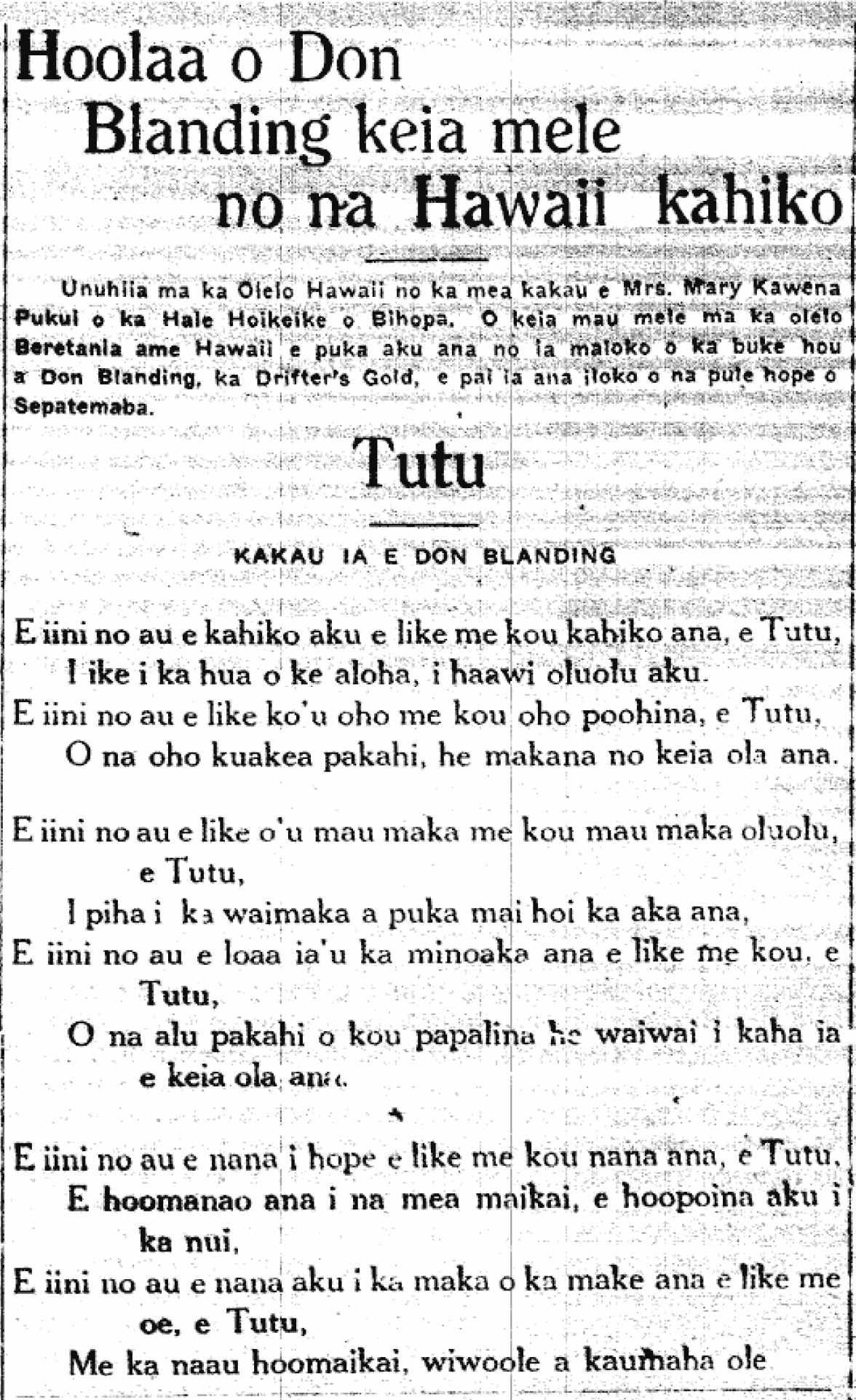
This was translated into Hawaiian for the writer by Mrs. Mary Kawena Pukui of the Bishop Museum. These mele in English and Hawaiian will come out in the new book by Don Blanding, Drifter’s Gold, which will be published in the last week of September.
WRITTEN BY DON BLANDING
E iini no au e kahiko aku e like me kou kahiko ana, e Tutu,
I ike i ka hua o ke aloha, i haawi oluolu aku,
E iini no au e like ko’u oho me kou oho poohina, e Tutu,
O na oho kuakea pakahi, he makana no keia ola ana.
E iini no au e like o’u mau maka me kou mau maka oluolu, e Tutu
I piha i ka waimaka a puka mai hoi ka aka ana,
E iini no au e loaa ia’u ka minoaka ana e like me kou, e Tutu,
O na alu pakahi o kou papalina, he waiwai i kaha ia e keia ola ana.
E iini no au e nana i hope e like me kou nana ana, e Tutu,
E hoomanao ana i na mea maikai, e hoopoina aku i ka nui,
E iini no au e nana aku i ka maka o ka make ana e like me oe, e Tutu,
Me ka naau hoomaikai, wiwoole a kaumaha ole.
(Hoku o Hawaii, 7/12/1939, p. 1)
Ka Hoku o Hawaii, Volume XXXIV, Nuimber 11, Aoao 1. Iulai 12, 1939.
 nupepa