Beginning of line-by-line commentary of “Aia i Honolulu kuu pohaku,” 1929.

EXPLANATION OF THE FIRST LINE.

1. Aia i Honolulu kuu pohaku

Kapanookalani’s thoughts:—This land Honolulu, it is close to Nanawale, Puna, by the sea. It is a ku, a small land in between large lands.

The stone [pohaku] is Lord [Haku] of the chiefess and in this word, the important idea is chiefess [‘lii wahine].

Kahapula’s thoughts:—Honolulu is on Oahu, where King Kamehameha V dwelt and those who opposed him is the Honolulu in this first line of the mele. It was here his enemies schemed and carried out all their defiant acts against him. While they knew the wish of the King to marry the chiefess Pauahi, her teacher, Amos Cooke secretly agreed to  Bishop for him to meet with Pauahi without the knowledge of her parents. That is how Pauahi became Bishop’s, and this is how Bishop and his relative Lee [? William Little Lee] became dignitaries of the land.

Kupihea’s thoughts:—Honolulu is a fish stone called a Kuula, and was brought here to this Honolulu [on Oahu] from the Honolulu of Puna [on Hawaii]. This Kuula was placed in the tiny land of Honolulu where an Alii called Honolulu lived, who was related to the chiefess Peleula, whose younger sister was the beautiful Waikiki. This place is mauka of the old Rawlin’s Estate. There is a bank of coral where Honolulu is; the fishing altar [Kuula] for the fish ponds [loko i’a] is on the Waikiki side of Liliha Street and between Vineyard and King Streets.

The stone is related to chiefs from times immemorial [mai ka po mai]. It is a manifestation made by God.

Iokepa’s thoughts:—Honolulu is a small land and a canoe landing makai of Nanawale, Puna, between two sand dunes, one on the Hilo side and one on the Puna side, called Puu Waawaa. From this Honolulu is called the Honolulu here [on Oahu] which used to be called Kou before, and after it was called Honolulu until this day.

This is the meaning for the word Honolulu:—The wind is very calm [lulu] an the sea is serene; it is very fine and peaceful. Bay [? Hono] of calm sea; Hono that is peaceful.

Kuluwaimaka’s thoughts:—The stone is related to Kamehameha V. Honolulu in Puna is a lowland next to the sea. Its width is perhaps half a mile long between Na Puu o Pele and Waiakahiula on the Hilo side. Honolulu is a place where you pick opihi [ku’i opihi] and pick limu [hana limu]. There is a fine spring [punawai] there and there is a foot path there.

[And to think that this is but the very beginning of Kelsey’s detailed account of the explanation of the six loea of the mele “Aia i Honolulu kuu pohaku.” This is just the first line! It continues in the following issues!!

One more (huge) reason that Hawaiian-Language Newspapers are priceless!!!]

(Alakai o Hawaii, 12/5/1929, p. 2)

NA MANAO WEHEWEHE MALUNA O KA LAINA EKAHI.

Ke Alakai o Hawaii, Buke 1, Helu 32, Aoao 2. Dekemapa 5, 1929.
More on “Aia i Honolulu kuu pohaku”! 1929.

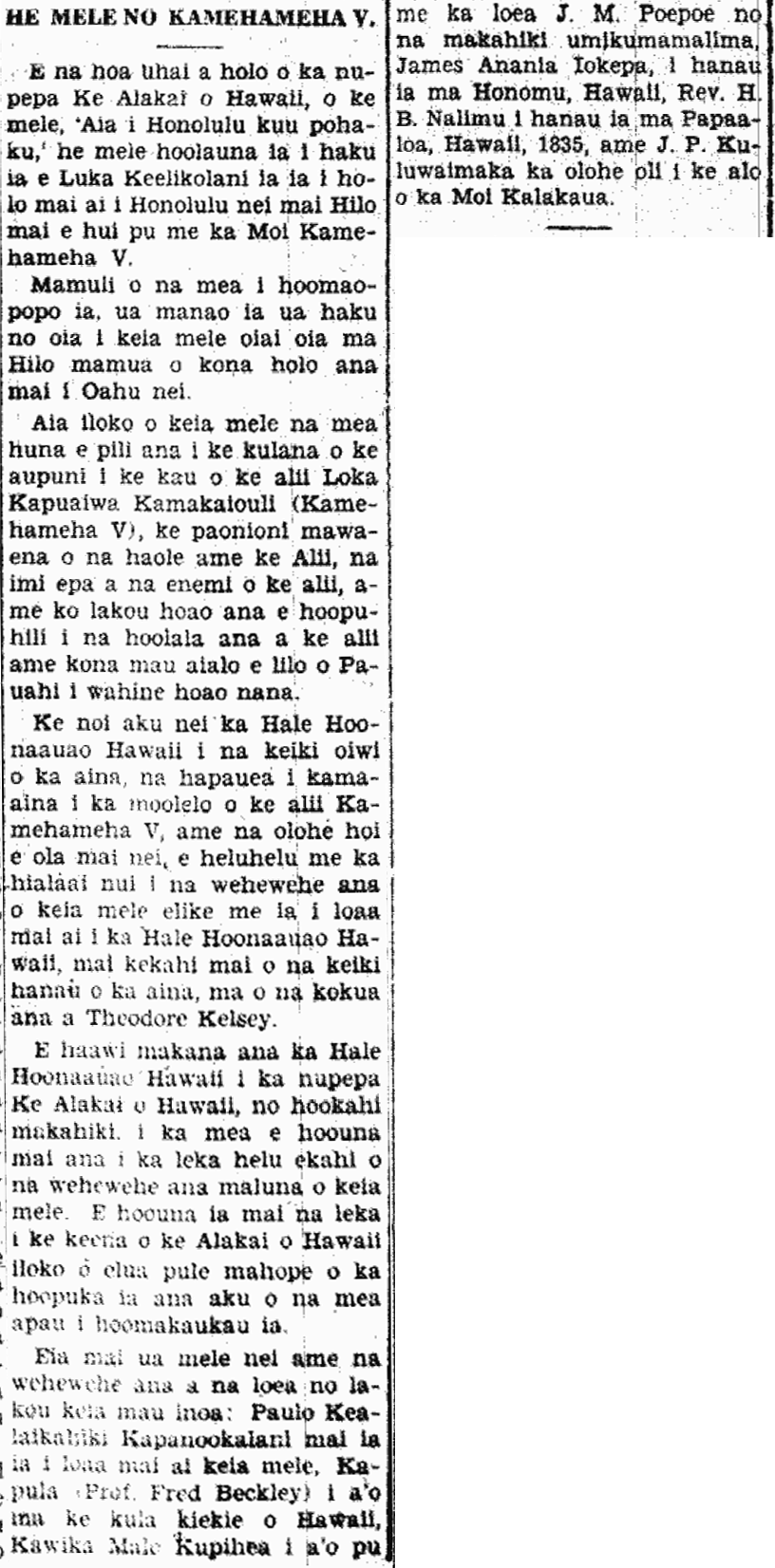
A MELE FOR KAMEHAMEHA V.

O Friends who chase after Ke Alakai o Hawaii, the mele, “Aia i Honolulu kuu pohaku,” is a mele of familiarity [mele hoolauna] composed by Luka Keelikolani when she was coming to here in Honolulu from Hilo to meet with King Kamehameha V.

From what is understood, it is believed that she composed this mele while she was in Hilo before her travelling to Oahu nei.

In this mele are hidden things dealing with the nation in the time of the alii Loka Kapuaiwa Kamakaiouli (Kamehameha V); the contention between the haole and the King, the deceit of the enemies of the King and their attempt to thwart the plans by the King and his court to make Pauahi his wife.

The Hale Hoonaauao Hawaii asks the native ones of the land, the old ones familiar with the history of King Kamehameha V, and the experts still living, to read with much pleasure the explanations of this mele as per what was obtained by the Hale Hoonaauao Hawaii from those native born of the land through the assistance of Theodore Kelsey.

The Hale Hoonaauao Hawaii will award a one-year subscription of the newspaper Ke Alakai o Hawaii to the one who sends the best letter with explanations on this mele. Send the letters to the office of Ke Alakai o Hawaii withing two weeks of the completion of the publishing of all that has been compiled.

Here is the mele and the explanations of the experts [loea] whose names are: Paulo Kealaikahiki Kapanookalani from whom we received this mele, Kahapula (Prof. Fred Beckley) who teaches at the University of Hawaii, Kawika Malo Kupihea who studied with the loea J. M. Poepoe for fifteen years. James Anania Iokepa who was born in Honomu, Hawaii, Rev. H. B. Nalimu who was born in Papaaloa, Hawaii in 1835, and J. P. Kuluwaimaka the skilled chanter [olohe oli] in the court of King Kalakaua.

[“Aia i Honolulu kuu pohaku” is perhaps the most widely studied mele i have seen, with line-by-line interpretations by experts of the day. It continues on for a number of issues of Alakai o Hawaii.

Does anyone have any details on the organization called Hale Hoonaauao Hawaii, or Hale Hoonaauao o Hawaii?]

(Alakai o Hawaii, 12/5/1929, p. 2)

HE MELE NO KAMEHAMEHA V.

Ke Alakai o Hawaii, Buke 1, Helu 32, Aoao 2. Dekemapa 5, 1929.

“Aia i Honolulu kuu pohaku,” name song for Kamehameha V., 1929.

AIA I HONOLULU KUU POHAKU.

1. Aia i Honolulu kuu pohaku

2. O Kealohilani kuu haku ia

3. Ua holo ka wela i na mokupuni

4. Ua puni hei au leo o ka manu

5. O a’u lehua i Mokaulele

6. Hooneenee mai e ka iliahi

7. Hoohanua mai la ka ua iuka

8. Aia ka pono ia Oniula

10. Ua malu ka honua ia Kalani

11. Kuu Haku i ka ehuehu kai olalo

12. I ahona Puna i ke ala o ka hala

13. Paa mai la Olaa i ka ua noe

14. Noho i ka ehuehu kai o Hilo

15. Kahiko Poliahu i ka hau anu

16. He manao paa ko’u a hiki aku

17. Ua lahui ia mai e iala

18. Hea aku no wau o mai oe

19. O Kamakaiouli kou inoa.

(Alakai o Hawaii, 12/5/1929, p. 2)

AIA I HONOLULU KUU POHAKU.
Ke Alakai o Hawaii, Buke 1, Helu 32, Aoao 2. Dekemapa 5, 1929.

Kaulilua… Mele inoa for Kamehameha IV, 1864.

[Excerpt found under: “A DIRGE FOR KING Alexander Kalanikualiholiho, Maka o Iouli, Kunuiakea o Kukailimoku, KAMEHAMEHA IV!”]

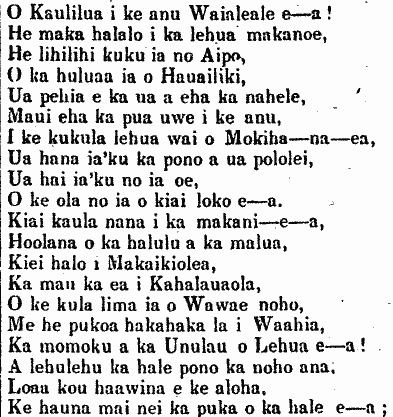
O Kaulilua i ke anu Waialeale e—a!
He maka halalo i ka lehua makanoe,
He lihilihi kuku ia no Aipo,
O ka huluaa ia o Hauailiki,
Ua pehia e ka ua a eha ka nahele,
Maui eha ka pua uwe i ke anu,
I ke kukula lehua wai o Mokiha—na—ea,
Ua hana ia’ku ka pono a ua pololei,
Ua hai ia’ku no ia oe,
O ke ola no ia o kiai loko e—a.
Kiai kaula nana i ka makani—e—a,
Hoolana o ka halulu a ka malua,
Kiei halo i Makaikiolea,
Ka mau ka ea i Kahalauaola,
O ke kula lima ia o Wawae noho,
Me he pukoa hakahaka la i Waahia,
Ka momoku a ka Unulau o Lehua e—a!
A lehulehu ka hale pono ka noho ana,
Loaa kou haawina e ke aloha,
Ke hauna mai nei ka puka o ka hale e—a;

[So many interesting things about this. The first and foremost perhaps is that this appears as part of an unusual kanikau for Alexander Liholiho Kamehameha IV in the form of a conversation between Kamehameha III (K III.) and himself (K IV.). Another is that if you hula, you probably learned this as a mele inoa for Kalakaua and not as one for Kamehameha IV. Does anyone know who it is that is labeled as (M.) in the conversation? Click here for a PDF of the issue with the rest of the piece on page 4.]

(Kuokoa, 1/23/1864, p. 4)

O Kaulilua i ke anu Waialeale e—a!

Ka Nupepa Kuokoa, Buke III, Helu 4, Aoao 4. Ianuari 23, 1864.

Another beautiful name song for Queen Kapiolani, still sung today, 1883.

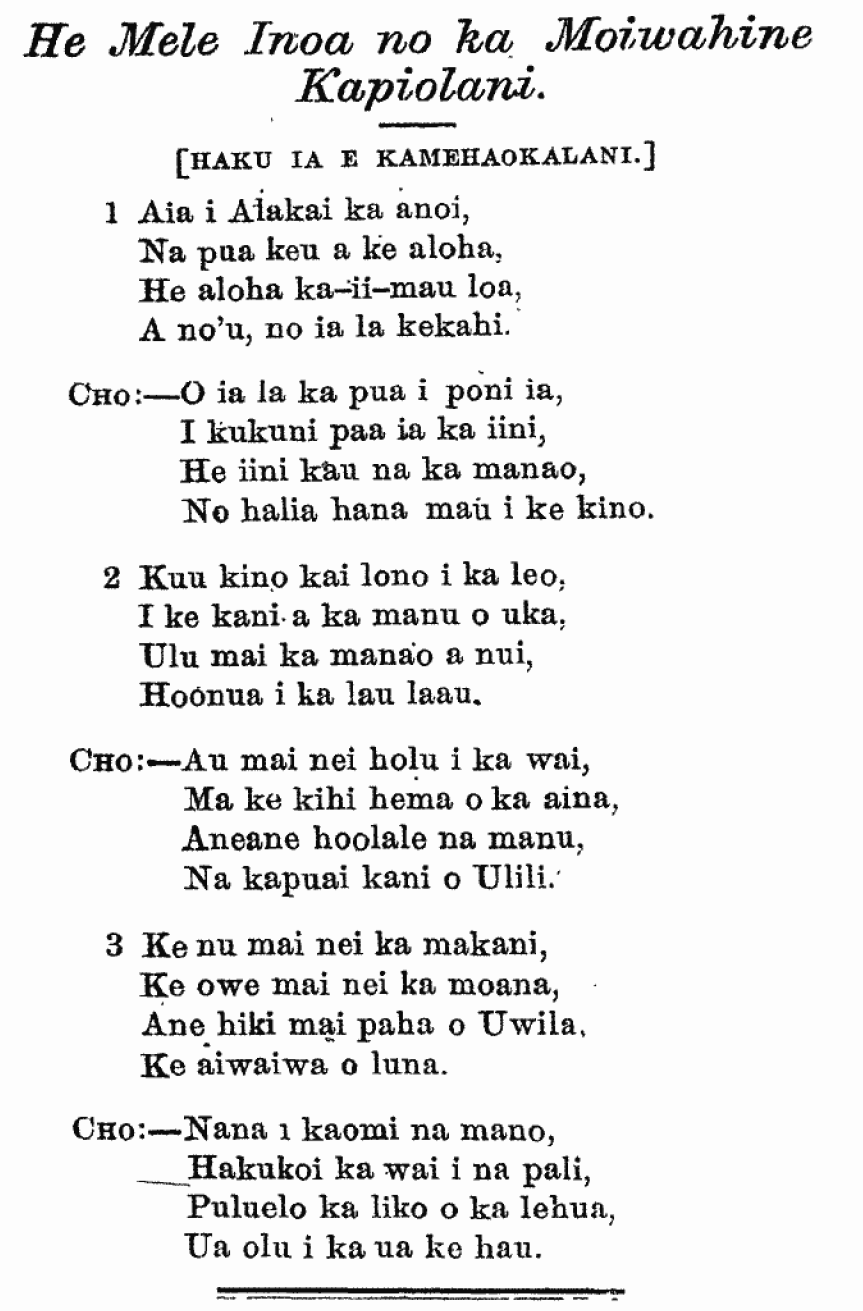
He Mele Inoa no ka Moiwahine Kapiolani.

[HAKU IA E KAMEHAOKALANI.]

1 Aia i Alakai ka anoi,
Na pua keu a ke aloha,
He aloha ka—ii—mau loa,
A no’u, no ia la kekahi.

Cho:—O ia la ka pua i poni ia,
I kukuni paa ia ka iini,
He iini kau na ka manao,
No halia hana mau i ke kino.

2 Kuu kino kai lono i ka leo,
I ke kani a ka manu o uka,
Ulu mai ka manao a nui,
Hoonua i ka lau laau.

Cho:—Au mai nei holu i ka wai,
Ma ke kihi hema o ka aina,
Aneane hoolale na manu,
Na kapuai kani o Ulili.

3 Ke nu mai nei ka makani,
Ke owe mai nei ka moana,
Ane hiki mai paha o Uwila,
Ke aiwaiwa o luna.

Cho:—Nana i kaomi na mano,
Hakukoi ka wai i na pali,
Puluelo ka liko o ka lehua,
Ua olu i ka ua ke hau.

[The mele in the newspapers need to be studied. Here, this one is credited to Kamehaokalani. Later on in 1897, in Edward C. Holstein’s “Ka Buke Mele o na Himeni Hawaii,” it is credited to Kamealoha. This book is available as a reprint from the Bernice Pauahi Bishop Museum.]

(Koo o Hawaii, 8/29/1883, p. 8)

He Mele Inoa no ka Moiwahine Kapiolani.

Ke Koo o Hawaii, Buke 1, Helu 2, Aoao 8. Augate 29, 1883.

The Kings of Hawaii, 1876.

This is from an issue of “The Friend,” which includes a short biography in English of the ruling monarchs of Hawaii nei, written by S. C. Damon. As for this page of illustrations, they say:

The illustrations accompanying this number of the Friend we could wish were better executed. The plate was made in New York, from the best photographs we could procure in Honolulu. The original of Kamehameha 1st was executed in 1817 by a Russian artist, who accompanied Kotzebue in his voyage, and may be seen by referring to the third volume of his voyage. The original of Kamehameha 2d was executed in England in 1824, in the style of the dress of George 4th’s reign. We think those of Kamehameha 3d, 4th and 5th are very good, but not quite so good those of Lunalilo or His Majesty Kalakaua.

[For the biographies, find them here: The Friend, February 1, 1876.

Although it is clunky to maneuver, most of this series of news letters is available from the Mission Houses Museum here: The Friend.]

(Friend, 2/1/1876, pp. 9–13)

[Monarchs]

The Friend, New Series, Volume 25, Number 2, Page unnumbered. February 1, 1876.

Hula and King Kalakaua’s 50th Jubilee, 1886.

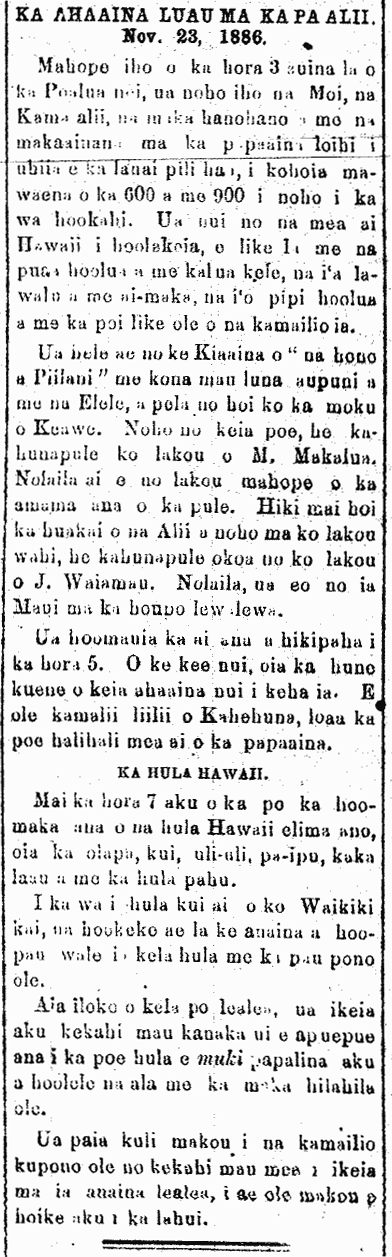
THE LUAU FEAST AT THE PALACE GROUNDS.

Nov. 23, 1886.

After 3 o’clock in the afternoon of this Tuesday, the King, the Princes and Princesses, the dignitaries, and the makaainana sat at a long table housed by a pavilion with corrugated iron roofing [lanai pili hao], which could sit an estimated 600 to 900 people at a time. There was much Hawaiian foods supplied, like laulau [puaa hoolua] and roasted pork [puaa kalua kele]; fish wrapped in ti leaves and baked [lawalu] and raw [ai-maka]; baked beef [i’o pipi hoolua] and all types of poi spoken of.

The Governor of the “bays of Piilani”¹ as well as his government officials and Delegates, along with those of the island of Keawe.² These people sat along with their pastor, M. Makalua. They began eating after the prayer was over. The entourage of the King and Queen arrived and sat in their area, and they had their own pastor, J. Waiamau. Therefore, Maui was victorious over their hunger [?? Nolaila, ua eo no ia Maui ma ka houpo lewalewa].

The eating continued perhaps until 5 o’clock. A big problem was the dearth of waiters for the grand feast that was boasted about. Thanks to the small children of Kahehuna [School], there were those to serve the food for the feast.

HAWAIIAN HULA.

From 7 o’clock in the night, Hawaiian hula of five types commenced, that being olapa, kui, uli-uli, pa-ipu, kaka laau, and hula pahu.

When those of Waikiki kai danced their hula kui, the audience complained, and that hula was put to an end without ending properly.

During that joyful night, some youths were seen attempting to get the dancers to kiss their cheeks, and to [?? hoolele na ala] without any sign of shame.

We were deafened by all the improper talk of some of the things seen in that partying crowd that we will not agree to tell the nation.

¹The governor of Maui was John Owen Dominis.

²The governor of Hawaii was Virginia Kapooloku Poomaikelani

(Ko Hawaii Pae Aina, 11/27/1886, p. 4)

KA AHAAINA LUAU MA KA PA ALII.

Ko Hawaii Pae Aina, Buke IX, Helu 48, Aoao 4. Novemaba 27, 1886.

Mele about Na Pali Mahoe, 1888.

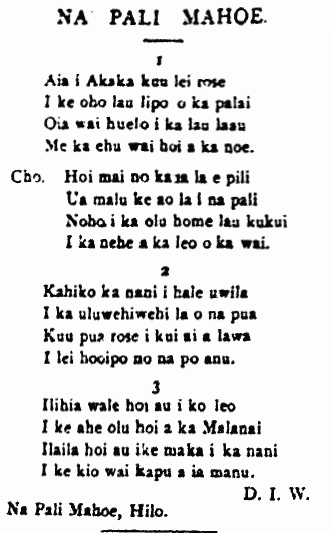
NA PALI MAHOE.

1

Aia i Akaka kuu lei rose
I ke oho lau lipo o ka palai
Oia wai huelo i ka lau laau
Me ka ehu wai hoi a ka noe.

Cho. Hoi mai no ka ia la e pili
Ua malu ke ao la i na pali
Noho i ka olu home lau kukui
I ka nehe a ka leo o ka wai.

2

Kahiko ka nani i hale uwila
I ka uluwehiwehi la o na pua
Kuu pua rose i kui ai a lawa
I lei hooipo no na po anu.

3

Ilihia wale hoi au i ko leo
I ke ahe olu hoi a ka Malanai
Ilaila hoi au ike maka i ka nani
I ke kio wai kapu a ia manu.

D. I. W.

Na Pali Mahoe, Hilo.

[There are so many beautiful songs held in the pages of the Hawaiian-Language Newspapers! Here is one written by someone living in the Na Pali Mahoe spoken of in the previous post. It would benefit modern composers greatly to look back at and to study these as they turn forward and compose their own mele.]

(Kuokoa, 5/5/1888, p. 1)

NA PALI MAHOE.

Ka Nupepa Kuokoa, Buke XXVII, Helu 18, Aoao 1. Mei 5, 1888.

Hula mounds, shoddy roads, and inclement weather in Hilo, 1887.

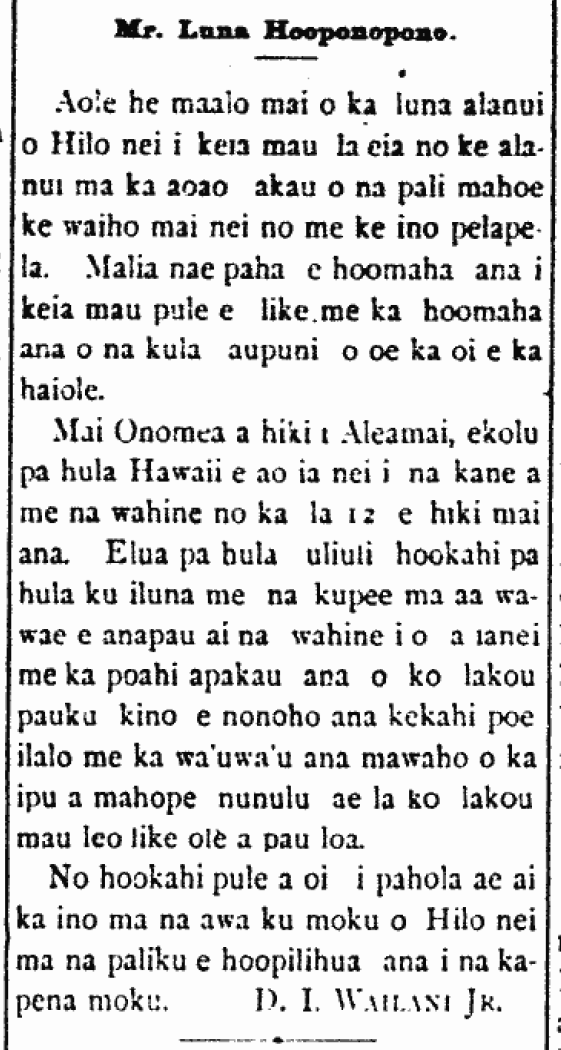
Mr. Editor.

The road supervisor [luna alanui] of Hilo has not passed by these days; the road to the north of the twin cliffs [na pali mahoe] is left damaged and filthy. Perhaps he is on vacation these weeks as the public schools are on vacation; haiole [?], you are the best.¹

From Onomea until Aleamai, there are three Hawaiian hula mounds [pa hula] where men and women are being taught for the upcoming 12th. There are two green pa hula that are got on with anklets [kupee] on the legs as the women turn this way and that, while they rotate about [poahi apakau] their torsos; some people sit below while rasping [wa’uwa’u] against the outside of a gourd and then their various voices reverberate forth.

For over a week, there was a storm covering the docks here in Hilo, bewildering the ship captains on the Paliku side.

D. I. Wailana, Jr.

¹The Road Supervisor in Chief for Hawaii Island that year, according to Thrum, was C. N. Arnold.

(Kuokoa, 4/30/1887, p. 2)

Mr. Luna Hooponopono.

Ka Nupepa Kuokoa, Buke XXVI, Helu 18, Aoao 2. Aperila 30, 1887.