Something to consider as more and more agricultural lands get covered over by concrete, 1911 / 2013.

THE STIRRING AND FLUTTERING OF TARO LEAVES TO DISAPPEAR

 We are discussing this problem, that being the disappearance of the fluttering taro leaves from places where kalo farming was seen often before. This is clear should our speculation be true.

The Bishop Trustees and those of Pauahi Bishop are considering putting an end for all time to the farming of kalo on lands owned by Bishop and Mrs. Pauahi Bishop here in Honolulu, or in all areas near Honolulu; there will be no more farming of kalo from now on. Should the reader take a look at the lands towards the ocean and towards the uplands of School Street, the majority of those kalo lands belong to Bishop and Pauahi, and should these large tracts of kalo-growing lands be put an end to, taro leaves growing there will no longer be seen, and two years hence, the leases with the Chinese taro farmers will come to an end; but these are not the only taro lands; in Manoa Valley, there are acres of kalo land. It can be said that most of the taro-farming lands in Manoa Valley belong to Bishop, and should the kalo farming be put to an end in that valley, then it is appropriate for us to say that taro leaves will disappear from the district of Kona, and when the leases are stopped, the lands will be dried up, and they will be made into lots to lease to those who have no homes, or they will be sold, like what is being considered by the Trustees of Bishop folks.

 One of the main reasons to end the farming of kalo on these lands is perhaps because if the farming of kalo continues, these areas will be places for infectious diseases to reside; through this, O Hawaiians, our end will come; if these kalo lands are dried out and kalo is not grown, then there will be no other lands for the Chinese to lease like these tracts of lands of many acres, and should they indeed be done away with, then the places where kalo is grown will decrease. As a result, the poi prices will increase, for where will kalo be readily obtained to supply this town and to get poi? For those who have taro fields, it is important that they continue to plant taro; there will not be the profits in that work like what we always speak of when talking of farming; and it is not just here that the leaves of the taro will no longer be seen, but it will disappear from Waikane, Waiahole, and Kahana, for the water there is going to the sugarcane plantations. Alas for us Hawaiians who hereafter will be left wandering, looking for kalo and poi. Rise O Hawaiians and continue to farm kalo lest you be left hungry, being that the stirring and fluttering of kalo leaves will disappear from Honolulu nei.

[This deserves to be retranslated nicely…]

(Kuokoa Home Rula, 8/18/1911, p. 2)
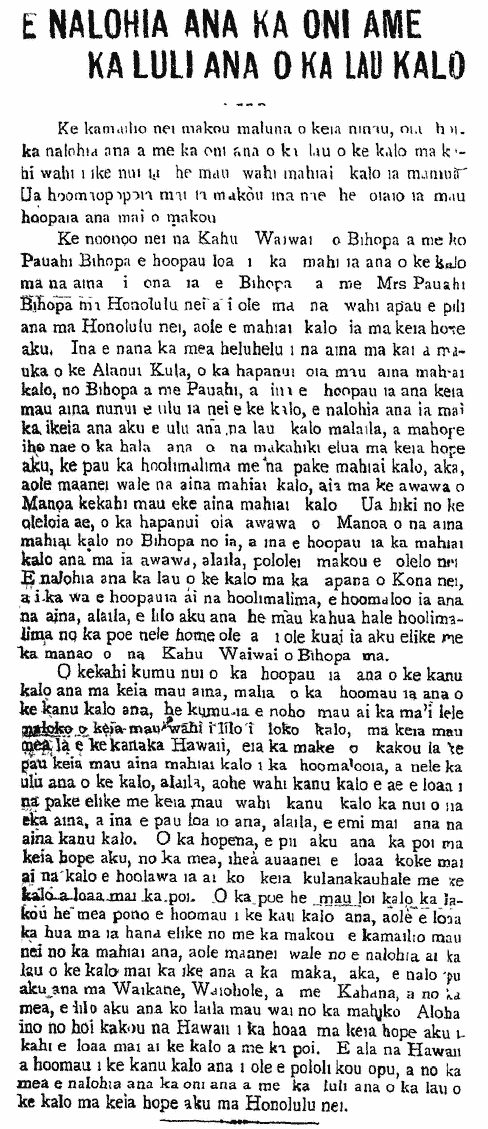
E NALOHIA ANA KA ONI AME KA LULI ANA O KA LAU KALO

Kuokoa Home Rula, Buke IX, Helu 33, Aoao 2. Augate 18, 1911.
More births, so many more, 1913.

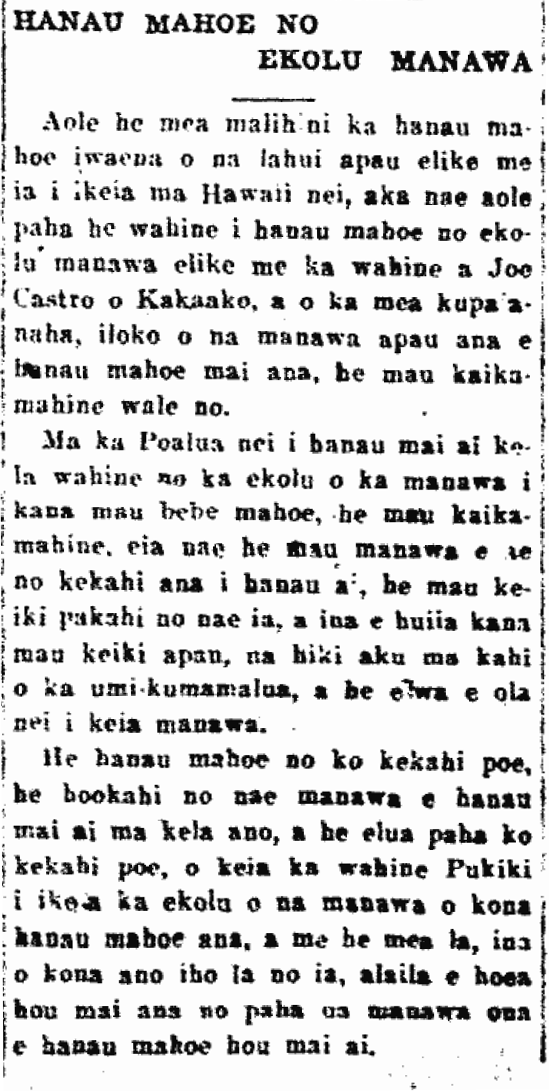
GAVE BIRTH TO TWINS THREE TIMES

It is not something new for twins to be born by all ethnicities, just as is seen in Hawaii nei; however, there perhaps has not been a woman who has given birth to twins three times like the wife of Joe Castro of Kakaako; and the amazing thing is that each time she has given birth to twins, they were always just girls.

This Tuesday, that woman gave birth for the third time her twins, but there has been other times which she has given birth to just a single child; and if you add up all of her children, they total up to twelve, and nine are still living at this time.

Some give birth to twins just one time, while others perhaps twice, but this Portuguese woman is known to have given birth three times to twins; and it would seem that being of her nature, there may come a time that she may give birth to twins once more.

(Kuokoa, 11/7/1913, p. 4)

HANAU MAHOE NO EKOLU MANAWA.

Ka Nupepa Kuokoa, Buke LI, Helu 44, Aoao 4. Novemaba 7, 1913.

Vital Statistics, 1913.

MARRIAGES.

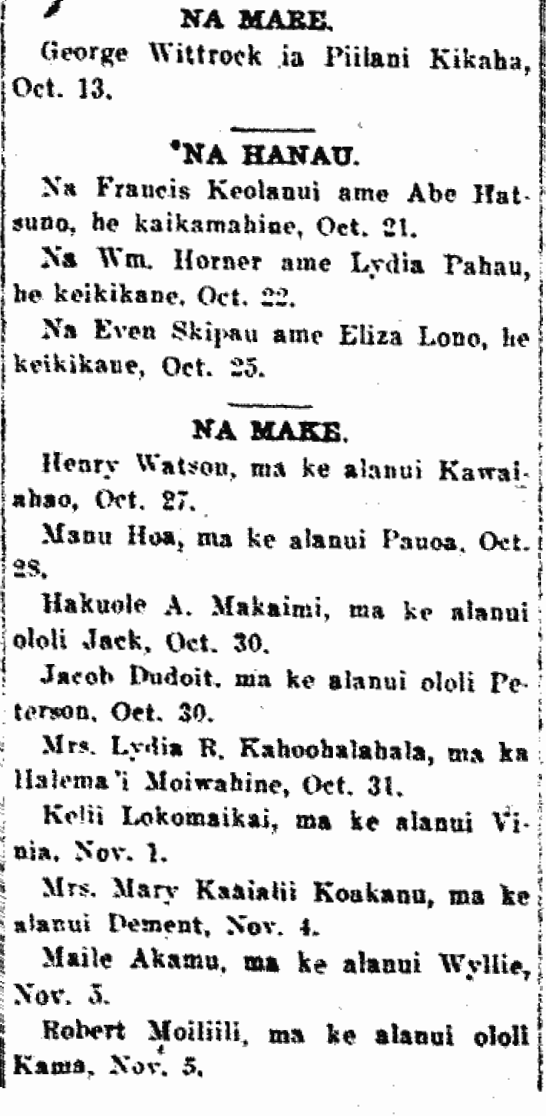
George Wittrock to Piilani Kikaha, Oct. 13.

BIRTHS.

To Francis Keolanui and Abe Hatsuno, a daughter, Oct. 21.
To William Horner and Lydia Pahau, a son, Oct. 22.
To Even Skipau and Eliza Lono, a son, Oct. 25.

DEATHS.

Henry Watson, on Kawaiahao Street, Oct. 27.
Manu Hoa, on Pauoa Street, Oct. 28.
Hakuole A. Makaimi, on Jack Lane, Oct. 30.
Jacob Dudoit, on Peterson Lane, Oct. 30.
Mrs. Lydia R. Kahoohalahala, at Queen’s Hospital, Oct. 31.
Kelii Lokomaikai, on Vineyard Street, Nov. 1.
Mrs. Mary Kaaialii Koakanu, on Dement Street, Nov. 4.
Maile Akamu, on Wyllie Street, Nov. 5.
Robert Moiliili, on Kama Lane, Nov. 5.

(Kuokoa, 11/7/1913, p. 4)

NA MARE. / NA HANAU. / NA MAKE.

Ka Nupepa Kuokoa, Buke LI, Helu 44, Aoao 4. Novemaba 7, 1913.

Veterans Day, the early years, 1938.

THE ENDING OF THE WAR
NOVEMBER 11

November 11, 1938. The battles of Marne, Ypres, Loos, Arras, Somme, Chateau Thierry, Verdun, Argonne, Belleau Wood—these famous blood-shedding battles, their stories and the men who fought in them, both living and dead, remain as memorials for the conscience. The great number of soldiers constantly sent away here and there for their home, to fight and for peace. We honor those men who fought for a purpose, and at the same time, put to use those frightful years as a means to attain the peace of which we are blessed.

Drive-In Market                                  E. Yanagihara Store

V. A. Carvalho                                      Quong Sing Market

Beamer’s Hardware Store              B. F. Shoen, Ltd.

S. Ikeda Soyo Factory                       Hawaii Motor Supply

J. S. Rickard                                           The Men’s Shop

Union Meat Co.                                  G. Miyamoto Cash & Carry

Diamond Bar                                        Kilauea Radio Shop

Simeon Armor The Sign Artist       Akadama

De Silva Vogue Shop                         Lacai Bros. [?]

June Shipman Beauty Shoppe      Mamalahoa Chapter No. 2 Order of Kamehameha

Isemoto Contracting Co. Ltd.

(Hoku o Hawaii, 11/9/1938, p. 3)

LA PAU O KE KAUA

Ka Hoku o Hawaii, Volume XXXIII, Number 28, Aoao 3. Novemaba 9, 1938.

E Nai Wale No Oukou… 1897.

NAI WALE NO OUKOU AO’E PAU

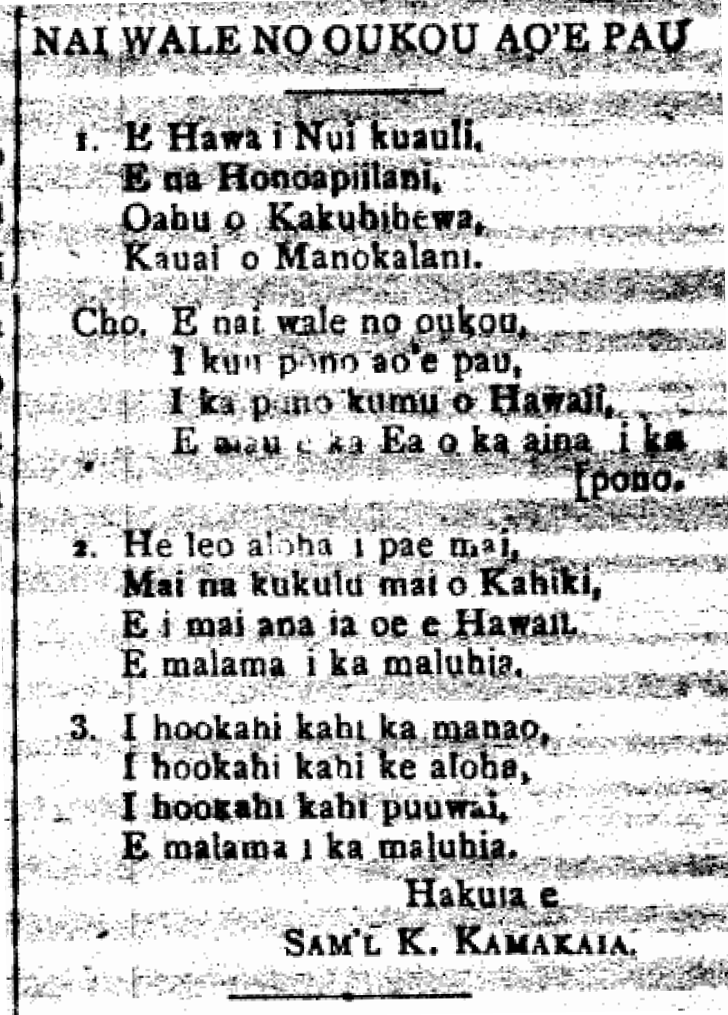
1. E Hawaii Nui kuauli,
E na Honoapiilani,
Oahu o Kakuhihewa,
Kauai o Manokalani.

Cho. E nai wale no oukou,
I kuu pono ao’e pau,
I ka pono kumu o Hawaii,
E mau e ka Ea o ka aina i ka pono.

2. He leo aloha i pae mai,
Mai na kukulu mai o Kahiki,
E i mai ana ia oe e Hawaii,
E malama i ka maluhia.

3. I hookahi kahi ka manao,
I hookahi kahi ke aloha,
I hookahi kahi puuwai,
E malama i ka maluhia.

Composed by
Samuel K. Kamakaia.

[Another well-known mele, with a few noticeable differences from what is sung today. The repeated line “E malama i ka maluhia.” would be “Keep the peace.”]

(Aloha Aina, 8/21/1897, p. 7)

NAI WALE NO OUKOU AO'E PAU

Ke Aloha Aina, Buke III, Helu 34, Aoao 7. Augate 21, 1897.

More news from Kamehameha School …in Hawaiian, 1940.

News of Kamehameha School

(Written by Henrietta Laeha)

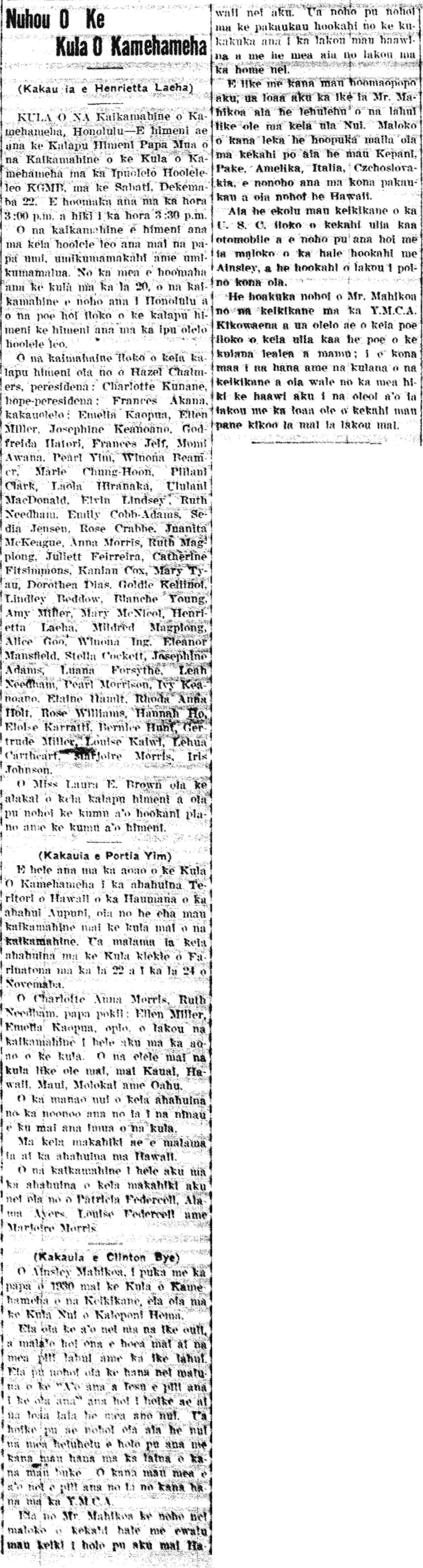
KAMEHAMEHA Girls’ School, Honolulu—The Upperclassmen Glee Club of the Kamehameha Girls’ School will sing at the KGMB Radio Station, on Sunday, December 22. It will begin at 3:00 p. m. until 3:30 p. m.

The girls singing in this broadcast are from the tenth-, eleventh-, and twelfth-grades. Because the school will be on vacation on the 20th, the girls who live in Honolulu and who are in the glee club will be singing at the radio station.

The girls in that glee club are: Hazel Chalmers, president; Charlotte Kunane, vice-president; Prances Akana, secretary; Emelia Kaopua, Ellen Miller, Josephine Keanoano, Godfreida Hatori, Frances Jelf, Momi Awana, Pearl Yim, Winona Beamer, Marie Chung-Hoon, Piilani Clark, Laola Hiranaka, Ululani MacDonald, Elvin Lindsey, Ruth Needham, Emily Cobb-Adams, Sedia Jensen, Rose Crabbe, Juanita McKeague, Anna Morris, Ruth Magplong, Juliett Feirreira, Catherine Fitsimmons, Kanian Cox, Mary Tyau, Dorothea Dias, Goldie Keliinoi, Lindley Beddow, Blanche Young, Amy Miller, Mary McNicol, Henrietta Leaha, Mildred Magplong, Alice Goo, Winona Ing, Eleanor Mansfield, Stella Cockett, Josephine Adams, Luana Forsythe, Leah Needham, Pearl Morrison, Ivy Keanoano, Elaine Hamit, Rhoda Anna Holt, Rose Williams, Hannah Ho, Eloise Karratti, Bernice Hunt, Gertrude Miller, Louise Kaiwi, Lehua Carthcart, Marjoire Morris, Iris Johnson.

Miss Laura E. Brown is the director of the glee club, and she is also the piano instructor and the singing teacher.

(Written by Portia Yim)

Going to represent Kamehameha School at the Territory of Hawaii Conference of the National Student Association [? ahahuina Teritori o Hawaii o ka Haumana o ka ahahui Aupuni], are four girls from the girls’ school. This conference was held at Farrington High School from the 22nd to the 24th of November.

Charlotte Anna Morris, Ruth Needham, children class; Ellen Miller, Emelia Kaopua, youths; were the girls who represented the school. The delegates came from many different schools, from Kauai, Hawaii, Maui, Molokai, and Oahu.

The main reason for this meeting was to think over the problems that come before the school.

This coming year, the meeting will be held on Hawaii.

The girls who went to the meeting last year were Patricia Federcell, Alama Ayers, Louise Federcell and Marjorie Morris.

(Written by Clinton Bye)

Ainsley Mahikoa, who graduated with the class of 1930 from Kamehameha School for Boys, is at University of Southern California.

He is there studying the social sciences [? ouli] and that includes the study of different peoples and their knowledge. He is also working on “The teachings of Jesus pertaining to life” of which he related that he gained a lot. He also said that there is a lot in his reading pertaining to his line of work. His studies are related to his work at the Y. M. C. A.

Mr. Mahikoa is living with eight other boys who went there together from Hawaii. They sit together at one table to discuss their studies as if they were living at home.

According to his explanation, that Mr. Mahikoa has gained a lot of knowledge of other peoples at that University. In his letter, he said that one night, there was a Japanese, Chinese, American, Italian, Czechoslovakian, sitting around his table with him, a Hawaiian.

There were three boys from USC who were in an automobile accident who live with him in the same dorm along with Ainsley, and one of them lost his life.

Mr. Mahikoa is a counsellor for the boys at the Central Y.M.C.A. and it is said that the boys who were in that accident were ones who liked to have fun, and because Mahikoa was used to the ways of boys, he was the only one that could talk to them without being talked back to.

[I was assuming that all of the news written in by Kamehameha students of that time would be done in English, but happily it was not so!]

(Hoku o Hawaii, 12/11/1940, p. 3)

Nuhou O Ke Kula o Kamehameha

Ka Hoku o Hawaii, Volume XXXV, Number 33, Aoao 3. Dekemaba 11, 1940.

Kamehameha Schools column in Hoku o Hawaii, 1940.

NEWS FROM KAMEHAMEHA SCHOOL FOR BOYS

By John Desha

KAMEHAMEHA SCHOOL. May 22 (Special)—Four seniors from the Big Island were graduated on May 30. They were Frances Nohoikaiu, Odetta Needham, George Mills, and Nephi Needham.

All of these students have attained a standard of which they can be proud.

George Mills and Nephi Needham have taken up at Kamehameha the agriculture course.

Frances Nohoikaiu and Odetta Needham have taken the general course at Kamehameha school for Girls.

Calvin Christ, also of Hawaii, is graduating this year. Calvin is in his high-eleventh year but is graduating with six other high-eleventh students. He has taken up the electrical course at Kamehameha and is planning to return to Hawaii where he intends to work.

KAMEHAMEHA SCHOOLS, May 26 (Special) — Memorial services were held for Bernice Pauahi Bishop by the Kamehameha Schools at Mauna Ala cemetery at Nuuanu on Friday, May 24.

While the school band played “Hawaii”, the students marched in and formed in a semicircles before the grave of Mrs. Bishop. The program ran in the following order:

“He Inoa No Pauahi” — Led by Daniel Hano.

“Pauahi O Kalani” — Led by Bernice Campbell.

“Boys’s School Pledge” — Led by Richard Hart.

“Pauahi Ke Alii” — Led by Amy Miller.

“Girls’ School Pledge” — Led by Florence Spencer.

“Decorating the Grave” — By the various class presidents.

“Only Remembered” — Led by Bernhardt Alama.

“Girls’ School Call” — Led by Josephine Keanoano.

A number of townspeople were present, including graduates and parents.

By D. Akaka.

KAMEHAMEHA SCHOOLS. May 22 (Special). Keanohou Ludloff of Hilo was recently elected to the post of treasurer for the coming year of the Hi Y Warriors club.

The other officers who were also elected are Robert Gomard, president, John Saber [?], vice-president, and Arthur Doo, secretary.

The present officers of the Hi Y club are James G???, president, Reuben Anderson, vice-president, John Desha, secretary, and Robert Fountain, treasurer.

“Ka oki ana o ka piko o Hale Lama” was the first sentence of a Hawaiian chant that was chanted by Kahuna pule Kahului Anderson and was interpreted by Moki Burrows, wearing malos, as “The cutting of the piko o Hale Lama” which is the ceremonial dedication of Hale Lama. A brief history of Hale Lama was presented by Louis Agard. the paina was followed by a program of dances and songs. “Aloha oe,” which was sung by the boys conducted the ritual ceremony. This ceremony marked the completion of a grass hut, constructed by students at Kamehameha schools.

Invited guests were as follows: Mrs. Lahilahi Webb, Mrs. Mary Pukui, Mrs. Keith Jones, Mrs. Margaret Bardwell, Miss Maude K. Scheiffer, Mrs. Antoinette Faahong, Dr. and Mrs. Homer F. Barnes, Mr. and Mrs. Pat Rankin, Mr. and Mrs. L??? G. Hudson, Miss Juliana Jones, Miss Pat Namaka Wiggin, Mr. William Jones and Mr. Jack Q. Haydgen. Sponsoring the paina were the 24? members of the Hui Kumulipo and 41? members of the Hui Oiwi which were successfully advised by Miss Mabel Catlin and Mr. Donald Mitchell a total of about 100 persons attended the ceremony.

[If only papers like Hoku o Hawaii were rescanned as clearly as possible, maybe more information would be available from articles like these. Information can only be appreciated if it is legible! It is however awesome that you can actually make out that attending the opening ceremony for Hale Lama were people like Lahilahi Webb, Mary Kawena Pukui, and Pat Namaka (Wiggin) Bacon!

Oooh, and D. Akaka? Senator Daniel Akaka, class of ’42?

Once again, i am sorry if some of the names i typed are incorrect!]

(Hoku o Hawaii, 6/5/1940, p. 4)

NEWS FROM KAMEHAMEHA SCHOOL FOR BOYS

Ka Hoku o Hawaii, Volume XXXV, Number 6, Aoao 4. Iune 5, 1940.

Another mele by Maryjane Kulani Montano, 1919.

LAIMI.

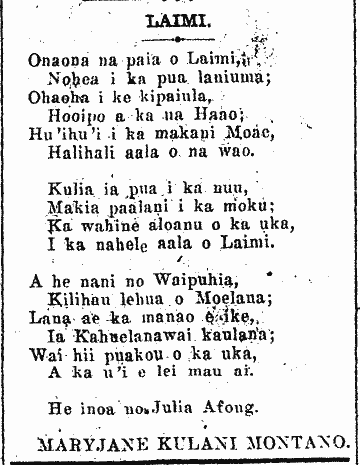
Onaona na paia o Laimi,
Nohea i ka pua laniuma;
Ohaoha i ke kipaiula,
Hooipo a ka ua Haao;
Hu’ihu’i aala o na wao.

Kulia ia pua i ka nuu,
Makia paalani i ka moku;
Ka wahine aloanu o ka uka,
I ka nahele aala o Laimi.

A he nani no Waipuhia,
Kilihau lehua o Moelana;
Lana ae ka manao e ike,
Ia Kahuelanawai [Kahuailanawai] kaulana;
Wai hii puakou o ka uka,
A ka u’i e lei mau ai.

He inoa no Julia Afong.

MARYJANE KULANI MONTANO.

[This name song (mele inoa) for Julia Afong (daughter of Chun Afong and Julia Fayerweather) is another composition by famous composer Mary Jane Kulani Montano, sister of Julia Fayerweather and therefore aunt of Julia Afong. Laimi it seems was the name of the family home on Nuuanu Avenue.]

(Kuokoa, 1/24/1919, p. 2)

LAIMI.

Ka Nupepa Kuokoa, Buke LVII, Helu 4, Aoao 2. Ianuari 24, 1919.

A mele for the counter revolution, 1895.

KAALAWAI.

Kumaka ka ike’na ia Kaalawai
I ka peki wawae i ke kula loa
Mea ole ka loa a oia kula
Me ke kai hone mai i ka iliili
Me he ‘la a e i mai ana
Imi ia e ka pono o ka aina
Ilaila ohohia kuu manao
I ka ike ana aku i na hoa
Hooho Wilikoki me ka leo nui
Imua kakou a lanakila
Lana mai ka manao Nou e ka Lani
E hoi hou ana i ke Kalaunu
Eia makou ke paa nei
Mamuli o ke aloha i ka aina
O ke kani makawalu a na pu
Pau ka manaolana no ka ohana
Haina ia mai ana ka puana
No ka poe i aloha i ka aina.

Hakuia e
S. Kanehe.
Kawa.

KAALAWAI.
In plain sight was Kaalawai
Treading across its wide plains
The extent of that field is of no consequence
With the sea that whispers atop the pebbles
As if saying
Let pono for this land be sought out
There my mind is elated
To see my comrades
Wilcox cheers with voice aroar
Forward to victory!
Our belief is for You, O Heavenly One
That you will return to the Throne
Here we are, unyielding
Faithfully patriotic
With gunfire ringing out from all directions
No more do we hope to see our families
Let the refrain be told
For the patriotic ones.
Composed by S. Kanehe.
Kawa. [The prison]

[There was a man named Herman K. Kanehe, who was one of many patriots sentenced to 5 years at hard labor and a fine of $5000. But i could not find out information on this S. Kanehe.

It is also interesting to note that this composition is reminiscent of another composition known widely today…]

(Oiaio, 3/22/1895, p. 3)

KAALAWAI.

Ka Oiaio, Buke VII, Helu 3, Aoao 3. Maraki 22, 1895.

Faith, Hope, Love, and Tradition, 1874.

The Key to open the door of heaven, and all of its rooms.

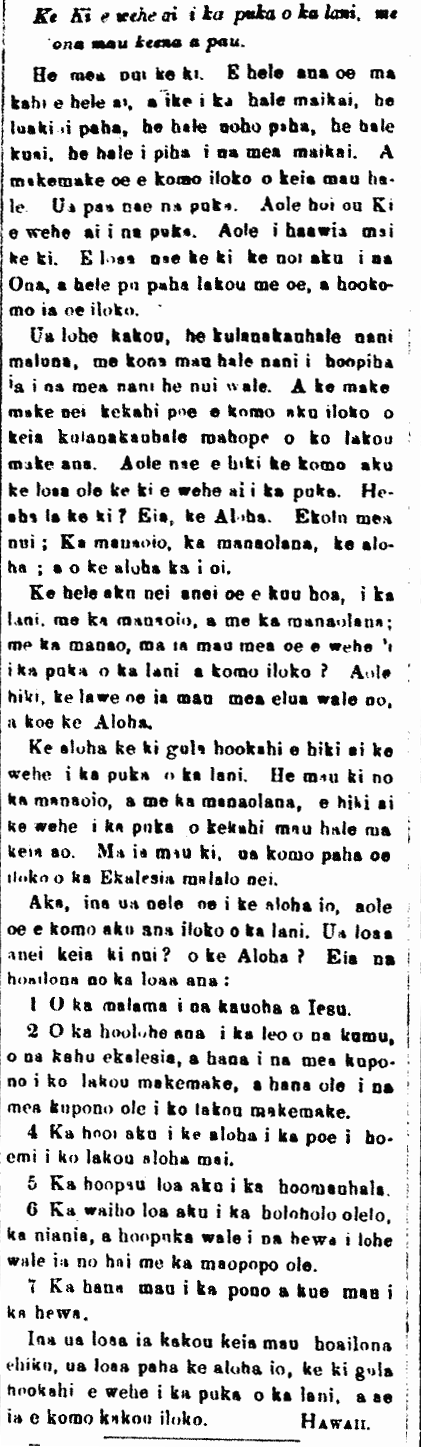
Keys are important. You go somewhere, and see a beautiful structure, perhaps it is a church, or a home, a store, or a building filled with wonderful things. And you want to enter into these buildings. The doors however are locked. You have no Key to open the doors. You are not given the key. You can obtain key if you ask of the Owner, and they perhaps will accompany you and let you in.

We have heard that there is a beautiful city up above, with its lovely houses filled with many great wonderful things. And should one want to enter into this city after they die. They cannot enter should they be without the key. What is this key? It is this, Aloha. There are three great things: faith [manaoio], hope [manaolana], and love [aloha]; but aloha is the greatest of all things.

Are you heading, O Friend, for heaven, with faith and hope, while believing that with these things you will open up the door of heaven and enter within? You can’t with just those two things, without Aloha.

Aloha is the single golden key that can open the door of heaven. Faith and hope are keys that can open some of the houses here in this world. With these keys, you perhaps have entered Churches down here.

However, should you be without true aloha, you shall not enter into heaven. Do you possess this great key? Aloha? Here are the signs that you have it:

1. You uphold the commandments of Jesus.

2. You listen to the words of the teachers, the church pastor, and you do what is righteous as per their desires and you don’t do what is wrong as per their desires.

4. Give more aloha to those who give you little aloha.

5. To cease totally begrudging others.

6. Set aside slander, gossip, and hearsay.

7. Do good always and never do bad.

Should we have these seven signs, we may perhaps be in possession of true aloha, the single golden key that can open the door of heaven, and we will be allowed within. HAWAII.

[It is also interesting to note that while the Bible was being translated into the Hawaiian Language, Hawaiians of course traditionally had the word, “Aloha.” As for “Manaolana” and “Manaoio,” (and “enemi” [enemy] as well), those had to be made up just for the Bible. See “No ka unuhi ana i ka Palapala Hemolele iloko o ka Olelo Hawaii.” Hae Hawaii, Iulai 8, 1857, 57–58.]

(Kuokoa, 5/16/1874, p. 4)

Ke Ki e wehe ai i ka puka o ka lani, me ona mau keena a pau.

Ka Nupepa Kuokoa, Buke XIII, Helu 20, Aoao 4. Mei 16, 1874.