Enoch Wood Perry, Jr. in Hawaii, 1864.

[Found under: “NA MEA HOU O HAWAII NEI.”]

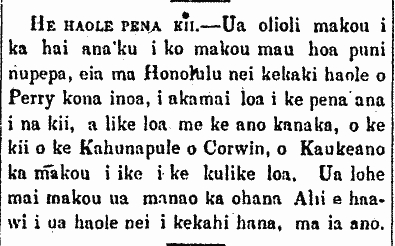
A HAOLE PAINTER OF PICTURES.—We are happy to announce to our fellow devotees of the newspaper, that here in Honolulu is a haole named Perry who is highly skilled in painting pictures, and very accurate are the features of the painting of the Reverend Corwin of Kaukeano Church,¹ of which we have seen the likeness. We have heard that the Royal family has decided to give the haole a job of this nature.

¹Kaukeano Church was located at the corner of Fort and Beritania Streets.

(Kuokoa, 12/10/1864, p. 2)
He haole pena kii...

Ka Nupepa Kuokoa, Buke III, Helu 50, Aoao 2. Dekemaba 10, 1864.
Marriage of Maud Knudsen and Herbert Garstin, 1892.

[Found under: “NU HOU HAWAII.”]

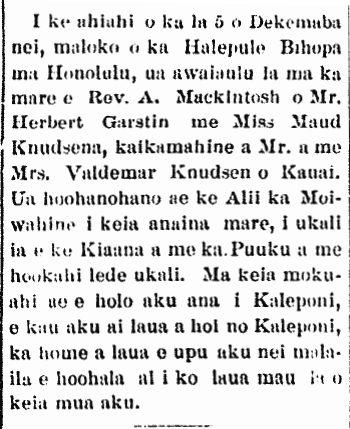
On the evening of the 5th of this December, in the Episcopalian Church [St. Andrew’s Cathedral] at Honolulu, joined in marriage by the Rev. A. Mackintosh were Mr. Herbert Garstin and Miss Maud Knudsen, the daughter of Mr. and Mrs. Valdemar Knudsen of Kauai. The Alii, the Queen graced this marriage gathering, accompanied by the Governor and the Chamberlain, and a lady-in-waiting. On the next steamship to California, the couple will return to California, the place they wish to make their home, where they will spend their future days.

(Kuokoa, 12/10/1892, p. 3)

I ke ahiahi o ka la 5...

Ka Nupepa Kuokoa, Buke XXXI, Helu 50, Aoao 3. Dekemaba 10, 1892.

Explosive eruption, 1924.

The Deeds of Madame Pele, the Woman of the Pit, are Mystical.

Many Lives Were Spared from the Volcanic Rocks.

Rocks and Ash were Spewed into the Air When the Volcanic Explosion Occurred Last Tuesday

Hilo, May 13.—Many lives were spared this evening, because of the foreseeing of trouble by Thomas E. Boles, the superintendent of the national parks [paka lahui] of Hawaii, and by him preventing people from going to see the volcanic crater of Halemaumau a few minutes before the strong volcanic explosion, sending large rocks to a distance of 2000 feet. Volcanic ash was spewed 1800 [feet] in the air above the crater. Continue reading

Mele found in moolelo, 1920.

[Found in the story: “Ka Moolelo o He’ma, ke Koaie Ku Pali o ka Makani Kaili Aloha o Kipahulu, Maui.”]

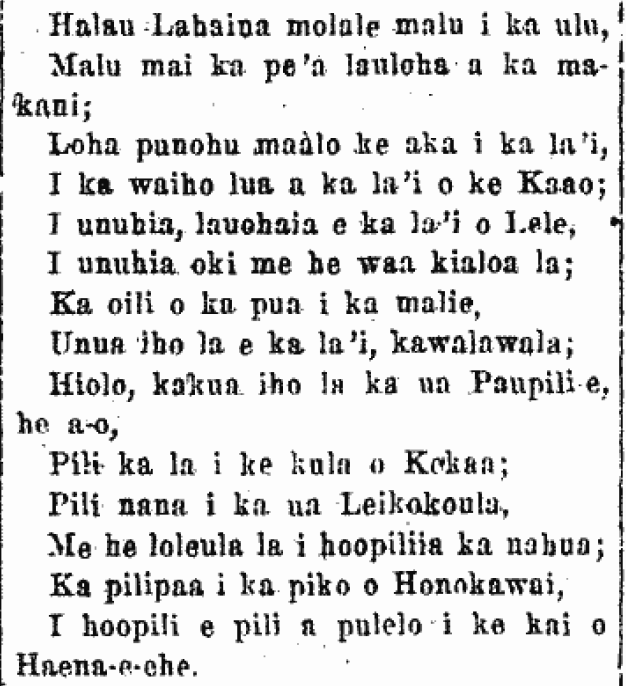
Halau Lahaina molale malu i ka ulu,
Malu mai ka pe’a lauloha a ka makani;
Loha punohu maalo ke aka i ka la’i,
I ka waiho lua a ka la’i o ke Kaao;
I unuhia, lauohaia e ka la’i o Lele,
I unuhia, oki me he waa kialoa la;
Ka oili o ka pua i ka malie,
Unua iho la e ka la’io, kawalawala;
Hiolo, kakua iho la ka ua Paupili e, he a-o,
Pili ka la i ke kula o Kekaa;
Pili nana i ka ua Leikokoula,
Me he loleula la i hoopiliia ka nahua;
Ka pilipaa i ka piko o Honokawai,
I hoopili e pili a pulelo i ke kai o Haena-e-ehe.

[Many times you will find the writer of a story will insert lines of a mele mid-story to evoke a shared memory or emotion with the audience. This writer says these lines of mele were well memorized by those like his grandparents folk.]

(Kuokoa, 10/1/1920, p. 7)

Halau Lahaina molale malu i ka ulu...

Ka Nupepa Kuokoa, Buke LVIII, Helu 40, Aoao 7. Okatoba 1, 1920.

Another good reference online, 1879.

[Found under: “NU HOU KULOKO”]

A highly valuable book.—Here amongst us is a malihini, George Bowser is his name, and he has began to prepare information about these islands to publish a Directory showing the condition, state, and everything pertaining to the income and the finance of Hawaii nei. It will show the occupation, residence and name of each businessman amongst the haole and the kanaka maoli. It will show the locations of the sugar mills, rice plantations, and others; their size and their overseers. It will show the major industries and their owners. It will also show the state of each district across the land, and what kinds of businesses are being run, and it would seem that the significance of this book is that it will have complete information about the areas inhabited by man, the work that is done, and the position and names of the people. This is a valuable book, and there should not be a lack of benefits coming from its references and illustrations. He will try to sell some of these books to Hawaiians who understand English. We hope that this progressive and beneficial endeavor will go well.

[This book is published as The Hawaiian Kingdom Statistical and Commercial Directory and Tourist’s Guide, 1880–1881.]

(Kuokoa, 11/29/1879, p. 3)

He buke waiwai nui.

Ka Nupepa Kuokoa, Buke XVIII, Helu 48, Aoao 3. Novemaba 29, 1879.

Waikiki Wedding and Bing Crosby, 1936.

A FITTING HAWAIIAN SOUGHT

FOR WORKING ON HAWAIIAN STORY FOR A MOVIE

HOLLYWOOD, Sept. 1.—Mr. Bing Crosby will be landing in Honolulu next Thursday aboard the steamship Lurline, one of those who are writing the script of a movie called “Waikiki Wedding.” The news was heard from his studio that on this trip he is searching for a very famous woman in ancient Hawaiian hula, that understands the hand motion and the foot movements, as in ancient Hawaiian history; the hula of Hawaii that made it famous and was seen as one of the things that were taught to all women of Hawaii during those days. Also they are on the search for famous young musicians of Hawaii nei that know the proper mele for the hula foot movements of women, who know the string instruments and drums of the Hawaiians, and are not just handsome to look at, but true to the history that is written about: the ti-leaf whistle, the kilu drum, the puhenehene flute, the jew’s harp and bamboo ukeke. Continue reading

Queen Emma, Honolulu Library and Reading Room, and the Hawaiian Historical Society, 1886 / 2014.

[Found under: “LOCAL NEWS”]

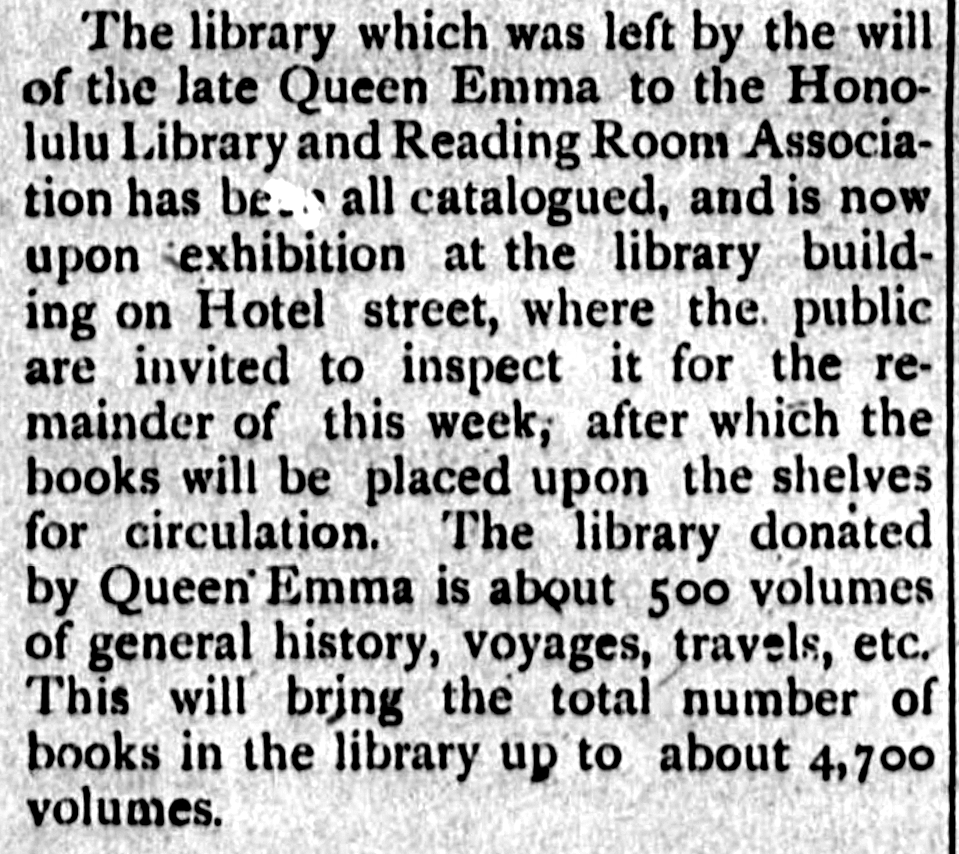
The library which was left by the will of the late Queen Emma to the Honolulu Library and Reading Room Association has been all catalogued, and is now upon exhibition at the library building on Hotel street, where the public are invited to inspect it for the remainder of this week, after which the books will be placed upon the shelves for circulation. The library donated by Queen Emma is about 500 volumes of general history, voyages, travels, etc. This will bring the total number of books in the library up to about 4,700 volumes.

[Queen Emma’s books eventually found their way to the Hawaiian Historical Society, where they are cared for today!]

(Daily Honolulu Press, 1/12/1886, p. 3)

The library which was left by the will of the late Queen Emma...

The Daily Honolulu Press, Volume I, Number 113, Page 3. January 12, 1886.

The beginnings of the Honolulu Library and Reading Room, 1879.

Library and Reading Room.

We are pleased to see that this institution which is designed to meet a real need in this community, is exhibiting a very commendable degree of enterprise in the line of its appointed work. At the last business meeting, a new Constitution and By Laws were adopted, of the most liberal and practical character. The membership is now open to all respectable persons of sixteen years old and upwards without qualification of race, creed, or any distinction whatever either natural or artificial. The rooms are open every week day from 10 a. m. to 10 p. m., and on Sundays, from 9 a. m. to 9 p. m. Books from the library may be drawn out and returned every day and evening except Sundays. By the last arrival from San Francisco an invoice of books was received embracing a number of the latest works of the most popular authors. These are now on the shelves and at the disposal of members. The library which already contains nearly nine hundred volumes and is constantly increasing, comprises a very good and diversified collection of reading, calculated to suit a variety of tastes. The supply of papers and periodicals regularly supplied to the reading room is for a town of this size exceedingly liberal. Some of these are subscribed for by the association and others are furnished through the liberality of friends. The following can be found on the tables at all times. Continue reading

Queen Emma on Kauai, 1871.

The Queen’s Travels to the Island to the West.

O Ke Au Okoa;—Aloha oe:

At 3 o’clock yesterday afternoon, Lawai was left by the entourage of

“Maikai ka Waikini he nani ke nana,
Ka hemolele oia uka me ke onaona,
Ua hele a nolu pe i ka lehua maka noe,
Ua ike maka iho nei i ka nani o Aipo.”

[Fine is Kawaikini, beautiful to see,
The uplands are perfect in its fragrance,
The misty-eyed lehua are drenched
Beheld was the beauty of Aipo.]

The travels of Kaleleonalani continued on into dusk; the good home of the Hon. J. Kauai in Waimea nei was visited, and he gave them the entire house for the alii to do as she pleased. That is the fashion in which the well-to-do son of Waimea gave. Continue reading

The mirage of Limaloa, 1885.

WITNESSED THE VILLAGE OF LIMALOA

O Ko Hawaii Pae Aina newspaper,

Aloha oe:—Please allow your patience to let me shake hands with your captain and the metal typesetting boys.

At dawn, 2 o’clock, on the Wednesday of the 1st of July, the night of Laau Pau in the reckoning of the Hawaiians. We left Waimea and the motion of our cars were driven straight for Lolomauna, where we would stay and watch for the building of the village [kauhale] of Limaloa, and we settled back for the rest of the night and the morning; it was a 6 o’clock. Our eyes looked quietly down at the beautiful flat plains of Limaloa spread silently before us,  hoping to see the famed magical kauhale (Limaloa), but we did not. 7 o’clock passed by and there was no sign of what we were hoping to see, and 7 minutes thereafter, the plains of Limaloa began to change; they were shrouded in different colors: red, yellow, and green, and glittered like gold, and it moved from the sea upland, and amongst the coconut trees that were standing. And from there it went on until the edge of the salt beds, headed towards Mana like an ocean wave crashing upon the surface of the sea.

Continue reading