Aloha Aina, 2015.

Expressing aloha ʻāina on the anniversary of the overthrow

“And so it happened that on the 16th day of January, 1893, between four and five o’clock in the afternoon, a detachment of marines from the United States Steamer Boston, with two pieces of artillery, landed at Honolulu. The men, upwards of 160 in all, were supplied with double cartridge belts filled with ammunition and with haversacks and canteens, and were accompanied by a hospital corps with stretchers and medical supplies. This military demonstration upon the soil of Honolulu was of itself an act of war. . .”

By nightfall of the next day, the Kingdom of Hawaiʻi had been illegally overthrown.

Hawaiʻi’s people today live in the resulting repercussions of that infamous day. For some, reflection on those historical events still conjures up the ʻeha (pain, hurt) of being wronged.

There may never be an adequate outlet to express the ʻeha, nevertheless, this story commemorates the 122nd anniversary of the illegal overthrow and honors some of the great expressions of aloha ʻāina (patriotism) coming from Hawaiʻi’s aliʻi (monarchs) and lāhui (people).→Continue reading.

Queen Liliʻuokalani, Hawaiʻi’s last reigning monarch, was imprisoned after her kingdom was illegally overthrown on January 17, 1893.

Reformist Party, 1893.

O True Hawaiians, don’t fall for the sweet talking of the Reformist Party [pohai hoomaemae], for here they are wanting to push the land into annexation.

(Leo o ka Lahui, 1/17/1893, p. 3)

E na kanaka Hawaii oiaio...

Ka Leo o ka Lahui, Buke II, Helu 624, Aoao 3. Ianuari 17, 1893.

Who was threatening whom? 1893.

Martial law in a situation of this kind is a ridiculous and absurd proceeding and does not reflect creditably on the part of those who designed it or who still keep it enforced. The late Ministry and their adherents surrendered everything peacefully and quietly. No one wants to attempt to change the state of affairs existing as everyone is content to await the decision of the United States and abide by it. The Hawaiians are eminently a peaceable people and no one is either exiting them or endearvoring to excite them. All are confident in the justice of their cause and willing to await the result with patience. The foreigners who adhere to that side advise them so, and follow their own advice; to do nothing calculated to annoy, scare, or injure anyone or anything, and this advice is being sedulously followed.

(Daily Bulletin, 1/18/1893, p. 3)

Martial law in a situation...

The Daily Bulletin, Volume V, Number 627, Page 3. January 18, 1893.

Who was threatening whom? 1893.

THE TROOPS OF THE AMERICAN WARSHIP.

Here on land are the troops from the warship, as they go around town with their guns and their ammunition belts. They came ashore this past Monday. Let them be to enjoy themselves upon the blessed soil of Hawaii and look to the day when they will see that Hawaii is on the side of peace.

QUEEN LILIUOKALANI.

(Hawaii Holomua, 1/18/1893, p. 2)

[This set of newspapers is not available online yet, so I will try to make a copy of the original article from a microfilm as soon as I can.]

Hawaii at the Great London Exposition, 1862.

The Sandwich Islands.—During the last few days a stall has been fitted up near the department of the Ionian Islands which represents the latest and most distant echo in response to the invitation given to all nations and peoples to exhibit their natural and artificial products under the domes of South Kensington. The Hawaiian, or, as they are better known, the Sandwich Islands, were unrepresented in 1851, owing to the collection made there not reaching England till the Exhibition had finally closed, the voyage by a sailing vessel occupying five or six months. This year a similar fate threatened this remote group in the Pacific, and it seemed likely that the name of Hawaii would only be known in connexion with the International Exhibition of 1862 by a pair of silk banners in the nave, and a foreign commissioner with nothing to do. Continue reading

Episcopal Church in Hawaii, 1861.

[Found under: “NOTES OF THE WEEK.”]

We are frequently inquired of whether anything definite has been done towards establishing an Episcopal Church at Honolulu. By the following, which we extract from the London Examiner of March 9, our readers will be gratified to learn that the matter is in progress and has been referred to a committee consisting of responsible and intelligent men, who will probably see that it is carried to a successful issue. It will be a source of great pleasure not only to us but to all interested in the progress of religion in the Pacific, to announce that the establishment of an Episcopal Church here, has been fully decided upon: Continue reading

More on Lady Franklin and ahuula and upcoming events, 1861 / 2015–2016.

While in Hawaii in 1861, Lady Franklin enjoyed the company often of King Kamehameha IV and Queen Emma. According to newspaper reports, the relationship between them was very cordial. She was given this treasured ahuula in commemoration of this bond.

If you find yourself in San Francisco at the end of this summer until the early part of next year (8/29/2015–2/28/2016), do make your way to the de Young Museum:

Lady Franklin cape

Lady Franklin cape (detail) (#5948). ‘apapane feathers, ‘ō‘ō feathers. Bernice Pauahi Bishop Museum, Ethnology Collection, 09670/1909.007

Royal Hawaiian Featherwork: Nā Hulu Ali‘i

August 29, 2015February 28, 2016

Explore the distinctive art, culture, and history of Hawai‘i with the first exhibition of Hawaiian featherwork on the U.S. mainland, developed in partnership with the Bernice Pauahi Bishop Museum, Honolulu. Presented in San Francisco, which is considered to be the gateway to the Pacific, the exhibition will feature approximately 75 rare and stunning examples of the finest featherwork capes and cloaks in existence, as well as royal staffs of feathers (kāhili), feather lei (lei hulu manu), helmets (mahiole), feathered god images (akua hulu manu), and related eighteenth- and nineteenth-century paintings and works on paper. Continue reading →

Lady Jane Franklin in Hawaii nei, 1861.

[Found under: “NOTES OF THE WEEK.”]

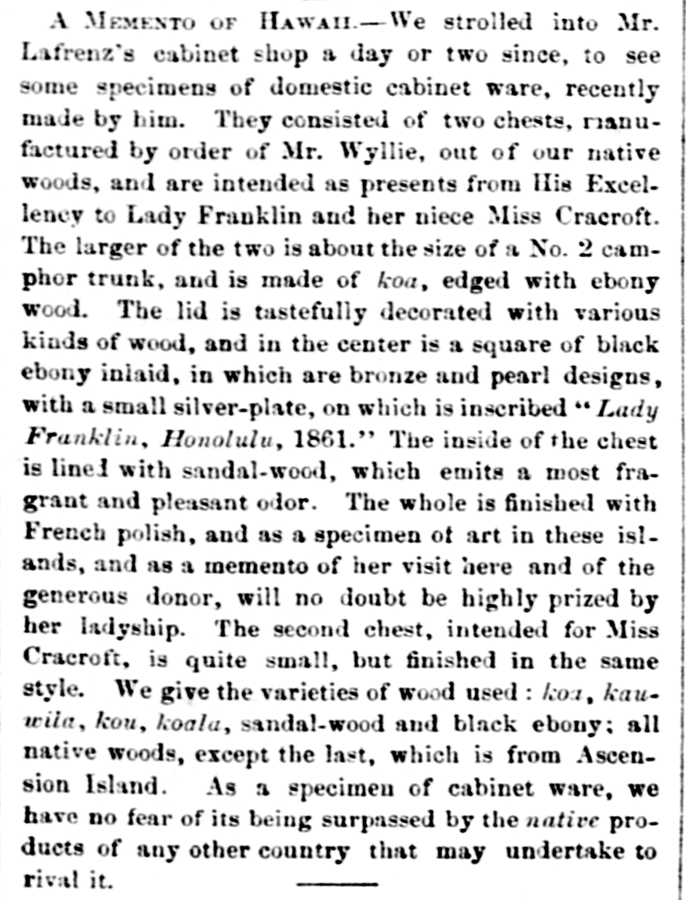
A Memento of Hawaii.—We strolled into Mr. Lafrenz’s cabinet shop a day or two since, to see some specimens of domestic cabinet ware, recently made by him. They consisted of two chests, manufactured by order of Mr. Wyllie, out of our native woods, and are intended as presents from His Excellency to lady Franklin and her niece Miss Cracroft. The larger of the two is made of koa, edged with ebony wood. The lid is tastefully decorated with various kinds of wood, and in the center is a square of black ebony inlaid, in which are bronze and pearl designs, with a small silver-plate, on which is inscribed “Lady Franklin, Honolulu, 1861.” The inside of the chest is lined with sandal-wood, which emits a most fragrant and pleasant odor. The whole is finished with French polish, and as a specimen of art in these islands, and as a memento of her visit here and of the generous donor, will no doubt be highly prized by her ladyship. The second chest, intended for Miss Cracroft, is quite small, but finished in the same style. We give the varieties of wood used: koa, kauwila, kou, koala, sandal-wood and black ebony; all native woods, except the last, which is from Ascension Island. As a specimen of cabinet ware, we have no fear of its being surpassed by the native products of any other country that may undertake to rival it.

(Pacific Commercial Advertiser, 5/16/1861, p. 2)

A Memento of Hawaii.

The Pacific Commercial Advertiser, Volume V, Number 46, Page 2. Mei 16, 1861.

Another Hawaiian son away at war, 1917.

A LETTER TO HIS PARENTS.

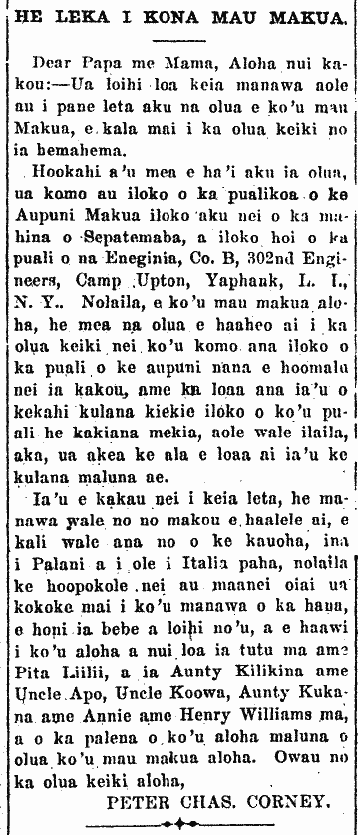
Dear Papa and Mama, much love:–It has been a very long time that I have not written back to you, my Parents. Please forgive your child for his neglect.

There is one thing I will tell you; I have joined the military of the Father Country this past September, and I am in the forces of the Engineers, Co. B, 302nd Engineers, Camp Upton, Yaphank, L. I., N. Y. Therefore, my beloved parents, this is something you should be proud of your child for, for my joining the military of the country which protects us, and for me obtaining a high rank in my division, a sergeant major; and not just that, but the path is wide open for me to advance higher.

As I compose this letter, it is time for us to move out, and I am just waiting for the orders, whether it be to France, or to Italy perhaps, so I will make it short as it is soon time for me to get into action. Give baby a long kiss for me, and give my great aloha to tutu them and Pita Liilii [Little Peter], and to Aunty Kilikina and Uncle Apo, Uncle Koowa, Aunty Kukana and Annie and Henry Williams them; and all of my aloha to you two, my loving parents. Your loving child,

PETER CHARLES CORNEY.

(Kuokoa, 12/28/1917, p. 5)

HE LEKA I KONA MAU MAKUA.

Ka Nupepa Kuokoa, Buke LV, Helu 52, Aoao 5. Dekemaba 28, 1917.

Walking around Honolulu, 1853.

HONOLULU IN 1853.

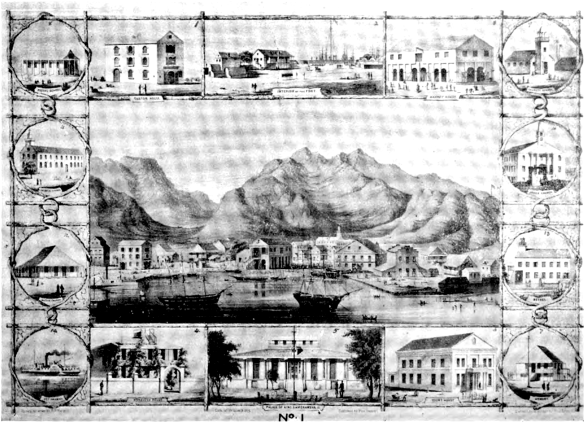
Oftentimes it is difficult to picture what places looked like and where they were situated. This paper appearing in Thrum’s Hawaiian Almanac and Annual for 1898 by Warren Goodale and supplemented by Thomas G. Thrum is an interesting read because it show buildings of old Honolulu from lithographs (in the collection of the Hawaiian Historical Society) done by Paul Emmert, and describes locations of the buildings.

[One of yesterday’s posts mentioned Kalakaua boarding a skiff makai of Halemahoe, which appears in this paper as Hale Mahoe. Luckily this volume and most years of Thrum’s Almanac and Annual are available online. For this particular article, click on the image below.]

Paul Emmert Lithograph No. 1

“HONOLULU IN 1853.” Hawaiian Almanac and Annual for 1898, pp 80-104.