Kou trees, 1875.

Kou Trees.—The beautiful kou, which furnished a remarkably rich-grained furniture wood, and which old residents remember as growing abundantly as shade tree on the seacoasts all over the islands, has quite disappeared within the past ten or fifteen years, having been destroyed by a new insect enemy. A few days since, a gentleman whose occupation called him to the extreme low point of land seaward from Moanalua, discovered a thrifty young kou tree, growing in front of a native dwelling, on which were a number of bright yellow blossoms. It is to be hoped that the kou will be again cultivated. What would be finer than rows of these beautiful trees on the Esplanade? They flourish best near the sea, and do not succeed far inland. The same gentleman informs us that during his ramble he found a specimen of the ohai, native locust, a flowering shrub which is now considered rare on this island. This species bears a bright red flower, while that of the island of Hawaii is a dark red.

(Pacific Commercial Advertiser, 7/10/1875, p. 3)
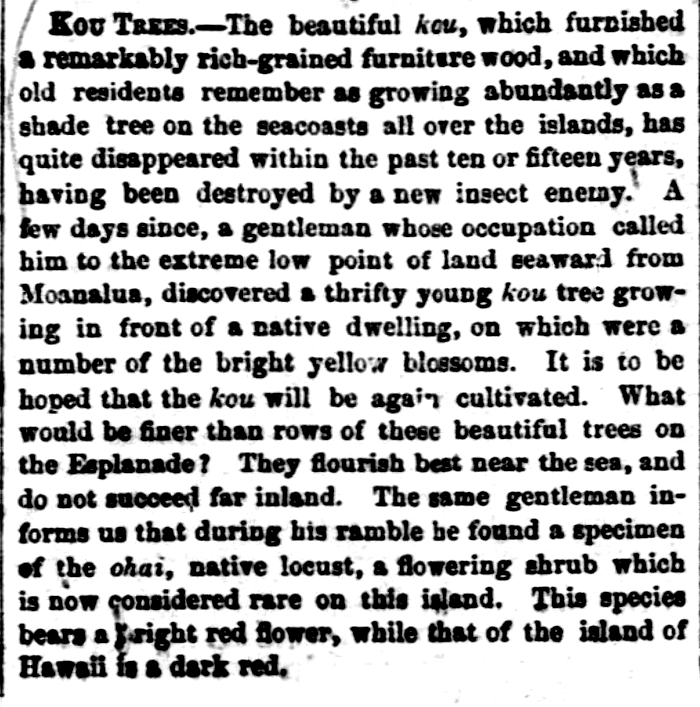
Kou Trees.

The Pacific Commercial Advertiser, Volume XX, Number 2, Page 3. July 10, 1875.
Lunalilo Crypt, 1875.

[Found under: “Nu Hou Kuloko.”]

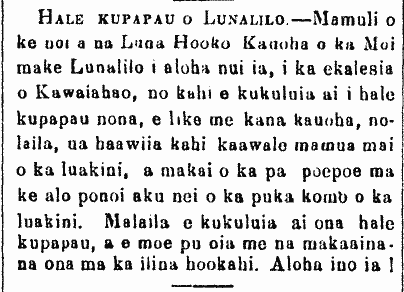
Crypt of Lunalilo.—Because of the request by the Executor of the Will of the Deceased dearly beloved King Lunalilo to Kawaiahao Church, for a place to build his crypt, as per his will, therefore, an open space in front of the church was given, makai of the circular yard right in front of the entrance to the church. There will be built his crypt and he will sleep there with his people in the same cemetery. How sad this is!

(Kuokoa, 9/19/1875, p. 2)

Hale Kupapau o Lunalilo.

Ka Nupepa Kuokoa, Buke XIII, Helu 38, Aoao 2. Sepatemaba 19, 1874.


Licensed kahuna and non-licensed kahuna, 1875.

[Found under: “Nu Hou Kuloko.”]

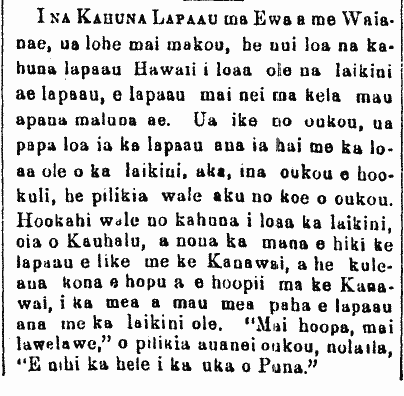
To the Medical Kahuna in Ewa and Waianae, we have heard that there are many Hawaiian medical kahuna without licenses to practice medicine who are treating patients in those districts. You know that the treating of others without a license is prohibited, and if you do not listen, you will be in trouble. There is but one kahuna who is licensed, and that is Kauhalu; and he has the power to arrest and sue under Law the one or ones who doctor people without license. “Don’t touch, don’t undertake this,” or you will face troubles, therefore, “Beware when treading in the uplands of Puna.”¹

¹”E nihi ka hele i ka uka o Puna,” is a famous warning given by Hiiaka to her aikane Wahineomao. It became used as a general warning to be careful of what you are doing.

(Kuokoa, 9/19/1874, p. 2)

I na kahuna lapaau...

Ka Nupepa Kuokoa, Buke XIII, Helu 38, Aoao 2. Sepatemaba 19, 1874.

Newly pardoned, 1891.

[Found under: “By Authority.”]

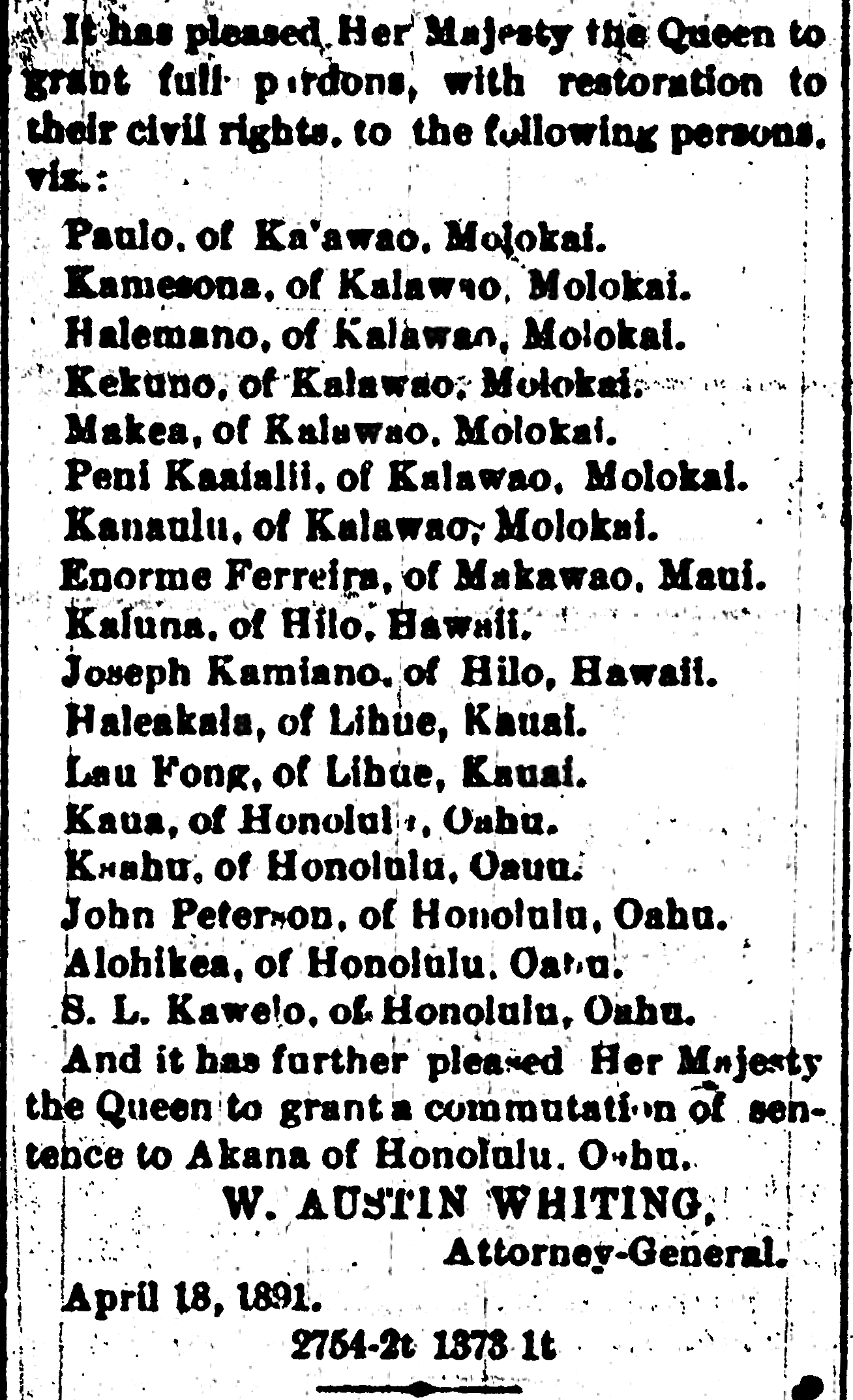
It has pleased Her Majesty the Queen to grand full pardons, with restoration to their civil rights, to the following persons, viz:

Paulo, of Kalawao, Molokai.
Kamesona, of Kalawao, Molokai.
Halemano, of Kalawao, Molokai.
Kekuno, of Kalawao, Molokai.
Makea, of Kalawao, Molokai.
Peni Kaaialii, of Kalawao, Molokai.
Kanaulu, of Kalawao, Molokai.
Enorme Ferreira, of Makawao, Maui.
Kaluna, of Hilo, Hawaii.
Joseph Kamiano, of Hilo, Hawaii.
Haleakala, of Lihue, Kauai.
Lau Fong, of Lihue, Kauai.
Kaua, of Honolulu, Oahu.
Kaahu, of Honolulu, Oahu.
John Peterson, of Honolulu, Oahu.
Alohikea, of Honolulu, Oahu.
S. L. Kawelo, of Honolulu, Oahu.

And it has further pleased Her Majesty the Queen to grant a commutation of sentence to Akana of Honolulu, Oahu.

W. AUSTIN WHITING,
Attorney-General.

April 18, 1891.

(Hawaiian Gazette, 5/5/1891, p. 4)

It has pleased Her Majesty the Queen...

Hawaiian Gazette, Volume XXVI, Number 18, Page 4. May 5, 1891.

A feast given at the Sacred Hearts Church, 1913.

[Found under: “Nuhou Kuloko”]

There will be a grand feast held, full of rich delicacies like pig laulau, fatty kalua pig, opihi, opae, aku, kawakawa, kulolo, haupia, koelepalau, fatty amaama, poi, sweet potato, Portuguese bread, and other delights. It is being given by the Sacred Hearts Church, at the corner of Miller and Beretania streets. The attendees will be entertained while they are eating by the two bands, the St. Louis Band and the Catholic Mission Band.

(Kuokoa, 2/21/1913, p. 8)

He papa ahaaina hanohano...

Ka Nupepa Kuokoa, Buke L, Helu 8, Aoao 8. Feberuari 21, 1913.

John Harbottle visits Hilo, 1943.

Just in Hilo.

This past week the kamaaina of the land renowned for the Apaapaa Wind, of Kohala with its hills that move along together, Kalahikiola and Pili, that is John Harbottle, and after some days he returned to his famous lands.

Looking at him, he is still in good health, he has not changed, as if it is still in the days of his youth, when I first met him 27 years ago, when I arrived in his famous aina.

He spent some days with his daughter and son-in-law, Mr. and Mrs. Eddie Nelson, of Keaukaha.

(Hoku o Hawaii, 9/8/1943, p. 1)

Ka Hoku o Hawaii, Volume XXXVIII, Number 20, Aoao 1. Sepatemaba 8, 1943.

Ka Hoku o Hawaii, Volume XXXVIII, Number 20, Aoao 1. Sepatemaba 8, 1943.

More on language, 2015.

LANGUAGE MATTERS

Language Matters asks what we lose when languages die and how we can save them. It was filmed around the world: on a remote island off the coast of Australia, where 400 Aboriginal people speak 10 different languages, all at risk; in Wales, where Welsh, once in danger, is today making a comeback; and in Hawaii, where a group of Hawaiian activists is fighting to save the native tongue.

Language Matters is a co-production of David Grubin Productions and Pacific Islanders in Communications. Major funding provided by the National Endowment for the Humanities with additional funding provided by the Corporation for Public Broadcasting, the Arthur Vining Davis Foundations, the National Endowment for the Arts.

[This showed on PBS on 1/19/2015. It might be a long show, but don’t skip to the back, it is well worth watching from the beginning! Click the picture below.]

Language Matters

Language Matters

Cornerstone of the new Kaumakapili Church, 1881.

LAYING OF THE CORNERSTONE OF KAUMAKAPILI.

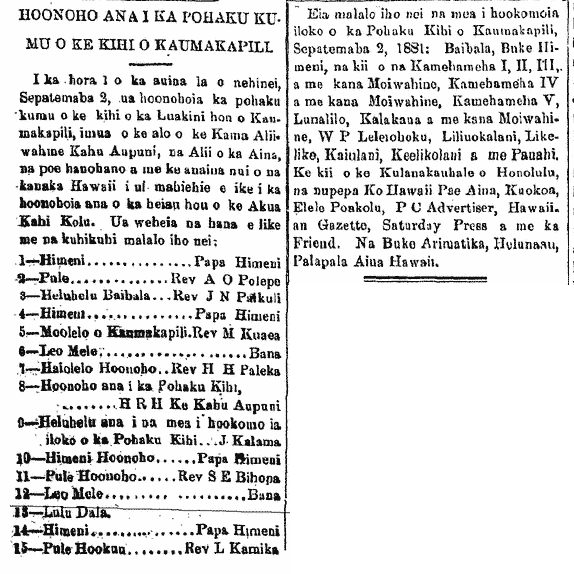
At 1 o’clock yesterday afternoon, September 2, the cornerstone [pohaku kumu o ke kihi] of Kaumakapili Church was laid, before the Princess Regent [Liliuokalani], the Alii of the Land, dignitaries, along with a huge contingent of Hawaiian people who were finely dressed to see the laying out of the new heiau of the Trinity. The ceremony opened like the program below:

1—Hymn . . . . . Choir
2—Prayer . . . . . Rev. Anderson Oliver Forbes [A. O. Polepe]
3—Bible Reading . . . . . Rev. J. N. Paikuli
4—Hymn . . . . . Choir
5—History of Kaumakapili . . . . . Rev. M. Kuaea
6—Song . . . . . Band
7—Speech for the Laying of the Cornerstone . . . . . Rev. H. H. Parker [H. H. Paleka]
8—Laying of the Cornerstone . . . . . Her Royal Highness, The Princess Regent
9—Reading of the contents of the Cornerstone . . . . . J. Kalama
10—Hymn for the Laying of the Cornerstone . . . . . Choir
11—Prayer for the Laying of the Cornerstone . . . . . Rev. S. E. Bishop [S. E. Bihopa]
12—Song . . . . . Band
13—Monetary Donations
14—Hymn . . . . . Choir
15—Closing Prayer . . . . . Rev. L. Smith [L. Kamika]

Here below are the things put inside of the Cornerstone of Kaumakapili on September 2, 1881: Baibala, Buke Himeni, pictures of Kamehameha I, II, III and his Queen, Kamehameha IV and his Queen, Kamehameha V, Lunalilo, Kalakaua and his Queen, W. P. Leleiohoku, Liliuokalani, Likelike, Kaiulani, Keelikolani and Pauahi. A picture of the Town of Honolulu, the newspapers, Ko Hawaii Pae Aina, Kuokoa, Elele Poakolu, P. C. Advertiser, Hawaiian Gazette, Saturday Press, and the Friend. The books, Arimatika, Helunaau, Palapala Aina Hawaii.

(Ko Hawaii Pae Aina, 9/3/1881, p. 2)

HOONOHO ANA I KA POHAKU KUMU O KE KIHI O KAUMAKAPILI.

Ko Hawaii Pae Aina, Buke IV, Helu 36, Aoao 2. Sepatemaba 3, 1881.

Flooding on Molokai, 1883.

ASTONISHING WATERS AT HALAWA, MOLOKAI.

O Kuokoa Newspaper: Aloha oe.

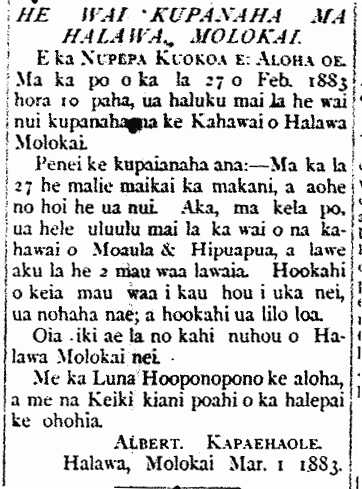
On the night of February 27, 1883, at perhaps 10 o’clock, a shockingly huge amount of water rushed down the river of Halawa, Molokai.

Here is what was shocking:—On the 27th, the wind was perfectly calm, and there was no big rain. However, that night, the waters of the rivers of Moaula and Hipuapua came violently down and swept away 2 fishing canoes. One of these canoes was brought back on land but was broken up; the other is gone.

That is just some small news from here in Halawa, Molokai.

Aloha to the Editor and to the typesetting Boys of the press my delight.

Albert Kapaehaole

(Kuokoa, 3/10/1883, p. 3)

HE WAI KUPANAHA MA HALAWA, MOLOKAI.

Ka Nupepa Kuokoa, Buke XXII, Helu 10, Aoao 3. Maraki 10, 1883.