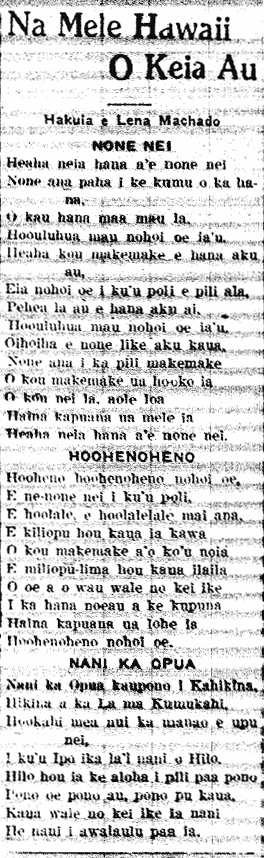
Three Lena Machado mele! 1939.

Hawaiian Songs of This Age

Composed by Lena Machado

NONE NEI

Heaha neia hana a’e none nei
None ana paha i ke kumu o ka hana,
O kau hana maa mau ia,
Hoouluhua mau nohoi oe ia’u.
Heaha kou makemake e hana aku au,
Eia nohoi oe i ku’u poli e pili ala,
Pehea la au e hana aku ai,
Hoouluhua mau nohoi oe ia’u.
Oihoiha e none like aku kaua,
None ana i ka pili makemake
O kou makemake ua hooko ia
O ko’u nei la, aole loa
Haina kapuana ua mele ia
Heaha neia hana a’e none nei.

HOOHENOHENO

Hooheno hoohenoheno nohoi oe,
E ne-none nei i ku’u poli,
E hoolale, e hoolalelale mai ana,
E kiliopu hou kaua ia kawa
O kou makemake a’o ko’u noia
E miliopu-lima hou kaua ilaila
O oe a o wau wale no kei ike
I ka hana noeau a ke kupuna
Haina kapuana ua lohe ia
Hoohenoheno nohoi oe.

NANI KA OPUA

Nani ka Opua kaupono i Kahikina,
Hikina a ka La ma Kumukahi,
Hookahi mea nui ka manao e upu nei,
I ku’u Ipo ika la’i nani o Hilo.
Hilo hou ia ke aloha i pili paa pono
Pono oe pono au, pono pu kaua,
Kaua wale no kei ike ia nani
He nani i awaiaulu paa ia.

(Hoku o Hawaii, 6/28/1939, p. 1)

HokuoHawaii_6_28_1939_1

Ka Hoku o Hawaii, Volume XXXIV, Number 9, Aoao 1. Iune 28, 1939.

Death of the translator of Twenty-Thousand Leagues Beneath the Sea, Oniula, George W. Kanuha, 1876.

A Solemness, an  Expression of Affection for G. W. Kanuha.

[Aia aku la paha oe i ka aina hanau,
Ia Kona kai opua i ka lai,
Opua hinano ua malie
Hiolo na wainaoa a ke kehau,
Aole—eia ka paha i na hono a Piilani,
I ka lai o Hauola,
I ka malu o ka Ulu o Lele
E holoholo kuaua paupili ana.
Auwe! Aloha ino.]

Perhaps you are at the land of your birth,
Kona of the billowing clouds on the sea in the calm,
The clouds white like hinano blossoms,
Where the chilling waters of the Kehau mists fall,
No—maybe you are here amongst the bays of Piilani,
In the calm of Hauola,
In the shade of the Breadfruit of Lele,
Travelling about like the Paupili showers.
Auwe! How sad.

George W. Kanuha was born in 1845 in the town of Kailua, North Kona, Hawaii, of the streaked sea, the peaceful sea at Kalaiaehu, ever moistened by the amazing rains of the land of his birth in the face of the clouds. And he passed on to the other side of the black river, that line before the animals life and plant life which forever moves toward the final Great Revelation in the City of heaven. On the 16th day of this month, G. W. Kanuha travelled one last time in the shade of the ulu trees of Lele [Lahaina] in the sparkling sun and the red dirt of his welcoming home, sinking into the eternal home, the belly of the earth following after papa and mama. Aloha ino.

Ahukinialaa Wahineiki was his father, a student of Lahainaluna College, from the very beginning of the school in 1831, he boarded at that school until he graduated with the fluttering flag upon his Diploma. Mrs. Kealoha Wahineiki was his mother. G. W. Kanuha was an only child. Continue reading

English announcement of officers and writers of the Kuokoa, 1867.

English Column.

To Our Patrons.

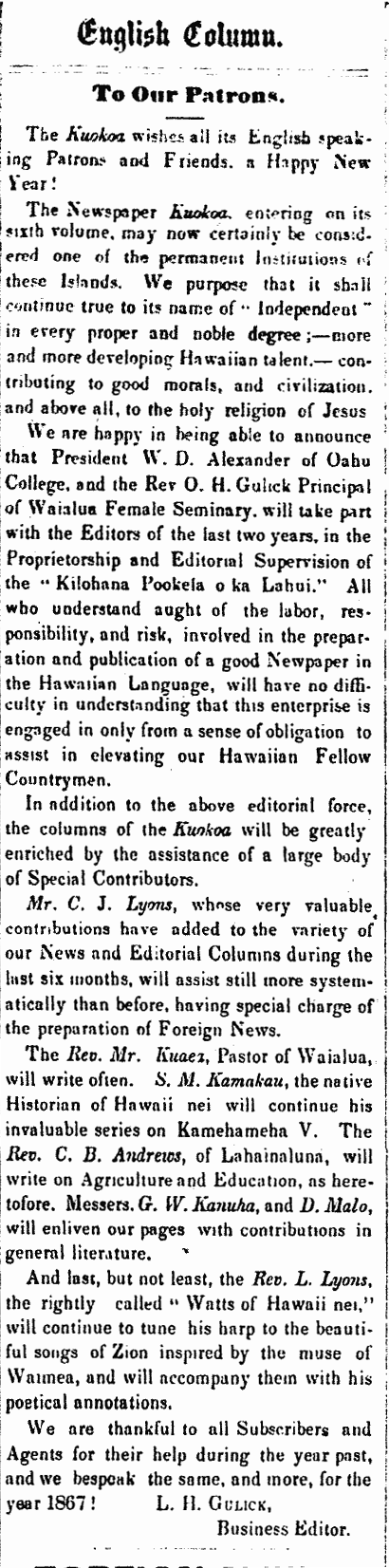
The Kuokoa wishes all its English speaking Patrons and Friends, a Happy New Year!

The Newspaper Kuokoa, entering on its sixth volume, may now certainly be considered one of the permanent Institutions of these Islands. We purpose that it shall continue true to its name of “Independent” in every proper and noble degree;—more and more developing Hawaiian talent—contributing to good morals, and civilization, and above all, to the holy religion of Jesus.

We are happy in being able to announce that President W. D. Alexander of Oahu College, and the Rev. O. H. Gulick Principal of Waialua Female Seminary, will take part with the Editors of the last two years, in the Proprietorship and Editorial Supervision of the “Kilohana Pookela o ka Lahui.” All who understand aught of the labor, responsibility, and risk, involved in the preparation and publication of a good Newpaper in the Hawaiian Language, will have no difficulty in understanding that this enterprise is engaged in only from a sense of obligation to assist in elevating our Hawaiian Fellow Countrymen.

In addition to the above editorial force, the columns of the Kuokoa will be greatly enriched by the assistance of a large body of Special Contributors.

Mr. C. J. Lyons, whose very valuable contributions have added to the variety of our News and editorial Columns during the last six months, will assist still more systematically than before, having special charge of the preparation of Foreign News.

The Rev. Mr. Kuaea, Pastor of Waialua will write often. S. M. Kamakau, the native Historian of Hawaii nei will continue his invaluable series on Kamehameha V. The Rev. C. B. Andrews, of Lahainaluna, will write on Agriculture and Education, as heretofore. Messers. G. W. Kanuha, and D. Malo, will enliven our pages with contributions in general literature.

And last, but not least, the Rev. L. Lyons, the rightly called “Watts of Hawaii nei,” will continue to tune his harp to the beautiful songs of Zion inspired by the muse of Waimea, and will accompany them with his poetical annotations.

We are thankful to all Subscribers and Agents for their help during the year past, and we bespeak the same, and more, for the year 1867!  L. H. Gulick,

Business Editor.

(Kuokoa, 1/5/1867, p. 3)
Kuokoa_1_5_1867_3.png

Ka Nupepa Kuokoa, Buke VI, Helu 1, Aoao 3. Ianuari 5, 1867.

Officers and Writers of the Kuokoa, 1867.

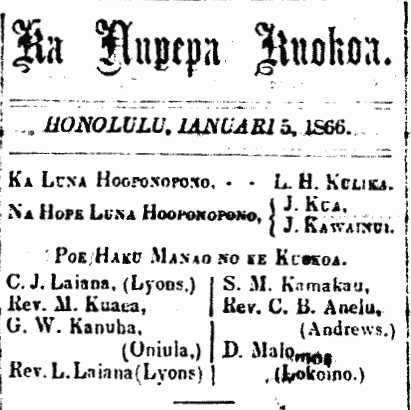
Ka Nupepa Kuokoa

HONOLULU, JANUARY 5, 1866 [1867].

Editor [Ka Luna Hooponopono] – – L. H. Gulick [L. H. Kulika].

Junior Editors [Na Hope Luna Hooponopono] – – J. Kua, J. Kawainui.

Writers for the Kuokoa.

C. J. Laiana [Lyons],
Rev. M. Kuaea,
G. W. Kanuha [Oniula],
Rev. L. Laiana [Lyons],
S. M. Kamakau,
Rev. C. B. Anelu [Andrews],
D. Malo [Lokoino].

[Here we see that G. W. Kanuha calls himself Oniula, but does anyone know more about this D. Malo who calls himself Lokoino?]

(Kuokoa, 1/5/1866, p. 2)

Kuokoa_1_5_1867_2.png

Ka Nupepa Kuokoa, Buke VI, Helu 1, Aoao 2. Ianuari 5, 1867.

Selection from Homer’s Iliad, 1868.

WRITING.

Greetings to you [E weli aku ana ia oe] O Maaa wind of my beloved land moistened by the light showers of Winter, and the fragrance-carrying Puulena wind of Mahamoku: O Honele Ihuanu of Albion,¹ aloha to you. It was many years ago when I was overcome by a sudden desire for the poems of the Iliad, the book of Homer of the Greeks, along with the Aeneid of Virgil of the Romans, as I assumed that these mele books were the greatest compositions of the world. I had a great desire to read wisely the lines which brought delight to my mind—however, I was held back by a great cliff from which I was not able to leap and dive to the other side where my mind desired, being that it was written in a superior foreign language reaching the very core of the tongue, which these lips could not mouth; the classical language of those poems. And because I saw these mele in English, translated by someone skilled in those classical languages, that is the reason I thought to bring it into our own language so that you as well may see some of those poems; and perhaps there will be some of you who will hold the past in high regard just as I do. The nature of this mele composed below is a conversation between Hector (a fearless Warrior of Troy) and his wife, Andromache, when they were being warred upon by Greece: The composition of this mele is near factual; and it is truly beautiful. Thus:

“A! e ke alii wiwo ole, i hea la oe e holo aku ai?
A hoopoina loa hoi i kau wahine a me kau keiki.
Aole anei ou manao i ka nui o ko maua pilikia?
Ia’u, he wahine kane ole, a me iala hoi he keiki makua ole? Continue reading

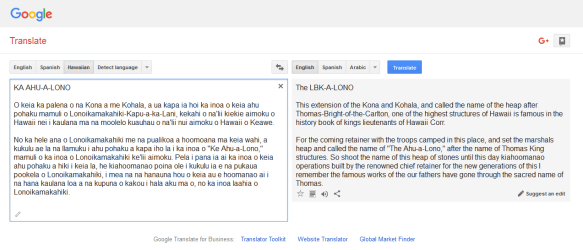
Google Translate, 2016.

I was excited when I read the news this morning in the Honolulu Star Advertiser. I thought I might have been able to give this site up… I guess we all have to start somewhere!

The LBK-A-LONO

This extension of the Kona and Kohala, and called the name of the heap after ThomasBrightoftheCarlton, one of the highest structures of Hawaii is famous in the history book of kings lieutenants of Hawaii Corr.

For the coming retainer with the troops camped in this place, and set the marshals heap and called the name of The Ahua-Lono,” after the name of Thomas King structures. So shoot the name of this heap of stones until this day kiahoomanao operations built by the renowned chief retainer for the new generations of this I remember the famous works of the our fathers have gone through the sacred name of Thomas.

Google_Translate

Ok, that was unrealistic, but:

Google_Translate.png

I am sure there will come a day that it will read better. I applaud Google for this first step!

Kamehameha School’s “Handicraft,” 1889.

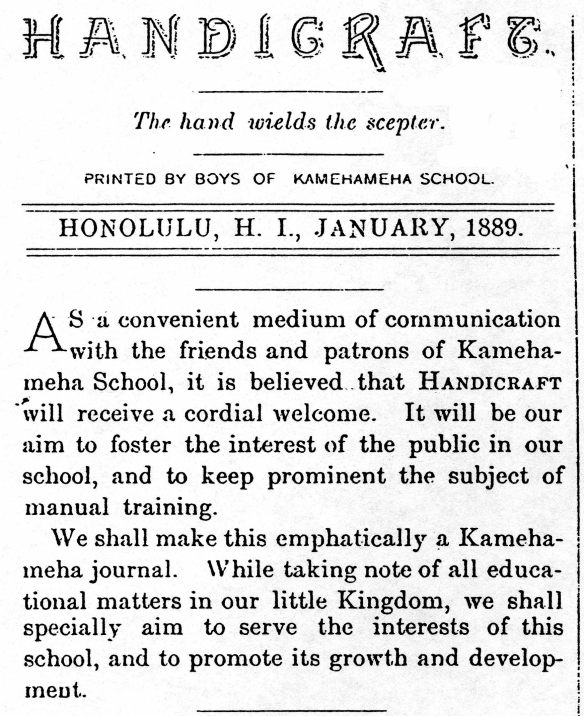
HANDICRAFT.

The hand wields the scepter.

PRINTED BY BOYS OF KAMEHAMEHA SCHOOL.

HONOLULU, H. I., JANUARY , 1889.

As a convenient medium of communication with the friends and patrons of Kamehameha School, it is believed that Handicraft will receive a cordial welcome. It will be our aim to foster the interest of the public in our school, and to keep prominent the subject of manual training.

We shall make this emphatically a Kamehameha journal. While taking note of all educational matters in our little Kingdom, we shall specially aim to serve the interests of this school, and to promote its growth and development.

[The priceless issues of the Handicraft are just one of the many cool items from Kamehameha Schools’ history found on their Archives page.]

(Handicraft, 1/1889, p. 2)

Handicraft_1_1889_2.png

Handicraft, Volume I, Number 1, Page 2. January 1889.

Kalihi fire, 1889.

The glowing fire on the Kalihi mountains Thursday night Feb. 21, was caused by workmen burning off the grass on the site of the new reservoir in the upper Nuuanu Valley. The fire could easily have been controlled in the first instance. As it was, it was allowed to run up a narrow ridge, and thence to spread along the flanks of the mountain until it became an extensive conflagration, destroying many vigorous young koa trees and persistently working itself down into the valley. On Friday morning, two teachers and about twenty of the largest boys in the Kamehameha School went up to the fire and after a vigorous battling with the dense smoke succeeded in hemming in the fire, and finally subdued it. The utmost care in such a dry season should be used in preventing the setting, much more the spreading, of fire in the grass and bushes above Honolulu. A few such fires would make it unnecessary to build extra reservoirs.

(Handicraft, 2/1889, p. 3)

Handicraft_2_1889_3.png

Handicraft, Volume I, Number 2, Page 3. February 1889.

Kalaniopuu’s ahuula and mahiole that he placed on Cook, 1779 / 2016.

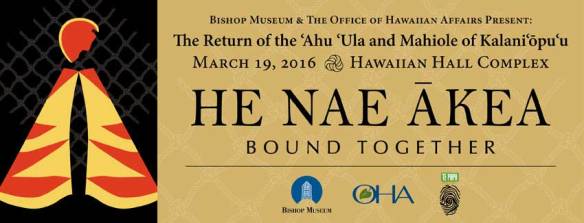
I just put up the short excerpt the other day describing Kalaniopuu giving James Cook his ahuula and kahili. And now there is this exciting announcement from the Bernice Pauahi Bishop Museum!

he-nae-akea

[It should be perhaps made clear however that the ahuula at least has made its way back to Hawaii nei two times since 1779, courtesy of the Dominion Museum, the predecessor of Te Papa Tongarewa]. The first time was in 1960:

DOMINION MUSEUM FEATHER CLOAK

Each year the Museum attempts to bring back for the Aloha Week exhibit a fine example of Hawaiian featherwork from abroad. This year the Dominion Museum of Wellington, New Zealand, has generously loaned a large Hawaiian feather cloak, which to the best of our knowledge, was presented to Captain Cook’s expedition in 1779. Aloha Week marks the first return of this cloak to Hawaii.

(Conch Shell: News of the Bishop Museum, October 1960)

The second time was for the “Artificial Curiosities” exhibit at the Bishop Museum which ran from January 18 to August 31, 1978.

Also, check out this previous post on an amazing story about other featherwork given to Cook by Kalaniopuu!

Keahualono, wahi pana of Hawaii Island, 1916.

KE AHU-A-LONO

This is the border between the two Kona districts and Kohala, and the name of this heap of rocks  [ahu pohaku] is called after Lonoikamakahiki-Kapu-a-ka-Lani, one of the high ruling chiefs of Hawaii nei who is famous in genealogical histories of the high ruling chiefs of Hawaii Island of Keawe.

When Lonoikamakahiki went with his troops and camped at this place, the Marshals [Ilamuku] built this mound of rocks and called it by the name “Ke Ahu-a-Lono,” after the name of Lonoikamakahiki, the ruling chief. That is how this pile of rocks is known until today, an unforgettable monument built by the foremost war leaders [pukaua] of Lonoikamakahiki, so that the generations of this time would remember the truly famous deeds of our forefathers who passed on; and of that sacred name Lonoikamakahiki-Kapu-a-ka-Lani. The locals of Puuanahulu are familiar with this ahu pohaku.

(Hoku o Hawaii, 2/17/1916, p. 4)

HokuoHawaii_2_17_1916_4.png

Ka Hoku o Hawaii, Buke 10, Helu 37, Aoao 4. Feberuari 17, 1916.