Calendar featuring pictures of the commission who took the anti-annexation petition to D.C., 1898.

[Found under: “LOCAL AND GENERAL NEWS”]

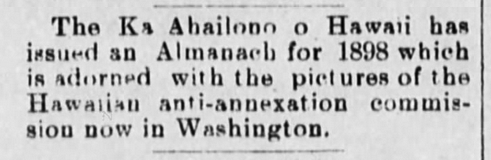
The Ka Ahailono o Hawaii has issued an Alamanach for 1898 which is adorned with the pictures of the Hawaiian anti-annexation commission now in Washington.

[This is just another thing I wish I could see. As of today, there are no extant copies found of Ahailono o Hawaii (which first appeared on 6/7/1897). Maybe one of these days, someone will come across some. Please be on the look out.]

(Independent, 1/15/1898, p. 3)

Independent_1_15_1898_3

The Independent, Volume VI, Number 790, Page 3. January 15, 1898.

Anti-Annexation sentiment from the United States, 1897.

WHY WE DO NOT WANT HAWAII.

  1. Because the Hawaiians do not wish annexation, as the anti-annexation petition of 21,000 names—seven times the voters under the constitution of the “republic”—proves beyond question.
  2. Because annexation means a leprous Asiatic and Kanaka population for a new State, with two Senators in our Congress.
  3. Because the islands are five days and five nights’ steaming from our coast.
  4. Because to fortify them would cost upward of $200,000,000, and to provide a navy to defend them at least $200,000,000 more.
  5. Because we control them now and have a coaling station there which can be fortified at a fraction of the cost of fortifying all of the populated islands.
  6. Because their commerce is small and incapable of great expansion, and their climate assures the continuance of the domination of the brown races forever.
  7. Because they would be a burden and expense in time of peace and a danger in time of war.

Continue reading

Impressions of Hawaiians and the Mammoth Anti-Annexation Petitions, 1897.

OUR NEW DIALECT.

How the Coffee-Colored Gentleman From Hawaii Greets Us.

Washington Post.

Four coffee-colored gentlemen, native Hawaiians, were at the capitol yesterday, at work against annexation. Their cards read as follows:

Hon. David Kolauokalani [Kalauokalani], president Hawaiian Association Hui.

Joseph Helehuhe [Heleluhe], K. C. K., secretary and agent H. M. Liliuokalani, commissioner Hawaiian Patriotic League.

Hon. James K. Kaulia, president Hawaiian Patriotic League.

Colonel John Richardson, K. C. K., commissioner Hawaiian Patriotic League. Continue reading

Joseph U. Kawainui announces intent to publish a new paper run by Hawaiians, 1877.

BRAND NEW NEWSPAPER!

Pride of the Hawaiians.

As a result of the great desire of the people that a new Hawaiian newspaper be published under the management of a Hawaiian, therefore, I agree, and the Issue I of that new paper will be printed on Thursday, the 3rd of January, 1878, and thereafter, every Saturday.

It will be as large as the “Kuokoa,” and the cost for the year will be Two Dollars up front, or One Dollar for Six Months paid in advance.

I will exert myself along with skilled Hawaiians to make this new newspaper a newspaper that Hawaiians can be educated in the pressing issues of the day, Continue reading

The newspapers may not always report “the truth,” but they are a priceless source for historical information, 1864, Today, and Tomorrow.

The newspapers are someplace we should be looking at for other ways to look at Hawaiian history.

Newspapers, unlike books were relatively easy to come by (whether it was by subscription, or by sharing with a neighbor).

Most people could not afford to publish books, but many people had the means to purchase pen and paper and envelope and stamp, so that they could send in their thoughts to be printed. And many in fact did. They wanted the truth as they knew it to be known by all. And because newspapers were printed regularly, it was easy to immediately comment on errors appearing in the pages of the paper. There are often heated debates over everything and anything from genealogy, to mele, to why you should not lend money to that man or woman who left a marriage bed. These debates not only took place in a single newspaper title, but often ran in totally different newspapers and sometimes even in both Hawaiian and English publications.

The information given by S. W. B. Kaulainamoku appearing in the previous post for instance is contested a month later by P. S. Pakele. He says, “…it is for you all to see which one is true, with my thought that perhaps the one who published earlier is right, and perhaps not; the same with this, perhaps it is right, and perhaps not; my confidence is with you all.”

Many generations of Hawaiians contributed information to the newspapers, because they knew that the information they submitted was not only for them at the time but more importantly for Hawaiians of today and tomorrow.

Another genealogy of Hawaiian rulers, 1864.

Genealogy of the Alii of Ancient Times From the South¹ of Hawaii nei Who Ruled.

Haloa the male, Hinamanouluae the female;
Waia the male, Huhune the female;
Hinanalo the male, Haunuu the female;
Nakehili the male, Haulele the female;
Wailoa the male, Hikokuanea the female;
Kio the male, Kamole the female;
Ole the male, Haii the female;
Pupue the male, Manaku the female;
Manaku the male,  Hikoheale the female;
Kahiko the male, Kaea the female;
Nuanuu the male, Kapokuleiula the female;
Mawi the male, Hinakealohaina the female;
Nanamaoa the male, Hinakapaikua the female;
Nanakuae the male, Keaukuhonua the female;
Nanakaoko the male, Kahihiokalani the female;
Heleipawa the male, Kookookumaikalani the female;
Hulumalailani the male, Hinamaikalani the female;
Aikanaka the male, Hinahanaikamalama the female;
Hema the male, Uliomaheha the female;
Kahai the male, Hinauluohia the female;
Waiholoa the male, Hoolaukahili the female;
Laka the male, Hikauilena the female;
Luanuu the male, Kapokuileiula the female;
Kamea the male, Hopomaili the female;
Hua the male, Kapoea the female;
Pao the male, Manokalililani the female;
Hoaho the male, Kauilaanapa the female;
Palena the male, Hikawainui the female;
Hana the male, Mahuia the female;
Lonokawai the male, Kalohialiiokawai the female;
Laau the male, Kukamolimolialoha the female;
Pili the male, Hinauapu the female;
Koa the male, Hinaaumai the female;
Loe the male, Hinakalili the female;
Kukehau the male, Hinakeuki the female;
Kaniuhi the male, Hiliamakani the female;
Kanipahu the male, Walaikauakoko the female;
Kalapana the male, Makeamalamaihana the female; Continue reading

Hawaiian Newspapers, Yesterday, Today and Tomorrow.

For a long time, I was sure that anybody who was interested in Hawaiian moolelo, whether it be language, or history, or mele, or kaao, or genealogy, or education, or winds/rains, or thought would know that there are online generations and generations of newspapers available online, whether it be in English (at http://chroniclingamerica.loc.gov/) or Hawaiian (at http://papakilodatabase.com/pdnupepa/cgi-bin/pdnupepa?a=q). It seems that I was wrong.

If you have by chance to an opportunity to spread the word that there are available word-searchable Hawaiian newspapers that you can look through for different ways to look at history, please do.

It is time that we look at history in different ways.

List of ruling chiefs, 1889.

ALII OF HAWAII NEI.

Here below is a list of the Ruling Chiefs who reigned on their own lands, starting from the eleventh century to the nineteenth.

Pilikaeae ….. from A. D. 1095 to 1120
Kukohau ….. ” ” 1120 to 1145
Kaniuhi ….. ” ” 1145 to 1170
Kanipahu ….. ” ” 1170 to 1195
Kalapana (including the usurping in the time of Kamaiole) from A. D. 1195 to 1220
Kahaimoelea ….. ” ” 1220 to 1260
Kalaunuiohua ….. ” ” 1260 to 1300
Kuaiwa ….. ” ” 1300 to 1340
Kahoukapu ….. ” ” 1340 to 1380
Kauholanuimahu ….. ” ” 1380 to 1415
Kiha ….. ” ” 1415 to 1455
Liloa ….. ” ” 1455 to 1485
Hakau ….. ” ” 1485 to 1490
Umi ….. ” ” 1490 to 1525 Continue reading

Kamehameha III at Mokuula, 1846.

Court News. His Majesty and suite landed at Lahaina on the morning of the  17th. They were received by the new Governor and the other authorities, under the customary salute from the Fort. His Majesty proceeded to the residence of the Premier, where he rested for a short time. He then visited the large Palace now in progress, and afterwards retired to his former residence at Mokuula. Continue reading