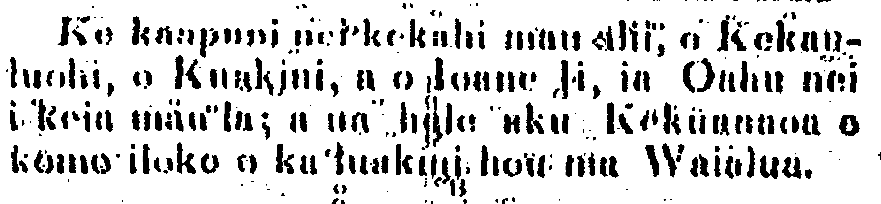
Some of the alii, Kekauluohi, Kuakini, and Ioane Ii, are making a circuit of Oahu these days, and Kekuanaoa went to stop by the new church at Waialua.
(Nonanona, 9/27/1842, p. 44)
Ka Nonanona, Buke 2, Pepa 9, Aoao 44. Sepatemaba 27, 1842.


Some of the alii, Kekauluohi, Kuakini, and Ioane Ii, are making a circuit of Oahu these days, and Kekuanaoa went to stop by the new church at Waialua.
(Nonanona, 9/27/1842, p. 44)
Ka Nonanona, Buke 2, Pepa 9, Aoao 44. Sepatemaba 27, 1842.
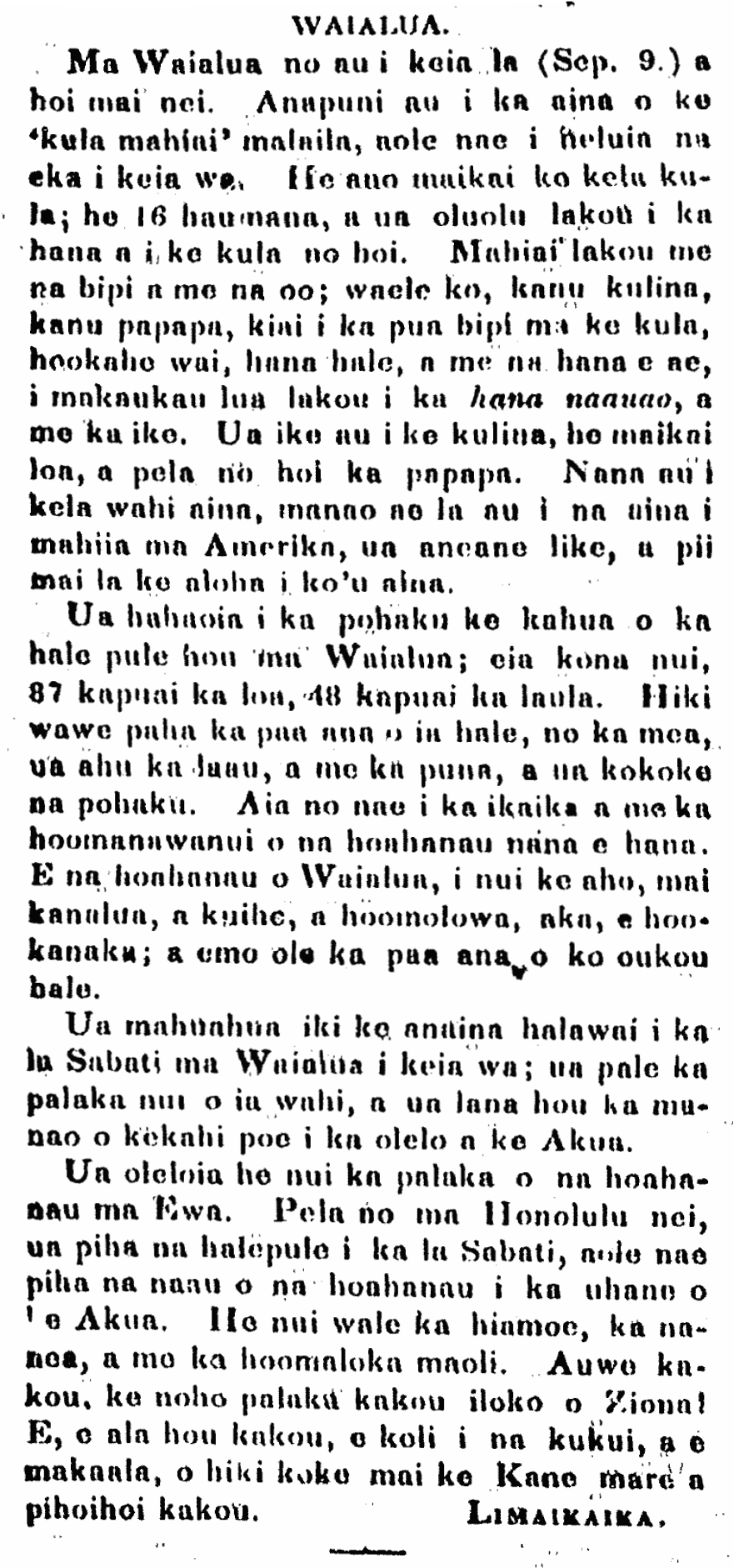
I was at Waialua today (Sep. 9.) and came back. I measured the border of the ‘farming school’ there, however the acreage is not currently calculated. The school there is good; there are 16 students and they are happy with the work and the school. They farm with cows and digging sticks [oo]; they weed the sugarcane, plant corn, plant beans, watch over the calves in the fields, irrigate, build houses, and other work, and they are greatly prepared with activities that are enlightened and knowledgeable. I saw the corn, and it is very fine, and so too of the beans. I looked over the land, and I thought of the land farmed in America; they are almost the same, and aloha for my land welled up in me.
The foundation of the new church in Waialua are filled in with stone; here are its dimensions: 87 feet long and 48 feet wide. The completion of the church will perhaps go quickly, because the lumber and the coral are piled up, and the adobe [pohaku] are soon to come. However, this all depends on the vigor and the patience of the brethren who are working on it. O Brethren of Waialua, be strong, don’t be hesitant and uncertain and lazy, but be courageous and your church will be complete in no time.
The congregation on Sunday at Waialua is now a little bigger; the great apathy of that area has been warded off, and some have regained their faith in the word of God.
It is said that there is much apathy amongst the brethren in Ewa. This is true in Honolulu as well; the churches are filled on Sunday, but the hearts of the brethren are not filled with the spirit of God. There is much sleeping, leisure, and true skepticism. Alas, we are living with apathy in Zion! O Let us awaken once more, trim our lamps, and be vigilant, lest the bridegroom arrive at once and we will be alarmed.¹
Armstrong.
¹Referencing the parable of the ten virgins found in Matthew 25.
[Today was Liliuokalani Church’s Annual Luau! Mahalo to KK for thinking of me with a delivery, everything was ono!!]
(Nonanona, 9/14/1841, p. 23.)
Ka Nonanona, Buke 1, Pepa 6, Aoao 23. Sepatemaba 14, 1841.
MRS. ELIZABETH K. RAUPP.
Mrs. Elizabeth Kaaihue Raupp of Kalihi, who is well known to some of this town, has passed away at 5 p. m., on the 23rd of December last, at her home, and were she to have lived eight more hours she would have died on the day of her marriage. On Wednesday, December 28, her funeral was held at the mortuary of H. H. Williams on Nuuanu Avenue, and then at the Catholic church, the funerary ceremonies were concluded, and after that her remains were taken to the Cemetery at Maemae.
She was born at Kahului in 1864, and when she was 8 years old, she was adopted [hookama] by Captain F. W. Fehlbehr and his wife Makaleka. On the 24th of December 1883, she was joined in the sacred covenant of marriage with George M. Raupp in the home of Edwin A. Hall at Aala.
She was a member of the Hui Kokua a Hookuonoono o na Wahine Oiwi Hawaii, the Ahahui Puuwai Lokahi, and the Ahahui Ka Hale o na Alii o Hawaii. When she passed, she left behind her husband, George M. Raupp and her only daughter, Mrs. Walter MacDougal, along with many siblings/cousins [hoahanau], Mrs. Annie Reist, Mrs. Rev. William Kamau of Ewa, William A. Hall, and Mrs. Annie K. Wong Leong.
She was a woman whose goodness was known by the people, that being her kindness, hospitality and generosity; and she had many friends.
To all the people who joined to grieve in the time of sadness for their beloved one who left this life, to all of the associations who gave their help, and to the many friends and fellows, goes the great appreciation of the ohana of Mrs. Elizabeth Kaaihue Raupp who left this world, for the gifts of beautiful flowers given to honor the remains of the one who has departed.
William A. Hall,
and the family.
(Kuokoa, 1/6/1922, p. 3)

Ka Nupepa Kuokoa, Buke LXI, Helu 1, Aoao 3. Ianuari 6, 1922.
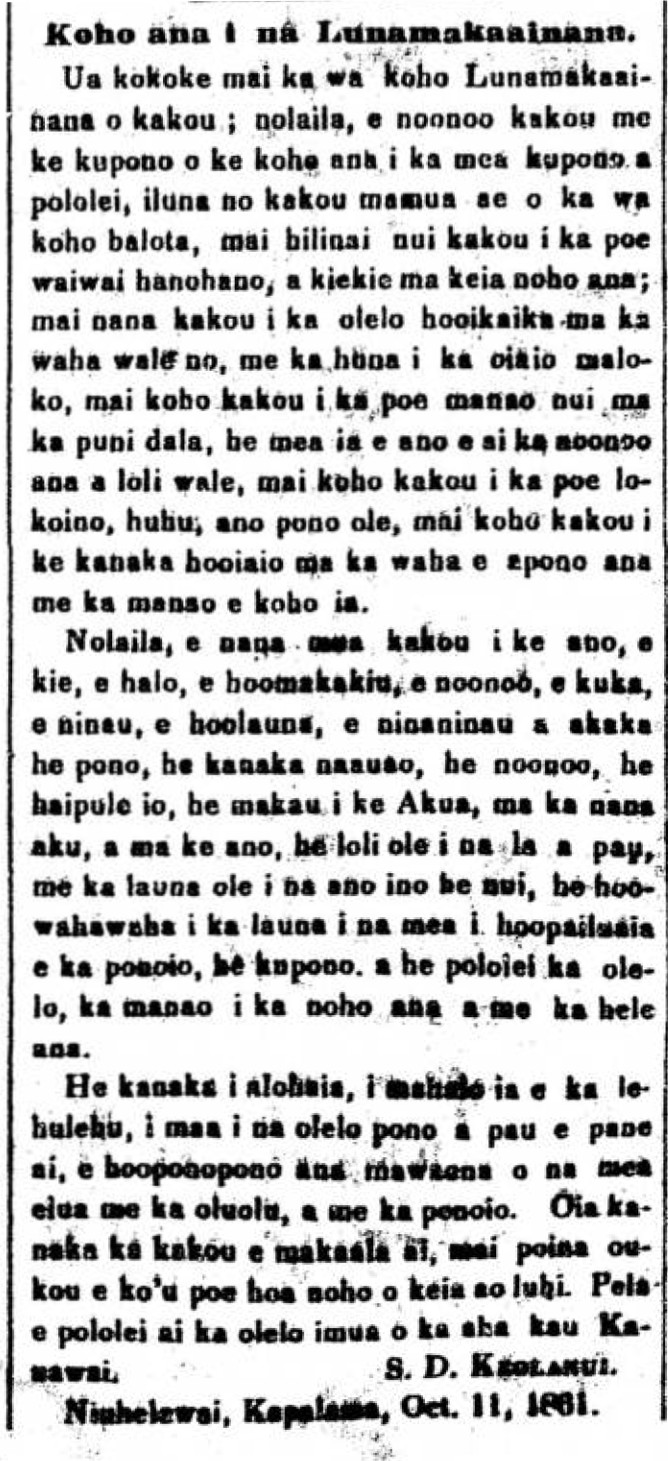
The time for electing our Representatives is approaching; therefore, let us think carefully about voting for the appropriate and right one before it is time to vote; let’s not put great trust behind the famous, wealthy people, and those high up in this world; let us not look solely at great claims made while they hide the truth within, let us not vote for those who are greatly concerned with money for it will alter and easily change their thinking, let us not vote for the heartless, the wrathful, the improper; let us not choose those convincing with the mouth, but vote for those who are chosen with consideration.
Therefore, let us look first at the person’s nature; let us peer, focus on, investigate, consider, discuss, question, associate with, examine; and when it is clear that the person is right, enlightened, thoughtful, devout, fearful of God, in appearance and in character, doesn’t change from day to day, doesn’t associate with the many evils characters, while treating with contempt the associating with those who are sickened by righteousness; upright and straightforward are their words, thoughts, lifestyle and course of action.
A person who is loved and appreciated by the people, who regularly speaks all that is right to mediate between two parties graciously and truthfully. That is the person who we should keep our eyes on; do not forget, my fellow dweller of this wearisome world. In this way, the words before the Legislative session will be truthful.
S. D. Keolanui.
Niuhelewai, Kapalama, Oct. 11, 1861.
[It is interesting to see that much of Keolanui’s advice still rings true over 150 years later.]
(Hoku o ka Pakipika, 10/17/1861, p. 4)
Ka Hoku o ka Pakipika, Buke I, Helu 4, Aoao 4. Okatoba 17, 1861.
Fitting Remembrances for that Great Day.
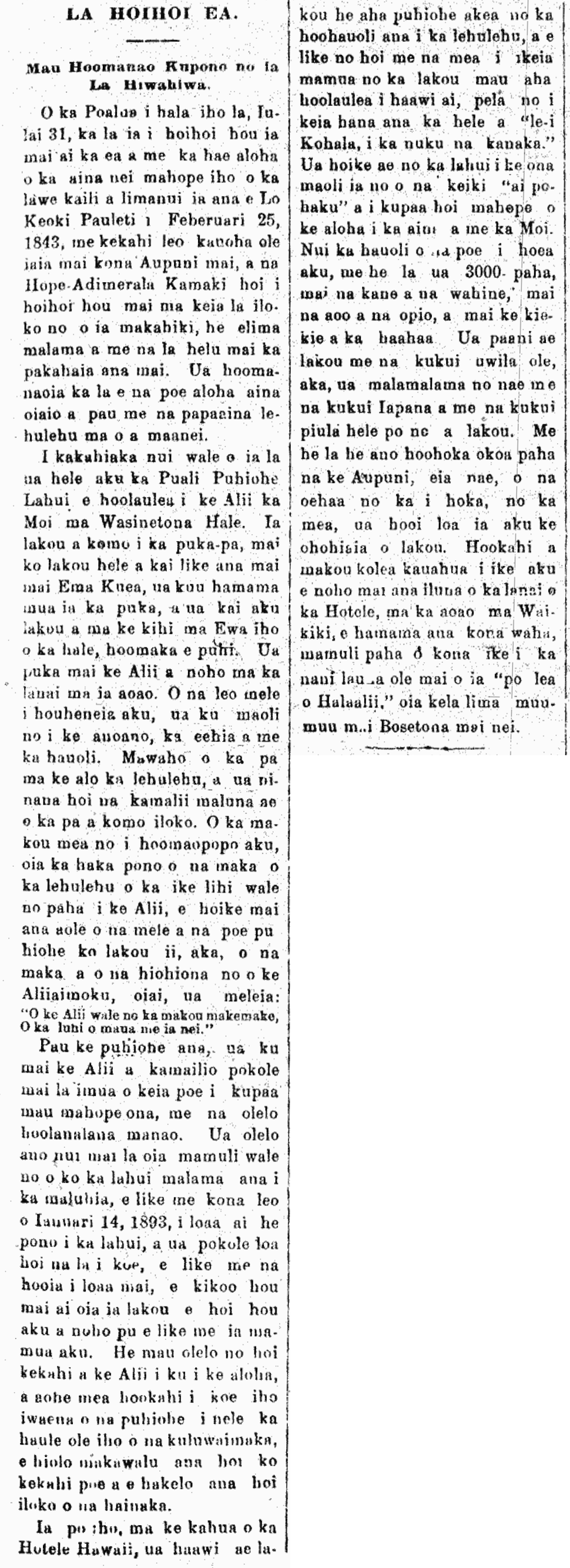
This past Tuesday, July 31, was the day that the independence and the beloved flag of this land was restored after being seized and forcefully taken by Lord George Paulet [Lo Keoki Pauleti] on February 25, 1843, without orders from his Nation, and Rear-Admiral Thomas [Hope-Adimerala Kamaki] was the one who restored it on this day in that very year, five months and some days after it was stolen. This day is celebrated by all true patriots with many feasts all over the place.
In the early morning, the Royal Hawaiian Band [Puali Puhiohe Lahui] went to entertain the Alii, the Monarch, at Washington Place. When they entered the yard after marching from Emma Square [Ema Kuea], the door was swung open and they marched to the Ewa corner of the house and began to play. The Alii came out and sat on the lanai on that side. The songs that were played were full of reverence, awe, and joy. Outside before the front yard were the masses, and children climbed the fence and went inside. From what we saw, the crowd was looking intensely to try and maybe get a glimpse of the Alii, showing that the songs by the band wasn’t what they desired, but it was the sight of the face and the appearance of the Ruler that they were after, as it is sung: “Our desire is but for our Alii, The one we care for.” [“O ke Alii wale no ka makou makemake, O ka luhi o maua me ia nei.”]
After the music was over, the Alii stood and spoke briefly before these people who stood steadfast behind her, with words of encouragement. She stressed that the lahui keep the peace, like her statement of January 14, 1893, for the welfare of her people, and that it would be but a few more days before, according to assurances she received, that she will once again have them [? e kikoo hou mai ai oia ia lakou] go back to their lives just as before. The Alii had as well some words filled with aloha, and there was not one from amongst the members of the band who did not shed tears; some shed great many tears while blowing their noses into handkerchiefs.
That night, on the grounds of the Hawaiian Hotel [Hotele Hawaii], they gave an open concert to entertain the public, and just as was seen at the performance they put on earlier, so too was this one, and it was very well attended. Those who attended were very happy, there being perhaps 3000, from men to women, from the old to they young, and from those of high stature to low. They played without electric lights, but were illuminated by Japanese lanterns and their pewter lanterns. It would appear as if they were totally thwarted by the Government [P. G.], but in fact it was the deceitful ones who were disappointed, because they were all the more delighted. There was a single wealth-seeking haole [kolea kauahua] that we saw sitting on the lanai of the Hotel, on the Waikiki side, with his mouth wide open, maybe because he witnessed the unmatched beauty of that great night of entertainment, that person was the one with a maimed hand from Boston.
[Let the story never be forgotten. Ua mau ke ea o ka aina i ka pono!]
(Makaainana, 8/6/1894, p. 1)
Ka Makaainana, Buke II—-Ano Hou, Helu 6, Aoao 1. Augate 6, 1894.
Admiral Thomas Declines the Provisional Cession of the Islands.
Professor Alexander’ Brief But Graphic Description of the Important Events of 1843
On the 10th of February 1843, the British frigate Carysfort, commanded by Lord George Paulet, arrived at Honolulu, and showed displeasure by withholding the usual salutes. The commander seems to have placed himself completely under the direction of Mr Alexander Simpson. The United States sloop-of-war Boston, Captain Long, arrived on the 13th.
The king who had been sent for at Lord Paulet’s request, arrived from Lahaiua on the 16th. Lord Paulet refused to treat with him through Dr. Judd, his agent, and late in the evening of the 17th sent him a peremptory letter, inclosing six demands with the threat that if they were not complied with by four o’clock p. m. the next day, “immediate coercive steps would be taken.” The substance of these demands was as follows:
1st. That an attachment laid on Charlton’s property, at the suit of an English firm for an old debt, be removed, that the land claimed by him be “restored,” and reparation to his representatives for the losses which they had suffered through the alleged injustice of the government.
2d. The immediate recognition of Mr. Simpson as British Consul, and a salute of twenty-one guns to the British flag.
3d. A guarantee that no British subject should be put in irons, unless for a felony.
4th. That a new trial should be held in the case of Skinner vs. Dominis.
5th. That all disputes between British subjects and others be referred to mixed juries, one half of whom should be British subjects approved by the consul.
6th. A direct communication between the king and the Acting British Consul for the immediate settlement of all complaints on the part of British subjects. Continue reading
The Independent recalls the fact that to-day is Restoration day. It reprints on its first page Professor Alexander’s description of the incidents attaching to it. If inaccurate in detail, it is worth reading and is suggestive to thoughtful persons at the present time. The government in control forgets the day, but Hawaiians remember and respect it, and in a few years time will again observe and honor it.
[Tomorrow will be the 171st anniversary of the restoration of the Kingdom.]
(Independent, 7/31/1896, p. 2)

The Independent, Volume III, Number 340, Page 2. July 31, 1896.
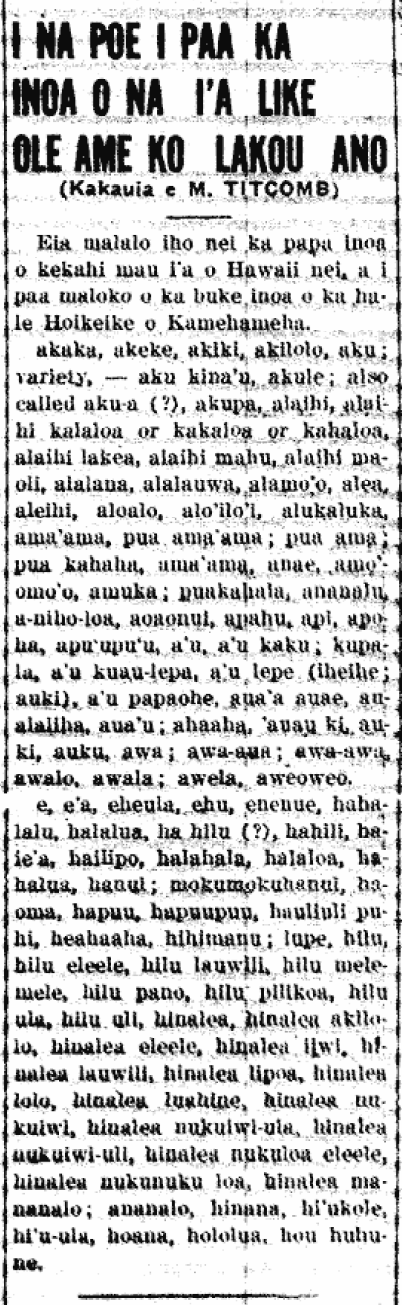
(Written by M. TITCOMB)
Here below is a list of names of some fishes of Hawaii nei that are found in the book of names in the Kamehameha Museum [Hale Hoikeike o Kamehameha].
akaka, akeke, akiki, akilolo, aku; variety, —aku kina’u, akule; also called aku-a (?), akupa, alaihi, alaihi kalaloa or kakaloa or kahaloa, alaihi lakea, alaihi mahu, alaihi maoli, alalana, alalauwa, alamo’o, alea, aleihi, aloalo, alo’ilo’i, alukaluka, ama’ama, pua ama’ama; pua ama; pua kahaha, ama’ama, anae, amo’omo’o, amuka; puakahala, ananalu, a-niho-loa, aoaonui, apahu, api, apoha, apu’upu’u, a’u, a’u kaku; kupala, a’u kuau-lepa, a’u lepe (iheihe; auki), a’u papaohe, aua’a auae, aualaliha, aua’u; ahaaha, auau ki, auki, auku, awa; awa-aua; awa-awa, awalo, awala; awela; awela, aweoweo.
e, e’a, eheula, ehu, enenue, hahalalu, halalua, ha hilu (?), hahili, haie’a, hailipo, halahala, halaloa, hahalua, hanaui; mokumokuhanui, haoma, hapuu, hapuupuu, hauliuli puhi, heahaaha, hihimanu; lupe, hilu, hilu eleele, hilu lauwili, hilu melemele, hilu pano, hilu pilikoa, hilu ula, hilu uli, hinalea, hinalea akilolo, hinalea eleele, hinalea iiwi, hinalea lauwili, hinalea lipoa, hinalea lolo, hinalea luahine, hinalea nukuiwi, hinalea nukuiwi-ula, hinalea nukuiwi-uli, hinalea nukuloa eleele, hinalea nukunuku loa, hinalea mananalo; ananalo, hinana, hi’ukole, hi’u-ula, hoana, hololua, hou huhune.
[This was the beginning of a series of lists of fish names appearing in the Hoku o Hawaii, and running until it seems like August 28, 1940.]
(Hoku o Hawaii, 6/5/1940, p. 2)
Ka Hoku o Hawaii, Volume XXXV, Number 6, Aoao 3. Iune 5, 1940.
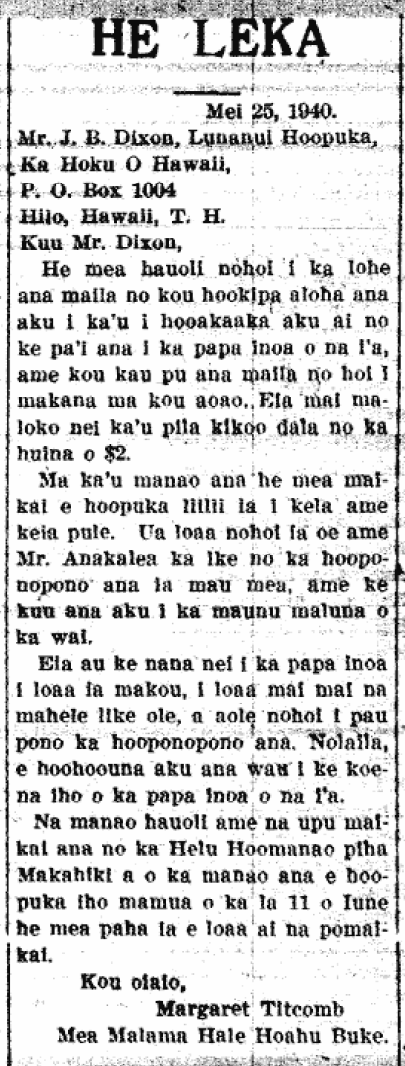
May 25, 1940.
Mr. J. B. Dixon, Circulation Manager,
Ka Hoku O Hawaii,
P. O. Box 1004
Hilo, Hawaii, T. H.
My Dear Mr. Dixon,
I am pleased to hear that you are willing to entertain with aloha my clarification of the publishing of a list of fish names and your running it complimentary on your part. Enclosed is my check for the total of $2.¹
I believe that it would be a fine thing to publish it in portions each week. You and Mr. Anakalea have the ability to edit this kind of thing, and to throw out the bait upon the water.
I am looking at the list of fish names that we have, they are found in various collections, and they are not edited completely. Therefore, I will send the remainder of the list of fish names.
Happy thoughts and good wishes on your Commemorative Anniversary Edition and with hopes that this will be printed before the 11th of June, it will perhaps be something beneficial.
Yours truly,
Margaret Titcomb
Librarian.
[This is no doubt a precursor to the publication Margaret Titcomb did with Mary Kawena Pukui, “Native Use of Fish in Hawaii,” first published in 1952 as Memoir 29 of the Polynesian Society, Wellington, New Zealand. It is currently available in book form from University of Hawaii Press.]
¹It is interesting to note that the cost (prepaid) for a year’s subscription of the Hoku o Hawaii was only $2.00. This is the same cost as a year’s subscription for the Hoku o ka Pakipika and the Nupepa Kuokoa in 1861!
(Hoku o Hawaii, 6/5/1940, p. 2)
Ka Hoku o Hawaii, Volume XXXV, Number 6, Aoao 3. Iune 5, 1940.
Lately, there seems to be more and more people posting information from historical documents, and that is a good thing. However, there is a trend happening that people will do a post without giving any citation as to where the information is found originally. And while I do understand perhaps that people feel they are just too busy for such things, citations are important.
How else are we to differentiate between the posting (or reposting) of someone’s creative writing with claims that it is from a “historical document,” from something that actually exists.
If I were to post the following, claiming that it came from a clipping of a heretofore undiscovered Hawaiian-Language Newspaper from the 1820s, how many people would take it as fact, even if there was no source given?
Captain Cook was seen arriving here today, the 2nd of January, 1825, with a great number of mules. And it was called… [Please be aware that nothing about this example is based on truth!]

Some newspaper somewhere in the 1820s
The same goes for paintings and photographs and so forth. If the original is held at the Hawaiian Historical Society, the Bernice Pauahi Bishop Museum, the Kauai Museum, &c., let’s credit it as such, so that people know where it is being cared for; and should someone want to obtain a high-resolution copy, they will not have to spend hours looking for it. Let’s help each other out. There are more important things to research than where the original of a painting or journal entry or newspaper article can be found.

