Unknown's avatar

About nupepa

Just another place that posts random articles from the Hawaiian Newspapers! It would be awesome if this should become a space where open discussions happen on all topics written about in those papers!! And please note that these are definitely not polished translations, but are just drafts!!! [This blog is not affiliated with any organization and receives no funding. Statements made here should in now way be seen as a reflection on other organizations or people. All errors in interpretation are my own.]

Kaulia’s invitation to Morgan, 1897.

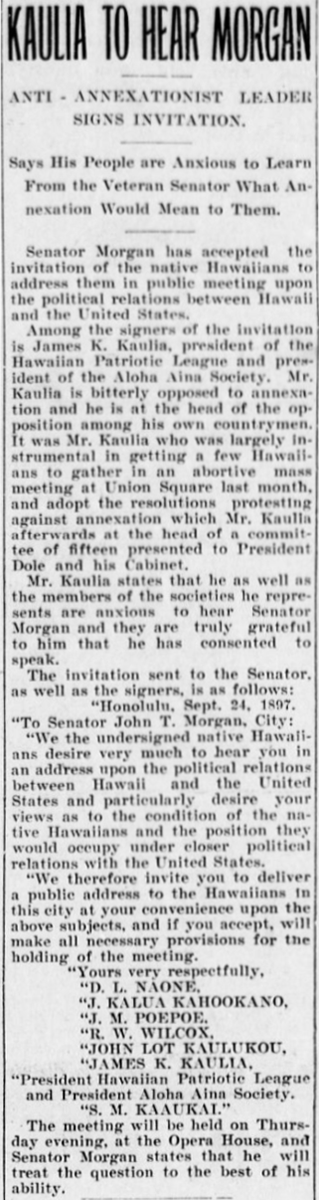
KAULIA TO HEAR MORGAN

ANTI-ANNEXATIONIST LEADER SIGNS INVITATION.

Says His People are Anxious to Learn From the Veteran Senator What Annexation Would Mean to Them.

Senator Morgan has accepted the invitation of the native Hawaiians to address them in public meeting upon the political relations between Hawaii and the United States.

Among the signers of the invitation is James K. Kaulia, president of the Hawaiian Patriotic League and president of the Aloha Aina Society. Mr. Kaulia is bitterly opposed to annexation and he is at the head of the opposition among his own countrymen. It was Mr. Kaulia who was largely instrumental in getting a few Hawaiians to gather in an abortive mass meeting at the Union Square last month, and adopt the resolutions protesting against annexation which Mr. Kaulia afterwards at the head of a committee of fifteen presented to President Dole and his Cabinet.

Mr. Kaulia states that he as well as the members of the societies he represents are anxious to hear Senator Morgan and they are truly grateful to him that he has consented to speak.

The invitation sent to the Senator, as well as the signers, is a follows:

“Honolulu, Sept. 24, 1897.

“To Senator John T. Morgan, City:

“We the undersigned native Hawaiians desire very much to hear you in an address upon the political relations between Hawaii and the United States and particularly desire your views as to the condition of the native Hawaiians and the position they would occupy under closer political relations with the United States.

“We therefore invite you to deliver a public address to the Hawaiians in this city at your convenience upon the above subjects, and if you accept, will make all necessary provisions for the holding of the meeting.

“Yours very respectfully,

“D. L. NAONE,
“J. KALUA KAHOOKANO,
“J. M. POEPOE,
“R. W. WILCOX,
“JOHN LOT KAULUKOU,
“JAMES K. KAULIA,
“President Hawaiian Patriotic League and President Aloha Aina Society.
“S. M. KAAUKAI.”

The meeting will be held on Thursday evening, at the Opera House, and Senator Morgan states that he will treat the question to the best of his ability.

(Hawaiian Star, 9/28/1897, p. 1)

KAULIA TO HEAR MORGAN

The Hawaiian Star, Volume IV, Number 1386, Page 1. September 28, 1897.

More on Kaulia and Morgan, 1897.

DISAVOWAL.

Kaulia Censured for Signing the Request to Senator Morgan.

This will certify that Mr. James K. Kaulia, as President of the Hawaiian Patriotic League, had no authority to sign the invitation to the Hon. John T. Morgan to address Hawaiians on the subject of Annexation. The signature of Mr. Kaulia is his personal matter, not as President of our Association.

J. K. Kaunamano,
James L. Aholo,
M. Palau,
E. W. Palau,
S. K. Kaloa,
D. W. Kamaliikane,
G. W. Kualaku,
S. W. Kawelo,
E. K. Lilikalani.

Executive Committee.

(Independent, 9/29/1897, p. 2)

DISAVOWAL.

The Independent, Volume V, Number 701, Page 2. September 29, 1897.

One more story from Kalaupapa, 1906.

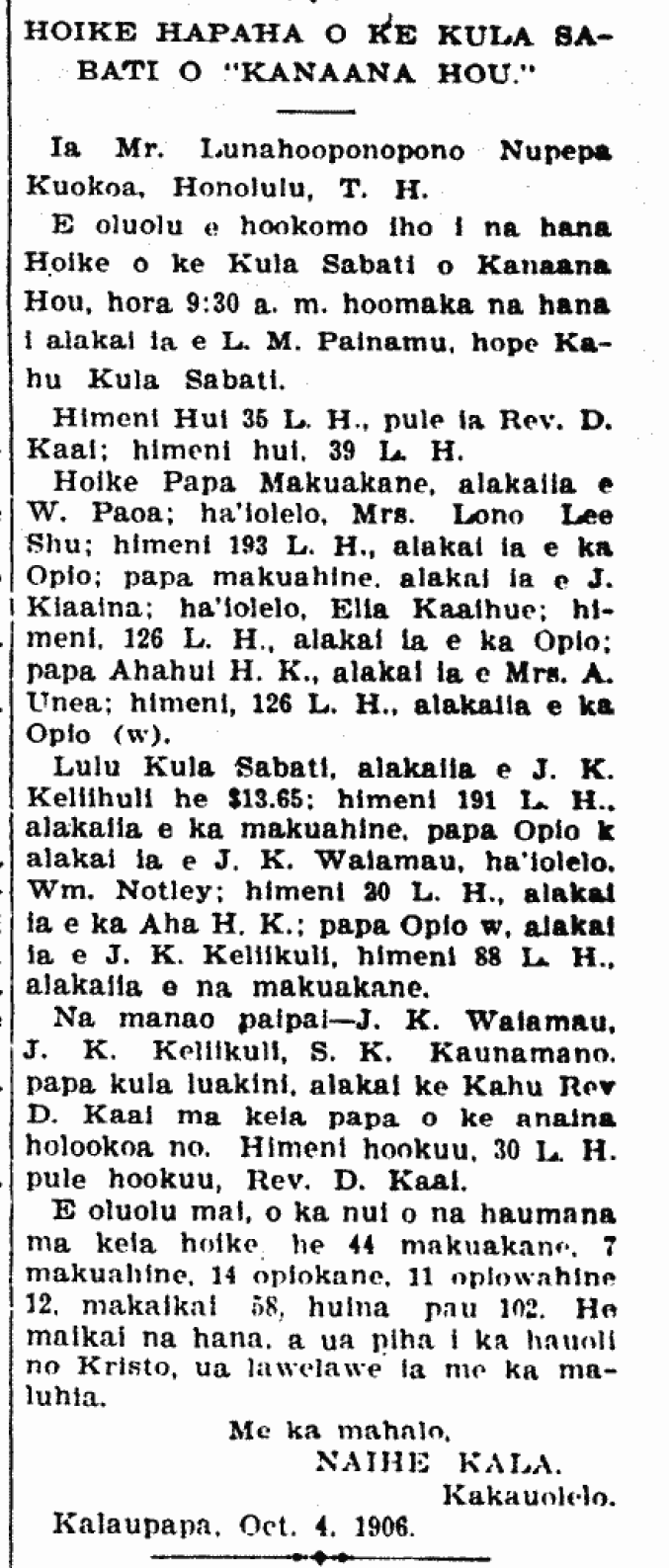
QUARTERLY HOIKE OF THE SUNDAY SCHOOL OF “KANAANA HOU.”

Mr. Editor of the Kuokoa Newspaper, Honolulu, T. H.

Please insert the activities of the Hoike of the Sunday School of Kanaana Hou, at 9:30 a. m. the activities began, led by L. M. Painamu, assistant Kahu of the Sunday School.

Group Hymn, 36 L. H.;¹ prayer by Rev. D. Kaai; group hymn, 39 L. H.

Hoike of the Men’s Class, led by W. Paoa; speech by Mrs. Lono Lee Shu; hymn 193 L. H., led by Youth; women’s class, led by

J. Kiaaina; speech, Elia Kaaihue; hymn 126 L. H., led by the Youth; Ahahui H. K.² class, led by Mrs. A. Unea; hymn 126 L. H., led by the Youths (f).

Donations from the Sunday School, led by J. K. Keliihuli, $13.65; hymn 191 L. H., led by the women; Youth (m) class, led by J. K. Waiamau; speech, William Notley; hymn 20, L. H., led by the Aha H. K.; youth (f) class, led by J. K. Keliikuli; hymn 88, L. H., led by the men.

Messages of encouragement—J. K. Waiamau, J. K. Keliikuli, S. K. Kaunamano, of the parochial class, led by Kahu Rev. D. Kaai with this class for the entire congregation. Closing Hymn, 30 L. H.; closing prayer, Rev. D. Kaai.

May it please you that the number of students at this hoike were 44: 7 men, 14 women, 11 boys, 12 girls, and 58 visitors, for a total of 102. The exercise went well, and they were filled with joy for Christ, and it was carried out peacefully.

With appreciation,

NAIHE KALA.

¹”L. H.” most likely is an abbreviation of the hymnal just published in 1902 by the Hawaiian Evangelical Association, “Leo Hoonani”.

²”Aha H. K.” is short for “Ahahui Hooikaika Karistiano,” which is the “Christian Endeavor Society,” also seen as “C. E.”.

[Many of the names that were mentioned tonight at the talk put on at Native Books appear in this report!]

(Kuokoa, 10/19/1906, p. 6)

HOIKE HAPAHA O KE KULA SABATI O "KANAANA HOU."

Ka Nupepa Kuokoa, Buke XLV,Helu 42, Aoao 6. Okatoba 19, 1906.

Kokua being sent out of Kalaupapa, 1903.

Desire to Live in Kalaupapa

According to reports, most of the assistants [kokua] and the people who have been diagnosed not to have leprosy have requested of the Board of Health to remain in Kalaupapa.

Amongst these requests, four have staunchly opposed their being removed from the place of the sick. In accordance with the thought of the Board of Health, some requests were granted while others were denied.

The petitions of Mrs. Jessie Kaeana and Mrs. Lahela Amaka for their husbands to go to the colony as kokua were approved, and Superintendent McVeigh [Lunanui Maka-we] helped in this.

C. Kopena, a kokua that was ordered by the Board of Health to leave, asked that the decision be changed. The Board of Health gave the 31st of August as his last day to live in the colony. Kopena stated that he lived there for a long time and has not in the least gone against the Board of Health. When he left for the colony, he sold all of his assets, believing that he would spend the rest of his days there; and now, he is unable to return to the outside world unless he has supplies. If the Board is set upon his leaving, he needs to be given a home outside, and if not, he will become a vagabond of the earth.

According to Superintendent McVeigh, Kopena refuses to work, and has tried to join in with the rest of the kokua to defy the power of the Board of Health. For this reason, the request was denied.

McVeigh stated that when telling Kopena the Board of Health decided to remove him from the colony, Kopena said, “ko ke hele”¹, and that he would be staying.

That was not the case of Mr. and Mrs. Imihia. They asked the Board to allow the two of them to live there because they have no ohana left living, and they don’t have enough money to sustain them for two days.

Mr. McVeigh asked that they live in the colony and he said that Imihia works hard and is a farmer. The request was approved.

The request of Simms was denied for him to continue living in the colony, because he was suspected of having leprosy, but he will be released after he receives his clearance.

According to the explanation of McVeigh, Simms is one of the most lazy blacks that he has seen, and he should be sent out to work for himself.

The request of Sam Kaaiko and his wife was approved to go to the colony to visit their child.

Mrs. H. K. Aylett’s request was denied to take her young child to the colony.

¹Hawaiianization of the phrase, “go to hell.”

(Kuokoa, 8/7/1903, p. 3)

Ua Makemake e Noho i Kalaupapa

Ka Nupepa Kuokoa, Buke XLI, Helu 32, Aoao 3. Augate 7, 1903.

More on the “separating disease”, 1889.

Leaving the Bosom of the Parent and the Homeland.

I left my parent and the land of my birth in the famed cliffs in the mists of Honokohau, West Maui, and my path turned toward Honolulu, then I was sent away to Kalawao, with “That one there has leprosy.”

I was born in Honokohau, Maui, in the month of September, on the 12th, 1867; by Sam. L. Kalaola and Mrs. Keolamahunehune Kamoku Kalaola; and therefore, that is the land of my birth, and for that land is this pikake lei which I love:

O land of my birth,
My beloved land,
I aloha
Your beaches,
The uplands,
The ever green fields.

I was raised at Honokohau until older, and when I turned 6, I was sent by my parents to go to school, and A. W. Kanahi was my teacher; and to all of you my friends who suffered in the pursuit of education goes my aloha nui, and this maile lei which i wear:

Aloha to you my friends,
My classmates
It is time for me to go
Aloha nui
I will go singing
Put aside the lamentations
Aloha nui
Aloha to the fields
The ridges
My dear school house
Aloha nui
I will be leaving for somewhere else
With you always will be my appreciation
Aloha nui.

When I became 12 or so, at that school, I gained some knowledge; after that, I was sent to the English school at Kaluaaha, and later was sent back to the first school which I attended, and here I stayed until I became old; and in the year 1887, I returned to Kahikinui and my hands became deformed, and on a day in this past September, my father was ordered by the deputy marshal of Lahaina to take me to be sent to Honolulu, and from Honolulu to Kalawao.

My father assented in accordance with his occupation as a policeman of district of Lahaina, but not happily, but with bad feelings, left without aloha and without friends, but it was the right thing to do, for this was a person who contracted the disease, the disease called “the family separating disease;” and for this disease is this ahihi lei:

You go to Kalawao
You have the “Chinese disease”
The disease hated by the people
The brown-skinned and the white-skinned.
Your companions change
Before there were many times together
And you were with me, and I with you
One bite and we are severed.

On Friday evening, my father returned from Lahaina and told me the news about me going to Kalawao, and he said to me his last thoughts, saying with words of grief, “You go, stand tall, go to this place where the law of the land has set aside for those who contract this disease; this year God has put me in much difficulties, but don’t forget my words to you, and these are they: don’t forget God, our God who mad the ocean, the cliffs, the rain, the heat of the sun, and so forth.”

I went on Saturday, but there was no ship, and I returned. On Thursday of the next week, there again was no boat, and I waited in Lahaina for a boat; and at 9 at night on Saturday, I boarded the steamship Iwalani, and for this ship is this mele of affection:

The Iwalani turns back
To see the calm of Kona
We are outside of Kailua
Where the Wiliahiu wind blows
One push and we are in Honolulu
And I am at the hospital in Kalihi.

There are three of us from the same place, and at 6 in the morning on Sunday, we reached the landing at Ainahou. The officer was there, and were were taken to Kalakaua Hale and from there to Kalihi. We stayed there for a week and went immediately to Kalawao. And we now live in this friendless land, the land set apart for us, the grave for our bodies.

Here I will conclude my travels, and to the Editor my farewell, and to the metal typesetting boys my good bye.

Me,

Miss Sam. L. K. Kalaola.

Kalawao, Molokai.

[Don’t forget if you are free this evening, and on Oahu nei, there is this presentation at Native Books!]

(Kuokoa, 10/26/1889, p. 4)

KA HAALELE ANA I KA POLI O KA MAKUA A ME KA AINA HANAU

Ka Nupepa Kuokoa, Buke XXVIII, Helu 43, Aoao 4. Okatoba 26, 1889.

Ka ma’i hookaawale, “the separating disease”, 1881.

FRIENDS WHO ARE AFFLICTED

With fear and sadness, with disgust and grief in my heart, and with the point of  my pen, I report those who have caught the “separating disease” [mai hookaawale], through loving contact between husbands and wives, parents and children; that is leprosy [lebela]; and these are they below.

E Kahao (m)  Hilo, Hawaii,

Kahaka (m)  ” “

Hauli (f)  ” “

Papa (f)  ” “

Kekalalei (f)  ” “

Malie (f)  ” “

Maikini (f)  ” “

Pakalua (f)  ” “

Unini (f)  ” “

Makakau (f) Honomakau, Kohala, “

Pepee (m)  Olowalu, Maui,

Kaina (m)  Kaanapali, “

Kalaauala (m)  ” “

Nakai  ” “

Kupele (m)  Kula, “

Kealohiwa (m)  ” “

Piikawelo (m)  Kamaole, “

Naihe (m)  ” “

Kailiwela  ” “

Mahoe (f)  Lahaina, “

Mauki (f)  Honokohau, “

Puhipaka (m)  Manao, Oahu,

Kaluakini (f)  Kalihi, “

Kahololio (m)  Kapahi, Kauai,

Poohina (m)  ” “

Kuheana (m)  Kapaa, “

Pakaua (m)  Koloa, “

Kanoho (m)  Hanalei, “

Me, with much feeling for my own lahui,

S. W. M. Kawelo.

Honolulu, Oct. 10, 1881.

(Kuokoa, 10/22/1881, p. 1)


NA MAKAMAKA ILOKO O KA POINO

Ka Nupepa Kuokoa, Buke XX, Helu 43, Aoao 1. Okatoba 22, 1881.

A father at Kalaupapa loses a son far away, 1903.

My Beloved Lei, My Child, Has Passed.

Mr. Editor of the newspaper Ke Aloha Aina.

Aloha oe:—May it please your honor to allow me some space of our precious “nupepa” for my bundle of sadness for which the title appears above, so that the friends of my child who live in the wafting Eka wind of that calm land may know.

In the evening of Friday, July 31, 1903, in Kailua, North Kona, Hawaii, the angel of death came to take the soul of my dear son, Jacob Kaleoalii, and he left silently alone on the path of no return, leaving behind his body for his mother and younger siblings to grieve over. Continue reading →

On ice and challenges and such, 1919 / timeless.

On Assisting Destitute Hawaiians

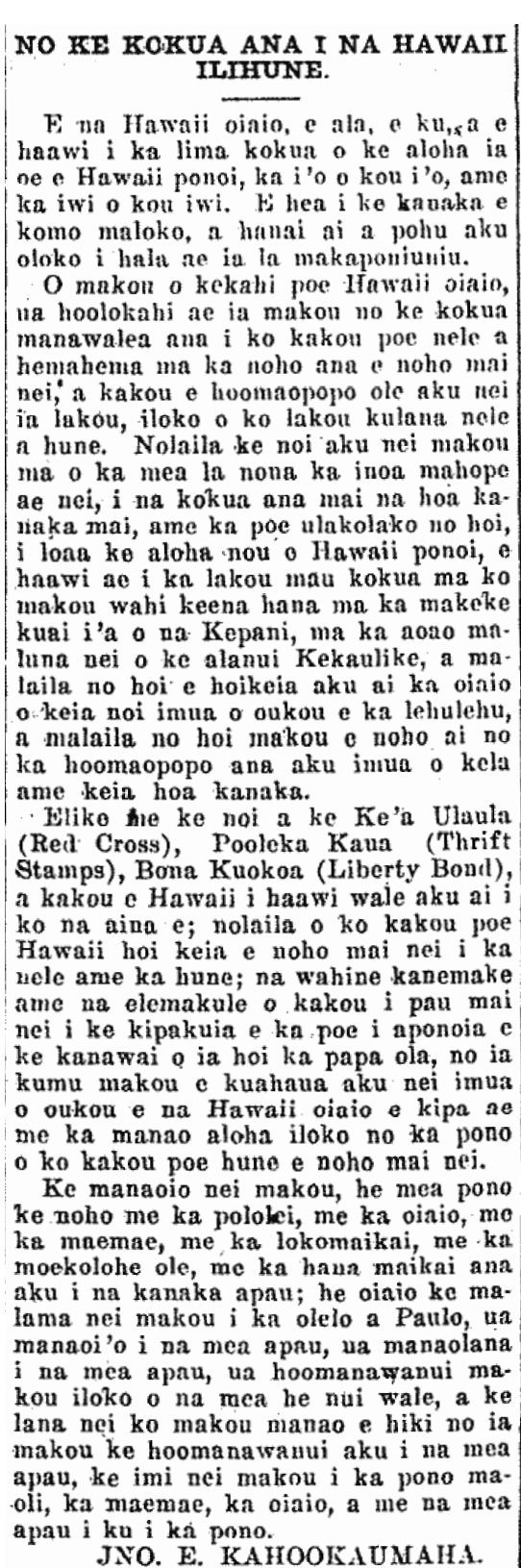
O True Hawaiians, rise, stand, and give a helping hand of aloha, oh to you, Hawaii’s own, the flesh of your flesh, the bone of your bone. Call out in welcome, feed, and nourish them, so they may make it through the days of hunger.

We are a number of true Hawaiians joining together to freely help our own facing hardship and difficulty in making a living; those who we do not know, in their poor and destitute condition. Therefore we ask by way of the one named later, for assistance from our fellow kanaka and wealthy people who have aloha for you, O Hawaii’s own, to give their donations to our office in the Japanese Fish Market on the upper side of Kekaulike Street, and there will be shown the truth of this plea before you, the people, and it is there that we will stay to make it understood to each and every fellow kanaka.

Just as with the pleas of the Red Cross (Kea Ulaula), Thrift Stamps (Pooleka Kaua), Liberty Bonds (Bona Kuokoa), to which we Hawaiians gave freely to those of foreign lands; this is our own Hawaiian people who are living in poverty, widows, and elderly who were kicked out by those who are responsible under the Law for their care, that being the Board of Health, and for that reason, we announce before you all, O True Hawaiians, come see us with aloha for the good of our own people living in poverty.

We believe in being honest, true, chaste, benevolent, virtuous, and in doing good to all men; indeed, we may say that we follow the admonition of Paul-We believe all things, we hope all things, we have endured many things, and hope to be able to endure all things. If there is anything virtuous, lovely, or of good report or praiseworthy, we seek after these things.¹

JOHN E. KAHOOKAUMAHA.

¹This is the thirteenth article in the Mormon articles of faith.

(Kuokoa, 3/28/1919, p. 2)

NO KE KOKUA ANA I NA HAWAII ILIHUNE.

Ka Nupepa Kuokoa, Buke LVII, Helu 13, Aoao 2. Maraki 28, 1919.

[The Aloha Aina also ran this announcement, but by this time, the typesetting done in this newspaper was not carefully done. There are frequent typesetting errors throughout. This can be seen in the parallel announcement found below.

One striking change however found in the Aloha Aina announcement is the phrase: “ka Papa Make (ka Papa Ola)” replacing “ka papa ola,” where they refer to the Board of Health as “the Board of Death”.]

No ke Kokou ana Ina Hawaii Ilihune

Ke Aloha Aina, Buke XXXIV, Helu 12, Aoao 4. Maraki 28, 1919.

The Independent speaks out, 1897.

Ed. The Independent:—

“The little knot of noisy royalists,” as the Star chooses to call the overwhelming majority of the legal voters of 1892, numbering about 15,000, who in the near future will be called upon to decide by a plebiscite as to the form of government they wish to live under is now by the natural whirl of events fast approaching their object. When the far astray Alabama Senator arose and advocated the passing of the annexation bill at the closing of the last session of Congress, no notice was taken of him, but the bill was laid over until the December term, to be killed in short order, for the following reasons. In the first place the American people excepting a few cranks of the Stevens and Morgan stamp, had far rather have Hawaii as an independent nation than annex it. The silent mutterings of Russia, Germany and France against America annexing the islands, with England quietly watching and enjoying the game, as she well knows, that the moment America reaches out in mid-ocean land grabbing, that moment dies the Monroe doctrine, which America now foresees. Tempest in a teapot, this little fuss and feathers oligarchic trundle bed minority, will end thus: Before next January there will be an understanding between America, England, France and perhaps Germany, for a joint protection of this nation against all other powers. Those nations will then say to Uncle Sam, that we cannot protect a small band of armed traitors against a people who have for the last five years been crying to the world for justice! Therefore, order at once the abrogation of the treaty between Japan and Hawaii, that Hawaii may regulate her plantation labor as the necessity for labor is required, and then in no uncertain tone demand a plebiscite to be taken and see that it is done fairly, which is but simple justice to that doubly wronged nation. That is the play now being prepared to be placed upon the stage of Hawaii, and performed to the admiration and joy of her people.

Au Revoir.

(Independent, 10/16/1897, p. 2)

Ed. The Independent

The Independent, Volume V, Number 716, Page 2. October 16, 1897.