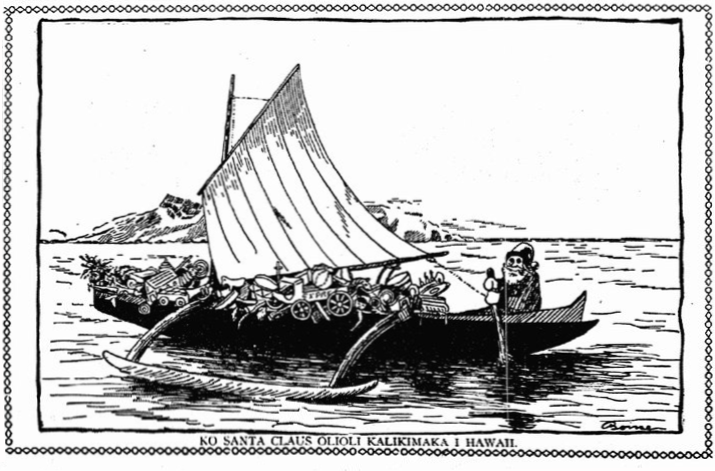
SANTA CLAUS’ CHRISTMAS JOY IN HAWAII.
[I hope Santa could fit this on his waa this year:
He malu ma ka honua, a he aloha no i kanaka.
Peace on earth and good will towards all people.]
(Kuokoa, 12/29/1905, p. 4)
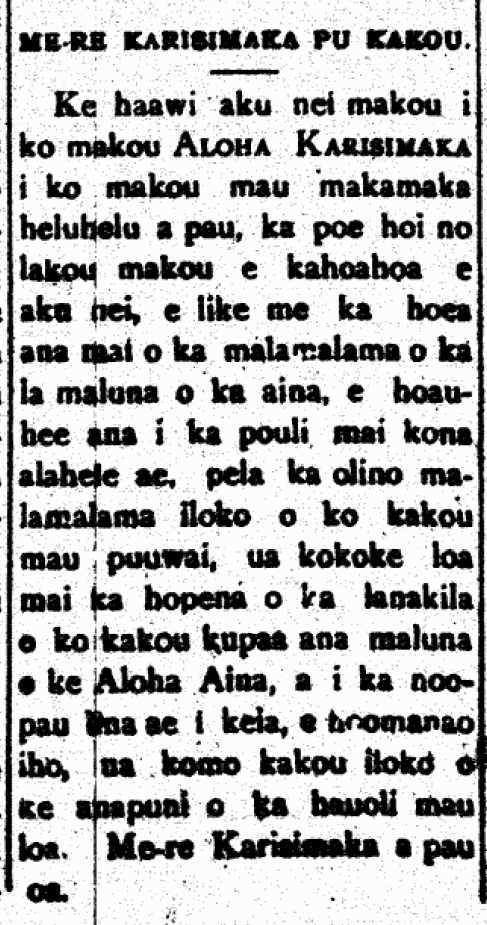
We give our ALOHA KARISIMAKA to all of our readers, to those people who we pray that just as the light of the sun reaches the land and dispels the darkness from its path, so too be the light shining in our hearts; we are near the conclusion of the victory in our loyalty behind the Aloha Aina [“Patriotism”], and after it is complete, remember that we will be surrounded by eternal happiness. Merry Christmas to all.
[I thought that this was just as fitting today as it was back then…]
(Aloha Aina, 12/26/1896, p. 2)
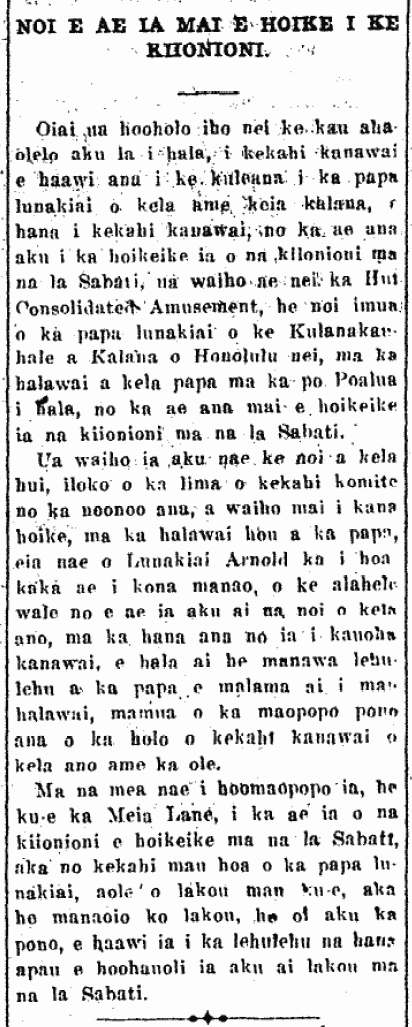
Being that a law was passed in this past legislative session giving the responsibility to the board of supervisors of each county to make laws to approve showing movies on the Sabbath; the Consolidated Amusement Company put a request before the board of supervisors of the City and County of Honolulu at the meeting of that board on this past Tuesday night, to ask for approval to show movies on Sundays.
But the request by that company was placed in the hands of a committee to consider, and to give its findings at the next meeting of the board; however Supervisor Arnold made his opinion clear that the only means by which those sorts of requests will be approved is by making an announcement of the law for which the board will spend much time holding meetings, before it is clear whether or not a law of that kind will pass or not.
From what is understood, Mayor Lane opposes the approval of movies being shown on Sunday, but some of the board members do not disapprove, but they believe that it is more important to give to the public all things that will make them happy on Sundays.
[Consolidated was entertaining Hawaii before 1917? That classic movie trailer we all are familiar with: Consolidated Amusement.]
(Kuokoa, 5/14/1915, p. 5)
This Monday, a Japanese went out fishing on his 33 feet boat. When he was outside of Makua, close by Waianae, while he was letting out his line to fish, and as he pulled, it was as if his hook was stuck, and this Japanese didn’t think that he had hooked a huge fish, but he figured it out when the fish began to drag him and his tiny boat. The fish was left to do as it pleased, being that he realized that he would not be able to pull in this huge fish because it was too strong to pull in the water. He followed after the fish for a long period of time, and when the Japanese saw that the fish had grown weak, that was when he pulled it to the side of his boat and returned to Honolulu nei.
When this fish reached the fish market, it was auctioned off and was sold to the Chinese with a $100 cash.
After going to the Chinese, it was immediately cut up into small pieces at 50¢ a pound, and at that price, the money got by the Chinese through retail sale was $265; the gross sale [?] was about $365; and so the Chinese who sold the fish profited about $265.
They say that everything was sold, nothing was left. In the fishing profession, Japanese make a lot of money, when it was work done by Hawaiians in years past; these days, the work has gone to these people. These people are not better prepared at fishing than Hawaiians, but the problem lies in that Hawaiians neglect this money-making profession, and because of this, it moved into the hands of other people.
Look at the great profit this Japanese made in one day, so therefore, O Hawaiians, you must keep up so that you will be prepared in this profession from now on, and that goes for farming as well—that is the only road to living comfortably and independently.
[The current “Hawaii State Record” seems to be recorded as 563 pounds. Take a look at Hawaii Fishing News.]
(Aloha Aina, 1/27/1917, p. 4)
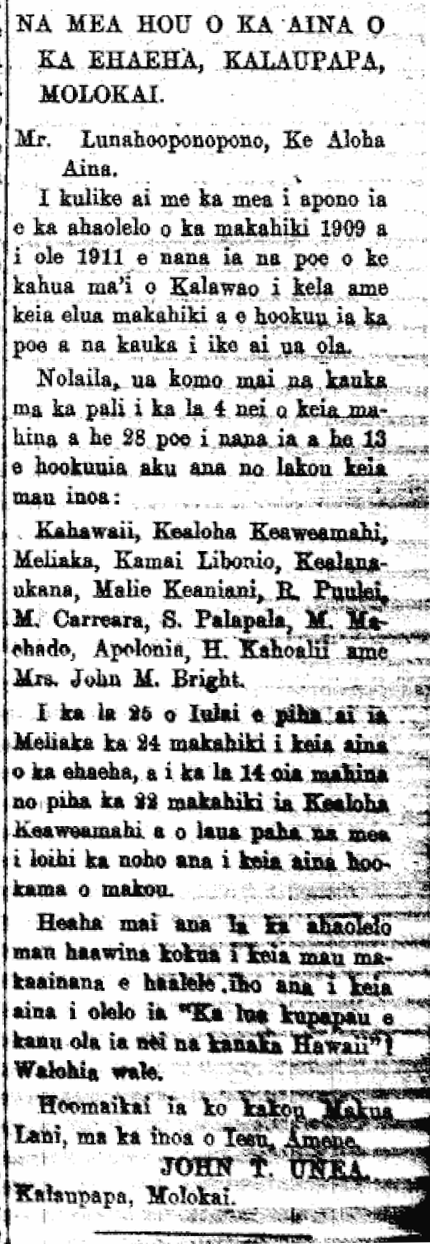
Mr. Editor, Ke Aloha Aina.
In accordance with what was approved of by the legislature of 1909 or 1911, the people of the patient colony of Kalawao will be examined every two years and the people who are determined by the doctor to be cured will be released.
Therefore, the doctors entered the pali on the 4th of this month, and 28 people were examined and 13 will be released, whose names are:
Kahawaii, Kealoha Keaweamahi, Meliaka, Kamai Libonio, Kealanaukana, Malie Keaniani, R. Puulei, M. Carreara, S. Palapala, M. Machado, Apolonia, H. Kahoalii and Mrs. John M. Bright.
On the 25th of July, Meliaka will have spent 24 years in this land of suffering, and on the 14th of that very month, Kealoha Keaweamahi will have spent 22 years, and the two of them are perhaps the ones who have lived the longest in this land which we adopt.
How will the legislature assist these citizens who will leave this land called, “The grave where Hawaiians are being buried alive”? How heart wrenching.
Blessed be our Heavenly Father, in the name of Jesus, Amen.
JOHN T. UNEA.
Kalaupapa, Molokai.
(Aloha Aina, 4/13/1917, p. 1)
We mostly just talk about words from the past here on this blog, but check this out… Words from today! And this could help you to better understand words from the past!! Go check them out, go!!!
From Oiwi TV
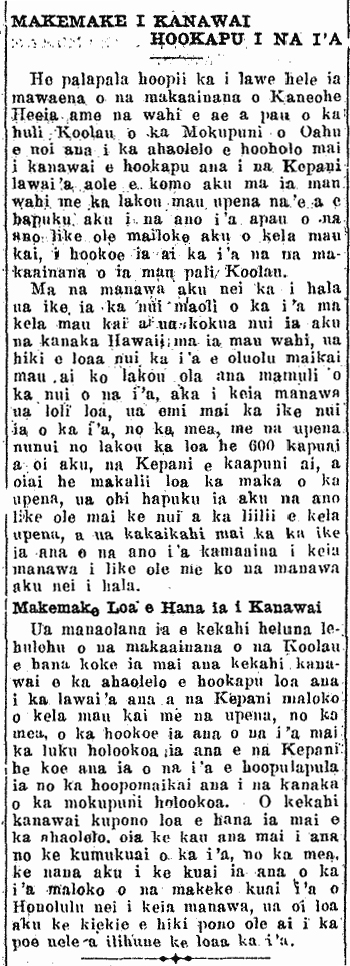
There was a petition carried around to the citizens of Kaneohe, Heeia, and all the other areas on the Koolau side of the island of Oahu which asks the legislature to pass a law prohibiting the Japanese fishermen from going into those areas with their small-meshed nets and indiscriminately taking all kinds of fish from those waters, so that fish will be left for the people of those Koolau cliffs.
In times past, there was an abundance of fish seen in those waters, and the Hawaiian people of the place were greatly blessed, in that fish were easily caught making life easy because of this bounty of fish; however, these days, it is changed, because with their huge nets which are 600 feet or more long, the Japanese go about, and being that the eyes of their nets are tiny, caught haphazardly are all sorts from big to small; and these day you hardly see fish that were regularly seen before.
It is hoped by a great number of the people of the (two) Koolau that a law is passed soon by the legislature banning the Japanese from fishing in those waters with nets, because it will save the fish from being wiped out by the Japanese, and fish will be left to propagate for the benefit of the people of the entire island. One very good law being worked on by the legislature, is the limiting of fish prices, because when you observe the selling of fish in fish markets of Honolulu nei these days, the prices are so high that the poor and indigent can’t afford it.
(Kuokoa, 2/19/1915, p. 2)
It seems that the fishing season for amaama is still the same today as it was back a hundred years ago…
ANNUAL CLOSURE OF ‘AMA ‘AMA (STRIPED MULLET)
SEASON TAKES EFFECT DECEMBER 1, 2011
There are many people in this Territory who donʻt know that they have been breaking the law since the first of this month, December; those law breakers are the owners of fish ponds, and those who sell amaama at markets. According to the law passed during this past Legislative Session of 1911, eating of amaama is banned from the 1st of December until the 1st of March.
Therefore, Attorney General Lindsay sent notice to the fish sellers at the markets that the sale of amaama over the counter will not be allowed anymore from next Tuesday on. Both ocean amaama and pond amaama are banned.
With this restriction on amaama during these months, there will be seen fish shortages in town on occasion in the future. It is known that during stormy times and when the sea is rough you canʻt get ocean fish. Amaama is a fish you can get all the time, in good and bad weather, and it is a favorite fish of the people.
This law prohibiting its sale to the public will make it disappear for several months before reappearing again. And dining tables in the upcoming holidays will be without this familiar fish of the land.
(Aloha Aina, 1/23/1911, p. 1)
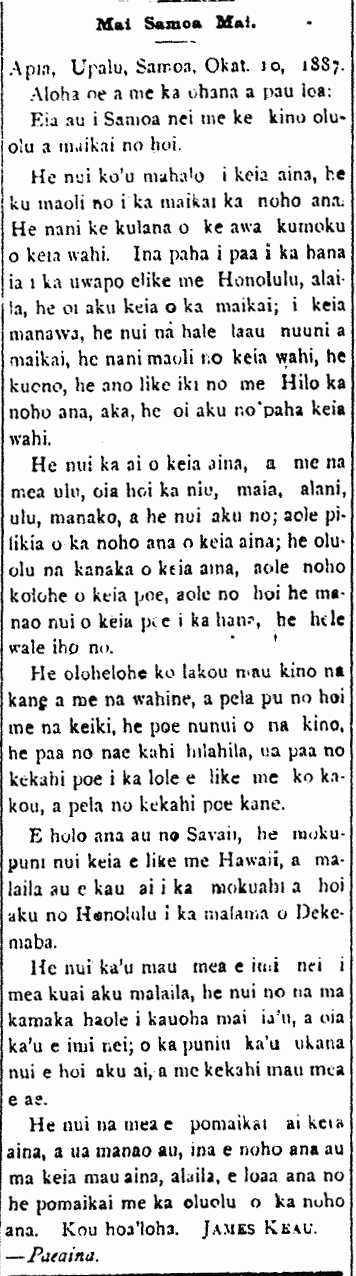
Apia, Upolu, Samoa, Oct. 19, 1887.
Aloha to you and your whole family:
Here I am in Samoa in good health.
I am very taken by this land; life is good. The lay of the harbor is fine. If it was built well like the harbor of Honolulu, then this one would be better; currently, there are many lovely huge wooden houses and life here is somewhat like that in Hilo, but perhaps it is better here.
There is much food in this land, and fruits like coconuts, bananas, oranges, breadfruit, mango, and much more; life is easy here; the people are pleasant, people do not make trouble, they do not think much of work, they just go about their way.
Their bodies are bare: the men, women, and children as well; they have big bodies, and they cover their privates; some of them wear clothes as we do, and so do some men [?]
I will be going to Savaii, a large island like Hawaii, and there I will board a steamship and return to Honolulu in the month of December.
I am looking for all sorts of things to sell there; many haole acquaintances put in orders, and that is what I look for; coconut bowls are mainly the goods that I bring back, as well as some other things.
There are many things which this place is blessed with, and I feel that if I were to live here, I will have a blissful existence. Your friend, JAMES KEAU.
—Paeaina [probably from the newspaper Ko Hawaii Paeaina (of which the May to December 1887 issues are missing…)]
(Kuokoa, 11/5/1887, p. 4)