Unknown's avatar

About nupepa

Just another place that posts random articles from the Hawaiian Newspapers! It would be awesome if this should become a space where open discussions happen on all topics written about in those papers!! And please note that these are definitely not polished translations, but are just drafts!!! [This blog is not affiliated with any organization and receives no funding. Statements made here should in now way be seen as a reflection on other organizations or people. All errors in interpretation are my own.]

Deaths from Kalawao, Molokai, 1887.

[Found under: “Correspondences from Friends”]

Kalawao, Molokai.

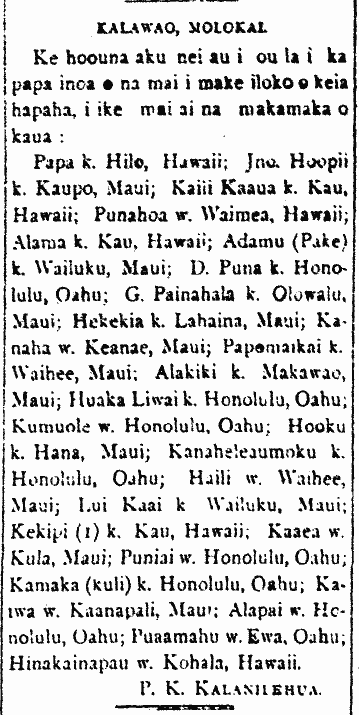
I am sending to you the list of names of the patients who died in this quarter, so that our friends may know:

Papa m. Hilo, Hawaii; Jno. Hoopii m. Kaupo, Maui; Kaiii Kaaua m. Kau, Hawaii; Punahoa f. Waimea, Hawaii; Alama m. Kau, Hawaii; Adamu (Chinese) m. Wailuku, Maui; D. Puna m. Honolulu, Oahu; G. Painahala m. Olowalu, Maui; Hekekia m. Lahaina, Maui; Kanaha f. Keanae, Maui; Paomaikai m. Waihee, Maui; Alakiki m. Makawao, Maui; Huaka Liwai m. Honolulu, Oahu; Kumuole f. Honolulu, Oahu; Hooku m. Hana, Maui; Kanaheleaumoku m. Honolulu, Oahu; Haili f. Waihee, Maui; Lui Kaai m. Wailuku, Maui; Kekipi (1) m. Kau, Hawaii; Kaaea f. Kula, Maui; Puniai f. Honolulu, Oahu; Kamaka (deaf) m. Honolulu, Oahu; Kaiwa f. Kaanapali, Maui; Alapai f. Honolulu, Oahu; Puaamahu f. Ewa, Oahu; Hinakainapau f. Kohala, Hawaii.

P. K. KALANILEHUA.

[This is one of the better lists, giving not only name, but whether male or female, and also where they were from (although the death date is not given)! Many times, there is just a list of names given…]

(Kuokoa, 11/5/1887, p. 4)
KALAWAO, MOLOKAI.

Ka Nupepa Kuokoa, Buke XXVI, Helu 45, Aoao 4. Novemaba 5, 1887.
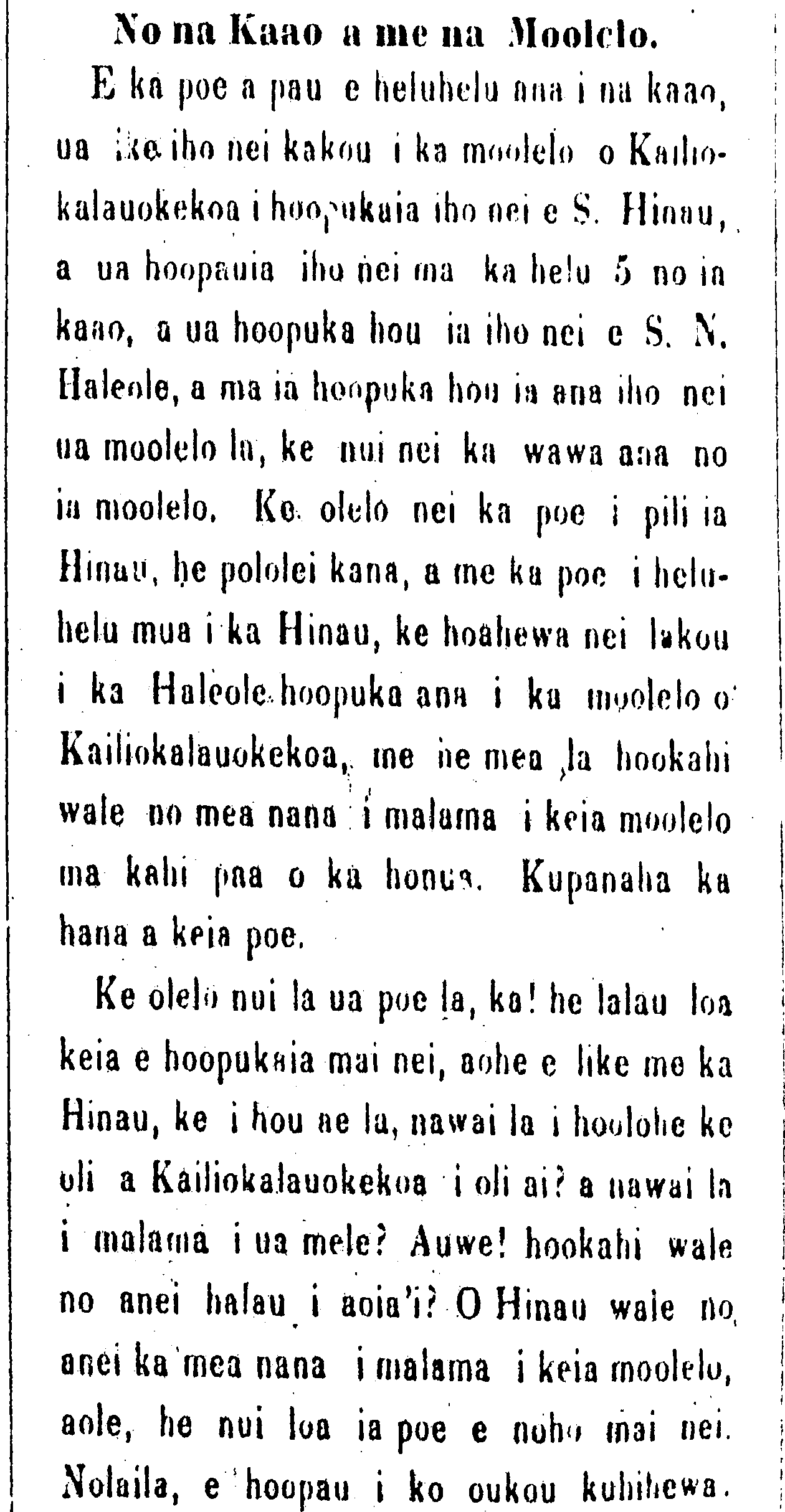
More on traditional stories, and variation within, 1862.

About Kaao and Moolelo.

O Readers of kaao, we have seen the story of Kailiokalauokekoa that was published by S. Hinau, and it was just completed with the 5th installment [this series, “He Moolelo no Kailiokalauokekoa,” probably started on 10/24/1861 (which is missing) and S. Hinau closes his telling on 12/5/1861]; S. N. Haleole has just started that story again [which begins with genealogy, on 12/12/1861, restarts with installment 6 on 12/19/1861, and probably ended with installment 10, on 1/30/1862 (which sadly is also missing)], and with that retelling of the story, there has been quite the uproar. Those who are with Hinau say that his is correct, and those that read Hinau’s first fault Haleole’s publishing of Kailiokalauokekoa, as if there is but one person who retained this story on this solid earth. The actions of these people are unbelievable.

Those people go on and on saying, “oh please! this series is so misguided and not like Hinau’s”; further more, “Who has heard those oli which were chanted by Kailiokalauokekoa? and who kept those mele?” Auwe! Is there only one school where it was taught? Is it only Hinau who has kept this story? No, there are many people today. So stop with your unfounded ideas.

(Hoku o ka Pakipika, 1/16/1862)

No na Kaao a me na Moolelo.

Ka Hoku o ka Pakipika, Buke 1, Helu 17, Aoao 4. Ianuari 16, 1862.

On traditional stories and finishing properly what you begin, 1862.

Words of Advice.

Before you, all those who want to write and publish stories (mooolelo and kaao) in the Hoku o ka Pakipika: you must all write the whole story from the beginning all the way until the end. Because it will be a waste of time to start printing before it is completed, as Kawelo by the person who submitted it, was printed in the Hoku o ka Pakipika [“Mooolelo no Kawelo” by S. K. Kawailiula from 9/26/1861 to 12/5/1861—5 helu total].

And as for the person who submitted the story of Mokulehua, he did not get to the end [“He wahi Kaao no Mokulehua” begins on 11/28/1861, and in the Helu 2 (12/5/1861), there is a note from the editor at the bottom, “Send in more of the story of Mokulehua; make it quick lest the Hoku o ka Pakipika give you a kick.” Helu 3 in the next issue (12/12/1861) is very short, and there is a long hiatus until well after this letter is published. It finally reappears as “He Moolelo no Mokulehua on 3/13/1862 to 3/27/1862, 6 Helu in total, by B. K. H.**.]; and so too of some other kaao and mooolelo that were published partially in this newspaper; therefore, i feel that it is necessary for the editor of the Hoku o ka Pakipika to require that those who write in mooolelo and kaao to complete it and then to put it before the editor, and then it can be printed from beginning to end, and it is right and good, and everyone who reads it will be satisfied.

Now then! all you people who write in mooolelo and kaao, don’t take this as a critique; no, it is just clarification, so that you all know.

Now then! let’s all finish everything we start properly, as some of us were taught by our parents: don’t do things leaving off the beginning, cutting off the top like a maimed one, imitating Lonomuku. What is necessary is to make it well-rooted, as are some of the mooolelo and kaao that are being published, and that is what what people all over really want. This is just encouragement to all my friends living throughout these Hawaiian islands. With aloha to the Hoku o ka Pakipika. I am done, Kaumakapili’s child returns, as the fields are tranquil with birds and it is eventide.  J. D. KAUAKOIAWE.

Kaumakapili, Honolulu, Dec. 24, 1861.

(Hoku o ka Pakipika, 1/2/1862, p. 4)

He Olelo ao.

Ka Hoku o ka Pakipika, Buke 1, Helu 15, Aoao 4. Ianuari 2, 1862.

Happy Birthday Pauahi, Ka Wahine Hele La o Kaiona! 1911.

[Found under: “Local News”]

This past Tuesday [100 years ago, on 12/19/1911], the students of the Kamehameha Schools celebrated the birthday of Mrs. Bernice Pauahi Bishop; there were a number of cars which brought them to the cemetery at Maemae; and Queen Liliuokalani was amongst the people who arrived to see the ceremonies held at the cemetery.

(Kuokoa, 12/22/1911, p. 8)

Ma ka Poalua nei i hoomanao ae...

Ka Nupepa Kuokoa, Buke XLVII, Helu 51, Aoao 8. Dekemaba 22, 1911.

Shark attack and heartless bystanders, 1872.

Escaped from almost being killed by a shark.—From Mr. Kahaawi, the Deputy Sheriff of South Kohala, Hawaii, we received this shark attack story at Kawaihae: On the 15th of this month, a Friday, an old man went fishing aboard his canoe, his name is Kaholo, from Kawaihae. It was not farther than a quarter mile away from land, while he continued paddling his canoe, a huge shark came up from the sea, its lower jaw bit up from the bottom of the waa and its upper jaw snapped down from the top edge of the waa, while some of the rows of its teeth caught the skin of his thigh, and he was pulled into the ocean. The man went down into the water with the shark, but here is the strange thing, the shark didnʻt bite him more. The man hurriedly got back on the waa and grabbed his paddle, at the same time the shark came up again; the man fended off the head of the shark with his hand. When the man got aboard the waa, the shark floated itself atop of the water and then disappeared. There were other fishermen on a canoe at the time, and when the two of them saw him, they paddled over to where Kaholo was floating. Here is how very bitter they were, they didnʻt come by to help the hurt man, they just asked him to give them some bait, and when they got it they just left to go fishing. Kaholo asked for one of them to help him paddle to shore, since he was in much pain and couldnʻt paddle well, but neither of them agreed. Because there was no one to help him, he kept paddling until he almost fainted from losing so much blood; he drifted and paddled until reaching land. The one who told us this news was the very one who stitched up the wound. He said, the fleshy part of the thigh was torn open and was dangling; it was cut [?] from the knee of the left leg up to the buttocks.

(Au Okoa, 3/28/1872, p. 2)

Pakele mai pau i ka mano.

Ke Au Okoa, Buke VII, Helu 50, Aoao 2. Maraki 28, 1872.

On riddles and pen names and such, 1925.

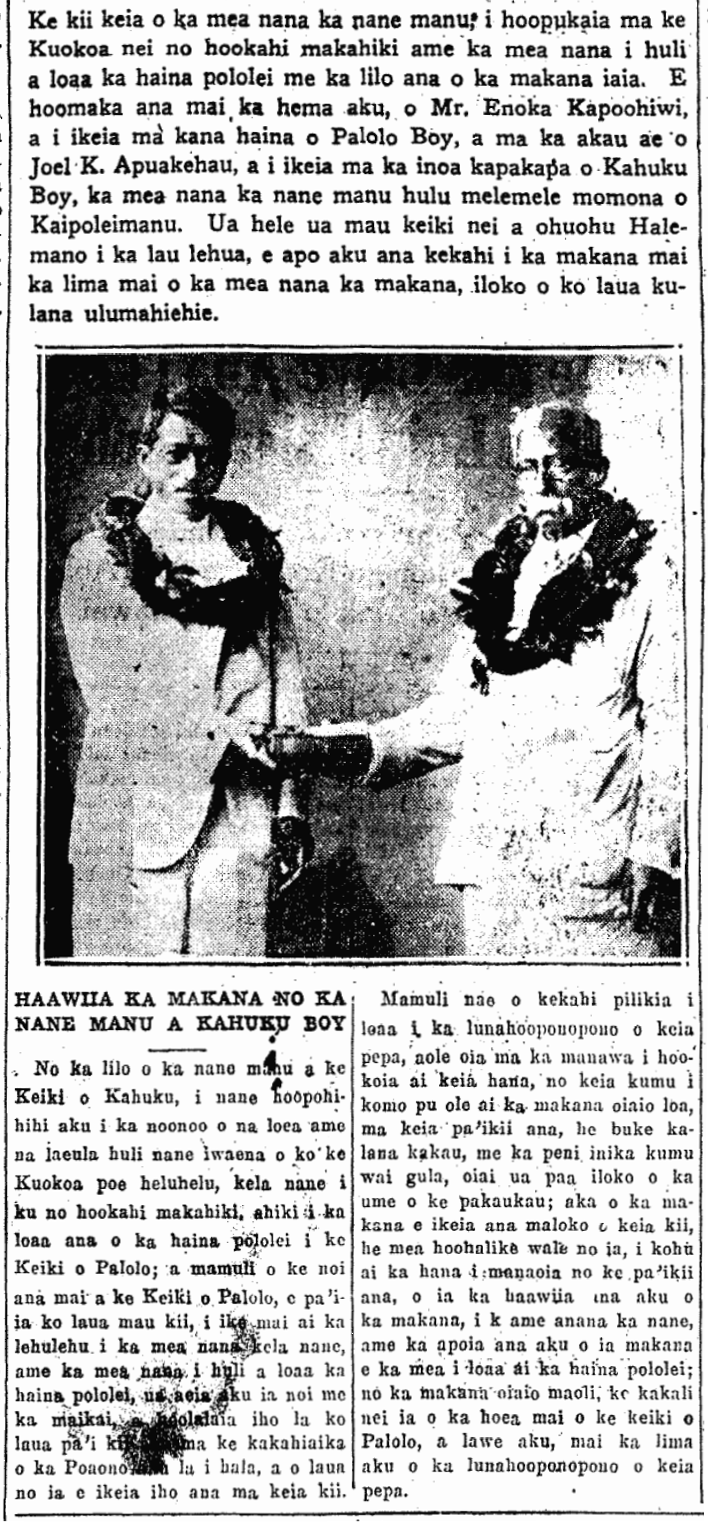
This is a picture of the person whose bird riddle (nane) it was that was published in the Kuokoa for a year, and of the one who searched and found the correct answer and won the prize. Starting from the left is Mr. Enoka Kapoohiwi, who is known by his answer as Palolo Boy; and to his right is Joel K. Apuakehau, and he is known by his pen name, Kahuku Boy, the one to whom belongs the sweet yellow-feathered bird riddle of Kaipoleimanu. These boys are all decked out, as one receives the prize from the hands of the other who offered the prize, as they pose festively.

THE PRIZE IS AWARDED FOR THE BIRD NANE OF KAHUKU BOY

Because the nane of Kahuku Boy was one which befuddled the experts and well-trained riddle solvers amongst the readership of the Kuokoa, that nane which stood for over year before the correct answer was found by the boy from Palolo; and because it was requested by that Palolo Boy, that a picture be taken of the two of them so that everyone might see the person who composed the nane and the one who searched and found the correct answer; his request was warmly fulfilled, and their picture taking was scheduled for the morning of this past Saturday, and it is the two of them who is seen in the photo.

Because of some difficulties encountered by the editor of this paper, he wasn’t present at the time this event was carried out, and as a result, the real prize does not appear in this photo taking (it was a writing book and a gold-colored pen which was put away in a drawer); the prize you see in the picture is just a stand in so that the desired picture could be shot, that being the presenting of the prize by the one who composed the nane, and the accepting of the prize by the one who had the correct answer; as for the real prize, we await the arrival of that boy from Palolo, to receive it from the hands of the editor of this paper.

[Nane are seen all through the life of the Hawaiian-Language Newspapers. One person would send in a nane to the editor, along with the correct answer. Readers of the paper would then send in their answers. The newspaper editor would often respond to incorrect answers with funny retorts spurring on people to think harder.]

[Pen names seem to naturally go along with nane (although there were many people who used them for submitting letter, articles, or poetry in general). Just a few examples are Kolu Lima Hiku, Hakalau Boy, Waihanau Boy, Sionala, Waiomao Boy, and Kakelakuikealopali. Without other information, like the article above, we may never know their real names. Perhaps the most famous of them all was Z. P. K. Kawaikaumaiikamakaokaopua, which was the pen name of Z. P. K. Kalokuokamaile.]

(Kuokoa, 7/23/1925, p. 2)

HAAWIIA KA MAKANA NO KA NANE MANU A KAHUKU BOY

Ka Nupepa Kuokoa, Buke LXIV, Helu 30, Aoao 2. Iulai 23, 1925.

A view of the current state and the future of Hawaii, 1916.

What is to Become of Hawaii?

(Written for the Puuhonua.)

As time goes on, the Hawaiian People move backwards.

Why is this?

First. Because they are not united. Because of the lack of aloha for their own. Because they do not support each other. Because they do not help one another.

Second. Because of greed. Because of wastefulness. Because of the love of alcohol. Because of not being thrifty. For their not thinking of and neglecting  God.

It is clear that the Hawaiian people are shoved up against a wall; as the malihini white-skinned people come in droves to this land, so are the Hawaiians People pushed against a wall, they are new, but already they have settled themselves in; there are only but a few years left, you can count them on your fingers; the Hawaiians will have no Power in Government of their beloved land which God bestowed upon them.

Therefore, now is the time to stand firm, to think, and to come together, to give aloha to your own people, to be courageous, to economize, to be vigilant, to help each other, to go down on bended knee and ask God to free us from that whirlpool of naught, and to bring us to state of plenty.

Just as King Kauikeaouli proclaimed to the Hawaiian Nation, about kneeling down on bended knee and praising the Glorious Name of the Lord of hosts, to restore the Sovereignty of the Land (the Flag), that was stripped away by George Paulette, and what came about was that the flag was returned without ever being troubled again by Great Britain; so too with this.

For there is no time left to dally; we’ve lost our independence, we have no Power for Governmental Reform, as a result of our neglect, waste, and so forth; and our beloved Mother Tongue will be lost for all times. Hawaiians are being selected for positions under the Government.

Therefore, if you possess some aloha, some affection, some sentiment for the lifestyle of our People, now is the time; let us join in thought, in cooperation, like one great rope made of many strands, until we are able to pull massive things, like huge islands; that is what we need to do in these ongoing times.

ALOHA LAHUI [Love for the People].
Honolulu, July 5, 1916.

(Puuhonua, 7/7/1916, p. 4)

E Aha ia Ana Hawaii?

Ka Puuhonua, Buke III, Helu 25, Aoao 4. Iulai 7, 1916.

Opposition to Hula in West Coast of the U. S., 1916.

Opposition to Hawaiian Hula in the West.

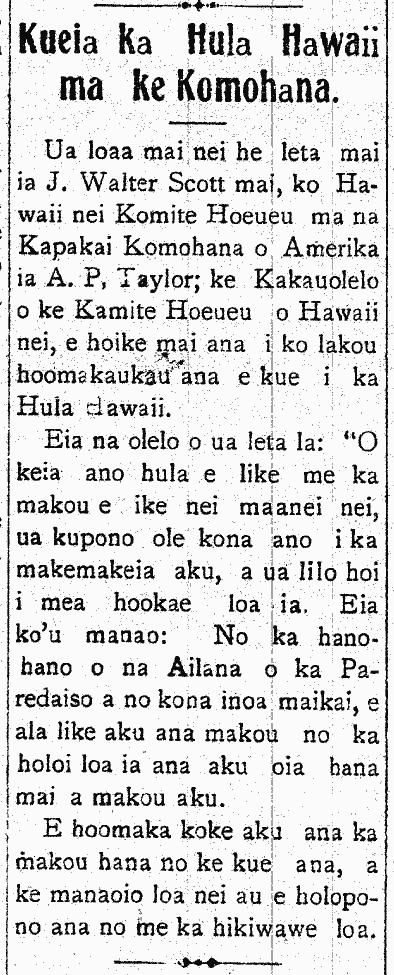
A. P. Taylor, the Secretary of the Promotion Committee of Hawaii, received a letter from J. Walter Scott, the representative of the Promotion Committee on the West Coast of America, speaking of their preparations to oppose Hawaiian Hula.

Here is what was said in the letter: “The kind of hula that we are witnessing here, it is not according to what is wanted, and is something that has become abhorred. This is what I think: For the honor of the Islands of Paradise, and for its good name, we rise as one to obliterate for good that act from amongst us.

We will begin this opposition immediately, and I trust it will move forward in no time.

(Puuhonua, 9/1/1916, p. 5)

Kueia ka Hula Hawaii ma ke Komohana.

Ka Puuhonua, Buke III, Helu 33, Aoao 5. Sepatemaba 1, 1916.

Pretty cool map of Honolulu, 1845.

HONOLULU.

In the picture above, clear are the yards and streets, and the layout of Honolulu, the great city of Hawaii. Here is where the King lives permanently, as well as the Prime Minister, and the Nation’s Legislature.

By the numbers on the picture, each place is clearly recognized, Thusly:

1. Residence of the King.

2. Fort, where the Governor lives.

3. Church of the King at Kawaiahao, where Armstrong preaches salvation.

4. Catholic Church, of Maigret them.

5. Smith’s Church at Kaumakapili.

6. Haole church at Polelewa, of Damon

7. School of the Young Chiefs

8. Hotel, “welcoming house”.

9. Government building at Honolulu.

10. Government printing house.

11. Haole school.

12. Store of Brewer them.

13. Store of Pele [Bell?] them.

14. Infirmary for the sailors from America.

15. Infirmary for the sailors from Britain.

16. Infirmary for the sailors from France.

17. British Consulate.

18. American Consulate.

19. French Consulate.

20. Building of the American diplomats.

21. House of Damon the pastor of the sailors.

22. Street going to Nuuanu.

23. Street going to Ewa.

24. Street going to Waikiki.

25. Inner Harbor.

26. French Hotel.

27. Place of the American missionaries.

This is the number of stores in Honolulu.

Clothiers, 11.

Small shops, 14.

Auction houses, 2.

Hotels, 5.

Establishments not selling liquor, 6

Saloons, 6.

(Elele, 10/7/1845, pp. 105–106.)

HONOLULU.

Ka Elele, Buke 1, Pepa 14, Aoao 105-106. Okatoba 7, 1845.

Kaena Song (Kuu Lei Momi), 1913

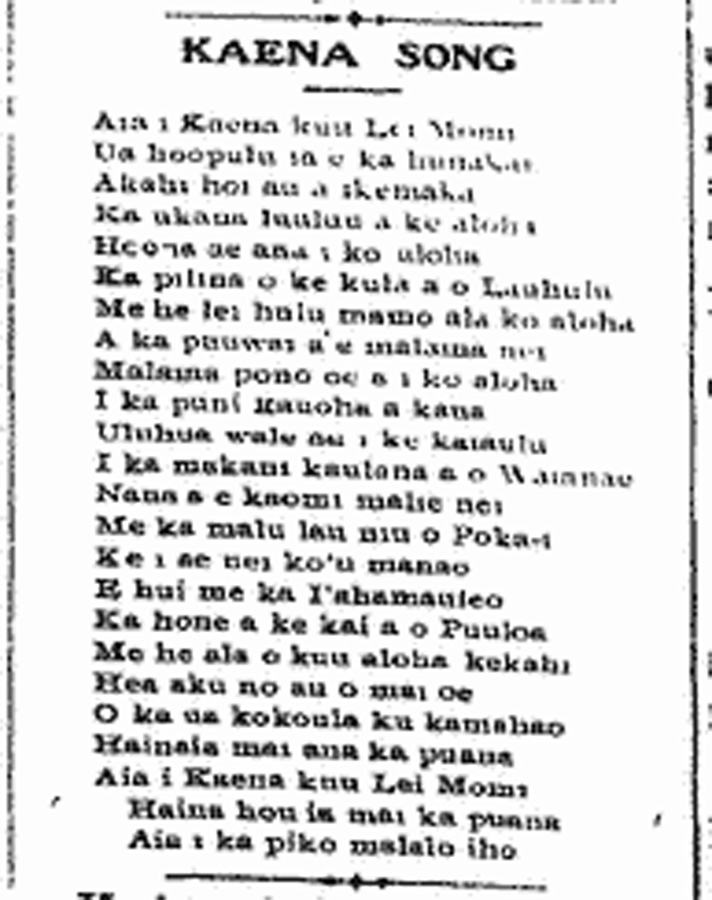
KAENA SONG

Aia i Kaena kuu Lei Momi

Ua hoopulu ia e ka hunakai

Akahi hoi au a ikemaka

Ka ukana luuluu a ke aloha

Hoona ae ana i ko aloha

Ka pilina o ke kula a o Lauhulu

Me he lei hulu mamo ala ko aloha

A ka puuwai a e malama nei

Malama pono oe a i ko aloha

I ka puni kauoha a kaua

Uluhua wale au i ke kaiaulu

I ka makani kaulana a o Waianae

Nana a e kaomi malie nei

Me ka malu lau niu o Poka-i

Ke i ae nei ko’u manao

E hui me ka I’ahamauleo

Ka hone a ke kai a o Puuloa

Me he ala o kuu aloha kekahi

Hea aku no au o mai oe

O ka ua kokoula ku kamahao

Hainaia mai ana ka puana

Aia i Kaena kuu Lei Momi

Haina hou ia mai ka puana

Aia i ka piko malalo iho

[Versions of familiar mele like this one (attributed to Samuel K. Halstead), and many others not heard today, are found all over the newspapers! There is so much that the haku mele of today can learn from them, if they would just look back…]

[A large portion of the digital images for this paper are illegible, and hopefully they will be reshot before it is too late.]

(Holomua, 12/20/1913, p. 4)

KAENA SONG

Ka Holomua, Buke I, Helu 12, Aoao 4. Dekemaba 20, 1913.