Rabbits for the Prince, 1861.

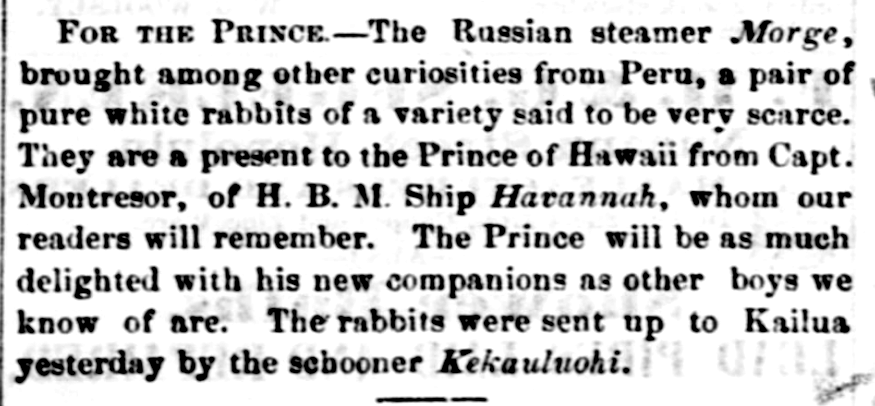
For the Prince—The Russian steamer Morge, brought among other curiosities from Peru, a pair of pure white rabbits of a variety said to be very scarce. They are a present to the Prince of Hawaii from Capt. Montresor, of H. B. M. Ship Havannah, whom our readers will remember. The Prince will be as much delighted with his new companions as other boys we know of are. The rabbits were sent up to Kailua yesterday by the schooner Kekauluohi.

[It is very interesting to compare this article with a Hawaiian-Language one found in the Kuokoa on 12/16/1861!]

(Pacific Commercial Advertiser, 12/5/1861, p. 2)

For the Prince.

The Pacific Commercial Advertiser, Volume VI, Number 23, Page 2. December 5, 1861.

Tahitian mele for La Kuokoa, 1861.

Songs of Polapola

Aue oe tau hoa hele e,
E fiteri tou e,
Tai ta pea ta te fa tu,
O Iesu ta haa maitai.

Eau ia oe te oa oa,
Eau ia oe te haa maitai,
Ia oe nae te fei a haa wale,
I loto i te au ahi oia nae.

Aue oe e ta Moi e,
He aroha to oe,
Mai horoa i te hau ia Mareta,
E ta pea maitai.

Iaorana oe e ta Hatu o Hawaii,
Tai haapao ia tai haapao hia,
E mono i tooe toloa.

Iaorana oe e Ema,
Te Alii Vahine e,
Faatere maitai to otou haue,
E mau te ora o te Alii e amuri no atu.

Auwe oe tou hoa he re e,
Pi te ri tou e tei ta pea i ta te fatu,
Oietu te parau maitai,
eau ia oe te oaoa,
Eau ia oe te haa maitai,
Ia oto nae te feia faa vare,
I roto o te au ahi oia nae.

Auwe oe e ta Moi e,
E aroha to oe e,
Mai ho roa i te hau,
Ia Amerita,
E ta pea maitai mai,
Iaorana oe e ta Hatu Hawaii e,
Tei haa pao hia i mano to oe to roa,
Iaorana oe e Ema te Rii vahine e,
Faa te re maitai to otou hau,
E mau te aroha o te Rii e,
Ea muri noatu.

Himeni 27.

1 Te ra, te aoae, te fetia,
Maramarama ai te ao,
Maitai atoa ai te po,
Na te Atua i faaue iho,

2 Ia ara, e ia moe tatou,
Te merahi maitai tei mau,
To ratou tiai ia tatou,
Aore e ino i roohia mai.

3 Te rai anaana i nia ae,
Te aihere rii i raro nei,
Te miti atoa e ati ae,
Na te Atua i hamani.

4 Te puapua, noanoa,
Unauna ai te raau nei,
Te raau maa na tatou a,
Na te Atua i horoa mai.

5 Te ata i pee, te ua i pou,
Te matai farara e oraʻi,
Te manu, i rere nei,
Te mau puaa nana anae,

6. Te ia e tere i te tai,
Tei nee i raro i te repo,
Tatiou atoa te taata nei,
Ohipa na te Atua mau.

7 Ia hamanihia ra tatou
Ia hau tu teie i te maitai,
E ia ra oe ta te Arii parau,
Ma te aau au i a rue ai.

[These are some of the mele performed on the 28th of November, 1861, at Kawaiahao Church in celebration of Independence Day.

For more Tahitian mele, see this composition of Ninito and Manaiula Sumner for Victoria Kaahumanu from 1862.]

(Kuokoa, 12/2/1861, p. 2)

He Mele Polapola.

Ka Nupepa Kuokoa, Buke I, Helu 4, Aoao 2. Dekemaba 2, 1861.

Constitution of the Hawaiian Patriotic League, in English, 1893.

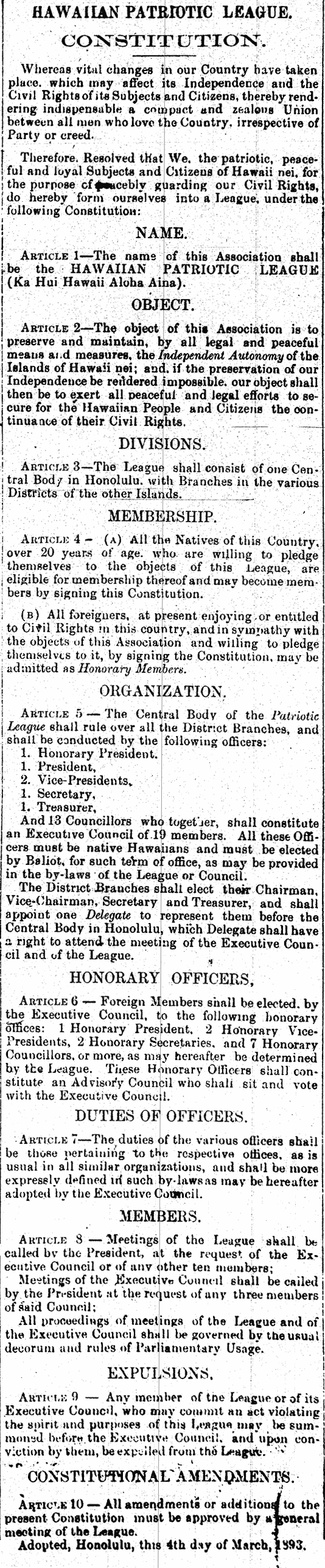
HAWAIIAN PATRIOTIC LEAGUE.

CONSTITUTION.

Whereas vital changes in our Country have taken place, which may affect its Independence and the Civil Rights of its Subjects and Citizens, thereby rendering indispensable a compact and zealous Union between all men who love the Country, irrespective of Party or creed.

Therefore, Resolved that We, the patriotic, peaceful and loyal Subjects and Citizens of Hawaii nei, for the purpose of peaceably guarding our Civil Rights, do hereby form ourselves into a League, under the following Constitution:

NAME.

Article 1—The name of this Association shall be the HAWAIIAN PATRIOTIC LEAGUE (Ka Hui Hawaii Aloha AIna).

OBJECT.

Article 2—The object of this Association is to preserve and maintain, by all legal and peaceful means and measures, the Independent Autonomy of the Islands of Hawaii nei; and, if the preservation of our Independence be rendered impossible, our object shall then be to exert all peaceful and legal efforts to secure for the Hawaiian People and Citizens the continuance of their Civil Rights.

DIVISIONS.

Article 3—The League shall consist of one Central Body in Honolulu, with Branches in the various Districts of the other Islands.

MEMBERSHIP.

Article 4—(A) All the Natives of this Country, over 20 years of age, who are willing to pledge themselves to the objects of this League, are eligible for membership thereof and may become members by signing this Constitution.

(B) All foreigners, at present enjoying or entitled to Civil Rights in this country, and in sympathy with the objects of this Association and willing to pledge themselves to it, by signing the Constitution, may be admitted as Honorary Members.

ORGANIZATION.

Article 5—The Central Body of the Patriotic League shall rule over all the District Branches , and shall be conducted by the following officers:

1. Honorary President,

1. President,

2. Vice-Presidents,

1. Secretary,

1. Treasurer,

And 13 Councillors who together, shall constitute an Executive Council of 19 members. All these Officers must be native Hawaiians and must be elected by Ballot, for such term of office, as may be provided in the by-laws of the League or Council.

The District Branches shall elect their Chairman, Vice-Chairman, Secretary and Treasurer, and shall appoint one Delegate to represent them before the Central Body in Honolulu, which Delegate shall have a right to attend the meeting of the Executive Council and of the League.

HONORARY OFFICERS,

Article 6—Foreign Members shall be elected by the Executive Council, to the following honorary offices: 1 Honorary President, 2 Honorary Vice-Presidents, 2 Honorary Secretaries, and 7 Honorary Councillors, or more, as may hereafter be determined by the League. These Honorary Officers shall constitute and Advisory Council who shall sit and vote with the Executive Council.

DUTIES OF OFFICERS.

Article 7—The duties of the various officers shall be those pertaining to the respective offices, as is usual in all similar organizations, and shall be more expressly defined in such by-laws as may be hereafter adopted by the Executive Council.

MEMBERS.

Article 8—Meetings of the League shall be called by the President, at the request of the Executive Council or of any other ten members;

Meetings of the Executive Council shall be called by the President at the request of any three members of said Council;

All proceeding s of meetings of the League and of the Executive Council shall be governed by the usual decorum and rules of Parliamentary Usage.

EXPULSIONS.

Article 9—Any member of the League or of its Executive Council, who may commit an act violating the spirit and purposes of this League may be summoned before the Executive Council, and upon conviction by them, be expelled from the League.

CONSTITUTIONAL AMENDMENTS.

Article 10—All amendments or additions to the present Constitution must be approved by a general meeting of the League.

Adopted, Honolulu, this 4th day of March, 1893.

[See the Hawaiian-Language Constitution here!]

(Leo o ka Lahui, 3/22/1893, p. 3)

HAWAIIAN PATRIOTIC LEAGUE.

Ka Leo o ka Lahui, Buke II, Helu 667, Aoao 3. Maraki 22, 1893.

Constitution of the Hawaiian Patriotic League, in Hawaiian, 1893.

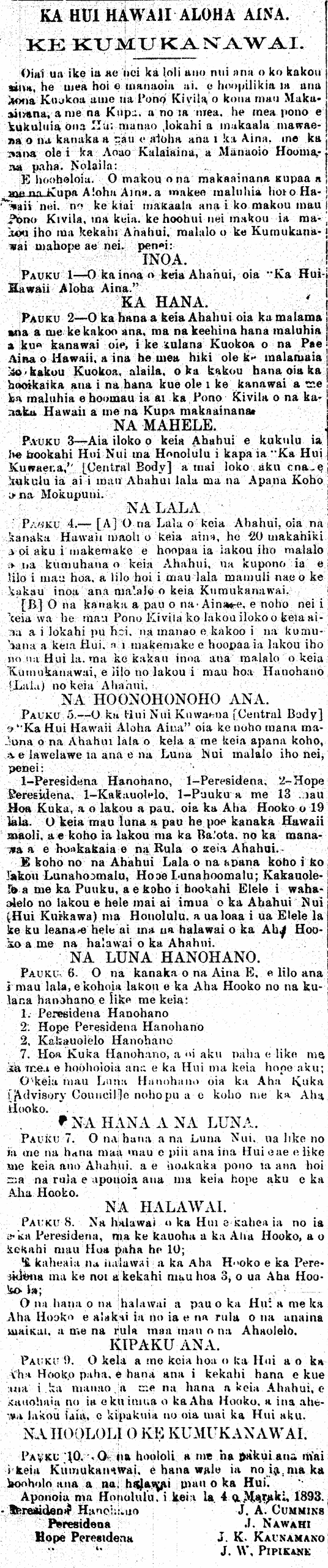
KA HUI HAWAII ALOHA AINA.

KE KUMUKANAWAI.

Oiai ua ike ia ae nei ka loli ano nui ana o ko kakou aina, he mea hoi e manaoia ai, e hoopilikia ia ana kona Kuokoa ame na Pono Kivila o kona mau Makaainana, a me na Kupa, a no ia mea, he mea pono e kukuluia ona Hui manao lokahi a makaala mawaena o na kanaka a pau e aloha ana i ka Aina, me ka nana ole i ka Aoao Kalaiaina, a Manaoio Hoomana paha. Nolaila:

E hooholoia. O makou o na makaainana kupaa a me na Kupa Aloha Aina a makee maluhia hoi o Hawaii nei, no ke kiai makaala ana i ko makou mau Pono Kivila, ma keia, ke hoohui nei makou ia makou iho ma kekahi Ahahui, malalo o ke Kumukanawai mahope ae nei. penei:

INOA.

Pauku 1—O ka inoa o keia Ahahui, oia “Ka Hui Hawaii Aloha Aina.”

KA HANA.

Pauku 2—O ka hana a keia Ahahui oia ka malama ana a me ke kakoo ana, ma na keehina hana maluhia a kue kanawai ole, i ke kulana Kuokoa o na Pae Aina o Hawaii, a ina he mea hiki ole ke malamaia ko lakou Kuokoa, alaila, o ka kakou hana oia ka hooikaika ana i na hana kue ole i ke kanawai a me ka maluhia e hoomau ia ai ka Pono Kivila o na kanaka Hawaii a me na Kupa makaainana.

NA MAHELE.

Pauku 3—Aia iloko o keia Ahahui e kukulu ia he hookahi Hui Nui ma Honolulu i kapa ia “Ka Hui Kuwaena,” [Central Body] a mai loko aku ona e kukulu ia ai i ma Ahahui lala ma na Apana Koho o na Mokupuni.

NA LALA.

Pauku 4—[A] O na Lala o keia Ahahui, oia na kanaka Hawaii maoli o keia aina, he 20 makahiki a oi aku i makemake e hoopaa ia lakou iho maloko o na kumuhana o keia Ahahui, ua kupono ia e lilo i mau hoa, a lilo hoi i mau lala mamuli nae o ke kakau inoa ana malalo o keia Kumukanawai.

[B] O na kanaka a pau o na Aina e, e noho nei i keia wa he mau Pono Kivila ko lakou iloko o keia aina a i lokahi pu hoi, na manao e kakoo i na kumuhana a keia Hui, a i makemake e hoopaa ia lakou iho no ua Hui la, ma ke kakau inoa ana malalo o keia Kumukanawai, e lilo no lakou i mau hoa Hanohano (Lala) no keia Ahahui.

NA HOONOHONOHO ANA.

Pauku 5—O ka Hui Nui Kuwaena [Central Body] o “Ka Hui Hawaii Aloha Aina” oia ke noho mana maluna o na Ahahui lala o kela a me keia apana koho, a e lawelawe ia ana e na Luna Nui malalo iho nei, penei:

1—Peresidena Hanohano, 1—Peresidena, 2—Hope Peresidena, 1—Kakauolelo, 1—Puuku a me 13 mau Hoa Kuka, a o lakou a pau, oia ka Aha Hooko o 19 lala. O keia mau luna a pau he poe kanaka Hawaii maoli, a e koho ia lakou ma ka Balota, no ka manawa a e hoakakaia e na Rula o keia Ahahui.

E koho no na Ahahui Lala o na apana koho i ko lakou Lunahoomalu, Hope Lunahoomalu; Kakauolelo a me ka Puuku, a e koho i hookahi Elele i wahaolelo no lakou e hele mai ai imua o ka Ahahui Nui (Hui Kuikawa) ma Honolulu, a ua loaa i ua Elele la ke kuleana e hele ai ma na halawai o ka Aha Hooko a me na halawai o ka Ahahui.

NA LUNA HANOHANO.

Pauku 6. O na kanaka o na Aina E, e lilo ana i mau lala, e kohoia lakou e ka Aha Hooko no na kulana hanohano e like me keia:

1. Peresidena Hanohano

2. Hope Peresidena Hanohano

2. Kakauolelo Hanohano

7. Hoa Kuka Hanohano, a oi aku paha e like me ka mea e hooholoia ana e ka Hui ma keia hope aku;

O keia mau Luna Hanohano oia ka Aha Kuka [Advisory Council] e noho pu a e koho me ka Aha Hooko.

NA HANA A NA LUNA.

Pauku 7. O na hana a na Luna Nui, ua like no ia me na hana maa mau e pili ana ina Hui e ae e like me keia ano Ahahui, a e hoakaka pono ia ana hoi ma na rula e aponoia ana ma keia hope aku e ka Aha Hooko.

NA HALAWAI.

Pauku 8. Na halawai o ka Hui e kahea ia no ia e ka Peresidena, ma ke kauoha a ka Aha Hooko, a o kekahi mau Hoa paha he 10;

E kaheaia na halawai a ka Aha Hooko e ka Peresidena ma ke noi a kekahi mau hoa 3, o ua Aha Hooko la;

O na hana o na halawai a pau o ka Hui a me ka Aha Hooko e alakai ia no ia e na rula o na anaina maikai, a me na rula maa mau o na Ahaolelo.

KIPAKU ANA.

Pauku 9. O kela a me keia hoa o ka Hui a o ka Aha Hooko paha, e hana ana i kekahi hana e kue ana i ka manao a me na hana a keia Ahahui, e kauohaia no ia e ku imua o ka Aha Hooko, a ina ahewa lakou iaia, e kipakuia no oia ma ka Hui aku.

NA HOOLOLI O KE KUMUKANAWAI.

Pauku 10. O na hoololi a me na pakui ana mai i keia Kumukanawai, e  hana wale ia no ia ma ka hooholo ana a na halawai mau o ka Hui.

Aponoia ma Honolulu, i keia la 4 o Maraki, 1893.

Peresidena Hanohano  J. A. Cummins

Peresidena  J. Nawahi

Hope Peresidena  J. K. Kaunamano

” ”  J. W. Pipikane

[See the English-language version here.]

(Leo o ka Lahui, 3/22/1893, p. 3)

KA HUI HAWAII ALOHA AINA.

Ka Leo o ka Lahui, Buke II, Helu 667, Aoao 3. Maraki 22, 1893.
Kanikau for Kamehameha IV, 1864.

ROUND—(4 Parts.)

1

Auwe! Auwe!

2

Aloha ino no,
Ka Moi Iolani,

3

Ua hala aku nei,
I ke ala hoi ole mai,

4

Auwe! Auwe!

ROUND of 4 parts.

1

Alas! Alas!

2

How sad for
The King Iolani,

3

He has passed,
On the path of no return,

4

Auwe! Auwe!

[This kanikau for Kamehameha IV shows that even as far back as 1864, dirges took all sorts of forms!]

(Kuokoa, 1/23/1864, p. 1)

ROUND--[4 Parts)

Ka Nupepa Kuokoa, Buke III, Helu 4, Aoao 1. Ianuari 23, 1864.

Storied places of Kiholo and Luahine Wai, 1923.

THE PLEASURES OF TIME

Luahine Wai

It is a big pool close to Kiholo and Laemano. It is a famed bathing spot for the alii of old. Its waters are numbing, and it is said that one cannot swim its circumference because it is cold like ice water.

It is said that within this pond is a hole where you enter into a hidden cave where the bones of the old chiefs are laid. It is said that Kamehameha’s bones are there as well. As for the truth of it all, it is not certain, until some living person enters this hidden cave; then there will be a witness to verify what is in this cave.

This pond is about 5 fathoms deep at its deepest, which is at its center, where it is very cold. And if you dive to the bottom, you will soon feel your body grow cold, and you won’t be able to stay there long. You will shoot up and swim for the edge.

A person that dives down to that deep area will turn red, like the red of coral [? puko’a] Continue reading

History and the kahu hanai of Kamehameha, 1911.

RESPONSE OF O-U KA MAKA O KA WAUKE OI OPIOPIO.

O Mr. Editor of the Kuokoa. With appreciation: Please allow my clarification pertaining to the person who raised Kamehameha I. which was shown in the newspaper Kuokoa Home Rula of the past 10th of February, 1911, which said that it was Naeole who raised him. Forgive me for my late response, but I just received the issue of the aforementioned newspaper from a friend last week, and so that the true person who raised Kamehameha I. is known, who is not Naeole, that is the reason I am disseminating this information without the intent to show my relation to royal genealogy, being that it is shameful to speak haughtily; there are many now living who are related to alii and who prize the alii genealogist who are written in the books about the relatives of the parents of Kamehameha I., and here they are:

Keaweikekahialiiokamoku (m) dwelt with Kalanikauleleiaiwi (f), born was Keeaumoku (m).

Keeaumoku (m) dwelt with Kamakaimoku (f), born was Keoua (m), the father of Kamehameha I.

Here is the mother’s side; Kalanikauleleiaiwi (f) dwelt with another kane, Kauauanuiamahi (m), born was Haae (m).

Haae (m) dwelt with Kekelaokalani (f), born was Kekuiapoiwa (f), the birth mother of Kamehameha I.

Kamehameha I was born of Kekuiapoiwa (f) at Ainakea, Kohala, Hawaii. They were living there at the time, and that is where King Kalakaua searched for and built the statue of Kamehameha I, and that is the truth; that is what I heard from my kupuna; he was not born on a canoe and not in Halawa or Kokoiki as it is being fabricated. Here is the story of his birth: Continue reading

Funeral procession of Nahienaena, 1837.

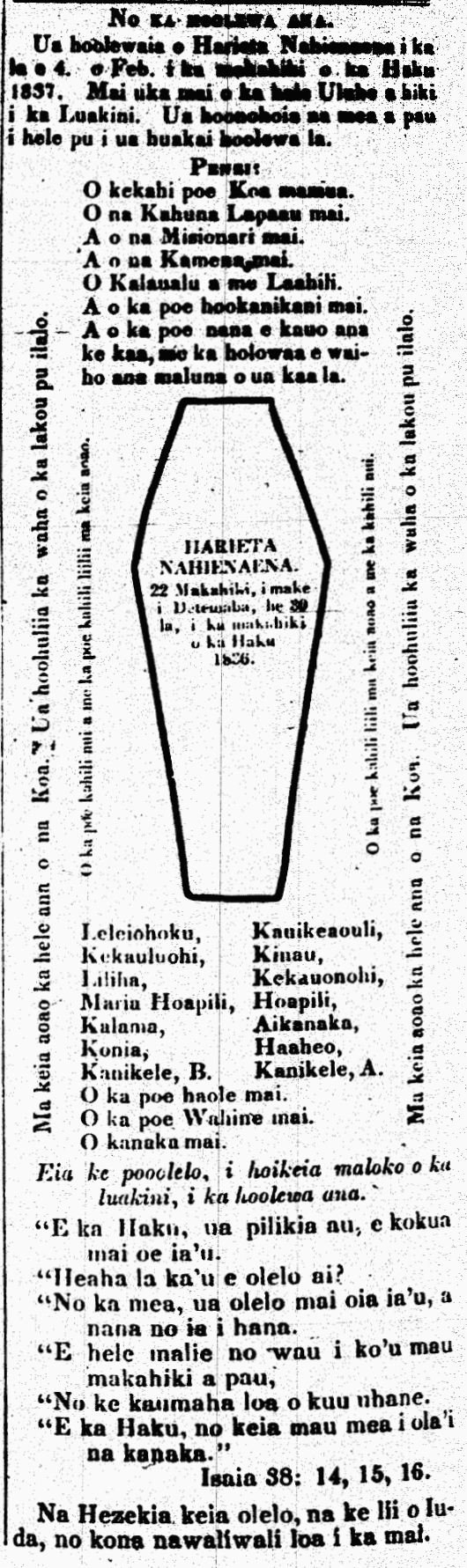
Pertaining to the Funeral.

A funeral was held for Harieta Nahienaena on the 4th of Feb. in the year of the Lord 1837. In the uplands of Hale Uluhe to the Church. Everyone in the procession were arranged.

In this manner:

Soldiers in the front.
Followed by the Doctors.
Then the Missionaries.
The Carpenters.
Kalaualu and Laahili.
The musicians.
And those that pulled the cart and the coffin which was placed on the cart.

[On the left side:]

On this side walked the Soldiers. The mouths of their guns were faced down.

Those with large kahili and small kahili on this side.

[On the right side:]

Those with large kahili and small kahili.

The Soldiers walked on this side. The mouths of their guns were faced down.

HARIETA NAHIENAENA.

22 Years, died on December 30, in the year of the Lord 1836.

Leleiohoku, Kauikeaouli,
Kekauluohi, Kinau,
Liliha, Kekauonohi,
Maria Hoapili, Hoapili,
Kalama, Aikanaka,
Konia, Haaheo,
Consul, B., Consul, A.
Then the haole
Then the Women
men.

This is the sermon that was given at the church at the funeral.

“O Lord, I am oppressed; undertake for me.

“What shall I say?

“He hath both spoken unto me, and himself hath done it.

“I shall go softly all my years.

“In the bitterness of my soul.

“O Lord, by these things men live.”

Isaiah 38: 14, 15, 16.

These words were of Hezekiah, the king of Judea, when he was very weak because of sickness.

(Kumu Hawaii, 2/15/1837, p. 74)

No ka hoolewa ana.

Ke Kumu Hawaii, Buke 2, Pepa 19, Aoao 74. Feberuari 15, 1837.


Song for Ka Na’i Aupuni, Kamehameha Paiea, 1909.

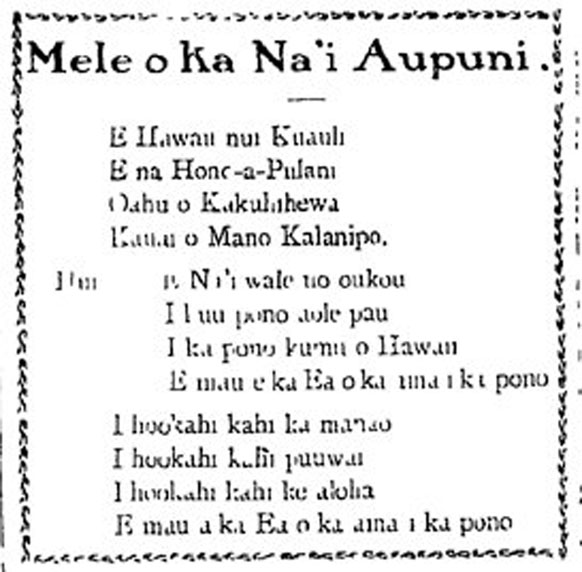
Mele o Ka Na’i Aupuni.

E Hawaii nui Kuauli
E na Hono-a-Piilani
Oahu o Kakuhihewa
Kauai o Mano Kalanipo.

Hui:  E Na’i wale no oukou
I kuu pono aole pau
I ka pono kumu o Hawaii
E mau e ka Ea o ka aina i ka pono.

I hookahi kahi ka manao
I hookahi kahi puuwai
I hookahi kahi ke aloha
E mau a ka Ea o ka aina i ka pono

[This was printed for Kamehameha Day 105 years ago! See also an earlier publication of a variant of this mele from Aloha Aina, 8/21/1897.]

(Kuokoa Home Rula, 6/11/1909, p. 1)

Mele o Ka Na'i Aupuni.

Kuokoa Home Rula, Buke VII, Helu 24, Aoao 1. Iune 11, 1909.


Death of Mary Ann Kaaumokulani Kinoole Pitman Ailau, 1905.

DIED.

AILAU—In Hilo, Hawaii. February 11, 1905. Mrs. Mary Ann Kaaumokulani Kinoole Pitman Ailau, daughter of the High Chiefess Kinoole and the late Benjamin Pitman, and widow of John Keakaokalani Ailau, aged 67 years.

Mrs. Ailau was known from one end of the group to the other, and in Boston and many of the Atlantic watering places.

She was born at Hilo 67 years ago, and with the exception of a number of years spent in Boston and New England completing her education, she always resided in the islands. She was a daughter of Benjamin Pitman a capitalist, who resided both in Hilo and Honolulu. The Pitman home was at the corner of Alakea and Beretania streets, on the site now occupied by the C. Q. Yee Hop building.

The Pitmans came here from Boston, where they were well connected. Mrs. Ailau’s father-in-law also resided here for a number of years. Her father married the High Chiefess Kinoole, daughter of the High Chief Hoolulu. Continue reading