Hawaiian returns home to Hilo after living in Boston for 50 years, 1917.

RETURNED ONCE AGAIN TO THE LAND OF HIS BIRTH

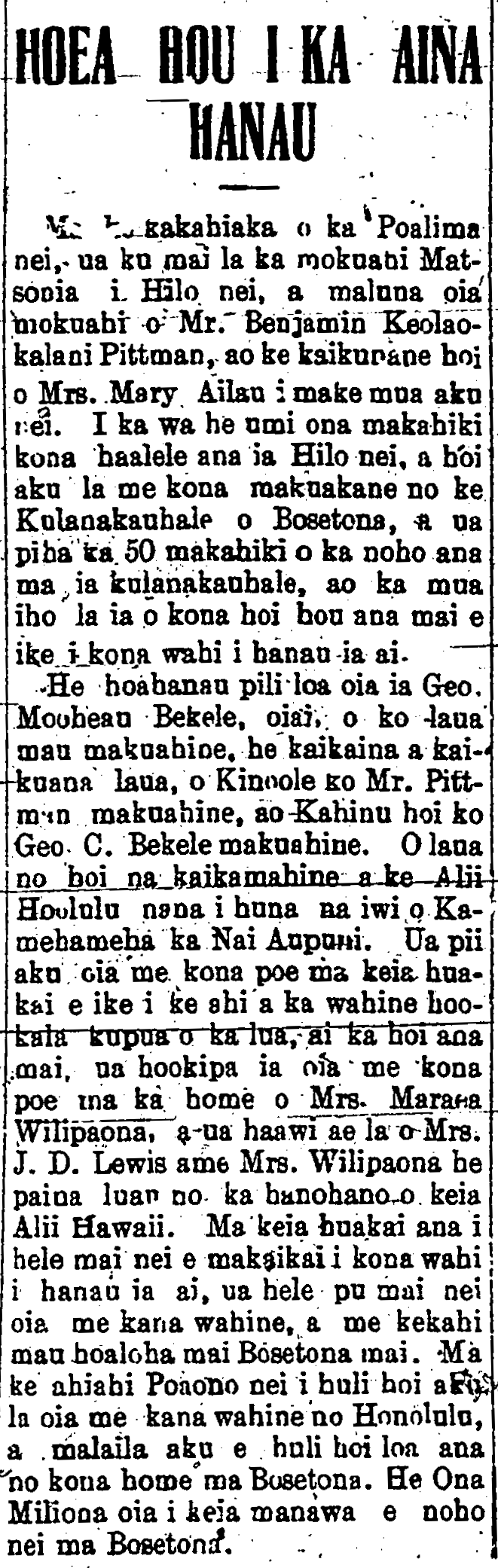
In the morning of last Friday, the steamship Matsonia docked in Hilo nei, and aboard the ship was Mr. Benjamin Keolaokalani Pitman [Pittman], the brother of the recently deceased Mrs. Mary Ailau. He left left Hilo when he was 10 years old, and went back with his father to the city of Boston, and he has lived there for a full 50 years, and this is the first time he has returned to see the place where he was born.

He is a direct cousin to George Mooheau Beckley, as their mothers were sisters; Kinoole is Mr. Pitman’s mother, and Kahinu is George C. Beckley’s. The two of them were daughters of the Alii Hoolulu who hid the bones of Kamehameha Ka Na’i Aupuni. He [Pittman] went with his people on a tour to see the fire of the enchanting woman of the pit, and on their return, they were entertained at the home of Mrs. Maraea Wilipaona [? Mrs. Maria Wilfong], and Mrs. J. D. Lewis and Mrs. Wilfong put on a luau to honor this Hawaiian Alii. On this trip of his to his homeland, accompanying him were his wife and some friends from Boston. On Saturday evening, he and his wife left for Honolulu, and from their they will return to his home in Boston. He is now a Millionaire living in Boston.

[Unfortunately, the digital images of the Hoku o Hawaii newspaper are only available online from 5/31/1917, and so the issue in which this story appears is not available yet (along with the ten years of newspapers that come before it).]

(Hoku o Hawaii, 2/8/1917, p. 2)

HOEA HOU I KA AINA HANAU.

Ka Hoku o Hawaii, Buke 11, Helu 37, Aoao 2.

Charles Nakao, survivor of the Aztec, writes home to Hawaii, 1917.

HAWAIIAN SURVIVOR OF AZTEC TELLS HIS STORY IN LETTER TO THE STAR-BULLETIN

A MESSAGE from a Hawaiian survivor of the steamship Aztec, sunk by a German submarine, came to the Star-Bulletin in yesterday’s mail from Brooklyn, New York.

Charles Nakao in a letter to this paper tells how some of his comrades were lost in trying to launch a lifeboat, and of the suffering of those on the wintry sea. Five Hawaiians were among those who perished, and a few weeks ago the legislature held a public memorial in their honor.

The letter says:

“Brooklyn, New York, April 26, 1917.

“Dear Sir: I, Chas. Nakao, was one of the members of the crew of the S. S. Aztec which was the first American vessel armed with two three-inch guns. Number of crew was 49, including 12 navy gunners and an officer of the U. S. S. Dolphin. We sailed from New York March 18, 1917, and were torpedoed by a submarine April 1, 1917, Sunday night, at 9:30 o’clock, off the coast of France. It was very stormy weather, the seas were about 30 feet in height and the current from English channel was running about 7 miles an hour. It were dark hail storm and were impossible to launch any lifeboat over the weather side. Seven of the crew got excited and try to launch the boat No. 2, which were on the weather side they were all smashed between the life boat and the ship side one of the boys were from Honolulu, Ekela Kaohi, the other were Chinese boy from Puna Pahoa Henry Look. No. 3 boat there were Hail Rice of Honolulu, Chas. Pumoku, Julian Makama of Honolulu, one from Tahiti Islands, John Davis. I were on board the No. 1 boat which I suppose to be the gunners’ boat. There were 19 of the crew on board. The vessel had sunk within 15 minutes it took 9 minutes because we were away from the ship side. After we were probably about 100 yards away some one gave four long blasts. Nobody knows how it happened. After four hours and a half in lifeboats on the high seas and hail storms and rain and darkness we were sighted by a French patrol boat. We had signaled to the boat with flashlights. They got full speed away from us. The second one had passed by and we lighted a torch and they came and picked us up. The temperature of the water was 40 degrees and I didn’t have any shoes or hat on. I was frozen and could hardly speak for about two hours after we got picked up. It was 1:30 o’clock in the early Monday…

Charles Nakao, survivor of the torpedoed Aztec

…morning and we had looked around for about 18 hours for the other boat. There were know sign whatsoever. So we landed at Brest, France, the American consul came and met us at the dock and over 6 hundred Frenchmen were treated fine. I got warm and were send to Brest hospital. From Brest we were send to Bourdeaux, France, about 48 hours ride train.

“We got on board the S. S. La Tourine, the French passenger boat from Bourdeaux, and we got back to New York safe.

“I remain yours truly,

CHAS. NAKAO,

Waiakea, Hilo, Hawaii.

“If any of boys’ family wants to get any information about the clothes or anything else please sent me your address and I will try my best to send it over. This is my address: Chas. Nakao, 324-32th street, Brooklyn, New York.

“P. S.—Thinking our Queen for her kindly remembrance to us boys off the ill-fated S. S. Aztec.

“Yours sincerely,

“C. N.”

[This article seems to be summarized in the Kuokoa of Iune 1, 1917, p. 5]

(Honolulu Star-Bulletin, 5/9/1917, p. 1)

HAWAIIAN SURVIVOR OF AZTEC TELLS HIS STORY IN LETTER TO THE STAR-BULLETIN

Honolulu Star-Bulletin, Volume XXIV, Number 7822, Page 1. May 9, 1917.

“American Queen”? 1917.

QUEEN LILIUOKALANI.

Clarifications by a Newspaper Writer about Her.

(Translated)

To “Ke Ola o Hawaii,”

Appearing in the British newspaper, The Outlook, of the other week, there were a number of awe-inspiring lines about our Queen, Liliuokalani, titled: “An American Queen.” This is how it went:

Americans sometimes forget that within one of the Territories of the United States there lives a real ex-Queen who owes the loss of her crown to the activities of American missionaries.

This Queen is, of course, Liliuokalani, of Hawaii, dethroned in the revolution of 1893. She is now a frail old lady of nearly seventy-nine years, and few but her immediate household and closest friends ever have the opportunity of meeting and talking with her.

It is interesting to record that because of one of the tragedies of the present war this aged Queen has permitted for the first time an American flag to fly over her home. The news of this incident comes to us in a letter from a correspondent in Hawaii. This correspondent writes:

It was my privilege a few days ago to attend what will possibly be the last public reception she will ever give to members of the Hawaiian Senate—some of her own race, and some sons of the missionaries who were mainly responsible for her overthrow. Although they belonged to a body absolutely democratic in form and elected by vote of the people as citizens of the United States, it was most interesting and somewhat touching to note the loyalty and love shown the aged ex-Queen: almost, one could imagine, as if she were still their reigning sovereign. Continue reading

Peleioholani’s home is destroyed by fire, 1901.

ANCIENT RELICS

WERE DESTROYED

Valuable Feather Cloak In Peleioholani’s Fire Claim.

BELONGED TO KEEAUMOKU

THE CLAIMANT’S ANCESTOR

While Husband and Wife Were Shut Out By Quarantine the Flames Swept Away Their Home.

Claims of native Hawaiians were resumed before the Fire Claims Commission yesterday morning. Two of these were called this morning, one of which is of more than ordinary interest.

S. L. Peleioholani presents a claim for $2000 and it appears to be a perfectly straight one. The claimant is a lineal descendant of high chiefs and among his household possessions were heirlooms of great value. Indeed, it is scarcely practicable to measure their value in money, the articles having both historical and ethnological—it might be added without joking, ornithological—interest.

Of the last-named class was a feather cloak, the only one existing of its class except the famous garment of Kamehameha treasured in the British Museum. This cloak descended to Peleioholani from his great-great-grandfather, Keeaumoku, a high chief whose name is given to one of the streets of Honolulu. Evidence was presented before the Commission showing that the claimant refused $500 from Mrs. Marry Ailau, the well-known dealer and connoisseur in Hawaiian relics, several years ago. Yes, and when she sent a relative to further sound the owner on his selling figure an offer of $700 for the cloak was declined by him.

Peleioholani had also a few calabashes of high value, besides other ancient objects of native art.

Why did not Mr. Peleoholani or his wife rescue all this archaeological wealth from the advancing flames? It is an easy question and its answer is not mysterious. The husband was working at his trade of a carpenter on the Castle house, while his wife was away from home on some errand, when the rigid quarantine came down suddenly as a Pali cloud. In consequence the couple could not gain access to their home and the tempest of flame came and swept it away.

Peleioholani lost sundry articles of latter day manufacture and utility, which went to make up his claim. An item was sixty fathoms of inch and a half rope at $47, this being the price he paid for it at an auction sale. He explained that he used the hawser in connection with building and house-moving operations. Scion of a noble house as he is, Peleioholani gave the Commissioners the impression of an honorable man.

[See what was said in an article from one of the Hawaiian-Language Newspapers here.]

(Evening Bulletin, 10/15/1901, p. 1)

ANCIENT RELICS WERE DESTROYED

Evening Bulletin, Volume XI, Number 1968, Page 1. October 15, 1901.

Keelikolani’s house and valuables destroyed by fire, 1873.

Destruction by Fire of the Residence of the Governess of Hawaii.

The tedium of this dull town, was relieved a little on last Wednesday night by a rousing fire. About one quarter to eight o’clock, the dwellers on Emma street, and in the immediate neighborhood, were suddenly aroused by the shouts and cries of kanakas, the screams of wahines, and the barking of dogs; and were first led to suppose that a big fight was on hand,—that perhaps the police had mutinied and the rifles were called out; but as each anxious individual peered into the street, they soon discovered by the column of flame that was leaping up into the dark sky, that a conflagration was on hand, and farther observation showed that it was taking place at the town mansion of Her Excellency, R. Keelikolani, the Governess of Hawaii.

The fire evidently had a good start, and as soon as discovered, was beyond the control of blankets or buckets of water; but not beyond the control of a good head of water from a fire plug, if spouting on it there and then. But the hydrant for public safety was not ready till the roaring devourer was licking the roof tree of Ruth. And when it was ready, the quenching stream served only to raise an impotent fizzle of stream. And oh! had the wind been up, and this fire had been in the close built part of the town, then we would have had a dance of destruction, that would have been equal to the cost of forty reservoirs.

But we must not complain, as the Ministers were out to see the fire burn, and lend a hand if needed. Emma street was lively with the jostling of Ministers and milkmen, diplomats and deacons, judges and jews, and editors and elderly ladies. Everybody turned out,—even some of the churches turned out. These were in the midst of the regular Wednesday evening service, when the uproar began. One pastor affected by the outside outcry, and the evident anxiety of his people, “sung it short,” and he and his flock, joined the throng in the street, to see the sight; but another one, while addressing his faithful, although he saw them speak out one by one, until he was left with only two to listen, yet he stood firm like the Roman sentinel at Pompeii, while the sparks of the conflagration were falling in his vestibule, and gave the two faithful witnesses the full benefit without halt or abbreviation of good orthodox sermon.

The cause of the fire is unknown, but as there had been on hand lately, a fierce litigation about this and other property, the circumstances afford occasion for a good deal of suspicion. Much that was curious and valuable in relation to ancient Hawaiian habits and costumes were unfortunately destroyed. There was some of the famed featherwork, worn by the old chiefs, many of the old feather insignia of office, the great kahilis of Hawaiian pageants, shell and hair ornaments, tappas and fine mats, and some royal bones—all of which were a considerable loss, excepting the bones.

The residence as a property, will not be much of a loss to the wealthy Governess of Hawaii. If the trades had been blowing fresh, several houses makai of this building, would have gone with it but as it was dead calm, and a light shower had fallen a few minutes before the fire broke out, it was easy to defend the roofs of neighboring houses.

On account of the absence of mail, we give this long report of an ordinary fire.

(Hoku o Hawaii, 1o/17/1873, p. 3)
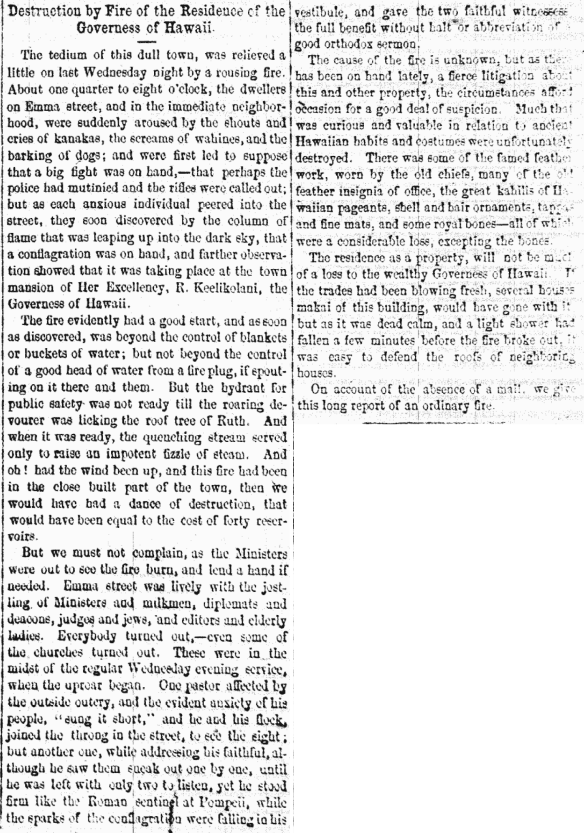
Destruction by Fire of the Residence of the Governess of Hawaii.

Nuhou, Volume II, Number 24, Page 3. October 17, 1873.
Kaumualii’s mahiole fetches a mere $120 at auction, 1873.

[Found under: “NU HOU KULOKO.”]

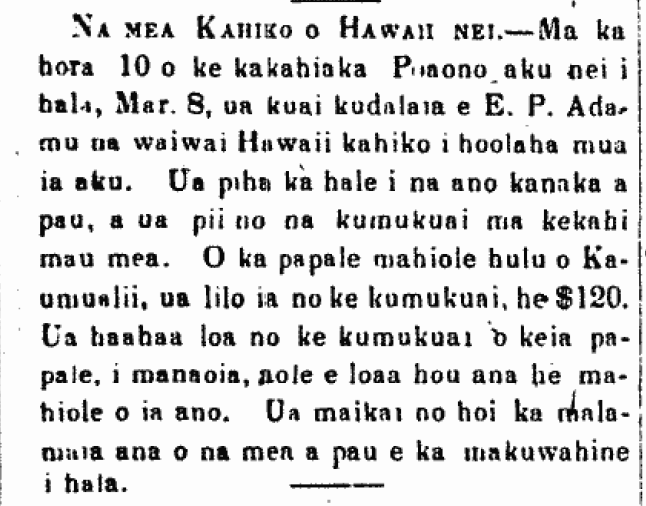
Antiquities of Hawaii nei.—At 10 o’clock in the morning of this past Saturday, Mar. 8, the valuables of old Hawaii which were advertised earlier were auctioned off by E. P. Adams. The house was filled with all sorts of people, and some objects went for high bids. The feather mahiole of Kaumualii went for the price of $120. This headdress went for a very low price; it is believed that never again will there be available a mahiole of that kind. The care given to all of the objects by the mother who has passed [Mrs. Whitney] was very good.

(Kuokoa, 3/22/1873, p. 3)

Na mea kahiko o Hawaii nei...

Ka Nupepa Kuokoa, Buke XII, Helu 12, Aoao 3. Maraki 22, 1873.

On Kaumualii and Kaahumanu, 1880.

[From: “Ka Moolelo o Kaahumanu”]

Kaahumanu was one of them who made a circuit of Maui, Oahu, and Kauai with Liholiho. When Kaahumanu arrived on Kauai, she took Kaumualii, the alii of Kauai, as a kane [husband] for herself. When Liholiho returned to Oahu, it was with Haakulou, the woman of Kaumualii; because Liholiho took Haakulou as a wahine [wife] for himself, along with his other wahine.

Kaahumanu lived on Kauai along with Kaumualii in the year 1822. Perhaps in the month of August.

Kaahumanu wanted to seek out Nihoa. It was the very first time that Nihoa was found, that tiny island to the North-West of Niihau. Continue reading

The name of Kaumualii’s mahiole, 1906.

[Excerpt from: “He Moolelo no Kamehameha I. Ka Na’i Aupuni Hawaii.” by Hooulumahiehie.]

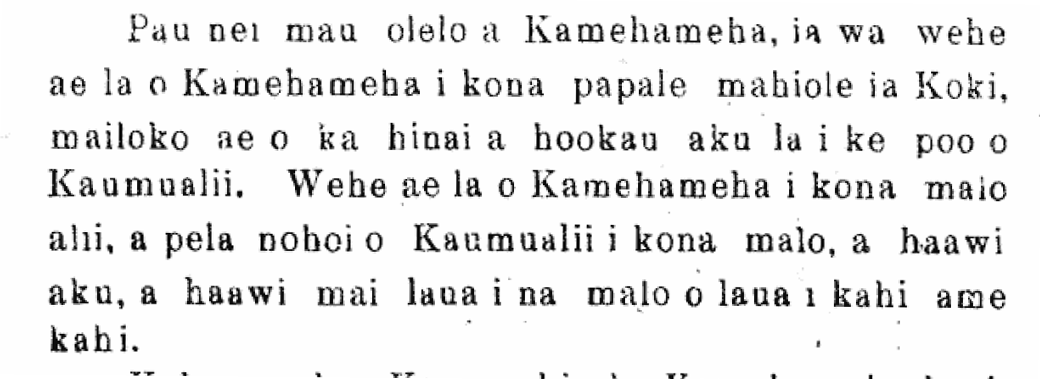
After these words of Kamehameha’s were over, he then took his mahiole, Koki, from a basket and placed it upon the head of Kaumualii. Kamehameha removed his royal malo and so too did Kaumualii remove his malo, and they exchanged them with each other.

[This account is from the meeting of Kamehameha and Kaumualii. It is just a tiny excerpt of the kind of awesome information available in the story of Kamehameha I translated by Kamaoli Kuwada, Emalani Case, and Beau Bassett, slated to come out from Kamehameha Publishing. I can’t wait.

I was informed that this priceless feathered object from the past is indeed being cared for amongst the many other antiquities at the Bernice Pauahi Bishop Museum.]

(Na’i Aupuni, 9/14/1906, p. 1)

HE MOOLELO NO KAMEHAMEHA I.

Ka Na’i Aupuni, Buke II, Helu 88, Aoao 1. Sepatemaba 14, 1906.

Kaumualii’s Mahiole, 1873.

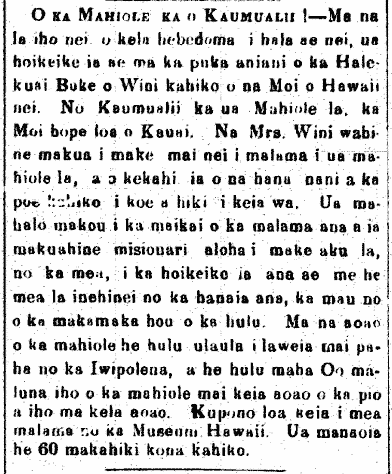
It is the Feather Helmet of Kaumualii!—During the days of this past week, displayed in the window of Whitney’s Bookstore the regalia of the Ancient Kings of Hawaii nei. The Mahiole is Kaumualii’s, the last King of Kauai. Mrs. Whitney [Wini] the elder who just passed was the one who was taking care of the mahiole, and it is one of the things remaining today of the beautiful works of the people of old. We praise the fine upkeep by the beloved missionary mother who passed, for on display, it seemed as if it was made yesterday; the feathers appeared new. On the sides of the mahiole were red feathers taken from the Iiwi polena, and feathers of the maha Oo are on top of the mahiole from this side to that of the crest. This should definitely be kept in the Hawaiian Museum. We believe that it is 60 years old.

[It is interesting to note what is not said in a similar article in English.]

(Au Okoa, 2/27/1873, p. 3)

O ka Mahiole ka o Kaumualii!

Ke Au Okoa, Buke VIII, Helu 46, Aoao 3. Feberuari 27, 1873.

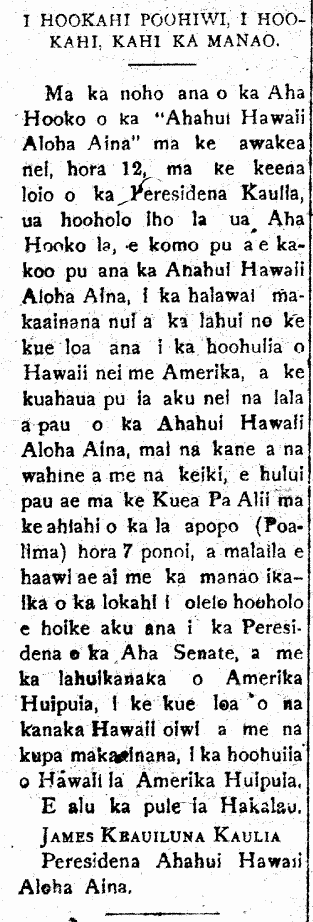
I hookahi, kahi ka manao, 1897.

LET US BE OF ONE SHOULDER,¹ LET US BE OF UNIFIED THOUGHT.

At the meeting of the Executive Committee of the “Ahahui Hawaii Aloha Aina” [Hawaiian Patriotic League] at noon, 12 o’clock, at the attorney’s office of President Kaulia, the said Executive Committee decided that the Patriotic League will join and support the great rally of the makaainana of the lahui to absolutely protest the annexation of Hawaii to America, and it is announced to all of the members of the Hawaiian Patriotic League, from the men, to the women, to the children, to assemble at the Palace Square [Kuea Pa Alii] tomorrow evening (Friday) at exactly 7 o’clock, and there will be presented with insistence and unity, the resolution informing the President of the Senate and the people of the United States, that the native Hawaiians and the long-time makaainana protest the annexation of Hawaii to the United States of America.

Let us combine our prayers to overcome Hakalau. [E alu ka pule ia Hakalau.]²

James Keauiluna Kaulia

President of the Ahahui Hawaii Aloha Aina.

¹Hearkening to the idea of “I hookahi umauma, i hookahi poohiwi, a i hookahi puuwai.” [Let us be of one chest, one shoulder, and of one heart.] Also from earlier that year, see by Samuel K. Kamakaia, “Nai Wale no Oukou A’oe Pau.”

²According to Mary Kawena Pukui’s Olelo Noeau (115): “A sorcerer at Hakalau once created havoc in his own and other neighborhoods. Many attempts to counter-pray him failed until a visiting kahuna suggested that all of the others band together to concentrate on the common enemy. This time they succeeded.”

(Aloha Aina, 10/9/1897, p. 3)

I HOOKAHI POOHIWI, I HOOKAHI, KAHI KA MANAO.

Ke Aloha Aina, Buke III, Helu 41, Aoao 3. Okatoba 9, 1897.