Hawaiian National Hymn, 1862.

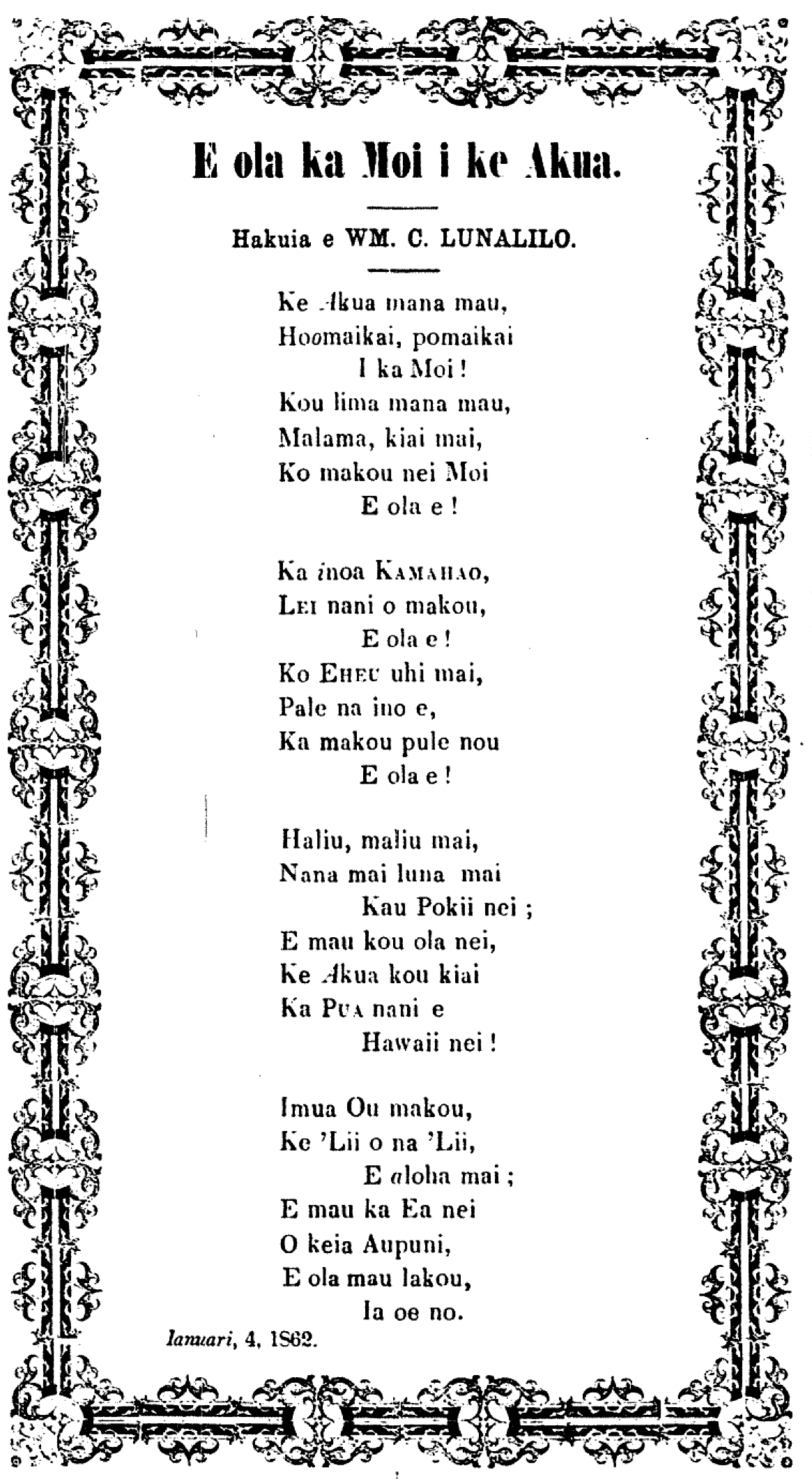
E ola ka Moi i ke Akua.

Composed by WILLIAM C. LUNALILO.

Ke Akua mana mau,
Hoomaikai, pomaikai
I ka Moi!
Kou lima mana mau,
Malama, kiai mai,
Ko makou nei Moi
E ola e!

Ka inoa Kamahao,
Lei nani o makou,
E ola e!
Ko Eheu uhi mai,
Pale na ino e,
Ka makou pule nou,
E ola e!

Haliu, maliu mai,
Nana mai luna mai
Kau Pokii nei;
E mau kou ola nei,
Ke Akua kou kiai
Ka Pua nani e
Hawaii nei!

Imua Ou makou,
Ke ‘Lii o na ‘Lii,
E aloha mai;
E mau ka Ea nei
O keia Aupuni,
E ola mau lakou,
Ia oe no.

January 4, 1862.

(Kuokoa, 2/8/1862, p. 1)

E ola ka Moi i ke Akua.

Ka Nupepa Kuokoa, Buke I, Helu 11, Aoao 1. Feberuari 8, 1862.

Keahu Kealiiaukai, an awesome biography, 1941.

Recalling the Days of Kamehameha V.

KEAHU KEALIIAUKAI

Keahu Kealiiaukai is one of the last Hawaiians left who is not proficient in English. He is a Hawaiian famous for his knowledge of plants, and he is 82 years old. He lives in Lahaina, Maui, the capital of Hawaii in days of yore. Kealiiaukai is now living with his daughter, Mrs. Juliette Pali.

When Kealiiaukai was born in Kaupo, Maui, on the road going to the crater of Haleakala, in the year 1859, this was the fifth year of Kamehameha IV’s reign over Hawaii nei. Kealiiaukai was 4 when that monarch died. He does not recall this.

Remembering the King.

However, Kealiiaukai does in fact remember Kamehameha V, or King Kapuaiwa, his given name; and the last of the Kamehamehas. Kapuaiwa went to Lahaina numerous times, where he was welcomed warmly by his makaainana.

In Kealiiaukai’s eighty and two years of life, he witnessed the passing of the monarchs of his homeland, closing with the overturning of the nation under Queen Liliuokalani’s protection, in 1893. Then the establishing of the provisional government and the Republic of Hawaii, and the joining of the Islands to the United States and the formation of this Territory of America, 40 years ago.

A Religious Man

Kealiiaukai is an important man in Lahaina for the kamaaina there. His wife left this world eight years ago, but she did not however leave behind children. Kealiiaukai is still strong and active. He participates often in works of this Father in Heaven. He spent his life being a member of the Faith of the Latter Day.

Perhaps he is the last medicine man living and practicing from before the times when there was licensing of those in that profession. During his time, it is said that Kealiiaukai practiced healing with plants amongst his own people and healed them due to his expertise in the use of plants growing in the forests of Hawaii, for all types of illnesses.

(Hoku o Hawaii, 3/5/1941, p. 1)

Hoomanao Ina La O Kamehameha V

Hoku o Hawaii, Volume XXXV, Number 45, Page 1. Malaki 5, 1941.

More on the death of Keanu, 1902.

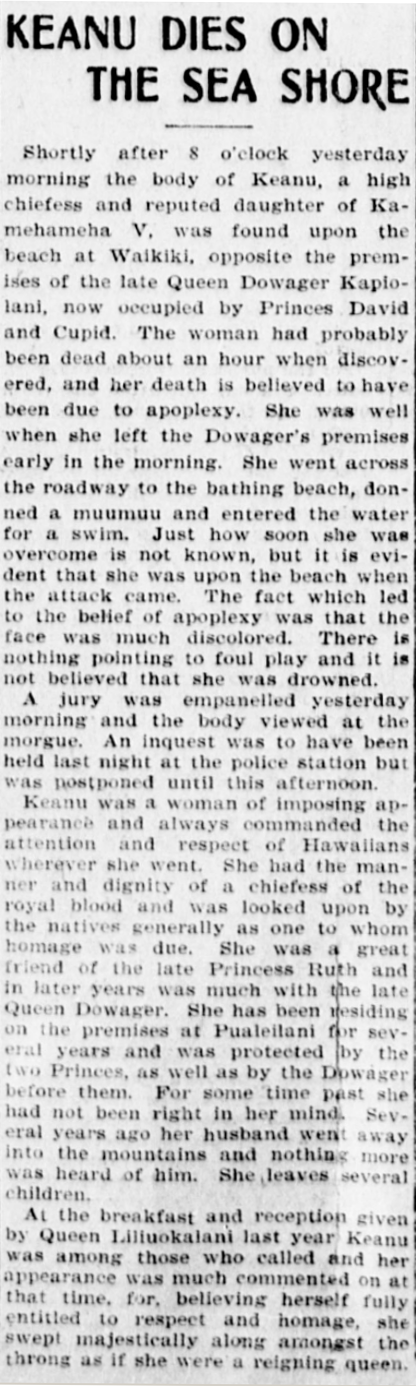
KEANU DIES ON THE SEA SHORE

Shortly after 8 o’clock yesterday morning the body of Keanu, a high chiefess and reputed daughter of Kamehameha V, was found upon the beach at Waikiki, opposite the premises of the late Queen Dowager Kapiolani, now occupied by Princes David and Cupid. The woman had probably been dead about an hour when discovered, and her death is believed to have been due to apoplexy. She was well when she left the Dowager’s premises early in the morning. She wen across the roadway to the bathing beach, donned a muumuu and entered the water for a swim. Just how soon she was overcome is not known, but it is evident that she was upon the beach when the attack came. The fact which led to the belief of apoplexy was that the face was much discolored. There is nothing pointing to foul play and it is not believed that she was drowned.

A jury was empanelled yesterday morning and the body viewed at the morgue. An inquest was to have been held last night at the police station but was postponed until this afternoon.

Keanu was a woman of imposing appearance and always commanded the attention and respect of Hawaiians wherever she went. She had the manner and dignity of a chiefess of the royal blood and was looked upon by the natives generally as one to whom homage was due. She was a great friend of the late Princess Ruth and in later years was much with the late Queen Dowager. She has been residing on the premises at Pualeilani for several years and was protected by the two Princes, as well as by the Dowager before them. For some time past she had not been right in her mind. Several years ago her husband went away into the mountains and nothing more was heard of him. She leaves several children.

At the breakfast and reception given by Queen Liliuokalani last year Keanu was among those who called and her appearance was much commented on at that time, for, believing herself fully entitled to respect and homage, she swept majestically along amongst the throng as if she were a reigning queen.

(Hawaiian Gazette, 7/1/1902, p. 4)

KEANU DIES ON SEA SHORE

Hawaiian Gazette, Volume XXXVII, Number 50, Page 4. July 1, 1902.

Keanu, daughter of Kamehameha V and Keelikolani, passes, 1902.

That Royal Descendant of the Land has Passed.

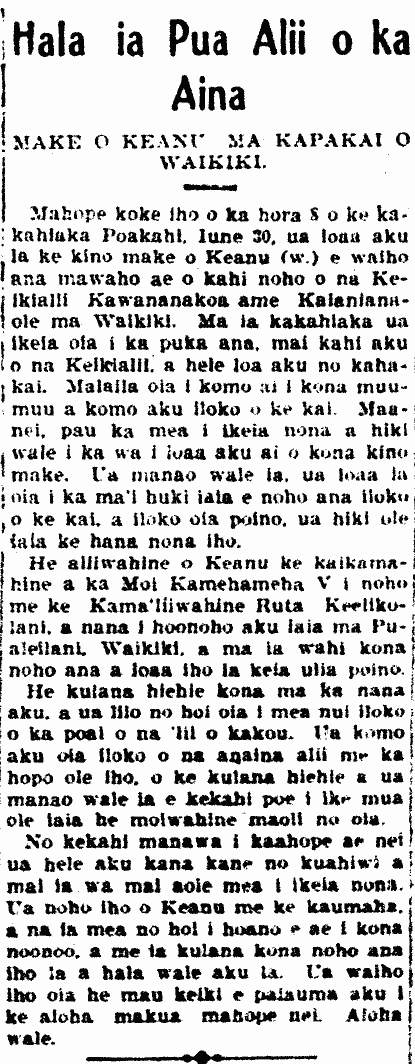
KEANU DIES ON THE SHORE OF WAIKIKI.

Right after 8 o’clock in the morning of Monday, June 30, the dead body of Keanu (f.) was found out near the residence of the Princes Kawananakoa and Kalanianaole at Waikiki. On that morning she was seen coming out of the Princes’ place, and went all the way to the ocean. There she put on her muumuu and went into the ocean. From here, that was all that was known of her until her body was found. It is believed that she had a stroke [ma’i huki] while in the water, and while being so afflicted, she could not help herself.

Keanu was a chiefess, the daughter of Kamehameha V and Princess Ruth Keelikolani [Ruta], and it was he who housed her at Pualeilani, Waikiki, and it was there that she lived until this unfortunate accident.

She had a regal stature, and she became an important presence in our chiefly circles. She fearlessly appeared at royal audiences with elegance, and some who had not seen her before thought she was an actual queen.

Some time ago, her husband went into the mountains, and since then nothing was known of him. Keanu lived in sadness, and it was this that made her lose her senses. She left behind children who grieve in their love for her. How pitiful.

[Anyone have more information on Keanu?]

(Kuokoa, 7/4/1902, p. 1)

Hala ia Pua Alii o ka Aina

Ka Nupepa Kuokoa, Buke XL, Helu 27, Aoao 1. Iulai 4, 1902.

Beginnings of Royal Mausoleum at Mauna Ala, 1865.

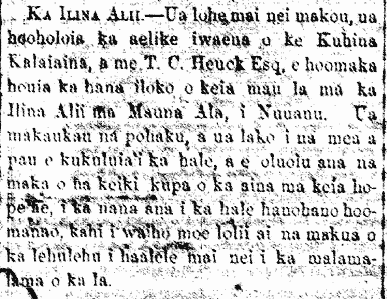
Royal Mausoleum.—We have heard that an agreement has been reached between the Minister of  the Interior and  T. C. Heuck, Esq., to commence once again, during these days, the work on the Royal Mausoleum at Mauna Ala in Nuuanu. The stones are ready, and everything is prepared for the building to be built, and hereafter all the native born will be pleased to see this grand memorial building where the parents of the populace who have left the light of the world lay to rest.

(Au Okoa, 4/24/1865, p. 2)

Ka Ilina Alii.

Ke Au Okoa, Buke I, Helu 1, Aoao 2. Aperila 24, 1865.

Awesome follow up to Princess Kaiulani funerary buttons, 2013.

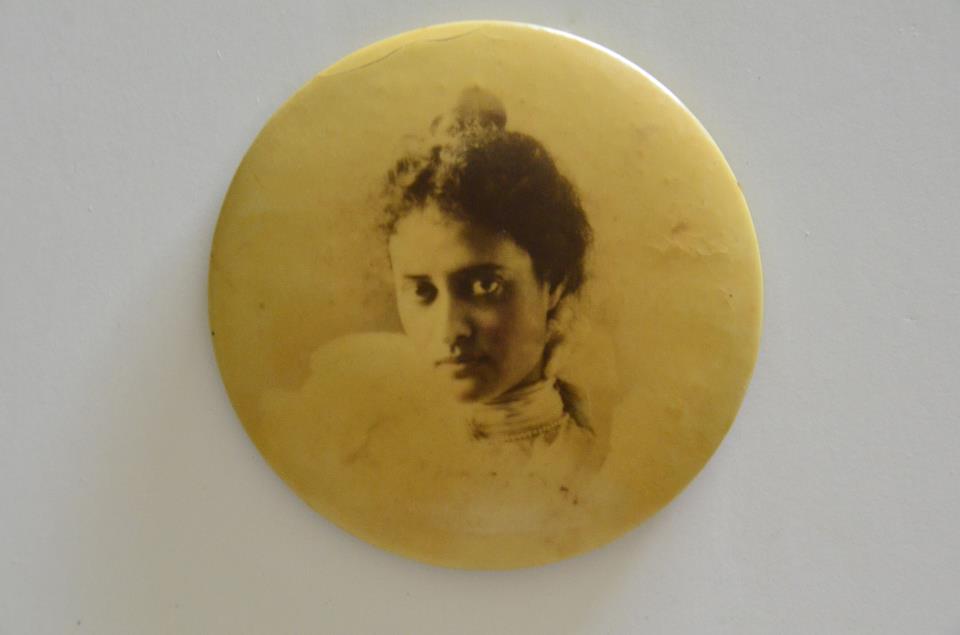
Last month, we posted articles about buttons produced for the funeral of Princess Kaiulani. JR kindly responded with an image of an example of one of these buttons! Here is the image sent, with the description: 3 15/16″ in diameter. Printed on the backside: “pin lock, patd. May 31, 98”

For the previous posts, click here:

Mourning of Princess Kaiulani, 1899.

and

More on Kaiulani buttons, 1899.

Kaiulani button

Kaiulani funerary button

A mele by Her Majesty Queen Liliuokalani, 1894.

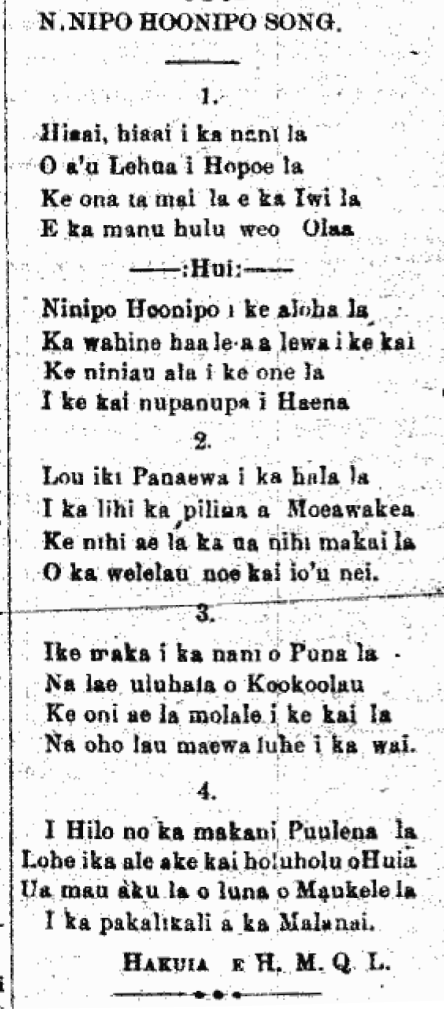
NINIPO HOONIPO SONG.

1.

Hiaai, hiaai i ka nani la
O a’u Lehua i Hopoe la
Ke ona ia mai la e ka Iwi la
E ka manu hulu weo Olaa

——: Hui :——

Ninipo Hoonipo i ke aloha la
Ka wahine haa le-a a lewa i ke kai
Ka niniau ala i ke one la
I ke kai nupanupa i Haena

2.

Lou iki Panaewa i ka hala la
I ka lihi ka pilina a Moeawakea
Ke nihi ae la ka ua nihi makai la
O ka welelau noe kai io’u nei.

3.

Ike maka i ka nani o Puna la
Na lae uluhala o Kookoolau
Ke oni ae la molale i ke kai la
Na oho lau maewa luhe i ka wai.

4.

I Hilo no ka makani Puulena la
Lohe i ka ale a ke kai holuholu o Huia
Ua mau aku la o luna o Maukele la
I ka pakalikali a ka Malanai.

Composed by H. M. Q. L.

[The newspaper “Ka Oiaio” begins in 1889, but there are only a few issues found for that year, and for 1890, 1891, 1892, and 1893, there are none! Hopefully someone is holding on to copies of these years, because they can open up a whole new picture to that period in history!!

Talk about the Hawaiian-Language Newspapers to others. The more people talk, the more likely it will be that these lost issues might once again be found.]

(Oiaio, 8/10/1894, p. 4)

NINIPO HOONIPO SONG.

Ka Oiaio, Buke VI, Helu 32, Aoao 4. Augate 10, 1894.

Beginning of line-by-line commentary of “Aia i Honolulu kuu pohaku,” 1929.

EXPLANATION OF THE FIRST LINE.

1. Aia i Honolulu kuu pohaku

Kapanookalani’s thoughts:—This land Honolulu, it is close to Nanawale, Puna, by the sea. It is a ku, a small land in between large lands.

The stone [pohaku] is Lord [Haku] of the chiefess and in this word, the important idea is chiefess [‘lii wahine].

Kahapula’s thoughts:—Honolulu is on Oahu, where King Kamehameha V dwelt and those who opposed him is the Honolulu in this first line of the mele. It was here his enemies schemed and carried out all their defiant acts against him. While they knew the wish of the King to marry the chiefess Pauahi, her teacher, Amos Cooke secretly agreed to  Bishop for him to meet with Pauahi without the knowledge of her parents. That is how Pauahi became Bishop’s, and this is how Bishop and his relative Lee [? William Little Lee] became dignitaries of the land.

Kupihea’s thoughts:—Honolulu is a fish stone called a Kuula, and was brought here to this Honolulu [on Oahu] from the Honolulu of Puna [on Hawaii]. This Kuula was placed in the tiny land of Honolulu where an Alii called Honolulu lived, who was related to the chiefess Peleula, whose younger sister was the beautiful Waikiki. This place is mauka of the old Rawlin’s Estate. There is a bank of coral where Honolulu is; the fishing altar [Kuula] for the fish ponds [loko i’a] is on the Waikiki side of Liliha Street and between Vineyard and King Streets.

The stone is related to chiefs from times immemorial [mai ka po mai]. It is a manifestation made by God.

Iokepa’s thoughts:—Honolulu is a small land and a canoe landing makai of Nanawale, Puna, between two sand dunes, one on the Hilo side and one on the Puna side, called Puu Waawaa. From this Honolulu is called the Honolulu here [on Oahu] which used to be called Kou before, and after it was called Honolulu until this day.

This is the meaning for the word Honolulu:—The wind is very calm [lulu] an the sea is serene; it is very fine and peaceful. Bay [? Hono] of calm sea; Hono that is peaceful.

Kuluwaimaka’s thoughts:—The stone is related to Kamehameha V. Honolulu in Puna is a lowland next to the sea. Its width is perhaps half a mile long between Na Puu o Pele and Waiakahiula on the Hilo side. Honolulu is a place where you pick opihi [ku’i opihi] and pick limu [hana limu]. There is a fine spring [punawai] there and there is a foot path there.

[And to think that this is but the very beginning of Kelsey’s detailed account of the explanation of the six loea of the mele “Aia i Honolulu kuu pohaku.” This is just the first line! It continues in the following issues!!

One more (huge) reason that Hawaiian-Language Newspapers are priceless!!!]

(Alakai o Hawaii, 12/5/1929, p. 2)

NA MANAO WEHEWEHE MALUNA O KA LAINA EKAHI.

Ke Alakai o Hawaii, Buke 1, Helu 32, Aoao 2. Dekemapa 5, 1929.
More on “Aia i Honolulu kuu pohaku”! 1929.

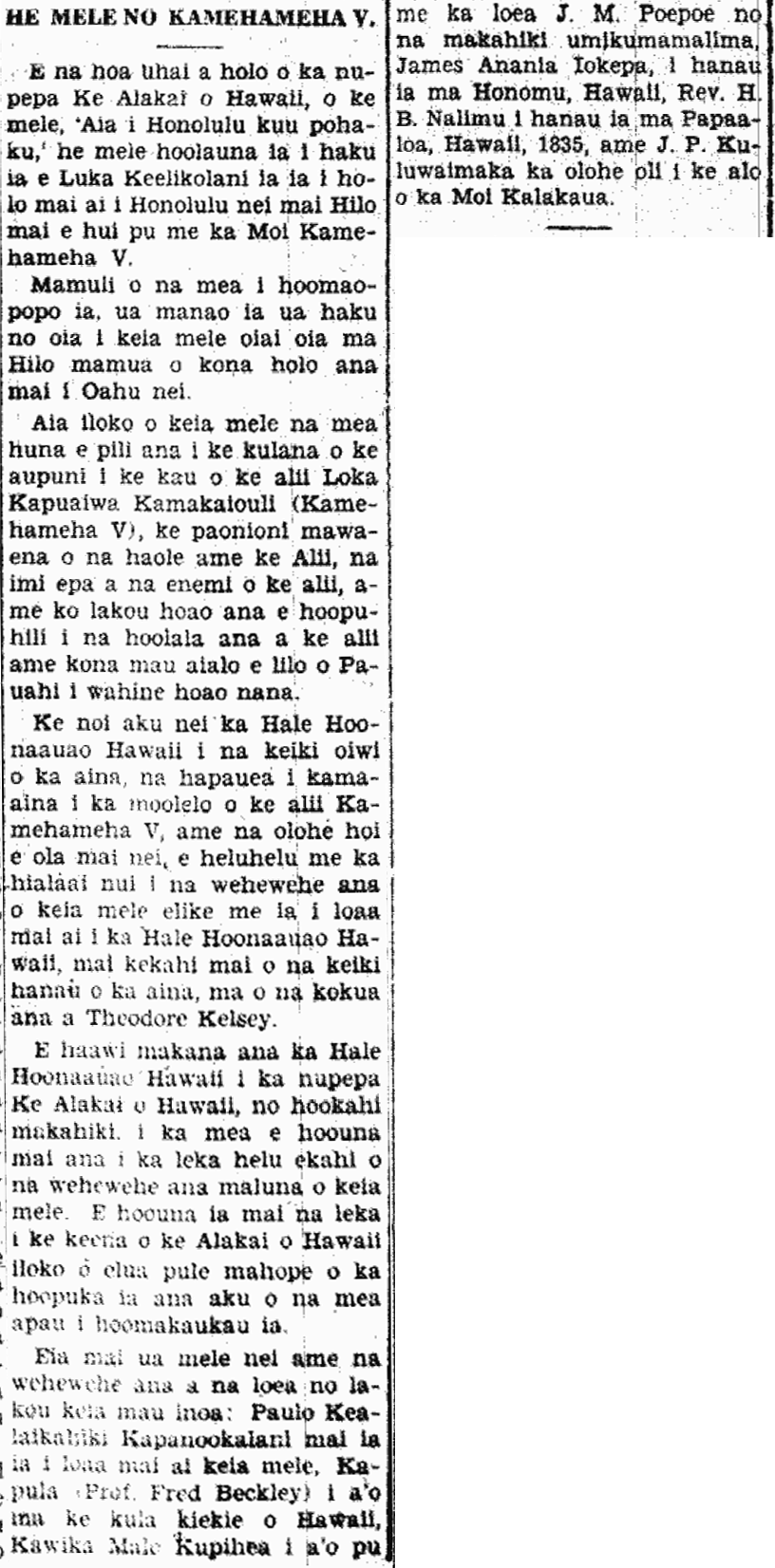
A MELE FOR KAMEHAMEHA V.

O Friends who chase after Ke Alakai o Hawaii, the mele, “Aia i Honolulu kuu pohaku,” is a mele of familiarity [mele hoolauna] composed by Luka Keelikolani when she was coming to here in Honolulu from Hilo to meet with King Kamehameha V.

From what is understood, it is believed that she composed this mele while she was in Hilo before her travelling to Oahu nei.

In this mele are hidden things dealing with the nation in the time of the alii Loka Kapuaiwa Kamakaiouli (Kamehameha V); the contention between the haole and the King, the deceit of the enemies of the King and their attempt to thwart the plans by the King and his court to make Pauahi his wife.

The Hale Hoonaauao Hawaii asks the native ones of the land, the old ones familiar with the history of King Kamehameha V, and the experts still living, to read with much pleasure the explanations of this mele as per what was obtained by the Hale Hoonaauao Hawaii from those native born of the land through the assistance of Theodore Kelsey.

The Hale Hoonaauao Hawaii will award a one-year subscription of the newspaper Ke Alakai o Hawaii to the one who sends the best letter with explanations on this mele. Send the letters to the office of Ke Alakai o Hawaii withing two weeks of the completion of the publishing of all that has been compiled.

Here is the mele and the explanations of the experts [loea] whose names are: Paulo Kealaikahiki Kapanookalani from whom we received this mele, Kahapula (Prof. Fred Beckley) who teaches at the University of Hawaii, Kawika Malo Kupihea who studied with the loea J. M. Poepoe for fifteen years. James Anania Iokepa who was born in Honomu, Hawaii, Rev. H. B. Nalimu who was born in Papaaloa, Hawaii in 1835, and J. P. Kuluwaimaka the skilled chanter [olohe oli] in the court of King Kalakaua.

[“Aia i Honolulu kuu pohaku” is perhaps the most widely studied mele i have seen, with line-by-line interpretations by experts of the day. It continues on for a number of issues of Alakai o Hawaii.

Does anyone have any details on the organization called Hale Hoonaauao Hawaii, or Hale Hoonaauao o Hawaii?]

(Alakai o Hawaii, 12/5/1929, p. 2)

HE MELE NO KAMEHAMEHA V.

Ke Alakai o Hawaii, Buke 1, Helu 32, Aoao 2. Dekemapa 5, 1929.
“Aia i Honolulu kuu pohaku,” name song for Kamehameha V., 1929.

AIA I HONOLULU KUU POHAKU.

1. Aia i Honolulu kuu pohaku

2. O Kealohilani kuu haku ia

3. Ua holo ka wela i na mokupuni

4. Ua puni hei au leo o ka manu

5. O a’u lehua i Mokaulele

6. Hooneenee mai e ka iliahi

7. Hoohanua mai la ka ua iuka

8. Aia ka pono ia Oniula

10. Ua malu ka honua ia Kalani

11. Kuu Haku i ka ehuehu kai olalo

12. I ahona Puna i ke ala o ka hala

13. Paa mai la Olaa i ka ua noe

14. Noho i ka ehuehu kai o Hilo

15. Kahiko Poliahu i ka hau anu

16. He manao paa ko’u a hiki aku

17. Ua lahui ia mai e iala

18. Hea aku no wau o mai oe

19. O Kamakaiouli kou inoa.

(Alakai o Hawaii, 12/5/1929, p. 2)

AIA I HONOLULU KUU POHAKU.
Ke Alakai o Hawaii, Buke 1, Helu 32, Aoao 2. Dekemapa 5, 1929.