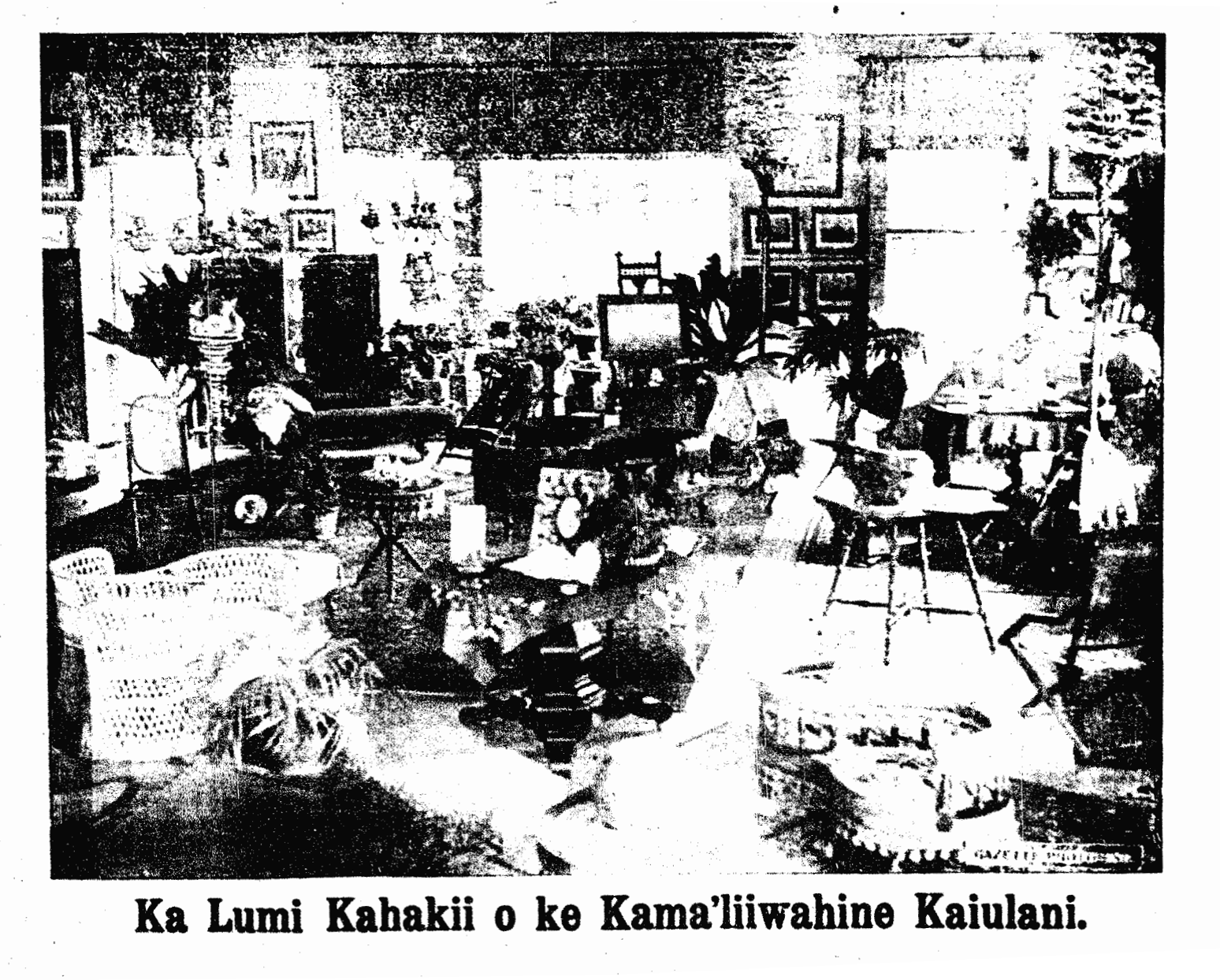
Looking back at Princess Kaiulani, 1904.

The Drawing Room [Lumi Kahakii] of Princess Kaiulani.

[Does anyone know where this room was? I am sure the original image in the newspaper is much more clear. This is yet another reason to reshoot the Hawaiian-Language Newspapers before it is too late and they crumble into pieces…]

Ka Lumi Kahakii o ke Kama'liiwahine Kaiulani.

Ka Nupepa Kuokoa, Buke XLII, Helu 18, Aoao 4. Aperila 29, 1904.

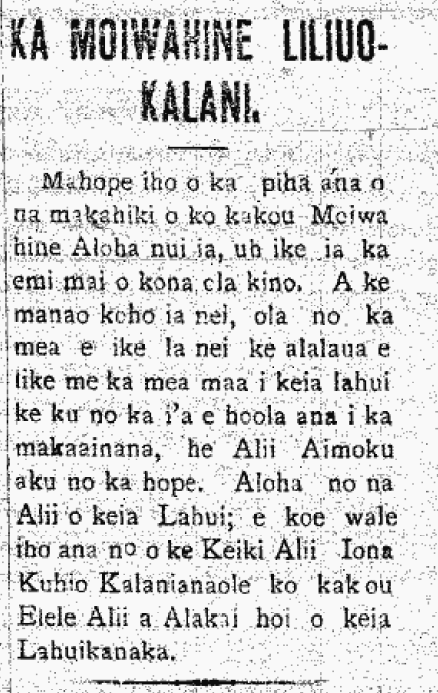
The Queen and the alalaua, 1917.

QUEEN LILIUOKALANI.

Following the birthdays of our dearly Beloved Queen, her weakening health was noticed. And we guess that this is the reason for the appearance of the alalaua, like what is usual for this lahui, that when this fish to save the people runs, the Ruler will follow. Aloha for the Chiefs of this Lahui; left is Prince Jonah Kuhio Kalanianaole, our Chiefly Representative and the Leader of this People.

(Puuhonua, 9/28/1917, p. 4)

KA MOIWAHINE LILIUOKALANI.

Ka Puuhonua, Buke IV, Helu 39, Aoao 4. Sepatemaba 28, 1917.

Mahalo to Elinor Langer for her comment on trial of participants of the January 6, 1895 Counter Revolution. 1895.

Elinor Langer says:

And it was on January 17, 1895, the second anniversary, that the Republic opened the trials of the people arrested for “treason” in the revolt. Has anyone seen accounts in the Hawaiian papers about what happened on January 24, the day the Queen signed her forced abdication statement? According to “The Friend” (February 1, 1895) “On the 24th, while engaged in the trial of a company of natives, the Court was startled by the fall upon the table around which they sat of a massive bar of plaster from the lofty ceiling [of the Throne Room, where the trials were taking place.] The bar was nine feet long, forming part of a decorative panel. It fell upon the center of the table, precisely fitting the length of it. Col. Whiting had a narrow escape, his face being grazed, although protected by his military hat. The plaster had been loosened by a sharp shake of earthquake the night before.” The Queen signed the statement at 11 a.m. in the rooms directly above –perhaps even at the same time?

[See the original article, “The Story of the Insurrection” in The Friend, Volume 53, Number 2, Pages 9–11. February 1895.

Comment to Writing on the wall, 1894.]

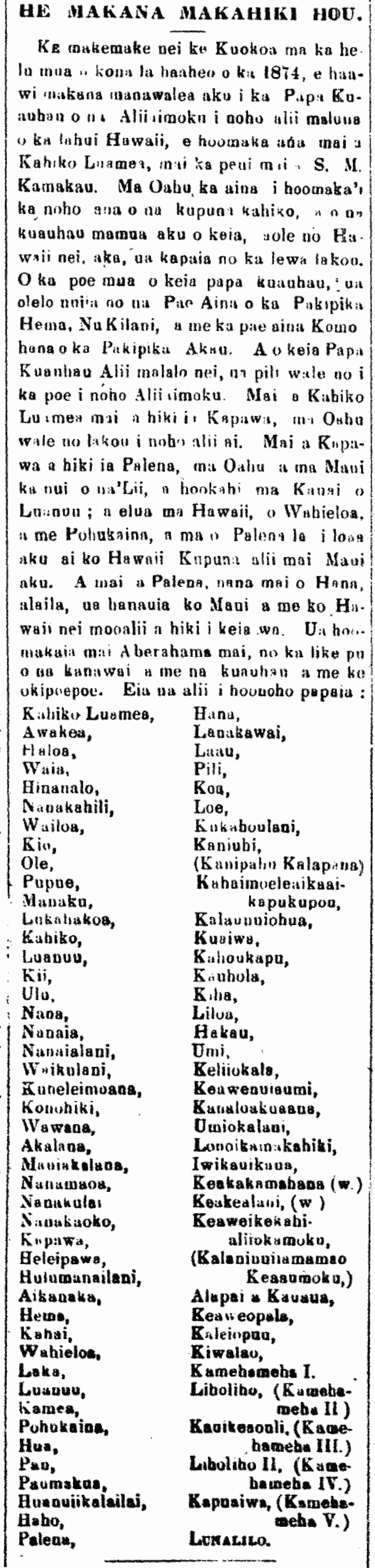
A New Year’s Gift: a Genealogy of Rulers, 1874.

A NEW YEAR’S GIFT.

The Kuokoa, on this first issue of its proud days of 1874, wants to gift this Genealogical List of the Rulers over the Hawaian people, starting from Kahiko Luamea, from the pen of S. M. Kamakau. It was upon Oahu that the ancient ones first lived, and the genealogy from before this is not from here in Hawaii, but it is said that they were from the sky [lewa]. The first people in this genealogy, it is widely stated that they are from the Islands of the South Pacific, New Zealand, and the islands to the Western North Pacific. And the listing of Alii Genealogy below just pertains to those who were Aliiaimoku. From Kahiko Luamea to Kapawa, they just ruled on Oahu. From Kapawa to Palena, most of the Alii were on Oahu and Maui; one was from Kauai, Luanuu; and two on Hawaii, Wahieloa and Pohukaina; and from Palena is where Hawaii’s royal Ancestry from Maui come from. And from Palena was born Hana, thereafter Maui’s and Hawaii’s chiefly line have been born until this time. It began from Abraham, being that the laws were the same, the genealogy was the same, and the circumcision was the same. Here are the alii listed out:

Kahiko Luamea,
Awakea [Wakea],
Haloa,
Waia,
Hinanalo,
Nanakahili,
Wailoa,
Kio,
Ole,
Pupue,
Manaku,
Lukahakoa,
Kahiko,
Luanuu,
Kii,
Ulu,
Nana,
Nanaia,
Nanaialani,
Waikulani,
Kuheleimoana,
Konohiki,
Wawana,
Akalana,
Mauiakalana,
Nanamaoa,
Nanakulai,
Nanakaoko,
Kapawa,
Heleipawa,
Hulumanailani,
Aikanaka,
Hema,
Kahai,
Wahieloa,
Laka,
Luanuu,
Kamea,
Pohukaina,
Hua,
Pau,
Paumakua,
Huanuiikalailai,
Haho,
Palena,
Hana,
Lanakawai,
Laau,
Pili,
Koa,
Loe,
Kukahoulani,
Kaniuhu,
(Kanipahu Kalapana)
Kahaimoeleaikaaikapukupou,
Kalaunuiohua,
Kuaiwa,
Kahoukapu,
Kauhola,
Kiha,
Liloa,
Hakau,
Umi,
Keliiokala,
Keawenuiaumi,
Kanaloakuaana,
Umiokalani,
Lonoikamakahiki,
Iwikauikaua,
Keakakamahana (w [wahine])
Keakealani (w),
Keaweikekahialiiokamoku,
(Kalaninuiiamamao Keeaumoku),
Alapai a Kauaua,
Keaweopala,
Kaleiopuu,
Kiwalao,
Kamehameha I.
Liholiho (Kamehameha II),
Kauikeaouli (Kamehameha III),
Liholiho II (Kamehameha IV),
Kapuaiwa (Kamehameha V),
Lunalilo.

[This seems to be a little different from what is seen in the appendix of Kamakau’s “Ruling Chiefs of Hawaii”.]

(Kuokoa, 1/3/1874, p. 2)
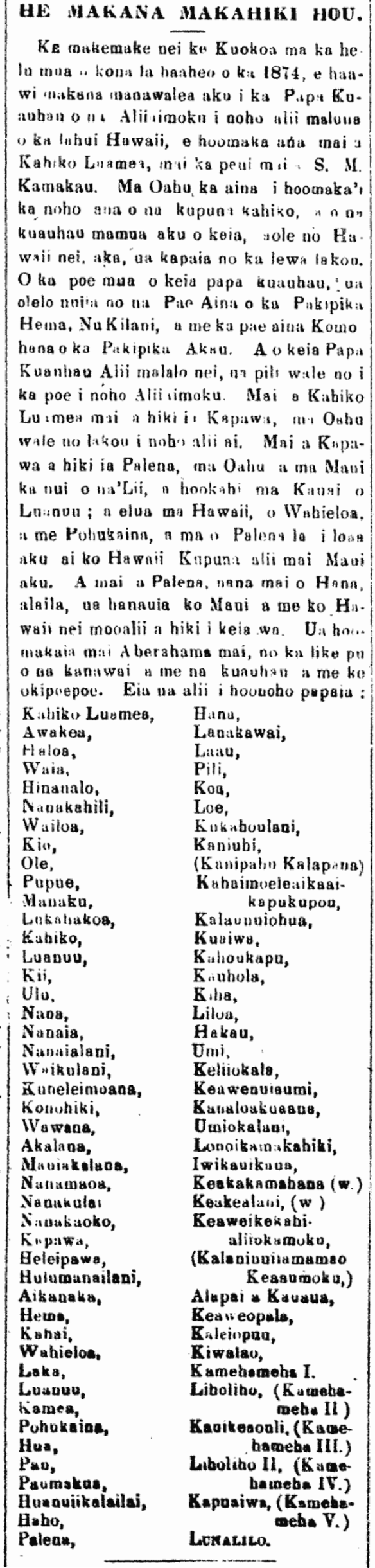
HE MAKANA MAKAHIKI HOU.

Ka Nupepa Kuokoa, Buke XIII, Helu 1, Aoao 2. Ianuari 3, 1874.

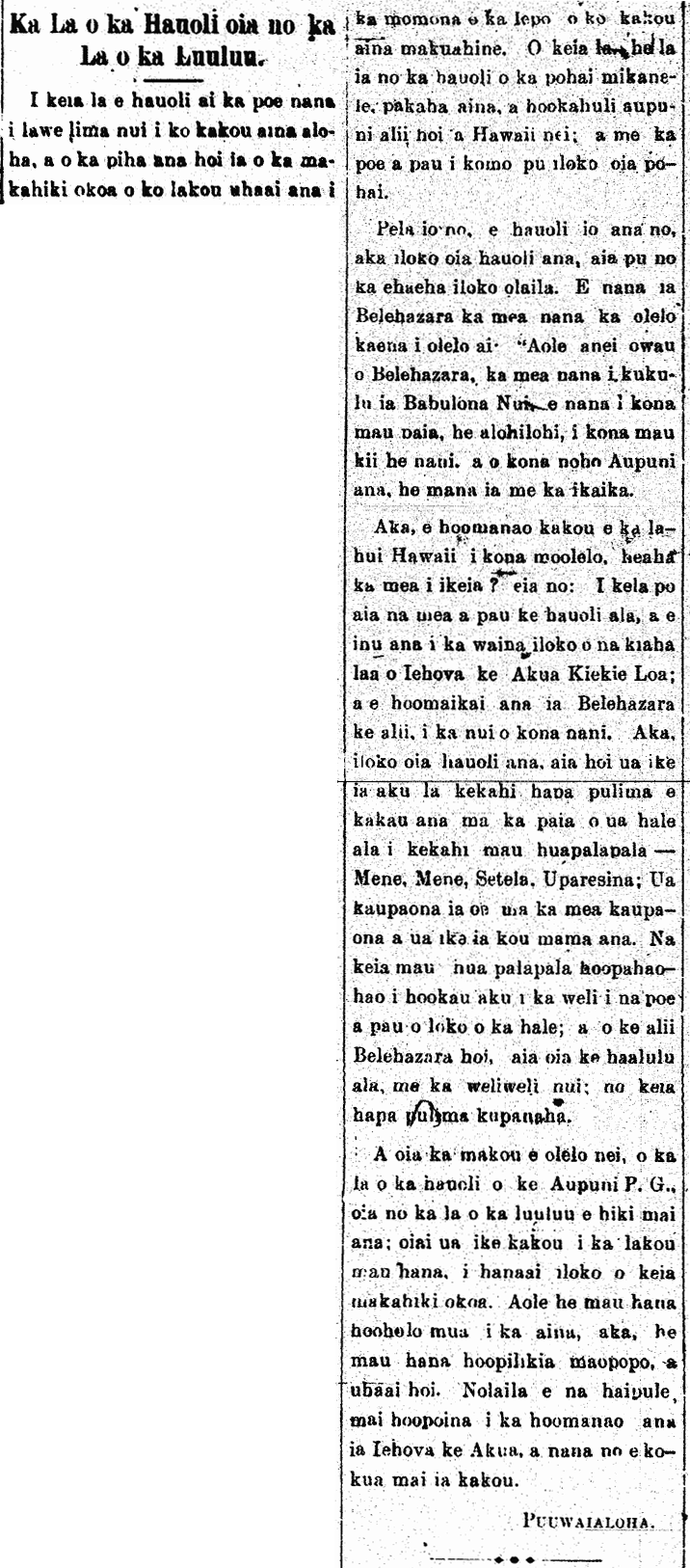
Writing on the wall, 1894.

The Day of Happiness is a Day of Sadness.

On this day, those who took our beloved land by force rejoice, and it makes a full years since they’ve feasted wastefully of the fertile soil of our mother land. This day is one of happiness for the circle of missionaries, plunderers of land, and overthrowers of the Hawaiian Kingdom, as well as for those who enter join their circle.

It is true, they will indeed rejoice; however, along with this joy, there is hurt within. Look at Belshazzar [Belehazara] the one whose boast went, “Am I not Belshazzar, the builder of the Great Babylon? Look at its shiny walls, its beautiful images, and its Throne has authority and might.”

However, let us recall, O Hawaiian Lahui, his story; what is known? it is this: That night, everyone was joyous, and drinking wine from cups sacred to Jehovah, Almighty God; and they praised Belshazzar for his great beauty. However, while the rejoicing was going on, there was seen part of a hand writing some words on the wall of the house—Mene, Mene, Setela, Uparesina; You have been weighed on the scales and have been found wanting. It was these astonishing words which caused a fear to fall over everyone in the house; and as for the king Beshazzar, he was shaking with trepidation at this amazing portion of a hand.

And that is what we are saying: the day of joy of the Government of the P. G. [Provisional Government], is the day that sadness will come; for we have seen their actions done over the past year. They were not actions done to move this land forward, but actions that were clearly harmful as well as squandering. Therefore O Pious Ones, do not forget to remember Jehovah, God, and he shall help us.

Puuwaialoha [“Loving-heart”]

(Leo o ka Lahui, 1/17/1894, p. 2)

Ka La o ka Hauoli oia no ka La o ka Luuluu.

Ka Leo o ka Lahui, Buke II, Helu 856, Aoao 2. Ianuari 17, 1894.

More on the landing of the Boston, 1893.

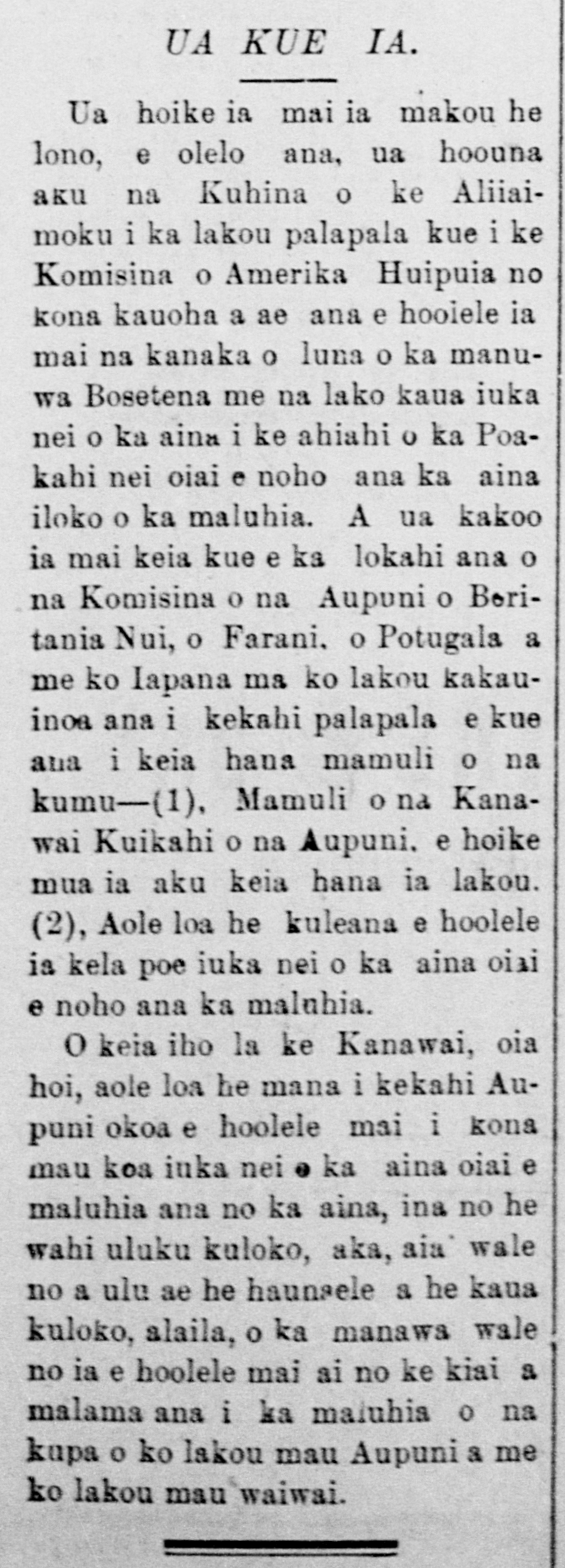
OPPOSED.

We have received news that the Ministers of the Queen sent their written protest to the Minister of the United States for his ordering the landing of the armed men from the man-of-war Boston on the evening of this Monday notwithstanding that there was peace on land. And this objection was jointly supported by the Commissioners of the Nations of Great Britain, France, Portugal, and Japan, by them signing a document opposing this action over these reasons—(1), Because of the agreement under law between the Nations to give prior notice. (2),  There was no cause to land the troops being that there was peace.

This is the Law, that being there is no other Nation that has any right to land its troops while there is peace; were there internal problems, but only if there was an uprising or a civil war, only then could there be troops landed to watch over and protect the safety of their citizens as well as their property.

(Hawaii Holomua, 1/18/1893, p. 3)

UA KUE IA.

Hawaii Holomua, Buke III, Helu 141, Aoao 3. Ianuari 18, 1893.

More on the Boston, 1893.

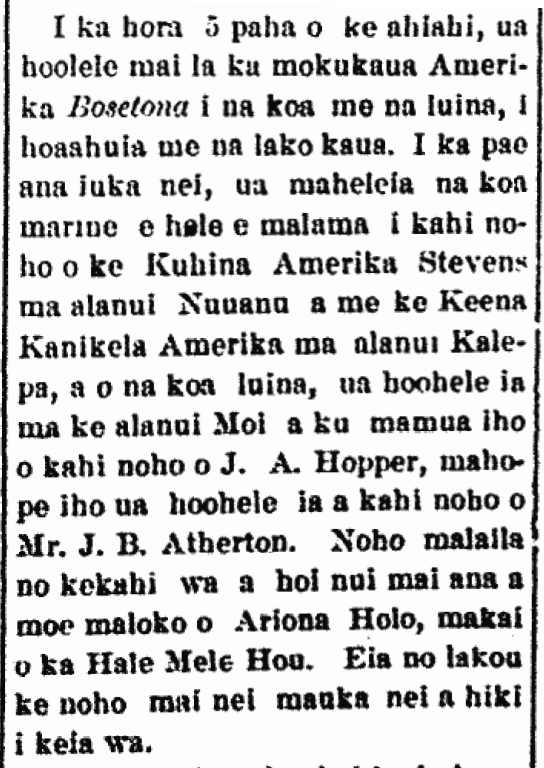
[Excerpt from the article: “OVERTHROW IN HAWAII NEI: The Queen Attempts to Push a New Constitution”]

At perhaps 5 oʻclock in the afternoon, the American warship Boston [Bosetona] landed its officers and sailors who were armed. When they came ashore, the marines were split up to go and guard the residence of the American Minister Stevens on Nuuanu Avenue, and the American Consulate on Merchant Street, and the sailors were sent to King Street and stood before the residence of J. A. Hopper, and later they were sent to the residence of Mr. J. B. Atherton. They stayed there for some time, and then all came back and slept in Arion Hall [Ariona Holo] makai of the Opera House. They are still on shore to the present.

(Kuokoa, 1/21/1893, p. 2)

I ka hora 5 paha o ke ahiahi...

Ka Nupepa Kuokoa, Buke XXXII, Helu 3, Aoao 2. Ianuari 21, 1893.

Coverage of the landing of the USS Boston, 1893.

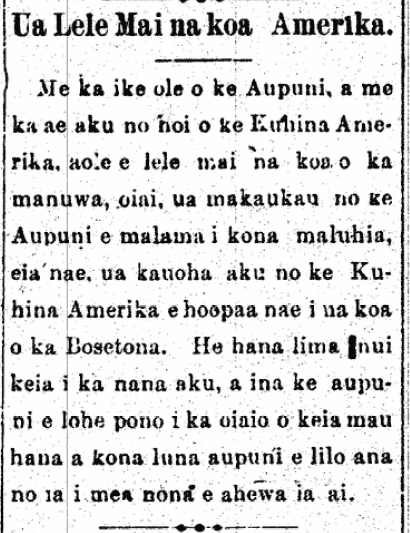
The American Troops Come Ashore.

Without knowledge of the Government, and regardless of the agreement of the American Minister that the soldiers from the warship would not come ashore, being that the Government was prepared to uphold the peace; the American Minister ordered the soldiers of the Boston to to take control. This is an apparent act of aggression, and if that nation learns of the truth of this act by its official, it will be grounds for him to be condemned.

[This article and the following are coverage of the landing of the U. S. S. Boston 120 years ago today by different newspapers. Just as we see today, back then there was different coverage depending on what you read.]

(Leo o ka Lahui, 1/17/1893, p. 2)

Ua Lele Mai na koa Amerika.

Ka Leo o ka Lahui, Buke II, Helu 624, Aoao 2. Ianuari 17, 1893.

Competing rallies, 1893.

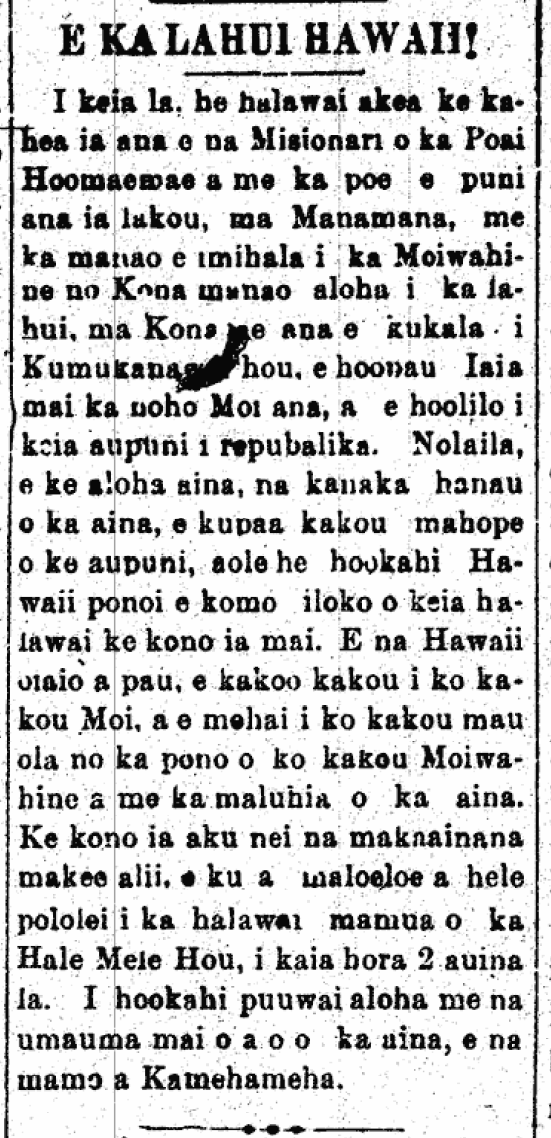
O HAWAIIAN LAHUI!

Today, there is a rally being called by the Missionaries of the Reformist Party [Poai Hoomaemae] and those who favor them, at Manamana, with the intent to bring harm to the Queen for Her aloha she has for the lahui, in Her proclaiming a new Constitution; by ending Her reign and making this nation a republic. Therefore, patriots, those born of this land, stand strong behind this nation; there shall not be a single true Hawaiian who will participate in this gathering, should they be invited. All of you true Hawaiians, let us stand behind our Sovereign and give our lives for the rights of our Queen and peace over the land. Those citizens who love their alii are called to join together to march straight to the rally fronting the Opera House [Hale Mele Hou] at 2 o’clock in the afternoon. With one heart of aloha and breasts side by side all across the land, you descendants of Kamehameha.

(Leo o ka Lahui, 1/16/1893, p. 2)

E KA LAHUI HAWAII!

Ka Leo o ka Lahui, Buke II, Helu 623, Aoao 2. Ianuari 16, 1893.